translate English
 پارسی
English
Englishپارسی
English
Englishپارسی EnglishپارسیEnglishپارسی
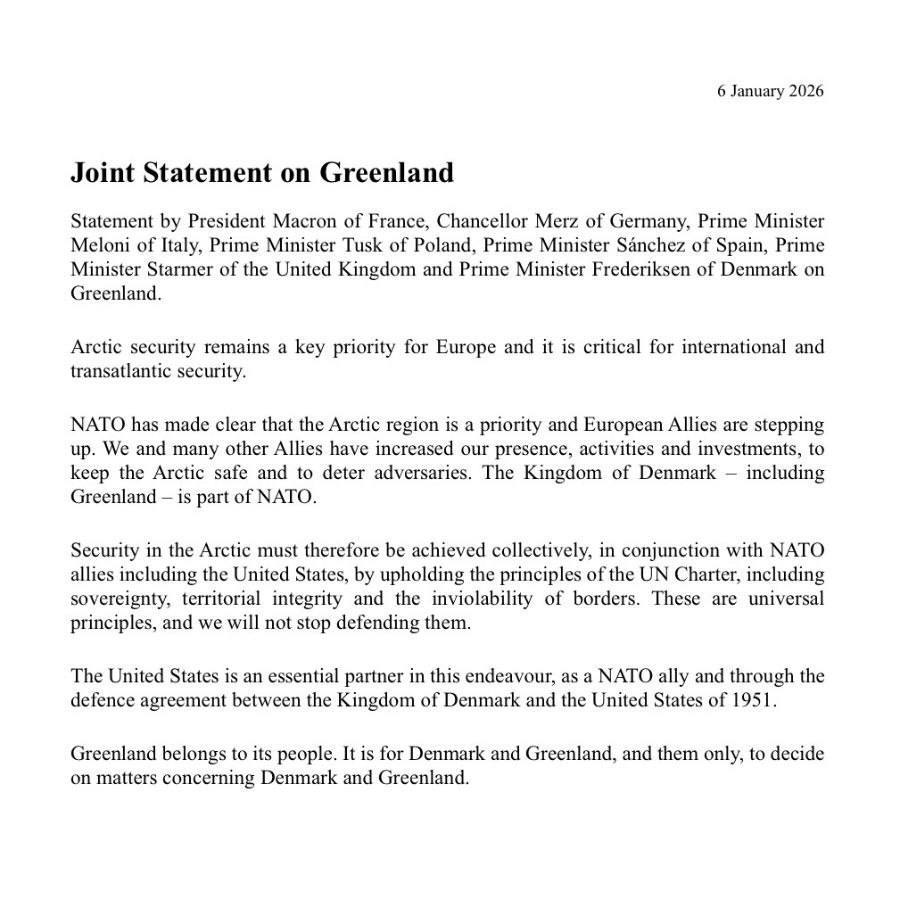
France’s Emmanuel Macron, the UK’s Keir Starmer, Italy’s Giorgia Meloni, and Poland’s Donald Tusk—alongside Denmark’s Mette Frederiksen and other European leaders—issued a joint statement reaffirming that Greenland “belongs to its people” and that decisions about its future rest with Greenland and Denmark alone. The statement also underscored that the Kingdom of Denmark (including Greenland) is part of NATO, framing Arctic security as a collective responsibility and rejecting any notion of coercion or aggression against allied territory.
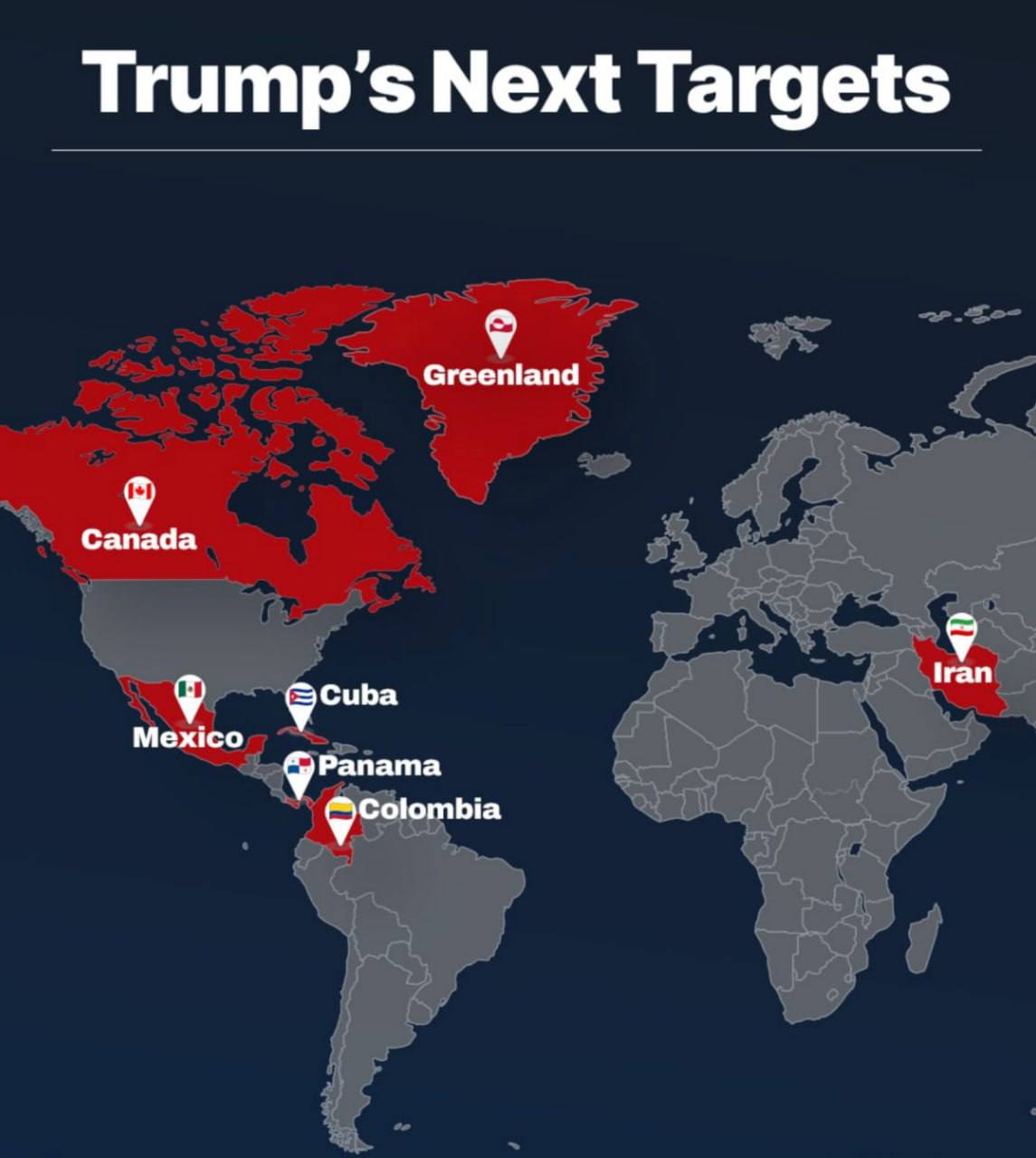
Clash Report circulated a graphic listing Greenland, Cuba, Iran, Mexico, Colombia, Panama, and Canada as potential “next targets,” amplifying online speculation in the wake of Washington’s recent Venezuela operation and a broader wave of commentary about further U.S. coercive actions. While the map reflects media/social speculation rather than any official U.S. announcement, the narrative itself can matter for markets by lifting geopolitical tail-risk premia—most directly around energy (Iran risk), regional trade and FX sensitivities (Mexico/Canada), and strategic transit/sovereignty headlines (Panama).
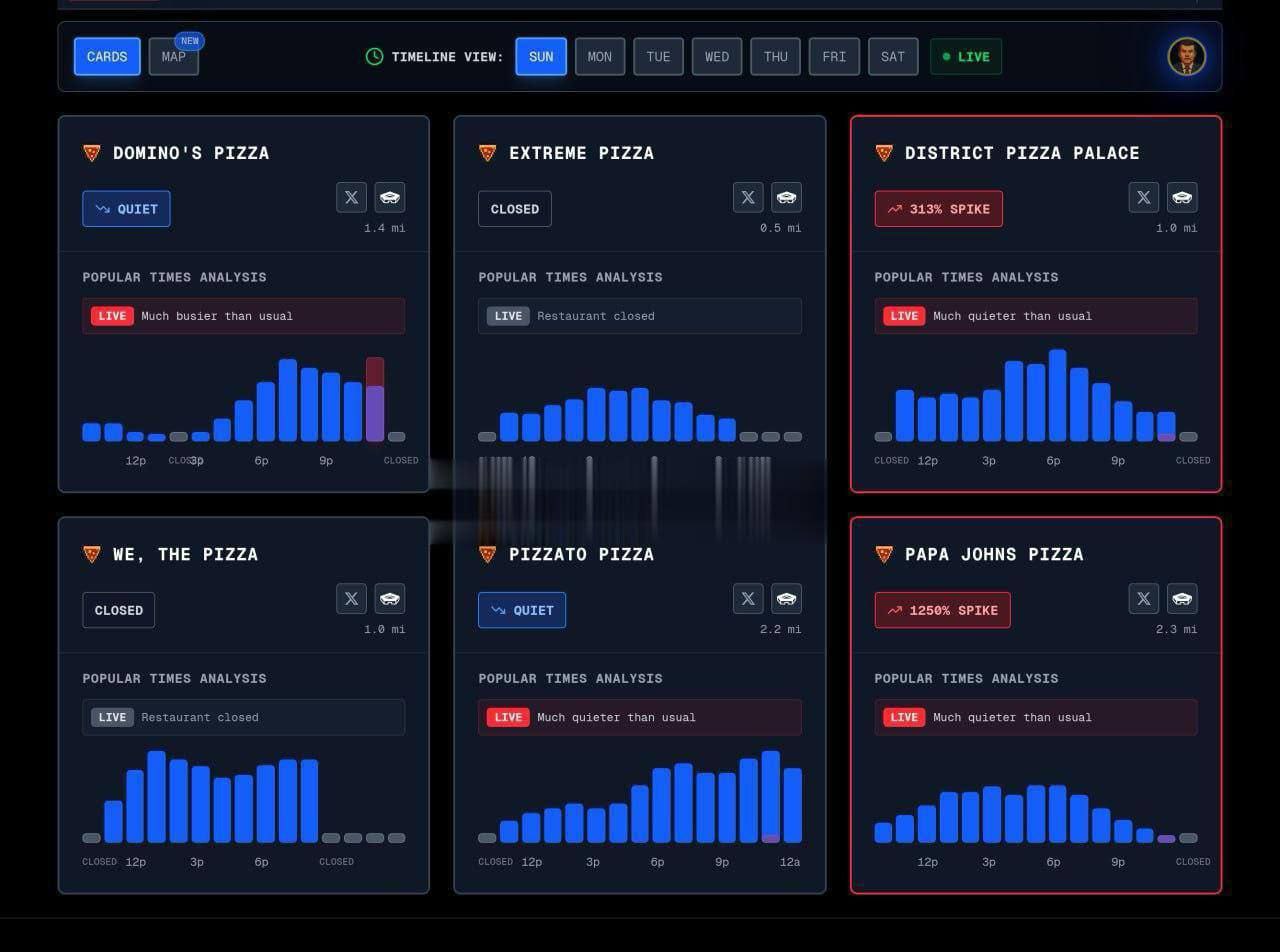
Social-media accounts tracking Google Maps “live busyness” near the Pentagon are claiming a sharp jump—sometimes framed as a 1,250% surge—at nearby pizza chains, with some posts comparing it to an alleged ~700% bump cited during the recent Venezuela operation narrative. The claim is not independently verified and the underlying metric is a proxy for foot-traffic/activity (not confirmed order volumes), making it highly vulnerable to noise, timing effects, and confirmation bias. The Pentagon has previously dismissed “pizza index” speculation as coincidental and noted there are plenty of internal food options, underscoring that the signal remains meme-adjacent rather than a reliable indicator of imminent action.
U.S. Secret Service officials said a 26-year-old suspect, William D. DeFoor, was detained after allegedly using a hammer to break windows and damage property at Vice President JD Vance’s Ohio residence, with the Vance family not home at the time; authorities cited roughly $28,000 in damage and said federal charges include damaging government property and resisting officers. Separately, tabloid coverage has emphasized DeFoor’s family background and claimed he has used the name “Julia” on social media; however, those personal details are not central to the official incident summary, and authorities have not publicly framed the case around gender identity or partisan affiliation.
Market impact: Limited direct market relevance, but adds to the broader U.S. political-security headline backdrop; the more actionable channel is risk sentiment if political violence concerns intensify or spill into policy escalation.

Syria’s finance minister, Mohammed Yusr Barnieh, said Damascus is preparing a compensation claim against Iran—arguing that if Iran (and Russia) present financial demands tied to the Assad era, Syria will seek “many times” those amounts for the killing and destruction inflicted during the war and for Tehran’s support of Bashar al-Assad’s rule. Persian-language outlets quoting Barnieh said the file is being compiled at the finance ministry and framed it as a determination to recover losses “without losing a single Syrian pound,” underscoring a sharper post-Assad line that could escalate into a prolonged legal-and-diplomatic fight, even as analysts note Iran’s Syria exposure has been widely estimated in the tens of billions of dollars and any enforcement pathway would be complex.
U.S. Secretary of State Marco Rubio pushed back on criticism from Kamala Harris and other Democrats over the operation that captured Nicolás Maduro, arguing it is a “double standard” given the U.S. had already treated Maduro as a top law-enforcement target under prior policy. Rubio pointed to the U.S. government’s reward program for information leading to Maduro’s arrest—first announced alongside the 2020 narco-terrorism case and later raised to $25 million in January 2025 (from $15 million)—as evidence that Washington’s posture predates the current administration’s action.
Venezuela’s acting president Delcy Rodríguez said her government wants to move toward “balanced and respectful” relations with the United States and invited Washington to take part in shaping a bilateral “agenda of cooperation” focused on shared development and grounded in international law. The overture, delivered via a social-media statement after the U.S. capture of Nicolás Maduro, signals a de-escalatory pivot aimed at opening a negotiating track while emphasizing sovereignty and non-interference—language that will likely be tested against the Trump administration’s next demands and conditions for engagement.
U.S. authorities are investigating an overnight incident at Vice President JD Vance’s residence in Cincinnati, Ohio. Local reporting says the Secret Service called for police response around midnight after spotting a person fleeing, with multiple windows found damaged; Vance was not at the home at the time and no injuries have been reported. Cincinnati police say one suspect is in custody, while officials have not disclosed a motive—an episode likely to intensify the security posture around senior U.S. officials and inject fresh political tension into an already charged domestic backdrop.
U.S. President Donald Trump said on Sunday that a military operation focused on Colombia’s government “sounds good to me,” accusing Colombian President Gustavo Petro of facilitating cocaine production and trafficking to the United States and suggesting Petro “won’t be doing it very long.” Separately, Trump warned Iran would be “hit very hard” by the U.S. if authorities began killing protesters, as demonstrations have spread in recent days amid economic pressures and reported fatalities.
Market impact: Risk-off at the margin—likely supportive for USD and safe havens (gold, Treasuries) while increasing volatility risk in LatAm FX (especially Colombia-linked exposure) and Middle East risk pricing if rhetoric shifts toward concrete measures.
U.S. President Donald Trump said on Sunday, January 4, 2026 that a U.S. military operation focused on Colombia’s government “sounds good” to him, escalating rhetoric toward Bogotá after the U.S. raid that captured Venezuela’s Nicolás Maduro. The comments, made aboard Air Force One and directed at Colombia’s leadership (including President Gustavo Petro), raise near-term geopolitical and policy-risk premia across Latin America, with markets watching for any shift from rhetoric to concrete sanctions, security actions, or aid cutbacks.
Market impact: Risk-off at the margin—potentially supportive for USD versus LatAm FX and a modest tailwind for safe havens if escalation risk builds; Colombia- and region-exposed assets may see higher volatility until policy follow-through becomes clearer.
In a phone interview with The Atlantic, U.S. President Donald Trump warned Venezuelan leader Delcy Rodríguez that refusing to cooperate with Washington would carry severe consequences—potentially “bigger than Maduro,” referring to Nicolás Maduro’s reported detention in New York following the U.S. operation in Caracas. The rhetoric reinforces an escalation path around Venezuela’s political transition and raises the temperature for sanctions and oil-flow uncertainty in the near term.
Open-source flight-tracking accounts and defense watchers reported an unusual uptick in U.S. Air Force C-17 transport movements staging through RAF Fairford in the UK, with some onward flights observed toward the Middle East. The reports surfaced as Israeli Prime Minister Benjamin Netanyahu’s cabinet publicly referenced discussions on Iran amid heightened regional tensions. The airlift activity could reflect routine contingency logistics or posture signaling rather than a confirmed operational trigger, but it adds to an already elevated geopolitical risk narrative; no official mission details have been confirmed.