 English
 پارسی


A Review of the Global Economy in March 2026
Slower Growth, Sticky Inflation, and Rising Energy Risk
The global economy remained in expansion during March 2026, but the quality of that expansion worsened as the month progressed. Growth did not collapse, and the world economy did not move into synchronized recession. But by month-end, the macro backdrop had clearly become more uneven, more energy-sensitive, and more vulnerable to policy and market shocks. The dominant shift was away from the earlier theme of slow expansion with easing inflation and toward a more difficult environment defined by higher oil prices, a firmer U.S. dollar, tighter financial conditions, and rising geopolitical uncertainty.
U.S. Economic Outlook for April 2026: Cooling Growth, Easing Inflation, and a Fed Still on Hold
The main growth story in March was resilience without comfort. The United States still showed enough strength to avoid a sharp downturn, but the mix became less favorable as momentum slowed and the disinflation story became less convincing. Europe remained soft, with parts of the euro area, especially the industrial core, looking close to stagnation. China delivered better hard data and stronger trade performance, but its recovery still appeared dependent on exports, liquidity support, and policy direction rather than a broad domestic revival. Japan continued to expand, though the domestic-demand engine still looked incomplete. Across emerging markets, March was less about synchronized improvement and more about divergence, as stronger economies held up while weaker importers and countries with fragile external balances came under more pressure.
Inflation and Central Banks
Inflation was no longer in panic territory, but it remained sticky enough to limit central-bank flexibility. The most important inflation development in March was the return of energy as a major macro force. Higher oil and fuel costs reintroduced upside inflation risks across both advanced and emerging economies. This made the final stage of disinflation more difficult and forced policymakers to remain cautious even where growth was slowing. In the United States, core inflation and underlying cost pressures remained persistent. In Europe, inflation was not out of control, but it became less comfortable just as growth weakened. China saw somewhat better inflation dynamics, helping it move away from earlier disinflationary weakness. Japan’s underlying inflation also remained firmer than headline readings alone suggested. In emerging markets, inflation outcomes became more uneven, with some countries still disinflating while others faced renewed pressure from weaker currencies and higher import costs.
UK Economic Outlook April 2026: BoE, Inflation, Growth, Gilt Yields, Sterling
That inflation backdrop shaped the central-bank story. March did not necessarily make central banks uniformly more hawkish, but it made them much more defensive. The Federal Reserve remained cautious because the U.S. economy was slowing without breaking, while inflation risks were still alive. The European Central Bank faced a similar problem: weak confidence and slow growth on one side, but not enough inflation relief to justify an easy dovish turn on the other. The Bank of England stayed restrictive, and the Bank of Japan continued to lean toward gradual normalization while facing a tougher trade-off as higher energy costs interacted with uneven domestic demand. In emerging markets, policy became even more differentiated. Some central banks still had room to ease, but others had to return to caution because of oil, FX pressure, or limited reserve protection.
Labor markets
Labor markets continued to support the global economy, but their strength looked less clean than before. The United States saw one of the more notable signs of cooling, with weaker payroll momentum and a modest increase in unemployment, even though broader labor indicators did not point to outright breakdown. Europe’s labor market remained relatively resilient and helped cushion softer growth. Japan’s labor conditions stayed tight by historical standards, though marginally less so. In many emerging economies, labor conditions were still stable in headline terms, but the key question became whether domestic resilience could survive tightening financial conditions and renewed external pressure. In short, labor markets were still preventing a deeper slowdown, but they were no longer strong enough to fully offset softer growth.
The sectoral picture
The sector picture also remained uneven. Manufacturing was still one of the weakest parts of the global economy. Europe’s industrial side remained fragile, Germany stayed soft, and the UK also disappointed. U.S. manufacturing held up better than feared but did not signal a strong acceleration. China’s industrial performance improved and stood out as one of the stronger factory stories globally, though it was still tied closely to policy and export demand. Japan also saw better industrial support, but not enough to make the overall economy look fully self-sustaining. By contrast, services remained the main stabilizer in many economies, especially in the United States and India. Still, even services looked less convincing by the end of the month, particularly in Europe, where service-sector momentum softened just as industry remained weak.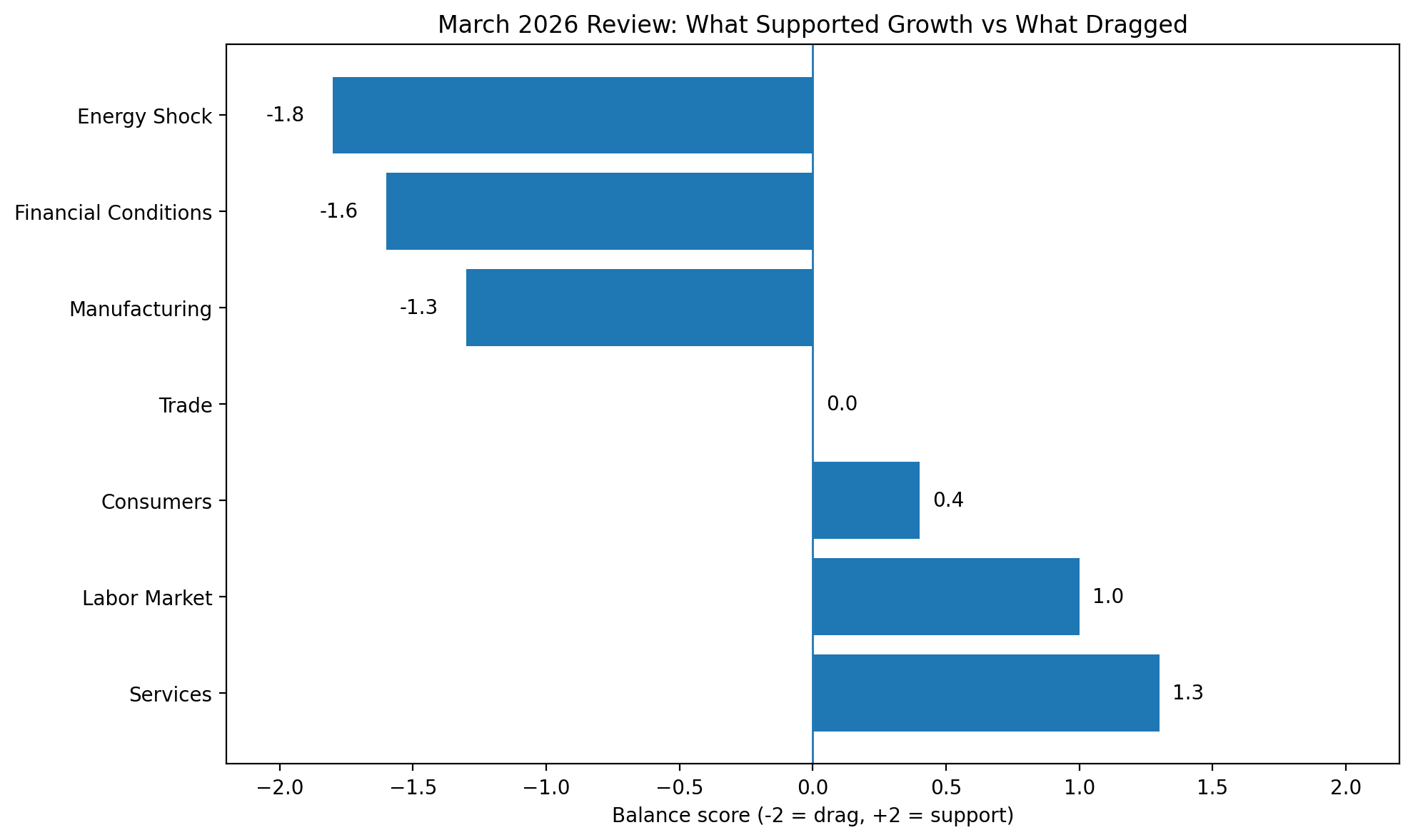
Consumers also remained active, but with far less conviction. U.S. household spending did not collapse, but confidence weakened as inflation concerns remained alive. Europe’s consumers stayed cautious, especially where higher energy costs threatened real incomes. China’s consumer side improved somewhat, but still did not look strong enough to anchor a fully self-sustaining recovery. Japan’s household sector remained fragile despite improved wage trends. Across emerging markets, consumption held up better in countries such as India and Brazil, but remained more vulnerable in fragile import-dependent economies such as Turkey.
Euro Area Economic Outlook April 2026: ECB, Inflation, GDP, Energy Risk, Euro
March also brought a clear tightening in global financial conditions. A stronger U.S. dollar, firmer inflation expectations, reduced confidence in near-term rate cuts, and higher oil prices pushed yields and risk premiums higher. Equities became more volatile, and even traditional havens behaved unevenly. Energy was the main transmission channel. Oil no longer looked like just one variable among many; it became the variable reshaping inflation expectations, central-bank behavior, household purchasing power, and external balances. Countries with stronger current accounts, better reserves, or commodity support looked more resilient, while fragile oil importers faced much sharper pressure.
March Summary
The bottom line is that March 2026 was not a month of global collapse, but it was a month of lost comfort. The world economy kept expanding, yet growth slowed in key regions, inflation remained sticky, central banks lost flexibility, and financial conditions tightened through market repricing. The result was a fragile low-speed expansion increasingly exposed to energy shocks, FX pressure, and geopolitical risk. Rather than a synchronized recession, March produced a stagflation-lite global environment marked by slower growth, stubborn inflation, and a much smaller margin for policy error.
Global Economic Outlook for April 2026:
Slower Growth, Cautious Central Banks, and Elevated Energy Risk
The global economy enters April 2026 in a slower but still expanding phase. The main message is not recession, but moderation. Growth is expected to soften modestly through 2026, while inflation continues to ease in many economies, though not smoothly enough for central banks to relax fully. Energy remains the key source of uncertainty, especially with oil prices elevated and geopolitical risk still feeding into inflation expectations, financial conditions, and market pricing. In that environment, policymakers are moving carefully, and investors are watching incoming inflation, labor-market, and growth data more closely than ever.
April economic calendar
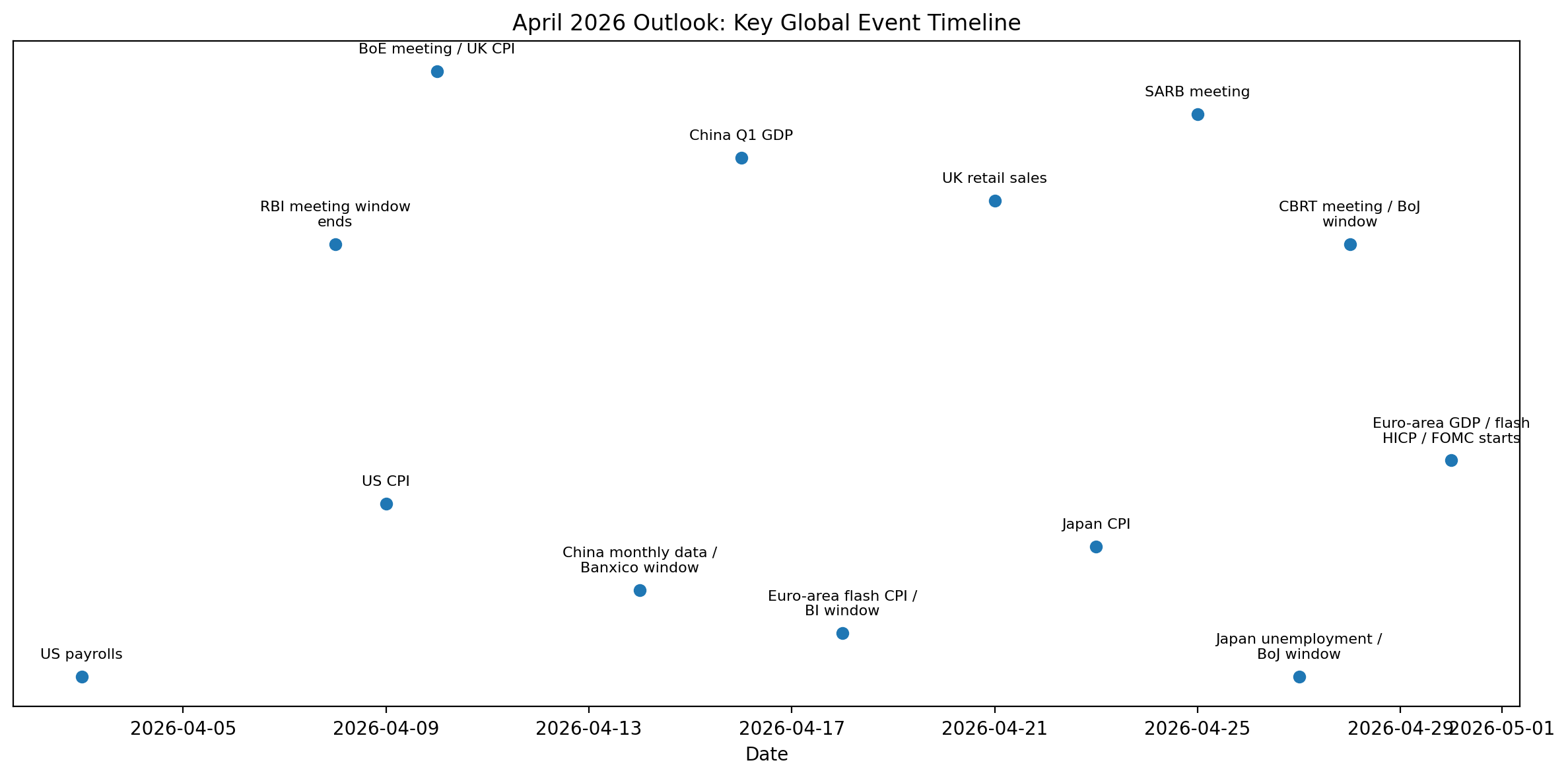
April’s global calendar is heavy with market-moving events. In the United States, the main focus is on the March payrolls report and CPI, followed by the April 30–May 1 FOMC meeting, where rates are expected to remain unchanged near 5.1%. In the euro area, attention is centered on flash inflation data and first-quarter GDP, while the UK faces a Bank of England meeting alongside CPI and retail sales releases. China’s monthly activity data and first-quarter GDP will be central to judging whether growth is stabilizing near the 5% area. Japan’s April story is dominated by the Bank of Japan meeting, CPI, and unemployment data. Across emerging markets, several major central banks are also on the calendar, including India, Mexico, Indonesia, South Africa, and Turkey.
Banks and Bonds
Market pricing reflects this cautious backdrop. Investors broadly assume that the Federal Reserve is on hold, with only limited odds of another hike and a modest possibility of cuts later in 2026. The European Central Bank is currently in a relatively balanced position with inflation, and unless the energy shock pushes inflation sharply higher, no near-term change in interest rates is expected. In the United Kingdom, the prevailing assumption is that inflation will continue to play the central role in policymaking, and the Bank of England is likely to maintain its current policy stance for some time until it gains confidence that inflation is genuinely declining. U.S. 10-year Treasury yields are around 4.43%, Germany’s 10-year yield is մոտ 3.1%, the UK’s is close to 5%, and Japan’s stands at around 2.4%, with these increases largely reflecting the rise in Middle East risk premia. In the foreign exchange market, the U.S. dollar remains relatively firm, and the major currency pairs are highly sensitive above all to inflation data and policy signals. At the same time, commodity markets continue to reflect geopolitical risk in prices. WTI crude remains above $90, copper is still at elevated levels, wheat remains expensive, and gold and silver, despite their pullback in recent weeks, are still holding in a relatively strong range.
Macroeconomy
The broader forecast picture is one of moderate growth and incomplete disinflation. The 2026 global GDP is close to 3.0%, broadly in line with major institutional and private-sector estimates. IMF and OECD projections differ somewhat, but both imply slower and less comfortable expansion than markets had hoped for earlier. Inflation is expected to move lower over time, but still remain elevated enough to complicate monetary policy, especially where energy prices feed directly into headline inflation and indirectly into services and wages. This means the world economy is not heading into a collapse scenario in the base case, but neither is it returning quickly to a low-inflation, easy-money environment.
Japan Economic Outlook April 2026: BoJ Tightening, Weak Yen, and Growth Risks
The underlying data picture supports that view. Global PMIs point to modest expansion overall, but manufacturing remains weak while services continue to do most of the work. The U.S. still looks more resilient than many peers, supported by consumption and labor-market strength, though growth has decelerated. Europe remains softer, with weaker consumption and a more fragile industrial backdrop. China is improving, but still with mixed signals: consumer demand is recovering, but inflation remains subdued, and PMIs remain close to the line between expansion and contraction. Japan continues to normalize gradually, while many emerging markets remain split between relatively resilient domestic stories and renewed vulnerability to oil, dollar strength, and external financing conditions.
Inflation and Geopolitical Tensions
Inflation remains the central policy constraint. U.S. core CPI is still elevated, euro-area core inflation remains above target, UK core inflation is also sticky, and even where headline inflation is easing, service inflation remains difficult to bring down. China stands apart with producer-price deflation, while Japan remains closer to moderate inflation. Energy is the main macro transmission channel. Higher oil prices raise headline CPI directly, reduce household purchasing power, and make central banks less willing to signal near-term cuts. In other words, even if inflation is no longer accelerating across the board, it is not falling cleanly enough to restore policy flexibility.
If elevated energy tensions continue over the coming weeks, the transmission into the broader economy will likely follow a familiar path. Higher fuel and energy costs first reduce household disposable income, leaving consumers with less room for non-essential spending. As a result, discretionary demand usually weakens first, especially in areas such as retail, travel, and durable goods. If the shock persists, the impact can then spread more broadly across the economy, leading to a slowdown in services activity, greater caution in hiring, softer overall consumption, and ultimately weaker GDP growth. At the moment, strong labor markets, particularly in the United States, are helping to delay this adjustment, but they are not removing the risk entirely. For traders and investors, today’s economic data and geopolitical headlines will be especially important in showing whether the shock is being absorbed through margin pressure or whether it is beginning to pass through into genuine demand destruction.
That is why the policy outlook is cautious rather than dovish. The Fed is paused, but not confidently shifting toward cuts. The ECB and BoE are also in hold mode, waiting for clearer evidence that inflation is durably under control. The BoJ remains on a gradual normalization path, while the PBoC is steady amid moderate growth and low inflation pressure. Emerging-market central banks are more mixed: some can hold or ease modestly, while others must remain defensive because of currency weakness, inflation, or fiscal fragility. Balance-sheet policy also matters, with the Fed and ECB quantitative tightening still helping keep liquidity conditions tighter than in previous years.
The scenario framework is straightforward. The base case, with 60% probability, is for roughly 3% global growth, easing inflation, steady-to-slightly easier policy later in 2026, and range-bound markets. The upside case assumes stronger growth, faster disinflation, earlier rate cuts, and a stronger performance from equities and emerging markets. The downside case centers on a new shock, such as a deep China slowdown or a Middle East escalation that pushes oil toward $120, leading to weaker growth, higher inflation, and deeper market stress. There is also a tail-risk scenario involving a financial accident or liquidity squeeze severe enough to produce recession and disorderly repricing.
China Economic Outlook April 2026: Growth Holds, But Demand Stays Weak
For markets, the practical implication is a world still dominated by inflation surprises, energy risk, and policy timing. If inflation behaves, yields could stabilize, and risk assets could hold up, especially in high-quality equities. If inflation re-accelerates, bond yields could rise further, and dollar strength could pressure emerging markets and cyclicals. Credit remains manageable for now, but vulnerable issuers—especially in emerging markets with external imbalances—would face the most stress in a risk-off environment. The outlook for April, therefore, is not one of crisis by default, but one of narrow margins, elevated sensitivity, and a global economy still expanding under pressure.
Q&A
What was the biggest global macro shift in March 2026?
The biggest shift was the move from a relatively comfortable, slow-growth, disinflation environment to a more fragile macro setting shaped by higher oil prices, stronger dollar conditions, and rising geopolitical risk.
Was the global economy in recession in March 2026?
No. The global economy was still expanding, but growth became slower, less balanced, and more vulnerable to inflation and financial shocks.
Why did oil matter so much in March?
Oil acted as the main transmission channel across the global economy. It affected inflation expectations, consumer spending power, trade balances, central-bank decisions, and financial conditions all at once.
Which regions looked strongest and weakest?
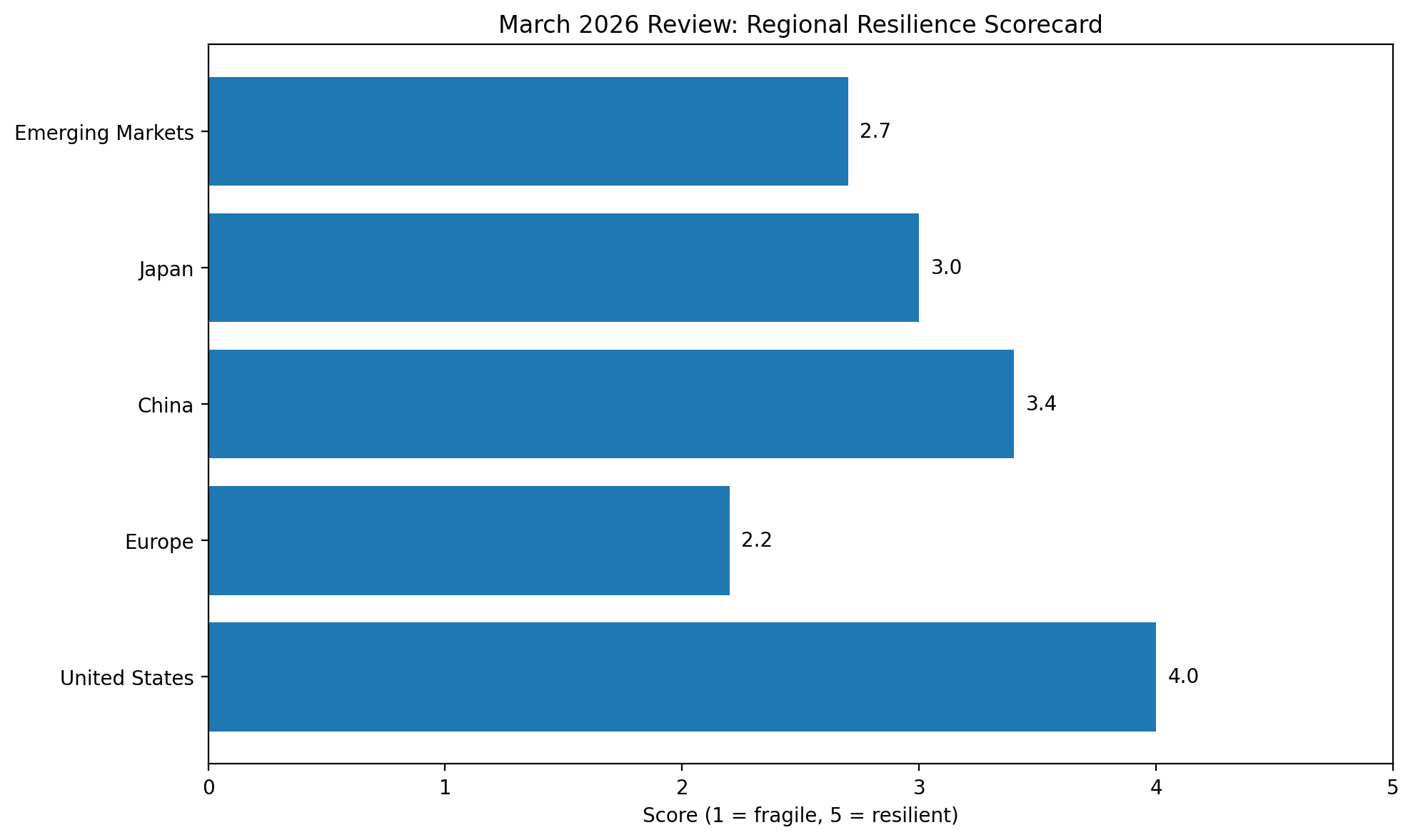
The United States remained relatively resilient, China improved but stayed policy-dependent, and India and Brazil showed relative resilience within emerging markets. Europe looked soft, and fragile oil-importing emerging markets remained under greater pressure.
What is the main takeaway for markets?
The main takeaway is that March 2026 increased the risk of a stagflation-lite environment: slower growth, stubborn inflation, tighter financial conditions, and greater sensitivity to geopolitical headlines.
What is the main global economic theme for April 2026?
The main theme is slower but still positive growth, with central banks staying cautious because inflation is easing only gradually and energy risk remains significant.
Are major central banks expected to hike again soon?
Markets largely expect the Fed, ECB, and BoE to stay on hold in the near term, though inflation surprises could still delay cuts or revive tightening concerns.
Why does oil matter so much in this outlook?
Because higher oil affects inflation, consumer spending, central-bank decisions, and broader market sentiment all at once.
What is the base-case outlook for global growth in 2026?
The base case is around 3.0% global GDP growth, with inflation easing gradually and policy rates staying restrictive before modest cuts later in the year.
What is the main downside risk?
A fresh shock—especially a deeper China slump or a Middle East event that sharply lifts oil prices—could push the world toward weaker growth, higher inflation, and tighter financial conditions.
Comments