
 English
 پارسی


Persistent Inflation, Uneven Growth, and a Changing Global Energy Market
Executive Summary
The global economy concluded the week of November 9–13, 2026, with growing evidence of persistent inflationary pressures, increasingly divergent economic growth, and a significant shift in global energy-market conditions. The latest releases from the United States, Europe, China, Japan, and emerging economies suggest that economic expansion remains resilient in certain regions, while others face weakening domestic demand, elevated financing costs, and structural imbalances.
The United States remained at the center of financial-market attention as October consumer and producer inflation reinforced concerns that price pressures could remain above the Federal Reserve's target. Although monthly inflation moderated compared with September, both the composition of consumer prices and elevated annual producer inflation complicated the monetary-policy outlook. Investors consequently reassessed expectations for additional interest-rate increases, contributing to rising Treasury yields and pressure on precious metals.
Europe presented a more fragmented economic picture. The United Kingdom delivered stronger-than-expected GDP and industrial-production figures, suggesting greater economic resilience. The eurozone continued expanding but at a slower quarterly pace, while employment stagnated and higher energy-import costs contributed to a deterioration in its external trade position. Inflation remained an important concern in France, Spain, and Germany.
In Asia, China's economy demonstrated a striking divergence between strong external trade and weak domestic credit demand. Exports continued expanding rapidly, supported by technology and semiconductor-related demand, but new bank lending contracted. Japan faced a different challenge: producer inflation accelerated considerably, while household consumption remained weak, presenting a difficult policy environment for the Bank of Japan.
Meanwhile, global energy markets began transitioning from fears of acute crude shortages toward the possibility of renewed oversupply. The International Energy Agency reported recovering production and projected declining global oil demand for 2026. Nevertheless, low onshore inventories, geopolitical tensions, and continued disruptions in refined petroleum products kept the market vulnerable to further volatility.
The central conclusion of the week is that the global economy is neither experiencing a synchronized recession nor a synchronized recovery. Instead, growth is becoming more geographically concentrated, inflation remains uneven, and monetary-policy divergence is increasing.
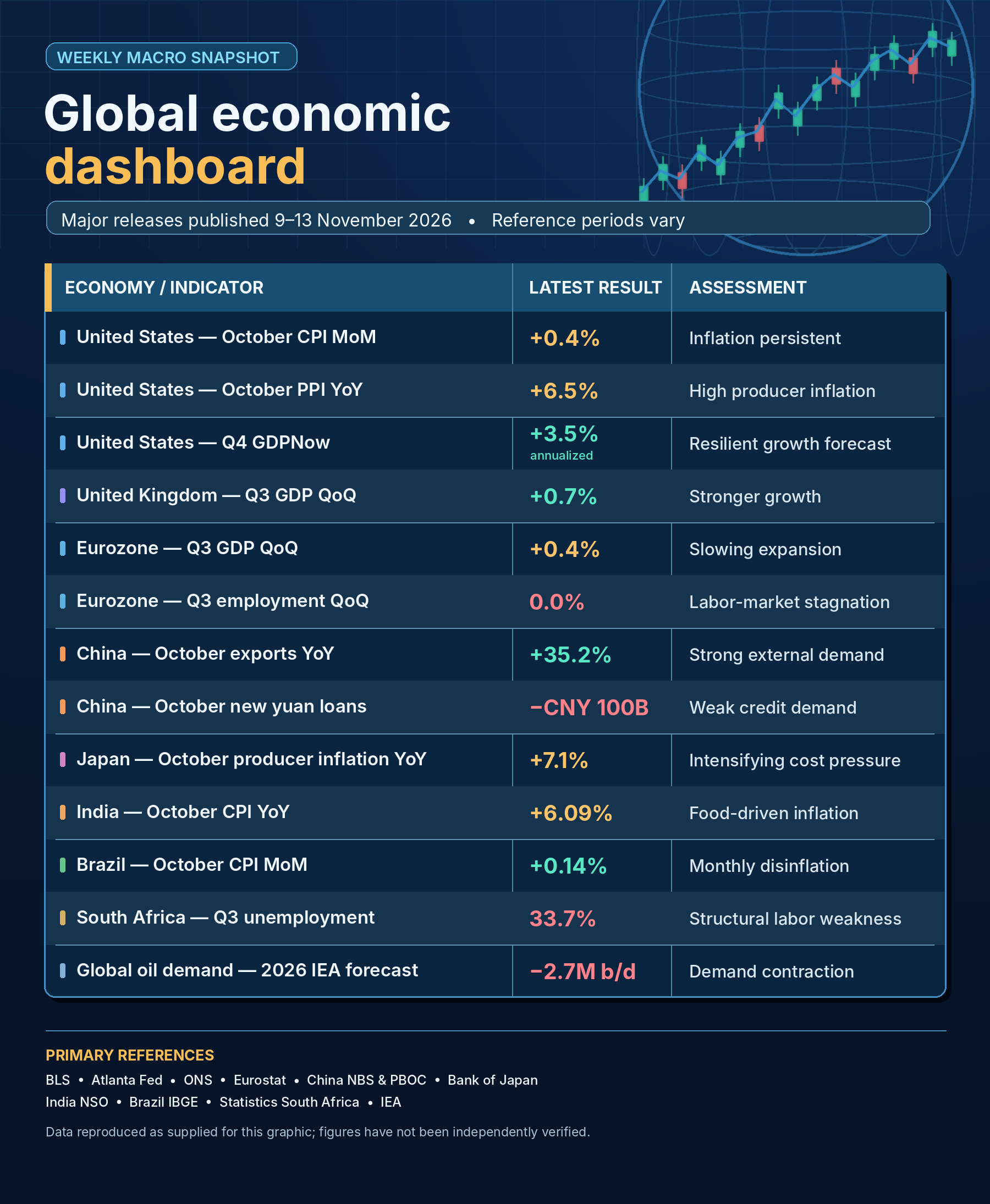
Global economic dashboard
1. United States: Economic resilience meets persistent inflation
Inflation strengthens the case for restrictive monetary policy
The United States delivered some of the week's most consequential economic releases, particularly October's consumer and producer inflation reports.
Consumer prices increased 0.4% month-on-month in October, following September's 0.6% increase and exceeding the 0.3% consensus forecast. Core CPI, excluding food and energy, increased 0.3% for the third consecutive month.
Several categories continued to experience upward pressure. Shelter costs increased by 0.3%, food prices rose by 0.5%, and energy prices advanced by 0.7%. Although the monthly headline slowed, price pressures remained broad enough to challenge expectations of a rapid return to inflation stability.
Producer inflation added another dimension. October PPI increased 0.3% month over month, down sharply from September's 1.4%, while annual producer inflation accelerated to 6.5%, its highest since November 2022. Core producer inflation remained elevated.
An important statistical limitation is that the Bureau of Labor Statistics could not publish standard October 2026 annual CPI changes for most series because the October 2025 observations were unavailable following the federal funding lapse. Therefore, monthly CPI and annual PPI should not be mistaken for directly comparable inflation measures.
2026 M10 Results+2
US inflation: monthly comparison
Seasonally adjusted month-on-month percentage changes from official BLS releases.
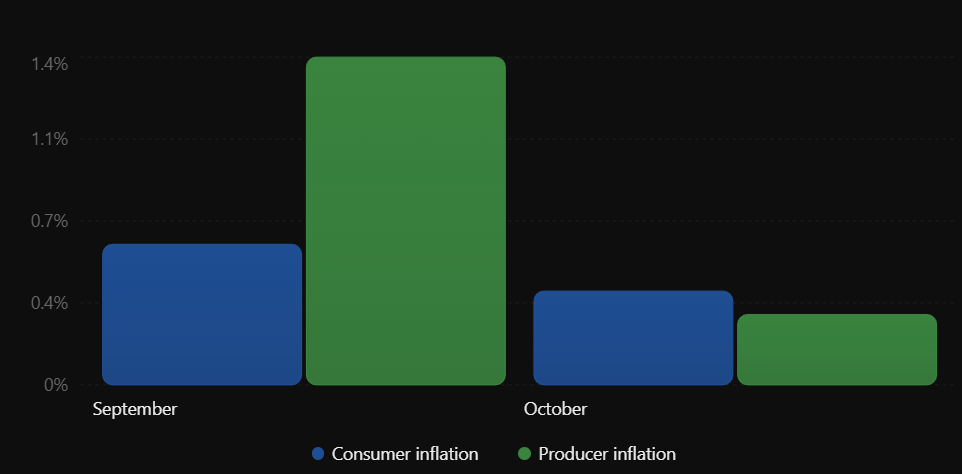
Both monthly measures moderated, but annual producer inflation remained unusually high.
The implications for monetary policy are considerable. Economists surveyed by Reuters during November 6–10 expected the Federal Reserve to raise its policy rate by another 25 basis points in December, potentially reaching a target range of 4.00%–4.25%. The risk of additional tightening remained important because of persistent inflation and resilient economic activity.
Reuters
Growth remains resilient, but housing is weakening
The Atlanta Fed's GDPNow model estimated 3.5% annualized growth for Q4 2026, compared with 3.4% previously. The upward revision reflected a slightly stronger private-investment forecast, suggesting that business activity remained resilient. GDPNow is a real-time model projection rather than an official growth result.
However, the housing sector sent a weaker signal. Existing-home sales fell 5.5% in October to an annualized rate of 3.75 million units. Mortgage applications improved as borrowing rates declined, but the broader housing market continued to face affordability constraints.
Labor indicators remained comparatively stable. Initial unemployment claims increased to 200,000, while continuing claims declined to approximately 1.697 million. The combination suggested limited deterioration in labor conditions rather than a sharp employment contraction.
The federal budget also remained a major challenge. October's deficit reached approximately $404 billion, considerably above expectations, highlighting substantial government financing requirements.
Taken together, these results describe an economy in which growth remains positive but restrictive financing conditions continue to affect interest-rate-sensitive activity.
US economic assessment: Growth is resilient, but inflation risks remain elevated. The most significant macroeconomic threat is that interest rates may have to stay higher for longer—or increase further—even as housing and selected consumer sectors weaken.
2. Europe: Stronger UK growth contrasts with eurozone stagnation
United Kingdom: Better output, but persistent domestic vulnerabilities
The United Kingdom emerged as one of the stronger-performing advanced economies in the week's economic reports.
Real GDP increased 0.7% quarter-on-quarter in Q3 2026, accelerating from 0.5% in Q2. Annual growth reached 1.9%, while September GDP increased 0.2% month-on-month, exceeding expectations for no growth.
The services sector was the principal growth driver, expanding 0.9% during the quarter. Manufacturing also delivered encouraging results: September output increased 0.7% monthly and 4.4% annually. Industrial production increased 0.3% monthly and 3.1% annually.
Nevertheless, the recovery was uneven. Construction output contracted 0.7% over Q3, business investment increased only 0.4%, and the merchandise trade deficit remained substantial. The Office for National Statistics reported a September goods deficit of £21.4 billion excluding precious metals, reflecting faster growth in imports than exports.
For the Bank of England, these developments create competing considerations. Stronger GDP and industrial activity reduce the immediate case for monetary easing, but weak construction and modest investment growth demonstrate the continuing effects of restrictive financial conditions.
UK economic assessment: The British economy appears more resilient than previously expected, supporting a cautiously constructive fundamental outlook for GBP. The sustainability of the recovery, however, depends on household spending, investment, and inflation.
Eurozone: Growth continues, employment stalls
The eurozone economy expanded 0.4% quarter-on-quarter in Q3 2026, slowing from 0.6% in Q2. Annual growth reached 1.3%, compared with 1.2% previously.
While the positive GDP result confirms that the currency bloc continued expanding, the employment data revealed weaker underlying momentum. Employment was unchanged quarter-on-quarter, following growth of just 0.1% in Q2. Annual employment growth slowed to 0.4%.
The broader European Union performed slightly better, with quarterly GDP growth of 0.5% and annual growth of 1.5%.
Trade provided another warning sign. The eurozone recorded a €10.3 billion external goods deficit in September, compared with a €13.5 billion surplus one year earlier. Imports increased 16.1% annually, substantially faster than the 6% increase in exports.
The deterioration was largely associated with energy. The energy-trade deficit widened from €20.7 billion to €33.0 billion, emphasizing Europe's continued sensitivity to imported fuel costs.
European inflation remains geographically uneven
Inflation added complexity to the eurozone outlook.
- Germany's annual CPI inflation slowed from 3.3% to 2.8% in October, but wholesale-price inflation remained elevated.
- France's annual CPI inflation accelerated from 3.1% to 3.4%, partly driven by energy prices, which rose 24.1% annually.
- Spain's annual CPI inflation remained at 4.9%, while core inflation was 3.1%.
Germany's relative inflation improvement contrasts with stronger price pressure in France and Spain. Such differences complicate monetary policy because the European Central Bank sets one policy rate for economies experiencing different inflation and growth conditions.
Eurozone economic assessment: The region remains in expansion, but growth is modest, labor-market momentum is weak, and energy costs are threatening both price stability and external competitiveness. This limits the potential for sustained euro appreciation based solely on economic fundamentals.
3. China: Strong exports conceal weak domestic credit demand
China delivered one of the most contradictory sets of economic indicators of the week.
Export growth remains exceptionally strong
Chinese exports increased 35.2% year-on-year in October, supported by strong global demand for technology, semiconductors, and AI-related equipment.
Imports increased even faster, rising 41.6%, helping reduce the monthly trade surplus to approximately $105.3 billion from $133.5 billion in September.
Nevertheless, China's cumulative merchandise trade surplus exceeded $1 trillion during January–October, demonstrating the considerable contribution of external demand to economic activity.
The technology sector was particularly important. High-tech shipments benefited from investment in AI infrastructure, data centers, semiconductor manufacturing, and computing equipment. However, this concentration also increases China's exposure to a potential slowdown in global technology capital expenditure.
Domestic credit remains weak
The domestic financial picture was substantially less encouraging.
New yuan-denominated bank lending contracted by CNY 100 billion in October, compared with CNY 1.08 trillion in new lending during September.
Total social financing increased by CNY 1.15 trillion, missing expectations, while annual M2 money-supply growth slowed to 7.1%. Outstanding bank loans increased just 4.7% year-on-year.
The data suggest that households and businesses remain cautious about borrowing, despite comparatively supportive financial conditions. Seasonal effects contribute to October's weakness, but they do not eliminate concerns about subdued credit demand.
Consumer inflation and industrial inflation are moving in different directions
China's CPI increased just 0.7% annually in October, down from 0.9% in September. Monthly consumer prices were unchanged.
In contrast, producer inflation accelerated to 5.7% annually, from 5.0%. Industrial input prices rose particularly sharply in mining and raw materials.
This creates a significant challenge for corporate profitability: manufacturers face higher input costs, but weak household demand may prevent them from fully passing those costs on to consumers.
China economic assessment: China's export-driven industrial economy remains powerful, but the domestic-demand recovery is incomplete. Strong technology exports cannot indefinitely substitute for weak household borrowing, consumption, and property-related activity. The divergence increases the importance of targeted domestic stimulus.
4. Japan: Rising production costs alongside weak household consumption
Japan's economic releases revealed increasing tension between inflation and domestic demand.
October producer inflation accelerated to 7.1% year-on-year, exceeding the 6.5% forecast. Producer prices also increased 0.7% monthly, reversing September's decline.
Higher energy, industrial-material, chemical, and transportation-related costs contributed to the increase.
However, household spending demonstrated considerably weaker demand. Real household expenditure declined 6.8% annually in September, while nominal spending fell 4.5%.
The combination suggests that higher prices continue to erode purchasing power even as wages and business activity show some resilience.
There were also positive developments. The Reuters Tankan manufacturing sentiment index rose from 22 to 27 in November, supported by semiconductor and electronics demand. Machine-tool orders remained substantially higher than a year earlier, although annual growth moderated.
This reinforces the distinction between internationally competitive Japanese manufacturers and domestic households experiencing significant cost-of-living pressure.
Implications for the Bank of Japan
Rising producer inflation strengthens arguments for a restrictive monetary-policy stance, but weak household consumption raises the risk that excessive tightening could undermine domestic economic activity.
At the same time, the yen remains highly sensitive to differences between Japanese and US government-bond yields.
Japan economic assessment: The outlook is mixed. Industrial exporters benefit from technology demand, but households remain under pressure. The yen may receive support from higher inflation expectations only if those expectations translate into a stronger Bank of Japan policy response relative to other central banks.
5. Emerging economies: Inflation, trade imbalances, and employment risks
India: Strong credit growth meets higher food inflation
India's October annual CPI inflation accelerated to 6.09%, compared with 5.54% in September.
Food inflation reached 8.94%, placing additional pressure on household purchasing power, especially in rural areas.
Meanwhile, India's merchandise trade deficit expanded to approximately $39.88 billion, despite strong exports. Higher imports increased external financing requirements.
Credit growth remained substantial, with the economic calendar indicating annual bank lending growth of approximately 19.5%.
Assessment: India's economic activity remains supported by credit expansion and domestic demand, but high food inflation and a widening trade deficit are increasing the difficulty of maintaining both price stability and external balance.
Brazil: Monthly inflation cools, but monetary constraints remain
Brazilian consumer inflation slowed to 0.14% month-on-month in October, compared with 0.82% in September.
However, annual inflation increased slightly to 4.63%, remaining above the upper boundary of Brazil's 1.5%–4.5% inflation tolerance range.
Lower electricity and transportation costs helped moderate monthly price increases, while food prices remained under pressure.
Retail sales increased 1.7% annually in September, suggesting some resilience in consumption.
Assessment: Brazil is experiencing partial disinflation rather than an unambiguous return to price stability. The central bank faces continued pressure to balance growth with inflation expectations and fiscal risks.
Mexico: Inflation and industrial weakness complicate the outlook
Mexico's annual CPI inflation accelerated to 3.75% in October, while core inflation reached 3.80%.
At the same time, industrial production declined 1.4% monthly in September, suggesting weaker manufacturing activity.
This combination limits monetary-policy flexibility. Higher inflation argues for caution on interest rates, while weaker industry increases concerns about economic growth.
Assessment: Mexico faces an increasingly difficult inflation-growth trade-off, despite relatively resilient consumer confidence.
South Africa: Structural weaknesses continue
South Africa's unemployment rate rose to 33.7% in Q3 2026, despite an increase in the total number of employed people.
Mining production contracted 10.7% annually in September, with significant declines in iron ore, coal, and platinum-group metals.
These developments continue to constrain household demand, export performance, and productive investment.
Assessment: South Africa remains vulnerable to weak labor absorption and industrial performance. Sustainable growth will require improvements in productivity, infrastructure, and private investment.
Other developments across Asia
Several smaller Asian economies provided important additional signals.
Hong Kong reported Q3 GDP growth of 5.2% annually, supported by technology-related exports and stronger investment. Malaysia's industrial production increased 6.3% annually in September, reflecting resilience in manufacturing.
Conversely, Thailand's consumer confidence weakened in October, suggesting persistent household caution. New Zealand's electronic retail spending fell 0.7% monthly, although manufacturing activity remained in expansion.
The Philippines experienced a particularly weak quarter, with Q3 GDP growth slowing to 2.1% annually, raising concerns about domestic investment and consumer demand.
Regional assessment: Asian economic performance is increasingly polarized between technology-export-oriented industries and economies dependent on weaker domestic consumption.
6. Global energy markets: From supply shortages toward potential surplus
The most consequential structural development of the week was the changing outlook for global oil supply and demand.
The International Energy Agency's November Oil Market Report suggested that the global oil market was beginning to rebalance after severe supply disruptions.
Global supply is recovering faster than demand

Global oil supply increased by 2.3 million barrels per day in October, reaching 105.4 million barrels per day. The increase was supported by recovering Persian Gulf exports.
Meanwhile, the IEA expects global oil demand to contract by 2.7 million barrels per day in 2026, averaging 102.3 million barrels per day, before recovering in 2027.
The agency estimates that the market could return to surplus during Q4 2026, with a more substantial supply build potentially emerging during 2027.
However, the improvement is not uniform. Global observed inventories increased by 52 million barrels in October, but onshore stockpiles remained at their lowest level since at least 2016. Refined-product markets, particularly diesel, continued to experience serious supply constraints.
US petroleum inventories reinforced the bearish supply signal
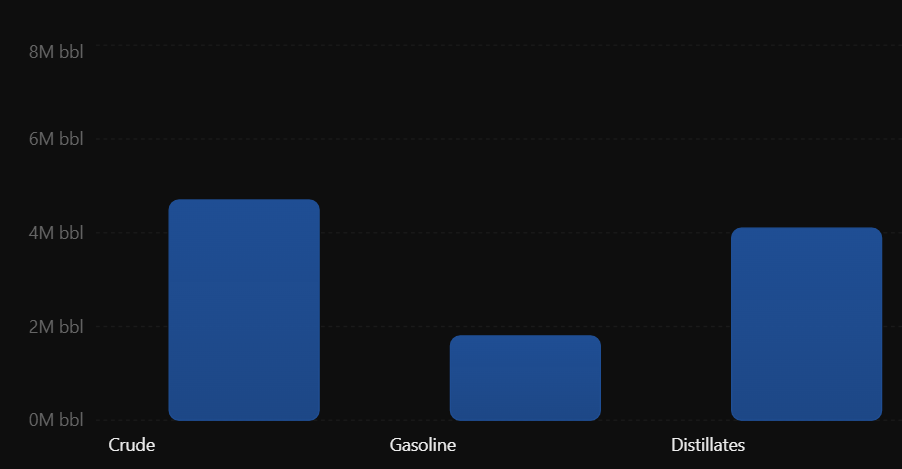
The US Energy Information Administration reported a 4.657 million-barrel increase in commercial crude inventories during the week ended November 6, compared with expectations for a 600,000-barrel decline.
Gasoline inventories increased approximately 1.8 million barrels, while distillate stocks rose 4.1 million barrels.
The broad inventory accumulation suggests that petroleum supplies exceeded immediate refinery and end-user requirements across several major product categories.
EIA Information Releases
US weekly petroleum inventory changes
Oil prices respond to the changing balance
By Friday, November 13, Brent settled near $95.84 per barrel, while WTI finished around $88.56. Both benchmarks declined approximately 2.5% over the week.
The price action suggests that traders increasingly focused on the possibility of a global supply surplus rather than exclusively on geopolitical supply disruptions.
Nevertheless, attacks affecting Middle Eastern energy infrastructure and shipping remained an important source of upside risk.
Energy-market assessment: The fundamental oil outlook became more bearish during the week, particularly for medium-term prices. Yet the combination of geopolitical uncertainty, historically low onshore inventories, and refined-product shortages argues against assuming a smooth or sustained decline in crude prices.
7. Financial-market reactions: Equities, bonds, currencies, and precious metals
Equity markets: Weekly gains mask growing AI-sector uncertainty
US equity markets ended the week higher despite volatile trading and pressure on large technology companies.
US major equity-index performance, November 9–13, 2026
Reported percentage changes for the full trading week ended November 13, 2026.
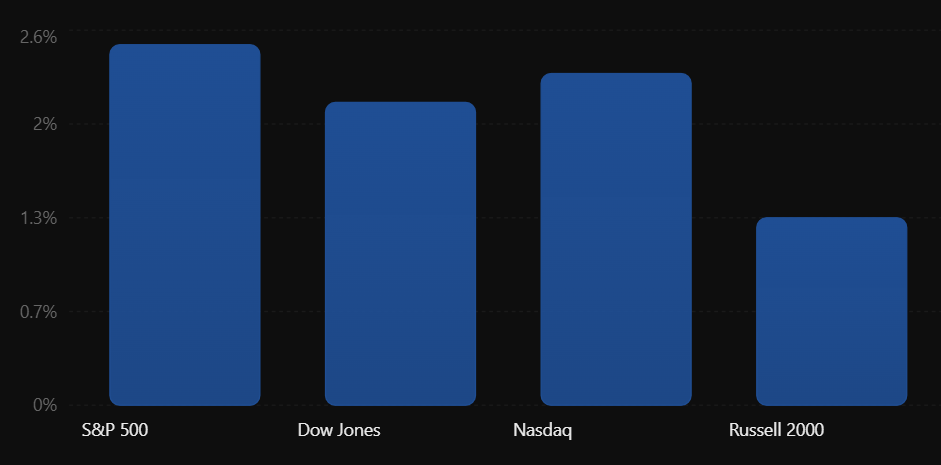
The S&P 500 gained approximately 2.5%, the Dow Jones increased 2.1%, and the Nasdaq rose 2.3% over the week. However, losses in major AI-related technology companies during individual sessions highlighted concerns about valuations, corporate leadership, export restrictions, and the sustainability of heavy data-center capital expenditure.
The longer-term importance of artificial intelligence remains substantial. Demand for chips, data-center infrastructure, electrical equipment, and industrial materials continues to support selected manufacturing and export industries, particularly in China, Taiwan, South Korea, and Hong Kong.
However, a stronger AI-related industrial cycle does not guarantee consistently rising technology-stock valuations. Higher interest rates, earnings disappointments, and excessive capital-investment expectations can undermine valuations even while demand for computing infrastructure continues expanding.
Bond markets: Inflation concerns drive yields higher
The US Treasury market experienced significant selling pressure as investors reassessed the risk of further Federal Reserve tightening.
The benchmark US 10-year yield increased approximately 29 basis points during the week to around 5.15%, while the two-year yield rose approximately 35 basis points to about 4.87%.
Higher yields increased pressure on interest-rate-sensitive assets and contributed to tighter market financing conditions.
The Federal Reserve's balance sheet increased modestly to around $6.759 trillion, but this weekly change does not independently represent a broad shift toward monetary easing.
Gold and silver: Higher real-rate expectations outweigh defensive demand
Gold faced substantial pressure as rising Treasury yields and expectations for a more restrictive Federal Reserve reduced the attractiveness of non-interest-bearing assets.
Spot gold traded near $3,880 per ounce on Friday, having declined approximately 4.5% over the week, its weakest weekly performance in several months.
Silver and other precious metals also experienced pressure. The decline occurred despite ongoing geopolitical risks, demonstrating that monetary-policy expectations and bond yields were dominant influences during this particular week.
Reuters
Foreign exchange: Policy divergence becomes the leading theme
Currency-market implications were increasingly driven by expected central-bank policy differences rather than individual economic releases.
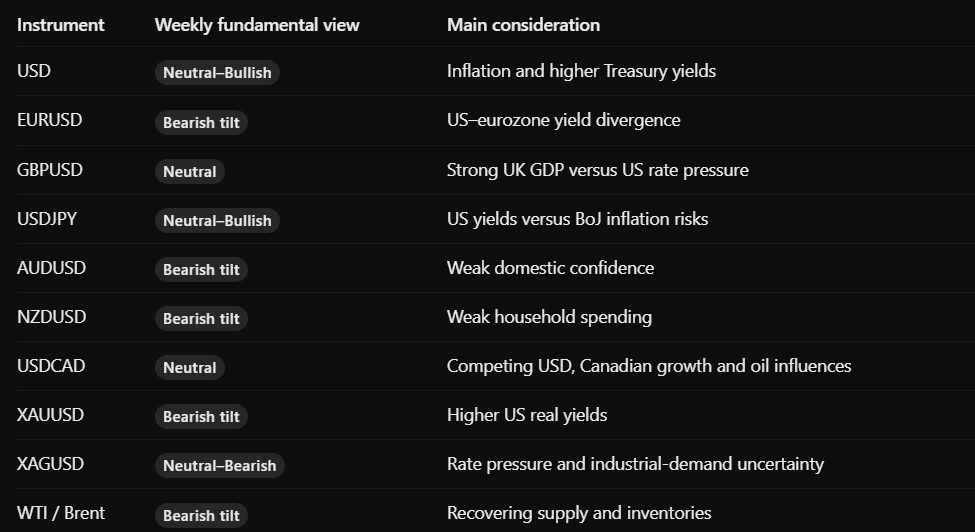
These are economic and cross-asset interpretations, not technical signals or instructions to enter positions at current market prices.
8. Global macroeconomic risks and the week ahead
The main risks for the coming weeks arise from the interaction of several forces.
First, persistent inflation could force central banks to maintain restrictive monetary policies even as economic activity weakens. This risk is most visible in the United States, India, Japan, and selected European economies.
Second, global growth may become increasingly dependent on a limited number of industries. AI infrastructure, semiconductor manufacturing, and technology exports are supporting important parts of Asia, but slower investment in those sectors could quickly affect export revenues and industrial activity.
Third, the energy market remains vulnerable to sudden reversals. The supply-demand balance is becoming less restrictive, but geopolitical disruptions and low onshore inventories could still cause sharp price increases.
Fourth, government financing needs and debt-service costs remain important risks. Higher bond yields increase fiscal pressure and can reduce private investment, particularly in highly indebted economies.
Finally, weak household demand and credit growth may prevent a broad global recovery. China, Japan, parts of Europe, and several emerging economies continue to show significant gaps between industrial activity and domestic consumption.
9. Final assessment
The week ending November 13, 2026, reinforced a fundamental change in the global economic environment: growth is still present, but it is increasingly uneven, inflation is proving difficult to contain, and financial conditions remain restrictive.
The United States has greater growth resilience than many other advanced economies, but its inflation and fiscal challenges create risks for bonds and interest-rate-sensitive assets. The United Kingdom surprised positively, while the eurozone remained constrained by slow growth and energy costs.
China continues benefiting from strong global technology demand, yet weak domestic credit growth highlights an incomplete recovery. Japan's rising industrial prices contrast with declining household purchasing power. Emerging economies face different combinations of inflation, fiscal vulnerability, and domestic-demand weakness.
At the same time, the prospect of improving global oil supplies offers a possible disinflationary force, although geopolitical risks remain substantial.
For financial markets, the most important variables are likely to be US real yields, central-bank policy expectations, oil-supply developments, Chinese credit demand, and the sustainability of AI-related investment.
The coming period is therefore likely to favor selective, data-driven market analysis rather than assuming a single directional trend across currencies, commodities, equities, and bonds.
Frequently Asked Questions (FAQ)
Q1. What were the main developments in the global economy during 9–13 November 2026?
The main developments included persistent US inflation, stronger-than-expected UK economic growth, weak Chinese domestic credit demand, slowing eurozone growth, and increasing global oil supply. These developments highlighted the growing divergence between major economies.
Q2. Is US inflation still a concern for the Federal Reserve?
Yes. US CPI increased by 0.4% month-over-month in October 2026, while core CPI rose by 0.3%. Producer price inflation also remained elevated, with annual PPI reaching 6.5%. These figures suggest that inflationary pressures have not been fully contained.
Q3. How did the UK economy perform in the third quarter of 2026?
The UK economy expanded by 0.7% quarter-over-quarter and 1.9% year-over-year in Q3 2026. Industrial and manufacturing production also improved, although construction and business investment remained relatively weak.
Q4. Why is China's economic recovery facing challenges?
Despite strong export growth, China's domestic credit demand remains weak. New bank lending declined in October, while M2 money supply growth slowed to 7.1%. This suggests that strong external demand has not yet translated into a sufficiently broad recovery in domestic economic activity.
Q5. What is the outlook for the global oil market?
The outlook points toward increased supply and potential market surplus. The International Energy Agency expects global oil supply to increase substantially, while weaker demand expectations could limit price appreciation. However, geopolitical risks and supply disruptions remain important sources of volatility.
Q6. How did US inflation and Treasury yields affect gold prices?
Higher inflation concerns and expectations of tighter monetary policy contributed to rising US Treasury yields. Higher bond yields increased the opportunity cost of holding non-yielding assets, putting downward pressure on gold during the reporting week.
Q7. Which economies showed the strongest performance during the week?
The United States continued to demonstrate economic resilience, while the United Kingdom recorded stronger-than-expected quarterly growth. China maintained strong export performance, and Hong Kong also reported solid annual GDP growth. However, their domestic economic conditions remained different.
Q8. What are the main risks facing the global economy in the coming weeks?
The main risks include persistent inflation, higher borrowing costs, geopolitical disruptions to energy supplies, weak domestic demand in China and Europe, and uncertainty surrounding global investment in artificial intelligence and technology.
 Global Economic Outlook – Week 48, 2026: US Consumer Strength, Australian Inflation, and Growing Global Economic Divergence
 Global Economy Review: Growth, Inflation & Markets | November 2026
 Global Economic Outlook for Week 34 of 2026: Key Data, Central Banks and Market Risks
 Global Economic Outlook August 2026: Markets and Risks
 Global Economic Outlook and Analysis, Week 33, 2026: Inflation Tests Markets
 United States Economic Outlook — August 2026: Resilience with Less Room for Error
 Global Economic Outlook for August 3–8, 2026: U.S. Jobs, Oil Risks and Central Banks
 Global Economic Outlook: July 26–31, 2026
 Global Economic Outlook for July 20–25, 2026: ECB, PMIs and the Oil Shock Test the Disinflation Story
 UK Economic Outlook for July 2026: June Economic Review, Bank of England Outlook, Inflation, GDP & FTSE 100 Analysis
 Japan Economic Review & Outlook: June 2026 Review and July 2026 Forecast | BOJ, Yen, Inflation & Growth
 Eurozone Economic Outlook for July 2026: Growth, Inflation, ECB Policy & Market Outlook