
 English
 پارسی


Global Economic Outlook for the Week Ahead
The final week of July brings decisions from the Federal Reserve, Bank of England and Bank of Japan, alongside U.S. GDP, PCE inflation, euro-area data, Chinese PMIs and megacap technology earnings. Here is our review of the past week and outlook for global markets.
Key takeaways
- The Federal Reserve is expected to keep its target range at 3.50%–3.75%, but its communication will probably remain hawkish.
- The Bank of England is likely to hold the Bank Rate at 3.75%, with the vote potentially becoming more supportive of future tightening.
- The Bank of Japan is expected to remain at 1.00% following its June increase.
- U.S. second-quarter GDP is expected to show moderate annualised growth, while June PCE inflation could soften.
- Euro-area GDP may return to modest quarterly growth, but inflation could rise toward 2.9%.
- China’s July PMIs are expected to remain close to the 50-point stagnation threshold.
- Brent crude remains exposed to developments in the Strait of Hormuz, Red Sea and Saudi energy infrastructure.
- Microsoft, Meta, Apple and Amazon will provide another major test of the artificial-intelligence investment narrative.
The IMF forecasts global growth of 3.0% in 2026 and 3.4% in 2027. Global inflation is expected to rise from 4.1% in 2025 to 4.7% this year, suggesting that the disinflation process has stalled. The IMF identifies Middle East conflict, trade fragmentation, and a correction in technology-related expectations as important downside risks.
Global economy review: July 20–24, 2026
Global activity improved, but the recovery remained fragile
Preliminary July purchasing managers’ indexes indicated that the third quarter began with stronger economic momentum across several major economies.
- The U.S. Composite PMI increased to 53.6, an eight-month high.
- The euro-area Composite PMI rose to 51.9 and returned to expansion.
- The UK Composite PMI climbed to 52.1, its strongest since February.
- Japan’s manufacturing output recorded its strongest expansion since 2014.
- India’s Composite PMI remained expansionary at 54.3, despite falling to its lowest level in more than four years.
These figures indicate that the world economy has avoided an immediate recession. However, some of the improvement was supported by temporary influences, including World Cup-related consumption, summer spending, inventory accumulation, fiscal support and concentrated AI investment.
United States: stronger services and higher inflation risks
The U.S. flash Composite PMI rose from 51.9 in June to 53.6 in July. Services PMI increased from 51.2 to 53.6, while manufacturing eased marginally from 53.9 to 53.8.
Spending connected to the World Cup, Independence Day celebrations, hospitality and leisure supported activity. The survey was consistent with economic growth of approximately 2% at the beginning of the third quarter.
However, supplier delays, higher energy prices, tariffs and diminishing support from previous inventory accumulation created uncertainty about whether the improvement could continue.
- U.S. economic condition: Resilient, with increasing inflation risk.
Euro area: business activity returned to growth
The euro-area Composite PMI rose from 50.0 to 51.9, its highest level in five months. Manufacturing output reached its strongest level in more than four years, Germany returned to growth and the French contraction moderated.
New orders increased at their fastest rate since April 2023. However, exports remained weak, and the region’s dependence on imported energy left the recovery vulnerable to higher oil and natural-gas prices.
- Euro-area economic condition: Improving, but exposed to imported inflation.
United Kingdom: retail sales and business activity recovered
The UK Composite PMI increased from 49.3 to 52.1, indicating the first expansion in three months.
June retail sales unexpectedly rose 1.0% month on month. Hot weather, online shopping, summer clothing, air-conditioning equipment and World Cup-related demand supported consumption.
The recovery may nevertheless prove temporary if higher energy costs weaken household purchasing power.
- UK economic condition: Improving, but still vulnerable.
China: export strength contrasted with domestic weakness
China continued to benefit from technology-related exports, electric vehicles, batteries, machinery and renewable-energy supply chains.
However, its economic structure remained unbalanced. Property investment and housing confidence were weak, consumption underperformed industrial production, and deflationary pressure continued to affect corporate margins.
China’s official manufacturing PMI rose to 50.3 in June, returning to expansion. The new-orders index improved to 51.2, but employment remained in contraction at 48.5.
- Chinese economic condition: Export-supported, with persistent domestic imbalances.
Japan: strong manufacturing and severe currency pressure
Japanese manufacturing benefited from automobiles, semiconductor equipment and global AI-related investment.
The weak yen remained the main economic vulnerability. USD/JPY traded near 164, increasing fuel, food and production costs while raising the probability of further monetary tightening or direct currency intervention.
- Japanese economic condition: Expanding but increasingly unbalanced.
Emerging economies became more divergent
The effect of the energy shock varied sharply across emerging economies.
Energy exporters benefited from higher commodity revenue, while energy importers faced larger trade deficits, inflation pressure and currency depreciation.
India’s Composite PMI fell from 57.1 to 54.3, its weakest level in more than four years, although activity continued expanding. Brazil faced additional tariff exposure, while several emerging-market central banks maintained restrictive policies because of oil and currency risks.
- Emerging-market condition: Resilient but externally pressured.
Oil returned to the centre of the global outlook
Brent crude briefly moved above $100 before closing Friday at $96.78. Despite Friday’s decline of almost 4%, Brent gained close to 10% during the week.
The supply risk was no longer confined to the Strait of Hormuz. Houthi attacks on Saudi energy facilities in Jizan and Yanbu threatened the Red Sea export route used to bypass Hormuz.
The weekend created additional uncertainty. Attacks continued around Saudi infrastructure, an Iranian tanker was reportedly damaged in the Strait of Hormuz, and Gulf equity markets declined on Sunday. At the same time, the United States paused immediate attacks, providing a limited opportunity for renewed diplomacy.
A sustained oil price above $100 would increase:
- Fuel and electricity costs.
- Shipping, aviation and insurance expenses.
- Fertiliser and agricultural prices.
- Food-production and distribution costs.
- Government subsidy requirements.
- Household inflation expectations.
- Pressure on central banks to maintain higher interest rates.
The IMF’s baseline assumes an average 2026 petroleum price near $89 and a gradual reopening of the Strait of Hormuz. Persistent disruption would make its global growth forecast more difficult to achieve.
Tariffs intensified the global inflation problem
The United States announced higher tariffs covering goods from approximately 60 trading partners.
Although part of the cost may be absorbed through lower exporter and importer margins, broad tariffs normally create some combination of higher consumer prices, trade diversion, reduced product availability and delayed investment.
Tariffs are especially dangerous when combined with expensive energy. Higher import prices and oil-related inflation could prevent central banks from supporting economic activity if growth begins to weaken.
ECB held rates but retained a tightening option
The European Central Bank left its deposit rate unchanged at 2.25% on July 23.
Policymakers indicated that future decisions would depend on the duration of the energy shock and whether higher headline inflation spreads into wages and underlying prices.
Markets continued to see another increase as possible in September. Renewed inflation has therefore restored the possibility of additional ECB tightening.
Technology shares confronted the cost of AI
Alphabet and Tesla earnings intensified concerns about high investment spending and the time required to produce adequate AI-related returns.
The underlying AI investment cycle remains strong and continues to support semiconductors, data centres, electricity infrastructure and cloud computing.
However, investors have become more selective. Revenue growth may no longer be sufficient when capital expenditure, depreciation, energy consumption and financing requirements are increasing.
Global financial-market review
At the July 24 close:
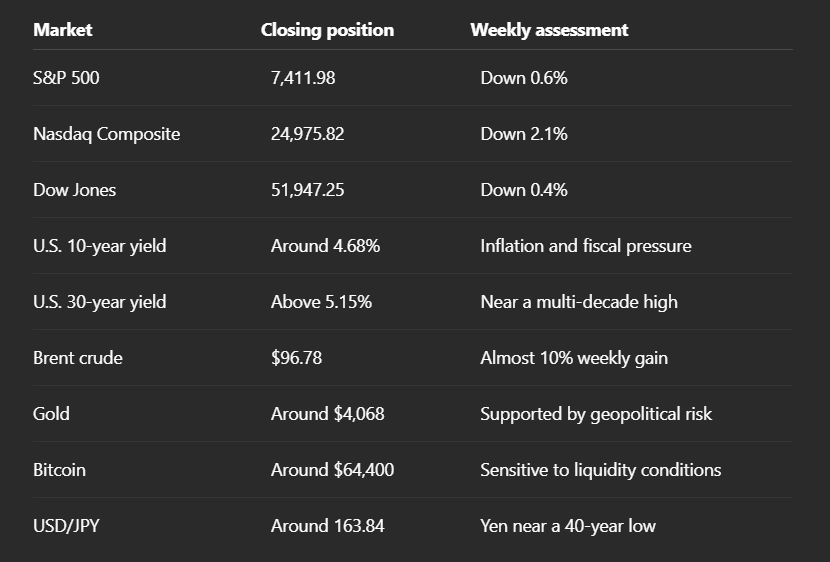
U.S. equities ended the week lower, led by technology shares, while energy stocks outperformed. The Dow gained 0.5% on Friday, but the Nasdaq declined 0.6%.
Bond yields were the clearest financial warning signal. Higher oil prices, tariffs, fiscal borrowing and the possibility of renewed rate increases pushed long-term yields higher.
Economic calendar for July 27–31, 2026
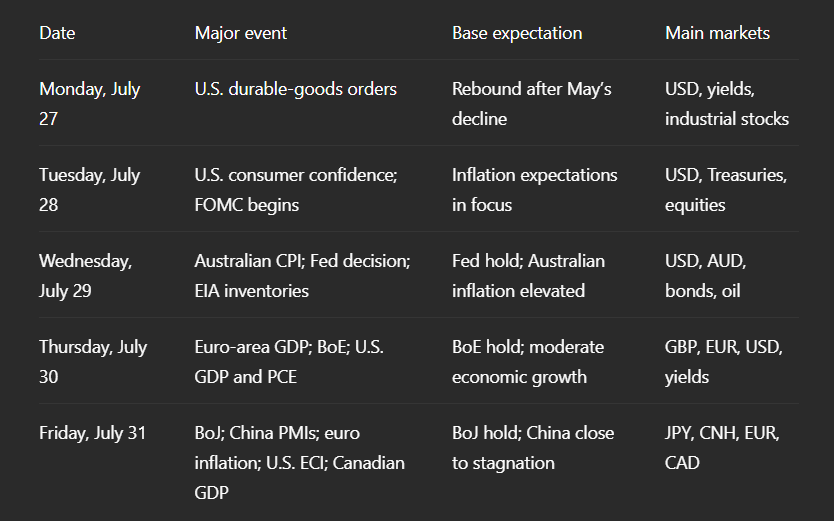
United States outlook: Federal Reserve, GDP and PCE inflation
Federal Reserve decision
The FOMC meets on July 28–29. Its decision is scheduled for 2:00 p.m. ET Wednesday, followed by Chair Kevin Warsh’s press conference. This meeting does not include new economic projections. The base case is an unchanged target range of 3.50%–3.75%. Markets were assigning approximately a 30%–38% probability to an immediate increase.
A hold remains more likely because policymakers may prefer to assess whether the latest energy shock produces persistent second-round inflation. The Fed may also want to preserve the September meeting as its next opportunity to tighten. The principal questions are:
- Will the Fed explicitly mention tariffs and energy prices?
- Will it say inflation risks have increased?
- How concerned is the Committee about inflation expectations?
- Will several members dissent in favour of an increase?
- Will Warsh validate expectations for a September move?
A surprise increase would probably strengthen the dollar, raise the two-year Treasury yield and pressure technology shares, gold and cryptocurrencies.
U.S. second-quarter GDP
June’s personal income and spending figures will be released one day after the FOMC meeting, placing the report’s inflation measures—especially core PCE—at the centre of market attention. Although the June CPI and PPI reports showed relatively contained price pressures, we expect core PCE to rise 0.2% month on month. This would lower annual core inflation only marginally, from 3.4% in May to 3.3% in June. Inflation is currently concentrated in a relatively small number of categories. The expansion of AI infrastructure, for example, has strengthened demand from hyperscalers and technology companies for software, computer equipment and related inputs, placing upward pressure on their prices. Because these items carry a greater weight in the PCE index than in the CPI, they help explain why we expect core inflation to cool only gradually.
Strong June retail sales and upward revisions to May’s figures suggest that spending on goods remained healthy. The more important question is whether households have sufficient financial capacity to maintain this pace. Growth in real disposable income has weakened, while the saving rate has fallen to a multi-year low. The sources of income growth and any movement in the saving rate should provide new evidence about how long consumers can continue spending while energy costs remain elevated—particularly now that the support from tax refunds and the additional cash they provided has largely faded.
Markets should examine:
- Real consumer spending.
- AI and data-centre investment.
- Residential investment.
- Inventories.
- Net exports.
- Final sales to private domestic purchasers.
A strong report driven by domestic demand would reinforce the argument for higher interest rates. A headline increase caused mainly by inventories would be less hawkish.
U.S. PCE inflation
Thursday’s personal income and spending report will be accompanied by the first detailed estimate of second-quarter GDP. We expect the U.S. economy to have grown at an annualized rate of 1.8%. As in the first quarter, business investment was probably the main source of strength, with the continued AI infrastructure expansion contributing to a double-digit rise in equipment spending. However, because a considerable share of this investment depended on imported goods, weaker net exports likely offset part of the gain. Consumer spending also appears to have improved, probably growing by more than 2% annualized, as unusually large tax refunds helped households absorb higher gasoline costs. Although the report should underline the economy’s resilience, we do not expect growth to gain momentum during the second half of the year. A cooling labor market, limited real income growth and a saving rate near historical lows are likely to constrain further expansion.
Friday’s Employment Cost Index may provide a clearer signal regarding persistent labour-cost inflation.
United Kingdom outlook: a hawkish hold
The Bank of England announces its decision and publishes a new Monetary Policy Report on Thursday. Bank Rate is currently 3.75%, and an unchanged decision is widely expected.
The June vote was 7–2, with two members supporting an increase. The vote could therefore be more important than the decision itself.
Investors should watch:
- Whether a third member supports an increase.
- Revised energy and food inflation forecasts.
- Wage and services inflation.
- Household-consumption projections.
- Any indication that the next rate move could be higher.
The improvement in PMIs and retail sales gives the Bank more room to focus on inflation.
Euro-area outlook: moderate growth and persistent inflation
Euro-area GDP is expected to expand approximately 0.2% quarter on quarter in the second quarter, following a revised 0.2% contraction in the first quarter.
The July PMI rebound suggests the third quarter began more positively, particularly in Germany. However, the recent oil increase occurred too late to affect most July business surveys. Friday’s preliminary inflation report is expected to show headline inflation near 2.9%, up from 2.8%, while core inflation could remain around 2.4%.
A combination of weak-to-moderate growth and inflation near 3% would reinforce a mild stagflation scenario.
Japan outlook: BoJ decision and intervention risk
The Bank of Japan meets July 30–31 and will publish an updated Outlook Report. The policy rate is expected to remain at 1.00% following June’s increase. The BoJ could raise its growth forecast because of strong exports, semiconductor equipment and AI-related demand. At the same time, the weak yen is increasing fuel, food and production costs.
USD/JPY near 164 creates several scenarios:
- A cautious BoJ hold could push USD/JPY toward 165.
- A stronger tightening signal could trigger yen short covering.
- Intervention warnings could generate volatility without an actual transaction.
- Direct intervention could produce a rapid decline in USD/JPY.
Tokyo CPI, unemployment, industrial production and retail sales will also be released.
China outlook: PMIs and Politburo signals
China’s July official PMIs are expected to remain close to the stagnation threshold:
- Manufacturing PMI: approximately 50.0–50.3.
- Non-manufacturing PMI: approximately 50.0–50.2.
- Composite PMI: marginal expansion.
A meaningful decline below 50 would pressure Chinese equities, copper, the Australian dollar and Asian industrial shares. Investors will also watch the traditional late-July Politburo meeting for measures addressing consumption, housing, local-government finances and private-sector confidence.
Targeted support is more likely than an aggressive, broad stimulus programme.
Australia and emerging-market outlook
Australia releases June and second-quarter CPI on Wednesday. Headline inflation is expected near 4.0% year on year, while trimmed-mean inflation could rise toward 3.7%. An upside surprise would strengthen expectations for an RBA rate increase in August and could support the Australian dollar.
Other important emerging-market events include:
- Mexico’s preliminary second-quarter GDP.
- Canadian monthly GDP.
- Monetary-policy decisions in Chile and Colombia.
- Brazilian inflation and labour-market data.
- Indian industrial production.
Energy exporters should continue to benefit from higher commodity revenue, while energy importers face inflation, weaker currencies and deteriorating external balances.
Earnings outlook: another test for artificial intelligence
The earnings calendar will be unusually important:
- Wednesday: Microsoft and Meta.
- Thursday: Apple and Amazon.
- Friday: Exxon Mobil and Chevron.
- Other major reports: Visa, Boeing, PayPal, Starbucks, UPS and Qualcomm.
Investors will focus on:
- Cloud and AI revenue growth.
- Capital-expenditure guidance.
- Data-centre investment.
- Free cash flow.
- Operating margins.
- Electricity and infrastructure requirements.
- The expected timetable for AI monetisation.
Strong revenue combined with another major increase in spending may not be enough to support share prices. Markets increasingly require evidence that AI income is growing quickly enough to justify the investment cycle.
Market outlook and sentiment
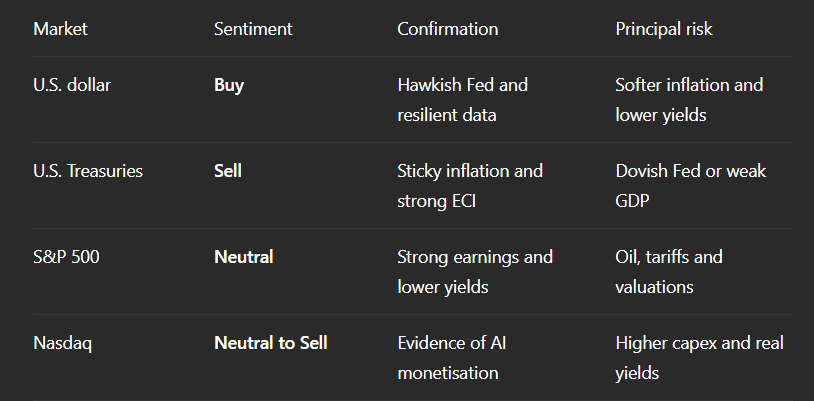
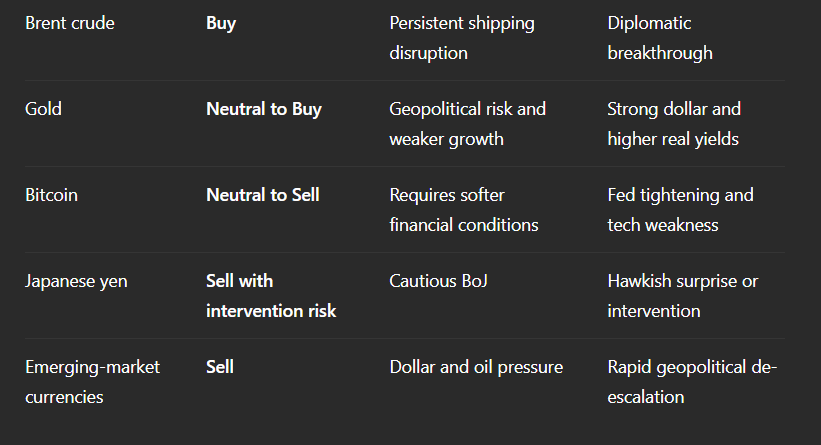
Three global economic scenarios
- Base case: hawkish holds and continued volatility
The Fed, BoE and BoJ leave rates unchanged. U.S. GDP remains positive, June PCE inflation moderates and euro-area growth returns marginally above zero. China’s PMIs remain close to 50, while oil stays elevated but fails to establish a sustained breakout above $100.
This scenario would support the dollar and energy sector while maintaining pressure on long-duration bonds and highly valued technology shares.
- Positive scenario: disinflation and diplomatic progress
U.S. inflation is softer than expected, GDP remains respectable, technology earnings exceed expectations, and diplomacy reduces shipping disruption. Treasury yields could decline, equities and cryptocurrencies could recover, the dollar could weaken, and oil would lose part of its geopolitical premium.
- Negative scenario: a renewed stagflation shock
The Fed surprises with an increase—or strongly signals a September move—while the Middle East conflict expands, Brent remains above $100, and technology earnings disappoint.
This scenario could create simultaneous weakness in bonds, technology shares, consumer stocks and cryptocurrencies. The dollar, energy shares and selected commodity exporters would probably outperform.
Final global economic outlook
The global economy remains in expansion, but its resilience increasingly depends on services, artificial-intelligence investment, fiscal support and inventory behaviour. Households and energy-importing economies face renewed pressure from fuel, food, tariffs and elevated borrowing costs.
My base case for July 26–31 is a week of hawkish central-bank holds, moderate U.S. and European growth and temporary improvement in June U.S. inflation. This combination should keep the dollar and global bond yields relatively firm while preventing a broad return to risk-on trading.
The decisive question is whether improving business activity can remain stronger than the combined damage from war, energy inflation, tariffs and restrictive financial conditions.
For now, the answer remains cautiously positive—but the margin of safety is becoming dangerously narrow.
Frequently Asked Questions
What is the global economic outlook for July 26–31, 2026?
The global economy is expected to remain in moderate expansion, but higher energy prices, tariffs and restrictive financial conditions create significant stagflation risks. Central-bank decisions and inflation data will determine whether markets focus more heavily on growth or renewed price pressure.
Will the Federal Reserve raise interest rates in July 2026?
The Federal Reserve is expected to keep its target range unchanged at 3.50%–3.75%. However, markets see an unusually meaningful probability of an increase. Even without a July hike, the Fed could signal that a September increase remains possible.
What should markets expect from U.S. GDP?
U.S. second-quarter GDP is expected to show positive annualised growth of approximately 1.7%–2.3%. Consumer spending, AI investment, inventories and net exports will determine whether the report is interpreted as genuinely strong or only technically positive.
What is the outlook for U.S. PCE inflation?
Core PCE inflation is expected to rise approximately 0.1%–0.2% month on month, with annual inflation near 3.3%. Headline inflation may moderate because of lower June energy prices, although it will not capture the latest oil-price surge.
Will the Bank of England change interest rates?
The Bank of England is expected to maintain the Bank Rate at 3.75%. The voting split and updated inflation forecasts may nevertheless indicate that additional tightening remains possible later in 2026.
What is expected from the Bank of Japan?
The Bank of Japan is expected to keep its policy rate unchanged at 1.00%. Investors will focus on its growth and inflation forecasts, tightening guidance and comments about the weak yen.
Why are China’s July PMIs important?
China’s PMIs will show whether the June improvement in manufacturing continued into July. A decline below 50 would indicate contraction and could pressure copper, the Australian dollar, Chinese equities and regional industrial markets.
Why is Brent crude important for the global economy?
Brent crude affects transportation, electricity, food production, manufacturing and household inflation. A sustained move above $100 could weaken growth while forcing central banks to maintain tighter monetary policy.
What are the biggest risks for global markets this week?
The largest risks are a surprise Fed increase, further disruption around Hormuz or the Red Sea, Brent holding above $100, disappointing technology earnings and intervention in the Japanese yen.
What is the outlook for the U.S. dollar?
The U.S. dollar maintains a bullish bias because of high Treasury yields, safe-haven demand and expectations of a hawkish Federal Reserve. Softer inflation, weaker GDP, or a diplomatic breakthrough could produce a corrective decline.
 Global Economic Outlook for Week 34 of 2026: Key Data, Central Banks and Market Risks
 Global Economic Outlook August 2026: Markets and Risks
 Global Economic Outlook and Analysis, Week 33, 2026: Inflation Tests Markets
 United States Economic Outlook — August 2026: Resilience with Less Room for Error
 Global Economic Outlook for August 3–8, 2026: U.S. Jobs, Oil Risks and Central Banks
 Global Economic Outlook: July 26–31, 2026
 Global Economic Outlook for July 20–25, 2026: ECB, PMIs and the Oil Shock Test the Disinflation Story
 UK Economic Outlook for July 2026: June Economic Review, Bank of England Outlook, Inflation, GDP & FTSE 100 Analysis
 Japan Economic Review & Outlook: June 2026 Review and July 2026 Forecast | BOJ, Yen, Inflation & Growth
 Eurozone Economic Outlook for July 2026: Growth, Inflation, ECB Policy & Market Outlook
 Emerging Economies Economic Outlook for July 2026: Growth, Inflation, Central Banks & Market Outlook
 Chinese Economic Outlook July 2026: GDP, PMI, Inflation, Yuan and Market Risks