
 English
 پارسی


Global Economic Review: November 2–8, 2026
Executive Summary
The first week of November 2026 revealed an increasingly divided global economy, with resilient growth in the United States and parts of Asia contrasting with slowing economic activity in Europe, Canada, and Latin America. Persistent inflation, restrictive monetary policies, geopolitical uncertainty, and volatile commodity prices remained the primary forces shaping global financial markets.
The United States delivered stronger-than-expected employment growth, reinforcing expectations that the Federal Reserve could maintain restrictive monetary policy. The Eurozone faced accelerating inflation alongside weaker consumer spending, while the Bank of England and Reserve Bank of Australia raised interest rates to contain price pressures.
In Asia, India and Indonesia maintained relatively strong economic growth, Japan reported accelerating wages, and South Korea benefited from exceptional semiconductor exports. Meanwhile, Brazil experienced a sharp contraction in private-sector activity, and Mexico unexpectedly reduced interest rates.
Financial markets reflected these conflicting economic signals. Oil prices declined sharply as geopolitical risk premiums eased, gold benefited from safe-haven demand, and U.S. technology stocks came under pressure amid concerns about AI-related investment costs and valuations.
The week's defining theme was an increasingly uneven global expansion, with persistent inflation and high financing costs threatening future growth.
1. United States: Strong Employment Supports Economic Resilience
The U.S. economy remained among the strongest of the major developed economies during the first week of November. October nonfarm payrolls increased by 165,000, substantially exceeding market expectations of 65,000. The unemployment rate declined from 4.2% to 4.1%, while private-sector employment increased by 159,000. Manufacturing employment also improved, adding 19,000 jobs.
Average hourly earnings increased 0.4% month over month, although annual wage growth slowed to 3.1%. The broader U-6 unemployment rate increased to 7.9%, indicating that some underlying labor-market weaknesses persisted despite the strong headline figures.
Business activity remained expansionary. The ISM Manufacturing PMI increased to 55.5, while the Services PMI stood at 54.5. However, slower services new-order growth and elevated input prices indicated continuing inflation pressures.
Third-quarter labor productivity increased at a 3.6% annualized rate, while unit labor costs declined 0.7%. This combination suggested improving production efficiency and potentially lower inflation pressure per unit of output. Consumer confidence also improved. The preliminary University of Michigan Consumer Sentiment Index increased to 51.0 in November, compared with 48.0 in October. One-year inflation expectations declined from 4.7% to 4.3%.
Despite these positive developments, the Atlanta Fed GDPNow estimate for fourth-quarter growth was revised downward from 3.7% to 3.4%, indicating some moderation in expected economic momentum.
Economic outlook: The U.S. economy remained resilient, supported by employment, manufacturing, and productivity growth. However, continued inflation risks could encourage the Federal Reserve to maintain restrictive interest rates for longer. The overall economic signals were fundamentally supportive of the U.S. dollar, particularly against currencies from economies experiencing weaker growth.
2. Eurozone: Rising Inflation Meets Weakening Consumer Demand
The Eurozone experienced a challenging combination of accelerating inflation and slowing domestic economic activity. Annual headline inflation increased to 4.0% in October, up from 3.8% in September. Energy inflation reached 20.8%, while core inflation remained at 2.5%.
Producer-price inflation also accelerated sharply. Industrial producer prices increased 11.1% annually in September, highlighting substantial cost pressures on European businesses. At the same time, Eurozone retail sales declined 0.7% month over month in September, significantly weaker than expected. Annual retail-sales growth slowed to 0.4%.
October's Composite PMI declined to 51.7, while the Services PMI fell to 51.4. Both remained above the expansion threshold, although economic momentum weakened. Construction activity was particularly depressed, with the Eurozone Construction PMI declining to 42.5.
Germany demonstrated some industrial improvement. September factory orders increased 4.4%, and industrial production grew 0.7% monthly. However, construction and consumer demand remained weak.
France showed more pronounced deterioration. Its Composite PMI declined to 46.6, industrial production fell 0.5%, and the merchandise trade deficit widened to approximately €7.3 billion. Italy maintained modest services growth, while Spain performed comparatively better, supported by stronger manufacturing and services activity.
Economic outlook: The Eurozone faced increasing stagflation risks, with higher prices coinciding with weakening demand. This combination complicated the European Central Bank's policy decisions. Persistent inflation supported restrictive monetary policy, while weaker economic activity increased the risk of a deeper slowdown.
3. United Kingdom: Higher Interest Rates Pressure Housing and Construction
The Bank of England increased its benchmark interest rate by 25 basis points to 4.00% on November 5, 2026.
All nine Monetary Policy Committee members supported an increase, with eight favoring 25 basis points and one preferring a larger 50-basis-point adjustment.
The decision reflected concerns about persistent inflation, particularly higher energy prices. The Bank projected that consumer inflation could approach 5% by mid-2027. The broader economy continued expanding moderately. October's Services PMI reached 52.8, while the Composite PMI stood at 52.9. However, interest-rate-sensitive sectors experienced substantial weakness.
The Construction PMI declined to 43.6, with residential construction particularly affected. House prices fell 0.6% monthly and 1.2% annually in October.
High mortgage costs and weaker affordability continued limiting housing demand and construction investment.
Economic outlook: The United Kingdom faced increasing tension between inflation control and economic growth. Higher interest rates provided fundamental support for the pound but also threatened housing, household consumption, and investment.
4. Asia-Pacific: Resilient Growth with Increasing Regional Divergence
Asia-Pacific continued providing important support to global economic activity, although performance varied significantly between countries.
China and East Asia
China's October Manufacturing PMI stood at 52.0, while the Services PMI reached 50.8. Both indicated continued expansion, although services growth remained relatively modest. South Korea reported a record $61.46 billion current-account surplus in September, largely supported by strong semiconductor exports. International demand for advanced technology and AI-related components remained an important growth driver. Taiwan also maintained relatively strong manufacturing activity, with its October Manufacturing PMI reaching 54.9.
These developments highlighted the increasing economic significance of global investment in artificial intelligence, semiconductor production, and data-center infrastructure.
Japan
Japan reported accelerating wage growth, with average nominal cash earnings increasing 4.6% annually in September. Real wages also improved, supporting household purchasing power. The October Manufacturing PMI reached 53.3, while the Composite PMI stood at 52.1. Stronger wages and continued economic expansion supported expectations of further monetary-policy normalization by the Bank of Japan.
India and Indonesia
India remained among the stronger major economies. Its October Composite PMI reached 56.2, supported by manufacturing at 54.7 and services at 55.8. Indonesia's economy expanded 5.47% annually in the third quarter, exceeding expectations. Household spending, investment, and exports contributed to growth, while manufacturing activity remained expansionary.
Vietnam also demonstrated resilience, with October industrial production increasing 15.0% annually and retail sales growing 14.7%.
Australia and Southeast Asian Inflation
Australia faced more challenging monetary conditions. The Reserve Bank of Australia increased its cash rate to 4.85%, responding to persistent inflation and rising energy costs. Although Australia's September trade surplus increased to A$2.826 billion, October services and composite PMI readings remained below 50, indicating weaker domestic activity.
Inflation also accelerated in parts of Southeast Asia. Philippine headline inflation reached 7.8% in October, while Thailand's inflation increased to 3.90%.
Economic outlook: Asia remained an important engine of global growth, particularly through Indian domestic demand, Indonesian economic expansion, and East Asian technology exports. However, inflation, energy costs, and divergent monetary policies created increasing risks.
5. Canada: Labor-Market Weakness Challenges Economic Growth
Canada's labor market deteriorated in October, contrasting sharply with stronger U.S. employment figures.
The unemployment rate increased from 6.5% to 6.7%, while total employment declined by 4,700 jobs.
Full-time employment fell by 18,100, partially offset by an increase in part-time employment. Annual wage growth also moderated.
Canada's Services PMI declined to 48.1, indicating contraction, while the Manufacturing PMI remained below 50. However, the Ivey PMI reached 58.3, suggesting continued expansion in purchasing activity among surveyed organizations.
External trade provided some support. September's merchandise trade surplus increased to approximately C$5.35 billion, although the improvement was influenced by higher commodity prices rather than stronger export volumes.
Economic outlook: Weak employment and slowing domestic demand increased pressure for more accommodative Bank of Canada policy. The divergence between stronger U.S. labor conditions and weaker Canadian employment created a favorable relative fundamental environment for USD/CAD.
6. Latin America: Brazil Contracts as Mexico Eases Monetary Policy
Brazil recorded one of the weakest economic performances during the week. September industrial production declined 0.8% monthly and 2.5% annually, both below expectations. The October Services PMI fell sharply to 44.5, while the Composite PMI dropped to 44.4, indicating a substantial contraction in private-sector activity.
Despite the slowdown, the Central Bank of Brazil maintained its benchmark Selic rate at 13.75%, reflecting continued inflation and fiscal risks. Brazil's October trade surplus increased to approximately $9.32 billion, offering some support to the country's external financial position. However, strong exports did not eliminate the weakness in domestic activity.
Mexico followed a different monetary-policy path. The Bank of Mexico unexpectedly reduced its benchmark interest rate by 25 basis points to 6.25%, compared with expectations for an unchanged rate of 6.50%.
The decision followed weaker investment conditions. Gross fixed investment declined 1.8% monthly in August, while consumer confidence softened in October.
Economic outlook: Brazil faced increasing recession risks from weak activity and restrictive monetary conditions. Mexico's rate cut could support domestic growth but reduced the peso's relative interest-rate advantage, potentially creating depreciation pressure.
7. Energy Markets: Oil Prices Decline Despite Tight Inventories
Energy markets experienced substantial volatility during the first week of November. The U.S. Energy Information Administration reported that commercial crude inventories declined by 865,000 barrels during the week ended October 30, less than expected.
Gasoline inventories declined by 222,000 barrels, while distillate stocks fell sharply by 3.565 million barrels.
The substantial distillate draw highlighted tight supply conditions for diesel and heating fuels. Despite these inventory developments, international crude oil prices fell sharply during the trading week.
By November 6, Brent crude settled around $98.32 per barrel, while WTI reached approximately $90.83, reflecting a substantial weekly correction.
The decline was primarily associated with reduced geopolitical risk premiums as investors reassessed the possibility of easing tensions involving Iran and the United States. However, uncertainty surrounding Persian Gulf shipping routes and future supply disruptions remained important risks.
In the natural gas market, U.S. storage increased by 77 billion cubic feet, below the 81 Bcf forecast. The smaller-than-expected injection provided modest fundamental support to prices.
Gold benefited from increased financial uncertainty and defensive demand, although stronger U.S. employment data created potential pressure through higher real interest-rate expectations.
Commodity outlook: Oil prices remained highly sensitive to geopolitical developments and supply expectations. Gold continued benefiting from uncertainty, while future movements depended on the balance between safe-haven demand, U.S. interest rates, and dollar strength.
8. Financial Markets: Technology Stocks Weaken as AI Valuations Face Scrutiny
U.S. equity markets experienced substantial volatility during the week. The Nasdaq declined approximately 3.4%, the S&P 500 fell 2.7%, the Russell 2000 lost 2.1%, and the Dow Jones Industrial Average declined 0.9%.
Technology shares faced particularly strong selling pressure as investors reassessed the costs and profitability of AI infrastructure investments. Large capital-expenditure commitments for data centers, advanced computing, and energy infrastructure increased scrutiny of future corporate returns.
Higher interest-rate expectations also pressured growth-stock valuations. The November 3 U.S. midterm elections contributed to uncertainty about future fiscal policy, technology regulation, and geopolitical developments. Nevertheless, AI investment remained an important contributor to demand for semiconductors, industrial equipment, and electricity infrastructure, particularly in Asia.
Financial-market outlook: Strong economic activity did not automatically translate into higher equity prices. Valuations, financing costs, geopolitical risks, and expected profitability became increasingly important determinants of market performance.
9. Global Monetary Policy: Central Banks Move in Different Directions
The week's central-bank decisions highlighted growing international monetary-policy divergence.
Central bankPolicy rateWeekly decision
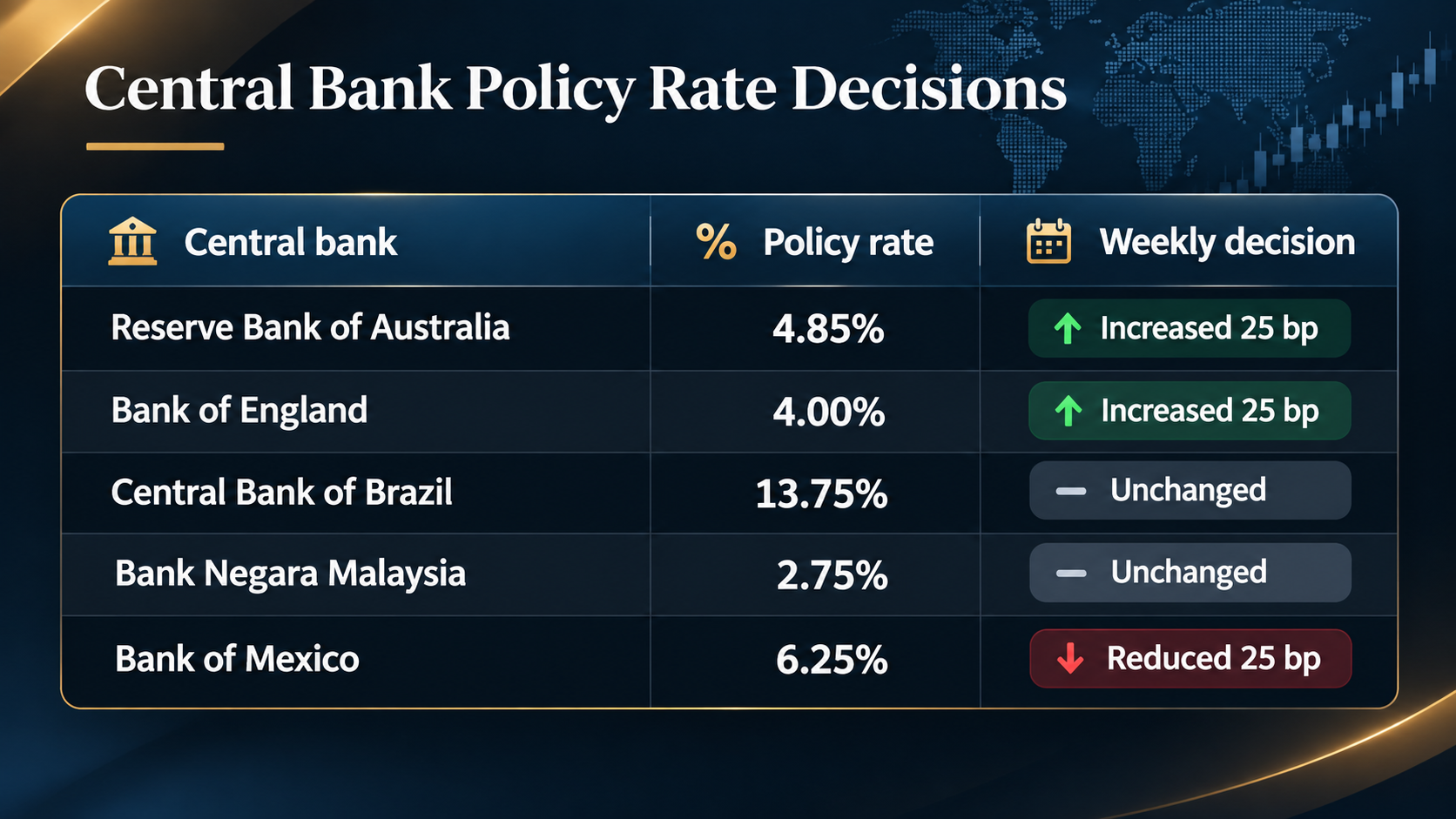
Australia and the United Kingdom prioritized controlling inflation, while Brazil maintained restrictive rates despite weaker domestic economic activity. Malaysia emphasized stability, while Mexico moved toward monetary easing to support growth.
The Federal Reserve did not announce a new policy-rate decision during the week, but stronger U.S. employment data reinforced expectations of restrictive monetary policy. These differences increased the importance of relative interest-rate expectations for currency valuations and international capital flows.
10. Global Economic Outlook and Market Implications
The first week of November highlighted several risks that could influence economic performance through the remainder of 2026 and into 2027. Persistent inflation remained the most significant challenge. Higher energy prices continued affecting producer costs, transportation, and household expenses, potentially forcing central banks to maintain higher interest rates.
At the same time, construction and housing weakness suggested that restrictive financial conditions were increasingly affecting the real economy. Labor-market divergence was another major concern. Strong U.S. employment contrasted with weakening conditions in Canada and parts of Latin America.
Geopolitical developments remained important for energy prices, while the sustainability of AI-related capital investment became an increasing concern for technology-sector valuations.
Fundamental Market Assessment
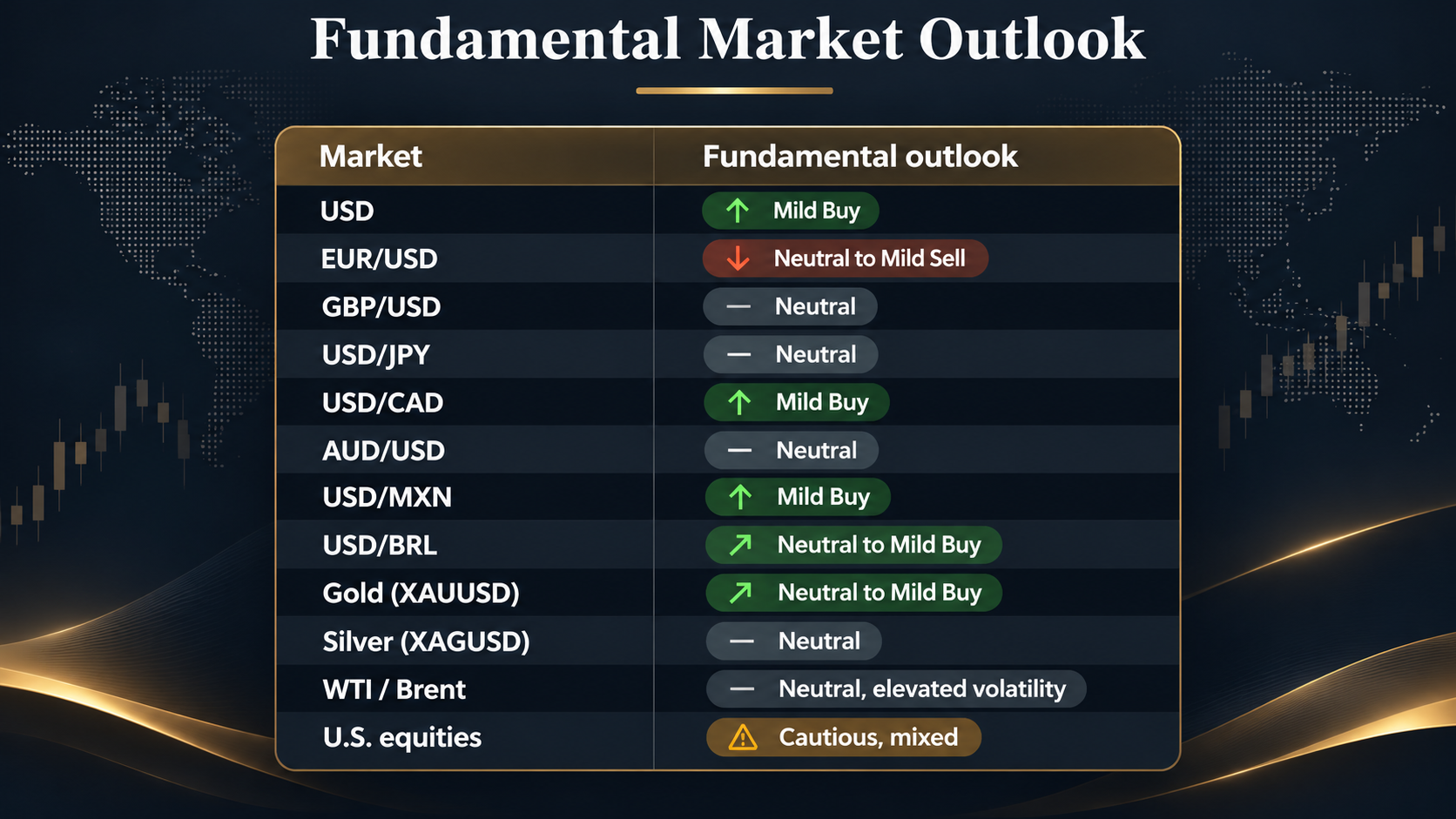
These assessments reflect the economic fundamentals of the reviewed period, not independently confirmed real-time trading signals.
Conclusion
The first week of November 2026 confirmed that the global economy remained in expansion, but its growth was becoming increasingly uneven.
The United States continued demonstrating resilience through strong employment, expanding business activity, and productivity improvements. Europe faced a more challenging combination of inflation and weak domestic demand, while the United Kingdom and Australia responded with higher interest rates.
Asia remained an important source of growth, supported by India, Indonesia, and technology-oriented exporters. However, rising inflation and tightening financial conditions created new risks.
Canada and Brazil showed significant signs of slowing economic activity, while Mexico's unexpected interest-rate cut reflected increasing concern about domestic growth.
In financial markets, sharp oil-price declines, gold's defensive appeal, and weakness in technology equities highlighted the growing influence of geopolitical developments, interest-rate expectations, and investment valuations.
The principal risk for the global economy is a prolonged period of persistent inflation and restrictive monetary conditions that gradually undermine consumption, investment, and employment.
Whether global growth remains resilient will depend on the evolution of energy prices, central-bank decisions, labor-market conditions, and international trade during the remainder of 2026.
Frequently Asked Questions (FAQ)
1. What happened to the global economy during November 2–8, 2026?
The first full week of November 2026 revealed growing economic divergence. The United States maintained relatively strong employment and business activity, while Europe faced accelerating inflation and weakening consumer demand. Several Asian economies continued expanding, but Canada and Brazil reported weaker domestic economic conditions.
2. How did the U.S. economy perform in the first week of November 2026?
The U.S. economy showed resilience. October nonfarm payrolls increased by 165,000, exceeding expectations of 65,000, while unemployment declined to 4.1%. Manufacturing and services activity remained expansionary, although inflation and restrictive monetary policy continued to present risks.
3. Why was Eurozone inflation a major concern in November 2026?
Eurozone annual inflation accelerated to 4.0% in October, partly driven by higher energy costs. At the same time, September retail sales declined 0.7% monthly. The combination of elevated inflation and weaker consumer demand increased concerns about stagflation.
4. Which central banks changed interest rates during the first week of November 2026?
The Bank of England increased its benchmark rate to 4.00%, and the Reserve Bank of Australia raised its cash rate to 4.85%. The Bank of Mexico unexpectedly reduced its policy rate to 6.25%. Brazil and Malaysia maintained their existing policy rates.
5. Which Asian economies showed strong economic growth in early November 2026?
India and Indonesia demonstrated relatively strong economic activity. Indonesia's GDP grew 5.47% annually in the third quarter, while India's manufacturing and services PMIs remained expansionary. South Korea also reported exceptionally strong semiconductor exports and a record current-account surplus.
6. Why did oil prices fall during the first week of November 2026?
Crude oil prices declined sharply as investors reassessed geopolitical supply risks and reduced part of the risk premium associated with tensions involving Iran and the United States. The correction occurred despite tightening U.S. inventories of refined petroleum products.
7. How did global financial markets perform during November 2–6, 2026?
U.S. technology stocks experienced significant selling pressure. The Nasdaq declined approximately 3.4%, while the S&P 500 fell around 2.7%. Investors focused on higher financing costs, AI infrastructure spending, geopolitical uncertainty, and changing monetary-policy expectations.
8. What was the global economic outlook after the first week of November 2026?
Global economic growth remained positive but increasingly uneven. Persistent inflation, restrictive interest rates, weaker construction and consumer demand, and geopolitical uncertainty presented risks to future growth. Stronger U.S. employment and resilient Asian activity provided important support.
 Global Economic Outlook — Week 49, 2026: US Jobs, Inflation and Central Bank Policy in Focus
 Global Economic Outlook – Week 48, 2026: US Consumer Strength, Australian Inflation, and Growing Global Economic Divergence
 Global Economy Review: Growth, Inflation & Markets | November 2026
 Global Economic Review: November 2–8, 2026 | Economician
 Global Economic Outlook for Week 34 of 2026: Key Data, Central Banks and Market Risks
 Global Economic Outlook August 2026: Markets and Risks
 Global Economic Outlook and Analysis, Week 33, 2026: Inflation Tests Markets
 United States Economic Outlook — August 2026: Resilience with Less Room for Error
 Global Economic Outlook for August 3–8, 2026: U.S. Jobs, Oil Risks and Central Banks
 Global Economic Outlook: July 26–31, 2026
 Global Economic Outlook for July 20–25, 2026: ECB, PMIs and the Oil Shock Test the Disinflation Story
 UK Economic Outlook for July 2026: June Economic Review, Bank of England Outlook, Inflation, GDP & FTSE 100 Analysis