
 English
 پارسی


July Review, Current Conditions and the Month Ahead
for Investors and Traders | Data and market conditions through August 10, 2026
Executive Outlook
The global economy entered August 2026 in a more complicated position than it occupied at the beginning of July. Economic activity remained positive across most major regions, artificial-intelligence investment continued to support manufacturing and capital expenditure, and several business surveys improved. However, the renewed Middle East conflict, disruption around the Strait of Hormuz, wider U.S. tariffs and higher long-term bond yields interrupted the disinflation narrative and narrowed the path to a global soft landing.
The latest evidence does not point to an immediate synchronized recession. The IMF projects global growth of 3.0% in 2026 and 3.4% in 2027. Nevertheless, the expansion is increasingly dependent on a limited number of engines: U.S. technology investment, Chinese high-technology exports, defence and infrastructure spending, selected services and stronger demand from higher-income consumers. Property, housing, traditional manufacturing and lower-income household demand remain weaker.
August has added another important tension. U.S. employment deteriorated sharply in July, but business activity continued expanding, and service-sector price pressure remained high. China reported exceptionally strong exports while its domestic economy stayed soft. Europe and Japan retained modest growth, but both remained vulnerable to imported energy inflation. Oil prices fell from their July peak, yet geopolitical risk around Gulf shipping was not fully resolved.
The central market question for the remainder of August is therefore not simply whether growth will slow. It is whether inflation can moderate enough to let central banks remain on hold while employment and consumption cool without collapsing. The answer will determine the direction of bond yields, the U.S. dollar, equity-market leadership and global risk appetite heading into September.
Source:
July Review: Resilience Met an Energy and Policy Shock
July began with a relatively constructive macroeconomic combination. Inflation was easing, manufacturing indicators were improving, and Brent crude traded near $71 per barrel. AI-related demand for semiconductors, servers, data-centre equipment, electricity infrastructure and industrial machinery supported production across the United States, China, Japan, South Korea, Taiwan and Europe.
That environment changed after the escalation of U.S.-Iran tensions and the sharp reduction in tanker traffic through the Strait of Hormuz. Brent rose above $100 at one stage during July 20-24 before ending the month near $90.12. Threats to Red Sea and Bab el-Mandeb shipping created a second vulnerable maritime corridor. The immediate economic consequences extended beyond crude oil to refined fuels, shipping, insurance, electricity, fertilizers, chemicals and food-production costs.
The energy shock did not trigger a global contraction, but it disrupted the expectation that inflation would decline smoothly. The Federal Reserve, European Central Bank, Bank of England and Bank of Japan all kept rates unchanged in July, while dissenting votes at the Fed, BoE and BoJ showed growing support for tighter policy. The U.S. 10-year Treasury yield finished the month near 4.71%, and the 30-year yield reached approximately 5.25%, reflecting not only monetary policy but also tariffs, fiscal deficits, defence spending and heavy sovereign issuance.
July's growth figures were more encouraging. U.S. second-quarter GDP expanded at a 1.5% annualized rate. Although that was weaker than expected, consumer spending rose 3.2%, and business-equipment investment increased 15.2%, demonstrating the strength of domestic demand and technology capital expenditure. The eurozone grew 0.4% quarter on quarter, twice the consensus estimate. The UK's July Composite PMI returned to expansion, while technology-intensive Asian exports remained strong.
The quality of that growth was less reassuring. China's second-quarter expansion slowed to 4.3% year over year, and its July manufacturing, services and construction indicators subsequently moved into contraction. U.S. household spending was supported by a saving rate of only 2.7%, leaving consumers vulnerable to higher fuel, credit and housing costs. The expansion had survived July, but it ended the month narrower, more inflation-sensitive and more dependent on technology investment.
Financial markets reflected this combination of resilience and fragility. Semiconductor shares suffered a sharp mid-month correction as investors questioned whether the returns from enormous AI expenditure would justify valuations. Megacap earnings later restored confidence, but smaller companies remained under pressure from high financing costs. Energy shares benefited from higher oil prices, while airlines, consumer businesses and energy-intensive industries faced renewed margin risk. Gold moved irregularly as geopolitical demand competed with high real yields, and the yen remained weak until official intervention risk intensified.
The key conclusion from July is that global growth remained intact, but the margin for error became smaller. August must now determine whether the energy shock is temporary, whether employment weakness spreads beyond the United States, and whether central banks can avoid another round of tightening.
The Global Starting Point for August
Oil has already provided some relief. By August 10, Brent had fallen to approximately $84.32 and West Texas Intermediate to $78.74. Negotiations over Gulf shipping were reportedly advancing, although a complete reopening of the Strait of Hormuz remained conditional on broader political concessions. Markets are consequently pricing neither a durable settlement nor a renewed full-scale disruption.
Oil around $80-$85 is still inflationary compared with the beginning of July, but it is considerably less damaging than oil above $100. A durable normalization of shipping would reduce freight and insurance costs, improve real household income and support energy-importing currencies and equities. A breakdown in negotiations could reverse these benefits within days.
This makes energy the link between the global growth outlook and the policy outlook. Falling oil would strengthen the disinflation case and allow central banks to focus on slower employment and consumption. Rising oil would keep inflation expectations elevated and could force policymakers to maintain or increase rates even as economic momentum weakens.
Source:
United States: A Cooling Labor Market Tests the Soft-Landing Narrative
The United States delivered the most consequential surprise of early August. Nonfarm payrolls declined by 23,000 in July, while the unemployment rate held at 4.1%. Local-government education lost 50,000 jobs, retail employment fell by 19,000, and financial activities declined by 14,000. Health care added 22,000 positions, but the overall report showed a clear loss of momentum.
The revisions were equally important. May payroll growth was reduced from 129,000 to 63,000, and June from 57,000 to 20,000, removing 103,000 jobs from previous estimates. Average hourly earnings were still 3.2% higher than a year earlier, while labor-force participation declined to 61.4%. The combination suggests that labor demand is weakening faster than wage inflation.
Other indicators point to cooling rather than an established recession. June job openings stood at 7.4 million, compared with 5.3 million hires, while quits remained subdued at 3.2 million. Second-quarter productivity increased at a 1.4% annualized rate and was 2.2% higher than a year earlier, which should help companies absorb part of the increase in wages and input costs.
Business surveys remain expansionary. The July ISM Manufacturing PMI rose to 55.6, its strongest reading since May 2022, with new orders at 56.7 and production at 58.5. The ISM Services PMI registered 54.1, business activity reached 59.1, and new orders stood at 57.2. However, services employment fell to 47.4 while the prices index remained extremely high at 70.3. The message is unusually mixed: companies are producing and receiving orders, but they are becoming more cautious about hiring while continuing to face significant cost pressure.
Federal Reserve Outlook
The Federal Reserve kept the federal-funds target range at 3.50%-3.75% in July. Before the employment report, markets assigned approximately a two-thirds probability to another increase in September. By August 10, that probability had fallen to around 44%.
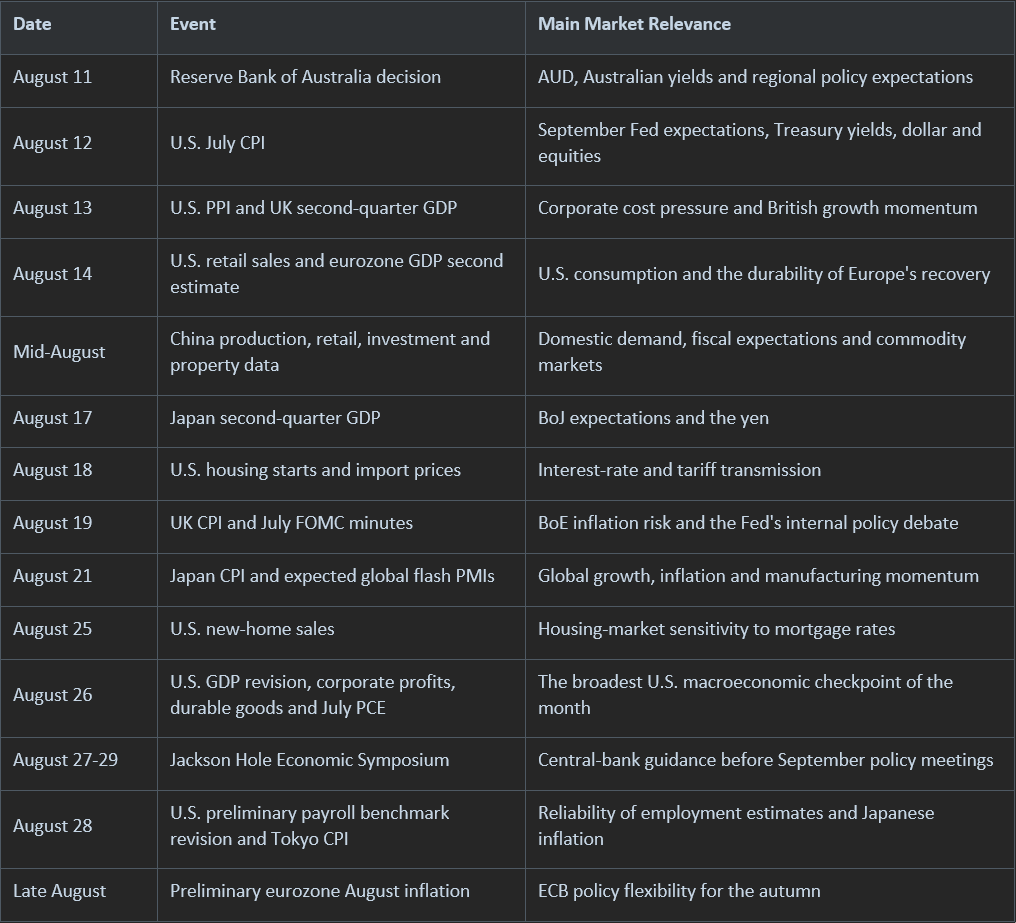
Inflation will determine whether the labor-market deterioration is sufficient to keep the Fed on hold. July CPI is scheduled for August 12, followed by producer prices on August 13 and retail sales on August 14. Consensus expectations point to approximately 0.1% monthly headline inflation and 0.2% core inflation, with the annual rates near 3.4% and 2.5%, respectively.
A soft CPI report, especially if accompanied by weaker retail sales, would reinforce the case for patience. A stronger inflation report in services, transportation, or tariff-sensitive goods would leave the Fed balancing deteriorating employment against inflation still well above target. The July FOMC minutes on August 19 will show how seriously policymakers viewed the inflation risk before the payroll decline became known. Jackson Hole at the end of the month will then provide the clearest opportunity to reset expectations before the September meeting.
For markets, weak employment is not automatically bullish. It becomes supportive for bonds and equities only if inflation also moderates. Weak employment combined with sticky inflation would instead create a stagflationary policy problem.
China: Export Strength Without a Broad Domestic Recovery
China opened August with exceptionally strong trade data. July exports increased 23.9% from a year earlier, imports rose 27.5%, and the monthly surplus reached approximately $112.5 billion. High-technology exports increased by more than 40%, while semiconductor exports almost doubled during the first seven months of the year. The figures underline China's competitiveness in electronics, industrial equipment and AI-related supply chains, although some shipments may also have been brought forward ahead of possible tariff changes.
The domestic economy remains much weaker than the trade numbers suggest. The official Manufacturing PMI fell to 49.2 in July and the Non-Manufacturing PMI to 49.0. A private manufacturing survey remained marginally expansionary at 50.9 but slowed from 51.7 in June. June retail sales grew only 1.0% year over year, fixed-asset investment contracted 5.7% in the first half, real-estate investment fell 18% and private investment declined 8.5%. High-technology investment, up 4.6%, remained one of the few stronger categories.
July inflation reinforced the two-speed picture. Consumer prices increased 0.5% from a year earlier but declined 0.1% from June. Core inflation was 0.9%, while food prices fell 1.5%. Producer-price inflation moderated from 4.1% to 3.5% but remained elevated because of energy and industrial input costs.
Mid-August industrial production, retail sales, investment and property data will test whether export and technology strength is spreading into household demand. Another weak report would increase pressure on Beijing to accelerate fiscal deployment, infrastructure financing and targeted support for consumers and property developers.
Large-scale monetary easing is less certain. Higher commodity prices, capital-flow concerns and possible dollar strength limit the People's Bank of China's flexibility. Targeted liquidity and fiscal measures are more likely than an unconditional broad rate reduction. For investors, this favors Chinese and regional businesses linked to semiconductors, automation and advanced manufacturing over those dependent on residential construction or a broad household-consumption recovery.
Eurozone and United Kingdom: Better Activity, Imported Inflation Risk
The eurozone begins August with more economic momentum than expected. Second-quarter GDP increased 0.4% from the previous quarter and approximately 1.0% from a year earlier. Spain remained a leading performer, while Germany improved from a weak base and France continued to lag. July's Composite PMI returned to expansion, supported by services, AI-related investment, defence expenditure, inventory rebuilding and stronger manufacturing output.
Inflation remains the principal constraint. After falling earlier in the summer, eurozone headline inflation reached approximately 2.9% by the end of July, with core inflation at 2.5% and services near 3.3%. Higher fuel and refining costs matter particularly for Europe because its reliance on imported energy and energy-intensive industry makes the region more exposed than the United States to a sustained Gulf disruption.
The ECB held its policy rate at 2.25% in July. With no August rate meeting, incoming information will shape the autumn debate. The second estimate of eurozone GDP arrives on August 14, followed later in the month by flash PMIs and preliminary August inflation. Stable oil and moderating services inflation would allow the ECB to remain patient. Renewed energy pressure would reduce its ability to support weak industry.
Britain presents a similar but more fragile combination. First-quarter GDP expanded 0.6%, May output rose 0.1%, June retail sales increased 1.0%, and the July Composite PMI reached 52.1. However, employment, construction and housing remained soft, while imported energy costs threatened household purchasing power.
The Bank of England maintained its policy rate at 3.75% in July, with three members supporting an increase. Inflation slowed to 2.6% in June, but the Bank expects it to rise toward 3.2% later in 2026. The first estimate of second-quarter GDP is due on August 13 and July CPI on August 19. Positive growth combined with higher inflation would keep the BoE cautious. Weak GDP with sticky inflation would be more damaging because it could pressure sterling, gilts and domestically focused equities at the same time.
Japan and Asia-Pacific: Growth, Inflation and Currency Pressure
Japan's July business indicators remained constructive. Services PMI stood at 51.2 and the Composite PMI at 52.7, supported by stronger factory output. Companies raised selling prices at the fastest pace since April 2014, indicating that imported costs and wage pressure were increasingly passing through to customers.
Economists expect second-quarter GDP, due on August 17, to increase approximately 0.5% from the previous quarter, equivalent to around 2.0% annualized. Household consumption is forecast to rise 0.5%, business investment 0.4%, and net exports to contribute approximately 0.3 percentage point.
The Bank of Japan kept its policy rate at 1.0% in July but warned that underlying inflation could exceed its target. USD/JPY had approached 164 during July before intervention pressure increased; it traded near 157.85 on August 10 after coordinated action helped limit the depreciation. National CPI on August 21 and Tokyo inflation on August 28 will be critical. Strong GDP, persistent price pressure and renewed yen weakness would raise the probability of a September or October increase.
Japan is also one of the clearest beneficiaries of lower oil prices. The government reduced its fiscal-year growth forecast from 1.3% to 0.9%, largely because of higher energy costs. A durable decline in oil would support household real income, reduce import costs and make the BOJ's decision less urgent.
Elsewhere in Asia, the AI investment cycle remains a major advantage for South Korea and Taiwan. South Korean July exports increased 62.8% year over year, with semiconductor exports up 179% and computer shipments up 404%. These economies offer powerful structural growth, but their markets remain vulnerable to valuation compression, crowded positioning and any reduction in global data-centre expenditure.
Australia's August 11 central-bank decision is one of the few major policy meetings remaining this month. Persistent domestic and non-tradable inflation keeps the possibility of an increase alive. A rate increase would support the Australian dollar but pressure property and other interest-sensitive assets. A hold with cautious guidance would leave the currency more dependent on China, commodities and global risk sentiment.
Emerging Markets: Increasingly Diverse Policy and Market Outcomes
Emerging economies are entering August with sharply different sensitivities. Oil and commodity exporters benefit from higher revenues, while energy importers face wider trade deficits, currency pressure and more persistent inflation. Asian technology exporters continue to benefit from AI demand, whereas economies dependent on domestic credit, property or household consumption face tighter conditions.
Brazil reduced the Selic rate by 25 basis points to 14.00% on August 5, its fourth consecutive reduction, but avoided committing to another cut. Mexico held its rate at 6.50% on August 6 as core inflation remained close to 4%, despite headline inflation declining to approximately 3.1%. Indonesia's second-quarter GDP expanded 5.29% year over year, demonstrating continued resilience in parts of Southeast Asia.
The broad opportunity in emerging markets therefore lies in selectivity rather than a uniform risk-on position. Countries with declining inflation, high real rates and improving external balances can attract bond flows, but these flows remain vulnerable to higher U.S. yields or renewed dollar strength. Energy importers with current-account deficits are the most exposed to another oil shock, while oil exporters and AI-linked Asian markets would be relatively better positioned.
Three Structural Forces Shaping August
Energy and Geopolitics
Oil remains the most important global macroeconomic variable because it influences inflation, household income, corporate margins, current-account balances and monetary policy simultaneously. A lasting normalization of Hormuz shipping would improve the outlook for Europe, Japan, India and other importers. Renewed attacks or restrictions could quickly return Brent above $95-$100, reviving stagflation concerns and reducing central-bank flexibility.
Trade Fragmentation and Tariffs
New U.S. tariffs covering goods from around 60 trading partners are likely to raise import costs, reduce exporter margins and encourage further trade diversion. Mexico, India, Vietnam and Malaysia may benefit from supply-chain relocation, but country-specific and product-specific restrictions make it increasingly difficult for companies to identify a permanently secure production base. August inflation and import-price data will show whether tariff costs are reaching consumers or being absorbed by corporate margins.
Artificial Intelligence Investment
AI remains the strongest structural support for global manufacturing and investment. It drives demand for semiconductors, memory, servers, electricity networks, cooling systems, copper and data-centre construction. However, July's semiconductor correction showed that the economic investment cycle and equity valuations are not the same thing. Capital expenditure may continue rising even while share prices become more selective. Investors will increasingly demand proof that revenue, productivity and cash flow can justify the scale of AI spending.
High-Impact Economic Calendar for the Rest of August
Outlook by Asset Class
Global Equities
The equity outlook remains constructive but selective. AI infrastructure, power networks, defence and companies with strong pricing power retain fundamental support. However, high valuations leave technology and semiconductor shares sensitive to earnings disappointments, weaker capital-expenditure guidance or another rise in long-term yields.
The stronger July and early-August performance of large technology companies should not be treated as evidence that all equities are equally attractive. Smaller companies, highly leveraged businesses and rate-sensitive consumer sectors remain exposed to expensive financing. European and Japanese equities would benefit disproportionately from lower oil prices, while Asian technology exporters could outperform if global AI investment remains intact.
Government Bonds
Government bonds face opposing signals. Weak U.S. employment supports shorter-maturity Treasuries because it reduces the probability of another Fed increase. Persistent services inflation, tariffs, high oil prices and heavy sovereign issuance remain obstacles for longer maturities.
The U.S. 10-year yield traded near 4.67% on August 10. Softer CPI and PCE data could bring yields lower and improve the case for duration. Hot inflation or a renewed oil disruption would push yields upward and could produce losses in both bonds and long-duration equities. Duration becomes more attractive if Brent remains below roughly $85 and core inflation moderates; it remains hazardous if oil returns toward $100.
U.S. Dollar and Major Currencies
The dollar is caught between weakening employment and its yield and safe-haven advantages. Softer U.S. inflation would reduce the need for further Fed tightening and create room for dollar weakness. Geopolitical stress, tariff uncertainty or higher Treasury yields would restore support.
EUR/USD traded near 1.156 on August 10. The euro could appreciate if U.S. inflation softens and Gulf risks decline, but it remains vulnerable to higher imported-energy costs. The yen has greater appreciation potential because of intervention and possible BoJ tightening, although a sustained decline in USD/JPY probably requires lower U.S. yields or clearer Japanese policy action. The Australian dollar will initially depend on the RBA and then on China, commodity prices and global risk appetite.
Oil and Refined Products
Oil should be treated primarily as a geopolitical market during August. A durable reopening of the Strait of Hormuz could move Brent toward the lower part of the $70-$80 range, supporting bonds, airlines, consumer sectors and energy-importing currencies. A failure of negotiations could return prices above $95 and potentially $100, benefiting energy producers but damaging broader risk assets.
Refined-product prices deserve separate attention. July demonstrated that disruptions to refining and shipping can lift petrol and diesel costs more sharply than crude alone, particularly in Europe. This is one reason headline inflation may remain elevated even if Brent does not revisit its peak.
Gold, Industrial Metals and Cryptocurrencies
Gold traded near $4,342 per ounce on August 10 after rising approximately 7% during the previous week. It remains supported by geopolitical uncertainty, central-bank demand and concern about fiscal and monetary credibility, but high real yields are an important constraint. Gold may perform best under either renewed geopolitical stress or softer inflation that brings yields lower.
Industrial metals face a divided outlook. China's weak property sector limits traditional construction demand, while AI infrastructure, electricity networks, defence investment and automation support copper and aluminium over a longer horizon.
Cryptocurrencies remain sensitive to liquidity and risk appetite. Bitcoin traded around the mid-$60,000 area in early August. Softer U.S. inflation and lower yields would be supportive; a renewed inflation shock, stronger dollar or broad reduction in risk appetite would be negative.
Scenario Framework for the Remainder of August
What Investors and Traders Should Monitor
- Employment Versus Inflation
The payroll decline changes the U.S. growth debate, but its market effect depends on inflation. Cooling employment with softer prices supports bonds and risk assets. Cooling employment with sticky prices raises stagflation risk and limits the Fed's response.
- Oil Versus Long-Term Yields
Falling oil should reduce inflation expectations and support government bonds. Rising oil would pressure bonds, consumer equities and energy-importing currencies, while supporting producers and selected inflation hedges.
- AI Earnings Versus Valuations
The AI capital-expenditure cycle remains powerful, but markets are no longer rewarding the theme indiscriminately. Earnings quality, free cash flow, electricity availability and credible monetization will determine which companies retain premium valuations.
- China's Exports Versus Domestic Demand
Strong exports can support Asian manufacturing and technology without creating a broad recovery in Chinese property or consumption. Retail sales, investment, and property data will be more useful than the trade surplus when judging the domestic cycle.
- Central-Bank Communication Versus Market Pricing
August contains relatively few major policy decisions, but several events that will shape September expectations. The FOMC minutes, national inflation reports, and Jackson Hole could produce substantial repricing even without an immediate rate change.
Conclusion
The global economy enters the remainder of August in a moderate but uneven expansion. July demonstrated greater resilience than many investors expected, but it also exposed the system's dependence on technology investment, selected services, fiscal support, and stable energy flows. The early-August employment deterioration in the United States has increased downside growth risk without eliminating inflation pressure.
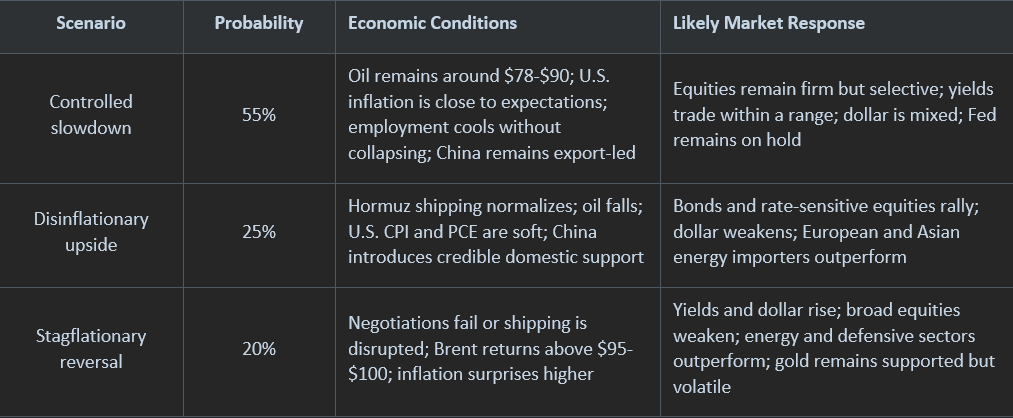
The base case remains controlled slowing rather than recession. Oil is likely to stay below its July peak, central banks are likely to remain cautious, China should continue relying on exports and targeted support, and global equities can remain firm where earnings justify valuations. However, this outlook is unusually sensitive to oil, inflation and policy communication.
The decisive period will run from the U.S. CPI release on August 12 through Jackson Hole on August 27-29. Softer inflation and continued progress on Gulf shipping would restore confidence in disinflation and broaden the market rally. Hot inflation or renewed disruption would revive the July stagflation shock, lift yields and the dollar, and force investors back toward energy, defensive assets and geopolitical hedges.
For investors and traders, August is therefore less about choosing a single global direction than about managing the relationships between employment and inflation, oil and bond yields, AI earnings and valuations, and Chinese exports and domestic demand. Markets can remain constructive, but the quality of growth, cash flow and balance-sheet strength will matter more than broad risk exposure.
Frequently Asked Questions
1. What is the global economic outlook for August 2026?
The global economy is expected to maintain moderate but uneven growth during August 2026. Inflation remains a concern in several economies, labor-market conditions are gradually weakening, and energy and geopolitical risks continue to create uncertainty for central banks, investors, and traders.
2. What were the main lessons from the global economy in July 2026?
July showed that global growth remained resilient but increasingly fragmented. Employment data weakened in some economies, inflation pressures remained persistent, oil markets became more sensitive to geopolitical developments, and central banks continued to take a cautious and data-dependent approach.
3. Which U.S. economic indicators are most important in August 2026?
Investors should closely monitor inflation, employment, consumer spending, business activity, and Federal Reserve communications. Data revisions are also important because they may significantly change perceptions of the U.S. economy and expectations for future interest-rate decisions.
4. How could oil prices and geopolitical tensions affect the global economy?
Higher oil prices could increase inflation, weaken household purchasing power, and make interest-rate cuts more difficult. Energy-importing economies would face greater pressure, while oil-producing countries and energy companies could benefit from higher prices. Geopolitical tensions could also increase the risk premium across global markets.
5. What is the outlook for Europe and the United Kingdom?
Europe and the United Kingdom continue to face weak or moderate growth alongside persistent inflation risks. Investors should monitor ECB and Bank of England communications, economic activity, wage growth, energy prices and the performance of the euro and British pound.
6. What should investors watch in Japan and the Asia-Pacific region?
The main issues include the Bank of Japan’s policy direction, movements in the Japanese yen, domestic support policies and regional trade conditions. China’s economic performance, global technology demand and currency volatility will also influence Asia-Pacific markets.
7. What is the outlook for China and emerging markets?
China continues to show stronger export performance than domestic demand. Emerging markets remain sensitive to U.S. interest rates, the dollar, commodity prices and international capital flows. Conditions will differ considerably between commodity exporters, manufacturing economies and countries with significant external debt.
8. What does the August outlook mean for financial markets?
Equity markets may remain selective and volatile, while bond performance will depend on the balance between inflation and slowing growth. The dollar will respond to relative monetary-policy expectations, gold will remain sensitive to real yields and geopolitical risks, and oil prices will remain exposed to supply-related headlines.
9. What is the main market scenario for August 2026?
The base scenario is continued but slower global growth, gradual disinflation and cautious central-bank policies. The downside scenario involves an energy shock, persistent inflation or a sharper deterioration in labor markets. The positive scenario would involve faster disinflation without a recession and improving financial conditions.
10. How should investors and traders approach the rest of August?
Investors and traders should follow the economic calendar, compare released data with market expectations, examine revisions, and monitor real yields, currencies, and energy prices. A scenario-based approach and disciplined risk management are particularly important in a market driven by economic data and geopolitical headlines.
 Global Economic Outlook for Week 34 of 2026: Key Data, Central Banks and Market Risks
 Global Economic Outlook August 2026: Markets and Risks
 Global Economic Outlook and Analysis, Week 33, 2026: Inflation Tests Markets
 United States Economic Outlook — August 2026: Resilience with Less Room for Error
 Global Economic Outlook for August 3–8, 2026: U.S. Jobs, Oil Risks and Central Banks
 Global Economic Outlook: July 26–31, 2026
 Global Economic Outlook for July 20–25, 2026: ECB, PMIs and the Oil Shock Test the Disinflation Story
 UK Economic Outlook for July 2026: June Economic Review, Bank of England Outlook, Inflation, GDP & FTSE 100 Analysis
 Japan Economic Review & Outlook: June 2026 Review and July 2026 Forecast | BOJ, Yen, Inflation & Growth
 Eurozone Economic Outlook for July 2026: Growth, Inflation, ECB Policy & Market Outlook
 Emerging Economies Economic Outlook for July 2026: Growth, Inflation, Central Banks & Market Outlook
 Chinese Economic Outlook July 2026: GDP, PMI, Inflation, Yuan and Market Risks