
 English
 پارسی


November 30–December 4, 2026 | Including a Global Economic Review of November 23–27, 2026
Executive Summary
The global economy enters December 2026 at a critical juncture, with resilient US growth, persistent inflation, weakening European economic momentum, and strong technology-related investment across several Asian economies creating an increasingly divergent global outlook.
During the week ended November 27, the United States delivered stronger-than-expected third-quarter economic growth, while inflation remained elevated and consumer spending showed signs of moderation. Australia experienced renewed inflation pressure alongside exceptional business investment, European economies struggled with weak growth and declining confidence, and parts of Asia benefited from robust industrial activity.
The coming week, November 30–December 4, will be dominated by the US ISM Manufacturing and Services surveys and November's employment report, which could significantly influence expectations for the Federal Reserve's December monetary-policy decision.
Our baseline forecast anticipates US manufacturing activity easing to 53.8, services activity improving to 54.9, and nonfarm payrolls increasing by approximately 80,000. The unemployment rate is expected to remain at 4.1%, while average hourly earnings could increase by 0.3% month-on-month.
Canada's third-quarter GDP and November employment figures will also receive considerable attention, particularly as investors evaluate whether the economy can withstand renewed trade-related challenges.
Elsewhere, eurozone inflation, Australia's third-quarter GDP, China's manufacturing surveys, and Japan's monetary-policy outlook will help determine whether global economic divergence intensifies or begins to moderate.
The central question for Week 49 is whether global economic growth can remain resilient while inflation continues to constrain central-bank policy flexibility.
1. Global Economic Review: November 23–27, 2026
United States: Strong GDP Growth Meets Persistent Inflation
The United States delivered one of the most influential economic reports of the week when third-quarter real GDP growth was revised upward to an annualized 4.3%, compared with an earlier estimate of 3.4% and second-quarter growth of 2.2%.
The revision highlighted the strength of domestic economic activity, particularly consumer spending and investment.
Real consumer spending increased at an annualized rate of 4.2% during the third quarter, reinforcing the importance of household consumption to US economic expansion.
However, the October Personal Consumption Expenditures report presented a more complicated picture.
Annual headline PCE inflation increased to 3.8%, while core PCE inflation accelerated to 3.3% from 3.1%. Both readings indicated that inflationary pressures remained persistent.
At the same time, personal spending increased just 0.3% month-on-month, slowing from 0.6% previously, while personal income rose by a stronger 0.7%.
The divergence between income and consumption suggests that household purchasing capacity may be improving even as consumers become more selective about spending.
November's consumer confidence report offered a more optimistic signal. The Conference Board's index increased sharply to 103.3 from 91.9, exceeding expectations and suggesting improved household sentiment.
Labor-market indicators also remained relatively resilient.
Initial jobless claims declined to 189,000, while continuing claims fell to approximately 1.697 million. These figures suggest that employers remain reluctant to reduce their existing workforce.
Nevertheless, regional manufacturing and services indicators showed mixed conditions, while preliminary November PMI readings indicated a moderation in business growth.
The Atlanta Federal Reserve's GDPNow estimate for the fourth quarter declined to 2.9%, suggesting that economic expansion could moderate after the particularly strong third quarter.
US economic assessment: The economy remains resilient, but persistent inflation and early indications of slower consumption complicate the Federal Reserve's monetary-policy outlook.
Europe: Weak Economic Growth and Easing Inflation
Europe's economic performance remained considerably less encouraging.
Germany's third-quarter GDP increased by just 0.1% quarter-on-quarter, while France's economy contracted by 0.2%.
Although Germany's manufacturing PMI and Ifo Business Climate Index improved in November, household confidence remained deeply negative.
The forward-looking German GfK Consumer Climate Index stood at -30.2 for December, indicating persistent consumer pessimism.
France experienced broader economic weakness. Manufacturing and services activity remained in contractionary territory, while consumer spending stagnated in October.
The eurozone Economic Sentiment Indicator declined to 95.8 in November from 96.5, reinforcing concerns about the region's growth trajectory.
However, inflation developments provided some relief.
France's annual headline inflation slowed to 2.9% in November, while Spain's preliminary inflation declined to 4.1% from 4.9%.
The moderation suggests that price pressures are easing in parts of the monetary union, potentially providing the European Central Bank with greater flexibility.
Nevertheless, inflation remains elevated in some sectors, and weak growth continues to constrain business investment and household demand.
European economic assessment: Growth remains weak and uneven, while moderating inflation could gradually improve the ECB's policy flexibility.
Australia: Inflation Accelerates as Business Investment Surges
Australia recorded two particularly important economic developments.
First, annual consumer price inflation accelerated to 4.9% in October, compared with 4.3% in September.
Trimmed mean inflation also increased to 3.8%, suggesting that underlying price pressures remain significant.
Second, private capital expenditure surged 12.2% quarter-on-quarter during Q3, substantially exceeding expectations of 4.5%.
Investment in plant, machinery, and equipment increased by 23.1%, reflecting strong capital spending, including investment in data-center infrastructure.
The combination of elevated inflation and strong investment suggests that Australia's economy retains important sources of growth, although weaker business surveys indicate that activity is not uniformly strong.
For the Reserve Bank of Australia, persistent inflation may limit the scope for monetary easing, even if economic growth becomes less consistent.
Australian economic assessment: Strong investment supports the medium-term growth outlook, but inflation remains a major monetary-policy challenge.
Asia: Technology-Related Investment Supports Growth
Several Asian economies delivered strong economic results during the week.
Taiwan reported third-quarter GDP growth of 14.39% year-on-year, reflecting exceptional economic expansion supported by technology-related activity.
October industrial production increased by 29.8% annually, reinforcing the importance of semiconductor manufacturing and advanced electronics.
Singapore also demonstrated economic resilience.
Third-quarter GDP increased 6.1% annually, while October industrial production rose 7.1% month-on-month and 6.1% year-on-year.
China's industrial profits increased 16.0% during January–October 2026, indicating improving earnings among major industrial enterprises.
India's manufacturing PMI remained expansionary, reaching 56.0 in November, while New Zealand recorded stronger-than-expected third-quarter retail sales growth of 2.2%.
Japan, however, faced persistent inflation pressure.
Tokyo's core CPI accelerated to 2.9% in November, while corporate services inflation reached 4.2% in October.
These developments could strengthen expectations of further monetary-policy normalization by the Bank of Japan.
Meanwhile, the Bank of Korea raised its benchmark interest rate to 3.25%, reinforcing the increasing divergence between central-bank policy approaches.
Asian economic assessment: Technology-related investment remains a powerful growth driver, but inflation and monetary-policy conditions differ significantly across regional economies.
Emerging Markets: Mixed Growth, Inflation and External Balances
Brazil experienced moderating consumer inflation alongside improving labor-market conditions.
The mid-November IPCA-15 inflation measure increased 0.22%, below expectations, while annual inflation stood at 4.64%.
Brazil's unemployment rate declined to 5.1%, and foreign direct investment reached $9.09 billion in October.
Mexico maintained positive economic growth, with Q3 GDP increasing 3.3% annually, although unemployment rose to 3.0% in October.
Thailand and the Philippines faced increasing external trade imbalances.
Thailand's October trade deficit widened to approximately $12.34 billion as imports increased 53.2% annually, substantially faster than export growth of 27.5%.
The Philippines also recorded a significant merchandise trade deficit of approximately $6.95 billion.
Turkey and Russia reported declines in international reserve values, while Russia's annual inflation accelerated to 6.9% in October.
These developments demonstrate the importance of financial stability, trade balances, inflation, and capital flows in emerging-market economic performance.
Emerging-market assessment: Economic conditions remain highly differentiated, with domestic inflation, external balances, and capital flows creating different risks for individual currencies.
Commodity Markets: Mixed Signals for Oil and Precious Metals
Energy markets received mixed inventory signals. The US Energy Information Administration reported a 1.109-million-barrel increase in crude oil inventories, below expectations of 2.0 million barrels. However, gasoline and distillate inventories also increased, limiting the bullish implications of the smaller crude build.
Natural gas inventories declined by 24 billion cubic feet, exceeding the anticipated withdrawal and indicating somewhat tighter near-term conditions. Gold and silver remained exposed to competing macroeconomic influences.
Strong US economic growth and persistent inflation could support Treasury yields and the dollar, potentially weighing on precious metals.
Conversely, weaker global growth and monetary-policy uncertainty could sustain defensive demand.
For industrial metals, strong technology-related investment in Asia provides a constructive demand backdrop, although physical supply and inventory conditions remain essential.
2. Week 49 Economic Calendar: November 30–December 4, 2026
The following releases represent the principal scheduled events and analytical priorities for the week ahead. Forecast figures are estimates, not published results.
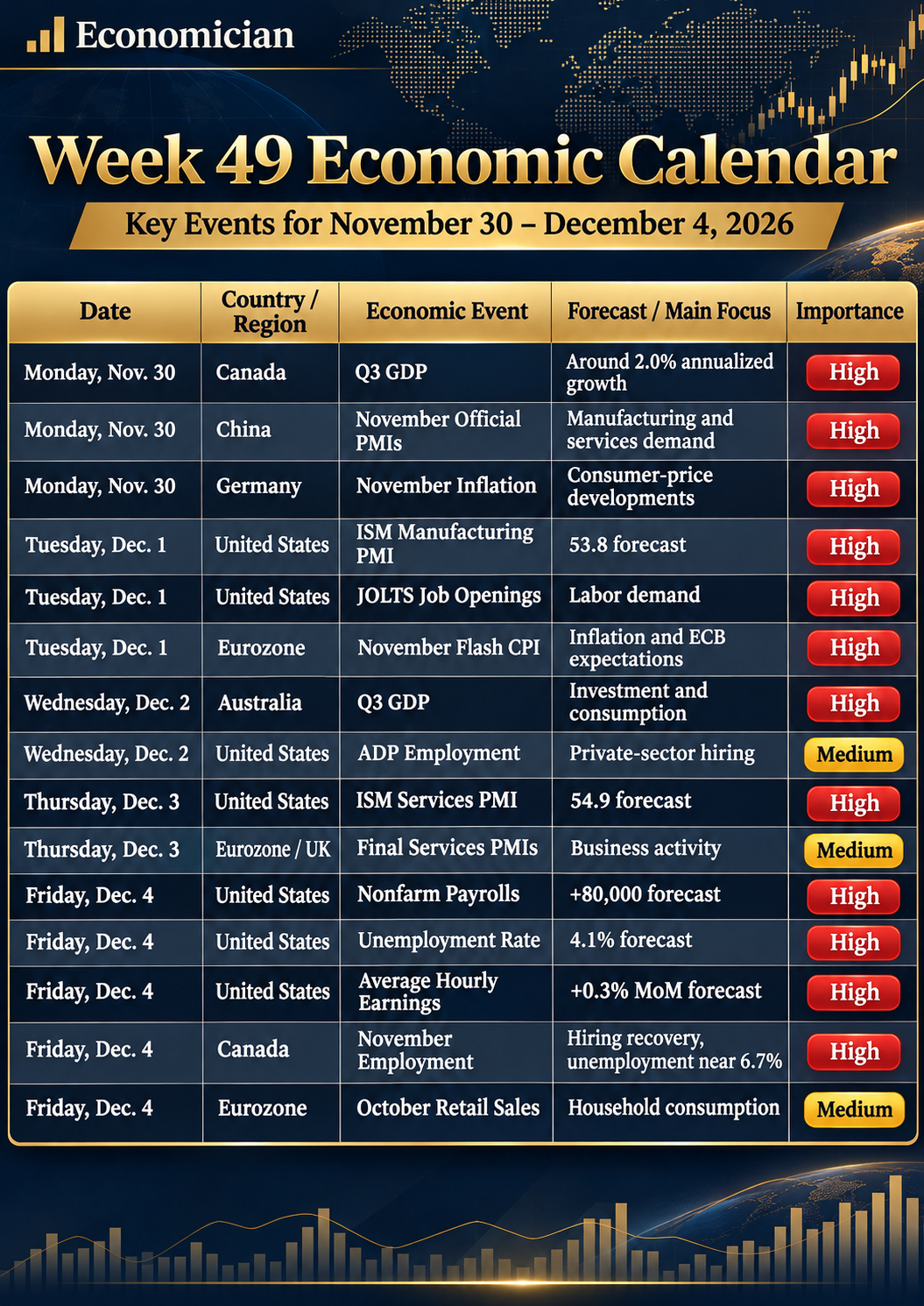
Forecasts for US ISM indicators, employment, and Canadian GDP reflect our baseline analytical scenario and may differ from published consensus estimates.
3. United States Week Ahead: ISM Surveys and Employment Will Shape Fed Expectations
The United States will remain the dominant influence on global financial markets during Week 49.
Following the strong GDP revision and persistent October inflation, investors will focus on whether economic momentum is continuing and whether labor-market conditions remain consistent with restrictive monetary policy.
ISM Manufacturing: Slower Expansion Expected
Tuesday, December 1
We expect the ISM Manufacturing PMI to decline to 53.8 in November from 55.4 in October, suggesting that manufacturing activity continues expanding but at a slower pace. Regional Federal Reserve surveys indicate that industrial momentum has moderated following October's stronger performance. However, weakness remains uneven across industries.
Demand associated with artificial intelligence, data centers, semiconductors, defense, and infrastructure investment continues providing important support to manufacturing.
Other sectors appear more cautious, with customers reluctant to commit to longer-term investment programs amid uncertainty about costs and future demand. The survey's new orders, production, employment, and prices-paid components will therefore be particularly important. Persistent cost pressures associated with tariffs, transportation, fuel, and industrial commodities could complicate the inflation outlook. Even if manufacturing activity slows, inflationary input costs may remain elevated.
Market implications: A stronger-than-expected manufacturing report could support the dollar and Treasury yields. A weak headline reading accompanied by persistent prices-paid inflation could create a more complicated market response.
ISM Services: Moderate Acceleration Expected
Thursday, December 3
The services sector is expected to remain relatively resilient. Our forecast anticipates the ISM Services PMI increasing to 54.9 from 54.5, indicating a modest improvement in activity. The services sector remains particularly important because it accounts for a substantial share of employment and consumer expenditure.
Recent indicators suggest that employment conditions have improved, even as some new orders and business activity measures have moderated. However, longer supplier delivery times can mechanically increase the headline PMI without necessarily indicating stronger underlying demand.
Consequently, the employment, new orders, business activity, and prices-paid components will be important for interpreting the results. A stronger services report accompanied by persistent cost pressures could reinforce expectations that the Federal Reserve will maintain restrictive monetary conditions.
Market implications: Firm services activity and elevated prices could support the dollar. Unexpected weakness in new orders and employment could strengthen expectations of future monetary easing.
US Employment: Payrolls Expected to Increase by 80,000
Friday, December 4
The November employment report is likely to be the week's most influential economic release. We expect nonfarm payrolls to increase by approximately 80,000, broadly consistent with the average pace of employment growth during the preceding six months. October's stronger hiring was partly supported by professional and business services and healthcare employment.
We expect those contributions to moderate in November. Nevertheless, forward-looking labor indicators remain relatively constructive. The Conference Board's labor differential improved significantly in November, while job postings tracked by Indeed have strengthened.
Initial unemployment claims also remain relatively low, suggesting that employers are reluctant to reduce existing workforces. These conditions may indicate a labor market experiencing moderate hiring rather than widespread employment deterioration.
Unemployment and Wage Growth
We expect the unemployment rate to remain at 4.1%, although risks are tilted toward a small increase if the number of unemployed workers does not decline as anticipated. Average hourly earnings are expected to increase by 0.3% month-on-month, placing annual wage growth near 3.0% if the forecast is realized.
Moderate wage growth alongside relatively stable unemployment would suggest that the labor market remains broadly balanced. However, persistent consumer inflation continues to limit real wage growth and household purchasing power. A stronger-than-expected employment report could reinforce expectations of restrictive Federal Reserve policy. Conversely, weaker payrolls accompanied by rising unemployment could increase expectations of monetary easing.
The Federal Reserve Outlook
The combination of strong third-quarter growth, elevated PCE inflation, and relatively resilient employment suggests that the Federal Reserve may remain particularly attentive to inflation risks. Our baseline employment forecast would be consistent with gradual labor-market normalization rather than a severe downturn.
The most important policy question is whether inflation is declining quickly enough to justify lower interest rates without generating renewed price pressures.
US Outlook: Resilient economic activity, moderate employment growth, and persistent inflation support a cautious monetary-policy approach.
4. Canada Week Ahead: GDP and Employment Will Test Economic Resilience
Canada faces an important week as investors evaluate growth, employment, and monetary-policy expectations.
Canada GDP: Third-Quarter Growth Expected Near 2%
Monday, November 30
Our baseline forecast anticipates Canada's third-quarter GDP increasing at approximately 2.0% annualized, moderating from the 3.3% annualized growth recorded during Q2. Statistics Canada's preliminary September estimate suggests a 0.1% monthly contraction, indicating that activity may have weakened toward the end of the quarter.
Despite the expected moderation, growth near 2% would suggest continued economic resilience.
Bank of Canada Governor Tiff Macklem has indicated that economic performance has been modestly better than previously anticipated. However, trade-related uncertainty remains an important challenge.
Renewed US tariffs could affect Canadian exports, manufacturing activity, business investment, and supply chains. The composition of GDP will therefore be as important as the headline growth rate.
Stronger consumption and productive investment would suggest more durable economic momentum, while growth driven by inventories could prove less sustainable.
Market implications: Above-forecast GDP growth could support CAD through stronger economic and interest-rate expectations. A significant disappointment could weaken the currency.
Canada Employment: Hiring Expected to Recover
Friday, December 4
Canadian employment declined by approximately 4,700 in October as lower full-time employment more than offset increased part-time hiring. We expect a modest recovery in November, with unemployment remaining near 6.7%. The broader labor-market picture remains relatively soft but not necessarily deteriorating rapidly.
Hiring has struggled to establish sustained momentum, while slower labor-force growth has helped limit additional upward pressure on unemployment. The composition of employment will be particularly important.
A recovery in full-time employment would provide stronger evidence of improving business confidence and household income prospects.
Conversely, weak hiring combined with rising unemployment could reinforce concerns about domestic demand.
Implications for the Bank of Canada
The GDP and employment reports will help determine whether the Canadian economy remains strong enough to absorb elevated borrowing costs and trade-related challenges. Under our baseline scenario, stronger GDP and stable employment could reinforce the argument for maintaining restrictive monetary conditions.
Combined with persistent inflation, the supplied forecast anticipates the possibility of another Bank of Canada rate increase in December.
However, this remains a conditional forecast rather than a confirmed policy decision.
Canada Outlook: Moderate economic growth and stable but subdued employment conditions, with monetary policy increasingly dependent on inflation and underlying growth resilience.
5. Eurozone Week Ahead: Inflation and Economic Activity in Focus
Europe enters Week 49 with weak economic growth, subdued confidence, and signs of moderating inflation.
The eurozone's November preliminary inflation release will be particularly important for evaluating the European Central Bank's next steps. Recent inflation figures from France and Spain indicate that price pressures have moderated in parts of the monetary union. However, services inflation and producer-price pressures remain important.
A larger-than-expected decline in eurozone headline and core inflation could strengthen expectations of monetary accommodation. Conversely, persistent services inflation could limit the ECB's flexibility even as economic growth remains weak. Final manufacturing and services PMI readings will also help determine whether Germany's stronger business activity can offset weakness in France and other economies.
Investors will focus on new orders, employment, and business expectations. October retail sales will provide additional evidence about household demand.
Eurozone Outlook: Weak growth and easing inflation could create greater scope for monetary accommodation, potentially limiting euro strength relative to the US dollar.
6. Asia-Pacific Week Ahead: China PMIs, Australian GDP and Japanese Monetary Policy
Australia: Q3 GDP Will Test Investment Strength
Australia's third-quarter GDP release on Wednesday, December 2, will help determine whether exceptional capital expenditure translated into stronger overall economic growth. Recent data showed private capital expenditure increasing 12.2% quarterly, while inflation accelerated to 4.9% annually. These developments suggest strong investment but persistent cost pressures.
A stronger-than-expected GDP result could reinforce expectations that the Reserve Bank of Australia will maintain restrictive monetary conditions. However, weaker consumption or disappointing overall growth would complicate that outlook.
AUD outlook: Cautiously bullish, supported by elevated inflation and strong investment, but sensitive to GDP surprises.
China: Manufacturing Surveys Will Reveal Demand Conditions
China's November manufacturing and non-manufacturing PMIs will provide important information about industrial demand, production, employment, and business expectations. Investors will watch whether manufacturing activity strengthens after previous readings indicated relatively weak factory conditions.
A recovery in new orders and production could support confidence in Chinese economic growth and global industrial demand. However, continued weakness would suggest that strong performance in selected export-oriented industries has not translated into a broad-based recovery.
The results will also influence expectations for industrial commodities and currencies exposed to Chinese demand.
Japan: Inflation Keeps Monetary Policy in Focus
Japan enters December with persistent consumer and corporate services inflation. Tokyo core inflation reached 2.9% in November, while corporate services inflation increased to 4.2% annually in October.
These developments could support expectations of additional monetary tightening by the Bank of Japan. However, services activity has moderated, creating uncertainty about the strength of domestic demand.
Investors will therefore monitor capital spending, labor-market conditions, and central-bank communication.
JPY outlook: Neutral to cautiously bullish, particularly if inflation and economic activity reinforce expectations of monetary-policy normalization.
7. Commodity Market Outlook: Oil, Gold and Industrial Metals
Crude Oil: Supply Balances and Global Demand Remain Decisive
Oil markets enter Week 49 following mixed US inventory data. The previous EIA report showed crude stocks increasing by less than expected, although gasoline and distillate inventories also rose.
The upcoming API and EIA reports will help determine whether crude inventories are tightening or continuing to accumulate.
OPEC+ production policy, geopolitical developments, and global demand expectations will remain important.
China's manufacturing surveys and US ISM indicators could also influence expectations for petroleum demand.
WTI and Brent outlook: Neutral, with increased sensitivity to inventory surprises and global supply developments.
Gold: US Employment and Treasury Yields Take Center Stage
Gold will be particularly sensitive to Friday's US employment report. Strong payrolls and wage growth could support the dollar and Treasury yields, increasing the opportunity cost of holding gold. Conversely, weaker employment conditions could reinforce expectations of monetary easing and provide support for precious metals. The relationship between inflation, real Treasury yields, and the dollar will remain central to gold's short-term direction.
Gold outlook: Neutral ahead of NFP, with volatility likely around employment and ISM releases.
Silver and Industrial Metals
Silver combines the characteristics of a precious metal and an industrial commodity. Consequently, it may respond both to US interest-rate expectations and to manufacturing developments in China and other major economies. Stronger industrial activity could support expectations for silver and copper demand. However, weak manufacturing data or rising real yields could offset these positive influences.
8. Global Financial Market Outlook: Week 49
The following table summarizes the fundamental implications of the expected economic developments.
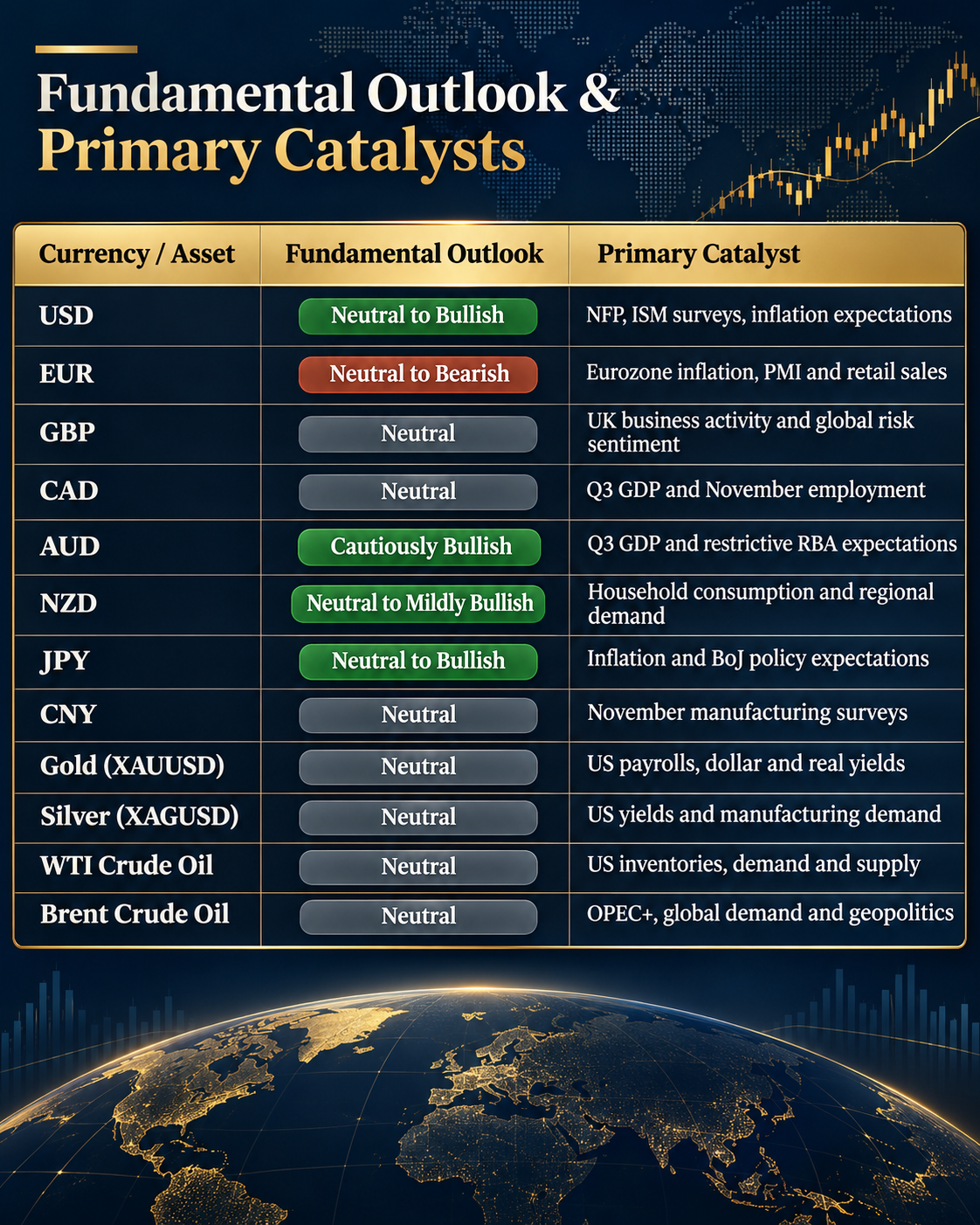
These assessments represent conditional fundamental expectations rather than confirmed technical trading signals.
Three Key Market Scenarios
Scenario 1: Strong US Growth and Persistent Inflation
If manufacturing and services activity remain strong, payrolls exceed expectations, and wage growth accelerates, markets may anticipate a more restrictive Federal Reserve policy stance. Such an outcome could support the dollar and Treasury yields while placing pressure on gold and interest-rate-sensitive assets.
Scenario 2: Moderate Growth and Controlled Labor-Market Cooling
If US payrolls rise around 80,000, unemployment remains near 4.1%, and ISM surveys indicate continued expansion without accelerating costs, expectations of gradual economic normalization could strengthen. This would be broadly consistent with a resilient economy that is no longer overheating.
Scenario 3: Weaker Economic Activity and Rising Unemployment
If US and Canadian employment reports disappoint significantly, while manufacturing indicators deteriorate, investors could increase expectations of monetary easing. Government bonds and defensive assets may benefit, although equities could face pressure from weaker growth expectations.
Final Outlook: Can Global Growth Remain Resilient Without Renewing Inflation?
Week 49, 2026, represents an important test of the global economy's resilience as financial markets enter the final month of the year. The previous week's data highlighted several important contrasts.
The United States demonstrated strong growth but continued facing elevated inflation. Europe struggled with weak economic activity and declining confidence, while Australia recorded substantial investment alongside accelerating prices. In the United States, the ISM surveys and November employment report will be decisive for expectations of growth, inflation, and Federal Reserve monetary policy.
Asia remained an important source of industrial growth, especially in technology-intensive economies, although monetary-policy conditions varied considerably between countries.
The coming week will determine whether these differences are beginning to narrow or becoming more persistent.
Canada's GDP and employment data will test the economy's ability to absorb trade-related headwinds.
Eurozone inflation will influence expectations about ECB policy flexibility, while Australian GDP and Chinese manufacturing indicators will provide important information about the strength of global investment and industrial demand.
For financial markets, the most important variables will be US labor-market resilience, inflation persistence, real Treasury yields, and differences between major central banks' policy expectations.
Our baseline outlook is for continued but increasingly uneven global economic growth, with inflation remaining the principal constraint on monetary-policy flexibility.
The results of Week 49 may therefore play an important role in determining how currencies, government bonds, equities, and commodities perform during the final weeks of 2026 and the beginning of 2027.
Frequently Asked Questions (FAQ)
What are the most important economic events in Week 49 of 2026?
The most influential scheduled releases are the US ISM Manufacturing PMI on December 1, ISM Services PMI on December 3, and November Nonfarm Payrolls on December 4. Canadian GDP and employment, eurozone inflation, Australian GDP, and Chinese manufacturing surveys are also important.
What is the forecast for US Nonfarm Payrolls in November 2026?
Our baseline forecast anticipates an increase of approximately 80,000 jobs, with unemployment remaining at 4.1% and average hourly earnings rising by 0.3% month-on-month.
What are the expectations for US ISM Manufacturing and Services in November 2026?
We expect ISM Manufacturing to moderate to 53.8 from 55.4, while ISM Services is forecast to increase to 54.9 from 54.5. Both readings would indicate continued expansion.
How strong was US economic growth in the third quarter of 2026?
The US economy expanded at an annualized rate of 4.3% in Q3 2026, exceeding the previous estimate of 3.4% and accelerating from the second quarter.
Why is the Federal Reserve facing a difficult monetary-policy decision?
Strong economic growth and relatively stable employment conditions suggest that the economy remains resilient, while persistent core inflation limits the scope for rapid interest-rate reductions.
What is the outlook for Canada's economy in Week 49?
Our baseline anticipates approximately 2.0% annualized Q3 GDP growth, followed by a modest recovery in November hiring and unemployment near 6.7%. Both releases will influence expectations for Bank of Canada monetary policy.
What is the outlook for the euro in December 2026?
The euro faces a neutral-to-bearish fundamental outlook because of weak European growth and improving disinflation. However, its direction will depend on incoming economic data and relative ECB–Federal Reserve policy expectations.
How could the US employment report affect gold prices?
Stronger employment and wage growth could support the dollar and real Treasury yields, potentially weighing on gold. Weaker employment data could increase expectations of monetary easing and support gold prices.
Why is Australia's economy important to global markets this week?
Australia's Q3 GDP report will help determine whether strong capital investment is supporting broader growth despite elevated inflation. The results could influence RBA expectations, the Australian dollar, and commodity-related market sentiment.
What is the overall global economic outlook for Week 49, 2026?
The baseline outlook anticipates continued but uneven global expansion, persistent inflation pressures, divergent central-bank policy expectations, and elevated sensitivity to US employment and business-activity data.
 Global Economic Outlook — Week 49, 2026: US Jobs, Inflation and Central Bank Policy in Focus
 Global Economic Outlook – Week 48, 2026: US Consumer Strength, Australian Inflation, and Growing Global Economic Divergence
 Global Economy Review: Growth, Inflation & Markets | November 2026
 Global Economic Outlook for Week 34 of 2026: Key Data, Central Banks and Market Risks
 Global Economic Outlook August 2026: Markets and Risks
 Global Economic Outlook and Analysis, Week 33, 2026: Inflation Tests Markets
 United States Economic Outlook — August 2026: Resilience with Less Room for Error
 Global Economic Outlook for August 3–8, 2026: U.S. Jobs, Oil Risks and Central Banks
 Global Economic Outlook: July 26–31, 2026
 Global Economic Outlook for July 20–25, 2026: ECB, PMIs and the Oil Shock Test the Disinflation Story
 UK Economic Outlook for July 2026: June Economic Review, Bank of England Outlook, Inflation, GDP & FTSE 100 Analysis
 Japan Economic Review & Outlook: June 2026 Review and July 2026 Forecast | BOJ, Yen, Inflation & Growth