
 English
 پارسی


Policy divergence deepens as oil keeps global inflation risk alive
Week of August 17-23, 2026 | Previous-week review: August 10-14
Executive Summary
The global economy enters Week 34 with a more fragmented policy map and a narrower margin for error. Softer U.S. employment, inflation and retail data have shifted the Federal Reserve debate away from an immediate additional increase and toward how long rates should remain unchanged. Europe and Japan, however, are moving in the opposite direction: firmer growth, imported energy inflation and currency pressure leave the European Central Bank, Bank of England and Bank of Japan with reasons to keep tightening options open. China remains the main large-economy demand concern, as weak credit appetite and soft surveys point to slower momentum at the start of the third quarter.
The week ahead will test each part of that divergence. FOMC minutes and U.S. housing starts will show whether the Fed's patient stance can survive another round of rate-sensitive weakness. U.K. labor and inflation data will determine whether resilient activity and a renewed energy shock justify further Bank of England restraint. Japan's GDP and CPI figures could strengthen the case for another BoJ increase, while China's retail sales and industrial production will reveal whether promised fiscal acceleration is reaching the real economy. Canadian CPI should offer a useful counterexample if core inflation remains near 2% despite energy volatility.
Central view: The base case is a cautiously constructive but fragile risk environment: no synchronized global recession, no synchronized recovery, and no uniform central-bank pivot. Asset performance is therefore likely to depend more on country exposure, duration, and energy sensitivity than on a single global growth trade.
The Starting Point: What Changed Last Week
United States: the debate shifted from another hike to a longer hold
The United States delivered the most important change in global rate expectations during the week ending August 14. July inflation was relatively benign, producer prices were unchanged, and retail sales unexpectedly fell 0.6% month on month - the first decline in nine months and the largest in 14 months. The GDP-sensitive control group fell 0.4%, while preliminary University of Michigan consumer sentiment declined to 51.0 from 55.2. Together with weak July employment and slower wage growth, these releases materially lowered the urgency for another near-term Fed increase.
By the end of the week, markets assigned about a 67% probability to no change in September and 33% to another increase. Equities initially welcomed that repricing: the S&P 500 reached a record closing level of 7,798.99 on Thursday and still gained 0.4% over the week, while the Nasdaq added 0.1%. Yet the 10-year Treasury yield remained near 4.69%, showing that softer expectations for the policy rate have not removed concern about fiscal borrowing, bond supply and longer-run inflation. This split between a more patient Fed and stubborn long yields is central to the Week 34 outlook.
Europe and the United Kingdom: better growth, less policy comfort
Eurozone GDP rose 0.4% quarter on quarter in Q2, employment edged higher, and the goods trade balance returned to an EUR 8.6 billion surplus in June. The recovery is uneven - industrial production was unchanged - but growth has been resilient enough to keep attention on inflation. With July inflation at 2.9% and energy costs rising, 83% of economists in a cited poll expected the ECB to lift the deposit rate by 25 basis points to 2.50% in September. The STOXX 600 lost 0.3% over the week, although it remained close to its record and was supported by an earnings season pointing to a 23.4% increase in aggregate Q2 profits.
The U.K. also surprised positively. GDP increased 0.3% in June and 0.4% in Q2, with services, consumption and business investment providing support. That resilience kept the BoE tightening debate alive even as the second-half outlook became less secure. Higher energy costs, weaker labor demand and the fading contribution of temporary supports mean that the Bank faces the uncomfortable combination of slower forward growth and renewed headline inflation.
China and Japan: opposite policy problems
China's July new yuan lending contracted by a record CNY 340 billion, including a CNY 460.3 billion fall in household loans. Loan growth slowed to a record-low 5.1% year on year, and M2 growth fell to a 16-month low of 7.7%. The problem is not simply a lack of liquidity: households and businesses remain unwilling to borrow despite lower financing costs. Beijing has promised faster use of approved fiscal funds, but the preference remains targeted support rather than a broad stimulus surge.
Japan is dealing with the reverse problem. The BoJ is concerned that a weak yen, high producer prices, strong AI-related demand and expensive energy could keep inflation above target. Markets ended last week pricing close to an 80% chance of a September increase, while the yen remained near JPY 159.33 per dollar and close to the psychologically important 160 area. Further Japanese normalization matters beyond the yen because it can change carry-trade economics and international demand for U.S. and European assets.
Oil and capital flows: the common global transmission channel
Brent ended Friday at USD 88.52 per barrel after gaining about 6% over the week, while WTI closed at USD 82.40 and rose about 5.4%. Restricted tanker traffic through the Strait of Hormuz and disruption at Russia's Novorossiysk export terminal maintained a large supply premium. Demand downgrades from OPEC and the IEA, together with higher U.S. inventories, limited the rally, but oil near USD 90 is already high enough to threaten disinflation and squeeze energy importers.
Financial flows nevertheless remained constructive. Global equity funds attracted USD 18.62 billion through August 12, bond funds received USD 18.01 billion, and emerging-market equity funds recorded a fifth consecutive week of inflows. Technology funds experienced outflows while gold funds attracted new capital. Investors were rotating risk rather than abandoning it - a pattern consistent with a late-cycle expansion that is becoming more selective.
Week 34 Global Macro Calendar
The week's releases are concentrated in the first three trading days, with Japan's national CPI providing a final policy test on Friday. The calendar matters less as a collection of isolated numbers than as a test of whether monetary-policy divergence is becoming stronger or beginning to converge.
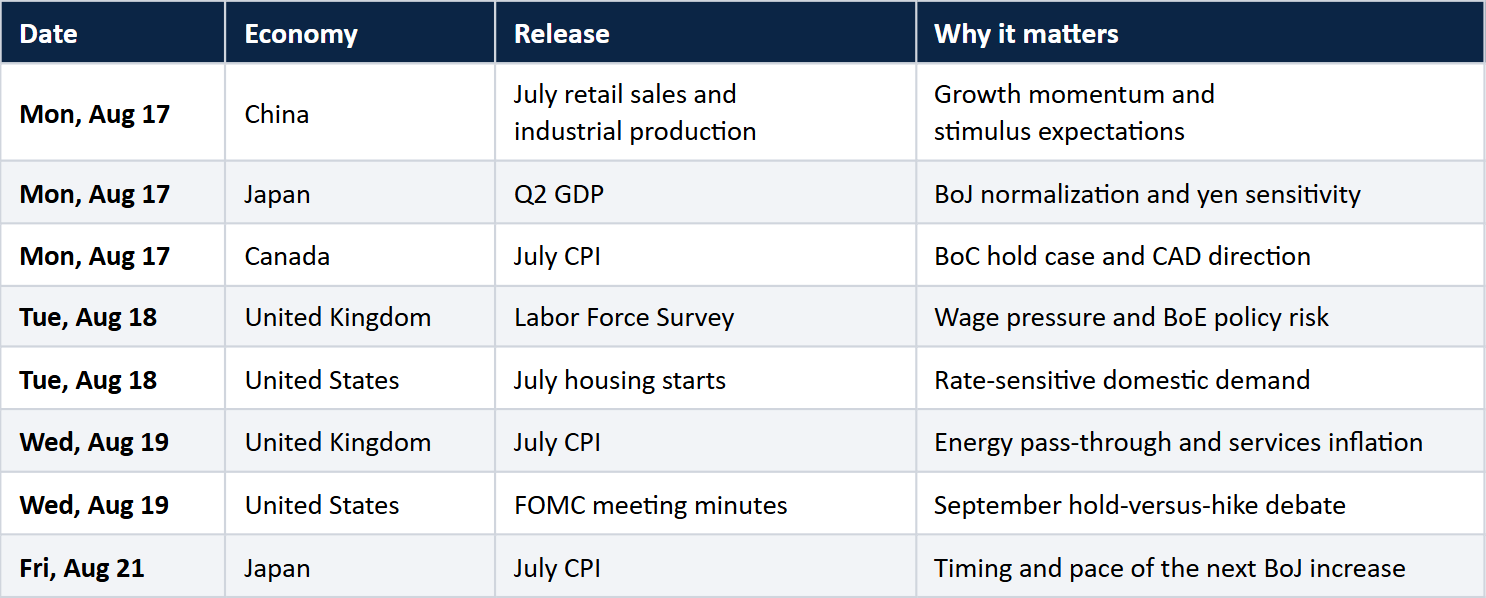
Calendar and forecasts reflect the supplied Week 34 briefing material.
United States Outlook: Patience From the Fed, Pressure on Housing
- Housing starts - Tuesday
Residential construction is likely to show renewed weakness after June's upside surprise. The previous increase was driven mainly by the volatile multifamily segment, while single-family starts have generally trended lower. Building permits and builder confidence remain soft, mortgage rates continue to damage affordability, and buyers are facing slower real-income growth and a less dynamic labor market. Builders are also contending with high construction costs, skilled-labor shortages, and elevated inventories relative to sales.
The supplied forecast expects total starts to fall to a 1.322 million annualized pace in July. A result near or below that estimate would reinforce the view that restrictive financing conditions are working through rate-sensitive domestic demand. It would be supportive for shorter-dated Treasuries and defensive equity sectors, but it would also add to concern that the consumer and housing cycle are weakening together. A meaningful upside surprise would challenge the recent dovish rate repricing, particularly if long yields remain elevated.
- FOMC minutes - Wednesday
The July FOMC minutes should show that most officials preferred patience while retaining a relatively low bar for further action if inflation stopped improving. Investors will search for concrete guideposts: whether policymakers focused more on the pace or composition of inflation, how they judged tariff, energy and AI-related price pressure, and what combination of labor and inflation data would justify a September increase.
The minutes are already partly dated. Since the meeting, employment growth and wages have softened, July inflation has offered evidence that several temporary price impulses may have peaked, retail sales have weakened, and oil prices are roughly unchanged from the meeting period despite continued Hormuz uncertainty. The median policymaker may therefore be somewhat more dovish today than the written record implies. The most likely interpretation is not an imminent easing cycle but a longer hold, with the next employment and inflation reports determining the September decision.
U.S. market implication: A patient set of minutes would favor the front end of the Treasury curve, gold and rate-sensitive equities. The benefit to broader risk assets will be limited if the 10-year yield stays high or if investors conclude that the Fed is pausing because demand is deteriorating too quickly.
Canada Outlook: Headline Noise, Benign Core Inflation
Canada's inflation picture remains more contained than the headline rate alone suggests. June CPI slowed to 2.8% from 3.2%, and the average of the trimmed-mean and median measures fell below 2% for the first time in several years. Inflation breadth has improved, consumer expectations remain reasonably anchored, and modest domestic demand has limited second-round pressure.
Headline CPI is expected to edge up to 2.9% in July as gasoline prices recover from June's decline, while core measures remain close to 2%. That combination should allow the Bank of Canada to look through energy-driven volatility and remain on hold. A benign core reading would reduce upside pressure on Canadian yields, although the Canadian dollar's response may depend as much on oil prices and the global dollar as on domestic CPI. The risk case would be a broader increase in services or core inflation that undermines the view that the energy shock is temporary.
United Kingdom and Eurozone Outlook: Inflation Re-enters the Foreground
- U.K. labor data - Tuesday
The labor report is likely to show subdued hiring conditions and slower wage growth, although strong public-sector pay may limit the moderation. For the BoE, the composition matters: softer private-sector wages would suggest that restrictive policy is cooling domestic inflation, while persistent services-sector pay pressure would support the case for keeping rates higher for longer. Sterling is therefore vulnerable to a two-sided reaction - weaker employment can hurt the growth outlook, but softer wages can also reduce the probability of further tightening.
- U.K. CPI - Wednesday
Headline CPI is expected to rise to 3.1% year on year and 0.5% month on month in July from 2.6% in June, mainly because of a 13% increase in the Ofgem energy price cap. Lower petrol prices and continued food disinflation should partly offset that move. Core inflation is expected to hold at 2.6%, while services inflation remains elevated at 3.5%.
This is a difficult mix for the BoE. A mechanical energy-driven rise does not automatically require another increase, especially if labor conditions weaken. Yet elevated services inflation, stronger-than-expected first-half growth and the risk that food and energy costs lift expectations keep second-round effects on the policy agenda. Another increase later in 2026 remains possible, but the Bank will need evidence that inflation is broadening beyond regulated energy prices.
- Eurozone read-through
The Eurozone has no equally dominant release in the supplied calendar, but the U.K. CPI report, oil prices and global bond yields will shape the regional debate. The ECB enters the week with stronger growth evidence and less confidence in the disinflation path. If energy remains expensive and U.K. services inflation proves sticky, investors may reinforce expectations for a September ECB increase. If oil retreats and global demand signals weaken, the case for additional tightening would become less comfortable despite Q2 resilience.
European market implication: Policy divergence can support the euro and sterling against the dollar, but higher rates are a headwind for domestic cyclicals and long-duration equities. European earnings remain an important cushion, so the more attractive setup may be selective rather than index-wide.
Japan Outlook: GDP and CPI Could Validate Further BoJ Normalization
- Q2 GDP - Monday
Japan's economy is expected to grow 0.6% quarter on quarter, equivalent to 2.4% annualized, supported by improving business activity, stronger machine-tool orders and continued AI-related investment demand. Household consumption probably remained subdued despite better real wages, while higher oil prices likely weighed on net trade. Strong demand for AI-related goods should have limited that drag.
A result around the forecast would give the BoJ more confidence that the economy can tolerate further normalization. The quality of growth will be crucial: business investment-led expansion supports tightening more clearly than an inventory or export-driven surprise, while stronger household consumption would make the domestic demand case more convincing.
- National CPI - Friday
Headline CPI is expected to rise to 2.0% year on year in July, while inflation excluding fresh food and energy is forecast at 1.9%. The expected pickup follows a similar increase in Tokyo CPI, which often provides an early signal for nationwide prices. A firm result would strengthen the argument that the weak yen and imported costs are feeding into a more durable inflation process.
The source forecast sees the policy rate reaching 1.25% in Q4, while market pricing already assigns a high probability to a September move. Week 34 data will help determine whether those views converge. Strong GDP and CPI data could bring the next interest rate increase forward and support the yen, but they could also trigger volatility in global carry trades and foreign bond markets. Weak consumption or a soft core reading would favor a slower path and could allow USD/JPY to retest the 160 area, with intervention risk rising as it does.
China Outlook: The Key Test of Global Demand
- Retail sales and industrial production - Monday
China's July activity data should clarify whether the loss of momentum visible in credit and survey data is spreading through the real economy. Consensus expectations point to industrial production slowing to 5.0% year on year from 5.3%, while retail sales improve to 1.5% from 1.0%. The official PMIs, however, warrant caution: manufacturing fell to 49.2 from 50.3, and non-manufacturing declined to 49.0 from 50.2, placing both below the 50 threshold associated with expansion.
The main risk is that both production and consumption underperform, confirming that Q3 began with weaker domestic momentum after softer Q2 consumption and investment. Authorities have pledged to accelerate spending on previously approved infrastructure, but weak household confidence, subdued inflation, property-sector stress and private-sector reluctance to borrow continue to constrain transmission. The supplied medium-term forecast expects GDP growth of 4.5% in 2026 and 4.3% in 2027.
For global markets, the composition of China's data matters. Weak retail demand would be negative for consumer exporters and commodity demand, while resilient industrial production could still support Asian supply chains and technology-linked exporters. A broad downside surprise would increase expectations for targeted PBOC support and faster fiscal execution, but the immediate market reaction could still be risk-negative if investors see stimulus as too gradual.
China market implication: A weak report is not automatically bullish because of expected stimulus. Markets will distinguish between policy announcements and evidence that households and private businesses are actually willing to spend and borrow.
Emerging Markets: A Selective Opportunity Set
A softer dollar and a more patient Fed are helpful for emerging-market assets, and recent fund flows confirm renewed investor interest. Yet oil has created a sharper divide between exporters and import-dependent economies. Countries with strong reserve buffers, credible policy frameworks and external surpluses are better placed to benefit from dollar weakness. Economies with high energy import bills, fragile currencies or large refinancing needs remain exposed to high oil prices and stubborn U.S. long yields.
The previous week illustrated that dispersion. India's reserves rose to USD 707 billion, providing a larger buffer against currency volatility and expensive energy. Brazil's annual inflation slowed to 4.44% and returned within the central bank's tolerance range, although policy remains restrictive. South Africa's unemployment rate climbed to 33.6%, highlighting deep domestic weakness, while Argentina's monthly inflation rose to 2.1% and annual inflation to 33.8%. Week 34 should therefore favor country selection over a broad emerging-market beta trade.
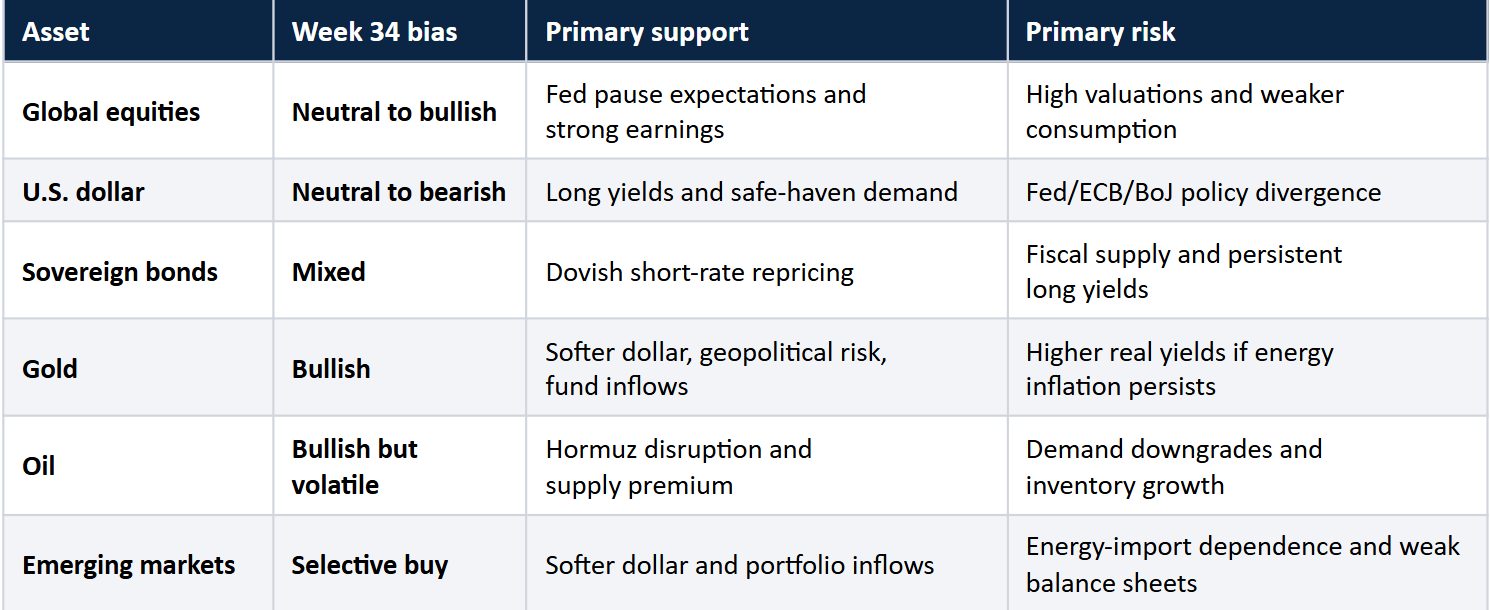
Cross-Asset Market Outlook for Week 34
Energy-import dependence and weak balance sheets
Biases are conditional analytical views derived from the supplied macro and market data, not investment advice.
- Global equities
The near-term bias remains neutral to bullish because the reduced probability of another immediate Fed increase, strong earnings and AI-linked capital expenditure continue to support valuations. The vulnerability is that the economic weakness behind the Fed pause may eventually damage revenues. U.S. indices remain the clearest expression of the AI cycle, but high expectations make even solid corporate results vulnerable to disappointment. European equities offer more valuation and earnings diversification, although they face a more hawkish central bank and greater energy sensitivity.
- Currencies and sovereign bonds
The dollar's short-term bias is neutral to bearish as the Fed becomes more patient while the ECB and BoJ retain tightening options. High U.S. long yields and geopolitical demand prevent a simple bearish dollar call. In bonds, the front end can benefit from lower policy-rate expectations, but longer maturities remain exposed to fiscal supply and energy-driven inflation. The yield curve may therefore communicate more than the direction of headline yields: a steepening driven by falling short yields but sticky long yields would confirm the current policy-fiscal split.
- Gold and oil
Gold remains supported by softer U.S. rate expectations, a weaker dollar, geopolitical uncertainty and new investment inflows. The main challenge would be an energy-driven rise in inflation expectations that pushes real yields higher. Oil retains a bullish but volatile bias while Hormuz traffic remains constrained. Brent near USD 88.52 contains a substantial geopolitical premium, but demand downgrades and rising inventories cap the upside. A sustained break above USD 90 would materially worsen the inflation outlook for Europe, Japan and energy-importing emerging markets.
Scenario Framework
- Base case - policy divergence without a global break
U.S. housing remains soft and the FOMC minutes support a September hold, while U.K. and Japanese inflation remain firm enough to preserve later tightening risk. China's data are weak but not disorderly, and oil remains elevated without a new supply shock. In this environment, equities can grind higher selectively, the dollar stays under moderate pressure, gold remains supported, and bond performance is strongest at shorter maturities.
- Constructive case - softer oil and stable growth
Hormuz conditions improve, oil retreats, U.S. data stabilize rather than collapse, and China's activity numbers show that fiscal spending is reaching production and consumption. Europe and Japan retain credibility without needing aggressive tightening. This would be the best combination for real incomes, global equities, emerging-market inflows and a broader decline in yields.
- Adverse case - stagflationary squeeze
Oil rises above USD 90 as shipping disruption worsens, while U.S. housing and consumption continue weakening. U.K. and Japanese inflation surprise higher, forcing their central banks to remain hawkish, and China's activity undershoots. The result would be slower global demand with persistent headline inflation - negative for broad equities and energy importers, supportive for oil and gold, and difficult for long-duration bonds because growth weakness and inflation risk would pull yields in opposite directions.
What Investors Should Watch Most Closely
The most important signal will not be any single release. It will be the interaction among three variables: U.S. demand, imported energy inflation and central-bank reaction functions. If U.S. data weaken while oil stays high, the Fed's room to support growth will remain limited. If Japan tightens into a stronger yen, global carry trades may unwind even while the Fed pauses. If China disappoints without a forceful policy transmission, commodity and manufacturing demand will remain vulnerable.
For that reason, Week 34 should be approached as a confirmation week. The FOMC minutes will confirm whether patience is the dominant U.S. policy stance. U.K. and Japanese inflation will confirm whether energy and currency pressures are broadening. China's activity data will confirm whether fiscal support is reaching domestic demand. The clearer those signals become, the more durable the current cross-market rotation is likely to be.
Conclusion
The global economy is entering the week of August 17-23, 2026 without a synchronized recession, but also without a synchronized recovery. U.S. momentum is cooling enough to favor a Fed pause; Europe and Japan remain resilient or inflation-prone enough to preserve tightening risk; China is struggling to convert easy financial conditions into stronger private demand; and emerging markets are splitting along energy and balance-sheet lines.
This fragmentation keeps the investment backdrop cautiously constructive but fragile. Strong earnings, AI investment and portfolio inflows can continue supporting risk assets, while a softer short-rate outlook favors gold, selected bonds and some non-dollar currencies. Yet high long-term yields, expensive oil and weaker consumption limit the margin for error. Week 34 will therefore be less about whether the world economy is simply strong or weak and more about which economies can absorb tighter financial and energy conditions without losing growth.
FAQ
1. What is the global economic outlook for Week 34 of 2026?
The global economy remains resilient but uneven during August 17–23, 2026. US growth is losing some momentum, inflation risks remain visible in the UK and parts of Europe, Japan may provide evidence of stronger economic activity, and China continues to face questions about the strength of domestic demand. These differences are creating divergent monetary-policy and market expectations.
2. What are the most important economic events to watch this week?
The main events include the release of the FOMC meeting minutes, US housing starts and building permits, UK labour-market and inflation reports, Canadian CPI, Japan’s second-quarter GDP and national CPI, and China’s retail-sales and industrial-production data. These releases could materially affect interest-rate expectations, bond yields and currency markets.
3. Why are the FOMC minutes important for financial markets?
The FOMC minutes may reveal how Federal Reserve officials assess inflation, employment and the appropriate timing of future policy changes. Investors will look for signs of whether policymakers favour an extended pause or are becoming more open to lower interest rates. The interpretation could influence the US dollar, Treasury yields, gold and global equities.
4. What could affect the US dollar during Week 34?
The dollar will be influenced by the FOMC minutes, US housing data, Treasury yields and changes in global risk sentiment. A patient or relatively dovish Federal Reserve message could limit the dollar’s upside, while persistent inflation concerns or strong economic data could support renewed demand for the currency.
5. Why is UK inflation a major market risk this week?
UK headline inflation is expected to rise partly because of higher regulated energy prices, while services inflation may remain elevated. Persistent price pressures could encourage the Bank of England to keep interest rates higher for longer, supporting sterling but creating additional pressure on households, housing and interest-rate-sensitive sectors.
6. What should investors expect from Japan’s economic data?
Japan’s second-quarter GDP may show that business investment, machinery orders and external demand supported growth. National CPI could also indicate whether inflation is becoming more persistent. Strong GDP and inflation data would reinforce expectations that the Bank of Japan can continue gradually normalising monetary policy.
7. Why are China’s retail-sales and industrial-production reports important?
The reports will help determine whether weaker confidence and domestic demand are spreading into the real economy. Stronger industrial production could support Asian exporters and commodity demand, but weak retail sales would signal that households remain cautious and that additional policy support may be necessary.
8. What are the main market scenarios for the week?
The base scenario is a soft but orderly global slowdown, with selective equity gains, a mildly pressured dollar and support for gold. A more positive scenario would involve lower oil prices, stronger Chinese activity and easing inflation. The negative scenario would combine an energy-price shock, persistent inflation, weaker consumption and more restrictive central-bank policies.
9. Which assets may benefit from a relatively dovish Federal Reserve?
Gold, short-duration government bonds, selected growth and technology shares, and some emerging-market assets could benefit if markets anticipate lower US interest rates. However, the effect will depend on whether policy easing reflects improving inflation or a more serious deterioration in economic growth.
10. What is the biggest risk facing global markets in Week 34?
The principal risk is the interaction between weaker demand, persistent energy-related inflation and central-bank responses. If inflation remains elevated while economic activity deteriorates, policymakers will have less room to support growth, increasing the probability of volatility across equities, bonds, currencies and commodities.
 Global Economic Outlook for Week 34 of 2026: Key Data, Central Banks and Market Risks
 Global Economic Outlook August 2026: Markets and Risks
 Global Economic Outlook and Analysis, Week 33, 2026: Inflation Tests Markets
 United States Economic Outlook — August 2026: Resilience with Less Room for Error
 Global Economic Outlook for August 3–8, 2026: U.S. Jobs, Oil Risks and Central Banks
 Global Economic Outlook: July 26–31, 2026
 Global Economic Outlook for July 20–25, 2026: ECB, PMIs and the Oil Shock Test the Disinflation Story
 UK Economic Outlook for July 2026: June Economic Review, Bank of England Outlook, Inflation, GDP & FTSE 100 Analysis
 Japan Economic Review & Outlook: June 2026 Review and July 2026 Forecast | BOJ, Yen, Inflation & Growth
 Eurozone Economic Outlook for July 2026: Growth, Inflation, ECB Policy & Market Outlook
 Emerging Economies Economic Outlook for July 2026: Growth, Inflation, Central Banks & Market Outlook
 Chinese Economic Outlook July 2026: GDP, PMI, Inflation, Yuan and Market Risks