 English
 پارسی


U.S. Economic Review, March 2026
Slower Growth, Sticky Inflation, and a Cautious Fed
The U.S. economy in March 2026 remained in expansion, but the overall picture became less comfortable than before. Growth slowed, yet domestic demand did not collapse. At the same time, inflation stayed sticky in several key areas, labor-market signals softened, and the Federal Reserve remained far from an easy path toward rapid easing. The broad conclusion is that the U.S. economy is still moving forward, but it is doing so in a more fragile, uneven, and policy-sensitive manner than in late 2025.
Labor market: still functioning, but less reassuring
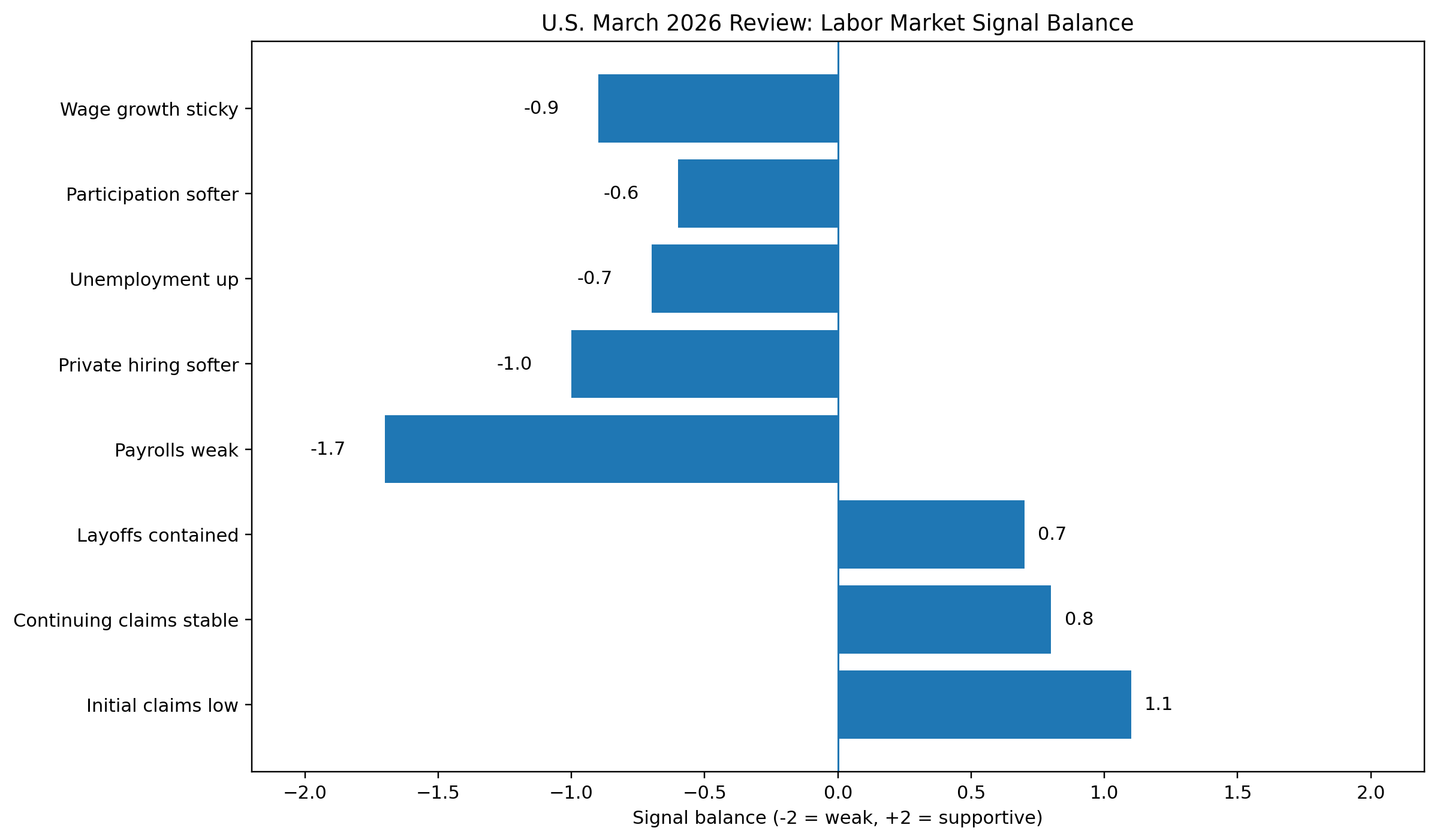
The labor market remained one of the economy’s main stabilizers, but its trend became less convincing over the month. On the supportive side, initial jobless claims stayed relatively low, continuing claims did not suggest a collapse, and layoffs remained contained in several weekly readings. However, the most important downside surprise came from a weak payrolls report, including negative nonfarm payroll growth, softer private hiring, a slight rise in unemployment, and weaker labor-force participation. At the same time, wage growth remained firm enough to matter for inflation. That means labor is no longer only a source of resilience; it is also part of the inflation and policy problem. The key question for the next month is whether payroll weakness was temporary or the beginning of a broader cooling phase.
Consumers: resilient, but increasingly selective
Consumer spending held up better than some of the softer headlines suggested. Retail sales were mixed, but firmer control-group and ex-auto/ex-gas readings implied that the most GDP-relevant parts of consumption remained relatively stable. Personal spending continued to rise, although real consumption improved much more modestly, showing that inflation is still eroding part of nominal household purchasing power. At the same time, sentiment and inflation expectations stayed cautious, showing that households remain uneasy about the outlook. The main message is that consumers are still spending, but they are becoming more price-sensitive, more selective, and less confident. That points to slower consumption growth, not a sudden consumer collapse.
Inflation: progress, but the last mile remains difficult
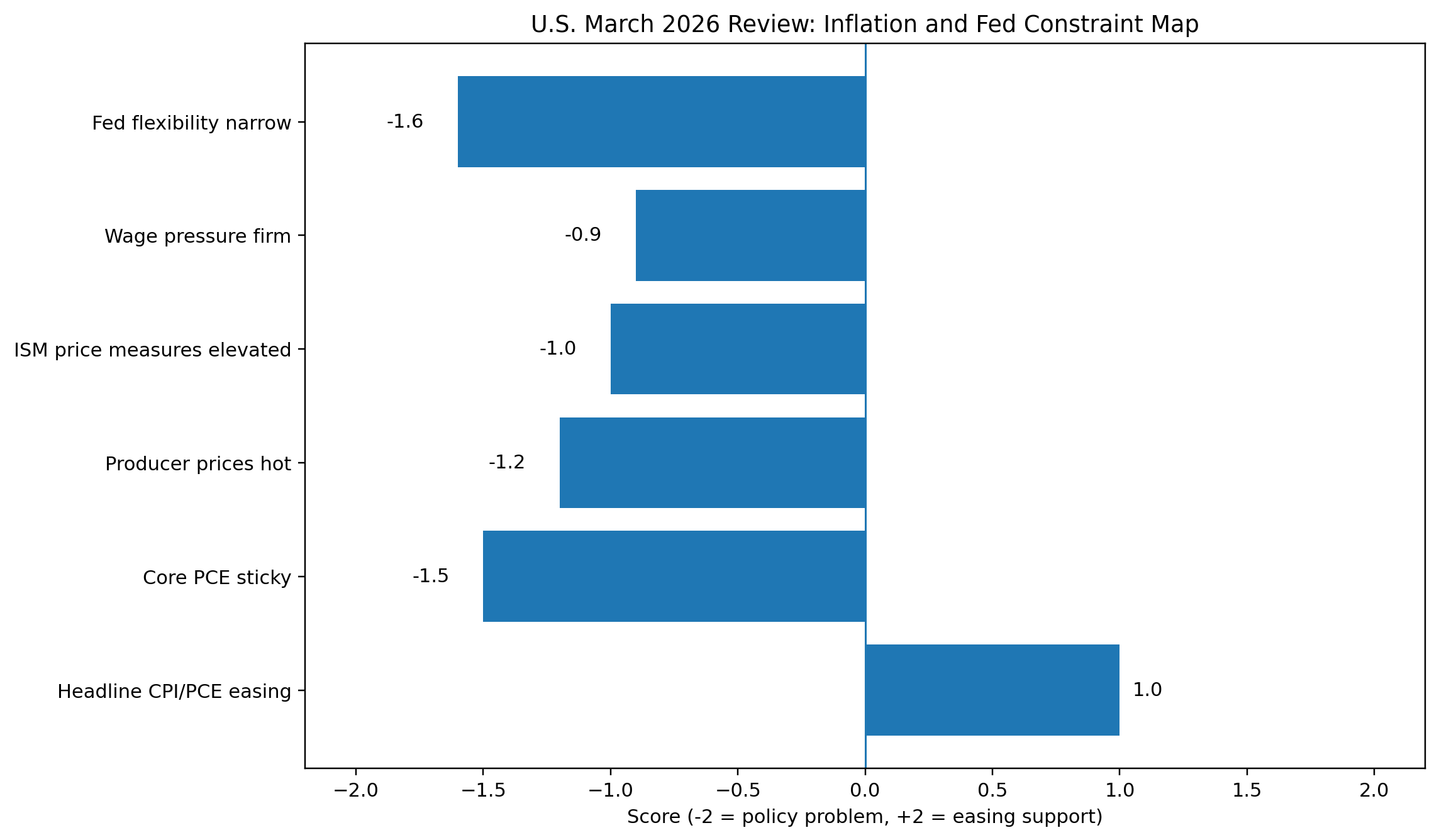
Inflation improved in headline terms, but not enough to create a clean disinflation story. Headline CPI and headline PCE suggested that price pressures are no longer accelerating in a broad-based way. But core inflation, especially core PCE, remained firmer, indicating that the stickier parts of inflation have not fully cooled. Producer prices also came in hot, reinforcing the idea that pipeline price pressure remains alive. Survey-based pricing indicators, including ISM input-price measures, stayed elevated, while wage growth added further persistence. The overall message is clear: the U.S. is still moving away from peak inflation, but the last leg of disinflation is proving slow, uneven, and uncomfortable for policymakers.
Federal Reserve: cautious, constrained, and data-dependent
The Federal Reserve was shaped by exactly this uncomfortable combination of slower growth and sticky inflation. The Fed left rates unchanged at 3.75%, which was expected, but its tone remained cautious rather than dovish. Policymakers did not receive enough improvement in core inflation to justify signaling rapid easing, and energy-related geopolitical risks added further uncertainty. Treasury yields also stayed firm enough to show that markets are not fully convinced by an aggressive rate-cut story. In practical terms, monetary policy remains restrictive, patient, and highly data-dependent. If growth weakens more sharply, the Fed may eventually shift more defensively. But as long as wages, services inflation, and energy costs stay elevated, the path to rapid cuts remains narrow.
Growth and activity: slowing, but still positive
The broader growth picture in March was one of moderation, not collapse. GDP data showed that late-2025 momentum faded more than previously believed, while real final sales and consumption also slowed. Even so, forward-looking estimates such as GDPNow still suggested that the economy entered 2026 on firmer footing than the backward-looking revision alone implied. Business activity surveys mostly remained above 50, showing that the private sector continued to expand, although the pace became less convincing. The main takeaway is that the U.S. economy is still growing, but with slower momentum and less room for disappointment in either policy or markets.
Manufacturing and services: one mixed, one supportive
Manufacturing delivered mixed but generally better-than-feared signals. Industrial production and manufacturing output rose, while several surveys pointed to ongoing expansion. Some factory firms were still investing, and new orders looked constructive in parts of the data. However, the improvement was not broad-based, and manufacturing employment was not especially strong. The sector is therefore resilient, but still selective and uneven.
By contrast, the services sector remained the economy’s main stabilizer. ISM Services stayed clearly in expansion territory, supported by strong new orders and constructive activity readings. Since services account for the larger share of U.S. output, that matters greatly. As long as services remain expansionary, the economy keeps an important buffer against weakness elsewhere. But there is a trade-off: services inflation is also one of the main reasons the disinflation process remains slow.
Housing and business investment: fragile but not collapsing
Housing remained one of the clearest examples of an economy under pressure from restrictive financial conditions. Some indicators improved, including existing home sales, housing starts, and pending home sales, in part of the month. But other indicators weakened, including permits, mortgage applications, refinance activity, and a sharp drop in new home sales. With mortgage rates still high, housing remains fragile and unlikely to become a strong growth engine without a clearer easing in financing conditions.
Business investment followed a similar pattern. Durable goods were soft on the headline level, but core orders remained somewhat firmer, suggesting that firms are still spending selectively rather than retreating aggressively. Companies are not behaving as if the economy is entering a strong upswing, but they are also not pulling back in panic.
Trade, energy, and financial conditions
The external sector was one of the cleaner positives in March. The trade deficit narrowed, helped by stronger exports and softer imports, which improved near-term GDP math. But energy remained the main external inflation risk. Geopolitical tensions kept oil and broader energy markets central to the outlook, while U.S. inventory and rig data suggested that supply was not responding aggressively enough to fully neutralize price risk. At the same time, financial conditions stayed tight, especially for housing and other rate-sensitive sectors. Treasury yields remained firm, and real financing costs were still restrictive enough to matter.
Conclusion
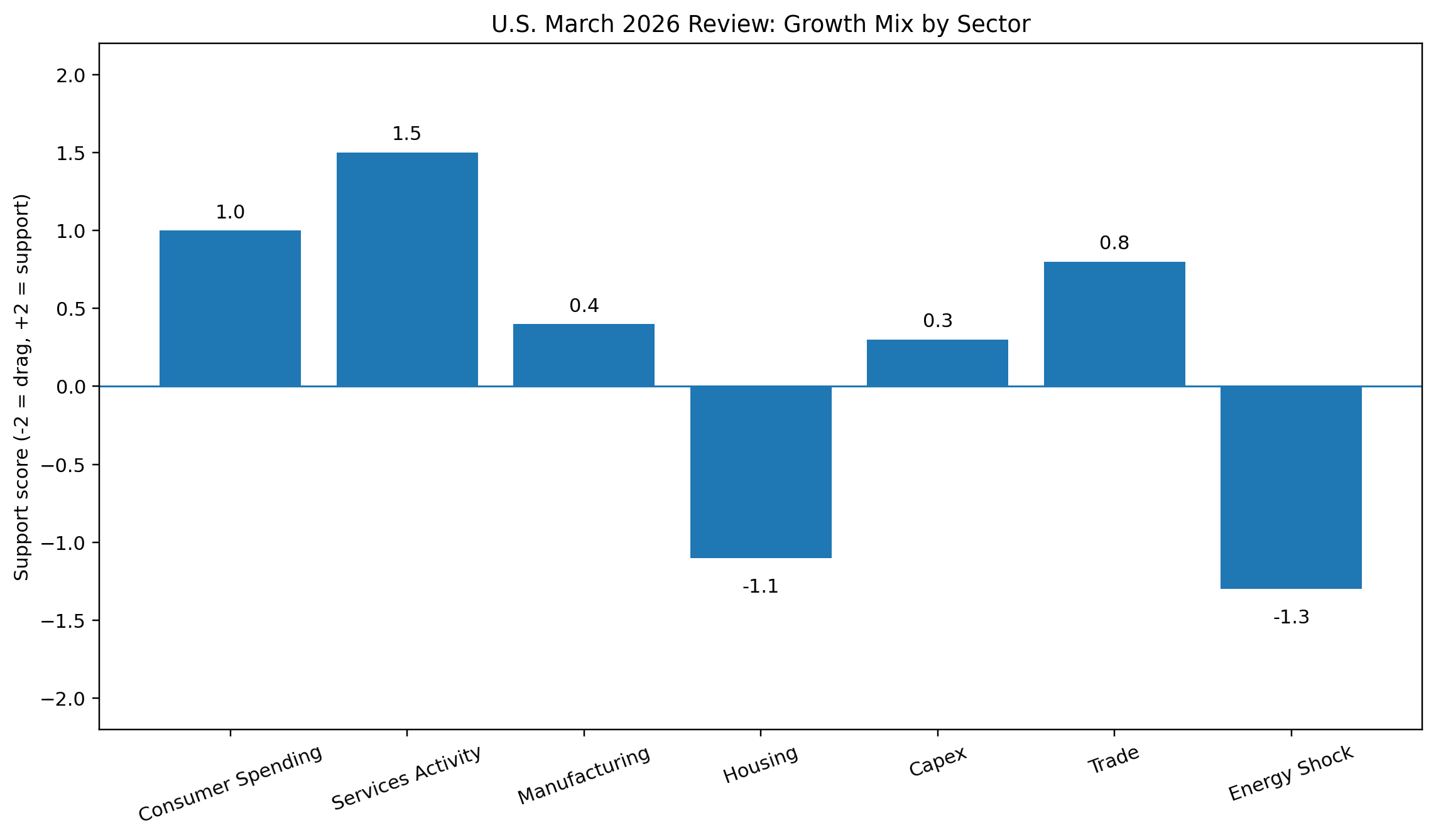
By sector, the U.S. economy still looks more resilient than weak, but the balance is becoming harder to maintain. Services and consumer spending are still keeping the expansion alive. Labor has not broken, but it is no longer entirely reassuring. Manufacturing is holding up, though unevenly. Housing remains fragile. Inflation is improving only slowly and remains sticky in core areas. As a result, the Fed remains cautious and constrained. In short, the U.S. economy in March 2026 was still expanding, but with a more uncomfortable mix of slower growth, sticky inflation, and rising sensitivity to labor-market deterioration and energy shocks.
U.S. Economic Outlook for April 2026
Cooling Growth, Easing Inflation, and a Fed Still on Hold
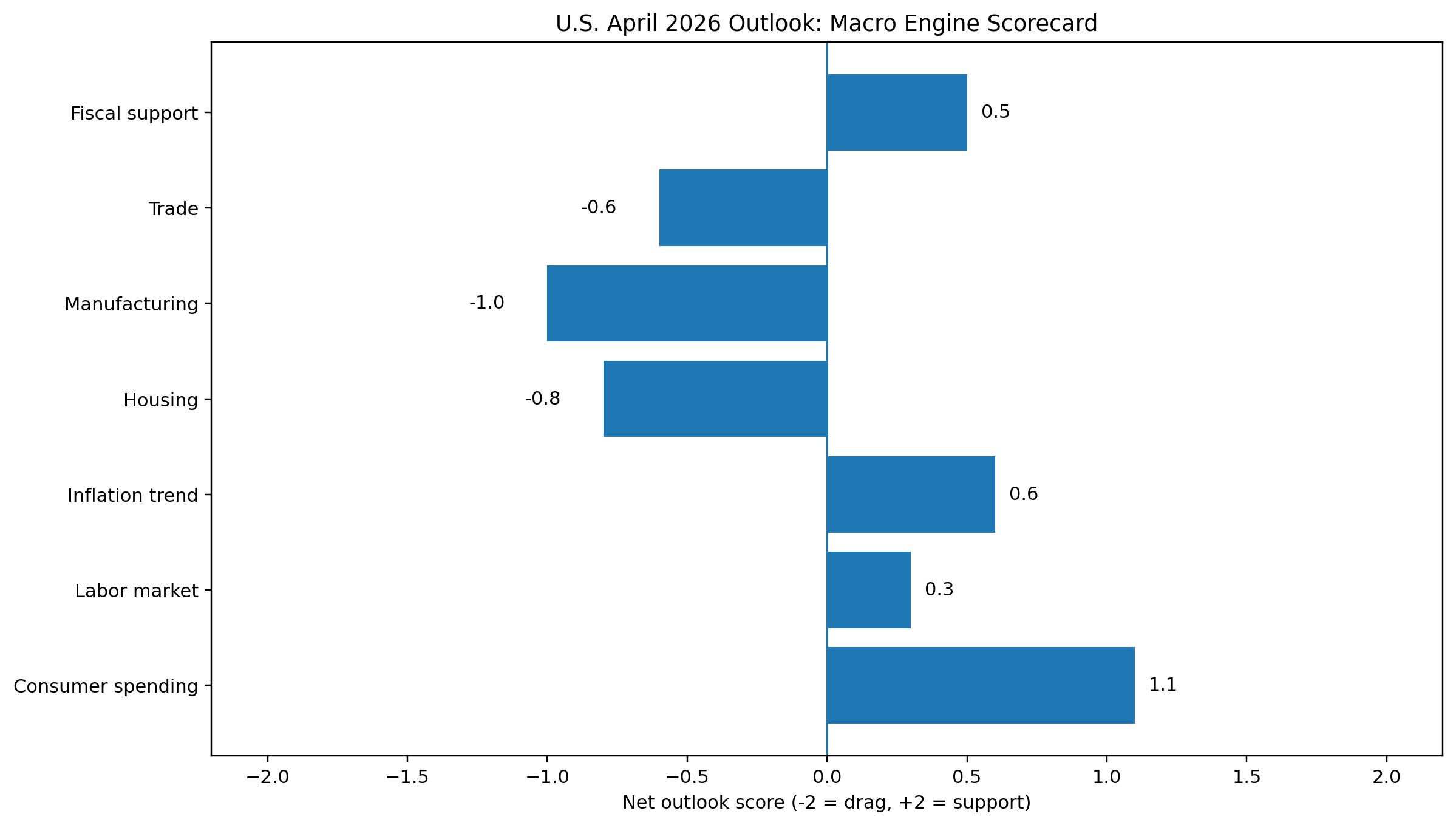
The U.S. economy enters April 2026 with a heavy data calendar and a macro backdrop that looks softer, but not broken. The broad message is that growth is cooling, inflation is easing, and the labor market is becoming less tight, even though not all indicators are pointing in the same direction. Weak nonfarm payroll data suggested a softer jobs backdrop, but low weekly unemployment claims still show that labor conditions have not deteriorated sharply. Inflation has moderated closer to target, yet the outlook remains vulnerable to higher oil prices, geopolitical tensions in the Persian Gulf, and the risk that energy costs keep headline inflation firmer in the near term. In short, the economy is slowing toward a more normal pace, but the balance remains sensitive to inflation, energy, and policy signals.
Labor market: softer payrolls, but no collapse
The labor market remains one of the key areas to watch in April. The March jobs report is central because February produced a surprisingly weak reading, with a decline in payrolls that was attributed partly to temporary factors such as weather and strikes. We expect a modest rebound, with slightly more than 50,000 new jobs and the unemployment rate holding near 4.4%. At the same time, labor supply constraints remain relevant, particularly as immigration cuts could keep labor slack limited. Wage growth has also remained solid, rising around 0.4% month-on-month and roughly 3.8% year-on-year, although this is still cooler than the much faster wage growth seen in 2023. The key takeaway is that the labor market is loosening, but only gradually. That is important because a softer labor market can help inflation ease, but it also raises concern about slower household demand later in the year.
Inflation: improving, but oil risk remains central
Inflation remains the central policy and market issue. Both headline and core inflation have moved lower, with February CPI at 2.4% year-on-year and core CPI at 2.5%, suggesting meaningful progress toward the Fed’s target. However, the inflation outlook is far from settled. The main concern is energy. With oil prices sharply higher and tensions in the Persian Gulf and Strait of Hormuz still unresolved, we expect inflation to remain somewhat higher in the short term. Market-based inflation measures tell a similar story: the 1-year inflation swap has risen to around 3.0%, while longer-term expectations remain more anchored near the low-2% range. This suggests that markets see a near-term inflation bump driven by energy and tariffs, but do not yet expect long-term inflation expectations to become unanchored. The implication is that inflation is easing, but not cleanly enough for the Fed to relax quickly.
Growth and GDP: slowing toward trend
The growth outlook points to an economy that is still expanding, but at a slower rate. Overall U.S. growth is cooling toward around 2%, which is broadly consistent with consensus expectations for 2026. After a weak fourth quarter of 2025, first-quarter GDP is expected to show some stabilization, though not a return to strong momentum. Consumer spending remains the main engine of growth, but it is also slowing as households face higher prices, tighter funding conditions, and fading support from earlier stimulus. Real spending growth is expected to stay positive, but modest. We expect the second half of 2026 to be softer than the first half, especially if higher energy costs continue to squeeze purchasing power. This leaves the economy in a familiar position: still expanding, but with less momentum and less margin for disappointment.
Housing and manufacturing: still weak spots
Two of the more fragile parts of the economy remain housing and manufacturing. Housing data are mixed. Both building permits and housing starts have shown some modest improvement, while existing home sales remain weak. The sector is still highly sensitive to interest rates, and a more convincing recovery likely depends on lower financing costs. Manufacturing also remains soft. ISM manufacturing PMI is only slightly above contraction territory, with weak new orders, falling production, and elevated input costs driven by tariffs and commodity pressures. Regional Fed surveys also suggest flat to slightly contracting conditions. Auto sales and capital goods orders have been underwhelming, reinforcing the message that manufacturing is not leading growth. Overall, both housing and industry remain constrained by high rates, cost pressures, and a cautious demand backdrop.
Federal Reserve: on hold, with one cut still the base case
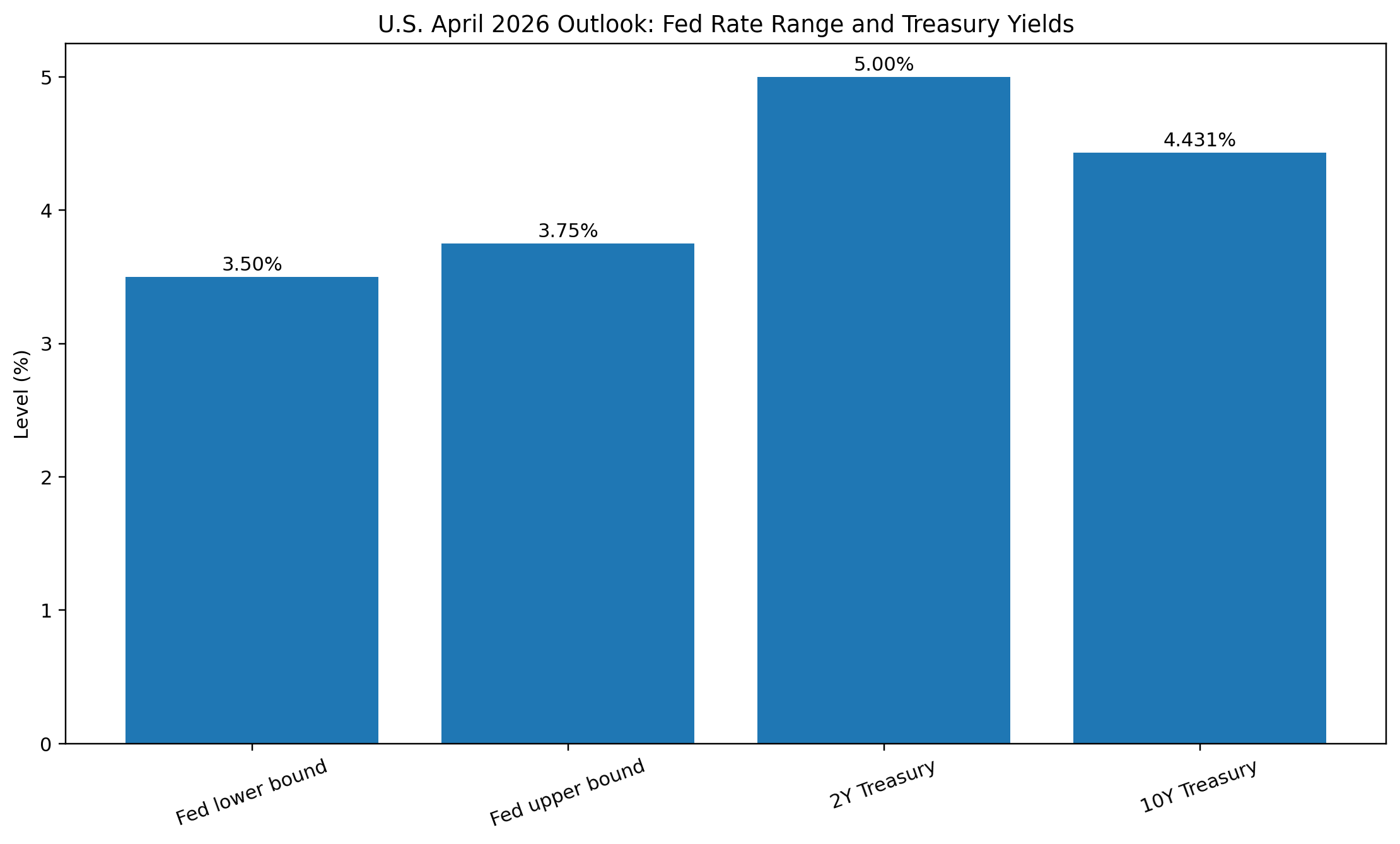
The Federal Reserve remains at the center of the stage. We expect the Fed to hold rates in the 3.50%–3.75% range at the April meeting, while Chair Powell’s press conference will be watched closely for clues about the timing of future easing. The base case is for only one 25bp cut late in 2026, followed by another small cut in mid-2027. That reflects the tension between slower growth and still-sticky inflation risks, especially from oil. If energy-driven inflation fades more quickly, the Fed could gain more confidence and potentially cut earlier. But if inflation remains stubborn or re-accelerates, the market could shift to expect no cuts at all, and in a more extreme risk scenario, even renewed tightening cannot be fully ruled out. The broader message is that policy remains patient, cautious, and highly dependent on incoming data.
Fiscal risks, debt, and balance sheet policy
Still, fiscal risks remain important. Large budget deficits, rising debt, and the possibility of additional tax cuts or stimulus measures could support growth in the near term, but at the cost of worsening medium-term debt dynamics and increasing pressure on bond markets. In that environment, a larger Treasury supply could keep long-term yields elevated and add to risk premia. Meanwhile, the Fed’s balance sheet remains large, but no major shift in balance sheet policy is expected in April. Quantitative tightening is continuing gradually, with interest rates still doing most of the policy work. In effect, fiscal policy may provide some short-term support, but it also adds to the structural risks surrounding debt, yields, and future policy flexibility.
Markets: elevated yields, firm dollar, and fragile sentiment
Financial markets reflect this uneasy balance. The 10-year Treasury yield remains elevated at around 4.431%, the 2-year yield is above 5%, and the yield curve remains inverted, signaling expectations of slower growth ahead. Credit conditions have also become more fragile, with some signs of stress showing up in credit-spread measures. The U.S. dollar remains firm, supported by elevated yields and continued global uncertainty, and the market stays constructive on the greenback in April. At the same time, the VIX remains elevated, highlighting persistent market sensitivity to geopolitics and Fed uncertainty. The overall market message is that sentiment remains cautious: if geopolitical tensions ease and oil prices fall, yields could decline, equities could recover, and the dollar could soften. But if tensions persist, markets are likely to remain defensive.
Conclusion
The April 2026 outlook for the U.S. economy is one of cooling, not collapsing. Growth is slowing toward trend, inflation is easing but remains exposed to energy shocks, the labor market is loosening gradually, and the Fed remains on hold, with only a narrow path to cuts. Housing and manufacturing remain weak spots, while consumer spending is still the main engine keeping the expansion alive. Financial markets, meanwhile, continue to reflect a mix of caution, elevated yields, firm dollar conditions, and geopolitical sensitivity.
Bottom line: the U.S. economy in April 2026 still looks expansionary, but it is moving into a more delicate phase marked by slower growth, lingering inflation risk, fiscal strain, and a Federal Reserve that cannot yet afford to move aggressively toward easing.
Q&A
What was the main message of the U.S. economy in March 2026?
The main message was continued expansion, but in a more fragile and uneven form. Growth remained positive, but inflation stayed sticky and labor-market signals became less reassuring.
Did the labor market weaken meaningfully?
The labor market did not collapse, but it clearly became less comfortable. Weak payrolls, softer hiring, and a higher unemployment rate made March more concerning than earlier months.
Why is inflation still a problem?
While headline inflation improved, core inflation, producer prices, and services-related price pressures remained persistent. That makes the final stage of disinflation much harder.
Why is the Fed still cautious?
The Fed is cautious because growth is slowing, but not enough to justify easy policy, while inflation is cooling, but not fast enough to justify rapid rate cuts.
Which sectors supported the economy the most?
The biggest supports were services, consumer spending, and, to some extent,t the external sector through a narrower trade deficit.
What were the main weak spots?
The main weak spots were housing, softer parts of the labor market, and the persistence of core inflation. Energy risk also remained an important external threat.
What is the main message of the U.S. April 2026 outlook?
The main message is that the U.S. economy is cooling, but not falling into recession. Growth is slowing, inflation is easing, and the Fed is staying cautious.
Is the labor market weakening?
Yes, but only gradually. Payrolls have softened, while weekly claims remain relatively low, which suggests a labor market that is loosening rather than collapsing.
Why is oil so important for the outlook?
Because higher oil prices can lift headline inflation, squeeze household spending, and make the Fed less comfortable about cutting rates.
What is the base-case Fed outlook?
The base case is that the Fed stays on hold in April and delivers only one 25bp cut later in 2026, unless inflation falls faster than expected.
What are the main downside risks?
The main risks are a prolonged oil shock, tighter credit conditions, rising fiscal deficits, and weaker growth in the second half of the year.
Comments