translate English
 پارسی
English
Englishپارسی
English
Englishپارسی EnglishپارسیEnglishپارسی
French President Emmanuel Macron is convening a Defence and National Security Council meeting on Monday, 19 January, at noon in Paris, with the Élysée saying discussions will cover Greenland, Syria, and Iran—signaling elevated attention to fast-moving international dossiers amid intensifying diplomatic and security pressures.
Bruno Retailleau, described as a former French interior minister, wrote on X in support of Iran’s national revolution that “condemnation with fear and caution is no longer enough,” calling on France to impose sanctions on what he termed Iran’s “criminal regime.” The message adds pressure on Paris to shift from statements to coercive measures, reflecting a broader push in Europe for tighter economic and diplomatic constraints.
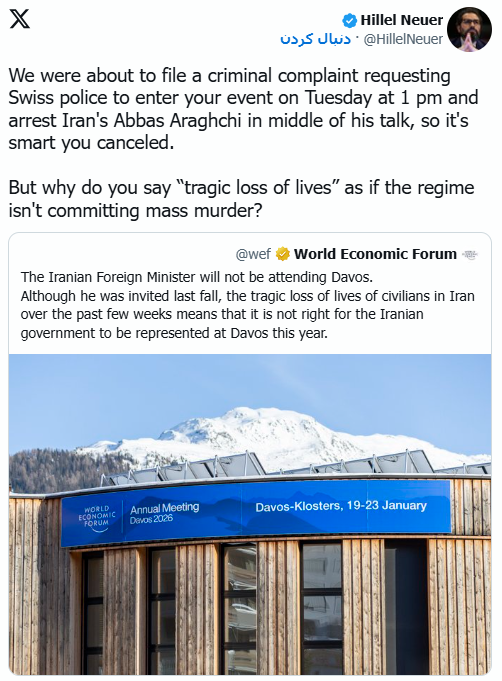
Hillel Neuer, executive director of UN Watch, criticized the World Economic Forum’s wording after the WEF referenced Abbas Araghchi’s cancelled Davos appearance on X. Neuer said UN Watch was preparing to file a criminal complaint seeking Araghchi’s arrest by Swiss police during any speech, calling the cancellation a “smart decision.” He also challenged the WEF’s phrasing about a “tragic loss of civilian lives,” arguing it understates what he described as an ongoing, organized massacre in Iran rather than an ambiguous “tragedy.”
Darya Safai, an Iranian-born member of Belgium’s parliament, wrote on X, urging the world to “be our voice” and to act now, describing what she called “one of the biggest massacres in history” unfolding in Iran. Separately, Der Spiegel reported on the possible involvement of foreign Shia militias in the crackdown on protests, while Israel Hayom reported that Israel’s prime minister and at least two other regional leaders support a more proactive approach aimed at toppling the Islamic Republic in the near term—claims that remain based on public statements and media reporting.
Günter Fehlinger-Jahn—who describes himself as chair of the Austrian Committee for NATO Enlargement—urged the EU to designate the Islamic Republic as a “terrorist state,” while Finnish MEP Sebastian Tynkkynen warned that global indifference enables Tehran to continue executions. Separately, reporting circulated citing Der Spiegel on the possible involvement of foreign Shiite militias in suppressing protests—an allegation that remains difficult to independently verify.
Germany’s Defence Ministry says it has deployed a 13-person Bundeswehr reconnaissance team to Greenland at Denmark’s invitation, joining a small European contingent arriving in Nuuk for what officials and media have described as a limited, symbolic mission linked to NATO-allied coordination. The stated purpose is to assess the framework for potential military support for Denmark’s regional security posture—often framed around surveillance and situational awareness—as Arctic geopolitics intensify around Greenland’s strategic location.
Market impact: A mild positive for the European defence/ISR and surveillance supply chain on expectations of incremental Arctic-related activity, but it also raises headline risk for transatlantic trade relations amid Greenland-linked political tensions, including U.S. tariff threats reported in recent coverage.
US Republican Senator Ted Cruz told Fox News that “America stands with the Iranian people” and said he agrees with President Donald Trump that Iran “needs new leadership,” arguing the United States should take every possible step to end the current system because Ali Khamenei “hates America.” Cruz also described Trump’s decision to strike Iran’s nuclear facilities as the most important foreign-policy decision of Trump’s second term, claiming a nuclear-armed Iran could have threatened mass casualties in the US.
Germany’s foreign minister, Johann Wadephul, said the EU should move toward designating Iran’s Islamic Revolutionary Guard Corps (IRGC) as a terrorist organization and keep tightening sanctions pressure, arguing in a ZDF interview that sanctions are “working” and Western allies should stay aligned. The German foreign ministry has also reiterated that Berlin supports an EU anti-terror listing, while noting the process faces significant legal hurdles and requires unanimity among member states. The renewed push comes as casualty claims from Iran’s late-December protests remain sharply contested, including a Reuters-cited Iranian official figure of at least 5,000 dead, adding urgency to the debate in European capitals over escalation from targeted sanctions to a formal terror listing.
The U.S. aircraft carrier USS Abraham Lincoln, redeployed from the South China Sea toward the Middle East amid rising U.S.–Iran tension, was observed transiting the Singapore Strait based on live vessel-tracking data, while regional reporting also points to broader U.S. preparations—including bomber activity at Diego Garcia and reinforced Gulf air defenses (Patriot/THAAD). In parallel, Israel said three new F-35I “Adir” jets landed at Nevatim Air Base, lifting its F-35 fleet to 48 aircraft (out of 50 already purchased), underscoring a synchronized ramp-up in regional deterrence messaging.
U.S. Ambassador to Israel Mike Huckabee reacted to a post attributed to Iran’s Supreme Leader Ali Khamenei by calling him a “true son of Satan” and accusing him of exporting terror while blaming the U.S. and Israel for his own actions, also describing him as mentally unwell. The exchange follows Khamenei’s public claim that “U.S. and Zionist” agents committed “heinous crimes” during Iran’s recent unrest—alleging widespread destruction (including hundreds of mosques and educational centers) and “thousands” killed—claims disputed by rights groups and activists. Independent verification remains constrained by a prolonged communications blackout, while reported casualty estimates vary sharply: HRANA has verified thousands of deaths, CBS News cited sources alleging 12,000–20,000 killed, and The Sunday Times reported a far higher toll based on accounts from doctors.
Syrian government forces, backed by allied Arab tribal fighters, have taken control of the Al-Omar oil field and the Conoco (Koniko) gas field in Deir ez-Zor—two of Syria’s most valuable energy assets—according to regional reporting, with Reuters also citing officials and security sources. The sites, previously held by the U.S.-backed Syrian Democratic Forces (SDF), are a major source of revenue and leverage in northeast Syria; their loss marks a significant setback for the SDF and raises the strategic stakes around control of energy infrastructure and surrounding territory east of the Euphrates.
U.S. warships are shifting toward the Middle East as Washington looks to bolster deterrence and expand operational options amid rising regional tension tied to Iran. Reporting indicates the USS Abraham Lincoln carrier strike group is moving toward the CENTCOM area, while open-source tracking and media accounts say the USS George H.W. Bush (CVN-77) departed Norfolk on January 13 and may be heading toward European waters and the Mediterranean—though official confirmation on specific ship movements remains limited. Analysts assess that any U.S. military action related to Iran appears postponed rather than taken off the table, with force posture adjustments designed to provide flexibility if the situation escalates.