translate English
 پارسی
English
Englishپارسی
English
Englishپارسی EnglishپارسیEnglishپارسی
U.S. Sen. John Barrasso, a senior Republican in the Senate, said he stands with Iran’s “brave people,” arguing that when America stands with freedom, the world becomes safer. Referring to the wave of unrest in Iran, he said the country is experiencing a historic uprising for freedom and accused the Islamic Republic of responding with “mass killing.” Barrasso claimed that over the past two weeks, protests have spread to 185 cities across all 31 provinces, calling it unprecedented in a generation, and said Iranians are rejecting poverty, repression, and the ruin of four decades of authoritarian rule. Citing what he described as credible reporting, he said estimates suggest **thousands—possibly tens of thousands—**have been killed, exceeding prior crackdowns, while tens of thousands more have been arrested and sent to prisons; he argued that internet and phone shutdowns indicate the regime fears exposure of its actions to global public opinion.
Asked why his team is again relying on figures connected to Nicolás Maduro’s government in Venezuela, Donald Trump said he remembers what happened in Iraq after the U.S. takeover, when security forces—including the police and army—were dismissed en masse. He argued that the sweeping purge helped create a vacuum that later fueled the emergence of داعش, framing the Venezuela approach as a lesson learned from Iraq.
CNN reported—citing an Iraqi security source and a European military source—that Iraqi militia fighters have crossed into Iran in recent weeks to assist Tehran’s security forces in suppressing nationwide protests. The Iraqi source said nearly 5,000 entered via the Shaib crossing in Maysan and the Zurbatiya crossing in Wasit, while the European source estimated about 800 fighters from Diyala, Maysan, and Basra moved under the cover of religious pilgrimages before being deployed; Iranian officials have not publicly commented, according to the report.
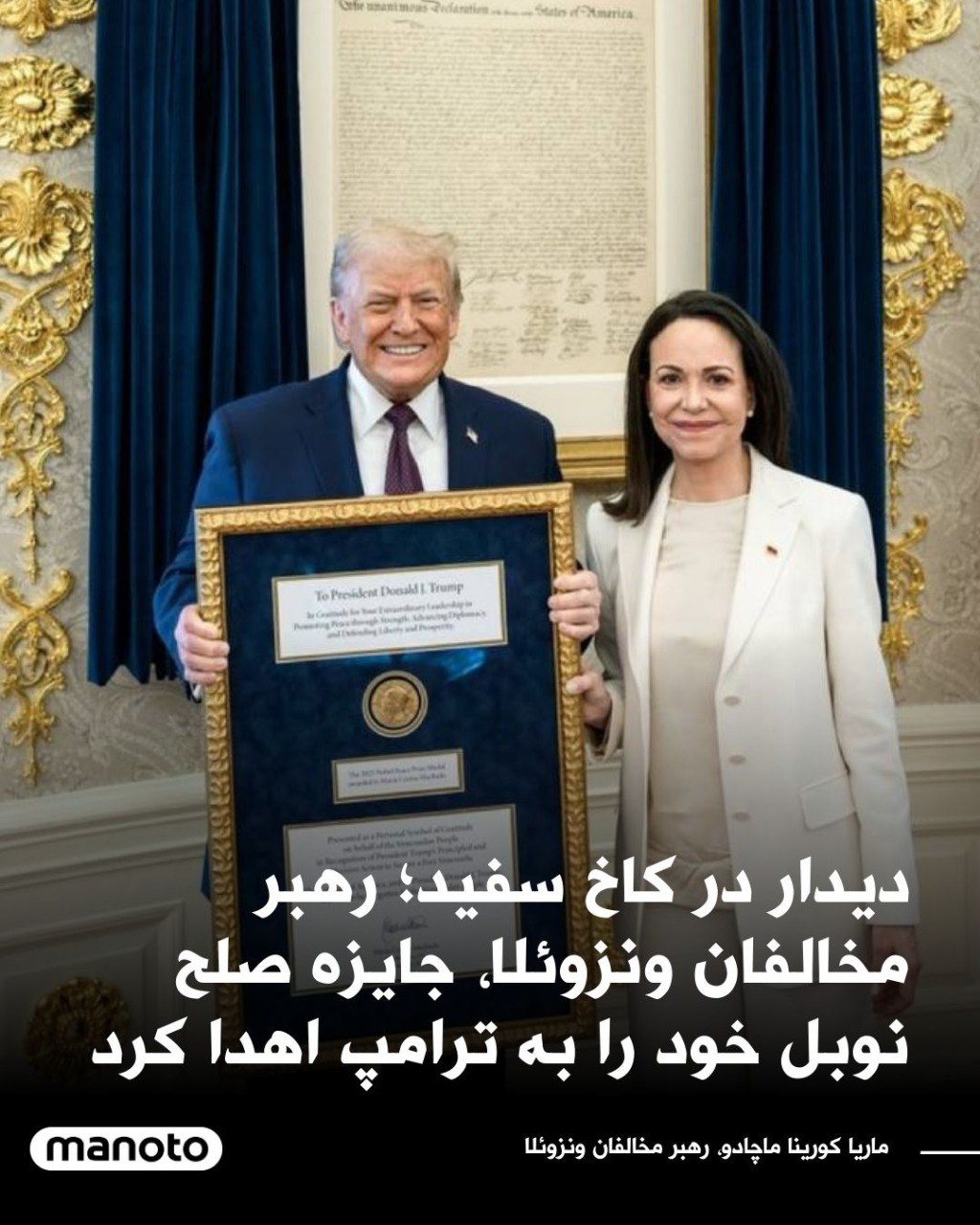
The White House said President Donald Trump met Venezuelan opposition leader Maria Corina Machado in the Oval Office, with its official accounts stating she presented the president with her Nobel Peace Prize medal as a gesture of appreciation. Machado described the meeting as “a historic day” for Venezuelans, while the Nobel Institute has emphasized that while a medal can be handed over, the Nobel laureate title and prize itself are not transferable.
U.S. special envoy Steve Witkoff, speaking at the Israeli-American Council gathering in Florida, said President Donald Trump has directed outreach to Islamic Republic officials amid concern over mass executions in Iran, adding that—as the president has stated—the killings have now stopped and he hopes a diplomatic solution is within reach. Without referencing the human-rights crackdown directly, Witkoff framed the U.S.–Iran agenda around four files: the nuclear program, missiles, roughly 2,000 kilograms of enriched material (ranging from 3.6% to 60%), and Tehran’s proxy forces, arguing Iran is “staggering” under economic strain; he said it would be ideal if Iran rejoined the international community and these issues were resolved diplomatically, but warned the fallback option “will be bad.”
Germany’s Munich Security Conference (MSC) said on Friday, January 16, 2026, it has rescinded its invitation to Iran’s Foreign Minister Abbas Araqchi for this year’s gathering, citing Iran’s crackdown on nationwide protests. MSC organizers said invitations had been extended to Iranian government representatives weeks earlier, but would not be maintained “in light of current events”; the conference is scheduled for February 13–15. Reuters also reported Germany’s foreign ministry opposed hosting Iranian officials amid reports of large-scale deaths during the suppression.
U.S. Sen. Jim Risch, chair of the Senate Foreign Relations Committee, wrote on X that the United Nations’ silence in the face of protests and repression in Iran amounts to a “global failure.” He argued that Tehran has for decades armed and financed Hamas and pursued openly destabilizing policies, and said the lack of meaningful international pressure on the Islamic Republic underscores the broader breakdown of global accountability.
Axios reported, citing two sources with knowledge of the matter, that U.S. President Donald Trump and Israeli Prime Minister Benjamin Netanyahu spoke by phone on Thursday night, January 15, 2026, to discuss Iran. The call was described as part of intensified U.S.–Israeli consultations as Washington weighs next steps amid escalating regional tensions and scrutiny of Tehran’s crackdown.
Former U.S. National Security Adviser John Bolton wrote on X that Washington does not need to send ground forces to support Iran’s opposition and can instead assist through intelligence and communications capabilities. He argued that backing the Iranian people is possible without direct military intervention.
U.S. President Donald Trump said in a post on Truth Social that more than 800 executions scheduled in Iran for Thursday have been canceled. Trump thanked the Islamic Republic’s leaders in the post while framing the move as a significant reversal amid intense international scrutiny of Iran’s crackdown.
Prince Reza Pahlavi said Russia and China are “also assessing the fall of the regime,” arguing that major powers are recalibrating as instability deepens. He stressed that a democratic Iran would not be hostile to any country’s legitimate interests, but would seek fair relations, saying Iranians want agreements in which they are not “extorted or swindled” through one-sided deals.
Iran’s foreign ministry condemned a G7 foreign ministers’ statement on Iran’s protest crackdown as “interventionist,” after the bloc warned it is ready to impose additional restrictive measures if repression continues and Iran violates international human-rights obligations. The G7 message adds to mounting Western pressure at a moment when Tehran is facing sustained scrutiny over the scale and tactics of the security response.