translate English
 پارسی
English
Englishپارسی
English
Englishپارسی EnglishپارسیEnglishپارسی
In an exclusive interview with Iran International, Australian House of Representatives member Aaron Violi condemned what he described as Iran’s violent crackdown on nationwide protests, citing reports of direct fire on demonstrators and a sweeping internet shutdown. Violi said no legitimate government kills its own people and argued the Islamic Republic, therefore, lacks legitimacy, calling for global condemnation, accountability for perpetrators, and the use of all available international tools to support and protect Iranians, warning that silence would betray core human-rights principles.
South Korea’s Rebuilding Korea Party (조국혁신당) issued a statement comparing the Islamic Republic’s response to protests to the Chun Doo-hwan military regime, saying Tehran—like the 1980 junta—brands public anger as “riots orchestrated by foreign forces” while severing communications and violently suppressing civilians. The party framed the moment as akin to Gwangju 1980, a pro-democracy uprising that was bloodily crushed but later became a catalyst for Korea’s democratization, and urged solidarity with Iranians demanding democratic change.
British-Australian academic and former Iranian detainee Kylie Moore-Gilbert wrote that the recent wave of killings reflects the desperation of a weakened regime that can only govern through extreme violence, adding that the Islamic Republic is “moribund.” She argued its collapse is no longer a question of if, but when, how, and at what cost in innocent lives.
U.S. President Donald Trump said he would not oppose Prince Reza Pahlavi’s leadership if Iranians accept it, while stressing he is unsure how Pahlavi would “play within his own country” and adding, “we really aren’t up to that point yet.” Trump’s latest remarks follow his January 8, 2026, comments that meeting Prince Reza Pahlavi would not be “appropriate” at this stage and that the U.S. should “see who emerges.”
New Zealand Foreign Minister Winston Peters said Wellington is “appalled” by escalating violence and repression in Iran, condemning what he described as a brutal crackdown and warning that Iranians’ rights to peaceful protest, free expression, and access to information are being brutally suppressed. He said New Zealand has raised its concerns directly with Iran’s embassy in Wellington and urged any New Zealanders still in Iran to leave immediately if it is safe to do so.
South Korean lawmaker Lee Eon-ju (Democratic Party) said the National Assembly is preparing a resolution to condemn Iran’s violent suppression of protests, calling for protection of Iranian civilians and a responsible, coordinated international response. Local reports said the draft urges Iran to halt armed repression and civilian killings, end unfair punishments and rights violations against detainees, and that around 50 lawmakers have already backed the initiative, with the resolution expected to be introduced on January 16, 2026.
Iraqi news platform AlJeebal reported that residents in Basra (southern Iraq), only a short distance from the Iranian border, heard—and in some cases saw—fighter jets overhead earlier this evening. There has been no official confirmation of the aircraft’s identity or mission, and the report should be treated as unverified amid heightened regional military activity.
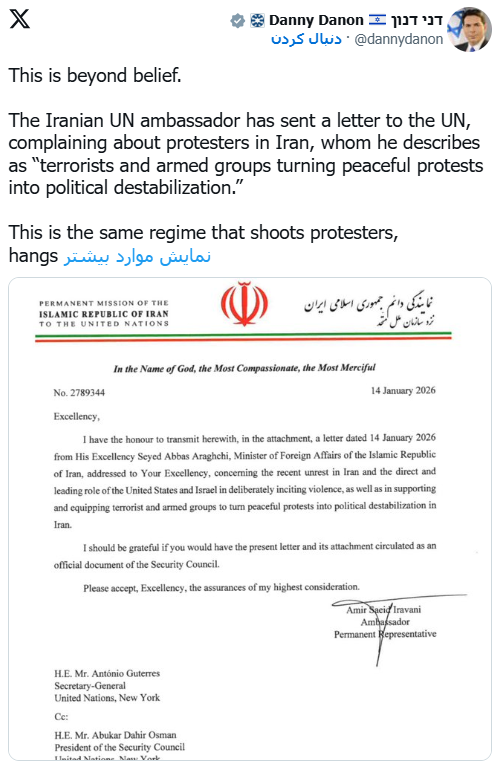
Israel’s Ambassador to the UN Danny Danon wrote on X that the Iranian ambassador’s letter to the United Nations about the protests amounts to “crocodile tears,” arguing it comes from a regime that “shoots protesters,” “hangs opponents,” and suppresses the population. In the Iranian envoy’s letter, protesters are described as “terrorists” who allegedly turned peaceful demonstrations into violence.
POLITICO reported that the UK has temporarily closed its embassy in Tehran. A UK government spokesperson said the mission will “now operate remotely,” and the Foreign Office has updated its travel advice to reflect the change in consular operations.
Spain’s Foreign Ministry said travel to Iran is strongly discouraged due to the “highly unstable” situation in Iran and the wider region, and advised Spanish nationals currently in Iran to leave the country using available means.
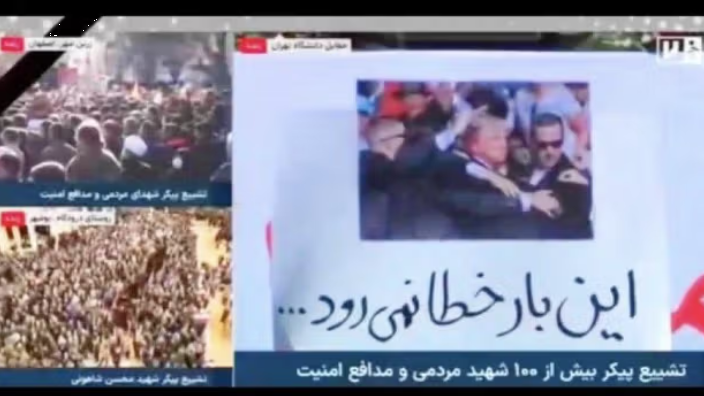
U.S. Senator Ted Cruz said Iran’s state broadcaster aired—and he reposted—a zoomed-in image referencing the July 2024 shooting attempt on Donald Trump, accompanied by the Persian caption “This time there will be no mistake.” Cruz argued the broadcast amounts to an explicit threat to assassinate the U.S. president, saying it contradicts claims circulated elsewhere that Tehran has not threatened Trump.
Shahab Zahedi, a former Persepolis forward, wrote in an Instagram story that the authorities “choked the protests,” cut the internet, and “silenced the streets with people’s blood,” reacting to what he described as the killing of 12,000 Iranian protesters during the national uprising. He added that “from this very blood, Iran will stand tall again.” Zahedi had earlier condemned the internet shutdowns from 18 Dey 1404, saying it was not merely an internet cut but “a cut to people’s lives,” citing disrupted calls, canceled flights, and Iran’s isolation from the world while urging the international community to amplify Iranians’ voices.