translate English
 پارسی
English
Englishپارسی
English
Englishپارسی EnglishپارسیEnglishپارسی
The Republican-led majority of the U.S. House Foreign Affairs Committee said in an X post on 23 Dey 1404 (January 13, 2026) that Supreme Leader Ali Khamenei is responsible for the killing of Iranian citizens, for driving the rial to what it called “the weakest currency in the world,” and for squandering national resources—urging Iranians to “make regime change inevitable.” The message came alongside intensifying U.S. political pressure over Iran’s crackdown, as Iranian state media continues to air “confession” videos that activists and rights groups describe as coerced.
European Commission President Ursula von der Leyen said the rising number of casualties in Iran is “horrifying,” condemning the “excessive use of force” and continued restrictions on freedoms. In a post on X on Tuesday, 23 Dey 1404 (January 13, 2026), she said the EU has already listed the Islamic Revolutionary Guard Corps (IRGC) in its entirety under the bloc’s human-rights sanctions regime, and that—working closely with EU foreign-policy chief Kaja Kallas—additional sanctions targeting those responsible for the repression will be proposed “swiftly,” adding that the EU stands with Iranians “bravely marching for their liberty.”
Former Swedish Foreign Minister Margot Wallström wrote on X that Germany and Australia have already stated clearly that Iran’s ruling system lacks legitimacy in the eyes of the Iranian people, and argued that other countries should now adopt the same position, saying she expects Sweden and the EU to do so quickly. She also urged the EU to immediately designate the IRGC as a terrorist organization, recall EU ambassadors from Iran, and explore ways to help Iranians regain internet access.
European Parliament President Roberta Metsola said 2026 should be the year “dictatorships are over,” calling the moment “golden” for the EU and member states to state openly that Iran’s ruling system is “on its last legs.” She added that Iranians want change and that Europe should support them, while emphasizing that the outcome must ultimately be decided by the people of Iran.
Reuters, citing three diplomatic sources, reported that some personnel at the U.S. military’s Al Udeid Air Base in Qatar were advised to leave the base by Wednesday evening, while the U.S. embassy in Doha had no immediate comment. Al Udeid—described as the largest U.S. base in the Middle East, hosting around 10,000 troops—has previously seen limited personnel moves ahead of periods of elevated tensions, and the advisory may signal a heightened security posture amid regional uncertainty.
Brett McGurk, a former U.S. National Security Council coordinator for the Middle East and North Africa, said President Donald Trump’s warnings over Iran’s crackdown effectively point toward regime change, arguing it is hard to imagine any military move as a single, isolated strike. McGurk said planners would likely seek to degrade Iran’s retaliatory missiles and systems, and that target sets could include what he called the regime’s internal repression apparatus—such as the Basij and IRGC headquarters—cautioning that leadership targets could open a “Pandora’s box.”
Norbert Röttgen, a member of Germany’s Bundestag, wrote on X that many Iranians felt Europe “left them alone” during the 2022 “Woman, Life, Freedom” protests—arguing that Europe should not repeat that mistake and must now act openly and clearly in support of the Iranian people as the current unrest escalates.
A Turkish Foreign Ministry source said Foreign Minister Hakan Fidan told his Iranian counterpart Abbas Araghchi in a phone call that negotiations are necessary to resolve current regional tensions. The message aligns with Ankara’s broader line, warning that escalation or outside intervention could deepen instability and urging dialogue to reduce pressure across the region.
The Washington Post, citing two European officials, reported that the Trump administration on Monday, 22 Dey 1404 (January 12, 2026), asked European countries to share intelligence on possible targets inside Iran. One of the officials said there were no indications the U.S. was preparing to strike nuclear facilities, and that a more likely focus would be leadership and forces linked to the security apparatus involved in killing protesters—part of a broader internal review of response options.
The Persian-language account of the U.S. State Department posted a video on X showing security forces firing toward protesters in Iran, writing: “When a regime needs weapons to confront unarmed people, that’s not strength—it’s fear and cowardice.” The State Department added that “real power” belongs to unarmed protesters who stand up to what it called brutality.
Iran’s Foreign Minister Abbas Araghchi spoke with the UAE’s Foreign Minister Sheikh Abdullah bin Zayed Al Nahyan about Iran’s national uprising, and said President Donald Trump’s statements amount to interference in Iran’s internal affairs. In a separate phone call with Turkey’s Foreign Minister Hakan Fidan, Araghchi also confirmed that Iranian protesters have been killed and discussed developments from recent days.
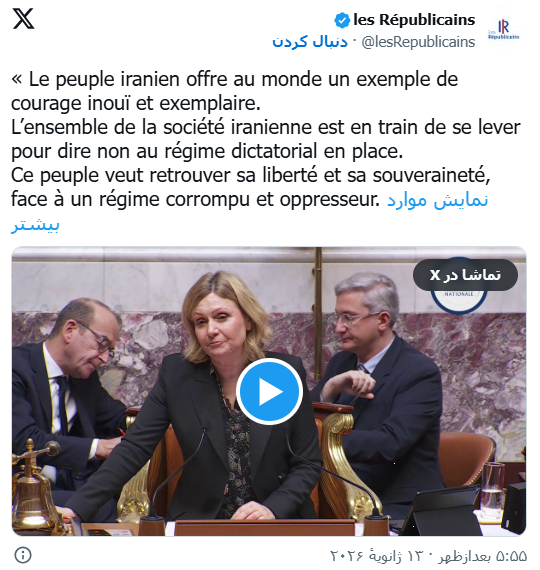
Philippe Gosselin, a member of France’s National Assembly, said in remarks to parliament that France should take action over the crackdown on Iran’s national uprising, arguing that silence is no longer an acceptable option. Gosselin said Iranians are showing “unprecedented” and exemplary courage, describing Iranian society as rising up to reject what he called a dictatorial regime and to reclaim freedom and sovereignty in the face of a corrupt and repressive system.