translate English
 پارسی
English
Englishپارسی
English
Englishپارسی EnglishپارسیEnglishپارسی
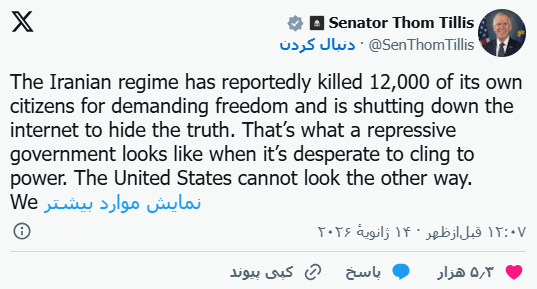
U.S. Senator Thom Tillis wrote on X that the United States should be prepared to stand with Iranians “fighting for freedom,” arguing that the Islamic Republic has “reportedly” killed 12,000 people and is shutting down the internet to conceal what is happening. He described this as what a repressive government looks like when it is desperate to cling to power, and said Washington cannot look the other way and should hold Iran’s rulers accountable.
In an exclusive CBS Evening News interview in Dearborn, Michigan, U.S. President Donald Trump said his objective in any action against Iran’s rulers is “to win,” adding that “a lot of help” is on the way for Iranians in “different forms,” including economic assistance. Trump also warned the U.S. would take “very strong action” if Iranian authorities begin hanging anti-government protesters, arguing that when the state starts “killing thousands” or moves toward executions, “it’s not going to work out well” for Tehran. Asked what “winning” means, he pointed to past operations he cited from his terms in office, including the recent capture of Venezuela’s Nicolás Maduro, the raid that killed ISIS leader Abu Bakr al-Baghdadi, and the 2020 killing of Quds Force commander Qassem Soleimani.
U.S. President Donald Trump, asked about the number of protesters killed in Iran, said he had not been given an exact figure, adding that “even one is too many.” He suggested clarity could emerge soon, saying the number would “probably” become known within the next 24 hours.
An i24NEWS journalist wrote on X that Israeli officials assess the United States will carry out an attack on the Islamic Republic, but that the key unknowns are when it happens and how intense it will be. The claim comes as reporting elsewhere describes Israel on heightened alert amid uncertainty over potential U.S. involvement tied to Iran’s domestic unrest and Tehran’s warnings of retaliation.
Axios, citing a senior U.S. official, reported that Steve Witkoff—President Donald Trump’s special envoy—held a secret meeting last weekend with Prince Reza Pahlavi to discuss Iran’s nationwide protests. The report described the meeting as the first high-level contact between the Trump administration and Iran’s opposition since the latest wave of demonstrations began, and Reuters separately reported the Axios account, also citing a European/US official summary of the report.
U.S. President Donald Trump, asked about the “help” he has suggested is coming for Iran, responded: “You’ll find out,” while pointing to the State Department’s warning and saying that Americans departing Iran is “a good decision.” The remarks underscore Washington’s escalating messaging as U.S. officials urge citizens to leave amid heightened unrest, security risks, and ongoing communications disruptions.
Ukraine’s government wrote in Persian on its official X account that it stands with the people of Iran, adding to the widening international messages of solidarity as scrutiny grows over the crackdown and ongoing nationwide unrest.
Norway’s Foreign Ministry summoned the Islamic Republic’s ambassador in Oslo in response to the crackdown on protesters in Iran, adding to the growing list of European diplomatic actions condemning violence and signaling heightened pressure on Tehran.
Russia’s Foreign Ministry spokesperson said Moscow “strongly condemns” what it called destabilizing foreign interference in Iran’s domestic affairs, and described U.S. threats of new military strikes on Iranian territory as “completely unacceptable.” The remarks highlight Russia’s positioning against U.S. pressure as Iran’s internal unrest and external tensions intensify simultaneously.
U.S. Republican Senator Tom Cotton reposted President Donald Trump’s message backing Iran’s protests and said he stands with Trump and the Iranian people. Cotton described Islamic Republic leaders as “terrorists” and argued they should be held accountable for their crimes after the regime falls, adding to a growing chorus of U.S. lawmakers publicly aligning with the protest movement.
Portugal’s Foreign Ministry summoned the Islamic Republic’s ambassador in Lisbon to convey what it described as condemnation of the “violent repression” against protesters in Iran. The step aligns with a widening pattern of European diplomatic pressure as governments signal tougher stances in response to the crackdown.
Germany’s Foreign Ministry said it has summoned the Islamic Republic’s ambassador in Berlin to formally convey its concern over violence against protesters in Iran. The move adds to a widening wave of European diplomatic actions as governments escalate pressure on Tehran over the crackdown.