translate English
 پارسی
English
Englishپارسی
English
Englishپارسی EnglishپارسیEnglishپارسی
White House Press Secretary Karoline Leavitt said President Donald Trump’s approach to Iran remains “diplomacy first,” describing it as the administration’s preferred and consistent option. She added, however, that Trump is “not afraid” to use U.S. military power—including “lethal force”—whenever he deems it necessary, underscoring a dual-track posture of negotiations backed by the threat of escalation as Iran’s crackdown on protests remains in focus.
A White House official, cited by Fox News, said Iran’s public rhetoric does not match the message it is sending privately to the United States, suggesting Tehran is striking a more conciliatory tone behind closed doors than in its public statements. The claim comes as the Trump administration weighs its next steps amid Iran’s crackdown and ongoing unrest, with U.S. officials indicating backchannel communications have remained active.
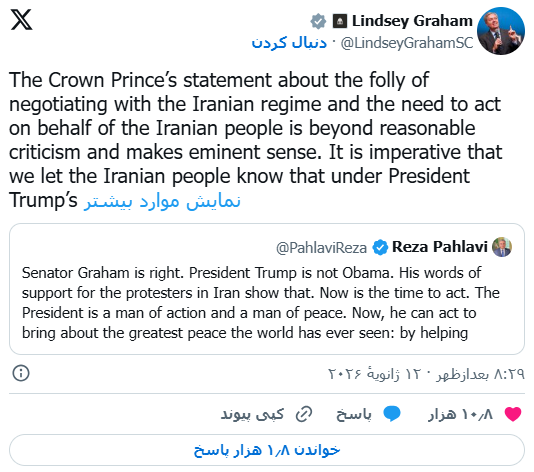
Sen. Lindsey Graham wrote on X that Prince Reza Pahlavi’s argument about the futility of negotiating with Iran’s ruling system is “entirely reasonable,” and said it is essential to show Iranians that under President Donald Trump, when the United States commits it is something people can trust and even stake their lives on.” Graham added that Trump is standing “courageously” with the oppressed people of Iran—likening it to Ronald Reagan’s call for the Berlin Wall to fall—and claimed the region is approaching one of the biggest Middle East shifts in a millennium.
Iranian Foreign Minister Abbas Araghchi said on X that during a phone call with UK Foreign Secretary Yvette Cooper he warned that if Britain cannot fulfill its duty to protect diplomatic premises, Tehran would have “no choice” but to consider evacuating its personnel from Iran’s embassy in London. Cooper said she told Araghchi directly that Iran must immediately end what she called the “horrific” violence against peaceful protesters and uphold fundamental rights, also stressing the safety of British nationals.
Eric Trump told Al Arabiya English that “nothing” would make President Donald Trump happier than seeing peace and stability in Iran, adding he hopes the situation “works itself out” in a way that benefits not only Iran but the broader Middle East. The comments frame the Trump camp’s messaging as publicly emphasizing a stabilization outcome even as regional tensions and debate over how Washington should respond to Iran’s unrest remain elevated.
Iranian Foreign Minister Abbas Araghchi told Al Jazeera Arabic that his communications with U.S. special envoy Steve Witkoff have continued both before and after the protests and are still ongoing, confirming an active channel despite escalating tensions. Araghchi added that “ideas are on the table” regarding a possible meeting with Witkoff and said those proposals are being reviewed, after Axios separately reported that Araghchi had reached out over the weekend as Washington weighed options.
Iran International reported—citing sources—that Iran’s Islamic Revolutionary Guard Corps (IRGC) has carried out what it described as a “media coup” to monopolize news distribution inside Iran, relying on a system referred to as a “whitelist” to control which outlets and channels can publish and circulate information. The report suggests the move is aimed at centralizing narrative management during the unrest by restricting independent reporting and steering public access to approved content.
Russia’s Security Council Secretary Sergei Shoigu said in a phone call with Iran’s top security official Ali Larijani that Moscow “firmly condemns” what he described as attempts by foreign powers to interfere in Iran’s internal affairs, according to Russian and international reporting. Shoigu also expressed condolences over casualties linked to the unrest and signaled continued Russian backing for closer bilateral cooperation under the two countries’ 2025 strategic partnership framework, as Tehran blames outside actors for fueling the protests and Western capitals ramp up pressure over the crackdown.
A French Foreign Ministry source said that Iran’s Foreign Minister Abbas Araghchi convened a meeting with European ambassadors and chargés d’affaires to discuss the ongoing developments, and that the European diplomats used the session to state their concerns “clearly and frankly.” The comment signals sustained European diplomatic pressure on Tehran as European capitals seek direct channels to convey alarm over the current trajectory.
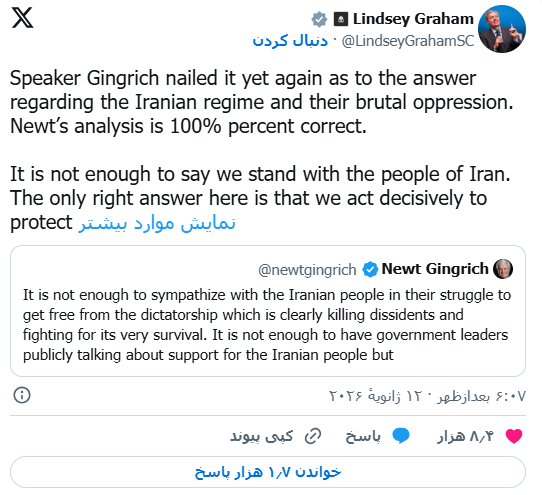
Republican Sen. Lindsey Graham wrote on X that it is not enough to say the U.S. stands with the people of Iran, arguing the “proper response” is decisive action to protect protesters in the streets and to signal Washington will not repeat what he described as the Obama-era approach or tolerate killings. Referencing remarks by former House Speaker Newt Gingrich, Graham said this is the best opportunity since 1979 to change the Middle East’s trajectory, as debate intensifies in Washington over how far to go in backing Iran’s protest movement.
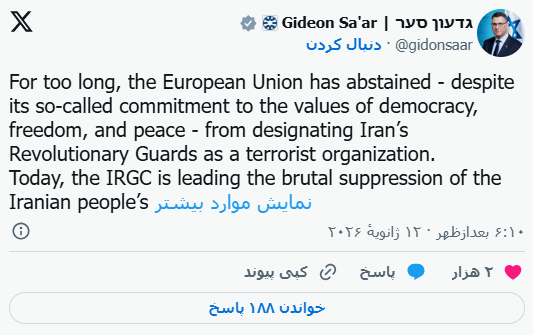
Israeli Foreign Minister Gideon Sa’ar wrote on X that the European Union waited too long to designate the Islamic Revolutionary Guard Corps (IRGC) as a terrorist organization, arguing that the IRGC is now leading a deadly crackdown on Iranian protesters and their struggle for freedom. Sa’ar said the IRGC previously promoted violence across the Middle East and beyond, and claimed it is now “killing its own people,” as international pressure mounts over Iran’s internal repression.
European Parliament President Roberta Metsola said she has banned all Iranian diplomatic staff and “any other representatives” of the Islamic Republic of Iran from entering all European Parliament premises, citing Iran’s ongoing crackdown on protesters and the communications blackout, and adding that “it cannot be business as usual” while the Parliament will not help legitimize a regime sustained through repression.