translate English
 پارسی
English
Englishپارسی
English
Englishپارسی EnglishپارسیEnglishپارسی
Axios reported, citing two sources, that Iranian Foreign Minister Abbas Araghchi contacted Trump envoy Steve Witkoff over the weekend as President Donald Trump weighed options and threatened possible military action amid Iran’s protests. The outreach was described as an effort to reduce tensions with Washington—or at least buy time before any U.S. move—while the sources said Araghchi and Witkoff also discussed the possibility of a meeting in the coming days, though it was unclear whether the contact was by phone or text.
Hans-Ulrich Jörges, a journalist affiliated with Germany’s news outlet Welt, said he hopes U.S. President Donald Trump will “intervene” in response to what he described as severe and escalating violence by Iranian authorities against protesters. In remarks framed as commentary on the unfolding unrest, Jörges argued that the situation has moved beyond a protest wave into an انقلاب-level confrontation, citing street slogans such as “Death to the Islamic Republic” as evidence that demonstrators are no longer seeking reforms. He warned the bloodshed could worsen because, in his view, the ruling system is fighting for survival, and added that if Western governments—especially the United States—allow this moment to pass without effective action, it would amount to a major historical mistake.
Ali Larijani, secretary of Iran’s Supreme National Security Council, dismissed President Donald Trump’s warnings related to the killing of protesters in Iran, saying Trump “talks like this a lot” and “should not be taken seriously.” Larijani added that “the Iranian nation has shown it intends to settle accounts with the United States and Israel,” echoing the Islamic Republic’s broader confrontational messaging as unrest and international scrutiny intensify.
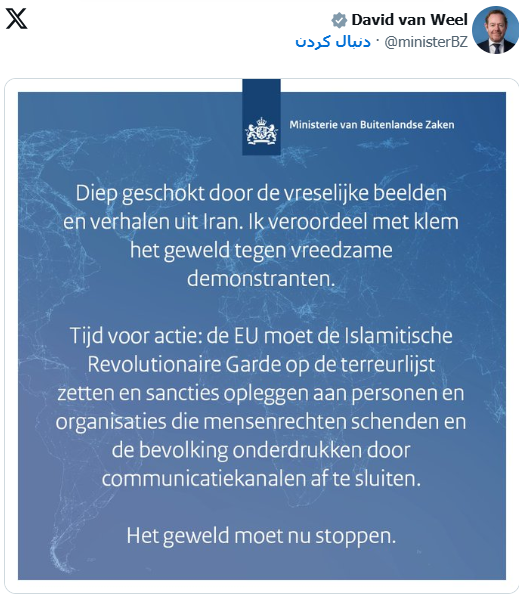
Dutch Foreign Minister David van Weel said he was deeply shocked by “horrific images and accounts” from Iran and strongly condemned violence against peaceful protesters, calling on the European Union to designate the Islamic Revolutionary Guard Corps (IRGC) as a terrorist organization. In a statement dated Monday, January 12, 2026, he also urged targeted EU sanctions against individuals and entities involved in human-rights abuses and those enabling repression by shutting down communication channels, adding: “This violence must stop now.”
Hannah Neumann, a German member of the European Parliament, urged EU countries to expel Iranian ambassadors and official representatives, arguing that “no diplomatic normality” is possible with a government that responds to peaceful protests with deadly shots to the head and cuts off its people’s communication lines. Neumann’s comments, posted on X on Monday, January 12, 2026 (22 Dey), add to growing European political pressure over Iran’s crackdown and the reported nationwide communications blackout.
Giorgio Gori, an Italian Democratic Party member of the European Parliament, wrote on X that Iranian citizens living in Italy are going through “days full of worry” as communications with Iran have been cut. Gori said Europe’s responsibility is not to leave Iranians alone and to “share” their struggle, arguing that sustained international solidarity helps strengthen the Iranian protest movement at a moment when the information blackout is deepening isolation and uncertainty for families abroad.
Nigel Farage, leader of the UK’s Reform Party, said Britain “should have” designated Iran’s Islamic Revolutionary Guard Corps (IRGC) as a terrorist organization years ago, and argued he would “absolutely” support military action targeting the IRGC inside Iran—framing it as a way to help protesters prevail. He also compared the moment to past Western-backed regime-change episodes in Iraq and Libya, said he hopes President Donald Trump acts “in the next few days,” and claimed he had been told the death toll could reach around 2,000.
Belgian Foreign Minister Maxime Prévot said he summoned Iran’s ambassador to Brussels on Monday, January 12, 2026, to convey Belgium’s concern over the deteriorating situation and to urge Tehran to “listen to the peaceful demands” of Iranians protesting in the streets. Prévot said Belgium expects Iranian authorities to refrain from any disproportionate use of force, as European governments intensify diplomatic pushback while Iran remains under a sweeping communications blackout that has made independent verification and reporting significantly harder.
The Wall Street Journal reported that President Donald Trump is leaning toward authorizing new military action against Iran, but some senior administration officials—led by Vice President J.D. Vance—are urging him to try diplomacy first, including weighing an Iranian offer to discuss its nuclear program before any strikes. The report said internal deliberations are ongoing and include a range of options—from military and cyber measures to expanded pressure—amid concerns inside the administration about escalation risk and the strategic consequences of acting before testing negotiations.
Mao Ning, spokesperson for China’s foreign ministry, responded to Donald Trump’s recent remarks about confronting Iran if protesters are killed, saying China opposes the use of force or threats in international relations. Her comments signal Beijing’s preference for de-escalation and diplomatic channels as tensions rise over Iran’s handling of the protests.
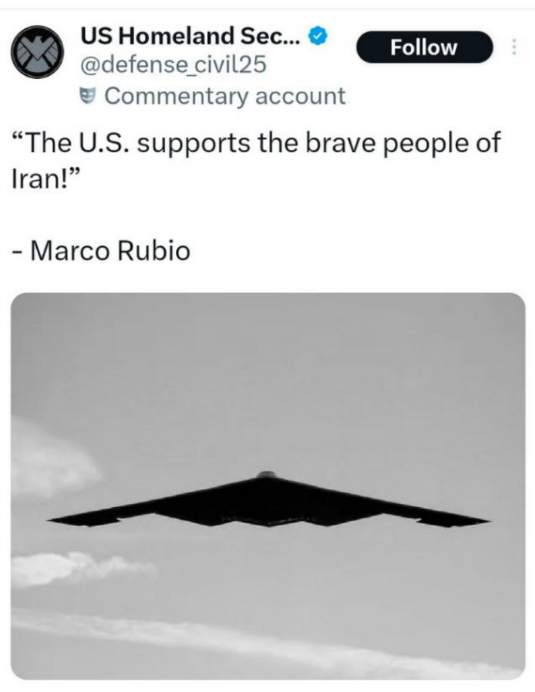
A social-media account branding itself as “US Homeland Security News” reposted a message from U.S. Secretary of State Marco Rubio—“The United States supports the brave people of Iran”—alongside an image of a B-2 stealth bomber, pairing a political statement with a heavy deterrence symbol as U.S. commentary on Iran intensifies. The account is not an official U.S. government channel (it has been described publicly as a commentary/parody-style account), but the post has circulated widely online as a symbolic show of backing for protesters. The amplification comes amid continued international attention on Iran’s crackdown, with separate incoming reports alleging large-scale killings of demonstrators on January 8–10, 2026 (18–20 Dey 1404), figures that remain difficult to independently verify given severe information constraints.
Barron Trump, the son of U.S. President Donald Trump, shared a video circulating on social media that shows darkened streets in Tehran lit up by protesters’ mobile-phone flashlights—an apparent response to reported power cuts during unrest. In accompanying text, he wrote that authorities tried to “kill the power” to silence the protests, but demonstrators did something “even more powerful” by lighting up the streets so “the whole world” could see the crowd, adding: “You can’t kill the will of the people,” and warning that “every tyrannical regime makes this mistake” and “it always ends the same way.”