translate English
 پارسی
English
Englishپارسی
English
Englishپارسی EnglishپارسیEnglishپارسی
U.S. Senator Lindsey Graham, a Republican, voiced support for President Donald Trump’s stance against the crackdown on protesters in Iran, arguing that the “biggest prize” of Trump’s tenure would be the collapse of Iran’s clerical leadership. Graham described Ayatollah Ali Khamenei as a “ruthless, Nazi religious dictator,” and claimed he would either be “killed” or end up “in Moscow,” while urging Trump to “stand with the people” and follow through on his promise—saying it would cement him in history as a “second Ronald Reagan.” Graham also dismissed the idea that Khamenei would honor any deal to curb nuclear ambitions, and criticized U.S. Democrats for, in his words, downplaying the movement even as he said “thousands” are dying—pointing to figures such as Prince Reza Pahlavi as potential partners for the United States.
Russian Security Council Secretary Sergei Shoigu, in a phone call with Iran’s top security official Ali Larijani, criticized what Moscow described as “attempts by external forces to interfere in Iran’s internal affairs,” according to Russian and international reporting. The readout signals Russia’s continued political backing for Tehran as protests escalate and foreign pressure mounts, with Moscow framing the crisis primarily through a sovereignty-and-non-interference lens.
U.S. Democratic Senator John Fetterman said that if military action against the Islamic Republic is judged to be necessary, he would “certainly” support President Donald Trump’s decision to carry out such an operation—signaling rare cross-party alignment around a potential escalation as Washington debates how to respond to Iran’s crackdown and the widening regional risk picture.
Abir Al-Sahlani, a member of the European Parliament, posted on Instagram describing Iran’s recent protests as a struggle for “dignity, freedom, human rights and accountability,” and said the European Union must act “concretely and consistently” to defend the rights of the Iranian people. Her remarks come as international reactions intensify following reports of a harsh crackdown and a widening communications blackout.
Asked whether the U.S. objective in talks with Iran remains “complete nuclear disarmament” or if President Donald Trump is pursuing a different endgame, White House press secretary Karoline Leavitt said Trump has made it “quite clear” he does not want to see people being killed in the streets of Tehran—adding that, in her words, this is “unfortunately” what the administration believes is happening now.
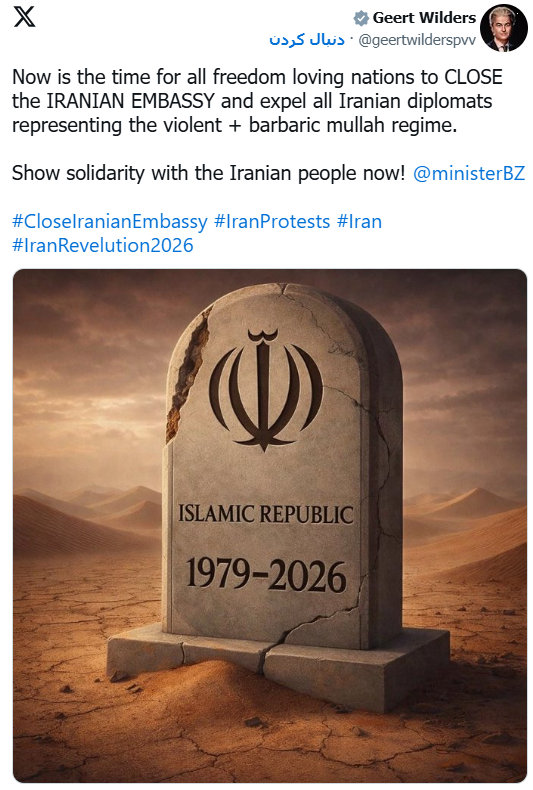
Dutch MP Geert Wilders called on “freedom-loving nations” to shut down Iranian embassies and expel Islamic Republic diplomats, urging international solidarity with the Iranian people as protests continue and pressure grows on governments to downgrade diplomatic ties with Tehran.
A French Foreign Ministry diplomatic source said some staff from France’s embassy in Tehran have left Iran, while the ambassador remains in place and the mission has been reconfigured to continue operating under local conditions. The source added that the embassy is still functioning to provide services to French nationals who may be in Iran, as security and communications disruptions linked to the ongoing unrest complicate consular operations and travel planning.
The U.S. Virtual Embassy in Iran urged American citizens currently in Iran to depart as soon as possible, warning that protests could escalate and that internet/phone disruptions and flight cancellations or suspensions may limit options. The notice advised U.S. nationals to plan their exit and—if flights are unavailable—to consider overland routes via Türkiye or Armenia if conditions allow, while those unable to leave were urged to follow official updates and take basic precautions to reduce risk.
Ukraine’s President Volodymyr Zelensky described Iran’s nationwide protests as a genuine “uprising” and argued that the international community should not “miss this moment” when change may be possible. In remarks echoed in a Persian-language message shared on X, he said “every normal person on Earth” wants Iranians to be able to free themselves from a regime he blamed for “so much evil,” including consequences for Ukraine, and he urged global leaders and international organizations to engage and help Iranians “remove those responsible” for the country’s current situation.
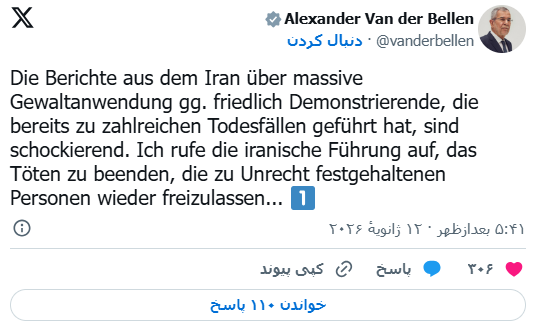
Austrian President Alexander Van der Bellen said in a video message that reports of massive violence against peaceful protesters in Iran—and the many deaths—are “shocking,” calling on Iran’s leadership to end the killings. He added that Iranian women and men seeking a better and freer life can count on Austria’s solidarity.
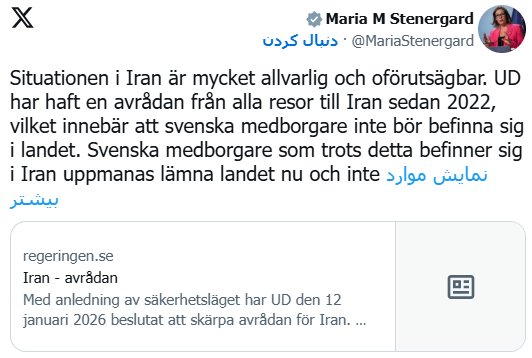
Swedish Foreign Minister Maria Malmer Stenergard said late Monday, January 12, 2026 (22 Dey) that Swedish citizens currently in Iran should leave immediately and “not wait,” describing the situation as “very serious and unpredictable.” She stressed Sweden has advised against travel to Iran since 2022—meaning Swedes should not be in the country—and said the new message represents the strongest level of guidance from Sweden’s Foreign Ministry. Stenergard added that SMS alerts were sent to registered Swedes in Iran who provided phone numbers, urging them to follow embassy travel updates where possible.
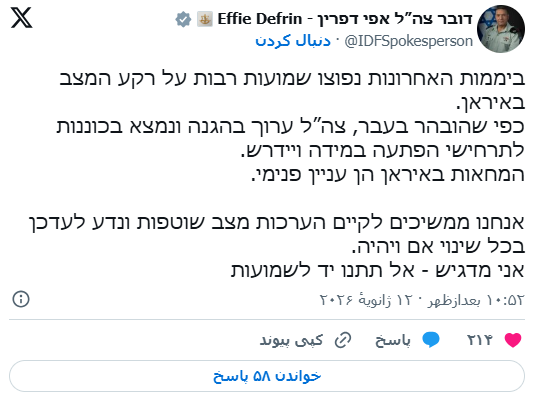
An Israeli military spokesperson said a wave of rumors has circulated in recent days amid developments in Iran, but stressed that the protests are an “internal matter” for Iran and that Israel is continuing to assess the situation. The spokesperson added that any changes will be communicated to the public, and reiterated that the Israel Defense Forces remain defensively prepared—saying the military is ready to respond if needed to any unforeseen scenario.