translate English
 پارسی
English
Englishپارسی
English
Englishپارسی EnglishپارسیEnglishپارسی
The Washington Post reports that U.S. Central Command (CENTCOM) has been directed to plan staffing for round-the-clock, seven-day-a-week high-level support “for the next month,” as the threat environment linked to the Iran crisis is expected to remain elevated.
IranWire says it obtained exclusive details about a recent meeting in which the UK summoned the Islamic Republic’s ambassador in London, portraying it as a sign of rising Iran–UK tensions and deeper diplomatic isolation. According to the outlet, the meeting—held last week—lasted just nine minutes, skipped customary formalities (including any tea or coffee), and ended immediately after Britain formally delivered its protest to the ambassador.
A senior U.S. official told Axios that Washington is pressing ahead with “phase two” of its Gaza plan and that Israeli Prime Minister Benjamin Netanyahu was not consulted on the newly announced Gaza oversight structure; the official signaled that if Israel wants the U.S. to manage Gaza, it will be “our way.” Netanyahu’s office has publicly complained that the Gaza Executive Board was not coordinated with Israel and runs against Israeli policy, with Israeli officials particularly objecting to Turkey’s involvement and the reported inclusion of Qatar in the broader framework—highlighting widening friction despite the close Trump–Netanyahu relationship.
Iraq’s defence ministry says the Iraqi army has taken full control of the Ain al-Asad air base in Anbar after a U.S. withdrawal, a move Iraqi officials frame as part of the 2024 Washington–Baghdad plan to wind down the U.S.-led coalition presence and shift to a bilateral security relationship. Iraqi commanders toured the base and reassigned responsibilities, with Iraqi forces shown armed and on alert; Reuters noted a small number of U.S. personnel may have remained temporarily for logistical reasons, while AP reported the withdrawal as complete.
The U.S. State Department’s Persian-language account said it has received reports indicating the Islamic Republic is preparing options to target U.S. bases, reiterating that “all options remain on the table.” The message warned that any attack on U.S. assets would be met with “very, very powerful force,” adding: “We’ve said it before and we’ll say it again—don’t play games with President Trump.”
Retired Gen. Jack Keane said in a Fox News interview that the United States is visibly repositioning military assets to widen its options as tensions with Iran rise. Fox News and ABC report the Pentagon is moving at least one aircraft carrier toward the Middle East and weighing a broader surge of air, sea, and missile-defense assets to strengthen deterrence and preserve strike flexibility. In parallel, Reuters reports the U.S. has begun withdrawing some personnel from key regional bases after Iranian officials warned neighboring states hosting U.S. forces that American bases could be targeted if Washington conducts strikes.
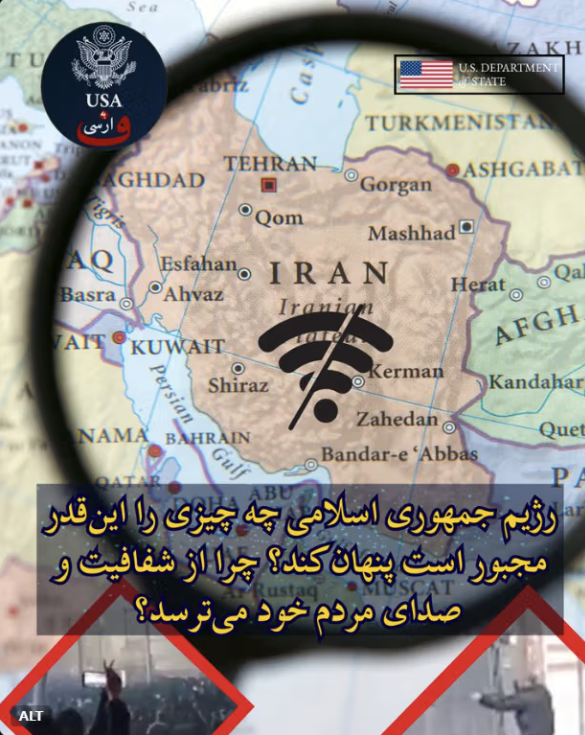
The U.S. State Department’s Persian-language account on X said Iran’s continued internet shutdown reflects the Islamic Republic’s fear of transparency and public voices, citing a claim by a regime spokesperson that restrictions will last until Nowruz—extending an isolation period that Iranians have already endured for more than 216 hours. The post argued the move is deliberate, pushing millions further into information darkness, cutting them off from the world and from each other, and signalling a government focused on silence and isolation rather than addressing the country’s real challenges.
U.S. Senator Tom Cotton told Fox News that Donald Trump has not forgotten what he described as the ayatollahs’ responsibility for the deaths of hundreds of Americans, warning Tehran should take the president’s threats seriously. Cotton said Trump has multiple options, but argued any course of action should maintain “maximum pressure” on Iran’s rulers while aiming to minimize casualties.
In an interview with POLITICO, U.S. President Donald Trump said “it’s time to look for new leadership in Iran,” blaming Supreme Leader Ayatollah Ali Khamenei for Iran’s deterioration and for relying on repression and violence to stay in power. The remarks came after Khamenei accused Trump and the U.S. of backing the unrest and bearing responsibility for deaths during the crackdown, escalating the war of words as protests and heavy security measures continue across Iran.
Argentina’s presidential office said on January 17, 2026 it has designated the IRGC Quds Force and 13 associated individuals as a terrorist organization and added them to the country’s RePET registry, triggering financial sanctions and operational restrictions. The statement cited Argentina’s history as a victim of Quds Force-linked operations in the 1990s, including the 1992 Israeli Embassy attack in Buenos Aires and the 1994 AMIA bombing, and highlighted that Ahmad Vahidi (a former Quds Force commander) remains under an INTERPOL red notice while Iran has not cooperated with prosecution.
Iranians in Bern, Switzerland, gathered on Saturday, January 17 (27 Dey) outside the Islamic Republic’s embassy to show solidarity with people inside Iran and support for Prince Reza Pahlavi. Protesters carried the Lion and Sun flag and chanted slogans against the Islamic Republic, reflecting continued diaspora mobilization alongside unrest at home.
Slovakia said it has temporarily closed its embassy in Tehran and withdrawn diplomatic staff, citing a “significant” deterioration in the security situation and a “real threat” of further military escalation, according to statements attributed to Foreign Minister Juraj Blanár. New Zealand also said it has temporarily closed its Tehran embassy, with diplomatic staff leaving on commercial flights and consular operations shifted to Ankara, while urging its citizens to avoid travel to Iran and leave if already there, warning its ability to provide consular assistance is “extremely limited.”