translate English
 پارسی
English
Englishپارسی
English
Englishپارسی EnglishپارسیEnglishپارسی
President Donald Trump warned that Iraq would be making a “very bad choice” by bringing back former prime minister Nouri al-Maliki, saying the U.S. would no longer help Iraq if he is reinstated and claiming Baghdad would have “ZERO chance” of “success, prosperity, or freedom” without U.S. support. Trump posted the message on Truth Social as Iraq’s dominant Shi’ite bloc moved to nominate Maliki—raising the political stakes in Baghdad as it tries to balance U.S. and Iran pressure.
In a rare interview with The Washington Post, Iraq’s intelligence chief Hamid al-Shatri warned that ISIS fighters in Syria have grown from roughly 2,000 to 10,000 in a little over a year—an estimate he says poses a direct threat to Iraq because ISIS operates as a single transnational organization seeking new ground for attacks. The claim diverges from a U.N. Security Council estimate of ~3,000 ISIS members across Syria and Iraq combined (as of August), underscoring the difficulty of verification and the heightened alarm in Baghdad. Al-Shatri said recent instability in northeastern Syria, where government forces moved to retake territory long held by Kurdish-led forces, triggered chaos at regional prisons holding thousands of ISIS members, allowing some to escape into the desert before many were rearrested. He also said new ISIS recruits include former Sharaa-aligned militants, plus defectors from groups such as Jabhat al-Nusra and Ansar al-Sunna, and newly recruited Arab tribesmen in Sunni areas previously controlled by Kurdish forces.
U.S. Secretary of State Marco Rubio warned Iraq against the formation of a government overly aligned with Iran, after Iraq’s dominant Shiite political bloc (the Coordination Framework) nominated former prime minister Nouri al-Maliki as its candidate to lead the next government. Rubio raised the issue in a phone call with Prime Minister Mohammed Shia’ al-Sudani on Sunday, January 25, 2026 (5 Bahman 1404), saying Washington wants the next Iraqi government to be a force for stability, prosperity, and security in the region—while stressing that a government “controlled by Iran” would struggle to prioritize Iraq’s interests, keep the country out of regional conflicts, or deepen the U.S.–Iraq partnership.
John Bolton, former national security adviser to Donald Trump, wrote on X that the White House should pursue a long-term plan on Iran, arguing a short, limited strike “cannot topple the regime.” He added that if Trump is committed to regime change as he has said, the administration should adopt a strategic, orderly approach—comments that underscore persistent hawkish pressure in Washington and can keep geopolitical risk (and the associated energy-risk premium) elevated.
A clip of Barack Obama saying he was “the President, not the emperor” and obligated to enforce immigration law is being reshared online as protests intensify over recent ICE-linked fatal incidents in Minneapolis, amid a broader crackdown that has driven renewed scrutiny of enforcement tactics and detention conditions. Some posts cite “56 deaths” under Obama to argue a double standard, but that figure is documented by rights groups as deaths in ICE custody during the Obama administration—not necessarily deaths in direct field “encounters”—making one-to-one comparisons politically charged and methodologically messy.
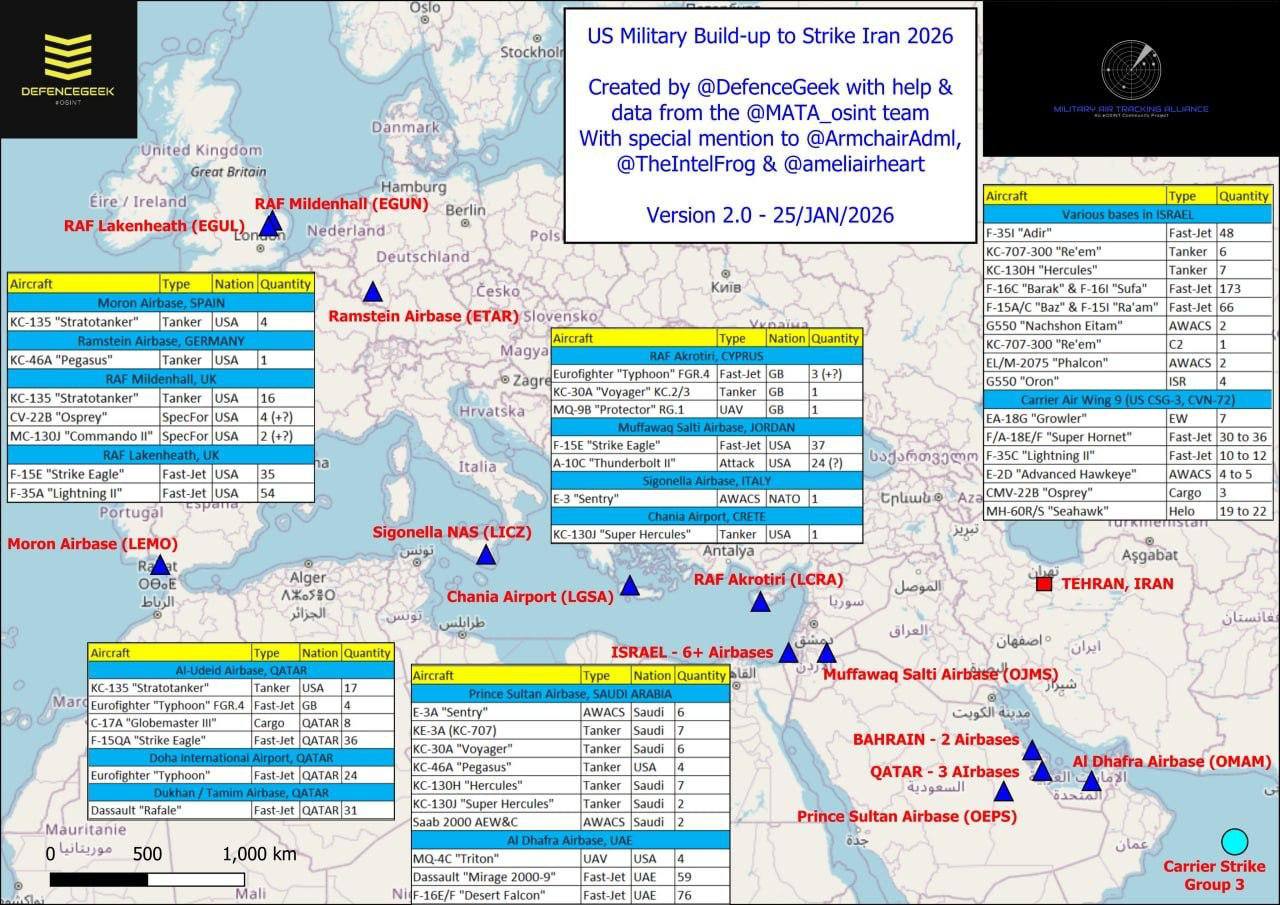
Online reports and OSINT-style summaries claim the U.S. has expanded its Middle East posture—highlighting a carrier strike group operating near Iran, a buildup of F-15E and A-10 aircraft at Muwaffaq Salti Air Base (Jordan), increased C-17 airlift activity into Jordan and Qatar, bombers and KC-135 tankers positioned at Diego Garcia, and added Patriot/THAAD deployments to protect Israel and U.S. Gulf sites. The unverified tallies and basing details vary by source, but the overall picture points to a broader strike-and-defense footprint that raises near-term escalation risk—especially as some hardline commentary frames retaliation and regional proxy involvement as inevitable, sharpening the danger of miscalculation.
An OSINT tracker map published by @DefenceGeek (v2.0, dated 25 Jan 2026) depicts a widening U.S.-aligned air-and-sea posture that could support a Iran contingency, centered on Carrier Strike Group 3 / CVN-72 (USS Abraham Lincoln) and a heavy emphasis on aerial refueling. The graphic lists KC-135 tankers at Al Udeid (17) and RAF Mildenhall (16), plus strike assets including RAF Lakenheath (F-15E: 35; F-35A: 54) and Jordan’s Muwaffaq Salti (F-15E: 37; A-10C: 24?), alongside partner inventories (e.g., Israel’s fighter and ISR fleet, Saudi AWACS/tankers, UAE fast-jets). As with all OSINT order-of-battle snapshots, the figures are estimates and can shift quickly, but the composition—tankers, fighters, and a carrier air wing—signals an effort to expand operational reach and readiness.
Axios reporter Barak Ravid says U.S. officials describe any diplomatic agreement under consideration as requiring Iran to eliminate its stockpiles of enriched uranium, halt all domestic uranium enrichment, severely limit long-range missiles, and end support for regional proxy groups—a set of demands that would amount to a sweeping rollback and could prove difficult for Tehran to accept amid escalating tensions. (Source: Axios / Barak Ravid)
The U.S. Embassy in Baghdad posted a warning message on X in Arabic and English on Monday (6 Bahman) saying Washington is monitoring developments in Iran “closely,” alongside an image of President Donald Trump and a quote attributed to him: “We are watching Iran very closely.” The embassy added that Trump is “a president who takes action,” echoing his recent repeated warnings that if protest-related execution sentences are carried out, the United States would respond with “very severe” measures—keeping “all options,” including military action, on the table if repression and executions continue.
The Wall Street Journal reported that the USS Abraham Lincoln carrier strike group has entered the Middle East, a move U.S. officials say broadens Washington’s offensive and defensive capacity if President Donald Trump chooses military action against Iran—though Trump says no final decision has been made. The report adds that F-15E fighters have shifted to a base in Jordan, while Patriot and THAAD air defenses are being deployed to protect U.S. facilities and partners from potential Iranian retaliation, with some systems moving into Kuwait and Saudi Arabia and the posture expected to be completed within one to two weeks. Former Pentagon official Dana Stroul said Trump has historically followed through after ordering such force concentrations, while analysts see the redeployment as another sign of how hard it is for the U.S. to step back from the region.
Saudi Arabia’s Ministry of Defense said the bilateral naval exercise “Riyah al-Salam 2026” began on Monday (6 Bahman) in the waters of the Sultanate of Oman, involving the two countries’ royal navies to deepen military cooperation. Exercise commander Rear Adm. Mohammed al-Otaibi said the drill aims to boost operational coordination, share field experience, integrate planning processes, and strengthen naval roles in protecting shipping lanes and regional maritime security. The exercise features advanced scenarios simulating modern naval operations and includes the Royal Air Force of Oman, 10 warships, helicopters, and two maritime-security special units, with activities split between the Sea of Oman and the Said bin Sultan Naval Base, including joint maritime operations, special-forces training, naval aviation, and live-fire missile and ammunition drills.
After Hezbollah chief Naim Qassem warned that the group would not remain neutral if Iran is attacked and that a new war on Tehran could set the region ablaze, Lebanese MP Fouad Makhzoumi responded on X by calling Hezbollah “the military arm of the Iranian regime,” not a Lebanese political party. Makhzoumi argued that entering a war to defend Iran would effectively be a war against Lebanon—its people, sovereignty, and future—and questioned Hezbollah’s continued role in Lebanon’s government while, in his view, professing loyalty to a foreign state. He added that the Lebanese government has a legal duty to prevent the country from becoming a front line for external wars, as Beirut tries to avoid further regional spillover.