translate English
 پارسی
English
Englishپارسی
English
Englishپارسی EnglishپارسیEnglishپارسی
Dan Shapiro, the former U.S. ambassador to Israel, said the odds of a diplomatic deal between Washington and Tehran are “very low,” arguing that even if the Islamic Republic were to hypothetically accept terms such as zero enrichment, strict limits on its missile program, and ending support for regional proxies, the concessions it would seek after a bloody crackdown on protesters would be politically and morally untenable. Shapiro added that after threatening force and deploying substantial military capabilities to the region, President Donald Trump now faces narrowing options—on a path that, in his words, is “more likely to end in military attacks.” He also said that scenarios involving targeting top Iranian leadership alongside other key regime assets remain part of Washington’s plausible calculations and warned that a turn toward diplomacy framed around “threat of force” is unlikely to produce a durable agreement given the sharply higher cost of any compromise with Tehran.
Former Swedish foreign minister Margot Wallström said she hopes the European Union will move to designate Iran’s Islamic Revolutionary Guard Corps (IRGC) as a terrorist organisation, welcoming what she described as a shift in France’s position toward backing an EU listing. Ahead of an EU foreign ministers’ meeting expected to take place tomorrow, Wallström said she hopes the gathering results in a final decision to blacklist the IRGC. She also argued there is a direct link between the Islamic Republic and the continuation of the war in Ukraine, saying weapons sent from Iran to Russia are helping prolong the conflict. Her comments come as political pressure inside the EU has been rising in recent days to tighten measures on Tehran and expand sanctions, including through a potential IRGC terrorist designation.
A new Politico poll suggests Donald Trump’s voter base within the MAGA movement—long identified with opposition to U.S. entanglement in foreign wars—is increasingly backing military action against a wider set of countries, led by Iran. According to the survey, 65% of Trump voters support U.S. military action against at least one of several potential targets, including Iran, Greenland, Cuba, Colombia, China, and Mexico. Iran stands out as the most prominent scenario: it recorded the highest support among all listed foreign targets, with 61% of MAGA supporters backing potential military action against Iran.
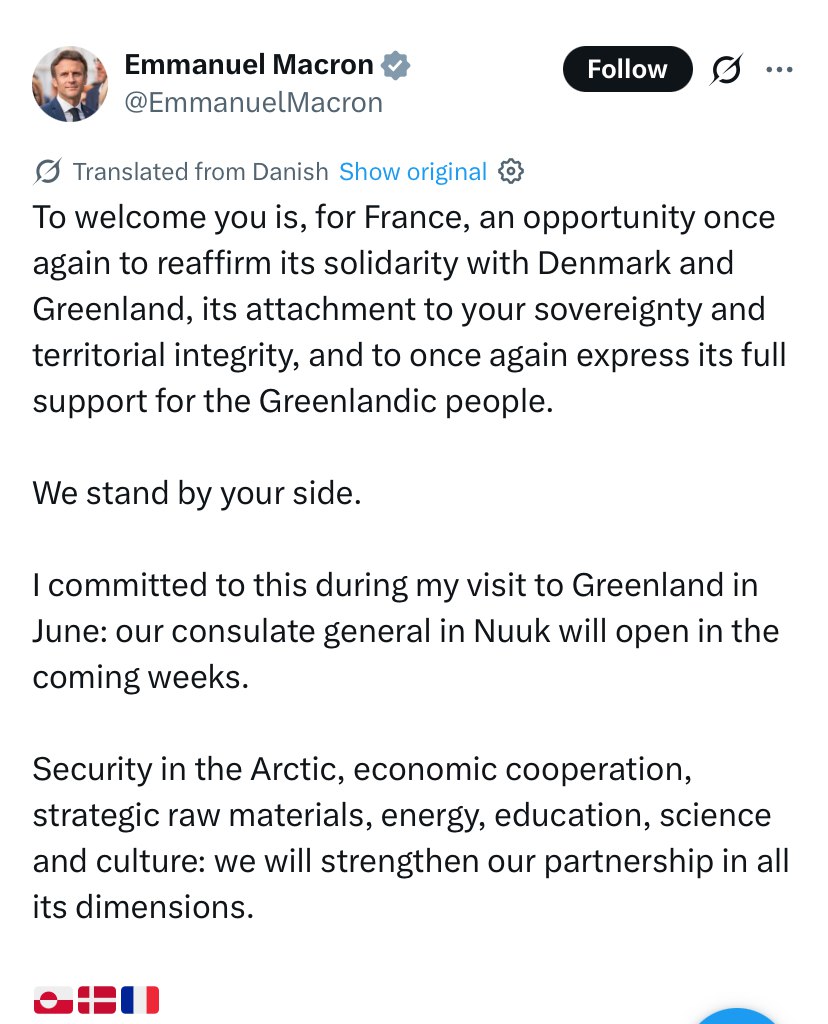
President Emmanuel Macron said France will “stand by” Greenland, backing Denmark and Greenland’s sovereignty and territorial integrity, and confirmed France will open a consulate general in Nuuk as a political signal of solidarity amid rising Arctic tensions.
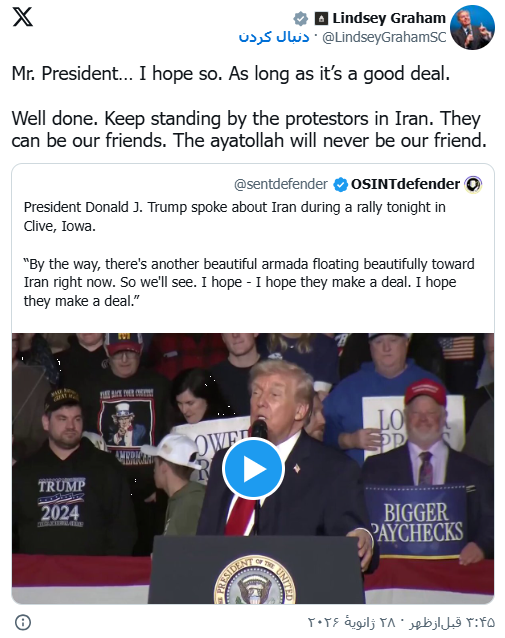
U.S. Senator Lindsey Graham reposted President Donald Trump’s remarks about “another” U.S. naval armada moving toward Iran and urged Trump to keep backing Iran’s protesters, writing on X: “They can be our friends. The ayatollah will never be our friend.” Trump, speaking in Iowa on Tuesday Jan. 27, 2026 (7 Bahman 1404), also said he hoped Iran would “make a deal,” as Washington continues to pair military signaling with pressure for negotiations.
Egypt’s Foreign Ministry says Foreign Minister Badr Abdelatty held separate phone calls with Steve Witkoff, the U.S. special envoy, and Abbas Araqchi, Iran’s foreign minister—signaling Cairo’s effort to keep a diplomatic channel open as regional tensions rise. The twin calls point to an active intermediary role by Egypt, aimed at de-escalation and keeping talks from collapsing into a single, high-stakes “all-or-nothing” package.
Syrian President Ahmed al-Sharaa is expected in Moscow for talks with Russian President Vladimir Putin, with the Kremlin saying the leaders will discuss the outlook for bilateral relations and the broader Middle East situation. The trip—reported as Sharaa’s second Moscow visit in his current role—comes as Russia recalibrates aspects of its Syria posture while maintaining key military footholds, and underscores Damascus’ push to reset ties with a pivotal wartime power amid mounting regional uncertainty.
Turkish Foreign Minister Hakan Fidan said it would be “wrong” to attack Iran and “wrong” to start another war, arguing there’s still room for diplomacy because Iran is ready to return to nuclear negotiations. In an interview with Al Jazeera, Fidan urged Washington to avoid a “package deal” approach and instead resolve disputes step by step—starting with the nuclear issue—warning that bundling everything together can look humiliating to Tehran and become politically hard to sell to Iran’s leadership.
Speaking to residents in Iowa, President Donald Trump said “another magnificent armada” of U.S. ships is moving toward Iran and added, “I hope they make a deal,” as Washington ramps up military signaling alongside diplomatic pressure. Iran’s foreign minister Abbas Araqchi pushed back, saying Tehran did not request negotiations with the U.S. and that talks cannot proceed under threats and coercive demands, though he acknowledged contacts via intermediaries.
Reports circulating on social media claim the Syrian Arab Army carried out artillery strikes on Syrian Democratic Forces (SDF) positions near Rmelan in Al-Hasakah governorate. The specific incident has not been independently confirmed by major wire services, but it comes as the U.S.-backed ceasefire between Damascus and the Kurdish-led SDF remains tense, with both sides repeatedly accusing each other of violations and reinforcing around key northeastern hubs. Reuters reported the truce has been extended through February 8 and that new U.S.-supported integration talks were expected inside Syria, underscoring that the situation remains a live military-political standoff despite negotiations.
Ukraine’s Foreign Minister Andrii Sybiha says the peace track currently being discussed would produce two separate documents: a 20-point framework signed between Kyiv and Washington, and a separate U.S.–Russia document, with no EU signature—though Sybiha stresses Europe is “present” in the process and that key provisions cannot move without coordination with European partners. He said talks showed “progress” at a trilateral meeting in Abu Dhabi, and that a parallel military track (including military intelligence and the General Staff) discussed ceasefire/truce parameters, monitoring/verification, deadlines, and how each side interprets key terms; he added negotiations remain ongoing and the final configuration could still change.
U.S. Senator Ted Cruz said the United States “should be arming the protesters in Iran. NOW,” arguing that support should help Iranians overthrow the Islamic Republic’s leadership, according to his post on X. The remark lands as U.S.–Iran tensions remain elevated and as Israel hosts its International Conference on Combating Antisemitism in Jerusalem—an event drawing global political attention and controversy over some invited guests. Haaretz also reported Cruz delivered video remarks tied to that conference. Politically, Cruz’s language underscores the louder “regime-change” wing of the U.S. debate; in markets, that kind of rhetoric can add to an escalation risk-premium channel (especially energy and broader risk sentiment).