translate English
 پارسی
English
Englishپارسی
English
Englishپارسی EnglishپارسیEnglishپارسی
Russian President Vladimir Putin congratulated Syrian interim President Ahmad al-Sharaa on what Moscow described as progress in restoring Syria’s territorial integrity, including the reintegration of areas in the Euphrates region/east of the Euphrates back under Damascus’s control. The remarks came during talks in Moscow that also focused on Syria’s reconstruction and the future of Russia’s military footprint in the country, with the Kremlin framing the territorial consolidation as a significant step in stabilizing Syria after years of fragmentation.
Flight-tracking data and defense reporting show a U.S. Air Force RC-135V Rivet Joint intelligence aircraft has arrived at Al Udeid Air Base in Qatar, adding airborne signals-intelligence capacity as U.S. forces reposition in the region. Separately, flight-tracking observers also reported British, Spanish, Italian, and German military transport aircraft heading toward the Middle East—moves typically associated with logistics flow, personnel/equipment lift, and coalition readiness—though those specific airlift claims rely on open-source tracking accounts rather than official announcements.
U.S. Secretary of State Marco Rubio said 30,000–40,000 U.S. military personnel are stationed across eight to nine bases/facilities in the Middle East, warning they are within range of Iran’s drones and short-range ballistic missiles. He added that the U.S. would maintain sufficient capability to defend those forces and that the President keeps a “preemptive” defensive option—meaning if Washington receives credible intelligence of an imminent Iranian attack, it could move first to protect U.S. troops and assets.
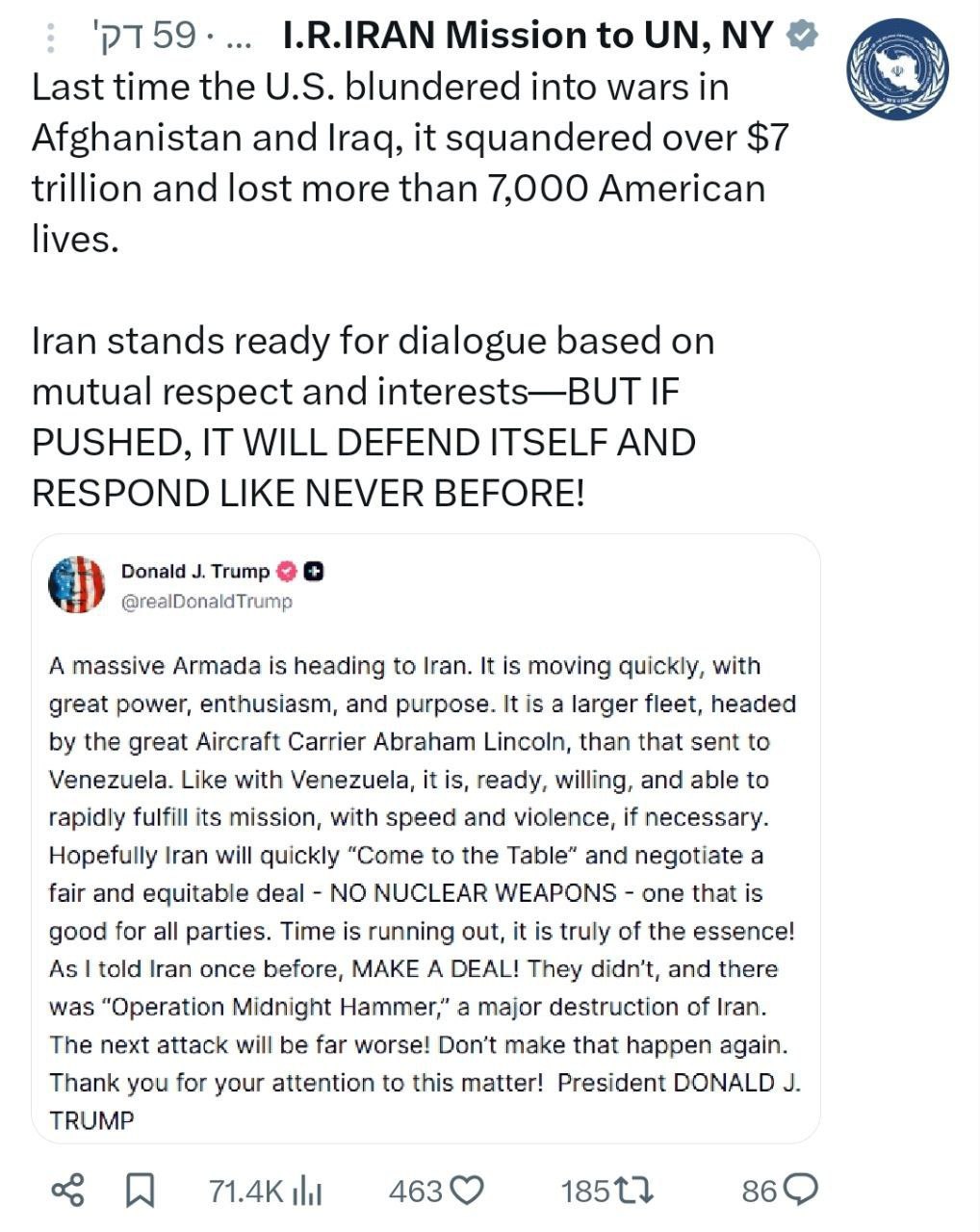
Iran’s mission to the United Nations reacted to President Donald Trump’s latest threat—where he claimed a “massive armada” is heading toward Iran and urged Tehran to “make a deal”—by warning against another U.S. war in the region. The mission said the last time the U.S. “blundered” into wars in Afghanistan and Iraq it spent over $7 trillion and lost more than 7,000 American lives, adding that Iran is ready for dialogue based on mutual respect and interests, but if provoked it will defend itself and respond “like never before.”
The U.S. State Department said the United States and 40 partner countries met last week in Prague, Czech Republic, for a symposium aimed at advancing implementation of re-imposed UN Security Council resolutions on Iran. Participants discussed the full range of issues tied to how UN member states carry out these renewed obligations, and the meeting was used to secure commitments from several countries seeking country- and sector-specific technical security assistance from the U.S. to maximize sanctions effectiveness. The symposium also addressed threats linked to Iran’s nuclear activities, ballistic missiles, and conventional arms, with Washington arguing that Iran’s continued threat posture and violent suppression of protests make broad, urgent enforcement of UN measures and related restrictions necessary.
Former U.S. Secretary of State Mike Pompeo said Washington should not expect a workable agreement with the Islamic Republic, arguing Iran’s leadership only backs down when confronted with force and sustained pressure. In remarks aired by Fox News and amplified in a post on X, Pompeo wrote that Tehran may claim it wants a deal, but any arrangement that keeps the regime in power is “inherently incompatible” with regional security—adding that it is “not a regime you can negotiate with.” He also welcomed the deployment of U.S. naval assets toward Iran and called for maintaining strong external pressure to help Iranians inside the country determine their own future.
German Chancellor Friedrich Merz said on Wednesday (Jan. 28) that the Islamic Republic—“a regime that can only hold onto power through sheer violence and terror against its own population”—has its “days numbered,” adding it “could be a matter of weeks” and arguing the government has “no legitimacy” to rule Iran. The remarks were made at a press conference in Berlin, reflecting a sharper European tone as debate grows inside the EU over new Iran-related measures.
U.S. Secretary of State Marco Rubio said Iran’s power structure is split between the Supreme Leader, the IRGC, and nominally elected institutions—but that key decisions ultimately run through the Supreme Leader—arguing there is “no simple answer” for what comes next if the Supreme Leader and the regime were to fall, beyond the hope that someone within the system could help steer a transition. He warned any major change after decades of entrenched rule would require careful, cautious planning, while stressing the U.S. must maintain a credible regional posture: Rubio told a Senate hearing that 30,000–40,000 U.S. troops are spread across eight or nine facilities in the Middle East and are within range of Iran’s drones and short-range ballistic missiles, adding the President “always reserves” a pre-emptive defensive option if there are indications of an imminent attack. Rubio also pointed to U.S. security commitments—including to Israel—and said that despite Iran’s economic deterioration, Tehran has still amassed “thousands and thousands” of ballistic missiles, which he framed as a direct threat to U.S. forces and partners.
The Jerusalem Center for Security and Foreign Affairs (JCFA) wrote that senior Israeli security officials fear a “historic opportunity” to replace Iran’s ayatollah-led system could be lost if U.S. President Donald Trump refrains from striking Iran, arguing Israel previously missed a chance during the June 2025 “12-day war” to take out Iran’s top leadership. The piece cites a “senior political source” claiming that if Washington does not replace the current leadership in Tehran, Israel could be forced to “eliminate” Ali Khamenei itself, while also portraying Prince Reza Pahlavi as a symbolic option for transitional leadership and warning that without leadership change Israel may face repeated confrontations to contain Iran’s nuclear and missile rebuild.
IRGC spokesperson Ali Mohammad Naeini said the “military option” against Iran has failed, claiming the Guard has plans for “all U.S. scenarios” and is “in control of the battlefield.” He also argued White House officials are operating in a state of “confusion and helplessness,” framing Tehran’s posture as prepared for escalation while projecting deterrence.
Israel’s foreign minister, Gideon Sa’ar, called on the European Union to designate Iran’s Islamic Revolutionary Guard Corps (IRGC) as a terrorist organisation, welcoming France’s reported support for such a move and arguing the IRGC is playing a central role in violent repression inside Iran. Sa’ar urged EU governments to translate political momentum into a formal listing, framing it as both a security step and a signal of solidarity with Iranians facing intensified crackdowns.
European Parliament President Roberta Metsola urged the EU to finally designate Iran’s Islamic Revolutionary Guard Corps (IRGC) as a terrorist organisation, arguing Europe has a “historic opportunity” and a “moral duty” to act. Writing on X, she said the move would not be merely symbolic, and called for moral clarity and leadership in response to repression in Iran—adding that Iranians living under crackdown are watching Europe, that those killed deserve justice, and that “oppressors” should have no safe haven.