translate English
 پارسی
English
Englishپارسی
English
Englishپارسی EnglishپارسیEnglishپارسی
Russia is prepared to evacuate its personnel from Iran’s Bushehr nuclear power plant if necessary, Rosatom chief Alexei Likhachev said, according to TASS, as reported by Reuters. He said Moscow is coordinating with Russia’s Foreign Ministry and Defense Ministry and hopes the facility’s “inviolability” is respected; hundreds of Russian specialists work at Bushehr, and Russia is also building additional units at the site, which Likhachev has previously warned could face catastrophic risk if attacked.
Israeli outlet Ynet reported that Liberian President Joseph Boakai and Austrian Chancellor Christian Stocker have called off planned visits to Israel scheduled for next week, with no official reason given in that report. However, Austrian media citing the Chancellery said Stocker’s trip was postponed due to a calendar conflict: Benjamin Netanyahu is expected to appear in court on Monday, disrupting planned meetings; Vienna says it is working on a new date.
U.S. President Donald Trump said on January 29, 2026, during a Cabinet meeting, that he personally asked Russian President Vladimir Putin to not strike Kyiv and other cities for a week because of record-cold weather, and that Putin agreed. Trump portrayed the pause as an unexpectedly successful, humanitarian-driven step, though there was no immediate confirmation from the Kremlin in early reporting.
The Mossad director David Barnea and Israel’s military intelligence chief Maj.-Gen. Shlomi Binder traveled to Washington for high-level consultations on how to handle Iran, according to The Jerusalem Post and Axios. The Jerusalem Post said Barnea arrived Jan. 16 and met Trump envoy Steve Witkoff, shortly after a Jan. 14 Netanyahu–Trump call in which Netanyahu reportedly urged delaying any strike until more U.S. forces were in place; Axios said Binder met senior officials at the Pentagon, CIA and the White House to share intelligence on potential targets, as Saudi Defense Minister Prince Khalid bin Salman also visited to push a diplomatic off-ramp.
EU foreign policy chief Kaja Kallas said the EU has added Russia to its money-laundering “blacklist” (the EU list of high-risk third countries), a step that will slow processing and raise compliance costs for transactions involving Russian banks as EU institutions apply tighter checks. The change is anchored in Commission Delegated Regulation (EU) 2026/46, which entered into force on 29 January 2026.
Germany’s foreign minister Johann Wadephul said the EU’s political agreement in Brussels to designate Iran’s Islamic Revolutionary Guard Corps (IRGC) as a terrorist organisation is a strong but overdue signal, stressing the next step must be rapid implementation into a legally binding listing. In an official statement dated 29 January 2026, Wadephul described the IRGC and its auxiliary forces as the regime’s “henchmen,” accusing them of brutal repression, executions of protesters, and a destabilising regional role, and said they were behind attempted attacks in Germany and Europe—“in short, they have blood on their hands.” He also welcomed that other EU member states have now backed Germany’s long-running push, after recent reporting that some capitals—including France, Italy and Spain—had been among the late holdouts before shifting position.
Swedish Prime Minister Ulf Kristersson said the EU has reached a political agreement to place Iran’s Islamic Revolutionary Guard Corps (IRGC) on the bloc’s list of sanctioned terrorist organisations—an outcome he noted Sweden has long pushed for. He added the decision signals a “strong and clear stance” against the Iranian regime’s brutal repression and against actions that threaten security, as EU foreign ministers moved to tighten pressure on Tehran.
Caretaker Dutch Prime Minister Dick Schoof called the EU’s decision to designate the IRGC a terrorist organisation “good news,” saying the Netherlands has backed the move for years and that Europe is united in responding to the bloody repression of peaceful protesters in Iran. The comments come as EU foreign ministers formally agreed on 29 January 2026 to add the IRGC to the EU terror list and roll out additional Iran-related sanctions.
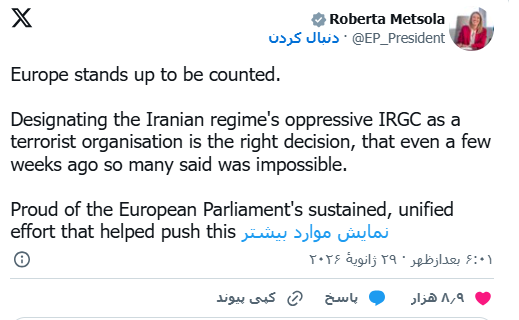
European Parliament President Roberta Metsola welcomed the EU’s move to designate Iran’s Islamic Revolutionary Guard Corps (IRGC) as a terrorist organization, calling it “the right decision” and noting that many considered it impossible only weeks ago. She said she is proud of the European Parliament’s sustained, unified push that helped drive the outcome, and argued the moment now demands continued resolve—adding that “now is the time to stand firm” and that “Iran will be free.”
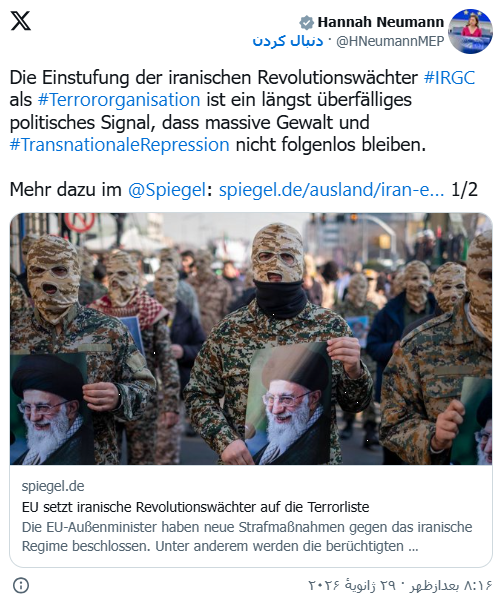
German Green MEP Hannah Neumann, who chairs the European Parliament’s delegation for relations with Iran, said the EU’s decision to designate the IRGC a terrorist organisation is a long-overdue political signal that “massive violence and transnational repression” will no longer go unanswered. She stressed the move has clear practical effects—including asset freezes and making financial/material support or cooperation with the IRGC a criminal offence, comparable to how EU rules apply to groups such as ISIS and Hamas.
At a January 29, 2026 Cabinet meeting, U.S. Defense Secretary Pete Hegseth warned that if Iran keeps pursuing nuclear weapons capability, the U.S. military “will be prepared to deliver whatever the president expects,” adding that Tehran “has all the options to make a deal” but “should not pursue nuclear capabilities.” Hegseth pointed to the recent U.S. operation that captured Venezuelan President Nicolás Maduro as an example of U.S. reach, as President Donald Trump continues weighing options on Iran amid rising regional tensions.
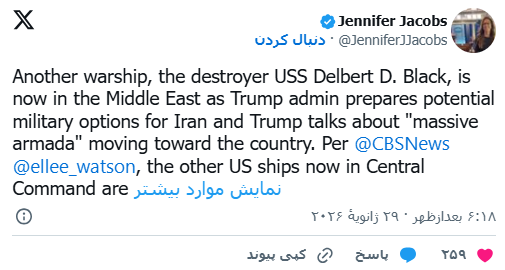
CBS News reported that the U.S. Navy has moved another guided-missile destroyer—USS Delbert D. Black—into Middle East waters. A U.S. official told Reuters the ship entered the region within the past 48 hours, lifting the U.S. naval posture there to six destroyers, alongside the aircraft carrier USS Abraham Lincoln and three littoral combat ships. CBS listed other U.S. vessels currently operating under U.S. Central Command (CENTCOM), including destroyers Spruance, Michael Murphy, Frank E. Petersen, McFaul, and Mitscher, plus littoral combat ships Canberra, Tulsa, and Santa Barbara, highlighting a broader buildup as regional tensions rise.