translate English
 پارسی
English
Englishپارسی
English
Englishپارسی EnglishپارسیEnglishپارسی
Germany’s Foreign Office has updated its Iran travel and security guidance, urging German nationals to leave the country and warning that the security environment can deteriorate rapidly. The advisory highlights a serious risk of arbitrary detention and notes that the German Embassy in Tehran can currently provide only limited consular assistance. Berlin also flags the possibility of further escalation—including military confrontation—alongside sudden flight cancellations and airspace closures, while urging citizens to avoid protests and large gatherings, follow local security instructions, and exercise extreme caution with photos/videos—especially around sensitive sites or locations showing damage.
Former U.S. Secretary of State Mike Pompeo wrote on X as U.S.–Iran negotiations in Oman move forward that there is “only one acceptable outcome” for talks with Tehran: the verifiable destruction of Iran’s nuclear program and ballistic missiles, plus an end to Tehran’s support for terrorism. He added that anyone who thinks “the Ayatollah” would accept those terms has “a bridge in Brooklyn” for sale—underscoring hawkish pressure on any diplomatic track as the Oman talks proceed.
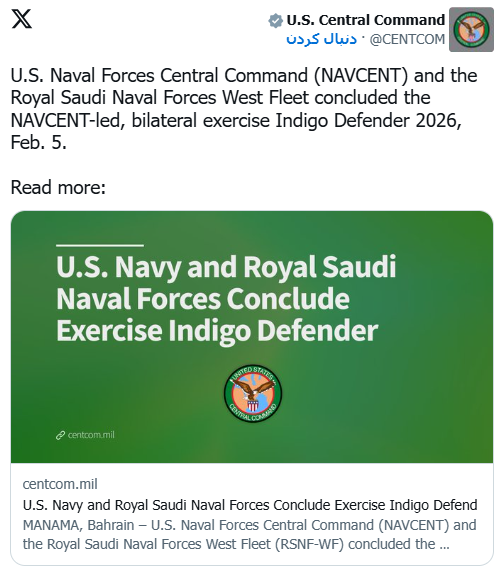
U.S. Central Command said U.S. Naval Forces Central Command and Saudi Arabia’s Royal Saudi Naval Forces (West Fleet) concluded the bilateral “Indigo Defender 2026” exercise on Feb. 5. CENTCOM said more than 50 U.S. personnel took part—spanning damage control, maritime engagement, and security teams from the U.S. Navy, Marine Corps, and Coast Guard—and that the guided-missile destroyer USS Delbert D. Black (DDG-119) also participated.
Saudi Foreign Minister Prince Faisal bin Farhan said Riyadh hopes ongoing talks between the United States and the Islamic Republic of Iran will reach a successful outcome, arguing that progress in the negotiations could make the region more secure. The remarks signal Saudi Arabia’s preference for de-escalation via diplomacy as tensions remain elevated across the Gulf.
Australia’s Foreign Minister Penny Wong and Germany’s Foreign Minister Dr Johann Wadephul issued a joint statement in Canberra on 5 February 2026 condemning what they called the Iranian regime’s “brutal crackdown” on protesters. They said they are following with “great concern” reports of casualties and arbitrary detentions, urged Tehran to meet its international obligations and fully uphold rights to freedom of expression, association and peaceful assembly, and called for ensuring the right to seek, receive and impart information—including by restoring internet access for all.
Photos/footage released from Muscat show Adm. Brad Cooper, commander of U.S. Central Command (CENTCOM), present during a meeting between the U.S. negotiating team and Oman’s foreign minister Badr al-Busaidi. The inclusion of the region’s top U.S. military commander—alongside envoys like Steve Witkoff and Jared Kushner—signals that the talks are being run with a parallel security/deterrence track in mind, as Washington and Tehran begin Omani-mediated nuclear discussions under heightened regional tension.
Iran’s Defense Minister Aziz Nasirzadeh traveled to Baku for meetings with Azerbaijani officials and held talks with President Ilham Aliyev, according to Iranian state media. The reports quote Aliyev as saying Azerbaijan will not allow “any threat” to be directed at the Islamic Republic—signaling an effort to project regional coordination and deterrence messaging amid heightened tensions around Iran.
German Chancellor Friedrich Merz downplayed Iran’s foreign minister’s criticism, saying the remarks reflect Tehran’s “nervousness and uncertainty,” during a press conference in Doha on Thursday, 16 Bahman. Merz avoided responding directly to personal insults after Iran’s Foreign Minister Abbas Araghchi accused him on social media of “political naivety” and having an “offensive personality,” while also saying Iran has traditionally welcomed strong relations with Germany and that it is “doubly regrettable” someone like Merz represents Germany globally. Araghchi’s comments came hours after Merz warned Iran would face new sanctions if it does not end violence against its own people and halt nuclear-related activities, adding Germany is ready to increase pressure. Merz said concern about regional military escalation is high, urged Iran to stop acting as a “destabilizing force,” and called on Tehran to enter talks, end “aggression,” align its nuclear program with international agreements, and protect countries such as Qatar, Jordan, and Israel from further military threats. He added talks would intensify in the coming hours and said Germany is acting in close coordination with the United States, as he continues a three-day Middle East trip including meetings with Saudi Crown Prince Mohammed bin Salman and Qatar’s Emir Sheikh Tamim bin Hamad Al Thani, with the UAE next.
Former Trump national security adviser John Bolton said there is “virtually no chance” of an agreement between Iran and the United States, calling the planned talks a “waste of oxygen” in comments to Al Jazeera. Bolton argued there is “no room” for a workable deal and suggested both sides are merely “going through the motions,” as negotiations are expected in Muscat, Oman, amid heightened military pressure and competing demands over the scope of any potential arrangement.
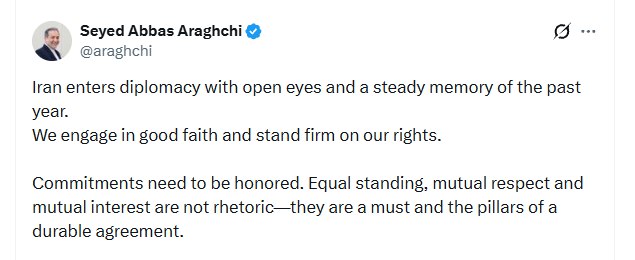
Iran’s Foreign Minister Seyed Abbas Araghchi said Tehran is entering the upcoming Oman (Muscat) talks with the U.S. “with open eyes” and “a steady memory of the past year,” adding: “We engage in good faith and stand firm on our rights,” and stressing that “commitments need to be honored” as a basis for any durable deal. The message signals a tougher Iranian posture going into negotiations where Tehran wants the agenda kept strictly nuclear, while U.S. officials have indicated interest in a broader scope.
The U.S. military is moving additional aircraft and land-based air defense systems into the Middle East as President Donald Trump weighs next steps on Iran alongside renewed diplomacy. U.S. officials have described the posture shift as primarily defensive—aimed at protecting U.S. forces and regional partners and deterring retaliation—rather than preparation for an imminent strike. NBC News reported the aircraft carrier USS Abraham Lincoln and its escorts are approaching a position within strike range of Iran, but officials told the network there is no specific mission planned at this stage.
President Donald Trump called for mandatory voter ID, proof of citizenship to register to vote, and an end to most mail-in ballots, framing the agenda as an urgent fix to U.S. election integrity. In the same remarks, Trump claimed “America’s Elections are rigged, stolen, and a laughingstock all over the world,” and warned the U.S. must “fix them” or “we won’t have a country any longer.” The proposals would mark a major shift in election administration and would likely face state-level resistance, legal challenges, and partisan gridlock, especially around federal authority over registration standards and how far mail voting can be restricted.