translate English
 پارسی
English
Englishپارسی
English
Englishپارسی EnglishپارسیEnglishپارسی
Sen. Lindsey Graham urged President Donald Trump to start the process of delivering Tomahawk missiles to Ukraine, arguing current pressure on Vladimir Putin to come to the negotiating table and halt large-scale attacks “is not working.” Graham said Trump’s idea of targeting Putin’s oil customers who help fund Russia’s war machine should be “vigorously implemented” by the U.S. and Europe, and claimed Tomahawks would be a “military turning point” after what he described as a massive overnight attack. He added that pressure on Putin must rise in the coming days and weeks, warning that negotiations perceived as rewarding aggression could trigger “disasters around the world.”
A Ukrainian delegation has arrived in Abu Dhabi for negotiations involving the United States and Russia, according to a source cited by Russia’s RIA Novosti. The talks are expected to follow the previous format and be held in a closed (non-public) setting, with no immediate details released on the agenda, participants, or timing.
Vladimir Putin held a video conference with Xi Jinping, framing their early-New-Year call as a continuation of a “good tradition” to review results and set plans. Putin used Spring Festival symbolism from the Chinese folk calendar—“the arrival of spring” and “renewal”—to argue that Russia–China relations remain in a constant “spring” season, and he congratulated Xi and the Chinese people on New Year 2026 and the upcoming Spring Festival. He also referenced the “red fire horse,” describing it as a symbol of strength, energy, and forward momentum—traits he said characterize the two countries’ ties.
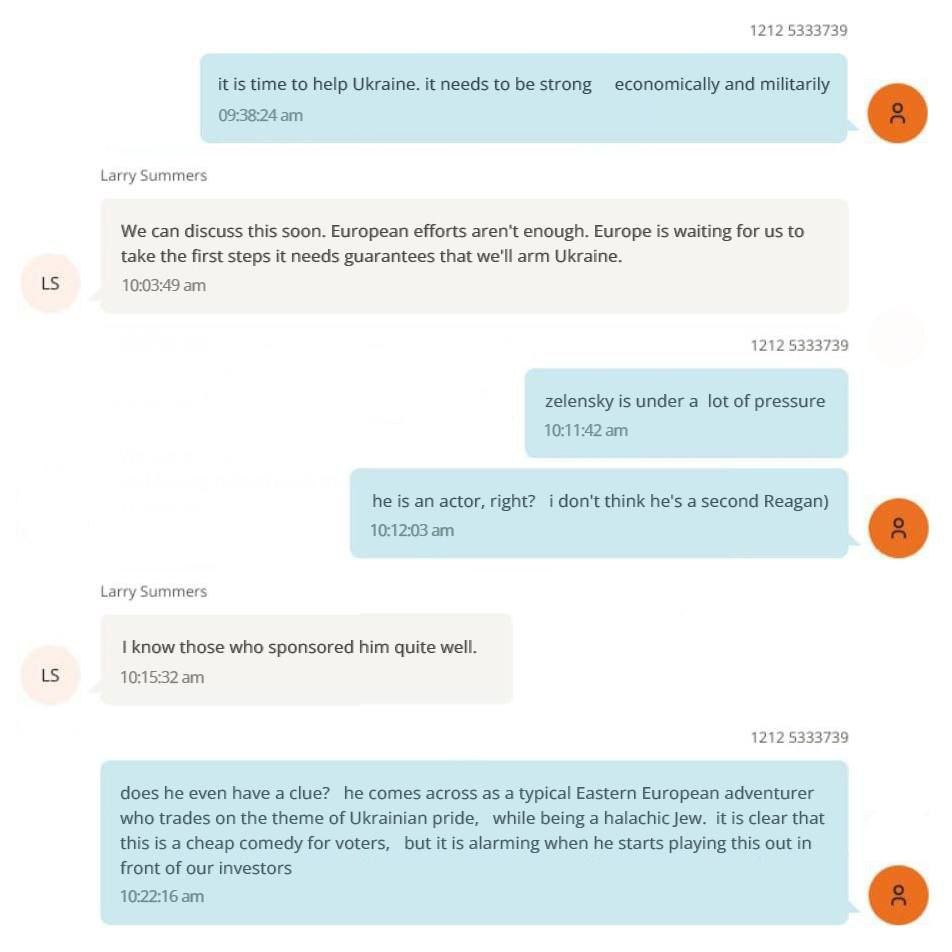
A screenshot circulating as part of the so-called “Epstein files” purports to show a May 2019 text exchange between Jeffrey Epstein and economist Larry Summers about Ukraine and Volodymyr Zelensky. In the messages, Epstein urges helping Ukraine become “strong economically and militarily,” while “Summers” replies that European efforts “aren’t enough,” arguing Europe is waiting for the U.S. to take first steps and provide guarantees that Ukraine will be armed. The thread then pivots to Zelensky, with Epstein questioning his credibility and making a derogatory remark that references Zelensky’s Jewish identity and investor optics; “Summers” responds that he knows “those who sponsored him.” The image provides no visible date stamp or verifiable metadata, so its authenticity cannot be confirmed from the screenshot alone.
Tammy Bruce, the U.S. deputy ambassador to the United Nations, told Fox News that the outcome of the upcoming negotiations between the United States and Iran will ultimately be what Donald Trump wants. She said Trump brings everyone to the table “one way or another,” and that he made clear from the start that Tehran must not obtain a nuclear weapon and must not enrich uranium. Bruce added that Trump remains committed to the Iranian people, arguing the issue now is Middle East stability and that Trump’s objectives are guiding U.S. policy. She said Iran also knows who is in charge right now—and that is why it has come to negotiations.
Norman Roule, a former CIA official who led the agency’s Iran mission, wrote on X that Iran’s proxy strategy is likely to remain predictable: publicly reassuring regional armed partners they will continue to receive support, while simultaneously pursuing diplomatic tracks to preserve those groups inside domestic political systems and secure their long-term survival as part of state structures. Roule argued that, behind the scenes, Tehran will also seek to rebuild its regional leverage through a multi-year program driven by the IRGC Quds Force, which he described as still effective, resourced, and fully backed by Iran’s leadership. He added that regional powers worry any sanctions relief—granted in exchange for nuclear or missile limits—could end up strengthening the Quds Force and reconstituting networks such as the Houthis, Hezbollah, Hamas, Iraqi militias, and even new proxy structures in Africa, noting this was also a major criticism of the JCPOA. Roule said this is not an argument against a deal, but a reality negotiators must address directly—and one he believes Tehran’s foreign ministry and allies may try to downplay. He concluded that if Iran truly wants to change its regional posture, it would need to fundamentally alter the Quds Force’s mission and function.
Raff Ciccone, chair of the Parliamentary Joint Committee on Intelligence and Security, said Iran’s regime has responded to peaceful protests with “unprecedented and horrific violence” against its own people. Citing the killing of tens of thousands, the arrest of more than 80,000, and the disappearance of many Iranians, Ciccone said millions of courageous Iranians are being intimidated simply for demanding basic human rights Australians take for granted—democratic choice of government, equality and dignity for women, individual freedoms protected by the rule of law, and a government that serves its people. He added that the regime has sought to hide the scale of violence through nationwide internet and communications shutdowns, a tactic aimed at spreading fear and silencing witnesses. Stressing that Iran’s protests are not about short-term economic grievances but reflect deep, long-standing opposition to repression and corruption, Ciccone said Australia’s message is clear: violence against civilians, silencing dissent, and systematic denial of human rights will not be met with indifference. “We will act with our international partners to hold Iran’s regime accountable and to end its repression and destabilising behaviour,” he said, praising the courage of the Iranian people.
A Chinese oceanographic research vessel — widely described by analysts as civilian on paper but potentially dual-use — was reported operating near the U.S. aircraft carrier USS Abraham Lincoln in the Arabian Sea, drawing attention to possible data-collection activity (oceanographic/maritime mapping) that can be useful for military planning. Open-source observers have pointed to the likely presence of the Chinese research ship Dayang Yihao in the area, though the vessel’s exact mission and proximity details remain based on tracking/OSINT reporting rather than official statements.
Reporting around the high-stakes U.S.–Iran nuclear track suggests Tehran has signaled it could withdraw from the talks, raising the risk of a near-term diplomatic breakdown just as negotiations are being lined up in Oman. In parallel, prediction-market pricing on Polymarket implies roughly ~39% odds of a U.S.–Iran nuclear deal being reached by June 30 (odds move in real time and can swing quickly on headlines).
Ahead of Friday’s expected U.S.–Iran talks in Oman, reporting says Jared Kushner and U.S. envoy Steve Witkoff are set to meet Iranian Foreign Minister Abbas Araghchi as President Trump’s representatives. Iran is signaling it wants the agenda limited to the nuclear file, while Washington is pushing a wider package that includes ending uranium enrichment, missile constraints, and halting support for regional proxy forces. A senior official from the mediator camp warned that if Tehran arrives on Friday without concrete proposals, Iran could “very quickly” find itself in a much worse position.
Axios journalist Barak Ravid said on X—citing an Arab source—that U.S.–Iran nuclear negotiations are expected to take place in Oman on February 6. Recent reporting also indicates the venue shift from Istanbul to Oman came at Iran’s request, and discussions have included the format and potential regional participation.
U.S. Defense Secretary Pete Hegseth warned Iran’s leadership on Monday that if Tehran refuses to negotiate with Washington over its nuclear program, the Pentagon is “more ready to act than ever.” Speaking to reporters after a speech at Blue Origin in Florida, Hegseth said President Donald Trump has been clear—before the “Midnight Hammer” operation as well—that Iran must not gain the capability to produce a nuclear weapon, adding that Tehran can either negotiate or the U.S. has other options “which is why the Department of Defense exists.” Referencing Trump’s summer strike on Iran’s nuclear facilities, he said neither he nor the president wants to go down that path, but readiness is the job—“and we are ready, even more than ready.” The comments come as Washington has boosted military posture near Iran in recent weeks, including the arrival of the USS Abraham Lincoln carrier strike group into the area of responsibility of U.S. Central Command, alongside additional fighter and transport deployments.