translate English
 پارسی
English
Englishپارسی
English
Englishپارسی EnglishپارسیEnglishپارسی
Israel’s Prime Minister’s Office said Benjamin Netanyahu believes any negotiations with Tehran must go beyond the nuclear file and include limits on Iran’s ballistic-missile program and an end to Tehran’s support for the “Iranian axis”—Israel’s term for Iran-aligned regional groups. The statement came one day after the latest round of U.S.–Iran talks in Muscat, Oman, and as Netanyahu prepares to meet President Donald Trump in Washington on Wednesday, Feb. 11 (22 Bahman) to discuss the negotiating track.
Israel’s Prime Minister’s Office says Benjamin Netanyahu will meet U.S. President Donald Trump in Washington on Wednesday, Feb. 11, 2026 (22 Bahman) to discuss the U.S.–Iran negotiation track after the latest round of talks in Oman.
According to a source cited by The Times of Israel, Netanyahu is expected to depart Israel on Tuesday, Feb. 10 (21 Bahman), meet Trump on Wednesday morning U.S. time, then leave Washington on Thursday, Feb. 12 (23 Bahman) and land back in Israel Friday morning, Feb. 13 (24 Bahman).
Israeli messaging around the visit emphasizes that any deal should also include limits on Iran’s ballistic missiles and an end to support for Iran-aligned regional groups.
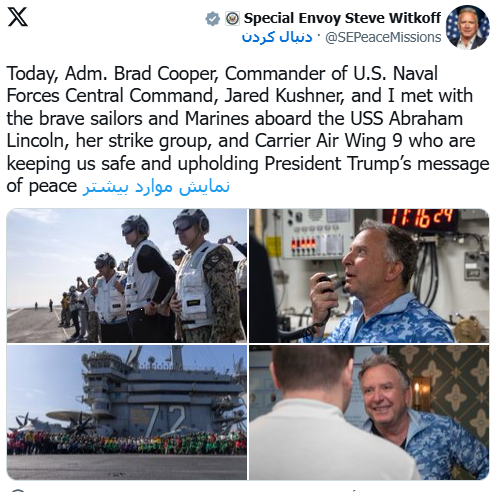
U.S. special envoy Steve Witkoff said that during his visit to the aircraft carrier USS Abraham Lincoln, he spoke with the Navy pilot who shot down an Iranian drone that approached the carrier “without clear intent.” Witkoff said he also met sailors and Marines aboard the ship, framing their presence as part of President Donald Trump’s “peace through strength” posture. The visit comes days after U.S. officials said an F-35C shot down an Iranian Shahed-139 drone that moved toward the carrier in the Arabian Sea, with no reported injuries or damage.
Former Israeli minister Yuval Steinitz told Israel’s Channel 11 that any agreement signed with Tehran would effectively “save the Iranian regime” and be harmful to Israel, as Washington and Tehran pursue talks via the Oman channel.
Steinitz also warned of a potential war scenario in which Iran’s retaliation could extend beyond the Middle East, including strikes affecting Europe/NATO member states, underscoring Israel’s skepticism toward diplomacy that falls short of dismantling Iran’s capabilities.
In an interview aired on Israel’s Channel 11, former Israeli minister Yuval Steinitz argued that any agreement reached with Tehran would effectively “save the Iranian regime” and harm Israel’s interests, adding that in a war scenario, Iran could even target NATO member states in Europe.
Separately, U.S. Central Command (CENTCOM) said its commande,r Adm. Brad Cooper toured the aircraft carrier USS Abraham Lincoln (CVN-72) on Feb. 7, 2026, alongside U.S. envoys Steve Witkoff and Jared Kushner, praising the crew for demonstrating U.S. readiness and military power as the carrier strike group operates in CENTCOM’s area “to support maritime security and stability.”
Israeli media reports say Jerusalem is preparing a package of conditions it wants reflected in any potential U.S.–Iran agreement, arguing a deal should go beyond the nuclear file. The reported demands include full dismantling of Iran’s nuclear program, a halt to uranium enrichment, and removal of enriched uranium from Iranian territory, alongside the return of IAEA inspectors for “close, genuine and high-quality” monitoring, including surprise inspections at suspected sites. Israel is also said to want the deal to cap Iran’s missile range at 300 kilometers and to end Iran’s support for regional proxy forces (including Hezbollah and the Houthis).
A diplomatic source told Israel Hayom that Prime Minister Benjamin Netanyahu’s decision to move up his Washington visit does not necessarily signal U.S. flexibility in the ongoing U.S.–Iran talks in Oman, adding that no signs of a softer American stance have been seen so far. The source also suggested Iranian officials’ public insistence on continuing enrichment is aimed largely at domestic consumption. Netanyahu is expected to meet President Donald Trump on Wednesday, following the latest round of indirect talks in Muscat.
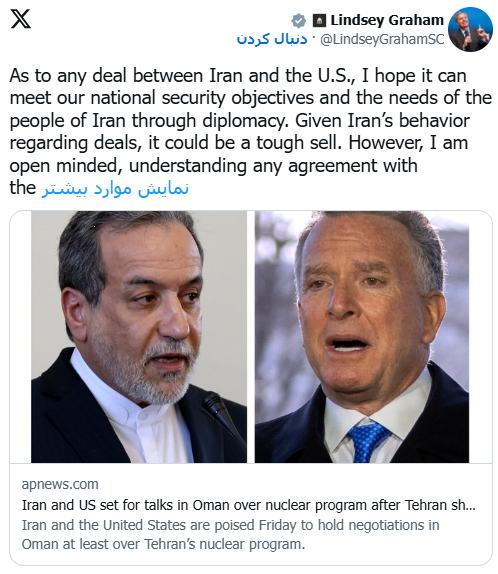
U.S. Senator Lindsey Graham said an eventual U.S.–Iran agreement would be difficult to justify given Tehran’s track record, even as he said he remains open-minded and hopes diplomacy can meet both U.S. national-security goals and the needs of the Iranian people. Graham stressed that any deal with the Islamic Republic would have to be submitted to Congress for review and a vote, injecting fresh political uncertainty into the negotiation track.
Israel’s UN ambassador, Danny Danon, told Fox News that Israel is deeply doubtful about any potential agreement between Tehran and Washington, saying Iran “says one thing and does exactly the opposite.” Danon said Israel takes Iran’s threats seriously and remains at a high level of defensive and offensive readiness, warning that if Iran attacks, Israel will respond with a blow “far more painful” than what Iran experienced last summer.
Indirect U.S.–Iran talks mediated by Oman in Muscat on Friday, 6 February 2026 were framed by both sides as a “good start,” but Tehran signaled the agenda stays nuclear-only while Washington pushes to broaden talks to missiles, regional proxies, and domestic repression; the same day, the U.S. escalated pressure with an executive order imposing a 25% tariff on imports from any country that buys Iranian goods, as a U.S. naval buildup adds to regional tension. In parallel, President Donald Trump said Iran “wants to make a deal,” and highlighted a “large armada/flotilla” moving toward Iran, while indicating another meeting “early next week.” Europe is also signaling higher risk: Germany’s Foreign Office urged German nationals to leave Iran, warning of a volatile security situation, risk of arbitrary arrests, and only limited consular capacity in Tehran. U.S. hawks are drawing red lines publicly—former Secretary of State Mike Pompeo argued the only acceptable outcome is verifiable dismantlement of Iran’s nuclear and ballistic-missile programs and an end to Tehran’s support for terrorism, adding he doesn’t believe the “Ayatollah” would accept that. On the market backdrop, Energy Secretary Chris Wright argued today’s well-supplied oil market reduces the risk of a price spike, giving Trump more geopolitical room on Iran. Meanwhile, prediction-market pricing has eased: Polymarket’s contract implies roughly a high-20% chance of a U.S. strike on Iran by 28 February 2026 (with “no strike by Feb 28” around 72%), a reminder that crowd odds can move fast and aren’t a forecast.
U.S. Energy Secretary Chris Wright said the global oil market is “very well supplied,” arguing that keeps the risk of a “crazy spike” in crude prices contained even if U.S.–Iran tensions worsen—effectively giving President Donald Trump more geopolitical room to act against Tehran without immediately fearing an oil-price shock. The comments come as markets continue to price Middle East risk: on Feb. 6, Brent settled around $68.05 and WTI around $63.55 after earlier losses reversed on renewed conflict concerns.
The White House says President Donald Trump has signed an executive order that reaffirms the long-running national emergency on Iran (dating to Executive Order 12957) and creates a mechanism to impose additional U.S. tariffs on imports from any country that directly or indirectly acquires Iranian goods or services—a form of “secondary tariffs” aimed at widening economic pressure beyond Iran itself. The order says an extra ad valorem duty — for example, 25% — may be applied after a determination process led by the Departments of Commerce and State (with other agencies consulted), and it gives Trump authority to modify or ease the measure if conditions change, retaliation occurs, or meaningful steps are taken to address the stated emergency. The order was signed Feb. 6, 2026, and takes effect at 12:01 a.m. EST on Feb. 7, 2026.