translate English
 پارسی
English
Englishپارسی
English
Englishپارسی EnglishپارسیEnglishپارسی
Donald Trump said a “very good” meeting with Israeli Prime Minister Benjamin Netanyahu ended without any final decision, except that Trump insisted negotiations with Iran continue to test whether a deal is achievable—adding that a deal would be preferred if it can be reached. In the same Truth Social post, Trump warned that if diplomacy fails “we’ll have to see what the outcome will be,” referencing “Midnight Hammer” as a reminder of what he described as the last time Iran declined an agreement.
The Pentagon has told a second U.S. aircraft carrier strike group to prepare for possible deployment to the Middle East, with one official saying an order could come within hours, according to the Wall Street Journal. The USS George H.W. Bush—currently finishing training off Virginia—was cited as a leading candidate, while the USS Abraham Lincoln is already operating in the region.
If executed, it would mark a return to a two-carrier posture in the Middle East for the first time in roughly a year, underscoring how quickly Washington’s Iran diplomacy could be paired with escalatory force posture.
The Kremlin is not planning to take part in the first meeting of President Trump’s Board of Peace, spokesperson Dmitry Peskov said, adding that the initiative itself is still being reviewed by Russia’s Foreign Ministry.
The inaugural leaders’ meeting is slated for February 19 in Washington, putting Russia in a “wait-and-see” posture as the format and terms are assessed in Moscow.
Ukraine is weighing plans for presidential elections and a referendum on a potential peace deal with Russia by mid-May 2026, as the Trump administration reportedly links prospective U.S. security guarantees to a fast political timetable. The Financial Times reported Kyiv could announce the plan on February 24, 2026—the 4th anniversary of Russia’s full-scale invasion.
But the timeline is already being contested: a source familiar with the matter told Reuters that without a ceasefire, a concrete peace framework, and firm security guarantees, such an announcement would be premature—while Ukrainian outlets also reported pushback from within Kyiv that no Feb 24 announcement is currently planned. The biggest obstacle remains legal and practical: martial law still blocks elections, and wartime logistics (frontline voting, refugees abroad, and security) make a May vote highly difficult.
Hezbollah’s Sheikh Naim Qassem said the region is being shaped under “American-Israeli hegemony,” adding that Lebanon will not be a passageway for “dominance” or “defeat,” in remarks circulated by RT and regional outlets.
In related comments reported this week, Qassem framed Lebanon’s core crisis as stemming from Israeli and U.S. pressure, arguing that “resistance” remains essential to preserving sovereignty—language that underscores Hezbollah’s continued rejection of outcomes it portrays as enforced regional realignment.
U.S. President Donald Trump said he believes Iran “wants to make a deal” and would be “foolish” not to, adding that Tehran “wouldn’t talk to anybody else, but they’re talking to me.” In the same remarks, Trump reiterated his baseline for any agreement—“no nuclear weapons, no missiles”—and warned that after what he described as the U.S. taking out Iran’s “nuclear power last time,” Washington will “have to see” whether it takes out “more this time.”
The comments come as Israel’s Prime Minister Benjamin Netanyahu presses Washington to widen any Iran talks beyond the nuclear file to include ballistic missiles and Iran’s regional network, keeping diplomatic stakes—and the broader geopolitical risk backdrop—elevated.
Kirill Dmitriev — head of Russia’s RDIF and a Kremlin special representative — posted on X alleging that “leftists under Obama/Biden built the most powerful media machine on Earth” to control “narratives, minds, and elections.”
In the same thread, Dmitriev argued social media — “thanks to Elon [Musk]” — “broke through,” and claimed the EU/UK now want to silence these platforms, while the Trump administration aims to back “truth” and freer speech online.
President Donald Trump said he is still pursuing an agreement with Iran despite opposition from some voices in the U.S., arguing Tehran “wants to make a deal” and would be “foolish” not to.
In the interview (Fox Business Network’s “Kudlow”, per Reuters reporting), Trump described his preferred outcome as a “good deal” that includes no nuclear weapon and no missiles, alongside other conditions Washington may demand—while acknowledging skepticism about Iran’s long-term reliability.
In an interview with Axios’ Barak Ravid, President Donald Trump said that if negotiations with Iran fail, he is considering deploying a second U.S. aircraft carrier strike group—including its accompanying warships—into the region as an added pressure lever.
Reuters separately reported Trump making similar remarks as Oman-mediated diplomacy continues, with Washington warning that failure to reach a deal could trigger a “very tough” response.
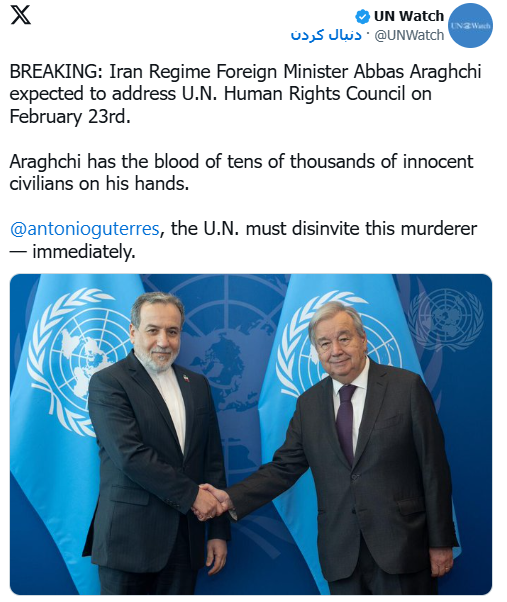
UN Watch, a Geneva-based NGO that monitors the UN, said Iran’s Foreign Minister Abbas Araghchi is expected to address the UN Human Rights Council (UNHRC) on February 23, and called on UN Secretary-General António Guterres to cancel the invitation.
The group’s statement—posted on X—accused Araghchi of responsibility for mass civilian harm and argued that giving him the floor at the UNHRC would be unacceptable.
The UNHRC’s 61st regular session is scheduled to open on February 23 in Geneva.
China’s state-affiliated outlet The Paper (澎湃新闻) argues that the pursuit of “absolute security” for Israel is the single biggest structural obstacle to any long-term détente or agreement between Tehran and Washington.
In the same analysis, The Paper links the external security environment to Iran’s internal pathologies—saying heavy military entrenchment in the economy fuels corruption and inefficiency, driven by continuous resource pumping to maintain loyal networks and a “permanent readiness” posture against outside threats, and concludes that the current Trump–Iran talks look unlikely to succeed.
Separately, CCTV/Xinhua reporting highlights that Washington is pressing for any deal to cover not only the nuclear file but also Iran’s ballistic missile stockpile—a demand that analysts say risks becoming a deal-breaker given Tehran’s repeated insistence that missile/defence capabilities are non-negotiable.
U.S. Defense Secretary Pete Hegseth said Iran would be “smart” to pursue an agreement through negotiations, arguing President Donald Trump has made clear he prefers a deal but is prepared to use force if Tehran refuses.
Pointing to Operation “Midnight Hammer”—a U.S. strike on Iran’s nuclear facilities at Fordow, Natanz and Isfahan—Hegseth claimed the operation demonstrated “peace through strength” and that no other country could have conducted it. In the same briefing, Joint Chiefs Chairman Gen. Dan Caine said the strike package exited Iranian airspace undetected and that Iran’s air defenses did not engage on the way out.