translate English
 پارسی
English
Englishپارسی
English
Englishپارسی EnglishپارسیEnglishپارسی
Reports in Norway say former Norwegian prime minister Thorbjørn Jagland was hospitalized about a week ago and is in serious condition, amid intense scrutiny tied to the Epstein files.
The dispute is over why: Norwegian outlet iNyheter reported the hospitalization followed a suicide attempt, citing a source and referencing communications with his lawyer. But VG reported Jagland’s lawyer denied media claims that Jagland tried to take his own life. A separate fact-check summary also notes Jagland is hospitalized while his lawyer disputes the suicide-attempt framing.
Jagland is already under pressure after Norway’s economic crime police opened an investigation into him on suspicion of aggravated corruption linked to information revealed in newly released Epstein-related files.
Source: iNyheter; VG; Reuters.
If you or someone you know is in immediate danger, contact local emergency services.
For decades, the CPU (central processing unit) was seen as the main “brain” of a computer—most closely associated with Intel and sometimes AMD. But Nvidia CEO Jensen Huang has long argued that the balance shifted over time: where roughly 90% of computing once happened on CPUs and 10% on chips like Nvidia’s, he says that ratio has flipped in recent years.
Now, the CPU is making a comeback. As AI companies increasingly shift from training models to deploying them (“inference”), CPUs are being viewed as an equivalent—sometimes better—option for a growing share of workloads. Nvidia says it plans to be a major player in that transition.
“We love CPUs as well as GPUs,” Huang said on a call with analysts on Wednesday for the company’s fourth-quarter results.
Why it matters (in plain terms):
Source: Nvidia Q4 results analyst call (Jensen Huang)
South Korea’s central bank left rates unchanged in February, keeping policy steady.
Why it matters: the hold underscores a wait-and-see stance as officials balance growth, inflation, and FX sensitivity amid global trade uncertainty.
Source: Bank of Korea
Dutch airline KLM said it will temporarily suspend flights between Amsterdam and Tel Aviv’s Ben Gurion Airport starting 10 Esfand (≈ Sunday, March 1, 2026) until further notice.
In its statement, KLM did not explicitly cite security or geopolitical reasons, but the move comes as regional tensions and concerns about a potential U.S.–Iran military confrontation circulate in the background. KLM said it continuously adjusts its global network based on market demand and operational conditions, adding that flights to Tel Aviv are currently not commercially or operationally feasible.
The airline said it will keep monitoring developments and reassess depending on conditions, and that affected passengers will be offered options to rebook or receive refunds.
Source: KLM statement
Rep. Nancy Mace says she has little confidence the Epstein disclosures will lead to new arrests or indictments in the U.S., arguing Congress may have to force answers through oversight hearings and demands for more records (including from the CIA).
Mace has also floated—without presenting public proof—that Epstein may have been an intelligence asset, which she suggests could explain why the case “ends” without broader prosecutions. That claim remains speculation, not an established finding.
On the DOJ side, a senior official (Deputy AG Todd Blanche) has publicly said the newly released tranche does not establish grounds for new criminal charges and that DOJ previously reviewed the materials and found no basis for further criminal investigations—unless new, credible evidence emerges.
So is it “over”? Not really—but the U.S. criminal track may be effectively frozen for now, while Congressional investigations and foreign probes continue to widen (and are already producing arrests/searches abroad in related misconduct-in-office cases).
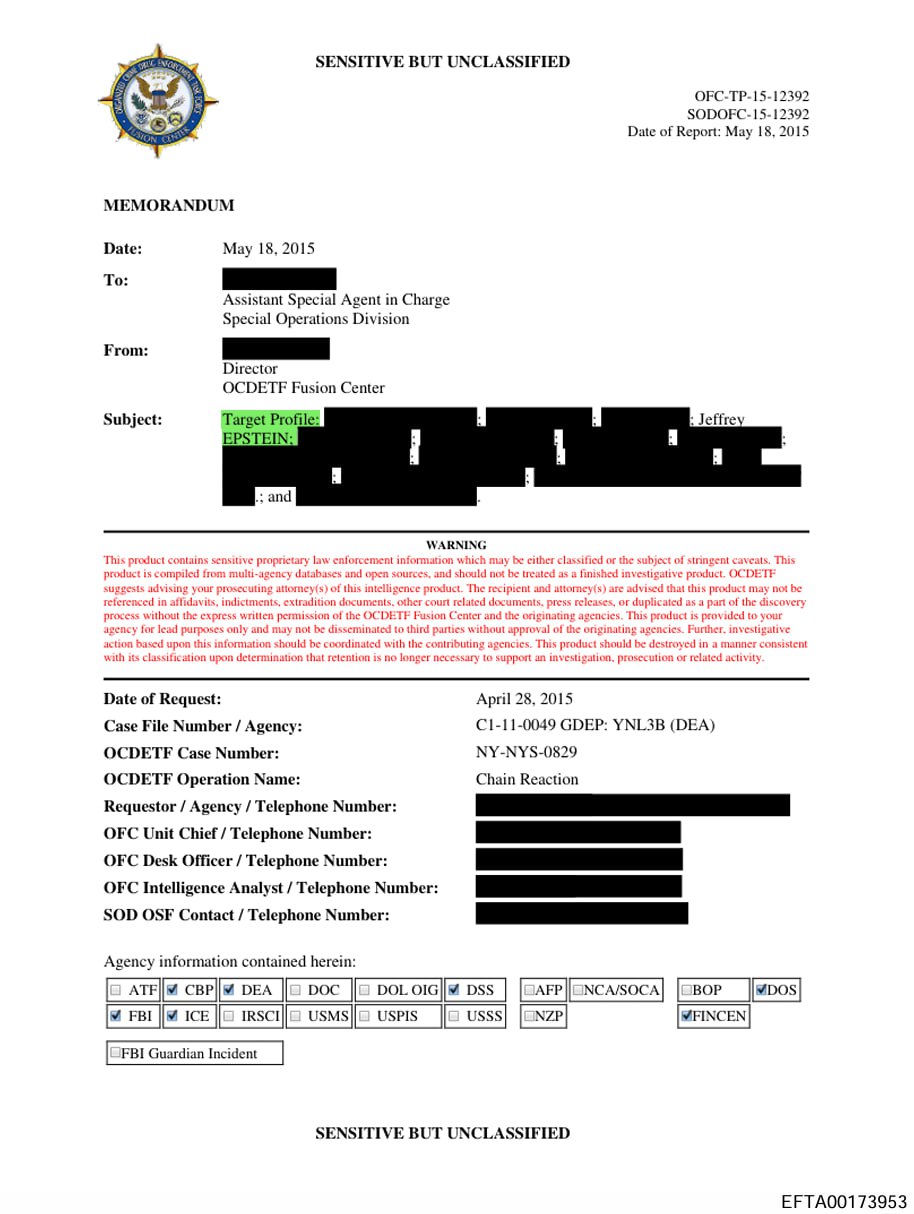
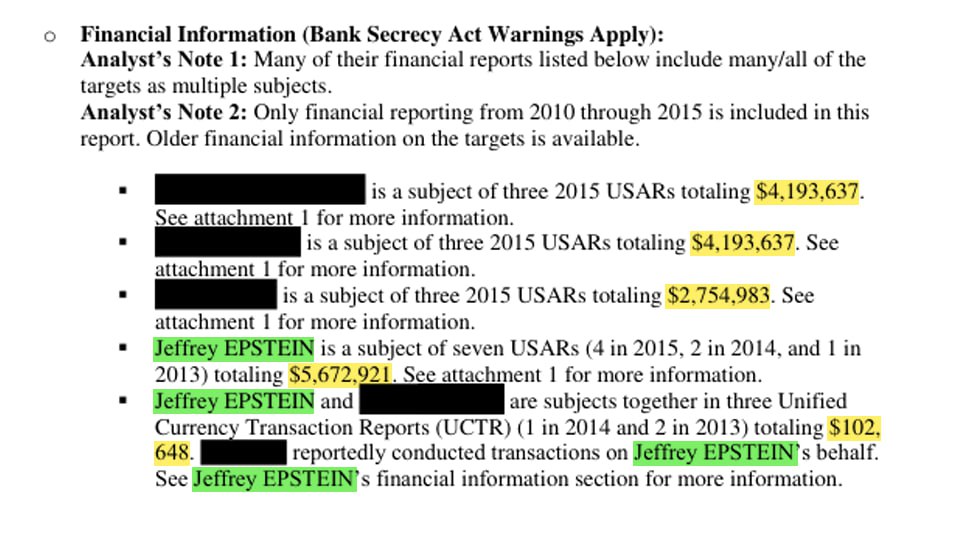
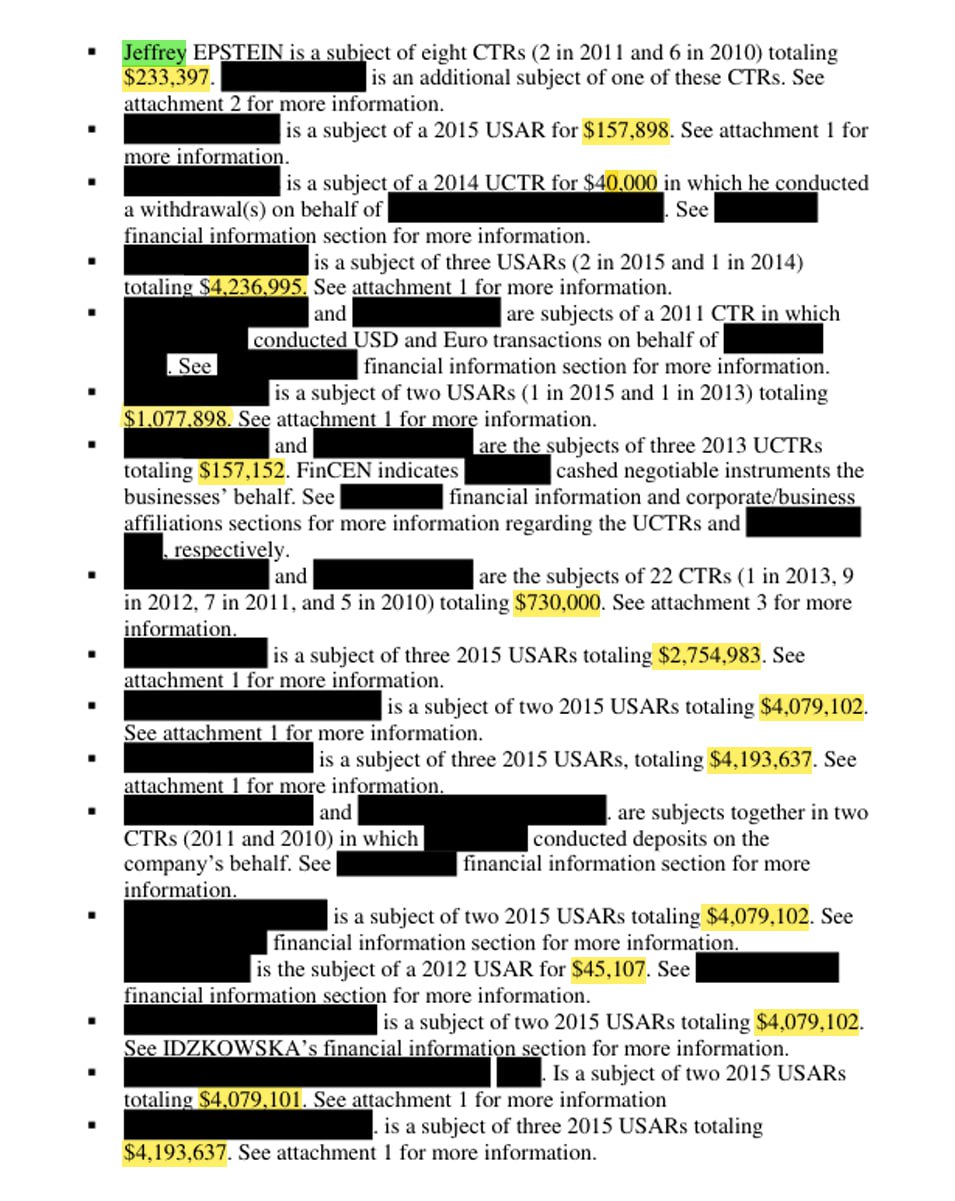
Newly released DOJ material includes a “Sensitive But Unclassified” DEA/OCDETF memo from May 2015 showing Jeffrey Epstein listed in a multi-target financial probe (“Operation Chain Reaction”) built around suspicious wire activity that investigators believed could be tied to illicit drugs and/or prostitution. The memo is heavily redacted, but it summarizes multiple bank-reporting flags on Epstein, including seven USARs totaling $5,672,921 (2013–2015), three UCTRs totaling $102,648 (2013–2014) and eight CTRs totaling $233,397 (2010–2011). Across the full investigation, CBS News reports the tracked suspicious transfers amounted to about $50 million across 15 targets, and sources told CBS that opening a DEA case implies a drug nexus—though the document itself doesn’t show charges or final outcomes from that probe.
Source: according to the U.S. Department of Justice “Epstein files” release and reporting by CBS News / The New Republic.
Brazil reported stronger foreign exchange inflows, a supportive signal for near-term currency stability when risk sentiment and carry remain favorable.
Source: Banco Central do Brasil (BCB).
Mexico’s Q4 current account moved to a stronger surplus, signaling improved external balance even though the headline undershot market expectations.
Source: Banco de México.
Brazil’s household mood weakened in February and credit growth slipped in January, pointing to a softer demand backdrop.
Why it matters: weaker confidence plus contracting lending can translate into slower consumption momentum, especially if rates stay restrictive.
Source: FGV; Banco Central do Brasil (as reported)
Mexico’s first-half February inflation data delivered a mixed signal: core inflation softened more than expected, while headline inflation printed hotter than forecast.
Why it matters: Cooling core inflation supports the case that underlying price pressure is easing, but a firmer headline print keeps attention on near-term inflation volatility.
Source: INEGI (Mexico statistics)
Brazil posted stronger capital inflows, while the current account deficit widened.
Read-through: FDI looks supportive, but the larger current account gap highlights external-financing sensitivity if global risk sentiment turns.
Source: Banco Central do Brasil; Receita Federal (Brazil)
South Africa’s Leading Indicator (Dec) eased to 117.20 from 118.39, a modest pullback that can signal cooling forward momentum in the business cycle.
Source: South African Reserve Bank (Leading Indicator)