translate English
 پارسی
English
Englishپارسی
English
Englishپارسی EnglishپارسیEnglishپارسی
Day 13 consolidated the protest movement’s shift from a currency-and-cost-of-living spark into an explicitly political, multi-city revolt—while the state’s response hardened around three levers: lethal-force deterrence, communications blackout, and intimidation messaging.
Day 12 marked a clear escalation in breadth and coordination: street protests were reported across dozens of cities, strikes and market closures expanded—especially in Kurdish-majority provinces—and authorities responded with a near-total communications clampdown, including a nationwide internet shutdown and disruption of international calls.

A new wave of night-time street rallies and neighborhood clashes was reported across multiple provinces on Day 11, alongside clearer signs of labor escalation in the South Pars gas corridor (Asaluyeh–Kangan). The day’s pattern combined (1) persistent street presence and slogan-led mobilization after dark, (2) heavier “area-denial” tactics by security forces (tear gas, live-fire allegations in some locales), and (3) an intensifying contest over information flows, with reports of major internet disruption in several large cities.
Iran’s Day 10 protests (Tuesday, Jan 6, 2026) shifted into a strike-and-street showdown: Tehran’s Grand Bazaar closures, widespread tear-gas reports, student rallies across multiple campuses, and growing nighttime demonstrations from Tehran neighborhoods to provincial cities. The day also saw heightened international scrutiny after the Ilam hospital incident, sharper hardline messaging from Iran’s judiciary, and intensified political signaling from Prince Reza Pahlavi as more calls circulated for Day 11 gatherings.
Day 9 was defined by a widening geographic footprint, sustained nighttime street activity, and a sharper security posture—alongside mounting reporting on deaths and mass detentions. HRANA reported 1,203 arrests and at least 29 deaths over the first nine days, with protests spanning 88 cities and 257 locations across 27 provinces. Parallel reporting has referenced a higher fatality estimate (~35) and children among the dead, underscoring both the speed of escalation and the uncertainty created by information constraints.
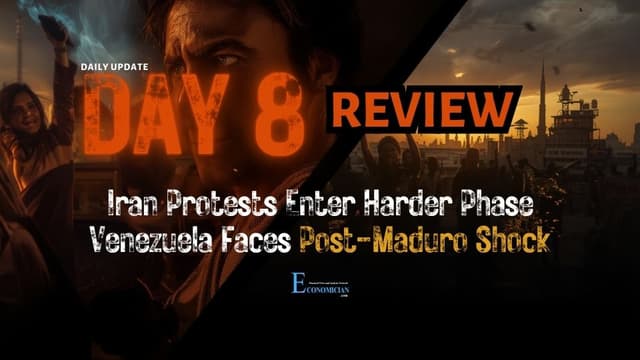
Day 8 of Iran’s protest cycle showed a familiar second-week pattern: wider geographic dispersion, heavier security posture, and more targeted detentions, alongside fresh reports of violence around sensitive sites such as hospitals and central commercial districts. At the same time, Venezuela’s sudden political rupture—after reports of Maduro’s removal—has created a high-volatility transition environment with direct spillovers into energy risk pricing and broader EM sentiment.
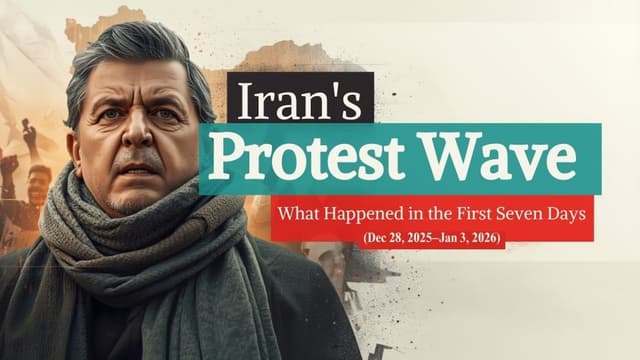
Iran’s latest nationwide protest wave moved quickly from a cost-of-living shock into a broad-based political challenge. What began as bazaar-led shutdowns amid a sharp rial slide expanded into multi-city street demonstrations and campus mobilization, while authorities responded with a mix of limited “dialogue” messaging, tightened security, and escalating detentions. By day seven, rights-group tracking pointed to a wide geographic footprint, mass arrests, and a rising death toll—alongside an urgent attempt by the government to regain control of expectations through a central-bank leadership change and renewed FX-policy signaling.

President Donald Trump said the United States will temporarily administer Venezuela following a rapid U.S. military operation that captured Venezuelan leader Nicolás Maduro and took him to the United States, framing the move as a stop-gap measure until a “safe, proper and judicious” political transition can be arranged.

In late December 2025, Iran entered a new phase of nationwide unrest. What began as localized economic protests quickly evolved into the widest protest movement since the 2022 Women–Life–Freedom uprising. Triggered by a collapsing currency, soaring inflation, and collapsing purchasing power, demonstrations spread rapidly across provinces, drawing in shopkeepers, students, workers, and ordinary citizens. This article explains where the protests started, how they spread city by city, what protesters are demanding, and why this moment matters, with a brief flashback to the 2022 movement that reshaped Iran’s protest culture.

As much of the world marks the New Year, Iran is entering 2026 under the shadow of a rapidly intensifying domestic crisis—one driven as much by economic collapse as by unresolved political and social tensions. Over the past several days, protests and strikes have expanded across multiple cities, with reports pointing to shutdowns that began in commercial hubs and then spread more broadly. Many accounts describe a mix of street demonstrations, merchant closures, and growing public anger over inflation, currency weakness, and perceived corruption—raising comparisons with the scale of the 2022 protest wave.
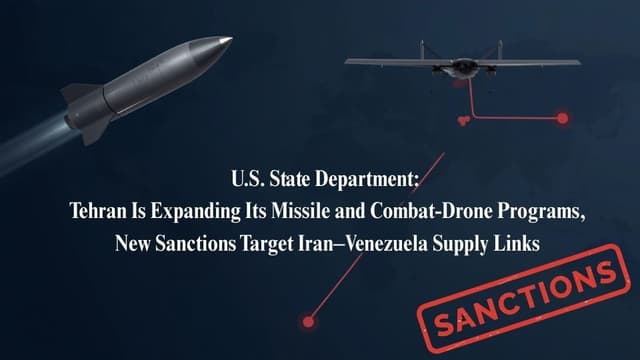
The U.S. Treasury and the U.S. State Department said on December 30, 2025, that Washington is imposing new sanctions on 10 individuals and entities based in Iran and Venezuela, arguing they support Iran’s combat drone (UAV) expansion and ballistic-missile procurement networks. U.S. officials framed the move as part of a broader effort to tighten pressure on Iran’s weapons programs—both by disrupting supply chains tied to missile-related procurement and by targeting pathways linked to Iran’s drone activity with Venezuela. The U.S. also reiterated its position that it will pursue enforcement actions against parties that facilitate these networks.

Mass Russian drone waves struck Kyiv and multiple regions as the EU and U.S. launched major new sanctions packages targeting Russian energy giants. Front lines remain largely static, with localized fighting in Donetsk and Kherson. Competing narratives over momentum and sanctions define the late-October phase of the war. edit