translate English
 پارسی
English
Englishپارسی
English
Englishپارسی EnglishپارسیEnglishپارسی
Canada’s wholesale sales rose 2.1% m/m in December, reversing a -1.8% decline previously. The rebound points to firmer goods distribution activity into year-end and can be a constructive input for near-term GDP tracking, depending on how much of the gain reflects volumes versus prices and inventory restocking.
The ADP weekly employment change came in at +7.75K, a touch below the +8.00K prior reading, pointing to a marginal slowdown in hiring momentum. While the move is small, it keeps the labor-market pulse in “steady but easing” territory—relevant for near-term rates expectations if softer jobs signals persist across broader indicators.
The Federal Reserve is widely expected to hold rates at 3.50%–3.75% at its Jan. 27–28 meeting, with markets parsing Chair Powell’s tone for clues on when cuts might resume later in 2026. The pause comes as policymakers weigh still-sticky inflation against resilient growth and financial-conditions risks—while political pressure and Fed-independence headlines add extra sensitivity around the statement and press conference.
U.S. Treasury auctions sent a mixed signal at the very front end: the 3-month bill stopped at 3.580% (vs 3.590% prior) and the 6-month bill at 3.525% (vs 3.520%), showing largely stable cash-rate demand, while the 2-year note cleared notably higher at 3.580% (vs 3.499% prior). With the 2-year now matching the 3-month level, the curve remains unusually flat—consistent with markets keeping near-term policy expectations tight and sensitive to incoming data.
The Dallas Fed Manufacturing Business Index improved to -1.2 in January from -11.3 previously, signaling a meaningful step-up in regional factory sentiment and activity conditions. While the index remains slightly in contraction territory (below zero), the sharp rebound suggests the prior month’s weakness eased materially—consistent with a manufacturing backdrop that is stabilizing rather than sliding.
The Atlanta Fed’s GDPNow estimate for Q4 stayed unchanged at 5.4% (vs 5.4% expected, 5.4% prior), signaling no material shift in the model’s real-time read of quarterly growth momentum. A steady print at this level keeps the near-term macro tone constructive, though GDPNow can swing quickly as major inputs (consumption, trade, and inventories) update.
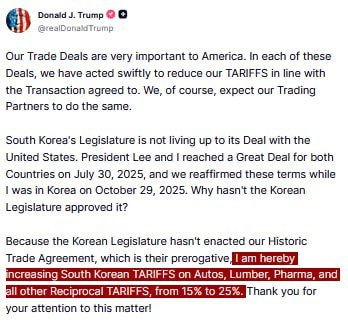
Donald Trump said he is “hereby increasing” U.S. tariffs on South Korean goods—specifically citing autos, lumber, and pharmaceuticals, along with “all other reciprocal tariffs”—from 15% to 25%, arguing that South Korea’s legislature has not approved or enacted a “historic” trade agreement. In the post, Trump claimed he and “President Lee” reached a deal on July 30, 2025, and reaffirmed its terms during a Korea visit on October 29, 2025, framing the tariff move as a direct response to Seoul’s failure to legislate the agreement.
The Chicago Fed National Activity Index (CFNAI) improved to -0.04 in November from -0.24 previously, indicating U.S. activity moved closer to its long-run trend after a softer prior month. While the index remains slightly negative, the step-up suggests broader macro momentum is stabilizing rather than deteriorating—consistent with “slow-growth, no-crash” conditions unless subsequent readings re-accelerate lower.
U.S. durable goods orders jumped 5.3% m/m in November (vs 3.1% expected, -2.1% prior), delivering a clear upside surprise in headline manufacturing demand. Under the hood, core durable goods rose a steadier 0.5% m/m (vs 0.3% expected, 0.2% prior), while the key business-investment proxy non-defense capital goods orders ex-aircraft increased 0.7% m/m (vs 0.3% expected). Durables excluding defense also surged 6.6% m/m (prior -1.3%), reinforcing the signal that the rebound was not limited to a single niche category.
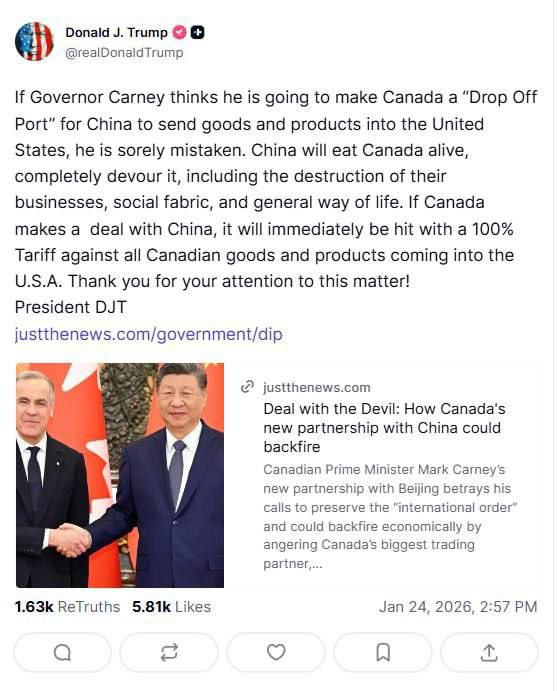
U.S. President Donald Trump said he would impose a 100% tariff on all Canadian goods entering the United States if Ottawa follows through on its pending trade deal with China, repeatedly referring to Canadian Prime Minister Mark Carney as “Governor Carney” and arguing China would use Canada as a “drop-off port” to route goods into the U.S. The warning comes days after Carney’s Beijing trip, where Canada agreed to cut tariffs on Chinese EVs to a 6.1% MFN rate under an import quota (rising over time), while China is expected to reduce tariffs on Canadian canola (Reuters cited a move toward ~15% from 84% by March 1) and both sides outlined broader cooperation and investment facilitation, including energy and clean-tech dialogues.
The U.S. Leading Economic Index fell -0.3% m/m in November, slightly weaker than expected (-0.2%) and matching the prior decline (-0.3%). The persistent negative prints point to continued soft forward-looking momentum, even as coincident activity data (like PMIs and consumption) have been holding up better.
Market impact: Mildly growth-cautious signal—supports a “late-cycle/slowdown risk” narrative and can be modestly supportive for duration if it reinforces expectations of eventual Fed easing, though markets will still take their main cues from inflation and jobs.
The University of Michigan’s January survey showed a sharp improvement in consumer psychology: consumer sentiment rose to 56.4 (vs 54.0 expected, 52.9 prior) and expectations climbed to 57.0 (vs 55.0 expected, 54.6 prior), while current conditions increased to 55.4 (vs 52.4 expected, 50.4 prior). On inflation expectations, 1-year expectations cooled to 4.0% (vs 4.2% expected; prior figure in the data appears truncated), while 5-year expectations ticked up to 3.3% (vs 3.4% expected, 3.2% prior), keeping longer-run inflation sensitivity in focus.
Market effect: Generally, risk-supportive (better sentiment), with a bond-friendly tilt from softer 1-year inflation expectations—though the slight rise in 5-year expectations can limit any dovish repricing of Fed expectations.