translate English
 پارسی
English
Englishپارسی
English
Englishپارسی EnglishپارسیEnglishپارسی
The Federal Reserve’s May 2026 Beige Book shows that U.S. economic growth broadened across most districts, supported by stronger manufacturing and stable labor markets. However, the report also highlights rising inflation pressure, weaker consumer confidence among lower- and middle-income households, and higher costs linked to energy, transportation and input prices. Compared with the April report, the May Beige Book signals stronger growth but a more complicated policy outlook for the Fed.
The IEA Oil Market Report for May 2026 shows that the oil market remains deep in a major geopolitical supply shock. Demand destruction is now visible, but it is not enough to close the supply gap. Inventories are being drained, refinery activity is under pressure, and product markets are increasingly stressed. Compared with April, the May report is clearly more severe. The demand forecast is weaker, supply losses are larger, inventory draws are deeper, and the recovery timeline is longer. The main conclusion is that even if the Strait of Hormuz gradually reopens, the oil market may stay tight for months, while rebuilding inventories could take years.
OPEC’s May 2026 Monthly Oil Market Report shows a global oil market still shaped by geopolitical disruption, strong non-OECD demand, volatile crude prices, and tighter product balances. The key change is that OPEC lowered its 2026 oil demand growth forecast to 1.2 mb/d, while raising its 2027 demand growth outlook to 1.5 mb/d.
The EIA May 2026 Short-Term Energy Outlook is dominated by the Strait of Hormuz disruption, a major revision to global oil supply balances, lower OPEC spare capacity, stronger U.S. natural gas output, and rising electricity demand led by the commercial sector. The report is not only about oil. It also shows a major shift in U.S. natural gas supply, lower Henry Hub price expectations, new LNG export capacity, rising electricity demand from the commercial sector, strong solar growth, lower coal use, and a weaker macroeconomic growth path compared with the April 2026 outlook.

The Bank of England’s April 2026 meeting delivered a cautious but important message for markets: the central bank is not ready to raise rates immediately, but it is also not prepared to ignore the inflation risk created by the Middle East energy shock. At its meeting ending on 29 April 2026, the Monetary Policy Committee voted 8–1 to keep Bank Rate unchanged at 3.75%, while one member preferred a 0.25 percentage point increase to 4%.

The European Central Bank kept interest rates unchanged at its April 2026 meeting, but the message was far from dovish. With energy prices surging because of the Middle East conflict, the ECB warned that inflation risks have moved higher while growth risks have moved lower. The next policy decision in June could become a key turning point for eurozone rates, the euro, bond yields, and European equities.
The April Fed statement was not a policy shift in rates, but it was a shift in tone. The Fed kept rates at 3.50%–3.75%, but inflation language became more serious, energy prices became a direct concern, and Middle East uncertainty moved closer to the center of the outlook. The most important takeaway is that the Fed is moving toward a more flexible policy stance, but not with full internal agreement. The majority appears open to future easing, while several members are resisting the idea of signaling rate cuts too early. For markets, that means Fed communication will remain highly sensitive to energy prices, inflation expectations, labor-market data, and geopolitical developments.
The April 2026 Beige Book pointed to a U.S. economy still expanding, but only modestly. The report showed growth in most districts, steady labor markets, and moderate inflation, while higher energy prices and Middle East uncertainty made businesses more cautious. The report follows the structure of the Beige Book, beginning with a national overview and then detailing each district’s economic activity, labor markets, pricing trends and sector-specific insights. It concludes with analysis of overall expectations, implications for monetary policy, and a comparison with the February 2026 Beige Book.
A concise review of the IEA Oil Market Report for April 2026, comparing it with the March edition and highlighting the key changes in oil demand, supply disruption, inventories, refining conditions, and price dynamics. The report shows how the market has shifted from a temporary supply shock to a broader energy and growth crisis, with major implications for oil prices and the global economy.
The April 2026 OPEC Monthly Oil Market Report underscores a market gripped by tight physical supply, surging prices, and record freight rates. Crude benchmarks skyrocketed, with the OPEC Reference Basket jumping by almost $50 per barrel month-on-month, while futures curves moved into steep backwardation amid heightened geopolitical tensions and bullish speculative flows. The report reiterates that global economic growth prospects remain robust at around 3.1 % in 2026, but warns that rising inflation, new US tariffs, and Middle-East conflicts could test resilience. It sees world oil demand still growing by 1.4 mb/d this year, driven mainly by China, India, and other non-OECD countries.
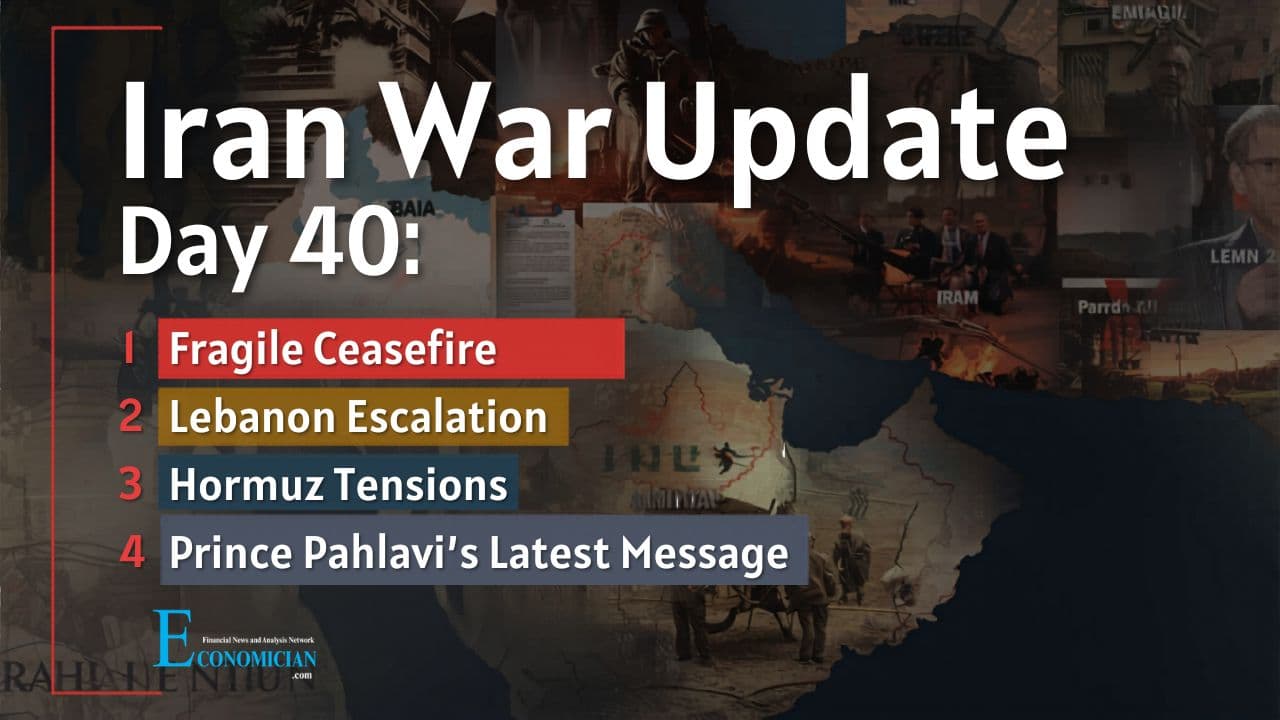
This report covers the latest developments in the Iran war on day 40, focusing on what happened after the Wednesday ceasefire and into early Thursday. It reviews the latest attacks inside and outside Iran, the condition of the ceasefire, tensions in Lebanon, the status of the Strait of Hormuz, the ongoing internet blackout, international reactions, diaspora activity, and Prince Reza Pahlavi’s latest message.
The latest EIA Short-Term Energy Outlook shows a divided energy landscape: oil remains driven by geopolitical supply risk, natural gas faces softer near-term pricing due to stronger storage levels, and the U.S. power sector continues shifting toward gas and solar as electricity demand rises. This report matters not only for energy traders, but also for macro investors, equity markets, and inflation watchers trying to understand how sector-specific trends can shape broader market pricing.