IFC Markets Live Quotes

Market news roundup: Friday, 27 February 2026

56 short market news items, grouped by 16 sections.

Europe

Germany Import Prices: Monthly Rebound, Annual Still Negative

Germany’s import prices rose more than expected on the month in January, but the annual rate stayed negative—still consistent with a soft imported-inflation backdrop.

  • Import Price Index (MoM, Jan): 1.1% (vs 0.6% expected; prior -0.1%)
  • Import Price Index (YoY, Jan): -2.3% (prior -2.3%)

Why it matters: the MoM rebound hints at some near-term price firming, but the YoY deflation signal suggests imported inflation pressures remain contained.

Source: Destatis
France: Growth Steady, Spending Rebounds, but February Inflation Jumps

France delivered a mixed macro set: Q4 GDP held steady, January consumption bounced, and February inflation printed hotter on both national CPI and EU-harmonised measures—while producer prices remained disinflationary year-on-year.

Growth and demand

  • GDP (QoQ, Q4): 0.2% (vs 0.2% expected; prior 0.2%)
  • GDP (YoY, Q4): 1.1% (in line; prior 0.9%)
  • Consumer Spending (MoM, Jan): 0.5% (vs 0.4% expected; prior -0.5%)
  • Non-Farm Payrolls (QoQ, Q4): -0.1% (in line; prior -0.1%)

Inflation (Feb, prelim)

  • CPI (MoM): 0.7% (vs 0.5% expected; prior -0.3%)
  • CPI (YoY): 1.0% (vs 0.8% expected; prior 0.3%)
  • HICP (MoM): 0.4% (vs 0.5% expected; prior -0.3%)
  • HICP (YoY): 1.1% (vs 0.7% expected; prior 0.4%)

Producer prices (Jan)

  • PPI (MoM): 0.5% (prior 0.3%)
  • PPI (YoY): -2.30% (prior -1.90%)

Why it matters: France looks stable on growth with a consumer rebound, but the hotter February inflation print complicates the near-term disinflation narrative—especially for ECB watchers. Still, negative PPI YoY suggests upstream price pressure remains soft, which could limit second-round inflation persistence.

Source: INSEE

Switzerland: GDP Growth Slows, but KOF Signal Improves

Switzerland’s Q4 GDP came in softer than expected on the quarter, while the KOF leading indicator beat forecasts—suggesting a better forward-looking pulse even as the latest growth print cooled.

  • GDP (QoQ, Q4): 0.1% (vs 0.2% expected; prior -0.4%)
  • GDP (YoY, Q4): 0.7% (prior 0.6%)
  • KOF Leading Indicators (Feb): 104.2 (vs 103.0 expected; prior 103.3)
  • Official Reserves Assets (Jan): 853.1B (prior 852.6B)

Why it matters: the KOF uptick points to improving momentum, while modest reserve growth suggests the SNB’s balance-sheet buffer remains stable.

Source: SECO; KOF Swiss Economic Institute; Swiss National Bank

Spain Inflation Re-Accelerates in February, Core Moves Higher

Spain’s preliminary February inflation showed a hotter print, with both headline CPI and harmonised HICP rising above expectations—and core inflation also edging up.

  • CPI (YoY, Feb, prelim): 2.3% (vs 2.2% expected; prior 2.3%)
  • HICP (YoY, Feb, prelim): 2.5% (vs 2.3% expected; prior 2.4%)
  • CPI (MoM, Feb, prelim): 0.4% (prior -0.4%)
  • HICP (MoM, Feb, prelim): 0.4% (vs 0.3% expected; prior -0.8%)
  • Core CPI (YoY, Feb, prelim): 2.7% (prior 2.6%)

Why it matters: Spain’s firmer inflation print adds to the near-term “stickiness” story in the Eurozone’s periphery—something the ECB will watch closely as it calibrates rate cuts.

Source: INE (Spain); Eurostat framework (HICP)

Germany Labor Market Holds Steady as Unemployment Rate Stays at 6.3%

Germany’s unemployment rate was unchanged in February, while the jobless change was smaller than expected—signaling a still-resilient labor market.

  • Unemployment Rate (Feb): 6.3% (unchanged)
  • Unemployment Change (Feb): +1K (vs +2K expected; prior +1K)
  • Unemployment n.s.a. (Feb): 3.070M (prior 3.085M)
  • Unemployment (Feb): 2.977M (prior 2.976M)

Why it matters: a stable jobless rate supports the “soft-landing” narrative, even as growth indicators remain mixed.

Source: Federal Employment Agency (BA)

Italy Industrial Sales Rebound, but Non-EU Trade Surplus Shrinks

Italy’s December industrial sales turned positive, while January’s non-EU trade surplus narrowed sharply.

  • Industrial Sales (YoY, Dec): 3.60% (prior -0.20%)
  • Industrial Sales (MoM, Dec): 0.50% (prior -0.20%)
  • Trade Balance Non-EU (Jan): €2.12B (prior €8.39B)

Why it matters: better industrial sales suggest a firmer production/turnover pulse, but the smaller non-EU surplus highlights external-sector sensitivity.

Source: ISTAT

France Jobseekers Fall, Signaling a Slightly Better Labor Pulse

France’s total number of jobseekers declined in January, pointing to a modest improvement in the employment backdrop.

  • France Jobseekers Total (Jan): 3,090.5K (prior 3,117.4K)

Why it matters: Fewer registered jobseekers can support consumption resilience and reduce near-term labor-market deterioration risk.

Source: France Travail

Germany Inflation Cools, Undercutting Hawkish Pressure

Germany’s preliminary February inflation printed softer than expected on both CPI and HICP measures, reinforcing the view that price pressures are not re-accelerating.

  • CPI (MoM, Feb prelim): 0.2% (vs 0.5% expected; prior 0.1%)
  • CPI (YoY, Feb prelim): 1.9% (vs 2.0% expected; prior 2.1%)
  • HICP (MoM, Feb prelim): 0.4% (vs 0.5% expected; prior -0.1%)
  • HICP (YoY, Feb prelim): 2.0% (vs 2.1% expected; prior 2.1%)

Source: Destatis; Eurostat (HICP framework)

More Europe news

Political

Araqchi: “We Got Into the Elements of a Deal—Seriously”

Iran’s Foreign Minister Abbas Araqchi said the latest round of indirect U.S.–Iran talks in Geneva lasted more than six hours and was among the most serious exchanges between the two sides.

Araqchi said Oman’s Foreign Minister Badr Albusaidi and IAEA Director General Rafael Grossi served as intermediaries/technical facilitators, and claimed “good progress,” adding that the parties “seriously entered the elements of an agreement” on both nuclear issues and sanctions.

He added that technical teams from both sides will begin work next Monday in Vienna, at the IAEA’s headquarters, and that the next political round could take place in about a week.

Source: Financial Times; The Guardian; Anadolu Agency.

Geneva Gap Widens: U.S. Hard Demands, Iran Says “No” — Envoys Reportedly Frustrated

White House envoys Steve Witkoff and Jared Kushner were disappointed by what they heard from the Iranian side in the morning session of the Geneva talks, Axios reporter Barak Ravid said, citing a source familiar with the negotiations.

Separately, reporting citing the Wall Street Journal says the U.S. put forward a proposal that would require Iran to destroy/dismantle key nuclear sites (Fordow, Natanz, Isfahan) and hand over all enriched uranium stockpiles, alongside a push for a tougher, more permanent framework.

An Iranian official told Al Jazeera, according to multiple reports, that Tehran has rejected permanent “zero enrichment,” dismantling facilities, and transferring uranium stockpiles abroad—underscoring how far apart the sides remain even as talks continue.

Source: Axios (Barak Ravid); The Wall Street Journal; Al Jazeera.

Oman’s Quiet Shuttle: Albusaidi Heads to Washington After Geneva Talks

Oman’s Foreign Minister Badr Albusaidi is set to meet U.S. Vice President J.D. Vance and other senior officials in Washington on Friday (8 Esfand / Feb. 27), in what appears to be an unannounced follow-up push to keep the U.S.–Iran track alive and stave off military escalation.

The meeting comes a day after indirect Iran–U.S. talks in Geneva, which ended without a deal but with Oman describing “significant progress,” and with technical-level discussions expected to move to Vienna next week.

Source: Reuters; MS NOW.

Oman FM Claims “Zero Stockpiling” Breakthrough in Talks

According to Fars News Agency, Oman’s foreign minister Badr al-Busaidi claimed the most important achievement in the negotiations is a “zero stockpiling” arrangement—under which Iran would not stockpile enriched material. He also said there is an understanding that existing enriched uranium stocks would be diluted to the lowest possible level and converted into fuel, adding that this fuel would be irreversible. Busaidi concluded that, in his view, an agreement has been reached on this point.

Source: Fars News Agency; Statements attributed to Oman Foreign Minister Badr al-Busaidi

IAEA Pinpoints Iran’s 60% Uranium Storage in Isfahan Underground Tunnels

The International Atomic Energy Agency (IAEA), in a confidential report circulated to member states on Friday, February 27 (8 Esfand) and seen by Reuters, said a quantity of highly enriched uranium—close to weapons-grade—is being stored in an underground area at Iran’s Isfahan nuclear site.

Reuters reported this is the first time the IAEA has identified where Iran’s uranium enriched up to 60% is being kept. For a nuclear weapon, uranium enriched to around 90% is typically required.

Diplomats also said the entrance to the tunnel complex was targeted in U.S. and Israeli military strikes in June, but the facility appears to have remained largely intact.

Source: Reuters; International Atomic Energy Agency (confidential report)

Vance: Don’t “Overlearn” Iraq—Military Force Can Still Be on the Table

U.S. Vice President JD Vance argued that Washington should avoid repeating past military mistakes—but also avoid “overlearning the lessons of the past.” He said that one president’s mishandling of a conflict shouldn’t mean the U.S. can never engage in military action again, stressing that future use of force must be careful and deliberate. The remarks come as the Trump administration weighs options amid heightened tensions and ongoing diplomacy around Iran.

Source: The Washington Post (interview); Fox News

More Political news

USA

Fed Liquidity Ticks Higher as Bank Reserves Rise

U.S. system liquidity edged up, with the Fed’s balance sheet and reserve balances both slightly higher.

  • Fed’s Balance Sheet: $6,614B (prev $6,613B)
  • Reserve Balances with Federal Reserve Banks: $3.004T (prev $2.960T)

Why it matters: higher reserve balances can signal a modest easing in bank liquidity conditions at the margin, even if the overall balance sheet change is small.

Source: Federal Reserve

Apple Gets NATO Green Light for Restricted Classified Use

Apple says iPhones on iOS 26 and iPads on iPadOS 26 are now approved to handle information up to the “NATO RESTRICTED” level—the lowest tier of NATO-classified material—without special software or custom settings.

The certification follows rigorous testing and evaluation led by Germany’s Federal Office for Information Security (BSI), and extends the approval across all NATO nations. Apple highlighted built-in protections such as encryption, Face ID, and Memory Integrity Enforcement as part of the security baseline.

Source: Apple Newsroom; NATO coverage (The Verge)

US Producer Prices Reheat: Core PPI Jumps Above Forecasts

U.S. January PPI came in hotter than expected, with core PPI YoY accelerating—keeping attention on pipeline inflation and what it means for the rate path.

  • PPI (MoM, Jan): 0.5% (vs 0.3% expected; prior 0.4%)
  • PPI (YoY, Jan): 2.9% (vs 2.6% expected; prior 3.0%)
  • Core PPI (YoY, Jan): 3.6% (vs 3.0% expected; prior 3.3%)
  • PPI ex Food/Energy/Transport (MoM, Jan): 0.3% (prior 0.3%)
  • PPI ex Food/Energy/Transport (YoY, Jan): 3.4% (prior 3.5%)

Source: U.S. Bureau of Labor Statistics

Chicago PMI Jumps Back Into Expansion, Beating Forecasts

U.S. manufacturing sentiment in the Midwest improved sharply in February, with Chicago PMI rising well above expectations and moving deeper into expansion territory.

  • Chicago PMI (Feb): 57.7 (vs 52.0 expected; prior 54.0)

Why it matters: a print comfortably above 50 signals improving activity momentum and can nudge rate expectations if followed by stronger national manufacturing data.

Source: ISM-Chicago

US Construction Spending Turns Positive, Signaling a Firmer Investment Pulse

U.S. construction spending rose in December, reversing the prior month’s decline and coming in slightly above expectations.

  • Construction Spending (MoM, Dec): 0.3% (vs 0.2% expected; prior -0.1%)

Why it matters: firmer construction outlays support the real-economy growth pulse, especially for residential and infrastructure-linked activity.

Source: U.S. Census Bureau

Atlanta Fed GDPNow Dips to 3.0%, Still Signaling Solid Q1 Growth

The Atlanta Fed’s GDPNow estimate edged lower, but still points to strong growth tracking for Q1.

  • Atlanta Fed GDPNow (Q1): 3.0% (vs 3.1% prior)

Why it matters: even with a small downgrade, a 3% tracking rate implies resilient activity—markets will watch incoming consumption and inflation data for the next revisions.

Source: Federal Reserve Bank of Atlanta (GDPNow)

More USA news

Others

South Africa Credit Growth Firm, but Money Supply Slows

South Africa’s January data showed steady private credit expansion, while broad money growth eased—suggesting lending demand is holding up even as liquidity growth cools.

  • Private Sector Credit (Jan): 8.83% (prior 8.74%)
  • M3 Money Supply (YoY, Jan): 7.44% (prior 8.16%)

Why it matters: resilient credit growth can support domestic demand, but slower money growth hints at a cooling liquidity impulse—relevant for the SARB’s growth-inflation balance.

Source: South African Reserve Bank

Turkey Unemployment Rises to 8.1%, Signaling a Softer Labor Pulse

Turkey’s unemployment rate increased in January, pointing to some easing in labor-market strength.

  • Unemployment Rate (Jan): 8.1% (prior 7.8%)

Why it matters: a higher jobless rate can weigh on consumption momentum and may influence the domestic policy debate alongside inflation and financial conditions.

Source: TurkStat

Mexico’s Current Account Improves, Signaling a Bigger External Buffer

Mexico posted a stronger current-account position in Q1, with the balance rising to 1.6% of GDP.

  • Current Account (% of GDP, Q1): 1.60% (prior 0.30%)
  • Current Account (USD, Q1): $7,702M (vs $11,520M expected; prior $7,702M)

Why it matters: a wider surplus/share-of-GDP improves Mexico’s external buffer, even if the headline USD balance undershot expectations.

Source: Banxico / INEGI

Brazil’s Inflation Surprise: Mid-Month CPI Jumps, Defying Forecasts

Brazil’s mid-month inflation accelerated sharply in February, coming in above expectations on both monthly and annual measures.

  • Mid-Month CPI (MoM, Feb): 0.84% (vs 0.60% expected; prior 0.20%)
  • Mid-Month CPI (YoY, Feb): 4.10% (vs 3.80% expected; prior 4.50%)

Why it matters: the hotter MoM print suggests near-term price pressure is re-firming, complicating the disinflation narrative even as the YoY rate eased from the prior reading.

Source: IBGE

Brazil Fiscal Picture Improves: Debt Ratio Dips and Budget Swings Positive

Brazil’s January fiscal data showed an improvement in key metrics, with gross debt edging lower and the budget balance posting a surplus.

  • Gross Debt-to-GDP (Jan): 78.7% (vs 79.0% expected; prior 78.7%)
  • Net Debt-to-GDP (Jan): 65.0% (prior 65.3%)
  • Budget Balance (Jan): 40.062B (vs 49.500B expected; prior -115.502B)
  • Budget Surplus (Jan): 103.689B (prior 6.251B)

Why it matters: A stronger fiscal print can support sovereign risk sentiment, but the durability depends on revenue trends and the path of primary spending.

Source: Banco Central do Brasil; Tesouro Nacional

South Africa’s Trade Surplus Shrinks in January

South Africa’s trade balance remained in surplus in January, but the surplus narrowed sharply versus the prior month—an early sign the external cushion may be less supportive if the trend persists.

  • Trade Balance (Jan): 9.31B (prior 22.38B)

Source: Statistics South Africa

More Others news

Iran

Alarm Grows Over Rashid Mazaheri’s Whereabouts After Anti-Khamenei Post

Maryam Abdollahi, the wife of former Iran national team goalkeeper Rashid Mazaheri, says she has had no contact for more than 48 hours, calling reports circulated by some pro-government outlets “engineered lies” meant to mask what she describes as the real story.

In an Instagram story, she said any claim that Mazaheri was detained over financial allegations is false, and argued that a football-related case previously ruled in his favor is now being pushed into a public court process to damage his reputation.

Iran International reported that Mazaheri had posted an image critical of Ali Khamenei—combining his picture with the word “devil”—and wrote that Khamenei’s command over the country had “ended.” The post was later removed, and since then, there has been no independently confirmed update on his status.

Source: Iran International; Instagram (Maryam Abdollahi).

Abadan Industrial Estate Fire: Officials Say Blaze “Under Control,” No Casualties Reported

A major fire broke out at an industrial unit in Abadan’s industrial estate, but local fire officials say the situation is now under control and no injuries or deaths have been reported so far.

According to Ali Ahmadian, head of Abadan Municipality’s Fire and Safety Services, the incident began at around 17:00 on Thursday, 7 Esfand at Shams Javid, a polymer-producing company in the Abadan industrial zone. He said firefighting operations are ongoing and the fire is expected to be fully contained within about an hour.

The cause of the fire remains unknown.

Source: Abadan Municipality Fire and Safety Services (Ali Ahmadian).

Trump Signals “Big Decision” on Iran, Says He Prefers a Peaceful Route

In a post shared by the U.S. Department of State, President Donald Trump said the U.S. faces a “big decision” on Iran—one he described as not easy. He added that he would prefer to handle it peacefully, but warned that Iran’s leaders are “very dangerous” and difficult.

Source: U.S. Department of State (tweet)

Trump Raises the Stakes on Iran Talks: “Say the Words” and “No Enrichment”

President Donald Trump said he is not satisfied with the current track of negotiations with Iran, arguing Tehran still hasn’t clearly committed to “never” pursuing a nuclear weapon. He also criticized Iran’s continued push to enrich uranium, saying an oil-rich country has no need for enrichment and insisting the U.S. position is no enrichment. In remarks that referenced decades of hostility, Trump said the U.S. cannot tolerate the situation for much longer, pointing to past attacks on U.S. interests and shipping.

The comments come as indirect U.S.–Iran talks recently ended without a deal, with mediators indicating further discussions may continue at a technical level in the coming days.

Source: CBS News; The Wall Street Journal; The Guardian

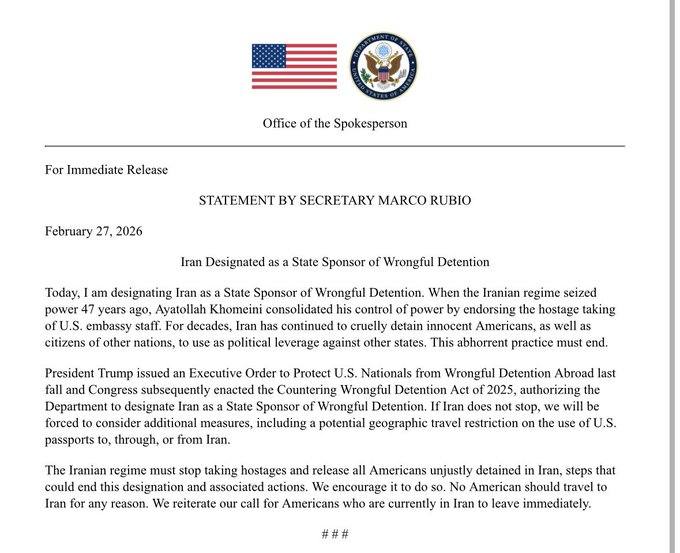
Washington’s New Pressure Tool: Iran Branded a “Wrongful Detention” Sponsor

The U.S. has designated Iran as a “State Sponsor of Wrongful Detention,” escalating pressure on Tehran over what Washington calls the unjust detention of Americans used for political leverage.

In public remarks, U.S. officials urged Tehran to “release all Americans unjustly detained,” and reiterated that Americans currently in Iran should leave immediately.

The designation is tied to a newer U.S. framework aimed at deterring “hostage diplomacy,” and could open the door to additional measures—including restrictions related to travel and passport use—if the U.S. deems Iran non-compliant.

Source: Reuters; CBS News; Anadolu Agency; The White House (Presidential Action)

More Iran news

Commodities

Venezuela Oil Sales Poised to Hit $2B as U.S. Control Tightens

Oil sales under a flagship U.S.–Venezuela supply deal are expected to reach $2 billion by end-February, U.S. officials said, as shipments ramp up and barrels held in floating storage move into the market.

The U.S. says it took control of Venezuela’s oil exports after U.S. forces captured President Nicolás Maduro in early January, with proceeds routed to a U.S.-supervised fund in Qatar—a framework that could reshape crude flows and pricing for refiners globally.

Source: Reuters

Gold Holds Near $5,187 as Haven Bid Locks in a Strong February

Gold steadied in Asian trade on Friday and was on track for solid February gains, as safe-haven demand stayed supported by rising geopolitical tensions and persistent economic uncertainty through the month. Disruptions in U.S. trade policy and worries about cooling growth in major economies also kept investors biased toward defensive assets, helping bullion recover most of its late-January losses.

Fresh geopolitical headlines added to the haven tone on Friday, with reports of a war breaking out between Pakistan and Afghanistan, although the conflict appeared contained to the two countries so far.

Current levels

  • Spot gold: $5,187.18/oz (00:12 ET / 05:12 GMT)
  • April gold futures: $5,203.61/oz (+0.2%)

Month-to-date

  • Spot gold: +6.7% in February, rebounding sharply from early-month lows after a speculative rally unwound rapidly.
  • Early-Feb low: near $4,600/oz.

Source: Reuters

Silver and Platinum Outrun Gold as February Rally Broadens

Precious metals extended February’s safe-haven/real-asset bid, with silver and platinum outperforming on the day and holding strong month-to-date gains.

  • Spot silver: +1.7% to $89.7785/oz; +6.0% in February
  • Spot platinum: +3.0% to $2,351.63/oz; +8.4% in February

Source: Reuters

Copper Holds a Quiet Bid as China Reopens and Inventories Come Into Focus

Copper prices edged higher on Friday and were set for a mildly positive February, with markets waiting for clearer signals from China, the world’s largest copper importer—especially after Lunar New Year holiday disruptions kept many buyers sidelined.

Pricing

  • LME copper (3M): +0.2% to $13,333.0/ton, +1.2% in February
  • COMEX copper: +0.4% to $6.0480/lb, +1.1% in February

What’s driving the “muted” month

  • China’s Lunar New Year break closed mainland markets for over a week, dampening spot buying and liquidity.
  • ANZ noted copper inventories built more than expected during the holiday—both in China and globally—amid mining and trade disruptions.

What to watch next

With China markets reopened this week, attention is shifting to whether restocking and fresh buying pick up. Long-term, copper demand is expected to strengthen as the AI buildout accelerates, lifting power and data-center related metals demand.

Source: Reuters; ANZ

Baker Hughes: U.S. Rig Count Slips, Hinting at Slightly Softer Drilling Activity

U.S. drilling activity eased marginally, with both oil rigs and total rigs down from the prior week.

  • Baker Hughes Oil Rig Count: 407 (prior 409)
  • Baker Hughes Total Rig Count: 550 (prior 551)

Why it matters: a lower rig count can signal slower supply growth momentum over time, though production trends also depend on productivity and completion activity.

Source: Baker Hughes

More Commodities news

Japan

Tokyo Inflation Cools vs Prior, but Core Beats Forecast

Tokyo’s February inflation prints showed a softer trend versus the prior month, even as the core measure came in a touch hotter than expected.

  • Tokyo Core CPI (YoY, Feb): 1.8% (vs 1.7% expected; prior 2.0%)
  • Tokyo CPI (YoY, Feb): 1.6% (prior 1.5%)
  • Tokyo CPI ex Food & Energy (YoY, Feb): 1.5% (prior 1.4%)
  • Tokyo CPI ex Food & Energy (MoM, Feb): 0.3% (prior -0.3%)

Why it matters: cooling vs the prior print eases urgency, but a firmer-than-expected core keeps the BoJ’s normalization debate alive.

Source: Statistics Bureau of Japan

Japan Data Split: Output Rebounds, Retail Surprises, but Factory Outlook Turns Negative

Japan’s January activity delivered a mixed message: industrial output rebounded, retail beat expectations, but forward production guidance points lower.

  • Industrial Production (MoM, Jan, prelim): 2.2% (vs 5.5% expected; prior -0.1%)
  • Retail Sales (YoY, Jan): 1.8% (vs 0.1% expected; prior -0.9%)
  • Large Scale Retail Sales (YoY, Jan): 3.0% (prior 1.0%)
  • Large Retailers’ Sales (MoM, Jan): 4.1% (prior -2.0%)
  • Industrial Production forecast 1m ahead (MoM, Feb): -0.5% (prior 9.3%)
  • Industrial Production forecast 2m ahead (MoM, Mar): -2.6% (prior -4.3%)

Why it matters: consumption looks stronger than feared, but the negative production outlook suggests factories remain cautious—key for the yen and BoJ expectations.

Source: METI (Japan); Statistics Bureau of Japan

Foreign Appetite for Japan Equities Cools as Bond Flows Flip Deeper Negative

Foreign investors still bought Japanese stocks, but at a much slower pace, while foreign bond flows turned sharply more negative—an uneven cross-border flow signal for Japan.

  • Foreign Investments in Japanese Stocks: ¥402.0B (prior ¥1,428.0B)
  • Foreign Bonds Buying: -¥1,898.8B (prior -¥487.9B)

Why it matters: softer equity inflows can temper the Nikkei’s momentum at the margin, while heavier net bond selling can influence JGB demand and FX dynamics if it reflects risk hedging or duration reallocation.

Source: Japan Ministry of Finance

Japan: 2-Year JGB Yield Dips as Housing Improves and Construction Orders Cool

Japan’s data mix showed slightly lower short-end yields at auction, a smaller decline in housing starts, and a sharp deceleration in construction orders growth.

  • 2-Year JGB Auction: 1.244% (prior 1.253%)
  • Construction Orders (YoY, Jan): 5.7% (prior 20.2%)
  • Housing Starts (YoY, Jan): -0.4% (vs -1.9% expected; prior -1.3%)

Why it matters: softer construction orders may hint at less momentum ahead, but the improvement in housing starts reduces recession-risk noise, while the lower 2-year yield signals steady demand at the front end.

Source: Japan Ministry of Finance; MLIT (Japan)

More Japan news

Day Trade Signals

Flows Rebound, But Options Expiry Can Whipsaw Crypto

Tape check: BTC ~$67.7k, ETH ~$2.04k (both softer on the day).

Institutional flow pulse: Spot BTC ETF inflows recently hit a 3-week high day, hinting demand is returning after de-risking.

Positioning catalyst: A large BTC options expiry today (reports flag ~$7.8B notional) can amplify intraday whipsaws around key strikes.

What it means: If price rallies on thin spot follow-through while expiry gravity is high, expect faster reversals. Cleaner trends typically need spot-led continuation.

Source: Spot BTC ETF flow reports; crypto options expiry (notional) reports; market tape

Macro Tripwire Today: US PPI Can Flip Rate-Cut Pricing — Crypto Follows

Event-risk alert: US PPI (Jan) is the macro tripwire today.

Why it matters: PPI is a key input into the Fed’s inflation narrative (and can swing rate-cut pricing fast).

  • Higher than estimates (30%) → yields up, USD up, risk assets down → BTC/ETH likely fade
  • In line with estimates (45%) → chop / mean reversion, focus shifts back to flows & options
  • Lower than estimates (25%) → yields down, risk bid → BTC/ETH relief

What it means: Today’s first move is likely a rates/liquidity move; crypto typically follows the direction of financial conditions.

Source: U.S. Bureau of Labor Statistics (Producer Price Index, PPI); CME Group FedWatch Tool

PPI: The “Rates-First” Catalyst That Can Move Markets Before the Fed Speaks

PPI → PCE expectations: Hotter wholesale inflation can lift expectations for the Fed’s preferred inflation gauges and delay “cuts,” tightening financial conditions.

Transmission to markets:

Tighter conditions typically mean higher real yields + stronger USD → lower risk appetite and tougher liquidity for levered crypto.

Traders note:

Watch the first 5–15 minutes post-release—if BTC and tech risk move in the same direction, macro is driving; if they diverge, it’s crypto microstructure (flows/expiry).

Why?

Today is a macro-first day: the cleanest crypto edges come from reading rates → risk → crypto in that order.

Source: U.S. Bureau of Labor Statistics (PPI); U.S. Bureau of Economic Analysis (PCE); Federal Reserve

More Day Trade Signals news

Oceania

Australia Credit Growth Slows as Private Lending Misses

Australia’s January credit data came in softer than expected, with private-sector credit growth slowing and housing credit easing slightly.

  • Private Sector Credit (MoM, Jan): 0.5% (vs 0.7% expected; prior 0.8%)
  • Housing Credit (Jan): 0.6% (prior 0.7%)

Why it matters: slower credit growth can signal cooling demand and tighter financial conditions at the margin—relevant for the RBA as it weighs sticky inflation against growth risks.

Source: Reserve Bank of Australia

New Zealand M3 Money Supply Falls, Hinting at a Softer Liquidity Pulse

New Zealand’s broad money supply edged lower in January, pointing to a mild cooling in liquidity conditions.

  • M3 Money Supply (Jan): NZ$441.7B (prior NZ$447.9B)

Why it matters: softer money growth can align with slower credit creation and a more restrained demand backdrop, depending on what happens next in lending and activity indicators.

Source: Reserve Bank of New Zealand

More Oceania news

China

PBOC Hits the Brakes on Yuan Strength, Nudging Markets Toward Dollars

China’s central bank moved Friday to slow the yuan’s rapid appreciation, announcing it will cut the foreign-exchange risk reserve requirement on certain forward FX purchases to zero—a tweak designed to encourage dollar buying and temper one-way yuan strength.

The move followed Thursday’s rally, when the onshore yuan strengthened to a near three-year high versus the U.S. dollar, driven in part by exporters rushing to sell dollars after last year’s record trade surplus. On the announcement, China’s offshore yuan weakened by roughly 0.2%.

“It means the PBOC is intervening as the yuan’s appreciation is too fast,” said Yuan Tao of Orient Futures, calling the decision “unexpected.”

Policy detail

  • The PBOC will lower the FX risk reserves for financial institutions when purchasing foreign exchange via currency forwards to 0% from 20%, effective March 2.

Why it matters: By reducing the “cost” of using forwards to buy dollars, the PBOC is effectively signaling it wants the currency’s rise to be more gradual—a move with potential spillovers into broader Asia FX and risk sentiment.

Source: People’s Bank of China; Orient Futures

Hong Kong Trade Surges, Deficit Narrows Sharply

Hong Kong’s January trade data showed a sharp pickup in both exports and imports, while the trade deficit narrowed materially versus the prior month; money growth eased slightly.

  • M3 Money Supply (Jan): 3.8% (prior 4.2%)
  • Exports (MoM, Jan): 33.8% (prior 26.1%)
  • Imports (MoM, Jan): 38.1% (prior 30.6%)
  • Trade Balance (Jan): -14.1B (prior -63.3B)

Why it matters: strong trade flows suggest a rebound in activity, while the smaller deficit reduces near-term external drag—though the surge in imports also signals strong domestic demand or restocking.

Source: Hong Kong Census and Statistics Department; HKMA (M3)

More China news

India

India: Q3 GDP Beats, but Fiscal Deficit Widens

India’s growth surprised to the upside in Q3, while the federal fiscal deficit widened in January.

  • GDP Quarterly (YoY, Q3): 7.8% (vs 7.2% expected; prior 8.2%)
  • GDP Annual: 7.6% (prior 7.4%)
  • Federal Fiscal Deficit (Jan): 9,814.07B (prior 8,558.42B)

Why it matters: stronger growth supports risk sentiment, but a wider deficit can complicate the policy mix—especially with inflation and rates in view.

Source: MOSPI; Controller General of Accounts (India)

India Credit Growth Slows, Deposits Ease, and FX Reserves Dip

India’s latest monetary and credit snapshot showed slower loan and deposit growth, with FX reserves edging lower and M3 growth easing.

  • Bank Loan Growth: 13.6% (prior 14.6%)
  • Deposit Growth: 11.2% (prior 12.5%)
  • FX Reserves (USD): $723.61B (prior $725.73B)
  • M3 Money Supply: 10.9% (prior 12.0%)

Why it matters: cooling credit and money growth suggest a softer liquidity impulse, while steady (but slightly lower) reserves keep the external buffer broadly intact.

Source: Reserve Bank of India (RBI)

More India news

Russia

Russia’s Reserves Slip, Trimming the Buffer

Russia’s central bank reserves declined, implying a smaller headline buffer compared with the previous reading.

  • Central Bank Reserves (USD): $797.2B (prior $806.1B)

Source: Bank of Russia

Russia Industrial Output Turns Negative, Signaling a Softer Start to the Year

Russia’s industrial production slipped into contraction in January, reversing the prior month’s growth.

  • Industrial Production (YoY, Jan): -0.8% (prior 3.7%)

Why it matters: a negative print suggests a weaker industrial pulse and can feed into broader growth expectations if the downturn persists.

Source: Rosstat

More Russia news

Canada

Canada GDP Unexpectedly Contracts in Q4, Raising Growth-Scare Risk

Canada’s economy shrank in Q4, missing expectations and marking a sharp slowdown from the prior quarter, even as December activity still showed a modest gain.

  • GDP Annualized (QoQ, Q4): -0.6% (vs 0.0% expected; prior 2.4%)
  • GDP (QoQ, Q4): -0.2% (prior 0.6%)
  • GDP (YoY, Q4): 0.72% (prior 1.58%)
  • GDP (MoM, Dec): 0.2% (vs 0.1% expected; prior 0.0%)
  • GDP (MoM, Jan, prelim): 0.0% (prior 0.2%)
  • GDP Implicit Price (QoQ, Q4): 0.70% (prior 0.90%)

Why it matters: A negative Q4 print strengthens the case that Canada’s economy is losing momentum, which can increase sensitivity to rate expectations and keep the BoC under pressure if the soft patch persists. The flat preliminary read for January suggests the rebound is not yet convincing.

Source: Statistics Canada

Canada Budget Swings into Surplus, a Sharp Turn from Prior Month

Canada’s federal budget balance moved into surplus in December, a notable improvement from the prior month’s deficit.

  • Budget Balance (Dec): 0.20B (prior -8.02B)

Why it matters: a swing into surplus can modestly improve fiscal optics, though month-to-month budget figures can be seasonal and volatile.

Source: Department of Finance Canada

More Canada news

UK

UK Consumers Turn More Pessimistic as GfK Confidence Misses

UK consumer sentiment weakened in February, with the GfK reading falling below expectations.

  • GfK Consumer Confidence (Feb): -19 (vs -15 expected; prior -16)

Why it matters: deeper pessimism can weigh on discretionary spending and reinforce the narrative of a cautious UK consumer backdrop.

Source: GfK (UK Consumer Confidence)

More UK news

Forex

February Wrap: Dollar Softens in Asia, but Logs Monthly Gain

The US Dollar Index (DXY) and DXY futures edged about 0.1% lower in Asian trade, even as the greenback was still on track for a ~0.7% gain in February amid safe-haven demand and uncertainty over the interest-rate path.

Current rates (with the moves you cited):

  • DXY: ~97.68 (-0.1%)
  • DXY futures (DX=F): ~97.77 (-0.1%)
  • USD/JPY: ~155.81 (-0.2% on Friday; pair set to +0.7% in Feb)
  • USD/CNY (onshore): ~6.860 (+0.2% on Friday) after the PBOC move that makes dollar buying cheaper via forwards
  • AUD/USD: ~0.7129 (Aussie set to +2.3% in Feb on a more hawkish RBA outlook)
  • USD/INR: ~91.0 (steady after moving back above 91; still -0.8% in Feb)
  • USD/SGD: ~1.264 (flat; -0.7% in Feb)

Source: Trading Economics; Yahoo Finance; Investing.com; Wise; Twelve Data; alanchand.com

More Forex news

Equities

Asia Ends February Split: Japan Leads, Hong Kong Lags

Asian equities finished the session mostly higher, with Japan and Hong Kong in the green while India lagged.

Friday live in the last trading hours

  • Asia Dow: 5,949.11 (+22.52, +0.38%)
  • Nikkei 225: 58,781.61 (+28.22, +0.05%)
  • Hang Seng: 26,624.45 (+243.43, +0.92%)
  • Shanghai Composite: 4,160.24 (+13.61, +0.33%)
  • Sensex: 81,719.73 (-528.88, -0.64%)
  • Singapore (STI): 4,981.39 (+17.01, +0.34%)

February performance (month-to-date, % — calculated vs Jan 30 close)

  • Asia Dow: +5.71%
  • Nikkei 225: +10.24%
  • Hang Seng: -4.18%
  • Shanghai Composite: +0.68%
  • Sensex: -0.67%
  • Singapore (STI): +1.55%

Source: Investing.com; Yahoo Finance

More Equities news