IFC Markets Live Quotes

Market news roundup: Thursday, 26 February 2026

55 short market news items, grouped by 12 sections.

Others

KLM Suspends Amsterdam–Tel Aviv Route Until Further Notice

Dutch airline KLM said it will temporarily suspend flights between Amsterdam and Tel Aviv’s Ben Gurion Airport starting 10 Esfand (≈ Sunday, March 1, 2026) until further notice.

In its statement, KLM did not explicitly cite security or geopolitical reasons, but the move comes as regional tensions and concerns about a potential U.S.–Iran military confrontation circulate in the background. KLM said it continuously adjusts its global network based on market demand and operational conditions, adding that flights to Tel Aviv are currently not commercially or operationally feasible.

The airline said it will keep monitoring developments and reassess depending on conditions, and that affected passengers will be offered options to rebook or receive refunds.

Source: KLM statement
Bank of Korea Holds at 2.50% as Policy Stays in Wait-and-See Mode

South Korea’s central bank left rates unchanged in February, keeping policy steady.

  • Interest Rate Decision (Feb): 2.50% (in line with 2.50% expected; prior 2.50%)

Why it matters: the hold underscores a wait-and-see stance as officials balance growth, inflation, and FX sensitivity amid global trade uncertainty.

Source: Bank of Korea

The CPU Strikes Back as AI Moves from Training to Deployment

For decades, the CPU (central processing unit) was seen as the main “brain” of a computer—most closely associated with Intel and sometimes AMD. But Nvidia CEO Jensen Huang has long argued that the balance shifted over time: where roughly 90% of computing once happened on CPUs and 10% on chips like Nvidia’s, he says that ratio has flipped in recent years.

Now, the CPU is making a comeback. As AI companies increasingly shift from training models to deploying them (“inference”), CPUs are being viewed as an equivalent—sometimes better—option for a growing share of workloads. Nvidia says it plans to be a major player in that transition.

“We love CPUs as well as GPUs,” Huang said on a call with analysts on Wednesday for the company’s fourth-quarter results.

Why it matters (in plain terms):

  • CPUs are generalist chips designed to handle a wide variety of tasks at reasonable speed.
  • GPUs and other accelerators have traditionally dominated heavy parallel workloads, especially in AI training.
  • As the AI industry pivots toward deployment at scale, the CPU’s flexibility and role in the broader system stack is returning to center stage.

Source: Nvidia Q4 results analyst call (Jensen Huang)

Jagland Hospitalized as Suicide-Attempt Reports Collide With Lawyer’s Denial

Reports in Norway say former Norwegian prime minister Thorbjørn Jagland was hospitalized about a week ago and is in serious condition, amid intense scrutiny tied to the Epstein files.

The dispute is over why: Norwegian outlet iNyheter reported the hospitalization followed a suicide attempt, citing a source and referencing communications with his lawyer. But VG reported Jagland’s lawyer denied media claims that Jagland tried to take his own life. A separate fact-check summary also notes Jagland is hospitalized while his lawyer disputes the suicide-attempt framing.

Jagland is already under pressure after Norway’s economic crime police opened an investigation into him on suspicion of aggravated corruption linked to information revealed in newly released Epstein-related files.

Source: iNyheter; VG; Reuters.

If you or someone you know is in immediate danger, contact local emergency services.

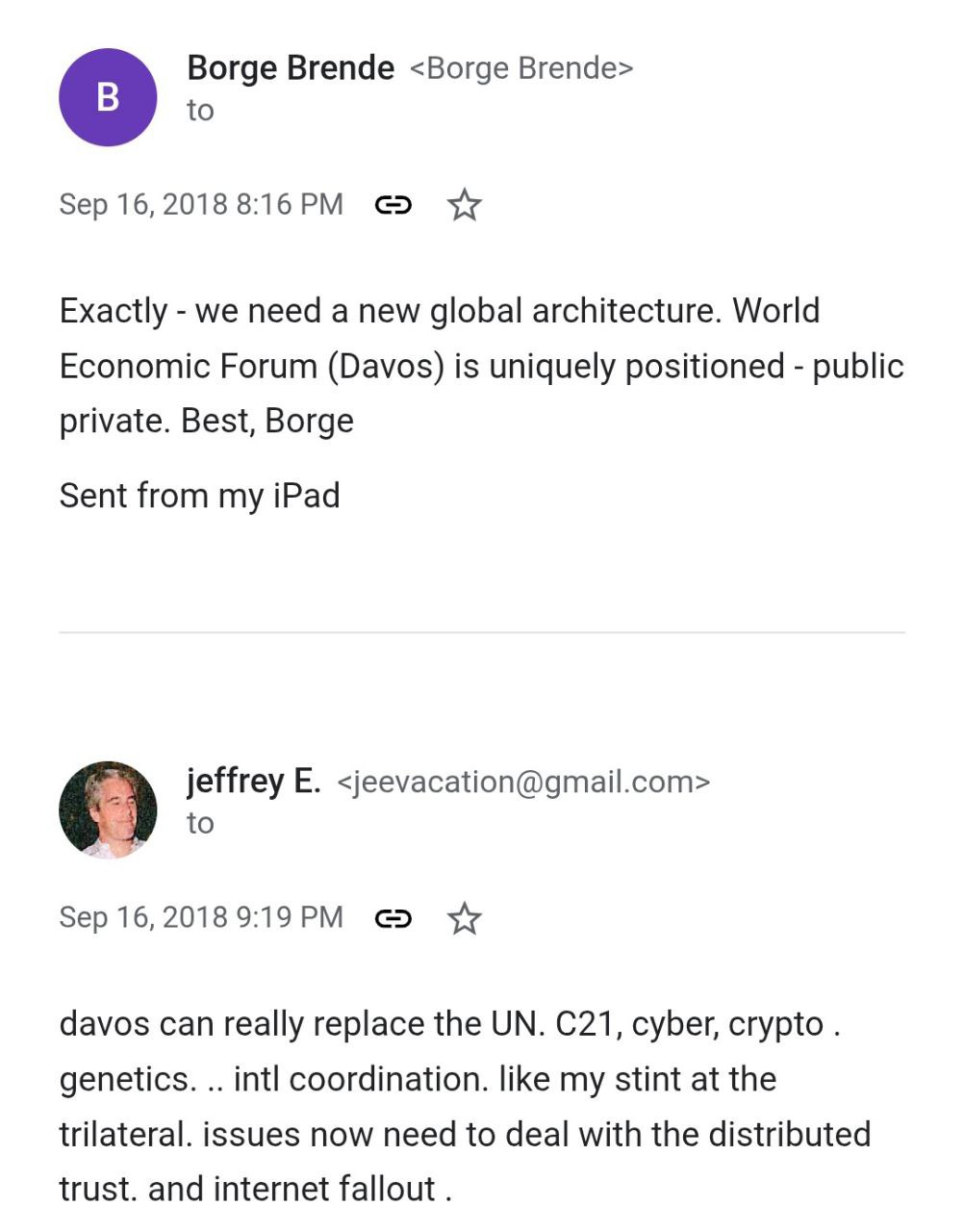
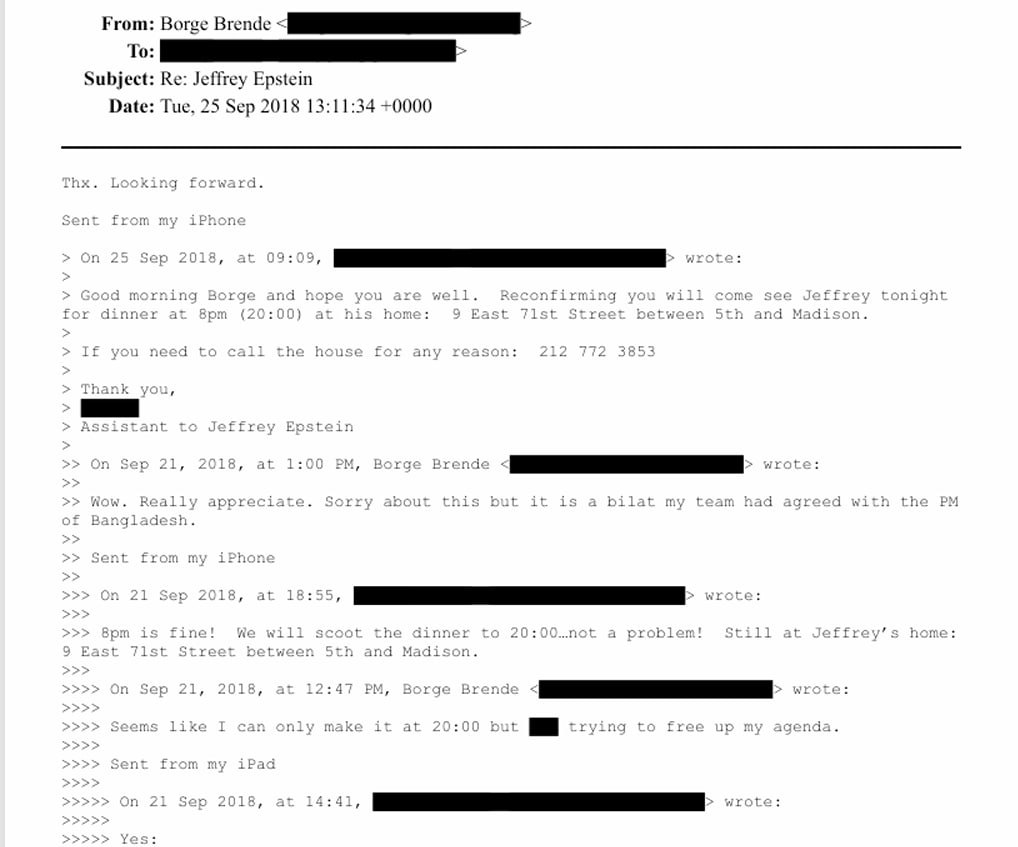
Davos Chief Steps Aside as Epstein Messages Reignite Pressure

World Economic Forum President and CEO Børge Brende has resigned, saying the Forum should continue its work “without distractions,” after renewed scrutiny of his past contacts with Jeffrey Epstein.

According to Reuters/AP/FT, newly released DOJ materials showed Brende attended three business dinners with Epstein and exchanged messages in 2018–2019; Brende said he regretted the meetings and claimed he did not know the full extent of Epstein’s criminal background at the time.

The WEF said an independent legal review found no new information beyond what had already surfaced; WEF Managing Director Alois Zwinggi will serve as interim chief while a successor is sought.

Brazil’s IGP-M Turns Negative, Signaling a Fresh Disinflation Pulse

Brazil’s IGP-M inflation index fell in February, flipping back into negative territory.

  • IGP-M (MoM, Feb): -0.73% (vs -0.60% expected; prior 0.41%)

Why it matters: IGP-M is a closely watched price gauge in Brazil (often referenced in contracts and rents); a negative print strengthens the near-term disinflation narrative.

Source: FGV (Getulio Vargas Foundation)

South Africa Producer Inflation Cools, Reinforcing the Disinflation Trend

South Africa’s producer inflation eased in January, with the monthly print turning negative—pointing to cooler upstream price pressures.

  • PPI (YoY, Jan): 2.2% (prior 2.9%)
  • PPI (MoM, Jan): -0.2% (prior 0.2%)

Source: Statistics South Africa

Israel’s Industrial Output Slumps After Prior Surge

Israel’s industrial activity fell sharply in December, reversing the prior month’s jump and signaling a choppy production backdrop.

  • Industrial Output (MoM, Dec): -4.3% (prior +7.2%)

Source: Israel Central Bureau of Statistics (as reported)

Turkey’s FX Reserves Decline, Cutting Buffer Size

Turkey’s foreign-exchange reserve metrics weakened, implying a smaller near-term buffer.

  • Gross FX Reserves: $73.65B (prior $79.59B)
  • Net FX Reserves: 89.18% (prior 95.87%)

Source: CBRT (Central Bank of the Republic of Türkiye) — as reported

Mexico Unemployment Ticks Up, but Stays Low Overall

Mexico’s unemployment rate edged higher in January, slightly above expectations, though the level remains low.

  • Unemployment Rate (Jan, n.s.a.): 2.70% (vs 2.60% expected; prior 2.40%)
  • Unemployment Rate (Jan): 2.60% (vs 2.60% expected)

Source: INEGI (Mexico statistics)

More Others news

Equities

Europe Rallies Into the Close as Broad-Based Buying Returns

European markets finished Wednesday firmly higher, with gains led by Spain and the UK and a solid uplift across the region’s benchmark indices.

  • FTSE 100: 10,806.41 (+125.82, +1.18%)
  • DAX: 25,175.94 (+189.69, +0.76%)
  • CAC 40: 8,559.07 (+39.86, +0.47%)
  • FTSE MIB: 47,170.44 (+518.72, +1.11%)
  • IBEX 35: 18,461.00 (+271.50, +1.49%)
  • STOXX 600: 633.47 (+4.33, +0.69%)

Market take: The close points to a risk-on tone with broad participation, suggesting investors were comfortable adding exposure across both core and peripheral Europe rather than hiding in a single pocket.

Tech-Led Rally Lifts Wall Street into the Close

Wall Street finished Wednesday (Feb. 25) higher, extending a tech-driven rebound as AI disruption worries eased and investors positioned ahead of Nvidia’s results.

  • Dow Jones: 49,482.15 (+0.63%)
  • S&P 500: 6,946.13 (+0.81%)
  • Nasdaq Composite: 23,152.08 (+1.26%)

Under the hood: Tech led sector gains while industrials lagged. Nvidia posted Q4 revenue above estimates and traded higher after hours, reinforcing the AI-bull case despite recent volatility across software and housing-linked names.

Source: Reuters

KOSPI Breaks Records as Nvidia’s AI Signal Ignites Korea’s Chip Giants

South Korea’s KOSPI led Asia on Thursday, jumping over 2% to a fresh record of 6,222.14, as Nvidia’s earnings reinforced confidence that AI-driven demand for advanced chips is not cooling meaningfully.

The rally was powered by Samsung Electronics and SK Hynix—key memory-chip suppliers to Nvidia—both of which surged to record highs and provided the biggest lift to the index, even as Nvidia itself was choppy in after-hours trade.

Beyond the AI tailwind, local catalysts added fuel:

  • Samsung unveiled its new flagship smartphone line, the S26, on Wednesday.
  • SK Hynix said it will invest 21.6 trillion won ($15.07B) to build a new production facility in South Korea.

Source: Samsung and SK Hynix statements

Home Depot Delivers a Clean Double-Beat, but Shares Slip (HD)

Home Depot (HD) reported EPS of $2.72 vs $2.54 expected (+7.09% surprise) and revenue of $38.2B vs $38.14B expected (+0.16% surprise). Market cap stands near $373.88B. Despite the beat, the stock was down ~2.32% (last $375.57) and +0.11% in extended hours (to $376.00), suggesting investors may be leaning more on guidance, housing-linked demand signals, and margin commentary than the headline numbers (according to the earnings snapshot you provided).

GoDaddy Beats Estimates, Stock Gets Hit (GDDY)

GoDaddy (GDDY) posted EPS of $1.80 vs $1.58 expected (+13.92% surprise) and revenue of $1.3B vs $1.27B expected (+2.36% surprise). Market cap is about $10.66B. Shares were down ~14.28% (last $79.12) and +0.13% in extended hours (to $79.22), implying the selloff likely reflects guidance, growth outlook, or margin/cost signals rather than the quarter’s beat itself (according to the earnings snapshot you provided).

NVIDIA Extends Its Beat Streak, Market Watches the Next Leg (NVDA)

NVIDIA (NVDA) reported EPS of $1.62 vs $1.52 expected (+6.58% surprise) and revenue of $68.1B vs $65.56B expected (+3.87% surprise). Market cap is shown near $4.75T. The stock was up ~1.41% (last $195.56) and +0.66% in extended hours (to $196.85). With numbers beating on both lines, attention typically shifts to forward guidance, AI/data-center demand visibility, and margin trajectory (according to the earnings snapshot you provided).

Lowe’s Beats Modestly, but the Tape Turns Negative (LOW)

Lowe’s (LOW) reported EPS of $1.98 vs $1.94 expected (+2.06% surprise) and revenue of $20.58B vs $20.34B expected (+1.18% surprise). Market cap is about $147.54B. Shares were down ~5.59% (last $263.02) and -0.01% in extended hours (to $263.00), hinting that investors may be prioritizing guidance, demand durability, and competitive/margin signals over a modest beat (according to the earnings snapshot you provided).

Asia Takes a Breather: China Pauses, Hong Kong Slips, Thailand Pops on a Surprise Cut

Asian markets were mixed as mainland China consolidated after a two-session sprint (helped by Lunar New Year spending optimism), Hong Kong eased with tech under pressure, and Thailand jumped after an unexpected rate cut.

Current levels (change, volume):

  • CSI 300: 4,724.63 (-0.24%), Vol: 22,481,354,700
  • Shanghai Composite: 4,145.26 (-0.05%), Vol: 62,258,165,000
  • Hang Seng: 26,511.50 (-0.95%), Vol: 1,646,892,860
  • Baidu (9888.HK): HK$124.70 (ahead of earnings; AI spend in focus)
  • Singapore Straits Times (STI): 5,007.74 (-0.26%), Vol: 167,654,876
  • Thailand SET: 1,529.41 (+0.88%), Vol: 6,197,233 (‘000 shares)

Source: Investing.com; Stock Exchange of Thailand (SET)

Asia Diverges: Thailand Pops on Surprise Cut, Nifty Edges Up

Asian trading was mixed as Thailand rallied on a surprise rate cut, while Singapore slipped and India grinded higher in morning trade.

Moves + current levels

  • Singapore STI: -0.2% → ~4,985
  • Thailand SET Index: +0.8% → ~1,529
  • India Nifty 50: +0.3% → ~25,556

Source: TradingView; NDTV Profit; Reuters

Turkey’s Trade Deficit Narrows as Confidence Moves Above 100

Turkey’s January external gap improved marginally, while February confidence rose back above the 100 line—hinting at a firmer domestic pulse.

  • Trade Balance (Jan): -$8.38B (vs -$8.40B expected; prior -$9.40B)
  • Exports (Jan): $20.30B (vs $20.30B expected; prior $26.30B)
  • Economic Confidence Index (Feb): 100.70 (prior 99.40)

Source: TurkStat (as reported)

More Equities news

Iran

Iran Says Geneva Talks Were “Intense and Serious,” With IAEA Chief Present

Iran’s Foreign Ministry spokesman Esmail Baghaei said the Geneva negotiations between Iran and the United States were held in a “compressed, serious” format, describing the discussions as focused and high-stakes.

Baghaei also said the Director General of the International Atomic Energy Agency (IAEA) was present during the talks—an unusual detail that underscores how central the nuclear file remains.

He added that both delegations needed to consult with their capitals, and that the talks were expected to resume around 6:00 p.m. Geneva time. Baghaei said conflicting media narratives have fueled “doubts and questions,” but insisted the Iranian team is focused on outcomes, while stressing that reported details circulating in the media are “mostly speculation” and cannot be confirmed.

Source: Iranian Foreign Ministry spokesman Esmail Baghaei on IRIB News (شبکه خبر),

Death Sentence Upheld Again for Rasht Poet, Rights Group Says

Human rights outlet Hyrcani reported that the death sentence of Peyman Farah-Avar—a poet and political prisoner from Rasht—has been confirmed for a second time by Branch 39 of Iran’s Supreme Court.

The report does not cite an official judicial announcement; it frames the update as information obtained by the rights group.

Source: Hyrcani Human Rights Media (as reported on its official channels).

Geneva Talks Pause as Iran Flags “Contradictory” U.S. Messaging

Iranian and U.S. delegations left the venue in Geneva after roughly three hours of discussions, as Tehran signaled concern over what it described as mixed/contradictory positions from the American negotiating team.

Oman’s foreign minister said the talks are set to resume shortly, after both sides consult with their capitals, while observers following the process remain cautious about a fully successful outcome.

Source: Iran International (Ahmad Samadi); Omani Foreign Ministry (X); Anadolu Agency.

Paris Verdict Watch: Iranian Woman’s Case Seen as Leverage in France–Iran Prisoner Talks

A French court is set to deliver a verdict on Mahdieh Esfandiari (39), with prosecutors seeking a four-year sentence—three years suspended—in a case France 24 says some observers view as a potential bargaining chip in dealings with Tehran over the fate of French nationals Cécile Kohler and Jacques Paris.

Source: France 24.

Iran’s “Pro Internet” SIM Sparks Two-Tier Access Fears

Iranian outlets report that a major mobile operator has launched a SIM plan branded “Pro” that can enable access to some filtered websites and social platforms, prompting debate over a deepening digital access gap.

According to Shargh, the service is presented as a business/organizational offering, but in practice individuals may also apply by registering a request under a business name to be placed on a so-called whitelist.

Reported terms and pricing:

  • Activation fee: 2,178,000 tomans (includes an initial 50GB package)
  • Access to blocked platforms (including Instagram and YouTube): charged separately at 40,000 tomans per GB
  • Operational details: Shargh says the company’s marketing team provided a product brief and a sample request letter; documents describe registration via a specific portal and identity verification through an integrated gateway, stating access is granted to businesses with legal authorization
  • Connection quality claim: Zoomit, citing sellers, reports the service uses an international IP and may remain stable even during broad disruptions or nationwide restrictions

The reports come amid renewed attention to internet disruption risks, after accounts of a near 20-day nationwide shutdown during the Dey protests, followed by continued complaints about lower quality, slower speeds, and harder access even with circumvention tools.

Source: Shargh; Zoomit.

Tehran GPS Disruptions Reported as Navigation Apps Misfire

Several Iranian outlets say GPS services were disrupted in parts of Tehran, with users reporting wrong locations and route-finding failures across both local and international navigation apps.

What’s known so far:

  • Reports describe the issue as starting Thursday morning (7 Esfand 1404 / Feb. 26, 2026).
  • No official cause has been announced publicly in the cited reports.
  • One report says authorities are investigating and have promised a quick fix.

Source: Fararu; Donya-e-Eqtesad (via Citna).

Allameh Tabataba’i University Moves Classes Online Through End of Esfand

Allameh Tabataba’i University announced that second-semester classes will be held virtually until the end of Esfand, extending remote instruction across the remainder of the month.

The decision effectively shifts the university’s teaching schedule to online-only delivery through late March on the Persian calendar, as campuses across Iran remain under heightened attention following recent student gatherings.

Source: Allameh Tabataba’i University announcement.

Shamkhani Signals Green Light: “Immediate Deal” Possible if Talks Focus on No Nuclear Weapon

Ali Shamkhani, Iran’s defense council secretary, said a rapid agreement is within reach if the core of the Geneva talks is Iran’s commitment not to build a nuclear weapon, arguing this aligns with the Supreme Leader’s fatwa and Iran’s defense doctrine.

In a post on X, Shamkhani added that Foreign Minister Abbas Araghchi has sufficient authority and backing to conclude a deal.

Source: Ali Shamkhani (X).


Islamic Azad University in Razavi Khorasan Moves Online Through Year-End

Islamic Azad University in Razavi Khorasan has announced that its classes will be held virtually until the end of the year, extending remote instruction through the remainder of the academic calendar year.

The shift adds to a widening pattern of Iranian universities moving courses online amid heightened campus sensitivity in recent weeks.

Source: Islamic Azad University (Razavi Khorasan) announcement.

More Iran news

Europe

Eurozone Sentiment Slips as Price Expectations Edge Up

The Eurozone’s February survey set showed a softer growth-confidence pulse, even as inflation expectations in the survey ticked higher.

  • Business & Consumer Survey (Feb): 98.3 (vs 99.8 expected; prior 99.3)
  • Industrial Sentiment (Feb): -7.1 (vs -6.1 expected; prior -6.8)
  • Services Sentiment (Feb): 5.0 (vs 7.5 expected; prior 7.2)
  • Consumer Confidence (Feb): -12.2 (in line; prior -12.4)
  • Business Climate (Feb): -0.36 (prior -0.38)
  • Selling Price Expectations (Feb): 11.5 (prior 10.3)
  • Consumer Inflation Expectation (Feb): 25.8 (prior 24.2)

Why it matters: sentiment is weakening across industry/services, while pricing expectations are creeping up—an awkward mix that can keep the ECB focused on “not declaring victory” even as activity indicators soften.

Source: European Commission (DG ECFIN) surveys

Italy BTP Auctions Clear Lower, Signaling Easier Funding Conditions

Italy’s bond auctions were priced at lower yields, pointing to a friendlier tone in sovereign funding costs.

  • Italian 10-Year BTP Auction: 3.31% (prior 3.44%)
  • Italian 5-Year BTP Auction: 2.62% (prior 2.74%)

Why it matters: lower auction yields suggest improved demand/conditions in BTPs, supportive for Italy’s front-to-belly funding curve as rate expectations evolve.

Source: Italian Treasury (MEF)

Eurozone Money Growth Firms, but Corporate Credit Softens

Eurozone liquidity accelerated in January, but lending to non-financial corporates undershot expectations—pointing to improving money growth with a mixed credit impulse.

  • M3 Money Supply (YoY, Jan): 3.3% (vs 2.9% expected; prior 2.8%)
  • M3 Money Supply (Jan): €17,344.7B (prior €17,230.7B)
  • Loans to Non-Financial Corporations (Jan): 2.8% (vs 3.1% expected; prior 3.0%)
  • Private Sector Loans (YoY, Jan): 3.0% (vs 3.1% expected; prior 3.0%)

Source: European Central Bank (ECB)

Italy’s Business Confidence Eases, While Consumers Turn Slightly More Upbeat

Italy’s February sentiment split: business confidence slipped, but consumer confidence improved modestly—important for consumption-led growth.

  • Business Confidence (Feb): 88.5 (prior 89.2)
  • Consumer Confidence (Feb): 97.4 (vs 97.2 expected; prior 96.8)

Source: ISTAT

Swiss Employment Ticks Higher, Keeping the Labor Market on a Steady Track

Switzerland’s employment level rose in Q4, pointing to continued steady labor-market expansion.

  • Employment Level (Q4): 5.544M (prior 5.532M)

Source: Swiss Federal Statistical Office

Spain Business Confidence Improves Slightly, Still in the Red

Spain’s business confidence index edged up in February, but remained negative overall.

  • Spanish Business Confidence (Feb): -2.6 (prior -3.1)

Source: INE (Spain)

More Europe news

Political

WSJ: Washington Hands Tehran a Hardline Geneva List

The Wall Street Journal reports the U.S. presented Iran with a detailed set of demands in the Geneva talks, anchored on permanent dismantlement of Iran’s core nuclear infrastructure and zero enrichment.

According to the report, Washington’s list includes:

  • Destroying/dismantling three major nuclear sites: Fordow, Natanz, and Isfahan.
  • Handing over all enriched uranium stockpiles to the United States.
  • Removing “sunset clauses” so restrictions do not expire over time, and reaffirming zero enrichment—while allowing Iran to keep the Tehran Research Reactor.
  • A phased sanctions concept: limited initial relief, with broader easing tied to verified Iranian compliance.

Source: The Wall Street Journal

Rubio Warns of Iran Threat: Nuclear Rebuild Claims and Regional Missile Risk

U.S. Secretary of State Marco Rubio said Iran’s nuclear and missile programs remain a serious threat to the United States and its interests, stressing that President Donald Trump prefers negotiations—but that Washington views Tehran as a long-standing security challenge.

Speaking to reporters Wednesday night, Washington time, Rubio described Iran’s nuclear program as the top threat, claiming Iran is attempting to rebuild parts of its nuclear infrastructure after U.S. strikes destroyed facilities. He said Iran is not enriching right now, but is working to reach a point where it can resume enrichment.

Rubio also called Iran’s missile program a direct threat to U.S. bases and regional partners, including in the UAE, Qatar, and Bahrain, and said Iran’s naval capabilities challenge shipping and the U.S. Navy—adding that Tehran has weapon systems that could be used against Americans if it chooses.

Source: Marco Rubio remarks to reporters.

Grossi Joins Geneva Talks as “Technical Observer,” Iran State TV Reporter Says

Iranian state TV reporting says Rafael Grossi, the Director General of the International Atomic Energy Agency (IAEA), has been added to the Geneva U.S.–Iran talks in the role of a technical observer—a signal that verification, inspection mechanics, and compliance language are increasingly central to the negotiation track.

International coverage of the Geneva round has also referenced Grossi’s presence alongside the Omani-mediated talks, underscoring the IAEA’s potential role in monitoring any nuclear commitments if a framework advances.

Source: IRIB News ; Financial Times ; AP

Geneva Talks Wrap Up as Delegations Head Out

Ahmad Samadi, a reporter for Iran International at the venue, said the Geneva talks between the Islamic Republic and the United States have ended, and the delegations are leaving the location.

Source: Iran International (Ahmad Samadi).

Oman Signals “Significant Progress” in U.S.–Iran Track, Technical Talks Set for Vienna

Oman’s foreign minister, Badr al-Busaidi, said the U.S.–Iran talks made “significant progress” and will resume soon after consultations in the respective capitals.

He added that technical-level discussions will take place next week in Vienna, indicating the process is moving into verification-and-implementation details after the latest round in Geneva.

Source: Badr Albusaidi (X); Associated Press.

More Political news

Forex

Yen Jitters: Dovish Board Picks Clash With Hawkish Hints

The yen slid into focus again, hovering near a two-week low after Japan’s government nominated two academics—seen by markets as strong pro-stimulus voices—to join the Bank of Japan board.

The surprise move was widely read as aligning with Prime Minister Sanae Takaichi’s preference for easy monetary policy, muddying the outlook for further BOJ rate hikes and reviving questions about how quickly Japan can normalize policy.

The currency found some support on Thursday after the Yomiuri newspaper reported BOJ Governor Kazuo Ueda left open the possibility of a near-term rate hike, while hawkish board member Hajime Takata also reiterated the case for gradual tightening.

Source: User-provided update; Yomiuri newspaper report

Dollar Softens in Asia as DXY Hovers Near 97.50

The U.S. Dollar Index (DXY) eased 0.1% during Asian hours, with U.S. Dollar Index futures also down 0.1%, trading around 97.50.

Why it matters: a softer dollar typically provides a mild tailwind for commodities and risk assets, while FX markets remain highly sensitive to tariffs and rate-path headlines.

Yuan Breaks Higher as Markets Price in Pre-NPC Policy Support

The Chinese yuan strengthened to fresh multi-year highs as traders leaned into expectations of additional policy support ahead of China’s annual parliamentary meeting, the National People’s Congress (NPC).

  • Onshore (USD/CNY): fell 0.5% to 6.834, marking a fresh 34-month low for the pair (i.e., a stronger yuan).
  • Offshore (USD/CNH): also fell, with the pair hitting its lowest level since mid-April 2023.

Why it matters: A firmer yuan into a major policy event often reflects a market view that authorities may lean on growth support, stability measures, or currency-management signals—all of which can spill over into broader Asia FX and risk sentiment.


Asia FX: KRW Steady After BoK Hold, AUD Grinds Higher

The South Korean won was largely muted after the Bank of Korea kept rates steady at 2.5% as expected. Elsewhere in Asia FX, the Singapore dollar firmed slightly, the Indian rupee softened marginally, and the Aussie edged higher.

Moves + current levels (spot / indicative):

  • USD/KRW: ~flat — ~1,427.8
  • USD/SGD: -0.1% — ~1.2622
  • USD/INR: +0.1% — ~90.98
  • AUD/USD: +0.2% — ~0.7132

Source: Investing.com; Yahoo Finance; TradingView

More Forex news

Day Trade Signals

NVIDIA Intraday: Bullish While 193.64 Holds — Target 201.52

  • Pivot / Support: 193.64
  • Plan: Long bias while above 193.64
  • Target: 201.52

Alternative: Below 193.64, look for downside toward 191.24, then 189.82

Momentum/notes: RSI > 50 (supportive), MACD positive but below signal (pullback risk), price above 20/50 MAs (195.27 / 192.46) → bullish structure, but allow for intraday retracement.

Tesla (30M) Intraday: Bullish While 410.05 Holds — Targets 422 / 426

  • Pivot / Support: 410.05
  • Plan: Long bias as long as 410.05 holds as support
  • Targets: 422 then 426

Alternative: Below 410.05, look for downside toward 403.92, then 400.28

Momentum / notes: RSI > 70 (strong trend or overbought → watch for bearish divergence), MACD positive and above signal, price above 20/50 MAs (412.59 / 407.31) → overall positive configuration, but allow for an intraday pullback.

Extreme Fear + ETF Outflows: Is Crypto “Buy Dips” or “Sell Rallies”?

✳️ ETF flows + sentiment is the tell right now: is the market in “buy dips” mode or “sell rallies” mode?

⏹️ Today’s crypto reports flag BTC/ETH ETF outflows and Fear & Greed at 11 (Extreme Fear).

Source: according to today’s crypto flow/sentiment reports.

❇️ What to watch:

If flows stay negative while BTC rallies, moves can be fragile (more likely to fade).

🔼 Upside gate: break + hold $69.8k → room to $71.0k–$72.5k.

🔽 Downside gate: lose $65.0k and fail the reclaim → $63.5k–$61.5k.

More Day Trade Signals news

USA

Big Tech Heads to White House to Sign “Rate Payer Protection” AI Power Pledge

A group of major AI and cloud players is expected at the White House on March 4 to sign the “Rate Payer Protection Pledge”—a commitment aimed at ensuring the electricity needs of new AI data centers don’t spill over into higher household power bills.

Who’s expected to attend: Fox News reported Amazon, Google, Meta, Microsoft, xAI, Oracle, and OpenAI are slated to participate.

What the pledge is about: The initiative follows President Trump’s State of the Union push for tech firms to build/secure their own power supply for AI infrastructure—rather than leaning on local grids in a way that could raise consumer rates.

Why it’s happening now: Rapid AI data-center growth is tightening grid conditions and stoking political sensitivity around electricity prices—especially in regions with dense data-center clusters.

What to watch next: whether the pledge comes with enforceable mechanisms (contracts, tariffs, utility rules) or remains largely voluntary, and which firms formally confirm participation.

Source: Fox News Digital; Reuters; The Verge

US Jobless Claims Stay Low, but Four-Week Average Edges Up

U.S. labor market signals remained broadly steady, with initial claims coming in below expectations, while the four-week average ticked higher.

  • Initial Jobless Claims: 212K (vs 217K expected; prior 208K)
  • Continuing Claims: 1,833K (vs 1,860K expected; prior 1,864K)
  • 4-Week Avg: 220.25K (prior 219.50K)

Why it matters: Claims data still point to a tight-ish labor market, but the gradual uptick in the average is worth watching for any signs of a trend change.

Source: U.S. Department of Labor (as reported)

Kansas City Fed Turns Up: Manufacturing Index Jumps into Expansion

Kansas City Fed activity improved in February, with the headline composite and manufacturing gauges rising notably.

  • KC Fed Composite Index (Feb): 5 (prior 0)
  • KC Fed Manufacturing Index (Feb): 10 (prior -2)

Why it matters: a move into positive territory points to better regional momentum, though Fed district surveys can be volatile—confirmation from broader ISM data matters.

Source: Federal Reserve Bank of Kansas City

More USA news

Oceania

New Zealand Business Mood Dips, but Activity Gauge Improves

New Zealand’s business confidence eased in February, even as firms’ own-activity measure ticked higher—an optimism pullback alongside still-strong perceived momentum.

  • ANZ Business Confidence (Feb): 59.2 (prior 64.1)
  • NBNZ Own Activity (Feb): 52.6% (prior 51.6%)

Why it matters: confidence cooled, but the improvement in “own activity” suggests the real-economy pulse is still holding up, complicating the near-term narrative for NZ growth and RBNZ policy expectations.

Source: ANZ / NBNZ business survey (as reported)

Australia Capex Beats, but Machines Pull Back—A Mixed Investment Signal

Australia’s Q4 private capex surprised to the upside, but the detail shows weakness in plant and machinery—suggesting investment is becoming more uneven.

  • Private New Capital Expenditure (QoQ, Q4): 0.4% (vs -0.1% expected; prior 6.4%)
  • Building Capital Expenditure (MoM, Q4): 2.3% (prior 2.3%)
  • Plant/Machinery Capex (QoQ, Q4): -1.7% (prior 11.2%)

Why it matters: the headline beat is supportive, but softer machinery spending can be a warning sign for productivity/industrial momentum—important for the RBA’s growth-inflation balancing act.

Source: Australian Bureau of Statistics (ABS)

More Oceania news

Japan

Japan’s Signals Diverge: Coincident Index Slips, Leading Index Improves

Japan’s latest indicators sent a split message: current conditions weakened, but forward-looking momentum improved.

  • Coincident Indicator (MoM, Dec): -0.6% (vs -0.4% expected; prior -1.0%)
  • Leading Index (MoM, Dec): 1.1% (vs 0.3% expected; prior 0.1%)
  • Leading Index (level, Dec): 111.0 (vs 110.2 expected; prior 109.9)

Why it matters: the improvement in leading indicators hints at better forward momentum, even as the coincident data shows the economy ended the year on a softer footing.

Source: Cabinet Office (Japan)

More Japan news

Canada

Canada’s External Gap Shrinks Sharply as Wage Growth Eases

Canada’s current account swung to a much smaller deficit in Q4, a notable improvement versus both expectations and the prior quarter, while wage growth slowed.

  • Current Account (Q4): -C$0.7B (vs -C$8.2B expected; prior -C$5.3B)
  • Average Weekly Earnings (YoY, Dec): 1.94% (prior 2.30%)

Why it matters: a smaller external deficit can be CAD-supportive at the margin, while softer earnings growth hints at cooling wage pressure—relevant for BoC inflation dynamics.

Source: Statistics Canada (as reported)

More Canada news

Commodities

US Natural Gas Storage Draw Larger Than Expected

U.S. natural gas inventories fell more than forecast, signaling a stronger drawdown for the week.

  • Natural Gas Storage: -52Bcf (vs -36Bcf expected; prior -144Bcf)

Why it matters: a larger draw can be supportive for gas prices near-term, depending on weather, demand, and production trends.

Source: EIA (as reported)

More Commodities news