IFC Markets Live Quotes

Market news roundup: Thursday, 12 February 2026

63 short market news items, grouped by 14 sections.

Iran

MMA Champion Urges Iranian Athletes in Europe to Join Feb. 14 Munich Rally

Iranian MMA fighter Hatef Moeil, who recently appeared in Munich after winning in the FNC organization while holding the Lion and Sun flag, has called on Iranian athletes living across Europe to attend the Feb. 14 Iranian gathering in Munich, in a video message sent to Iran International.

Death Sentence “Not Final”: Iran Judiciary Responds as Lawyer Flags Evidence Gaps

Iran International reported that Saleh Mohammadi, a young national-team wrestler, received an initial death sentence in a case linked to recent unrest—while noting the ruling is appealable.

After the report, Iran’s judiciary media outlet did not deny the existence of the case but said Mohammadi has no final, enforceable verdict and that the file has not reached an executable stage.

Legal expert Sadegh Bigdeli said key aspects remain unclear—most notably what evidence the judge relied on to issue the initial ruling—adding to doubts over the process and documentation.

Counting the Dead, Facing the Call-Up: Former Student Activist Summoned in Zanjan

The United Students network says Reza Abbasi—a former student activist and ex-member of the Islamic Association of Students at the University of Zanjan—has been summoned to Zanjan’s Security Police to provide explanations after publishing posts about the reported death toll on 18–19 Dey and the security forces’ treatment of victims’ families.

Midnight Raids, No Charges: 7 Kurdish Citizens Detained Across Three Cities

Hengaw reports at least seven Kurdish citizens—Jamal Abdollahi, Ali Nazarzadeh, Naser Yadiyar, Musa Yadiyar, Hamzeh Yadiyar, Hejar Rahimi, and Hassan Chamani—were arrested by Iranian security forces in Miandoab, Abdanan, and Bukan.

In Abdanan, Hengaw says Ali Nazarzadeh (26) was detained on Wednesday, Feb. 11, 2026 (22 Bahman) by IRGC intelligence and transferred to an undisclosed location. In Bukan, Hassan Chamani (Masoud) and Hejar Rahimi were detained; Hengaw says Chamani’s arrest occurred around 11 p.m. during a home raid involving violent assault.

Hengaw also reports three brothers—Naser (38), Musa (26), and Hamzeh (25) Yadiyar—were arrested without a judicial warrant (Musa and Hamzeh in Qarmosali village, Naser in Dashband village). In Miandoab, Jamal Abdollahi (41) was arrested around 3 a.m. on Monday, Feb. 9, 2026 (20 Bahman) after a raid on his home. Hengaw says no clear information is available yet on the charges, reasons for arrest, or detention locations.

When Healing Becomes “a Crime”: The New Yorker on Doctors Defying Iran’s Crackdown

The New Yorker reports that Iran’s authorities are pushing a campaign of “forced forgetting” after the recent protest bloodshed—pressuring not only wounded protesters, but also medical staff who witnessed the violence.

According to the report, some state-run hospitals effectively operated as an extension of security forces, with patients monitored, targeted, and in some cases arrested inside treatment wards—even while unconscious. Medical workers have also been documenting evidence, including sharing CT-scan images and other material with the magazine, while underground networks formed to provide care away from security surveillance.

From Qezel Hesar to the World: Prisoner Urges Diaspora to “Be the Voice of All Iran”

Political prisoner Reza Mohammad Hosseini, held in Qezel Hesar Prison, has issued a letter titled “In the Name of Humanity” calling on Iranians abroad—on a “Global Day of Action”—to amplify the voices of political prisoners, families of those killed, and suppressed protesters, and to carry a message of unity and human dignity.

In the letter, Hosseini stresses the appeal is “not political,” but rooted in fatigue and suffering after years of repression, imprisonment, and mourning. He urges the diaspora to keep the names and images of protest victims alive in rallies and campaigns, and warns against appropriating their blood in political disputes.

He also describes what he calls inhumane prison conditions, including lack of access to an independent lawyer and adequate medical care, and alleges baseless charges, forced confessions, and torture—arguing that freeing political prisoners is a necessary step toward a freer Iran.

Summoned by a Post: 20-Year-Old Sari University Student Reportedly Arrested in Qarchak

The United Students group says Aria Edavari (20), a Metals Industries student at Sari University, was arrested on 20 Dey in Qarchak, Tehran by security forces. No official details have been published about charges, detention location, or his current condition.

Iran Prosecutor General: Protest “Damages” Must Be Collected From Detainees

Iran’s Prosecutor General Mohammad Movahedi Azad said compensation for damages linked to recent protests should, “by law,” be taken from detained protesters, adding that cases where “criminal acts” are proven must be pursued quickly and without leniency until a final outcome is reached.

The comments add to a broader judiciary push to financially punish protest participation—alongside earlier calls to identify protesters’ assets and route claims through prosecutors.

“Which Exam, After All These Deaths?” Former Political Prisoner Urges Boycott of “Normality”

Former political prisoner Mehrdad Mohammadnezhad wrote in an Instagram post that with “so many dead and blinded eyes,” there is no place for business-as-usual—saying “nothing is normal, and it won’t be.” He argued that the Konkur and PhD entrance exam should be postponed until “Iran is free,” adding that many who studied for months ended up with bullets instead of seats, while their places were left to insiders and quota beneficiaries.

12 Executions Across 6 Prisons, Including a Woman — Hengaw Says Authorities Stayed Silent

Human-rights group Hengaw reported that 12 prisoners, including one woman, were executed in Iran across Sari, Ilam, Kermanshah, Khorramabad, Tabriz, and Isfahan prisons on dates spanning Jan. 31 to Feb. 10, 2026. Hengaw said the cases involved murder and drug-related charges, and noted that at least some executions have not been announced by official or judiciary-linked state media.

Baghdad Message: US Says It’s Ready to Use the “Full Range of Tools” Against Iran’s “Destabilizing” Activities

The U.S. Embassy in Baghdad said Washington is prepared to use the “full range of tools” to counter what it called Iran’s “destabilizing activities” in Iraq. The statement also stressed that any Iraqi government should remain “fully independent” and focused on the interests of all Iraqis.

From Coastal Waters to “Deep Oceans”: Iran Navy Chief Projects Global Reach

Iran’s navy commander Rear Admiral Shahram Irani said Iran’s forces are not limited to territorial seas or nearby waters, claiming they now have a “powerful presence” in the depths of the oceans and across “the world’s continents.”

The remarks fit a broader messaging push portraying Iran’s naval deployments as both deterrence and “maritime security,” as regional tensions remain elevated.

Child-rights inspector faces death-penalty risk after pellet-wound arrest, report says

Hamidreza Vatani, a 65-year-old from Firuzkuh and a child-rights activist who serves as an inspector for the Society for Protecting the Rights of the Child, is at risk of a death sentence after being accused by Iran’s Revolutionary Court of “baghi” and “conspiracy against national security,” according to Iran International.

The report says Vatani—an industrial electrical retiree and father of two—was detained on 19 Dey after seeking medical treatment with a body “full of pellets,” and was then held for about a month in Evin Prison under intense interrogation aimed at extracting a forced confession.

Shadow Starlink: U.S. covertly moved ~6,000 terminals into Iran — WSJ

The Wall Street Journal reports the U.S. covertly smuggled roughly 6,000 Starlink satellite-internet terminals into Iran after a January crackdown and sweeping internet shutdowns, aiming to keep dissidents/protesters online despite state restrictions. The report—citing U.S. officials—adds this would mark the first time Washington directly sent Starlink kits into Iran; the White House declined to comment, according to coverage of the story.

The claim lands amid broader reporting that Starlink access inside Iran is being contested through jamming, tracking and seizures, while networks and NGOs have worked to move terminals across borders to bypass blackouts.

More Iran news

Equities

T-Mobile US Beats on EPS and Revenue, Shares Drop After Hours (TMUS)

T-Mobile US (TMUS) reported EPS of $2.14 vs $2.04 expected (+4.90% surprise) and revenue of $24.33B vs $24.18B expected (+0.62% surprise), beating on both lines. Despite the beat, the stock was down ~4.53% in extended trading (to $190.40) after closing around $199.43 (+0.90%), with a market cap near $223.06B—putting the spotlight on guidance, subscriber trends, and margin/cash-flow commentary.

Shopify Posts a Strong Double-Beat, Shares Surge (SHOP)

Shopify (SHOP) delivered EPS of $0.57 vs $0.51 expected (+11.76% surprise) and revenue of $3.67B vs $3.59B expected (+2.23% surprise), beating on both earnings and sales. Shares were up ~7.47% (to $127.24) and gained ~11.56% in extended hours (to $141.95), with a market cap near $165.65B—a move consistent with markets rewarding growth + profitability momentum and upbeat forward commentary.


TotalEnergies Beats EPS and Smashes Revenue, Stock Steady-to-Up After Hours (TTE)

TotalEnergies (TTE) reported EPS of $1.73 vs $1.65 expected (+4.85% surprise) and revenue of $45.93B vs $31.45B expected (+46.04% surprise), a massive top-line upside alongside an earnings beat. The stock was down ~0.11% (to $74.63) but up ~1.50% in extended trading (to $75.75), with a market cap near $162.34B—so investor focus is likely on cash flow, shareholder returns, and guidance against the commodity-price backdrop.

Hilton Beats on Both Lines, Shares Slightly Mixed After Hours (HLT)

Hilton Worldwide (HLT) posted EPS of $2.08 vs $2.02 expected (+2.97% surprise) and revenue of $3.09B vs $2.99B expected (+3.34% surprise), beating on both profit and sales. Shares were up ~3.08% (to $323.70) but down ~0.25% in extended trading (to $322.89), with a market cap near $75.24B—suggesting investors are now grading guidance, RevPAR/demand trends, and 2026 booking visibility.

Asia Opens Mixed on Thursday: Hong Kong & India Slide While Japan Holds Flat

Asian markets traded with a mixed tone on Thursday morning. Hang Seng led declines while Nikkei was nearly unchanged, suggesting a cautious risk mood rather than a broad directional move.

  • Asia Dow: 5,765.22 (+0.33%)
  • Nikkei 225: 57,679.09 (+0.05%)
  • Hang Seng: 27,028.59 (-0.87%)
  • Shanghai: 4,135.17 (+0.08%)
  • Sensex: 83,719.44 (-0.61%)
  • Singapore: 5,008.96 (+0.49%)

The takeaway: regional breadth is thin strength in Singapore/China is being offset by softness in Hong Kong and India, keeping the overall Asian tape choppy.

Wall Street Drifts Lower: Dow and Nasdaq Slip While Volatility Eases

U.S. markets closed slightly weaker on Wednesday, with modest declines in equities and a small dip in the VIX—suggesting soft risk appetite, but no panic.

  • Dow: 50,121.40 (-0.13%)
  • S&P 500: 6,941.47 (-0.00%) (essentially flat)
  • Nasdaq: 23,066.47 (-0.16%)
  • VIX: 17.65 (-0.79%)

The takeaway: equities faded a bit, but volatility fell, pointing to a controlled, low-stress pullback rather than a risk-off shock.

KOSPI Smashes Record: Seoul Surges Nearly 3% as Samsung Rallies on AI-Driven Chip Demand

South Korean equities ripped higher, with the KOSPI jumping nearly 3% to a fresh all-time high of 5,515.8 in Seoul. The rally was led by Samsung and other heavyweight chip names as markets cheered AI-linked semiconductor demand, extending the broader momentum trade into tech and hardware.

The move underscores how the region’s equity leadership is increasingly tied to the AI capex cycle—with Korea’s benchmark acting as a high-beta proxy for global chip optimism.

Samsung Jumps 6% to Record: HBM4 Claims Spark Fresh AI-Memory Optimism

Samsung Electronics (005930.KS) surged more than 6% to record highs after a senior executive emphasized the firm’s technological edge in next-generation HBM4 (high-bandwidth memory), boosting confidence in its production roadmap and competitiveness in advanced AI memory.

Investors are increasingly positioning for HBM4 as the next growth engine in AI hardware—supporting expectations for stronger margins and improved earnings visibility as demand shifts toward higher-performance memory stacks.

SK Hynix Rises 3.5%: AI-Server Memory Demand Keeps Korea’s Chip Rally Alive

Shares of SK Hynix (000660.KS) gained 3.5%, extending the Korea semiconductor rally as investors leaned into expectations of sustained demand for premium memory used in AI servers.

The move reinforces the market’s current playbook: HBM and high-end DRAM remain the core “AI hardware” beta in Asia—supporting chipmakers most exposed to data-center buildouts.

Nikkei Breaks 58,000 for First Time: “Takaichi Trade” Lifts Japan to Fresh Records

Japan’s equity rally hit a new milestone as the Nikkei 225 briefly rose above 58,000 points for the first time, marking a fresh historic high before paring gains to trade little changed later in the session.

The broader TOPIX index was firmer, surging 1.5% to a record 3,888.94, underscoring that the move wasn’t just a handful of names—market breadth improved.

The rally is being linked to so-called “Takaichi trade” optimism after Prime Minister Sanae Takaichi’s election victory, with investors leaning into expectations of a policy mix that could be supportive for Japanese risk assets.

More Equities news

Political

Fidan’s Warning: A Nuclear Deal May Be Possible — Missile Talks Could Mean “Another War”

Turkey’s foreign minister Hakan Fidan told the Financial Times that the U.S. and Iran appear increasingly flexible and that Washington seems willing to tolerate Iranian enrichment within clearly defined limits—but warned that expanding negotiations to include Tehran’s ballistic missiles would bring “nothing but another war.”

Tehran is holding the missile line: Foreign Minister Abbas Araghchi has said Iran’s missile capabilities are not negotiable and will not be part of the agenda in indirect U.S. talks.

From Washington, Donald Trump has framed a “good deal” as one with “no nuclear weapons, no missiles,” even as he says talks should continue.

Ryabkov: New US Military Action on Iran “Can’t Be Ruled Out”

Russia’s Deputy Foreign Minister Sergei Ryabkov said Moscow does not exclude the possibility of a new U.S. military operation against Iran, warning that the Middle East situation looks “alarming.”

Speaking at the Zhirinovsky Readings forum, Ryabkov claimed the United States has again deployed a large number of strike systems in the region, continues to threaten force, and is pursuing efforts he described as aimed at destabilizing Iran’s internal political situation—keeping the risk of escalation on the table.

These remarks come as U.S.–Iran nuclear talks continue via Oman while Washington’s regional force posture remains under scrutiny.

Strasbourg’s Warning Shot: EU Parliament Condemns Iran’s Crackdown

The European Parliament has adopted a resolution condemning what it calls the Iranian regime’s systemic oppression, including arbitrary arrests, enforced disappearances, torture, extrajudicial killings, and inhumane detention conditions. The text cites estimates putting the death toll from recent protests at “several thousand to over 35,000”, and says the documented acts may meet the threshold for crimes against humanity.

MEPs demanded an end to violence against civilians and executions, the release of all people held in arbitrary detention (including foreign and dual nationals), and an immediate halt to targeting doctors and healthcare workers treating injured protesters. The resolution also urges UN bodies to independently document atrocities and preserve evidence for prosecutions, calls for expanded targeted sanctions and stronger enforcement, and presses the EU to support solutions that restore internet access and counter hostage diplomacy.

Gulf Bourses Slide as US–Iran War Risk Overrides Oil Support

Stock markets across the Gulf mostly fell on Thursday, as investors priced in renewed US–Iran conflict risk alongside soft corporate earnings. Dubai slipped 0.2% (with Emaar Properties -0.6%), Abu Dhabi dipped 0.1% (led by ADNOC Drilling -0.7%), and Qatar dropped 0.5% (with Industries Qatar -1.4%). Saudi Arabia was the outlier, edging 0.1% higher.

The risk tone followed Donald Trump’s post-meeting message with Benjamin Netanyahu that nothing definitive was decided but talks with Iran will continue, while U.S. force-posture headlines (including discussion of an additional carrier deployment) kept traders cautious.

Oil, meanwhile, turned lower after the IEA flagged softer demand growth and a likely surplus, limiting the usual tailwind that higher crude can provide to Gulf equities.

Eyes on Hormuz: US P-8A and MQ-4C Spotted Near Iran, RIA Says

Russia’s RIA Novosti reports that flight-tracking data showed a U.S. Navy Boeing P-8A Poseidon operating near Iran’s perimeter after departing Bahrain and flying holding patterns over the Strait of Hormuz, while a U.S. MQ-4C Triton drone took off from Abu Dhabi and patrolled over the Gulf of Oman. The activity comes as regional military postures remain elevated amid U.S.–Iran tensions.

Betting on War: Israelis Accused of Using Classified Intel to Wager on an Iran Strike

Israeli authorities have indicted a military reservist and a civilian on suspicion they used classified operational information to place bets on the U.S.-based prediction market Polymarket—including wagers tied to Israeli military action against Iran, according to Israeli and international reporting.

The case was investigated by the Shin Bet, Israel Police, and defense-security bodies, and prosecutors said the alleged conduct amounts to serious security offenses; reported charges include bribery and obstruction of justice.

Israel’s public broadcaster Kan and other outlets previously reported the bets involved tens of thousands of dollars and produced sizable winnings; authorities warned the behavior created a real security risk even if no operational damage was ultimately found.

Herzog to Melbourne Protesters: “Go to Iran’s Embassy”

Israeli President Isaac Herzog, speaking at a Jewish community event in Melbourne as he wrapped up his Australia trip, told pro-Palestinian demonstrators to “go protest in front of the Iranian embassy” instead.

Herzog framed the message around Iran’s internal crackdown, claiming Iran has “killed and butchered around 50,000” of its own people and describing it as an “empire of evil” operating against Israel—without citing a source for the figure, according to the report.

The comments came amid large Gaza-war protests that followed him across the visit and heavy security at public events in Melbourne.

Trump to Netanyahu Question: “I’ll Talk to Iran as Long as I Like”

In a sharp exchange with reporters, Donald Trump rejected the idea that PM Benjamin Netanyahu is pressuring him to halt Iran talks. Asked why Netanyahu wants him to stop negotiating, Trump said he never agreed to stop and that it wasn’t discussed—adding he’ll keep talking to Iran “as long as I like.”

Reporter: ‘Why does PM Netanyahu want you to stop negotiating with Iran?’

Trump: ‘You’re saying stop entertaining? Stop talking to them? Didn’t say that. We didn’t discuss that. I’ll talk to them AS LONG AS I LIKE.’

Netanyahu Sees “Good Deal” Window—But Stays Skeptical on Iran Agreement

Speaking just before boarding his flight back to Israel from the U.S., PM Benjamin Netanyahu said the conditions set by Trump could create circumstances for achieving a “good deal” with Iran. But he stressed that he remains generally skeptical about the chances of reaching any agreement with Tehran.

More Political news

Others

Macron in the Epstein Files: Paris Says “Fake Emails,” Real Fallout Spreads

France says a pro-Russia disinformation operation circulated fabricated email screenshots (via a fake site mimicking France-Soir and amplified on X) to link President Emmanuel Macron to Jeffrey Epstein. French authorities say the content is forged and part of an interference campaign.

At the same time, the genuine DOJ document dump is creating real political spillover in France: Paris has now referred to prosecutors a French diplomat accused of sending confidential UN material to Epstein in emails between 2010 and 2016.

On claims that “DOJ emails show Macron doing business with Epstein in 2016” or that “Macron sought Epstein’s help in 2018”: France’s warning specifically concerns fake screenshots, and major outlets have not uniformly published verifiable primary documents proving a direct Macron-Epstein operational relationship. Macron has publicly sought to distance France from the scandal, saying it mainly concerns the U.S.

Epstein’s FedEx Account Stayed Live: 2024 Shipments, Old Contacts, New Questions

Irish investigative outlet The Ditch reports it gained access to Jeffrey Epstein’s FedEx account after spotting an unredacted password inside the DOJ’s recent Epstein document release—an entry that the outlet says was later deleted. The outlet says the FedEx account was still active and shows shipments as recently as 2024, including invoices tied to aviation-related addresses in Georgia and deliveries to entities linked to Epstein’s jet operations.

The Ditch also says the account’s address book includes nearly 100 contacts, including Ghislaine Maxwell and Les Wexner, plus a former Israeli Air Force lieutenant colonel described as a “strategic consultant” on diplomatic matters. The outlet notes the account lists an administrator and still presents Epstein as the account holder.

One detail amplifying the optics: The Ditch points to a dissolved jet company tied to Epstein and cites reporting that Donald Trump chartered a jet formerly owned by Epstein during the 2024 campaign after his own plane had issues—something the Trump campaign said it wasn’t aware of at the time.

Context matters: The DOJ has acknowledged large-scale document takedowns to fix redaction problems and protect victims, which makes the broader data environment noisy—and increases the need for independent verification of specific claims beyond what any single outlet publishes.

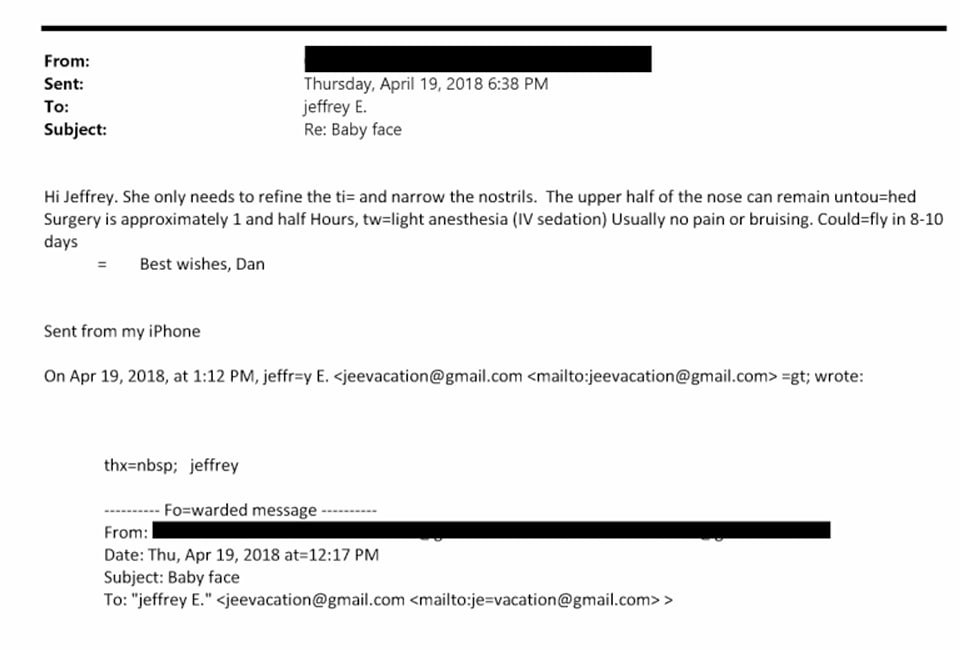
‘“Baby Face”’ Mention: A New Epstein Screenshot Raises Fresh Questions

A newly shared screenshot attributed to the “Epstein files” claims to show an exchange between Jeffrey Epstein and a contact identified only as “Dan,” discussing a young woman referred to as “Baby Face,” a cosmetic procedure, and subsequent air travel arrangements.

If authentic and in full context, the tone points to logistical coordination around a vulnerable person—adding to longstanding questions about who enabled Epstein’s broader network and how movements were arranged.

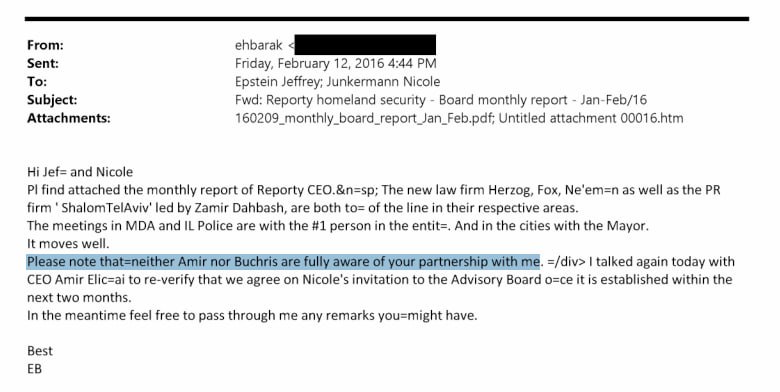
“Keep It Quiet”: Barak Email Sparks New Scrutiny Over Epstein’s Hidden Stake

A screenshot circulating from the latest DOJ Epstein document releases shows an email attributed to Ehud Barak (Feb. 12, 2016) telling Jeffrey Epstein and Nicole Junkermann: “Please note that neither Amir nor Buchris are fully aware of your partnership with me.” If the message is authentic and complete, it points to an effort to keep Epstein’s involvement in Reporty Homeland Security (later renamed Carbyne) from key company partners—raising governance questions about disclosure, reputational risk, and investor transparency.

The broader relationship itself is not new: reporting in Israel previously described Epstein as a significant financier behind Barak’s 2015 investment vehicle for Reporty/Carbyne, with Barak acknowledging a legal private-business relationship at the time. Separately, coverage of Carbyne’s board structure has long named Amir Elichai (CEO/co-founder) and Pinhas Buchris among senior figures—making the “not fully aware” line particularly explosive if verified. Recent reporting also frames Epstein’s Carbyne stake as quiet/opaque and potentially financially significant had it remained intact.

Bottom line: this isn’t proof of illegality on its own—but it’s a classic red-flag pattern in compliance terms: undisclosed beneficial involvement + politically exposed counterpart + later public scandal.

Israel Trade Gap Narrows Slightly: Imports and Exports Both Fall in January

Israel’s January trade data showed a cooling in both exports and imports, with the trade deficit narrowing modestly—an improvement driven more by lower imports than stronger external demand.

  • Exports (Jan): $5,105.0M vs $5,627.1M prior
  • Imports (Jan): $8,240.3M vs $8,803.8M prior
  • Trade Balance (Jan): -$3,135.3M vs -$3,176.7M prior (slightly smaller deficit)

Market takeaway:

A smaller deficit is directionally positive for the external balance, but the decline in exports suggests demand conditions may still be soft, while lower imports can reflect either weaker domestic demand or shifting purchasing patterns.

FX angle (ILS):

A narrowing trade deficit can be marginally supportive for the shekel, but near-term ILS moves are typically driven more by risk sentiment, geopolitical headlines, and relative rates than monthly trade prints.

Brazil Services Cool on the Month, Still Strong YoY: December Slips -0.4% but Annual Growth Jumps to 3.4%

Brazil’s services sector sent a mixed signal in December: activity contracted on the month, but accelerated on a year-on-year basis, keeping the broader demand backdrop constructive.

  • Service Sector Growth (MoM, Dec): -0.4% vs 0.0% expected
  • A downside surprise on the monthly momentum.
  • Service Sector Growth (YoY, Dec): +3.4% vs +2.7% prior
  • Annual growth re-accelerated, signaling services remain a key support pillar.

BRL angle:

The weaker MoM print is a short-term caution flag, but stronger YoY services growth can be BRL-supportive via growth. Still, the real’s main drivers remain rates/carry, fiscal headlines, and flows/commodities—so the market will watch whether this monthly dip is a one-off or the start of a trend.

Israel Consumer Confidence Jumps: Reuters/Ipsos PCSI Rises to 51.42 in February

Israel’s consumer mood improved sharply in February, with the Thomson Reuters/Ipsos Primary Consumer Sentiment Index (PCSI) jumping back above 50—often viewed as a psychological “better-than-neutral” zone.

  • Israel PCSI (Feb): 51.42 vs 47.74 prior

Market takeaway:

The jump suggests households are feeling materially less pessimistic, which can support near-term spending confidence if sustained.

FX angle (ILS):

Stronger consumer sentiment is mildly supportive for the shekel via the domestic-demand narrative, but near-term ILS pricing is still typically dominated by risk sentiment, geopolitical headlines, and relative rates.

South Africa: Consumer Mood Softens, Factory Output Still Contracting Despite Improvement

South Africa’s latest data showed a small dip in consumer sentiment, while manufacturing remained in contraction—though both the monthly and annual declines were less severe than previously.

  • Reuters/Ipsos PCSI (Feb): 48.57 vs 49.27 prior (sentiment eased)
  • Manufacturing Production (MoM, Dec): -1.2% vs -2.1% prior (less negative)
  • Manufacturing Production (YoY, Dec): -1.4% vs -2.0% prior (less negative)

Market takeaway:

The factory sector is still shrinking, but the pace of contraction moderated. Meanwhile, confidence cooled slightly—suggesting the recovery impulse is not yet broad-based.

ZAR angle:

Mixed signals are typically FX-neutral unless they shift the outlook for rates or the trade balance. ZAR will remain most sensitive to global risk sentiment, commodity prices, and domestic policy credibility.

Turkey’s FX Buffer Shrinks: Gross Reserves Drop to $78.87B, Net Metric Also Deteriorates

Turkey’s latest reserve update pointed to a weaker FX buffer, with gross reserves falling and the net reserve metric also slipping versus the prior read.

  • Turkish Gross FX Reserves: $78.87B vs $84.41B prior
  • Turkish Net FX Reserves: 91.26% vs 93.36% prior

Market takeaway:

A decline in reserves is typically read as reduced firepower for FX management and can raise sensitivity around liquidity, intervention, and external funding needs—especially when global USD conditions tighten.

TRY angle:

This is TRY-negative at the margin because shrinking reserves can undermine confidence in the currency’s buffer. That said, reserve moves can reflect seasonal flows, valuation effects, and tactical operations, so the market will watch whether the downtrend persists and how it interacts with inflation, real rates, and policy signaling.

More Others news

UK

UK Growth Miss: Q4 GDP Underwhelms as Momentum Stays Fragile

UK GDP data came in softer than expected, showing the economy ended the year with thin growth and fading momentum—a setup that keeps the expansion narrative cautious.

  • GDP (YoY, Q4): 1.0% vs 1.2% expected (prior 1.2%)
  • GDP (QoQ, Q4): 0.1% vs 0.2% expected (prior 0.1%)
  • GDP (MoM, Dec): 0.1% vs 0.1% expected (prior 0.2%)
  • Monthly GDP 3M/3M (Dec): 0.1% vs 0.2% expected (prior -0.1%)
  • GDP (YoY, Dec): 0.7% vs 1.1% expected (prior 1.2%)

GBP angle:

A broad miss across the quarterly and annual prints is typically GBP-negative at the margin, as it can reinforce a more dovish BoE tilt and keep UK assets sensitive to downside growth surprises—unless inflation data forces the Bank to stay restrictive.

UK Output Shock: December Industry Slumps as Services Flatline

UK activity data delivered a clear downside surprise in December, with industrial and manufacturing output contracting sharply and the services sector stalling—a combination that reinforces a fragile growth backdrop.

  • Industrial Production (MoM, Dec): -0.9% vs -0.1% expected (prior +1.3%)
  • Manufacturing Production (MoM, Dec): -0.5% vs -0.2% expected (prior +1.9%)
  • Manufacturing Production (YoY, Dec): +0.5% vs +1.8% expected (prior +1.3%)
  • Industrial Production (YoY, Dec): +0.5% vs +1.5% expected (prior +2.3%)
  • Index of Services: 0.0% vs +0.2% expected (prior +0.2%)

GBP angle:

This is broadly GBP-negative at the margin—weak output and flat services can strengthen the case for a more dovish BoE path if inflation allows, and keeps UK data sensitivity elevated in rates and FX.

UK Capex Shock: Business Investment Falls 2.7% in Q4, Trade Deficit Still Deep

UK data added another downside surprise, with business investment contracting sharply in Q4—a worrying signal for medium-term growth—while the trade gap remained large despite a slight improvement.

  • Business Investment (QoQ, Q4): -2.7% vs +0.4% expected (prior +1.6%)
  • Business Investment (YoY, Q4): +2.0% vs +2.5% expected
  • Trade Balance (Dec): -£22.72B vs -£22.30B expected (prior -£23.58B)
  • Trade Balance Non-EU (Dec): -£10.99B vs -£11.33B prior (slight improvement)

GBP angle:

The investment miss is typically GBP-negative because it hits the “growth quality” story—capex is a key driver of productivity and future output. A marginally better Non-EU balance helps, but the overall trade deficit remains a drag, keeping the pound sensitive to weak domestic data unless rate differentials do the heavy lifting.

UK Construction Disappoints Again: December Output Falls, Staying in Negative Territory

UK construction activity remained weak at year-end, with December output dropping on the month and annual growth staying negative, reinforcing the broader theme of fragile UK momentum.

  • Construction Output (MoM, Dec): -0.5% vs +0.5% expected (prior -0.8%)
  • Construction Output (YoY, Dec): -0.3% vs 0.0% expected (prior -0.3%)

The data show a sector that is still struggling to regain traction, even though the monthly pace improved from November’s deeper decline.

GBP angle:

Another downside surprise in activity is GBP-negative at the margin, adding to the case that growth is cooling and potentially supporting a more dovish BoE tilt if inflation permits.

UK Growth Tracker Flips Positive: NIESR Sees +0.3% in January After -0.1%

The UK’s high-frequency growth signal improved at the start of the year, with the NIESR Monthly GDP Tracker turning positive in January—an encouraging contrast after a negative prior read.

  • NIESR Monthly GDP Tracker (Jan): +0.3% vs -0.1% prior

Why it matters:

After a run of softer official UK activity prints, a rebound in the NIESR tracker suggests momentum may be stabilizing, though it’s an estimate and still needs confirmation from hard data.

GBP angle:

A stronger growth tracker is GBP-supportive at the margin, as it can temper dovish expectations for the BoE. Still, the pound’s follow-through will hinge on whether upcoming inflation and labor data validate a broader recovery signal.

UK Consumer Mood Softens: Reuters/Ipsos PCSI Edges Down to 49.0 in February

UK consumer sentiment slipped slightly in February, with the Thomson Reuters/Ipsos Primary Consumer Sentiment Index (PCSI) ticking lower and remaining just under the 50 mark.

  • UK PCSI (Feb): 49.0 vs 49.2 prior

Market takeaway:

The small decline suggests households are a touch more cautious, consistent with a fragile growth backdrop—though the move is modest rather than a sharp deterioration.

GBP angle:

This is usually low-impact for FX, but softer sentiment can be mildly GBP-negative at the margin if it reinforces weak consumption expectations alongside other soft UK data.

More UK news

USA

Fed “Hold” Bets Dominate: March Pause Priced Near 95%, April Still High

Rate expectations are leaning heavily toward a Federal Reserve pause. CME FedWatch shows markets pricing a 94.6% probability that the Fed keeps rates unchanged in March, with a still-elevated 78% probability of no change in April.

The setup reinforces a higher-for-longer baseline into early spring—typically supportive for front-end yields and potentially the USD, unless incoming inflation or labor data forces a fast repricing.

Treasury Curve Message: Bills Steady, 30-Year Yield Drops to 4.75%

U.S. Treasury auctions delivered a split but telling signal: ultra-short bills priced unchanged, while the long bond stopped at a lower yield, hinting at firmer demand for duration.

  • 4-Week Bill Auction: 3.630% (unchanged vs 3.630% prior)
  • 8-Week Bill Auction: 3.630% (unchanged vs 3.630% prior)
  • 30-Year Bond Auction: 4.750% vs 4.825% prior (lower yield = stronger demand)

Market takeaway:

The flat bill prints say front-end funding costs are stable, while the drop in the 30Y stop suggests duration demand is improving—often consistent with a market leaning toward slower growth and/or lower long-run inflation risk.

USD angle:

A lower 30Y yield can be mildly USD-negative at the margin via the long-end rates channel, but FX impact typically depends on whether the broader curve follows through—not just auction pricing.

U.S. Housing Stalls: Existing Home Sales Drop to 3.91M, Biggest Miss in Months

U.S. existing home sales fell sharply in January, missing expectations by a wide margin and signaling a cooling turn in housing turnover as affordability and mortgage-rate pressure lingered.

  • Existing Home Sales (Jan): 3.91M vs 4.16M expected, 4.27M prior
  • Existing Home Sales (MoM, Jan): -8.4% vs +4.4% prior

The data point to a material slowdown in transaction volume, a key real-economy channel that can spill into related spending (renovation, furnishings) if weakness persists.

USD angle:

Housing data is usually a second-tier FX driver, but a miss of this size can be mildly USD-negative if it reinforces a broader “growth cooling” narrative and nudges rate expectations lower.

U.S. Jobless Claims Edge Higher: Initial Claims Rise to 227K, Continuing Claims Climb

Weekly U.S. labor-market data came in slightly softer than expected, with both initial and continuing claims drifting higher—suggesting layoffs remain contained, but rehiring/placement may be a touch less smooth.

  • Initial Jobless Claims: 227K vs 222K expected, 232K prior
  • Continuing Claims: 1,862K vs 1,850K expected, 1,841K prior
  • 4-Week Average: 219.5K vs 212.5K prior (uptrend in the smoother)

What it means:

Initial claims are still in a range consistent with a resilient labor market, but the rise in continuing claims and the higher 4-week average hint at slightly less tight conditions—people may be taking longer to find a new job.

USD angle:

This is mildly USD-negative at the margin if it reinforces a cooling-growth/cooling-labor narrative, but it’s not a “breakdown” signal—claims remain far from recessionary levels.

More USA news

Europe

Eurozone Consumers Perk Up: France Leads a Broad February Improvement

A fresh batch of Thomson Reuters/Ipsos PCSI readings showed consumer sentiment improving across major Eurozone economies in February, with France posting the biggest uptick—suggesting households are feeling a bit less downbeat.

  • France PCSI (Feb): 41.15 vs 39.77 prior (largest improvement)
  • Germany PCSI (Feb): 47.07 vs 46.35 prior
  • Italy PCSI (Feb): 48.07 vs 47.69 prior
  • Spain PCSI (Feb): 49.99 vs 49.23 prior

EUR angle:

Broad-based improvements are mildly EUR-supportive via the growth narrative, but these levels remain relatively low, so the bigger swing factors for EUR are still ECB policy expectations, energy prices, and global risk sentiment. انرژی و فضای ریسک جهانی خواهند بود.

Germany External Surplus Widens: Current Account Rises to €16.1B in December

Germany’s external balance strengthened at year-end, with the current account surplus widening in December—signaling firmer net inflows from trade and income.

  • Germany Current Account (NSA, Dec): €16.1B vs €14.2B prior

A larger surplus typically reflects stronger net exports and/or improved income flows, reinforcing Germany’s role as a key surplus engine within the Eurozone.

EUR angle:

A wider German surplus is generally mildly EUR-supportive at the margin, but FX impact is usually limited unless the move reflects a broader Eurozone-wide improvement in external balances and coincides with supportive rate dynamics.

Italy’s Auctions Send Mixed Signal: 3Y Yield Drops, 7Y Edges Higher

Italy’s latest BTP sales showed a split outcome across the curve—shorter maturities priced at lower yields, while the 7-year segment nudged up slightly.

  • Italy 3-Year BTP Auction: 2.36% vs 2.48% prior (lower yield = stronger demand / easier pricing)
  • Italy 7-Year BTP Auction: 3.02% vs 3.00% prior (slightly higher yield = marginally weaker pricing)

Market takeaway:

Demand looks firmer in the front-to-belly, while the mild uptick at 7 years hints at a touch more term-premium sensitivity. Net-net, it’s not a stress signal—more a curve nuance.

EUR angle:

These moves are typically FX-neutral unless they materially shift Italy–Germany spreads. Traders will watch whether the mixed pricing shows up in secondary market spreads and ECB-rate expectations.

More Europe news

Commodities

South Africa Mining Rebounds: Gold Output Turns Positive as Total Mining Jumps 2.5%

South Africa’s mining sector delivered a clear upside swing in December, with gold production returning to growth and broader mining output accelerating after a prior contraction.

  • Gold Production (YoY, Dec): +1.1% vs -6.0% prior
  • A sharp turnaround, signaling improved gold-sector output versus last year.
  • Mining Production (Dec): +2.5% vs -2.4% prior
  • A strong rebound in overall mining activity.

ZAR/commodities angle:

A stronger mining print can be supportive for ZAR at the margin via growth and export volumes, especially if it feeds into a better trade balance. For gold markets, the message is more about supply normalization than a game-changing shock, but sustained production gains can add incremental supply pressure over time.

U.S. Gas Draw Smaller Than Expected: Storage Falls -249 Bcf, Easing Tightness

U.S. natural gas inventories posted a -249 Bcf withdrawal, coming in smaller than expectations and pointing to slightly less tightening in the near-term balance.

  • Natural Gas Storage: -249 Bcf vs -256 Bcf expected, -360 Bcf prior

Market takeaway:

A smaller draw is typically bearish/neutral for Henry Hub at the margin because it implies either softer demand (weather), stronger supply, or reduced net pulls versus the prior week’s much deeper withdrawal. The contrast with the previous -360 Bcf also signals that the intensity of winter-driven tightness may be moderating.

Natural gas angle:

Price reaction will depend on whether the market was positioned for a bigger withdrawal and how the next weather model runs evolve—storage is still falling, but not as aggressively as last week.

More Commodities news

Japan

Japan Producer Inflation Steadies: PPI Meets Forecast at 2.3% YoY, MoM Ticks Up to 0.2%

Japan’s producer-price data came in right on expectations, suggesting upstream inflation pressures are stable rather than re-accelerating.

  • PPI (MoM, Jan): +0.2% vs +0.2% expected, +0.1% prior
  • Monthly producer prices picked up slightly.
  • PPI (YoY, Jan): +2.3% vs +2.3% expected, +2.4% prior
  • Annual producer inflation eased marginally, but remains elevated.

JPY angle:

A “meet” print keeps the focus on the bigger drivers for yen: BoJ guidance and rate differentials. Stable PPI doesn’t add fresh inflation urgency, but it also doesn’t signal a sharp cooling that would weaken the case for gradual normalization.

More Japan news

Oceania

Australia Inflation Fears Re-Heat: MI Expectations Jump to 5.0% in February

Australia’s consumer inflation psychology ticked hotter, with the Melbourne Institute (MI) Inflation Expectations measure rising to 5.0% in February from 4.6% previously.

  • MI Inflation Expectations (Feb): 5.0% vs 4.6% prior

A move higher in expectations can matter because it risks embedding inflation persistence—potentially influencing wage-setting and pricing behavior, and complicating the disinflation path.

AUD angle:

Hotter inflation expectations are typically AUD-supportive via the rates channel, as they can reinforce a more hawkish RBA bias (or at least delay easing). The market will watch if hard inflation data confirms this re-heating signal.

More Oceania news

Cryptocurrency

Crypto Turns Choppy: Bitcoin Dips Under 67.2K While Solana, Doge, ADA Bounce

Crypto is trading mixed right now, with Bitcoin slipping while several majors and meme/alt names grind higher—a classic “BTC soft, alts rebid” tape.

  • Bitcoin (BTC): 67,176 (-0.53%)
  • Ethereum (ETH): 1,969.99 (-0.02%) (flat-ish)
  • XRP: 1.3820 (-0.07%)
  • Solana (SOL): 80.81 (+0.79%)
  • Dogecoin (DOGE): 0.092911 (+1.07%)
  • Cardano (ADA): 0.2626 (+1.63%)

What it signals: risk appetite is selective, with alt strength emerging even as BTC consolidates—suggesting traders are rotating rather than fully de-risking.

More Cryptocurrency news

Forex

Tears and a Resignation: Iranian Strongman Steps Down “For Masoud Zatparvar”

Iranian strongman Alireza Zarfchi said in an emotional video that he is resigning from all of his official roles in the sport, citing his positions as head of the national referees/coaches committee, chief referee of Mardan-e Ahanin (Iran’s “Iron Men”), and a national team coach.

Zarfchi said he is making the decision in memory of Masoud Zatparvar, a bodybuilding champion killed during the January protests, stressing: “He was a protester, not a terrorist.”

Iran International reported Zatparvar was killed on 18 Dey in Rasht by live ammunition, as economic and political tensions continue to spill into sport and public life.

More Forex news

Russia

Russia Reserves Drop Sharply: Central Bank Holdings Fall to $797.5B

Russia’s central bank reserve stockpile declined notably, with reported reserves falling to $797.5B from $826.8B previously.

  • Russia Central Bank Reserves (USD): $797.5B vs $826.8B prior

The move suggests a meaningful drawdown in headline reserve assets, which markets often interpret through the lens of intervention needs, valuation effects (FX/gold), and external payment flows.

RUB angle:

Lower reserves can be RUB-negative at the margin if it raises concerns about reduced buffers or heavier FX management. However, reserve changes can also reflect asset price moves and accounting rather than active intervention—so traders typically look for follow-up detail and whether the trend persists.

More Russia news

India

India Inflation Jumps: CPI Surges to 2.75% YoY in January, Above Expectations

India’s inflation print came in hotter than forecast, with CPI rising to 2.75% YoY in January—a sharp step up from December and a signal that price pressures are re-emerging.

  • CPI (YoY, Jan): 2.75% vs 2.40% expected, 1.33% prior

Market takeaway:

The jump suggests a re-acceleration in inflation momentum, which can complicate the near-term policy outlook—especially if the move is driven by sticky components (food/services) rather than one-off volatility.

INR angle:

Hotter inflation can be INR-supportive via the rates channel if it reduces the scope for easing and keeps real-rate support intact. However, if inflation is seen as a growth tax (especially via food), it can also dampen risk appetite—so the balance will hinge on what drove the upside surprise.

More India news