IFC Markets Live Quotes

Market news roundup: Friday, 13 February 2026

72 short market news items, grouped by 13 sections.

Iran

EASA Extends Aviation Warning: Airlines advised to avoid Iranian airspace until March 31

The European Union Aviation Safety Agency (EASA) has advised airlines from member states to avoid flying through Iranian airspace until March 31. Extending its previous warning, the agency cited the presence—and potential use—of a wide range of weapons and air-defense systems, combined with unpredictable state responses, as creating a high risk to civilian aircraft at all altitudes and flight levels.

The warning comes as global powers and regional governments remain concerned that a collapse in U.S.–Iran talks could escalate into military confrontation, potentially spreading beyond Iran’s borders.
Reza Pahlavi at Munich: “Be the Voice of People Inside Iran”

Reza Pahlavi told the Munich Security Conference that activists, journalists, political prisoners, civil society members—and those “with more freedom to speak”—should work to amplify the voice of people inside Iran and support them. He said the struggle for freedom starts this way and expressed hope that it will ultimately succeed inside Iran.

Pahlavi stressed that lasting change requires a shared commitment to democracy, the rule of law, and legal protections. He argued that only through these principles can discrimination be ended—whether against women, ethnic minorities, religious minorities, or any other group—adding that society has “learned the value” of these principles through hardship and now has the chance to put them into practice.

Graham in Munich: “Iranians Didn’t Protest for the Ayatollahs’ Nuclear Ambitions”

U.S. Republican Senator Lindsey Graham said at the Munich Security Conference that Iranians took to the streets not to advance the clerics’ nuclear agenda, but to demand a better life and a better Iran. His remarks framed the protests as driven by everyday aspirations rather than the regime’s strategic priorities.

Reza Pahlavi in Munich: Israel Can Be a Strategic Partner—Especially on Iran’s Water Crisis

Speaking at the Munich Security Conference, Reza Pahlavi addressed reported attacks and harassment against political opponents within the opposition, saying he cannot control millions of people or manage what is said on social media, nor can he always know who is “real” or not. He said he does not endorse such behavior and condemns it, adding that he has repeatedly taken a stand against actions he will not tolerate.

Pahlavi also argued that Iranians should show the world they are committed—unlike the current regime—to friendly relations with neighbors, stating: “We have no problem with Arabs. We also have no problem with Israelis.”

He went further, saying Israel could be an important strategic partner for Iran, not only politically but also in addressing Iran’s water crisis—noting that “without water, there is no life,” and claiming Israel has top expertise in this area.

“Freedom Has a Price”—Reza Pahlavi Says Iranians Are Ready to Pay It

At the Munich conference, Reza Pahlavi said freedom comes at a cost, adding that people must be prepared to “pay the price”—even to die for that goal. He argued that with pathways for reform and peaceful protest increasingly shut down, the struggle for freedom has become a necessity, and citizens are left with no option but to change their destiny.

Pahlavi’s Munich Roadmap: Republic or Constitutional Monarchy—Voters Decide

Speaking at the Munich Security Conference, Reza Pahlavi said the final political system of Iran—a republic or a constitutional monarchy—should be decided by the people, after a transition process that restores a functioning electoral pathway.

He argued that after a regime change, anyone not “tainted with the blood” of Iranians should be able to remain and have a role in the country’s future—potentially as part of the solution. He also claimed the Islamic Republic fuels division and delegitimization campaigns to prevent genuine opposition unity.

Pahlavi said the opposition should at minimum converge on four core principles: Iran’s territorial integrity, separation of religion and state, equality of all citizens before the law, and guaranteed individual freedoms—alongside the people’s right to determine their destiny.

On the transition mechanics, he outlined a transitional government tasked with enabling elections for a constituent assembly to draft a new constitution, followed by a referendum; if rejected, the text would be revised and re-submitted until a constitution is approved. The next step would be the first parliamentary and government elections in the future democratic order—at which point the transitional government dissolves and power is transferred to elected institutions, marking the end of the transition and the start of a new political chapter.

Pahlavi in Munich: “Unite for Freedom”—Says Transition Plan and ‘First 100 Days’ Roadmap Are Ready

At the Munich Security Conference, Reza Pahlavi said Iranians across the country have repeatedly called on him to support them, adding that he has accepted the leadership challenge of the transition period. He said a documented program has been prepared for both the pre-collapse phase and, especially, the post-regime transition, and that it is publicly available through the Iran Prosperity Project.

Pahlavi highlighted planning for the first 100 days after change, arguing it should be managed in a way that avoids repeating post-2003 Iraq dynamics—specifically warning against a de-Baathification-style approach.

He framed the immediate priority as freedom, urging broad unity to establish a secular democratic alternative to the current system, while arguing that political competition and differing electoral choices can come later. He said “secular democrats” across a wide spectrum—republicans, constitutionalists, socialists, conservatives, ethnic representatives, and religious minorities—can still align on shared principles in the present moment.

Cyrus Accord Pitch: Pahlavi Calls Iran–Israel Tie “Biblical,” Backs Strategic Partnership

Reza Pahlavi, Iran’s exiled crown prince, said Iran and Israel have “a biblical relationship” stretching back “25 centuries,” pointing to Cyrus the Great and the Jewish return from Babylon. He also argued that a future Iran could pursue a strategic partnership with Israel, highlighting Iran’s water crisis and saying Israeli scientists are among the best-placed experts to help address it.

Pahlavi to Amanpour: “In a Free Iran, Narges Mohammadi Could Run for PM or President”

At the Munich Security Conference, Reza Pahlavi—responding to Christiane Amanpour on online attacks targeting anti-regime figures such as Narges Mohammadi—said the demand is the release of all political prisoners, including Mohammadi. He added that in a free Iran, Mohammadi could legitimately run for prime minister or president.

Pahlavi also claimed part of the online harassment and character assassination is driven by the Islamic Republic to smear opposition figures, including himself. He said Iranians—whether republican or monarchist—share a belief in secular democracy, and he reiterated that he has consistently condemned online violence and harassment.

When Iran’s Internet Goes Dark, Freelancers Lose Their Lifeline

Freelancers across Iran say the January internet disruption cost them foreign contracts and slashed income, as weeks of unreliable connectivity blocked access to projects and delayed or prevented payments—deepening pressures in an economy already hit by global isolation.

Iran’s internet, which had been severely restricted for around 20 days during a crackdown on protests in January, has since been reconnected but remains unstable. Access to VPNs and anti-filtering tools is also described as much harder than before. One freelance electrical engineer, speaking anonymously for security reasons, said the connection is no longer reliable enough to accept projects with confidence, while money transfers have become so complex that “the losses outweigh the gains.” The problem is compounded by U.S. sanctions, which effectively shut many Iranian freelancers out of mainstream global platforms and payment systems—pushing them toward costly, risky workarounds.

Pahlavi at Munich: Calls for “Humanitarian Intervention” to Prevent More Deaths in Iran

Reza Pahlavi said at the Munich Security Conference that Iranians have been clear in asking the world for support, arguing many inside the country still hold on to promises that “support exists—hold on.” He said the most important conversation he is having is not with U.S. or European politicians, but with the people of Iran.

Citing political prisoners, civil society members, and those killed in street protests, Pahlavi said Iranians are asking the international community to intervene and are seeking a humanitarian intervention aimed at preventing the loss of more innocent lives.

“If It Were a Button, Washington Would Press It” — Sadjadpour Warns Post-Tehran Chaos Is the Real Fear

Speaking at the Munich Security Conference, Iran analyst Karim Sadjadpour said that if Washington—including Donald Trump—could remove the Islamic Republic “at the push of a button,” it would do so. He added that the main concern is the day-after scenario and the risk of Libya-style instability, even though Iran has important differences from those cases.

Graham at Munich: “Pahlavi Could Play a Prominent Role” as He Calls This a ‘Historic Window’ for Iran

U.S. Senator Lindsey Graham said at the Munich Security Conference that he expects Reza Pahlavi could have a prominent role in Iran’s future. He argued the best the West can do is give Iranians a chance at freedom—and if they fail, responsibility rests with them, but he prefers that risk over the continuation of the status quo.

Graham also criticized Europe and the U.S. for falling short in backing Iranians, saying broad mobilization seen on other issues has not translated into comparable support for Iran. He pointed to growing economic pressure—including constraints on Iran’s oil sales—as a factor weakening the regime, and suggested the Islamic Republic could ultimately collapse amid widespread public dissatisfaction.

He framed the moment as potentially decisive in a short timeframe, warning that peace with the current Iranian leadership is as difficult as dealing with past radically ideological regimes. While acknowledging the “day after” cannot be predicted with certainty, he argued change could open a new opportunity—whereas continued status quo risks long-term regional instability.

Graham in Munich: “I Fully Support Regime Change in Iran” — Calls Moment a Generational Turning Point

U.S. Republican Senator Lindsey Graham said at the Munich Security Conference that he fully supports regime change in Iran, framing it as standing with the Iranian people. He cited Donald Trump’s past messaging to protesters—urging them to “keep protesting” and pointing to the need for “new leadership in Iran”—as signals of alignment with demonstrators seeking an end to repression and the start of a new chapter.

Graham warned that backing away from this path could echo past U.S. foreign-policy mistakes and carry long-term consequences if promises to Iranians are not delivered. He argued that a change in Iran would weaken key regional armed groups—Hamas, Hezbollah, and the Houthis—by cutting off their main support, potentially reshaping the regional order. He described the current moment as one of the most sensitive historical inflection points, with outcomes that could define the Middle East for generations, for better or worse.

Pahlavi: “Neither Gaza Nor Lebanon” Slogan Shows Iranians Reject Regime’s Regional Agenda

Reza Pahlavi said the long-running street slogan “Neither Gaza, nor Lebanon—my life for Iran” carries a clear political message: ordinary Iranians do not support the Islamic Republic’s regional policies. He argued the chant explicitly signals “not Hamas, not Hezbollah,” framing it as a public rejection of the regime’s external priorities.

Pahlavi added that this reflects a deeper strand of Iranian political consciousness: separating the nation from the government—drawing a line between what people want and what the state pursues abroad.

Silent Champions: Khatoun Bam’s Trophy Stand Becomes a Protest Statement

Mohammad Taghavi said on Iran International’s Hattrick that Khatoun Bam women’s team paid tribute to the “fallen of Iran’s national revolution” by not celebrating during the Iranian Women’s Premier League trophy ceremony. He praised their decision to stand quiet and composed, even as the host tried to excite the players, calling their silence a source of pride.

Taghavi added he believes these women—through their discipline and courage—are the kind of people who will help shape Iran’s future society.

Ex-Iranian Diplomat Warns: U.S. Could “Use Talks to Buy Time” for a Broader Strike

Abbas Mousavi, a former official at Iran’s Foreign Ministry, said it is possible the United States could use negotiations as a pretext to buy time and prepare conditions for a wider military attack, potentially in coordination with Israel. His comments frame diplomacy as a tactical tool rather than a pathway to de-escalation.

More Iran news

Political

Bloomberg: Bilal Erdoğan’s Rising Profile Fuels Succession Talk

A Bloomberg report says President Recep Tayyip Erdoğan is increasingly positioning his 44-year-old son, Bilal Erdoğan, as a more prominent political figure—joining international trips, reportedly taking part in senior personnel decisions, and building a loyal network inside the ruling AKP. The report frames this as part of growing behind-the-scenes discussion about who comes after Erdoğan, even as succession remains a sensitive topic in Turkish politics.

E-Bike Strike in Central Gaza: Report names PIJ commander

Israel’s Yediot/ynet reports an Israeli strike on a motorized/electric bike in central Gaza killed a man it identified as a Palestinian Islamic Jihad (PIJ) commander. Other reporting on the incident says the strike hit a bike traveling on Salah al-Din Road near al-Musaddar, east of Deir al-Balah, with additional casualties reported locally.

The IDF has acknowledged carrying out strikes across Gaza in recent days, describing them as targeting militants in response to attacks on Israeli forces, though initial Israeli statements referenced Hamas targets rather than PIJ.

World’s Largest Carrier Moves Toward Middle East as Iran Pressure Rises

U.S. media and wire reports say the United States is deploying the USS Gerald R. Ford—the world’s largest aircraft carrier—from the Caribbean toward the Middle East, adding a second carrier to the region alongside the USS Abraham Lincoln. The move comes amid heightened U.S.–Iran tensions and renewed talk of a possible deal, while the White House and Pentagon have not provided immediate official comment.

Some tracking and OSINT commentary suggests the Ford’s transit could take around ~10 days depending on routing and operational tempo, but official arrival timing has not been publicly confirmed in the main statements carried by Reuters/AP.

Carrier Leverage: Trump Ties Second U.S. Flattop to an Iran Deal

U.S. President Donald Trump told reporters Friday that a second U.S. aircraft carrier will be sent to the Middle East, saying the deployment would be necessary “if we don’t make a deal with Tehran.”

Trump added that if a deal is reached, the carrier “will be leaving very soon,” while noting the U.S. already has one carrier in the region that has just arrived and can scale up to “a very big force” if needed.

Media reports, including early reporting cited by multiple outlets, identify the additional deployment as the USS Gerald R. Ford—often described as the world’s largest aircraft carrier—signaling a sharp increase in military pressure alongside ongoing diplomacy over Iran’s nuclear program.

Grossi: Iran’s Nuclear File “Fundamentally Changed” After 12-Day War—Inspections Still Possible, But Harder

IAEA Director General Rafael Grossi said at the Munich Security Conference that designing a verification and inspection framework for Iran’s nuclear program is technically possible and politically achievable, but warned the 12-day war has radically altered the overall nuclear situation—reshaping the baseline for any future deal.

His comments come as the agency continues pressing for meaningful access and accounting related to Iran’s nuclear activities, with Grossi repeatedly warning that prolonged standoffs over inspections cannot persist indefinitely.

Graham at Munich: “Negotiations With Tehran Won’t Work,” Warns of Ideological Nuclear Threat

U.S. Republican Senator Lindsey Graham told the Munich Security Conference that Iran’s leadership and inner circle—not the Iranian people—are “religious fundamentalists,” arguing their worldview is about religious supremacy. He said negotiating with such a regime is futile.

Graham also claimed the Islamic Republic has “American blood on its hands,” acts as a driver of regional instability, and warned that if it ever obtained a nuclear weapon, it would use it to advance religious-ideological goals—specifically citing threats against Israel and confrontation with the United States.

Metsola Draws a Red Line on Iran: “List the IRGC” and Don’t Let Hamas/Hezbollah Rebuild

At the Munich Security Conference, European Parliament President Roberta Metsola said Europe is facing a regime that represses its own people and destabilizes the region, calling it a red line the EU should not retreat from. She warned Europe must not allow Hezbollah or Hamas to regain strength, arguing that outcome would also be “very dangerous” for the EU.

Metsola added that if Europe is serious about standing for freedom in Iran, it should start by placing the Islamic Revolutionary Guard Corps (IRGC) on the EU’s terrorist list—and said achieving unanimity among all 27 member states was essential and has been secured. Recent reporting indicates the EU’s 27 members have backed the designation.

Trump on Iran: “Rebuilt Power” Meets Carrier Pressure as He Pushes for a Deal

U.S. President Donald Trump said Friday (Feb. 13) the U.S. is moving an additional aircraft carrier toward the Middle East, framing it as leverage “in case we don’t make a deal” with Tehran.

Trump argued Washington is now operating from a stronger position, saying he rebuilt the U.S. military and is “making it even stronger,” and pointed back to Operation “Midnight Hammer” as a benchmark for what happens when diplomacy fails.

Munich Sideline Diplomacy: Pahlavi and Zelensky Link Two Freedom Struggles

Reza Pahlavi said on X that he was pleased to meet Ukrainian President Volodymyr Zelensky on the sidelines of the Munich Security Conference, arguing they represent “two nations” confronting threats to freedom and national sovereignty.

He drew a contrast between the two challenges—saying the threat to Ukraine is external, while the threat to Iran is internal—and added that the shared reality, along with the “exceptional courage” of both peoples, ties the two nations together.

Pahlavi said they discussed mutual support for efforts to liberate their countries and potential practical cooperation in the broader fight for freedom, adding he hopes to continue cooperation with Zelensky and thanked him for supporting the Iranian people.

Trump Presses Zelensky: “Get Moving” on a Peace Deal — Midterms Add Political Clock

President Donald Trump urged Ukraine’s Volodymyr Zelensky to move quickly toward a peace agreement, saying “Russia wants to make a deal” and warning Zelensky could “miss a great opportunity” if he doesn’t act.

The push comes as U.S.-brokered negotiations are set to continue, with a new round of talks in Geneva next week, while earlier reporting suggested U.S. and Ukrainian negotiators discussed an ambitious March target for a deal—though timelines remain uncertain.

Speculation circulating online claims Zelensky may try to delay major concessions until after the U.S. midterm elections. Reuters, citing a New York Times report, says midterms may be influencing Washington’s urgency—while noting the claims were not independently verified. Meanwhile, Zelensky has publicly argued Russia is not serious about peace and has linked any elections to a ceasefire.

Kyiv’s Red Lines: Ukraine MP Says Russia Demands Land, Language—and the Church

Ukrainian lawmaker Roman Kostenko (Holos party), secretary of the Verkhovna Rada’s national security/defense committee, said ongoing negotiations with Moscow remain stalled because Russia is pushing terms Kyiv considers unacceptable starting with the surrender of territories.

Kostenko said Russia is also insisting on issues it treats as “principled,” including the Russian language and the church, arguing that when Moscow brings demands and Kyiv lacks strong counterarguments, talks become fruitless and Ukraine is effectively forced to “be present” in the process.

He stressed he wants peace but warned that “peace at any cost” is a trap—and that any settlement cannot come at the expense of Ukrainians living in occupied territory.

Geneva Talks Go Live: Medinsky Returns as Kremlin Floats an Economic “After Deal” Track

A new round of trilateral talks involving Russia, the U.S., and Ukraine is scheduled for Geneva on Feb. 17–18, according to the Kremlin, with Vladimir Medinsky set to lead the Russian delegation.

Kremlin spokesman Dmitry Peskov said Moscow and Washington are also discussing potential trade and economic cooperation, but suggested concrete details are unlikely before an Ukraine settlement is reached.

Peskov added that Russia has not finalized its position on participating in a proposed “Peace Council/Board of Peace,” saying the Foreign Ministry is still working on the issue.

On currency policy, Peskov said Russia has not abandoned the dollar, arguing it was the U.S. that restricted its use in transactions.

Weeks-Long War Plan: Pentagon Preps for Sustained Iran Operations if Trump Orders Strike

The U.S. military is preparing contingency plans for sustained, weeks-long operations against Iran if President Donald Trump orders an attack, two U.S. officials told Reuters on Feb. 13. The officials, speaking anonymously due to the sensitivity of the planning, said the scenario could evolve into a more serious conflict than previously seen between the two countries.

The disclosure raises the stakes for the U.S.–Iran diplomacy now underway, signaling that Washington is weighing outcomes that go beyond a limited action and could extend into prolonged operations.

Talks or Time-Buying? Iran Negotiations Look Stuck as U.S. War Planning Goes “Weeks-Long”

Despite public messaging that diplomacy is still on track, the fault lines look hard: Iran’s FM Abbas Araqchi has reiterated Tehran won’t accept “zero enrichment” and says Iran’s missile program is not on the agenda—positions that keep the talks structurally constrained.

At the same time, Reuters reports the U.S. military is preparing for the possibility of sustained, weeks-long operations against Iran if President Donald Trump orders a strike—an escalation posture that raises the stakes for the negotiations now underway.

The “deadline” question is also back in focus. In June 2025, Trump publicly said he had given Iran a 60-day ultimatum that expired without a deal—days before major strikes followed. Some U.S. outlets (including the Wall Street Journal) have recently described the current track as fragile and driven by efforts to avert escalation, but no new, specific ultimatum has been officially disclosed.

More Political news

Others

Classified Bets on Polymarket: IDF reservist, civilian charged — Ynet

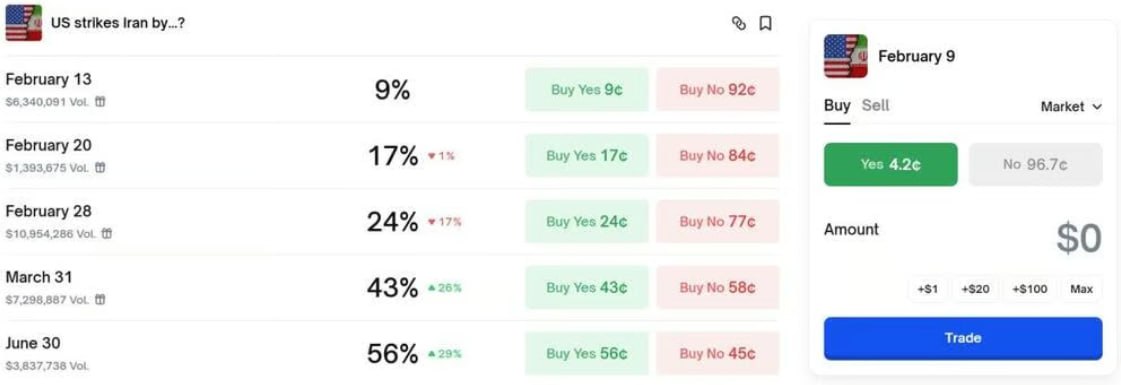
Israeli outlet Ynet reports that an IDF reservist and a civilian have been charged for allegedly using classified military information to place bets on Polymarket tied to military operations. The case spotlights how prediction markets can become targets for insider intelligence, raising fresh questions around operational security, market integrity, and platform monitoring. The screenshot circulating shows a contract on “US strikes Iran by…?” with shifting odds across dates—illustrating how sensitive, nonpublic info could translate into tradable probability.

Korea’s Trade Price Squeeze: Import Prices Flip Negative While Export Prices Surge to 7.8%

South Korea’s January price data delivered a favorable terms-of-trade shift: import prices fell into negative territory, while **export prices accelerated sharply—often a margin tailwind for exporters.

  • Import Price Index (YoY, Jan): -1.2% vs +0.5% prior
  • A notable swing lower, implying cheaper imported inputs and reduced imported inflation pressure.
  • Export Price Index (YoY, Jan): +7.8% vs +5.0% prior
  • A strong acceleration, suggesting better pricing power for outbound goods (often linked to tech/semis and FX effects).

KRW / macro angle:

This mix can be supportive for KRW at the margin via improved external pricing dynamics, while also easing the inflation impulse from imports. The key watch is whether the export-price strength reflects real demand/pricing (bullish) or mainly FX/commodity base effects (less durable).

Korea Consumer Sentiment Improves: Reuters/Ipsos PCSI Rises to 45.89 in February

South Korea’s consumer mood brightened in February, with the Thomson Reuters/Ipsos Primary Consumer Sentiment Index (PCSI) rising to 45.89 from 44.81 previously—an improvement, though still below the 50 threshold.

  • South Korea PCSI (Feb): 45.89 vs 44.81 prior

Market takeaway:

The uptick suggests households are less pessimistic, but sentiment remains subdued, implying confidence is recovering gradually rather than snapping back.

KRW angle:

This is typically a secondary FX input. A firmer confidence read can be marginally KRW-supportive via the growth narrative, but KRW is more directly driven by global risk sentiment, USD moves, and the semiconductor cycle.

Korea Liquidity Builds: M2 Growth Accelerates to 7.3%, M3 Stock Climbs Above ₩6,087T

South Korea’s latest money data points to easier domestic liquidity, with broad money growth accelerating and the headline M3 stock rising further.

  • M2 Money Supply (Dec, YoY): 7.30% vs 6.80% prior
  • Broad money growth picked up, suggesting stronger credit/deposit momentum.
  • M3 Money Supply (Dec): ₩6,087.0T vs ₩5,999.2T prior
  • The total stock of broad liquidity rose, reinforcing a looser financial backdrop.

Market takeaway:

Faster M2 growth and a rising M3 base can support activity and risk appetite domestically, but they can also keep an eye on future inflation/asset-price pressures if liquidity continues to build.

KRW angle:

This is usually a second-tier driver for FX. If rising liquidity is read as supportive for growth without stoking inflation, it can be marginally KRW-positive. In practice, KRW is still more sensitive to global USD moves and the semiconductor/export cycle.

“Macron’s Boyfriend” Claim Surfaces in Epstein-File Screenshots — France Says It’s a Bot-Driven Smear

A new snippet circulating online alleges Jeffrey Epstein wrote to a contact that he’d been shown a photo of French President Emmanuel Macron’s “boyfriend,” followed by a quip about “hypocrisy.” The claim is being amplified through screenshots and reposts, but its provenance remains murky and—critically—Paris says doctored Epstein-related material is already being used in a coordinated foreign influence push.

French officials have publicly warned that a pro-Russia disinformation operation pushed fabricated “DOJ email” screenshots to falsely link Macron to Epstein, using a fake site and social amplification.

Separately, the real DOJ dump has triggered a genuine French legal response: France has alerted prosecutors over a diplomat accused of sharing confidential UN material with Epstein. That is a verifiable, document-linked thread—unlike viral “boyfriend” claims that currently sit in the gray zone of unauthenticated excerpts.

“Two-Legged Excursions” in Peru: Maxwell Emails Reignite Prince Andrew Scrutiny

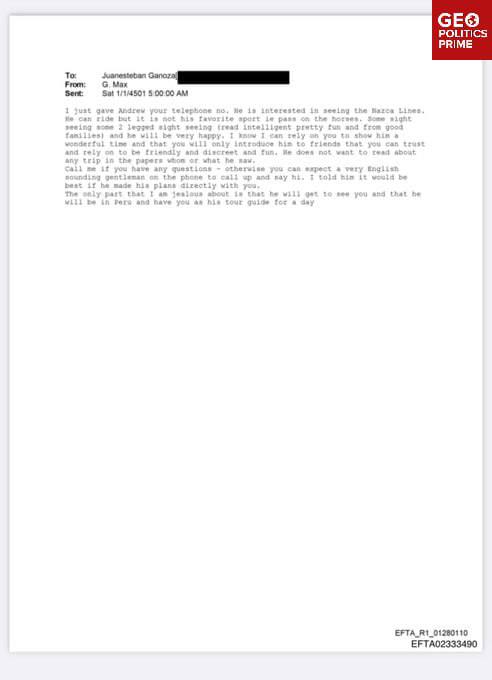
Newly released U.S. Justice Department documents include email exchanges in which Ghislaine Maxwell appears to help plan a Peru trip for a correspondent described as “The Invisible Man”—a figure several outlets say is believed to be Prince Andrew, though the identity is not confirmed in the documents themselves.

In the Peru-related thread, Maxwell uses coded phrasing about arranging “two-legged sightseeing / bipedal excursions”—a euphemism described in reporting as referring to female companionship—and stresses discretion, including a warning against media leaks.

Bottom line: these are documented communications now in the public record, but calendar/email presence ≠ proof of criminal acts; the significance hinges on verification, context, and what investigators can corroborate beyond the excerpts.

Zorro Ranch Allegations Force New Mexico’s Hand

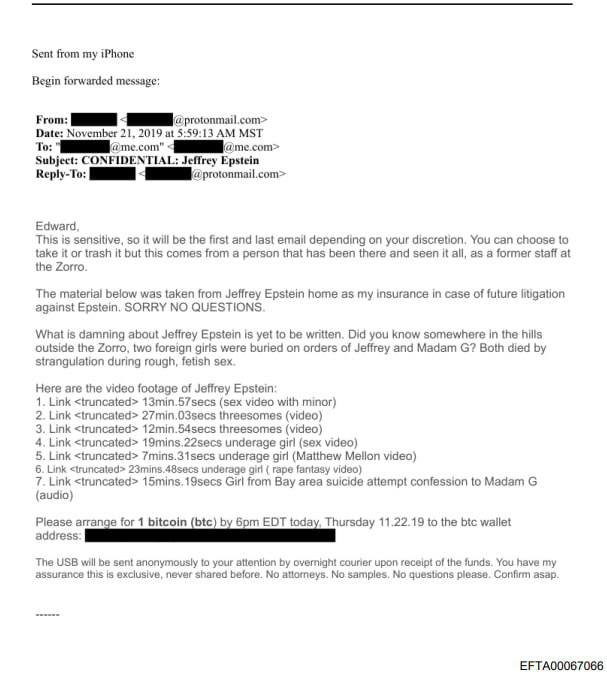
New Mexico’s Commissioner of Public Lands Stephanie Garcia Richard has formally urged state and federal law enforcement to investigate a disturbing allegation tied to Jeffrey Epstein’s former Zorro Ranch: an anonymous 2019 email (now referenced in the latest DOJ document releases) claimed that two girls were buried in nearby hills.

State Attorney General Raúl Torrez’s office responded that the claims currently appear unsubstantiated and stem from an anonymous source, but said investigators will seek the original, unredacted emails and any underlying files to assess credibility and determine next steps.

BBC Tightens the Belt: 10% Cut Plan Puts Jobs on the Line as World Service Hits a March Funding Cliff

The BBC is preparing a new cost-cutting drive of roughly 10% over the next three years—equating to hundreds of millions of pounds (with UK media estimates running as high as ~£600m)—with job losses and programming cuts now widely expected.

The move comes even as the UK government has confirmed the annual TV licence fee will rise to £180 from 1 April 2026 (+£5.50), underscoring the scale of the broadcaster’s structural squeeze as viewing habits and licence-fee compliance shift.

Separately, the BBC World Service is facing an immediate funding crunch: Director General Tim Davie has warned the current funding arrangement with the UK Foreign, Commonwealth and Development Office expires at the end of March 2026, with no future deal yet in place.

All of this is playing out while the government runs a formal BBC Charter Review consultation (open until 10 March 2026) and as the BBC continues to fight a $10bn defamation lawsuit filed by Donald Trump linked to a Panorama editing dispute.  

Turkey Macro Warning: Inflation Expectations Rise as Current Account Deficit Widens

Turkey’s latest macro reads delivered a stagflation-leaning mix: year-end inflation expectations climbed, while the current account deficit deteriorated more than forecast.

  • End-Year CPI Forecast (Feb): 24.11% vs 23.23% prior (inflation expectations up)
  • Current Account (Dec): -$7.25B vs -$5.20B expected, -$3.74B prior (deficit wider)

Market takeaway:

Higher inflation expectations + a wider external deficit is a double headwind—it raises questions around real-rate credibility and external financing needs, especially if global USD conditions tighten.

TRY angle:

This combination is typically TRY-negative at the margin, as it can pressure the currency through both the inflation and balance-of-payments channels unless policy remains convincingly restrictive and reserves/flows stabilize.

Brazil Retail Wobbles: December Sales Fall -0.4% MoM, Annual Growth Misses

Brazil’s December retail report came in softer than expected, with sales contracting on the month and the YoY print underwhelming—suggesting demand cooled into year-end.

  • Retail Sales (YoY, Dec): +2.3% vs +2.5% expected, +1.5% prior
  • Retail Sales (MoM, Dec): -0.4% vs -0.2% expected, +1.0% prior (clear downside surprise)

Market takeaway:

The negative MoM print signals a loss of momentum, even though the YoY rate improved versus the prior month. It’s a reminder that the consumer story is not linear and remains sensitive to credit conditions and real income.

BRL angle:

This is mildly BRL-negative at the margin via the growth channel, but FX will still be driven more by rates/carry, fiscal headlines, and commodity flows. If weak consumption persists, it strengthens the case for a more dovish policy path.

More Others news

Equities

Ford (F) — EPS Miss, Revenue Beat; Stock Steady

Ford (F) reported EPS of $0.13 vs $0.18 expected (-27.78% surprise) but revenue of $45.9B vs $44.2B expected (+3.85% surprise). Shares were flat (0.00%) at $13.59 and +1.70% in extended hours (to $13.80), with market cap around $54.19B—investor focus typically shifts to margin guidance, pricing, and EV/ICE mix.

L’Oréal Tops Revenue Forecast, EPS Not Shown; Shares Slide (LRLCY)

L’Oréal ADR (LRLCY) reported revenue of $13.36B vs $13.21B expected (+1.14% surprise). EPS was not displayed in the data shown. Shares were down ~7.30% (last $86.72), with a market cap around $248.09B—so the market’s next focus typically shifts to forward guidance, organic growth trends, and regional/category mix.

Siemens Delivers a Strong Double-Beat (SIEGY)

Siemens ADR (SIEGY) reported EPS of $1.53 vs $1.27 expected (+20.47% surprise) and revenue of $22.75B vs $22.18B expected (+2.57% surprise), beating on both lines. Shares were up ~1.41% (last $154.68) and flat in extended hours (0.00%), with a market cap near $236.73B—attention now typically turns to guidance, order momentum, and margin outlook.

PG&E Misses EPS and Revenue, Despite a Higher Close (PCG)

PG&E (PCG) reported EPS of $0.36 vs $0.37 expected (-2.70% surprise) and revenue of $6.8B vs $7.1B expected (-4.23% surprise), missing on both earnings and sales. Shares were up ~2.69% (last $17.56) but down ~0.34% in extended hours (to $17.50), with a market cap near $38.6B—so the market’s next focus typically shifts to guidance, regulatory updates, and cost/capex trajectory.

Coinbase Posts a Sharp EPS Miss and Revenue Miss; Stock Hit (COIN)

Coinbase (COIN) reported EPS of $0.66 vs $1.05 expected (-37.14% surprise) and revenue of $1.78B vs $1.85B expected (-3.78% surprise), missing on both lines. Shares were down ~7.90% (last $141.09) but up ~1.32% in extended hours (to $142.95), with a market cap near $38.05B—the market’s next focus typically shifts to outlook, trading activity trends, and margin/cost commentary.

Expedia Beats on EPS and Revenue, but Shares Fall After Hours (EXPE)

Expedia (EXPE) reported EPS of $3.78 vs $3.25 expected (+16.31% surprise) and revenue of $3.55B vs $3.41B expected (+4.11% surprise), beating on both lines. Shares were down ~2.72% (last $227.24) and down ~5.67% in extended hours (to $214.35), with a market cap near $27.84B—suggesting investors are weighing forward guidance, booking trends, and margin outlook more than the headline beat.

Wall Street Sells Off: Nasdaq Leads a Broad Risk-Off Close

U.S. equities closed sharply lower on Thursday, with tech-heavy Nasdaq taking the biggest hit as risk appetite faded across the board.

  • Dow: 49,451.98 (-669.42 | -1.34%)
  • S&P 500: 6,832.76 (-108.71 | -1.57%)
  • Nasdaq: 22,597.15 (-469.32 | -2.03%)

The takeaway: a broad-based de-risking session, with growth/tech under the most pressure—often a sign that markets are reacting to tighter financial conditions, rates sensitivity, or macro headline risk.

Europe Ends Lower: Broad Risk-Off Close Despite France Holding Up

European equities mostly closed in the red on Thursday, with UK and Spain among the laggards. France’s CAC 40 was the standout gainer, but it wasn’t enough to lift the broader region.

  • FTSE 100: 10,402.44 (-0.67%)
  • DAX: 24,852.69 (-0.01%) (flat-ish)
  • CAC 40: 8,340.56 (+0.33%) (outperformer)
  • FTSE MIB: 46,222.95 (-0.62%)
  • IBEX 35: 17,896.90 (-0.82%)
  • Stoxx 600: 618.52 (-0.49%)

Tape read: a broad de-risking tone across Europe, with strength concentrated in France while the wider market weakened.

Asia Turns Risk-Off Friday: Broad Selloff Hits Stocks Across the Region

Asian equities opened Friday in a sharp, broad-based decline, with every major index in the red—signaling a clear risk-off tone to end the week.

  • Asia Dow: 5,652.72 (-2.24%)
  • Nikkei 225: 56,941.97 (-1.21%)
  • Hang Seng: 26,574.54 (-1.69%)
  • Shanghai: 4,082.07 (-1.26%)
  • Sensex: 82,839.50 (-1.00%)
  • Singapore: 4,937.56 (-1.58%)

Tape read: the selloff is region-wide, not isolated—often consistent with global risk de-risking (rates/FX shocks, macro surprises, or headline-driven risk aversion). The biggest hit is in Asia Dow, with Hong Kong and Singapore also notably weak.

More Equities news

Oceania

New Zealand PMI Stays Expansionary: January Holds at 55.2 Despite a Small Dip

New Zealand’s manufacturing pulse remained solidly in growth territory, even as momentum eased slightly.

  • Business NZ PMI (Jan): 55.2 vs 56.1 prior

A PMI above 50 signals expansion, so 55.2 still points to healthy activity, with the modest pullback suggesting growth is continuing but not accelerating.

NZD angle:

An expansionary PMI is generally NZD-supportive via growth sentiment, though FX reaction is often muted unless the move materially shifts expectations for RBNZ policy or aligns with broader risk-on/risk-off flows.

New Zealand Inflows Strengthen: Long-Term Migration Jumps, Visitor Growth Slows but Arrivals Rise

New Zealand’s December migration and tourism data showed stronger long-term inflows, while external migration growth cooled slightly—yet visitor arrivals continued to improve on the month.

  • Permanent/Long-Term Migration (Dec): 2,870 vs 1,560 prior (sharp jump)
  • External Migration & Visitors (Dec): 7.00% vs 8.20% prior (growth rate eased)
  • Visitor Arrivals (MoM, Dec): +1.7% vs +0.8% prior (momentum improved)

Market takeaway:

The surge in long-term migration can support labor supply and domestic demand over time. Meanwhile, tourism momentum looks steady-to-improving on the monthly arrivals print, even as the broader growth rate cooled.

NZD angle:

This mix is mildly NZD-supportive through the growth narrative, but NZD typically reacts more to RBNZ policy pricing, risk sentiment, and commodity/China signals than migration data.

New Zealand Inflation Expectations Edge Up: 2.4% QoQ Keeps Price Pressures Sticky

New Zealand’s inflation expectations ticked slightly higher, reinforcing the idea that disinflation is gradual rather than decisive.

  • Inflation Expectations (QoQ): 2.4% vs 2.3% prior

Market takeaway:

A small rise suggests expectations remain sticky, which can complicate the path to easier policy if the Reserve Bank wants to avoid re-anchoring risks.

NZD angle:

Firmer inflation expectations are typically NZD-supportive via the rates channel, as they can keep RBNZ hawkish or delay rate cuts—though FX reaction depends on how markets were positioned and what the next CPI print shows.

Australia Consumer Mood Softens: Reuters/Ipsos PCSI Falls to 52.46 in February

Australia’s consumer sentiment eased in February, with the Thomson Reuters/Ipsos Primary Consumer Sentiment Index (PCSI) slipping while remaining above the 50 threshold.

  • Australia PCSI (Feb): 52.46 vs 53.89 prior

Market takeaway:

Confidence is still net-positive, but the dip suggests households are turning a bit more cautious—consistent with cost-of-living and rate sensitivity.

AUD angle:

This is typically a second-tier FX input. Softer sentiment can be mildly AUD-negative via growth expectations, but the Aussie remains more sensitive to RBA pricing, risk sentiment, and China/commodities than this survey alone.

More Oceania news

Europe

Germany Wholesale Inflation Re-Heats: WPI Jumps 0.9% MoM, Signaling Upstream Pressure

Germany’s Wholesale Price Index (WPI) surprised sharply to the upside in January, pointing to renewed upstream price pressure.

  • German WPI (MoM, Jan): +0.9% vs +0.1% expected, -0.2% prior (big upside surprise)
  • German WPI (YoY, Jan): +1.2% (around prior levels)

Market takeaway:

The monthly surge suggests pipeline inflation picked up at the start of the year. If it persists, it can feed into producer and consumer prices with a lag—though one month doesn’t make a trend.

EUR / rates angle:

A hot WPI print is marginally EUR-supportive via the inflation narrative (less room for aggressive easing), but markets will mainly wait for Eurozone CPI and wage signals before repricing the ECB path.

Swiss Inflation Stays Ultra-Low: CPI Dips -0.1% MoM, Holds at 0.1% YoY

Switzerland’s January inflation print reinforced the country’s low-inflation regime, with headline prices slipping slightly on the month while annual inflation stayed barely above zero.

  • CPI (MoM, Jan): -0.1% vs 0.0% expected, 0.0% prior (small downside surprise)
  • CPI (YoY, Jan): +0.1% vs +0.1% expected, +0.1% prior (unchanged)

Market takeaway:

This keeps Switzerland firmly in near-zero inflation, strengthening the case that the SNB has ample room to stay dovish (or consider further easing if needed), especially if CHF strength or weak external demand persists.

CHF angle:

Low inflation is typically CHF-negative at the margin via the rates channel (lower yields/less tightening pressure). But CHF can still behave as a safe-haven, so risk sentiment often dominates.

Eurozone Holds Growth, Trade Surplus Widens: Q4 GDP Steady as Exports Improve

Eurozone data came in steady on growth and better on trade, reinforcing a picture of modest expansion with an improving external balance.

  • GDP (YoY, Q4 – prelim): 1.3% vs 1.3% expected, 1.4% prior (in line, slightly softer vs prior)
  • GDP (QoQ, Q4 – prelim): 0.3% vs 0.3% expected, 0.3% prior (steady)
  • Trade Balance (Dec): €12.6B vs €11.8B expected, €9.3B prior (surplus wider)

Market takeaway:

Growth isn’t accelerating, but it’s holding up, while the wider trade surplus suggests external demand and/or import dynamics improved into year-end—supportive for the region’s macro stability.

EUR angle:

A stronger trade surplus is mildly EUR-supportive at the margin, but with GDP flat vs expectations, the bigger driver remains ECB rate pricing and how inflation evolves.

Eurozone Jobs Hold Firm: Employment Growth Beats as Q4 Hiring Stays Resilient

Eurozone labor data stayed constructive in Q4, with employment growth coming in stronger than expected—a sign the jobs market is still providing a cushion even as overall growth remains modest.

  • Employment Change (QoQ, Q4 prelim): +0.2% vs +0.1% expected (prior +0.2%)
  • Employment Change (YoY, Q4 prelim): +0.7% vs +0.6% expected (prior +0.6%)
  • Employment Level (Q4 prelim): 172.5166M vs 172.2104M prior

EUR angle: steady-to-firmer employment is mildly EUR-supportive through the growth narrative and can make the ECB more comfortable staying patient—though inflation remains the main trigger for repricing.

More Europe news

USA

Fed Liquidity Ticks Up: Balance Sheet Rises to $6.622T, Reserve Balances Climb

The latest weekly Fed plumbing data showed a modest increase in system liquidity, with both the headline balance sheet and reserve balances moving higher.

  • Federal Reserve Balance Sheet: $6,622B vs $6,606B prior
  • Reserve Balances (with Fed Banks): $2.958T vs $2.937T prior

Market takeaway:

A rise in reserves typically signals slightly easier liquidity conditions at the margin, though week-to-week moves can reflect technical factors (Treasury cash balance shifts, settlement dynamics) rather than a durable change in the policy stance.

USD angle:

This is generally second-order for FX day-to-day, but sustained increases in reserves can be mildly USD-negative over time if they coincide with easier overall financial conditions.

US Inflation Surprise: Headline CPI Cools to 0.2% MoM / 2.4% YoY, Core Holds at 0.3% / 2.5%

U.S. January CPI came in cooler than expected on the headline, with CPI (MoM) at 0.2% (vs 0.3% est.) and CPI (YoY) at 2.4% (vs 2.5% est.). Core inflation was steadier: Core CPI (MoM) matched forecasts at 0.3%, while Core CPI (YoY) held at 2.5% (in line, slightly down from 2.6% prior). A notable bright spot was purchasing power: Real Earnings (MoM) jumped 0.5% after -0.5% previously.

Market read: headline disinflation is a dovish tilt, but core sticking at 0.3% MoM keeps the “Fed hold” narrative intact unless subsequent prints re-accelerate.

Spain Inflation Cools Faster: Headline Misses as Monthly Prices Drop Sharply

Spain’s January inflation data came in cooler than expected, with headline measures undershooting forecasts and monthly prices falling, while core inflation held steady.

  • HICP (YoY, Jan): 2.4% vs 2.5% expected, 3.0% prior
  • CPI (YoY, Jan): 2.3% vs 2.4% expected, 2.9% prior
  • CPI (MoM, Jan): -0.4% vs -0.4% expected, +0.3% prior
  • HICP (MoM, Jan): -0.8% vs -0.7% expected, +0.3% prior (bigger fall than forecast)
  • Core CPI (YoY, Jan): 2.6% vs 2.6% expected, 2.6% prior (unchanged)

Market takeaway:

Headline disinflation is progressing, but core at 2.6% suggests underlying pressure is stable, not collapsing. The sharp negative MoM print likely reflects seasonal/energy effects, but it still supports the broader cooling trend.

EUR / ECB angle:

A softer Spain print is mildly dovish for the ECB narrative, reinforcing the disinflation path. EUR impact is usually limited unless similar softness shows up across the Eurozone aggregate CPI.

More USA news

China

China Property Slump Deepens: House Prices Fall -3.1% YoY in January

China’s housing downturn showed further deterioration in January, with house prices falling faster on an annual basis, underscoring persistent weakness in the property sector.

  • House Prices (YoY, Jan): -3.1% vs -2.7% prior

Market takeaway:

A deeper decline signals ongoing stress in household confidence and developer balance sheets, keeping pressure on consumption and local-government finances—key channels for China’s broader growth outlook.

CNY angle:

A weaker property backdrop tends to be CNY-negative at the margin because it strengthens the case for continued policy support and easier financial conditions. The near-term direction still hinges on PBOC management, USD trends, and risk sentiment, but property remains a structural drag.

China Consumer Sentiment Ticks Up: Reuters/Ipsos PCSI Rises to 72.82 in February

China’s Thomson Reuters/Ipsos Primary Consumer Sentiment Index (PCSI) edged higher in February to 72.82, up from 72.75 previously—signaling a small improvement in household mood and near-term demand confidence.

For markets, the uptick is a marginally supportive signal for the China growth narrative, though traders typically look for confirmation in hard activity data (retail sales, credit, housing) before repricing the macro path.

China Credit Pulse Mixed: TSF Beats, New Loans Miss as Money Growth Jumps to 9%

China’s January financing data sent a two-speed signal: broad funding (TSF) was stronger than expected, but bank lending undershot forecasts—while M2 money growth accelerated.

  • New Loans (Jan): 4,710B CNY vs 5,000B expected (prior 910B) (miss)
  • Total Social Financing (TSF, Jan): 7,220B CNY vs 7,050B expected (prior 2,210B) (beat)
  • M2 Money Stock (YoY, Jan): 9.0% vs 8.3% expected (prior 8.5%) (liquidity up)
  • Outstanding Loan Growth (YoY, Jan): 6.1% vs 6.2% expected (prior 6.4%) (credit growth slowing)

Market read: TSF strength suggests policy support and non-loan channels are doing more heavy lifting, but the miss in new loans plus slowing loan growth hints that credit demand is still soft.

CNY angle: supportive liquidity can help stabilize conditions, yet weaker loan growth keeps the macro backdrop cautious, leaving the yuan sensitive to PBOC management and risk sentiment.

More China news

Japan

Foreign Flow Divergence in Japan: Overseas Investors Buy ¥543B in Stocks, Dump Bonds

Japan’s weekly flow data showed a clear split in foreign appetite: overseas investors added to Japanese equities while turning net sellers of Japanese bonds.

  • Foreign Investments in Japanese Stocks: +¥543.2B vs +¥494.6B prior (stronger equity inflow)
  • Foreign Bonds Buying: -¥365.7B vs +¥713.7B prior (sharp swing to bond outflows)

Market takeaway:

This looks like a risk-on equity rotation paired with duration caution—consistent with investors leaning into Japan’s stock rally while trimming bond exposure amid rate/BoJ uncertainty.

JPY angle:

Equity inflows can be JPY-supportive, but bond outflows can offset that. Net FX impact depends on whether equity buying is hedged and how yields are moving; a swing to bond selling can also align with higher domestic yields, which may reduce the need for yen-funded carry at the margin.

Japan Consumer Mood Stays Weak: Reuters/Ipsos PCSI Flat at 41.33 in February

Japan’s consumer sentiment remained subdued in February, with the Thomson Reuters/Ipsos Primary Consumer Sentiment Index (PCSI) essentially unchanged at a low level.

  • Japan PCSI (Feb): 41.33 vs 41.37 prior

Market takeaway:

A near-flat print in the low 40s signals households are still cautious, which can cap consumption momentum unless real income growth improves.

JPY angle:

This is typically low-impact for FX day-to-day. Yen direction is still driven more by BoJ policy expectations, yield differentials, and risk sentiment, though persistently weak confidence supports the view that Japan’s domestic-demand recovery remains fragile.

More Japan news

India

India Consumer Mood Slides: Reuters/Ipsos PCSI Drops to 56.37 in February

India’s consumer sentiment weakened notably in February, with the Thomson Reuters/Ipsos Primary Consumer Sentiment Index (PCSI) falling to 56.37 from 60.73 previously—signaling a clear cooling in household confidence, even though the index remains above the 50 line.

  • India PCSI (Feb): 56.37 vs 60.73 prior

Market takeaway:

The drop suggests consumers are turning more cautious, which can weigh on discretionary spending expectations if it persists—especially alongside rising inflation concerns.

INR angle:

This is usually a secondary FX driver, but weaker sentiment can be mildly INR-negative via the growth channel. The rupee’s near-term path remains more sensitive to oil prices, USD moves, and RBI policy signals.

India Credit Accelerates as FX Reserves Slip: Loans Jump to 14.6%, Deposits Catch Up

India’s latest banking and liquidity snapshot showed stronger credit creation and faster deposit growth, even as headline FX buffers eased.

  • Bank loan growth: 14.6% (prior 13.1%)
  • Deposit growth: 12.5% (prior 10.6%)
  • FX reserves: $717.06B (prior $723.77B)

What it means: Faster loans and deposits point to firmer domestic activity/credit demand, while the dip in reserves is a mild reminder of external-flow management (valuation and intervention effects can matter).

INR angle: Credit momentum is growth-supportive, but lower reserves can be marginally INR-negative if it persists—markets will watch whether reserves stabilize and how oil/USD dynamics evolve.

More India news

Russia

Russia CPI Comes in Below Forecast: 1.6% MoM, but Annual Inflation Re-Accelerates to 6.0%

Russia’s January inflation print delivered a mixed message: monthly CPI rose 1.6% (below the 2.0% forecast, but well above the 0.3% prior), while annual CPI accelerated to 6.0% (below the 6.4% forecast, up from 5.6%).

Market read: the downside surprise versus expectations is mildly disinflationary at the margin, but the YoY climb shows inflation pressure is still building.

RUB angle: a softer-than-expected print can be RUB-supportive short-term, but the higher YoY trend keeps the backdrop tilted toward tight policy and inflation risk.

Russia Cuts Rate to 15.5%: Bigger-Than-Expected Move Signals Pivot

Russia’s central bank delivered a surprise rate cut, lowering its policy rate to 15.50%—below the 16.00% market expectation and down from 16.00% previously.

  • Interest Rate Decision (Feb): 15.50% vs 16.00% expected, 16.00% prior

Market takeaway:

A larger-than-expected cut suggests policymakers are prioritizing growth/financial conditions and see enough progress (or confidence) on inflation dynamics—even as price pressures remain elevated in the broader narrative.

RUB angle:

This is typically RUB-negative via the carry channel (lower rates reduce support), especially if the cut is read as the start of an easing cycle. The key watch is whether forward guidance stays cautious or opens the door to further cuts.

More Russia news

Cryptocurrency

Crypto Bounces Friday: Bitcoin Reclaims 66K as Alts Lead the Rebound

Crypto opened Friday on a risk-on rebound, with Bitcoin up over 1% and Solana/Dogecoin outperforming—suggesting dip-buying after the broader risk-off tone.

  • Bitcoin (BTC): 66,180 (+1.28%)
  • Ethereum (ETH): 1,931.90 (+0.53%)
  • XRP: 1.3505 (-0.03%) (flat/slightly lower)
  • Solana (SOL): 78.53 (+1.62%)
  • Dogecoin (DOGE): 0.092978 (+1.60%)
  • Cardano (ADA): 0.2611 (+0.67%)

Tape read: broad bounce with alt leadership, a typical pattern when traders re-risk after a pullback—while XRP lags slightly.

More Cryptocurrency news

Commodities

U.S. Oil Rigs Dip: Baker Hughes Shows Activity Cooling at the Margin

U.S. drilling activity softened slightly, with the Baker Hughes oil rig count ticking lower while the total rig count held steady.

  • Baker Hughes Oil Rig Count: 409 vs 412 prior (down 3 rigs)
  • Baker Hughes Total Rig Count: 551 vs 551 prior (unchanged)

Market takeaway:

A small drop in oil rigs is a mildly supportive signal for crude at the margin (less future supply growth), but the move is modest. Traders usually watch the trend over several weeks—especially alongside WTI prices and U.S. shale productivity.

More Commodities news