IFC Markets Live Quotes

Market news roundup: Thursday, 22 January 2026

117 short market news items, grouped by 16 sections.

Iran

Transition Council Urges EU Diplomatic Freeze, IRGC Terror Listing

Iran’s Transition Management Council said the international community should act immediately to prevent a Syria-style crackdown from being repeated in Iran, arguing the Islamic Republic’s record in backing Bashar al-Assad must not be replicated at home. In its statement, the council called on EU member states to expel Islamic Republic ambassadors and urged European governments to recall all their ambassadors from Iran, while also pressing for the IRGC to be designated as a terrorist organization—claiming such steps could help disrupt the state’s “killing machine” and protect detainees at risk of execution. The council warned that any normalization of relations with Tehran would amount to legitimizing the killing of Iranians and paving the way for further abuses.

Malayer: Witnesses Say Elderly Were Among the Dead as Families Face Silent Burials

Iran International reported—citing messages received and an eyewitness account—that security forces’ crackdown in Malayer did not spare older residents, with women and men among the elderly reportedly killed. The report says around 100 people died in Malayer on 18–19 Dey, and that many families were forced to bury victims quietly and without ceremonies. The eyewitness also claimed at least 35 bodies were held by authorities, and families were asked to pay up to 1 billion tomans to retrieve remains.

Students’ Group Reports Death of Tehran Software Student Sina Kazemi

The “Students United” Telegram channel reported that Sina Kazemi, a software student, was killed in Tehran on 19 Dey 1404 (Jan. 9, 2026). No additional details were provided in the post, and independent verification remains difficult amid information constraints.

U.S. warns Iran could execute soldier who refused to shoot protesters

In a post on X, the U.S. State Department’s Persian-language account said reports indicate an Iranian soldier, Javid Khales, has been sentenced to death for refusing to fire on “innocent” protesters. Washington framed his refusal as the only moral choice and condemned Tehran for punishing security personnel who follow their conscience, arguing that no government should demand violence against its own citizens—and then impose the harshest penalty on those who refuse.

Gunshot Wounds Kill Iran’s Math PhD Student, Reports Say

Student activists and rights monitors report that Habib Khoobi-pour, a PhD mathematics student described as a high-achieving talent, died on 24 Dey 1404 (14 January 2026) after several days in hospital with gunshot-related injuries sustained during the protests. Reports say he was buried the next day in Likak (Bahmai County, Kohgiluyeh and Boyer-Ahmad province).

Borujerd Witnesses Describe Live Fire, Hot-Water Cannon, and Drone Surveillance

Messages from residents in Borujerd describe a large turnout on the first day of Prince Reza Pahlavi’s call to protest, with crowds gathering on Safa Street—“elderly, youth, and children” included—chanting “Pahlavi will return.” According to these eyewitness accounts, security forces used live ammunition and pellet fire, while protesters had “only stones” to defend themselves; the reports also claim the deployment of water cannons using hot water, as well as drones and aerial surveillance to track and disperse crowds. One witness further alleges that non-local forces, including Afghan and Arabic-speaking personnel, were present around Imam Hossein Street. The accounts say civilians were killed and many injured that night and note that internet restrictions limited the ability to publish images and videos widely.

Kosar Salami Dismisses Trump’s “Headless-and-Tailless” Threats

Kosar Salami, identified in circulated reports as the daughter of slain IRGC commander Hossein Salami, said Donald Trump’s “headless-and-tailless” threats “do not matter,” a remark being amplified online as part of the hardline messaging responding to U.S. pressure and escalating rhetoric around Iran.

Baha’i Citizen Detained in Kerman, Taken to Unknown Location

Iran International reported that Peyvand Naimi, a Baha’i resident of Kerman and a dog trainer/behaviourist, was arrested on 18 Dey 1404 (8 January 2026) and transferred to an undisclosed location, as pressure on civil society and minority communities continues to mount.

Germany Warns Tehran Could Step Up Spying on Exiles

Germany’s domestic intelligence service (BfV) is warning that Iran may intensify surveillance and intimidation of regime opponents abroad—particularly as Tehran faces heightened internal pressure and its ally Hezbollah is perceived as weakened. The warning highlights a toolkit that can include monitoring, discrediting, threats and potentially violence, while noting that data harvested through cyber operations could also be used to target individuals inside Iran if they are digitally connected to people in the diaspora.

Graham: “You Can’t Deal With Evil” on Iran Diplomacy

U.S. Republican Senator Lindsey Graham rejected talk of a possible deal with Iran if its leadership “changes behavior,” arguing that such optimism misunderstands the Islamic Republic’s record and ideological nature. In a post on X, Graham compared the idea to historical misjudgments about negotiating with Hitler, called Iran’s supreme leader a “religious Nazi,” and said the correct response is confrontation—framing that, in this case, as standing with the Iranian people.

NetBlocks: Two Weeks Offline, Iran Cut From the World

NetBlocks said it has now been two weeks since Iran was effectively cut off from the outside world as people took to the streets demanding change, warning that the “digital blackout” has helped silence Iranians and enabled what it described as one of the deadliest crackdowns in recent history to unfold under reduced visibility.

Prince Reza Pahlavi calls on diaspora to unite under the Lion and Sun, focus on six global demands

In a video message on Thursday, Prince Reza Pahlavi urged Iranians abroad to remain united under Iran’s Lion and Sun flag, set aside personal disputes, and avoid fragmented, parallel initiatives in the same cities—arguing that recent large marches worldwide have boosted morale inside Iran while the authorities raise the cost of street protests through lethal force and martial-law tactics. He said the diaspora’s responsibility to mobilize international support is now heavier and must become broader, more coordinated, more organized, and more goal-oriented. Referencing his recent Washington press conference, he called for all overseas activities—from rallies and sit-ins to outreach, letters to lawmakers, and online/media advocacy—to concentrate on six demands: protecting Iranians by weakening the regime’s repression machine (especially by targeting the IRGC, its commanders, command structures, and infrastructure), applying “maximum” economic pressure by freezing regime assets globally and targeting the covert “ghost fleet” of oil tankers, enabling free internet access for Iran via Starlink and other secure tools while neutralizing shutdown capabilities, expelling regime diplomats and pursuing legal action for crimes against humanity, the immediate and unconditional release of political prisoners, and readiness for a democratic transition including recognition of a legitimate transitional government. He added that plans for a “Global Day of Action and Solidarity” will be announced soon.

Hospital shifts reshuffled as security presence tightens at Iran’s medical centers

Messages cited by Iran International say some Iranian hospitals imposed wide-ranging staffing changes after the Jan. 8–9 protests (18–19 Dey), moving many night-shift nurses to day shifts while assigning only selected nurses to cover nights—an adjustment witnesses described as seemingly pre-planned. The reports coincide with multiple accounts of security forces exerting control over medical facilities and interfering in the treatment of injured protesters. Separate allegations include security personnel removing injured individuals from Rasht’s Poursina Hospital and emptying the blood bank; gunfire targeting doctors and nurses who sheltered protesters in Najafabad, Isfahan; and the placement of security agents at patients’ bedsides in Rey (Firoozabadi Hospital) and Zanjan, with claims that some wounded were abducted after transfer. The same reports also describe intensified pressure to prevent medical records and treatment-related information from being documented or shared.

Diaspora activists urge Khamenei’s removal, call for secular transition

Eighteen Iranian activists living abroad who describe themselves as “national and transition-minded figures” issued a statement addressed to “the people of Iran” calling for Ali Khamenei to resign or be removed and for an end to what they termed the country’s “religious despotism.” The signatories described Khamenei as the lifetime, absolute authority of the ruling system and argued that his departure would open a path toward establishing a “secular government.” The statement strongly condemned what it called the brutal killings during recent nationwide protests, mass arrests, and retaliatory accusations used to issue harsh and expedited sentences, urging “free people of the world,” independent human-rights bodies, and international forums to take meaningful steps to deter continued targeted violence and the silent suppression of Iranians—particularly vulnerable youth. While offering condolences to victims’ families, the authors emphasized that Iran’s future must be determined by Iranians themselves “without any foreign interference.” Named signatories included Abdolali Bazargan, Soroush Dabagh, Fatemeh Shams, Reza Alijani, Mohammad Ali Kadivar, and Hassan Yousefi Eshkevari.

Report: Shahin Shahr “fell” on Jan. 8; witness alleges mass gunfire crackdown on Jan. 9

A viewer message sent to Iran International claimed that Shahin Shahr “fully fell” on 18 Dey (Jan. 8), saying residents came out the next morning celebrating and distributing sweets after allegedly seizing law-enforcement outposts. The same account alleged that government forces returned on the afternoon of 19 Dey (Jan. 9) and opened fire on crowds, describing indiscriminate shooting at anyone in the streets, including women, men, and children. These claims were presented as eyewitness testimony and have not been independently verified.

Iran Human Rights: Actual death toll may be around 25,000

Iran Human Rights said the Islamic Republic’s official fatality figure for Iran’s “national revolution” is not credible, arguing that the real number of those killed could be around 25,000. The group noted authorities have put the total at 3,117, but said the state has a documented record of systematically underreporting lethal violence; it cited its finding that, over the past five years, officials publicly announced only about 12% of executions on average, while other cases verified by Iran Human Rights through two independent sources were concealed. The organization said if a similar underreporting pattern is being applied to protest deaths, the true toll could reach roughly 25,000. In the same report, it said officials are attempting to shift responsibility by attributing violence to “other groups” or “terrorist groups,” but argued the evidence it has indicates protesters were targeted by government repression forces, including the IRGC and affiliated actors, using live ammunition and, in some cases, heavy machine guns—describing the killings as widespread, planned, and coordinated nationwide. Iran Human Rights called for independent investigations and urged a UN-supervised independent fact-finding committee; its director, Mahmood Amiry-Moghaddam, said emerging evidence from inside Iran suggests deaths far exceed official figures, adding that the published number was “for external consumption” and timed just ahead of a planned emergency session of the UN Human Rights Council on Iran, which he said was meant to influence outcomes and distract global opinion. He also warned that blaming “terrorist groups” could be groundwork for issuing and carrying out death sentences against protesters under charges such as moharebeh.

IHRDC: Surviving Kahrizak protester is under 18

The Iran Human Rights Documentation Center (IHRDC), citing “additional information,” said the injured protester who survived in Kahrizak is under 18 years old. According to the center, the survivor remained motionless for three days inside a plastic body bag used for transporting corpses, fearing security forces would deliver a “final shot” (tir-e kholās).

Prince Reza Pahlavi ties Iran–Venezuela opposition fight, warns of Tehran–Caracas “repression alliance”

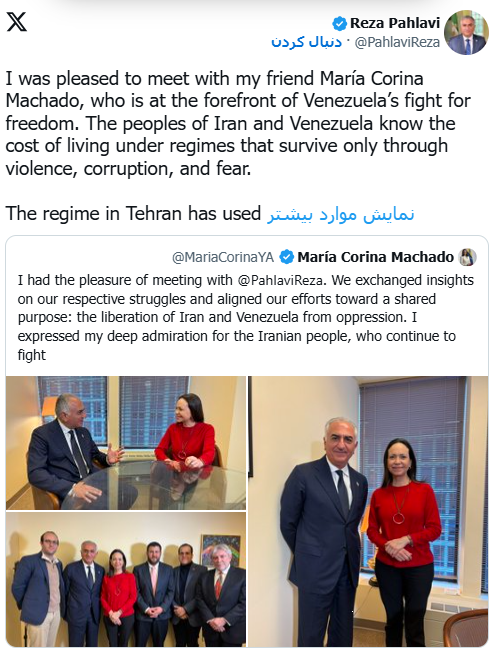
Prince Reza Pahlavi said on Thursday, January 22, 2026 (2 Bahman) that he met with Venezuelan opposition leader María Corina Machado, describing her as being on the front line of Venezuela’s struggle for freedom. In a post on X, he argued that Iranians and Venezuelans understand the cost of living under regimes sustained by “violence, corruption, and fear,” and claimed Tehran has leveraged cooperation with Caracas to expand influence in the Western Hemisphere. He alleged the Islamic Republic uses Venezuela to launder money, evade sanctions, support criminal networks, and strengthen its domestic repression capacity—warning that the partnership threatens regional stability and U.S. security. Referencing Iran’s ongoing uprising, he said Iranians are rising despite mass killings, prisons, and information blackouts, and insisted a free Iran and a free Venezuela would end decades of chaos, terror, and destruction, leaving a legacy of peace, stability, and prosperity.

USS Abraham Lincoln reportedly enters the Arabian Sea, signaling broader U.S. naval presence

An open-source account on X known as “War Monitor” reported that the U.S. aircraft carrier USS Abraham Lincoln has entered the Arabian Sea, framing it as a marker of an expanded U.S. naval footprint in the region. Separate reporting in recent days has indicated the carrier strike group was being redirected toward U.S. Central Command waters and was expected to arrive in the Gulf of Oman/Arabian Sea operating area, underscoring a deterrence signal amid heightened Iran-linked regional tensions.

Fresh protests reported in Marvdasht and Kuhdasht as bereaved families mobilize

Reports indicate a new wave of protests is intensifying in Marvdasht (Fars province) and Kuhdasht (Lorestan province), driven by the families of those killed. Details about the scale, timing, and security response have not been independently verified.

Reports of quasi-martial law nationwide as Iranian and allied forces patrol streets

Accounts from inside Iran describe a quasi-martial law environment across the country, with armed units tied to the IRGC, Basij, and other security forces visibly deployed in public spaces. The same reports claim the presence of non-Iranian allied fighters—including Afghanistan’s Fatemiyoun and Iraq’s Hashd al-Shaabi—operating alongside Iranian units, contributing to heightened intimidation and street-level coercion. These allegations have not been independently verified.

Strikes persist nationwide as authorities reportedly use closures and financial pressure to break walkouts

Reports indicate strikes are continuing across many Iranian cities, keeping the situation tense. In some areas, however, the walkouts are said to have been temporarily disrupted after threats and coercive measures—such as sealing businesses, blocking bank accounts, or revoking operating permits—were used to pressure participants back to work. These accounts have not been independently verified.

Reports: Death sentences issued amid due-process concerns, detainees allegedly denied legal counsel

Accounts indicate that death sentences have been issued for some detainees despite what is described as a lack of definitive evidence, alongside broader claims of due-process violations. The same reports say many detainees have been denied the right to choose or obtain legal counsel, raising concerns about fair-trial standards and the risk of coerced confessions. These allegations have not been independently verified.

Report: Blood banks depleted as authorities allegedly block public donation appeals

Accounts claim blood supplies have been depleted in some areas and that the Ministry of Intelligence has ordered relevant institutions not to issue public calls for blood donations—insisting the situation remain as is. If accurate, such restrictions would intensify pressure on hospitals and emergency care capacity at a time of heightened unrest. These claims have not been independently verified.

Families allege some protesters were buried alive amid secret mass burials

Accounts from several families in Tehran, Arak, and Isfahan allege that during the identification process they noticed faint chest movement and weak breathing in some bodies, raising fears that certain victims may not have been dead at the time authorities handled them. The claims point to the period of 20–23 Dey, when large numbers of bodies were reportedly buried secretly, at night, and in groups, fueling suspicions that some protesters—possibly unconscious—were buried alive. These allegations are extremely serious and have not been independently verified.

Tehran (Fri., 19 Dey): Reports of live rounds fired directly at residential windows

A report from Tehran dated Friday, 19 Dey alleges security forces fired live ammunition directly toward windows of residential homes, signaling an escalation that blurs the line between street-level enforcement and direct intimidation of civilians inside private residences. Details on the location, casualties, and the units involved have not been independently verified.

Kahrizak: Footage and family accounts allege mass body transfers to forensic center

A distressed message attributed to residents said “our young people have all been killed” and claimed bodies were being transported by trucks, urging urgent help. Separately, received images were described as showing multiple body-transport trailers queued at the entrance of the Kahrizak Forensic Medicine Center on Saturday, 20 Dey, with accompanying claims that bodies were moved into a warehouse-like area and families searching for missing relatives were told to look among the remains. These accounts and images cannot be independently verified.


Pezeshkian blames “US–Israeli plot” for protests, orders probe into violence

Masoud Pezeshkian said “ill-wishers of Iran” had turned what he called the people’s “rightful civil protest” into a “bloody and violent arena,” describing the unrest as an “American–Israeli plot” and “the enemy’s revenge” for its defeat in a “12-day war.” He added that he has tasked multiple groups to conduct a detailed review of the causes and drivers of the incidents, identify the “main roots” of the violence, and “dry them up.”

Unverified Tehranpars Hospital visuals allege high fatalities; car torched to stop body removal

A sender circulated images and two videos they said were taken at/near Tehran’s Tehranpars Hospital and linked them to people killed on 18–19 Dey, claiming the photos corroborate a previously shared video whose authenticity they had doubted. The same sender alleged that, to prevent security forces from removing bodies for clandestine burial, people set fire to a vehicle that had arrived to transport them—an incident they dated approximately to 19–20 Dey. These materials and claims have not been independently verified.


Video claim: Protester shot in Tehran’s Selsebil (Roudaki St.) on Jan. 8, 2026

A received video is being circulated with the claim that it shows a protester who was shot in Tehran’s Selsebil area (Roudaki Street) on Thursday, January 8, 2026. The footage and accompanying description are graphic in nature, and the time, location, and circumstances have not been independently verified.


Videos claim Qazvin protesters set fire to Qassem Soleimani statue outside governor’s office (Thu., 18 Dey)

Received videos are being shared with the claim that protesters in Qazvin set fire to a statue of Qassem Soleimani positioned outside the provincial governor’s office on Thursday, 18 Dey. The footage and accompanying details have not been independently verified.


Karaj-area (Fardis, Alborz): Families reportedly wait for bodies of those killed on 18 Dey

Received videos described as from Fardis in Alborz province show what is claimed to be families waiting for the bodies of people killed on Thursday, 18 Dey. The footage is being shared as part of wider accounts of delays and uncertainty around the handover of remains. These videos and accompanying claims have not been independently verified.


Video claim: Kermanshah family says brother killed by shotgun fire on 18 Dey; vows “we’ll take justice”

A received citizen video shows a person with the body of a man identified as his “brother,” accompanied by the claim that he was killed in Kermanshah on Thursday, 18 Dey after being shot with a shotgun. The clip includes the chant “We’ll take justice!” The identity, circumstances, and timing described in the video have not been independently verified.


Safavi warns “stage of war” with Israel, hints next conflict could be the last

Yahya Rahim Safavi, a senior military adviser to Iran’s Supreme Leader Ali Khamenei, has been quoted in Iranian media as saying Iran is “not in a ceasefire” but in a “stage of war,” warning that another war with Israel (and potentially the United States) could begin at any time and suggesting that a future conflict could be decisive in ending further wars. Separately, Safavi has previously used messaging about undisclosed capabilities—telling Al Jazeera in 2006 that Iran had “weapons which are unknown to others”—language now resurfacing in renewed escalation narratives.

Trump on Iran protest deaths: “No one knows the number… we’ll determine the real figure”

Speaking aboard Air Force One, Donald Trump said he has not seen a reliable estimate of how many people have been killed in Iran’s protests, arguing that “no one knows the number” but that it is “a lot.” He added that even a single death would be front-page news “in this country,” while cautioning there is a meaningful gap between “a lot” and figures as high as 20,000. Trump said the United States will find out what the precise number is and “determine exactly” the real death toll.

More Iran news

Political

Trump Backs Off Greenland Threats, Markets Exhale

The dollar strengthened, gold eased and stocks rebounded on Thursday after President Donald Trump dropped tariff threats and said he would not seize Greenland “by force,” telling audiences at Davos: “I won’t do that… I don’t have to use force, I don’t want to use force, I won’t use force.” The shift delivered visible relief across markets, though investors remained cautious given this week’s whipsaw headlines and lingering uncertainty over how durable the de-escalation will be.

Market impact: Near-term risk-on tone (supportive for equities, USD firmer, gold softer), but pricing likely stays headline-sensitive—any reversal on tariffs or Greenland rhetoric could quickly reintroduce volatility.

EU Parliament Moves to Label IRGC a Terror Group as Iran Crackdown Deepens

The European Parliament adopted a resolution on 22 January 2026 condemning Iran’s violent repression of protesters, calling for an immediate end to violence and executions, and demanding the unconditional release of detained protesters, journalists, and human-rights defenders. The text passed 562–9 (57 abstentions) and urges the EU Council to proceed “without delay” with the full designation of the Islamic Revolutionary Guard Corps (IRGC)—including the Basij and Quds Force—as terrorist organisations, alongside expanded EU restrictive measures (asset freezes and visa bans). It also condemns Iran’s internet shutdowns and calls on the EU and member states to scale up technical and financial support for censorship-circumvention tools and protection against cyber/information manipulation, while stressing that any normalisation of ties should be contingent on genuine progress toward democracy, rule of law, and the release of political prisoners.

Estonia MP: West must back Iranians against “state terror”

Marko Mihkelson, chair of the Estonian parliament’s foreign affairs committee, said the West must defend itself “not only in words but also in deeds,” arguing that a core priority is defeating Russia’s expansionism while also helping Iranians resist the “mass terror” imposed by what he described as an Islamist dictatorship. He added that Europe’s response will help define the role Europeans play in shaping a renewed global order.

Israel Raises Alert as US Strike Speculation Grows

Israel has raised its internal alert level and boosted both defensive and offensive readiness amid growing concern that the United States could move toward military action against the Islamic Republic in the coming days, according to reporting citing Israeli security officials. Reports also say Prime Minister Benjamin Netanyahu will convene a limited security meeting on Thursday, 22 January 2026 (2 Bahman 1404) as Israel reviews potential retaliation scenarios and preparedness measures.

IRGC Commander: US Bases “Legitimate Targets” if Iran Is Attacked

Ali Abdollahi, commander of Iran’s Khatam al-Anbiya Central Headquarters, said that any “aggression” against Iran would make all US bases a “legitimate” target, warning Washington it understands the consequences of any miscalculation. He added that any attack on Iran’s territory, security, or interests would promptly place US interests, bases, and “centers of influence” within reach of Iran’s armed forces, and claimed Iran’s response would be faster, more precise, and more destructive than the US and Israel “can imagine,” amid escalating war-of-words tied to renewed threats from President Donald Trump.

U.S. Q3 Growth Revised Up: GDP 4.4% as Price Pressures Stay Firm

U.S. Q3 GDP was revised to 4.4% q/q, slightly above expectations (4.3%) and up from 3.8% previously—underscoring a stronger growth pulse. The GDP Price Index held at 3.7% q/q (in line with expectations, up from 2.1% prior), pointing to firmer economy-wide inflation pressures during the quarter. Meanwhile, GDP Sales came in at 4.5% (just below 4.6% expected, but down from 7.5%), suggesting underlying domestic demand was still strong, though less torrid than the prior print.

Market impact: Growth revision is USD- and yields-supportive at the margin, while the sticky price index keeps a hawkish inflation tone in the backdrop; net effect can be negative for long-duration assets if markets reprice “higher-for-longer.”

Zelensky and Trump Hold Davos Meeting on Peace Initiative

At Davos 2026, Ukrainian President Volodymyr Zelensky met with U.S. President Donald Trump for an hour‑long discussion, which Trump described as productive and tied to his “Board of Peace” initiative. The meeting focused on ending the Russia‑Ukraine war and broader global conflict mediation, though details on concrete outcomes remain limited. Trump also reiterated progress on a Greenland security framework and withdrew related tariff threats. The dialogue took place amid cautious responses from European allies about U.S. geopolitical positions. China likewise rebutted Trump’s renewable energy critiques during the forum.

Market impact: May reduce geopolitical risk premiums in conflict‑sensitive assets if talks encourage diplomatic engagement; energy and defense sectors remain sensitive to evolving Ukraine war dynamics.


Trump Unveils “Board of Peace” but Key Allies Sit Out

At Davos, U.S. President Donald Trump unveiled a new international initiative dubbed the “Board of Peace,” aimed at maintaining ceasefires and envisioning post‑war futures (starting with Gaza). Trump claimed support from 59 countries, but major U.S. allies — such as the U.K., France, Norway, and Sweden — declined to participate, raising questions about its legitimacy and reach. Diplomats from countries including Saudi Arabia, Argentina and Indonesia joined, while Russia and China are reportedly deliberating involvement. Critics warn the board may undercut established norms and the UN’s role.

Market impact: Introduces diplomatic risk & uncertainty in geopolitical risk pricing, particularly in Middle East and peace‑focused development funds, as private capital digests potential new frameworks outside traditional international institutions.

EU Commission’s von der Leyen Calls for Transatlantic Cooperation

European Commission President Ursula von der Leyen delivered a special address at Davos emphasizing the need for European strategic autonomy amid geopolitical shocks and reaffirming the EU’s commitment to Ukraine and Arctic security (including Greenland). She stressed reforming trade, regulation, and investment policies while maintaining strong transatlantic ties — fitting into the Spirit of Dialogue focus on dialogue alongside divergent global priorities.

Market impact: May buoy European markets by reinforcing policy clarity on trade and security, and by reassuring investors about EU‑US cooperation on shared security interests.

Canada PM Carney: Middle Powers Must Lead for New Global Order

Canadian Prime Minister Mark Carney delivered a special address at the WEF Annual Meeting, warning that the rules‑based international order is eroding amid rising great‑power rivalry. He urged middle powers like Canada to collaborate on shaping a more cooperative and resilient global system that upholds human rights, sovereignty, and sustainable development — aligning with the Spirit of Dialogue theme’s call for multilateral problem‑solving.

Market impact: Reinforces multilateralism narratives, potentially stabilizing investor confidence in frameworks that support predictable global trade and cooperation.

Trump and Zelensky Hold Behind‑Closed‑Doors Davos Meeting

Donald Trump and Ukrainian President Volodymyr Zelenskyy held a private discussion on the margins of the forum, with both leaders signaling a shared intent to end the Russia‑Ukraine war. Trump publicly stated that the dialogue with Zelenskyy was constructive, while Zelenskyy participated in broader Davos sessions on Ukraine’s recovery and investment needs.

Market impact: May ease risk sentiments around Europe‑linked assets if markets interpret the dialogue as a step toward diplomatic progress, though uncertainty remains high.

Trump Launches “Board of Peace” at Davos Signing Ceremony

U.S. President Donald Trump hosted a signing ceremony for his controversial “Board of Peace” initiative on the sidelines of the World Economic Forum in Davos, describing it as a body that could become “one of the most consequential ever created.” Trump said the effort marked early steps toward a “brighter day for the Middle East and a much safer future for the world.” Some key U.S. allies reportedly expressed reservations about the initiative’s scope and legitimacy.

Market impact: Raises geopolitical risk premiums as markets assess the Board’s implications for traditional diplomatic frameworks and conflict‑region stability.

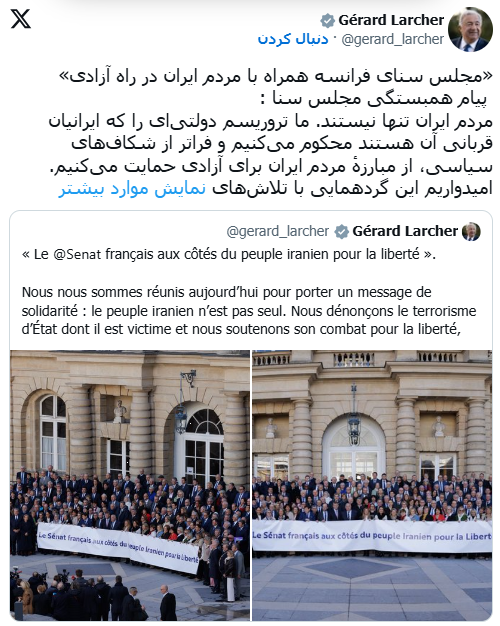
French Senate president voices support for Iranians, urges EU to list IRGC as a terrorist group

Gérard Larcher, President of the French Senate, issued a solidarity message saying Iranians “are not alone” and condemning what he described as “state terrorism” faced by the Iranian people, adding that—beyond political divides—the French Senate supports Iranians’ struggle for freedom. He expressed hope that the Senate’s collective initiative will continue and expand in resonance across Europe, encouraging other legislatures to adopt a similar stance so the message reaches women and men in Iran. Larcher also recalled that roughly two years ago the French Senate adopted a European resolution calling on France and its EU partners to place the Islamic Revolutionary Guard Corps (IRGC) on the EU terrorist list, saying “now is the time” to do so.

Machado after meeting Prince Reza Pahlavi: Coordinating to free Iran and Venezuela from tyranny

Venezuelan opposition leader María Corina Machado said on Thursday, January 22, 2026 (2 Bahman) that she met with Prince Reza Pahlavi, writing on X that they exchanged views on their respective struggles and coordinated efforts around a shared objective: freeing Iran and Venezuela from tyranny. She said she conveyed “deep admiration” for Iranians who continue fighting for their future despite what she described as brutal repression, arguing that as authoritarian regimes deepen “criminal cooperation,” pro-freedom forces must strengthen coordination. Machado warned that the Caracas–Tehran partnership has turned Venezuela into a hub for the Islamic Republic’s influence and has endangered the security of the entire Western Hemisphere. She added that the survival of such regimes is not only a tragedy for citizens seeking democracy but also a direct threat to global stability and the United States, alleging that Iran uses Venezuela as a key platform to fuel instability, terrorism, and transnational criminal networks beyond its borders. She concluded that a free Iran and a free Venezuela are not just aspirations but necessary conditions for a safer, democratic world, and insisted both countries will be free.

Trump at Davos: Iran “wants to negotiate,” US says it’s ready

U.S. President Donald Trump said on Thursday, on the sidelines of the World Economic Forum in Davos, that Iran is seeking talks with Washington and that the United States is prepared to negotiate, delivering the remarks during the launch event for his “Board of Peace” initiative. Trump also referenced U.S. military strikes on Iran’s uranium enrichment facilities last year, framing them as intended to prevent Tehran from obtaining a nuclear weapon, and reiterated that “we’ll talk.” Iranian officials had not issued an official response at the time of the reports.

Zelensky at Davos: Iran protests “drowned in blood” as world “stood aside”

Ukrainian President Volodymyr Zelensky said in his Jan. 22 speech at the World Economic Forum in Davos that the Iranian protests were “drowned in blood” and argued the world did not support Iranians enough, noting that while Europe was in the Christmas–New Year holiday period, “the Ayatollah had already killed thousands” by the time politicians returned and formed positions. He warned that if Iran’s ruling system survives, it sends a dangerous lesson to other authoritarian leaders—“kill enough people, and you stay in power”—and questioned what Iran could become after such bloodshed.

Trump: “Large force” moving toward Iran; claims mass execution plan was halted

U.S. President Donald Trump told reporters that a “large fleet” of American military equipment and forces is moving toward Iran, adding that he would prefer “nothing happens” but said the situation is being monitored closely. Trump also claimed he warned Tehran that if a plan to execute 837 people went ahead, Iran would be “hit harder than ever,” and said the executions were called off about an hour before the scheduled time—calling that a “positive sign.” Asked whether he wants Iran’s Supreme Leader to resign or go into exile, Trump said he does not see that “at this time” and declined to engage in the discussion.

Putin’s $1B “Board of Peace” gambit turns frozen assets into leverage

A new strategic read of Vladimir Putin’s reported offer to contribute $1 billion to Donald Trump’s “Board of Peace” argues Moscow is trying to convert its frozen assets into a diplomatic instrument while positioning itself for a potentially consequential partnership with the White House. The logic is twofold: first, any $1B transfer would likely require specific U.S. legal steps to unfreeze at least part of Russia’s blocked funds—creating a precedent that could open pathways for other assets, while allowing Putin to frame the freeze as a “previous administration” decision and shift the burden to Trump to prove a policy break. Second, Moscow casts the initiative as a broad global-stability platform—welcoming participation but stressing consultations with strategic partners—while using the pledge to reinforce its Middle East posture: insisting any process must align with UN decisions, fully account for Palestinian rights and needs, and prioritize Gaza reconstruction (health systems, water networks, and uninterrupted food supply).

More Political news

Others

South Africa Inflation Edges Up: Headline CPI at 3.6%

South Africa’s headline CPI rose to 3.6% y/y in December (in line with expectations, up from 3.5% prior), while monthly CPI increased 0.2% m/m after -0.1% previously. Core CPI held at 0.1% m/m and ticked up to 3.3% y/y (from 3.2%). Inflation remains contained in the lower half of the SARB’s target band, but the slight firming suggests disinflation is not linear.

Market impact: Largely neutral for SARB near term, but mildly reduces urgency for rate cuts; ZAR reaction is usually limited unless paired with global risk swings—though firmer inflation can add modest support to local yields.

South Africa Retail Demand Improves: Sales Growth Hits 3.5%

South Africa’s retail sales rose 3.5% y/y in November, up from 3.0% previously, signaling firmer consumer demand into year-end. The pickup is consistent with a more supportive real-income backdrop as inflation remains contained, though the durability will depend on credit conditions and employment momentum.

Market impact: Mildly positive for South Africa growth and domestic cyclicals; can be modestly ZAR-supportive if it reinforces a “soft landing” narrative, but FX is still primarily driven by global risk sentiment and rate differentials.

Mexico Retail Sales Surprise Higher: Demand Re-Accelerates in November

Mexico’s retail sales beat expectations, rising 1.0% m/m in November (vs 0.1% expected, 0.5% prior) and accelerating to 4.4% y/y (vs 3.0% expected, 3.4% prior). The upside surprise points to resilient household demand and a firmer near-term growth pulse, even as rates remain restrictive.

Market impact: Mildly MXN-supportive via stronger growth optics and carry appeal but can be hawkish for Banxico expectations at the margin if demand strength threatens disinflation; local rates may see modest upward pressure.

Brazil FX Flows Flip Positive: +$2.215B Inflow

Brazil’s foreign-exchange flows swung into surplus, showing a +$2.215B inflow versus -$1.696B previously. The shift points to improved near-term balance of payments dynamics—likely reflecting a mix of trade-related conversions and portfolio positioning—after an earlier outflow phase.

Market impact: Typically, BRL-supportive at the margin (better flow backdrop) and can help local rates/credit sentiment, but sustained currency impact depends on global risk appetite, commodities, and Brazil’s fiscal/policy headlines.

South Korea GDP Misses: Economy Contracts -0.3% q/q in Q4

South Korea’s economy unexpectedly contracted -0.3% q/q in Q4 (vs +0.1% expected, after +1.3% in Q3), while GDP slowed to 1.5% y/y (vs 1.9% expected, 1.8% prior). The downside surprise points to a sharper late-year slowdown, raising questions about domestic demand resilience even as the tech/export cycle has been a relative bright spot.

Market impact: KRW-negative at the margin and supportive for a more dovish BoK tone; may weigh on Korea cyclicals, while reinforcing the market’s preference for global AI/semis exposure over purely domestic-demand plays.

Turkey’s January Read: Confidence Up, Capacity Use Slips

Turkey’s January sentiment indicators improved modestly even as factory utilisation eased. Capacity utilisation dipped to 74.1% (from 74.4%), while manufacturing confidence rose to 101.6 (from 100.8). Consumer confidence also ticked up to 83.7 (from 83.5). The mix suggests sentiment is stabilising, but hard-activity utilisation remains soft—consistent with a cautious growth pulse amid tight financial conditions.

Market impact: Mildly supportive for TRY domestic sentiment and Turkey-facing cyclicals, but not a game-changer; FX remains driven primarily by inflation expectations, policy credibility, and external financing conditions.

CBRT Starts Easing Faster: Policy Rate Cut to 37%

Turkey’s central bank cut the one-week repo rate to 37.00% in January, a larger move than expected (36.50%) and down from 38.00% previously. The corridor was shifted lower as well: the overnight borrowing rate was reduced to 35.50% (from 36.50%) and the overnight lending rate to 40.00% (from 41.00%). The decision signals a quicker pivot toward easing than markets had priced.

Market impact: TRY-negative at the margin (wider real-rate uncertainty and carry compression) unless accompanied by strong guidance; supportive for local duration and rate-sensitive equities, while keeping inflation expectations and FX volatility in focus.

Turkey Rebuilds FX Buffer: Gross Reserves Jump to $84.2B

Turkey’s gross FX reserves increased to $84.15B from $79.35B, while the reported net FX reserves ratio rose to 91.01% from 82.93%. The uptick suggests an improved near-term external liquidity cushion and greater room for policymakers to manage volatility, even as markets continue to focus on inflation dynamics and the policy mix.

Market impact: Generally TRY-supportive at the margin (stronger reserves buffer), potentially reducing near-term tail risk and FX volatility; sustained impact depends on inflation expectations and policy credibility.

Mexico Inflation Split: Core Hotter, Headline Cooler in Early January

Mexico’s first half-month (quincena) inflation print for January was mixed. Core CPI rose 0.43% (vs 0.39% expected, 0.31% prior), signaling firmer underlying price pressure. But headline CPI increased 0.31% (below 0.37% expected, up from 0.17% prior), suggesting softer non-core components offset some of the core strength.

Market impact: Core upside is hawkish-leaning for Banxico and may keep front-end rates supported; however, the softer headline reduces immediate inflation-scare risk. MXN may stay resilient on carry, but near-term moves will track rate expectations and global risk sentiment.

Davos Conference Centre Evacuated After Fire Incident

A fire broke out at a conference centre in Davos during the forum, prompting an evacuation of guests. Although the blaze was fully contained and extinguished with no reported injuries, a strange smell caused coughing among attendees, and authorities are investigating the cause. The incident briefly disrupted proceedings amid the busy schedule of Davos panels. Separately, U.S. President Trump announced diplomatic developments involving Greenland and NATO after meetings with allied leaders in Davos.

Market impact: Minimal direct financial impact, but underscores operational risks at major global events; any disruption to scheduled high‑level meetings can affect market sentiment if linked to broader instability narratives.

Brazil Tax Take Jumps: Federal Revenue Hits BRL 292.7B

Brazil’s federal tax revenue rose to BRL 292.72B in December, up from BRL 226.75B previously—signalling stronger fiscal inflows at year-end. The jump may reflect seasonal factors and improved collection, but it still improves near-term cash flow optics for the government.

Market impact: Mildly BRL-positive at the margin (better fiscal-flow narrative) and supportive for local rates if it reduces near-term financing stress; sustained impact depends on Brazil’s broader fiscal framework and spending trajectory.

Billionaires & Millionaires Call for Higher Taxes on the Super‑Rich

Nearly 400 millionaires and billionaires from 24 countries — including artists and public figures — signed an open letter during the World Economic Forum in Davos urging global leaders to implement higher taxes on the ultra‑wealthy. The letter criticizes extreme wealth concentration for undermining democracy, controlling governments and media, and obstructing innovation and climate progress. It reflects growing elite concern about inequality and the social license for global capitalism amid A Spirit of Dialogue discussions.

Market impact: May put policy pressure on wealth‑tax initiatives and fiscal reforms, which could affect asset valuations in luxury sectors, private equity and hedge funds if global tax frameworks shift.

Protesters Clash with Police at Davos Demonstrations

Demonstrations against the World Economic Forum erupted near Davos, with protesters clashing with police using water cannons and tear gas. The protests reflect growing public frustration with global elites and concerns that high‑level dialogue does not deliver tangible improvements for broad populations.

Market impact: May add sociopolitical risk premium in markets sensitive to inequality and populist tensions, especially in Europe.

WCC Issues Supportive Message for Davos Dialogue Focus

The World Council of Churches (WCC) released a supportive message affirming the Davos 2026 theme A Spirit of Dialogue, urging global institutions to prioritize dialogue over confrontation amid geopolitical tensions and rising inequality. The WCC praised the Forum’s focus on cooperation and called for moral and political commitment to equitable solutions addressing climate, social justice, and economic vulnerability.

Market impact: Reinforces ESG and social cohesion narratives, likely motivating investor focus on inclusive policies and sustainability metrics.

Thai Commerce Minister Highlights Digital & Sustainable Trade

Thailand’s Commerce Minister Suphajee Suthumpun underscored the importance of digital trade and sustainability during her participation at WEF Davos 2026. She emphasized enhancing digital infrastructure, leveraging e‑commerce for inclusive growth, and integrating sustainable practices into trade policies — aligning with A Spirit of Dialogue by bridging public and private efforts for equitable economic participation.

Market impact: Supports digital commerce and sustainable trade, potentially attracting investments in platforms and green supply chains focused on inclusive economic integration.

HD Hyundai and Palantir Expand Strategic Partnership at Davos

HD Hyundai Chairman Chung Ki‑sun and Palantir Technologies CEO Alex Karp agreed at Davos to expand their strategic partnership, focusing on advanced data analytics, AI‑driven operations, and industrial digital transformation. The pact aims to leverage Palantir’s software capabilities to enhance Hyundai’s global supply chain efficiency and competitiveness, signaling private‑sector tech collaboration under the Spirit of Dialogue banner.

Market impact: Positive for industrial AI adoption, and may strengthen sentiment around data‑driven operational resilience in manufacturing and logistics sectors.

Elon Musk Highlights Robotics and Robotaxi Expansion in First Davos Talk

Elon Musk made his first appearance at Davos, speaking alongside BlackRock CEO Larry Fink about robotics, AI and Tesla’s robotaxi rollout. Musk revealed that Tesla’s robotaxi services are operating in select U.S. cities and are expected to expand by year‑end, with European market approvals on the horizon. He also discussed the future of humanoid robots and AI’s transformative economic potential.

Market impact: Bolsters technology and AI sector optimism, likely supporting valuations of robotics, autonomous transport, and AI‑related equities, while influencing investor expectations around tech‑driven growth.

German Chancellor Warns of “Great Power Politics” at Davos

German Chancellor Friedrich Merz warned forum delegates that the world is entering an era dominated by “great power politics,” with tensions rising from Russia’s war in Ukraine, China’s growing influence, and U.S. foreign policy shifts. Merz stressed the need for alliances based on mutual respect and urged Europe to boost defense, economic competitiveness, and unity with like‑minded partners.

Market impact: Could strengthen defense and security sector equities and heighten risk premiums on global trade–dependent assets amid geopolitical friction.

More Others news

USA

U.S. Mortgage Demand Surges as Rates Ease: MBA Apps +14.1%

U.S. mortgage activity jumped even as rates ticked lower. The MBA 30-year mortgage rate eased to 6.16% (from 6.18%), while mortgage applications rose 14.1% w/w (after 28.5% previously). The Purchase Index climbed to 194.1 (from 184.6), the Mortgage Market Index rose to 397.2 (from 348.0), and the Refinance Index jumped to 1,580.8 (from 1,313.1), signaling improved rate sensitivity and renewed borrower activity.

Market impact: Slightly constructive for U.S. housing sentiment and rate-sensitive equities; supports the “soft landing” narrative if sustained, but the outlook remains tied to the path of Treasury yields and broader financial conditions.

U.S. Retail Pulse Softens Slightly: Redbook Slips to +5.5% y/y

The latest Redbook same-store sales index showed annual retail sales growth easing to +5.5% y/y, down from +5.7% previously. The small dip suggests consumer spending momentum remains solid but is cooling marginally at the margin.

Market impact: Typically a low-tier market mover, but modestly supports a “slowing but resilient” consumption narrative—slightly constructive for a soft-landing view and broadly neutral for USD unless corroborated by wider retail and jobs data.

U.S. Housing Shock: Pending Home Sales Plunge 9.3%

U.S. pending home sales posted a sharp downside surprise in December, falling -9.3% m/m (vs -0.3% expected, after +3.3% prior), with the Pending Home Sales Index dropping to 71.8 (vs 79.2 expected). Construction spending was mixed: September fell -0.6% m/m (after +0.4% prior), while October rebounded +0.5% m/m (vs +0.1% expected, after -0.6%). The outsized drop in pending sales points to a sudden cooling in transaction activity—likely reflecting affordability and rate sensitivity—even as building outlays show uneven momentum.

Market impact: Dovish tilt for rates if housing weakness persists (supportive for Treasuries), negative for homebuilders and housing-linked cyclicals; the market will watch whether mortgage-rate easing translates into a rebound in contracts in the next prints.

GDPNow Ticks Up: Atlanta Fed Sees 5.4% Q4 Growth

The Atlanta Fed’s GDPNow estimate for Q4 edged higher to 5.4%, up from 5.3% previously (and above the prior 5.3% reading). The uptick reinforces a strong end-of-year growth signal in the model, though GDPNow can move quickly as new data land.

Market impact: Slightly hawkish for rates at the margin (supports the “resilient growth” narrative), potentially supportive for USD and a headwind for duration-sensitive assets if confirmed by broader data.

U.S. 20-Year Auction Tails Higher: Stops at 4.846%

The U.S. 20-year Treasury auction cleared at 4.846%, up from 4.798% previously signaling higher required yield (weaker pricing) versus the last sale and suggesting investors demanded more compensation for duration and supply. In the current backdrop, long-end auctions are especially sensitive to term-premium and fiscal headlines.

Market impact: Slightly bearish for long-duration Treasuries (upward pressure on long yields), supportive for the USD at the margin via higher yields, and a potential headwind for rate-sensitive equities if the move extends.

U.S. Q3 Inflation Re-Accelerates: Core PCE at 2.9% as Spending Stays Strong

U.S. Q3 core PCE prices (the Fed’s preferred inflation gauge) rose 2.9%, matching expectations but up from 2.6% previously—signaling firmer underlying inflation. Headline PCE prices increased 2.8% (in line with forecasts, up from 2.1%), while real consumer spending remained strong at 3.5% (unchanged vs expected, up from 2.5%). The mix underscores a “hotter prices + resilient demand” combination for the quarter.

Market impact: Hawkish at the margin for rate expectations—supports higher yields/stronger USD and can be a headwind for long-duration assets if markets lean toward “higher for longer.”

U.S. Corporate Profits Jump: +4.7% q/q in Q3

U.S. corporate profits rose 4.7% q/q in Q3, beating expectations (4.4%) and sharply higher than the prior 0.2% gain. The upside suggests improved margin dynamics and operating leverage through the quarter, even as input costs and rates stayed elevated.

Market impact: Generally equity-supportive (earnings backdrop improves) and can reinforce “resilient growth” pricing; however, stronger profits alongside firm inflation can also keep yields supported, which matters for valuation-sensitive segments.

U.S. Core PCE Cools to 2.7% as Spending Beats

October core PCE inflation came in steady-to-softer: 0.2% m/m (in line with expectations) and 2.7% y/y (down from 2.8%). Headline PCE also printed 0.2% m/m (down from 0.3%) and 2.7% y/y (down from 2.8%). On the growth side, personal spending rose 0.5% m/m, beating the 0.3% prior, while personal income increased just 0.1% m/m (down from 0.4%). The mix suggests easing inflation pressure alongside resilient consumption, though income softness implies spending may be drawing more on savings/credit at the margin.

Market impact: Mildly dovish for Fed pricing on the inflation side (supports duration), but the strong spending print offsets some of that dovishness by keeping the “growth is holding up” narrative intact; overall reaction often depends on rates positioning.

U.S. Core PCE Reheats: Inflation Firm, Spending Stays Strong

November core PCE inflation held at 0.2% m/m (in line with expectations and unchanged from prior), but the y/y rate rose to 2.8% (matching forecasts, up from 2.7%). Headline PCE was steady at 0.2% m/m (in line, down from 0.3%) with the y/y rate at 2.8% (unchanged, in line). On activity, personal spending rose 0.5% m/m (in line, up from 0.4%) and real consumption increased 0.3% m/m (up from 0.1%). Personal income came in at 0.3% m/m, missing 0.4% expectations and down from 0.4% previously. The mix signals sticky inflation with resilient demand, while income growth softened at the margin.

Market impact: Slightly hawkish for Fed pricing because core inflation is firmer y/y and spending is solid; supportive for USD and front-end yields, while keeping long-duration assets sensitive to “higher-for-longer” repricing.

Kansas City Fed: Manufacturing Improves Slightly, Composite Flat

The KC Fed Manufacturing Index ticked up to -2 in January (from -3 previously), signaling a modest easing in regional factory weakness, though activity remains slightly contractionary. The KC Fed Composite Index held at 0 (unchanged), pointing to broadly flat overall business conditions across the district.

Market impact: Limited market mover, but mildly supportive for a “stabilising manufacturing” narrative; unlikely to shift Fed pricing unless echoed by broader regional and national surveys.

U.S. Auctions: Front-End Bills Edge Higher, 10Y TIPS Reprices to 1.94%

U.S. Treasury auction yields moved up at the front end, with the 4-week bill clearing at 3.630% (vs 3.595% prior) and the 8-week bill also at 3.630% (vs 3.600% prior). In inflation-linked supply, the 10-year TIPS auction stopped at a 1.940% real yield, higher than the 1.843% expected, suggesting investors demanded more real yield compensation than anticipated.

Market impact: Slightly bearish for Treasuries at the margin (higher bill and TIPS yields), supportive for the USD via yield differentials; higher real yields can be a headwind for gold and long-duration equities if the move extends.

GDPNow Holds at 5.4%: Atlanta Fed Keeps Q4 Growth Estimate Elevated

The Atlanta Fed’s GDPNow model kept its Q4 2025 real GDP growth estimate unchanged at 5.4% (forecast 5.4%, prior 5.4%), reinforcing a strong late-year growth signal in the nowcast.

Market impact: Mildly hawkish at the margin—supports USD and front-end yields, while keeping duration-sensitive assets (long Treasuries, high-multiple equities, gold) more exposed to real-yield repricing.

More USA news

Equities

Trump Drops Greenland Tariffs, Markets Rally

President Donald Trump said on Truth Social that the U.S. and NATO have a framework for a deal and that he will not impose the tariffs previously threatened, triggering a broad relief move across risk assets. European futures were up 1.2% in Asia afternoon trade and FTSE futures rose 0.75%, while the S&P 500 gained 1.16% on Wall Street—its biggest rise in two months—with U.S. equity futures up about 0.3% through Asian hours. Investors are still treating the shift cautiously after a week of headline-driven whipsaws.

Market impact: Risk-on relief is supportive for equities and European cyclicals and typically weighs on safe havens (gold, CHF/JPY) while keeping FX and rates headline-sensitive until formal confirmation and clearer terms emerge.

Asia Stocks Bounce: KOSPI Breaks 5,000 for First Time

MSCI’s broadest Asia-Pacific ex-Japan equity index rose about 1%, while chip-led gains in Seoul pushed South Korea’s KOSPI above 5,000 points for the first time—a milestone reflecting the region’s renewed tech momentum and improving risk tone.

Market impact: Supports a near-term risk-on bias across Asia (tailwind for semis/tech), but leaves markets sensitive to global macro and trade headlines; a sustained break higher could pull incremental inflows into Korea and broader EM Asia equities.

SoftBank Rockets 13% as Nvidia’s Davos Optimism Lifts Asia Tech

SoftBank shares jumped more than 13% on Thursday, rebounding from a recent multi-month low and leading gains among Asian tech names, after NVIDIA CEO Jensen Huang struck an upbeat tone at the World Economic Forum on the scale and durability of the AI buildout. SoftBank’s outsized move reflects its high beta to AI sentiment—via its Arm stake and its multi-tens-of-billions investment in OpenAI—leaving the stock particularly sensitive to shifts in the AI narrative.

Market impact: Supportive for Japan/Asia tech risk appetite and the “AI infrastructure” trade; also implies higher headline-driven volatility for AI-linked equities if sentiment turns on regulation, rates, or earnings.

J&J Delivers Solid Q4 2025, Revenue Beat Offsets Inline EPS

Johnson & Johnson (JNJ) reported EPS of $2.46, in line with expectations of $2.46, while revenue came in at $24.6B, above forecasts of $24.15B. The print highlights steadier top-line momentum than consensus assumed, suggesting underlying demand across the portfolio held up well even as earnings landed exactly on target. J&J’s market capitalization stands at $525.25B, reinforcing its status as a defensive mega-cap with investors focused on the durability of growth drivers and margin trajectory into 2026.

Charles Schwab Posts Steady Q4 2025, Matches EPS and Revenue Estimates

Charles Schwab (SCHW) reported EPS of $1.39, exactly in line with expectations of $1.39, while revenue came in at $6.34B, matching forecasts of $6.34B. The print signals a quarter that tracked consensus closely, with results suggesting stable execution and limited surprise versus market assumptions. Schwab’s market capitalization stands at $180.87B, with attention likely on client cash sorting, net interest dynamics, and trading activity trends as 2026 unfolds.

Prologis Surges Past Q4 2025 Estimates, Massive EPS Beat

Prologis (PLD) reported EPS of $1.49, dramatically above expectations of $0.70, while revenue came in at $2.10B versus $2.09B forecast. The results show a sharp earnings outperformance on a roughly in-line top line, implying a meaningful profitability upside versus consensus—potentially driven by margin strength, operating leverage, or favorable items in the quarter. Prologis’ market capitalization stands at $124.74B, with investors likely focusing on rent growth, occupancy, and the outlook for industrial real estate demand into 2026.

P&G Posts Mixed Q4 2025 Results, Beats EPS but Misses Revenue

Procter & Gamble (PG) reported EPS of $1.88, slightly above expectations of $1.86, while revenue came in at $22.2B, below forecasts of $22.34B. The print suggests profitability held up better than the top line, implying margins and cost discipline helped offset a modest revenue shortfall versus consensus. P&G’s market capitalization stands at $341.3B, with investors likely focused on volume trends, pricing mix, and margin durability as 2026 progresses.

GE Aerospace Posts Strong Q4 2025, Beats EPS and Revenue Estimates

GE Aerospace (GE) reported EPS of $1.57, beating expectations of $1.43, while revenue came in at $11.87B versus $11.2B forecast. The upside across both earnings and the top line signals a firm quarter, consistent with solid aftermarket/service dynamics and improving operational execution, with profitability outperforming consensus assumptions. GE Aerospace’s market capitalization stands at $335.96B, reinforcing its position as a key beneficiary of sustained aircraft utilization and longer-cycle aviation demand heading into 2026.

More Equities news

UK

UK House Prices Re-Accelerate: HPI Jumps to 2.5% y/y

UK House Price Index (HPI) rose 2.5% y/y, beating expectations of 1.8% and up from 1.7% previously. The upside surprise signals firmer momentum in the housing market, likely helped by easing rate headwinds and improving buyer confidence at the margin—though affordability constraints remain a limiting factor.

Market impact: Mildly GBP-supportive and hawkish-leaning at the margin via stronger domestic-demand optics; supportive for UK housing-linked equities and banks, while reinforcing sensitivity of the rates path to broader inflation and wages data.

UK 5-Year Gilt Auction Yields Drop: Clears at 3.821%

The UK 5-year gilt auction cleared at 3.821%, down from 3.980% previously, pointing to improved demand and/or a rally in the front-to-belly of the curve. The lower yield suggests investors were willing to accept cheaper compensation for duration risk versus the prior auction, consistent with easing near-term rate pressure.

Market impact: Mildly supportive for gilts and can be marginally GBP-negative via lower yield support, though FX impact is usually limited unless auctions repeatedly signal a broader shift in UK rate expectations.

UK Factory Orders Improve Slightly, Still Deeply Weak: CBI at -30

The UK CBI Industrial Trends Orders balance improved to -30 in January, beating expectations of -33 and up from -32 previously. The uptick signals a marginal easing in the pace of weakness, but the level remains firmly negative—indicating manufacturers still see order books well below normal and demand conditions remain soft.

Market impact: Modestly supportive for UK growth sentiment at the margin, but unlikely to shift BoE pricing on its own; GBP reaction is typically muted unless followed by a broader run of stronger activity data.

UK Public Finances Mixed: Cash Need Jumps, Borrowing Turns More Negative

UK fiscal data for December showed a larger Public Sector Net Cash Requirement of £16.908B (up from £9.516B previously), indicating a higher near-term cash funding need. At the same time, Public Sector Net Borrowing printed -£11.58B, which was less negative than expected (-£13.40B) and more negative than prior (-£10.94B). In practice, the combination points to cash-flow pressure alongside a headline borrowing figure that came in slightly better than forecast.

Market impact: Mixed for gilts—higher cash requirement can lean bearish at the margin (supply/funding optics), while the better-than-expected borrowing print offsets somewhat; GBP impact is typically limited unless fiscal slippage becomes a sustained theme.

UK Retail Mood Rebounds: CBI Trades Balance Jumps to -17

The UK CBI Distributive Trades Survey improved sharply in January, with the retail sales balance rising to -17 (vs -35 expected, -44 prior). The reading still signals below-normal conditions, but the magnitude of the rebound points to a material easing in reported weakness across the retail sector—suggesting demand has stabilised at the margin.

Market impact: Mildly supportive for UK growth sentiment and domestic cyclicals; could be a small positive for GBP if confirmed by official retail sales, though BoE pricing is more likely to remain driven by wages and inflation.

More UK news

Commodities

Gold Holds Near Records as Trump Tariff Retreat Cools Safe-Haven Bid

Gold was largely steady in Asian trading on Thursday after surging to a fresh record near $4,900/oz in the prior session, as President Donald Trump’s apparent retreat from Greenland-linked tariff threats eased immediate demand for safe-haven assets. Spot gold slipped 0.1% to $4,826.03/oz by 06:19 GMT, after touching an all-time high of $4,888.1/oz in the previous session.

Market impact: Mild risk-on relief can cap gold’s upside in the near term, but prices remain highly sensitive to any reversal in trade/geopolitical headlines—keeping volatility elevated across havens and related miners.

API: U.S. Crude Stocks Rise +3.04M, Build Slows

The API weekly report for the week ended Jan 16 showed U.S. crude oil inventories increased by 3.040 million barrels, moderating from the prior 5.270 million build. The smaller build suggests inventory accumulation is still ongoing, but the pace is easing versus the previous week.

Market impact: Mildly supportive for crude versus a larger build (reduces immediate oversupply concern), but direction will hinge on confirmation from the official EIA data and any concurrent shifts in gasoline/distillate stocks and refinery runs.

U.S. Gas Draw Deepens: Storage Falls 120 Bcf

U.S. natural gas storage posted a larger-than-expected weekly withdrawal of -120 Bcf, versus -90 Bcf expected and -71 Bcf previously. The bigger draw points to a tighter near-term supply-demand balance—typically consistent with stronger heating demand and/or lower supply flows versus the prior week.

Market impact: Bullish-leaning for U.S. natural gas prices near term (tighter inventories) and supportive for gas-linked producers; however, follow-through depends on weather forecasts, production levels, and LNG export flows.

EIA Shock Build: Crude +3.6M as Gasoline Stocks Jump Nearly +6.0M

The EIA weekly report for the week ended Jan 17 showed U.S. crude inventories rising +3.602M versus -1.000M expected, a clear downside surprise for the crude balance. Cushing stocks also increased (+1.478M, prior +0.745M). In refined products, gasoline inventories surged +5.977M (vs +1.700M expected, prior +8.977M), while distillate stocks rose +3.348M (vs -0.200M expected, prior -0.029M). Refining activity softened: refinery crude runs fell -0.354M w/w and utilization dropped -2.0pp (prior +0.6pp), alongside declines in gasoline and distillate production. Crude imports slipped -0.027M (prior +0.710M), and heating oil stockpiles increased +0.279M (prior -0.745M).

Market impact: Near-term bearish for crude (unexpected stock build) and bearish for crack spreads if product inventories keep swelling, though the sharp drop in refinery utilization can tighten balances later if runs rebound; expect headline-driven volatility for WTI/Brent around demand and refining signals.

More Commodities news

Oceania

New Zealand Spending Turns Soft: Card Sales Slip in December

New Zealand’s electronic card retail sales weakened in December, with spending down -0.1% m/m (after +1.2% previously) and -0.5% y/y (vs +1.6% previously). The pullback suggests consumer demand lost momentum into year-end, consistent with a more constrained household backdrop amid tighter financial conditions.

Market impact: Mildly NZD-negative and supportive of a dovish RBNZ interpretation at the margin; reinforces sensitivity in New Zealand cyclicals and retail names if softer demand persists.

NZ Migration Cools: Net Inflows Drop to 990 as Visitor Growth Holds

New Zealand’s migration pulse softened in November. Permanent/long-term net migration fell to 990 from 1,610 previously, while the broader external migration & visitors measure eased to 8.20% (from 9.40%). Tourism momentum was steadier, with visitor arrivals up 0.8% m/m after 0.7% prior, suggesting continued incremental improvement in inbound travel even as net migration inflows cool.

Market impact: Cooling migration can reduce a tailwind for domestic demand, rents and housing pressure, modestly dovish for RBNZ at the margin; firmer visitor arrivals are supportive for tourism-linked activity, but NZD implications are typically limited unless the trend persists.

Foreigners Stay Long Japan Equities, Dump JGBs

Foreign investors remained net buyers of Japanese stocks, purchasing ¥874.0bn (down from ¥1,141.6bn previously), but flipped sharply to net selling in bonds with ¥361.4bn of net outflows versus ¥91.2bn of net buying in the prior period. The mix suggests ongoing equity appetite—likely tied to Japan’s tech/export leverage and global risk tone—while bond selling points to persistent concern around Japan’s long-end rates, fiscal optics, and term-premium volatility.

Market impact: Equity inflows are supportive for Nikkei/TOPIX, but bond outflows can keep JGB yields elevated and raise JPY volatility; watch whether sustained foreign bond selling forces broader curve repricing or triggers policy/intervention sensitivity.

Australia Jobs Shock Higher: Unemployment Drops to 4.1%

Australia’s labour market surprised on the upside in December. The unemployment rate fell to 4.1% (vs 4.4% expected, 4.3% prior) as employment rose 65.2K (vs 28.3K expected, after -28.7K), including a strong 54.8K gain in full-time jobs (vs -65.3K expected). The participation rate ticked up to 66.7% (vs 66.8% expected, 66.6% prior), implying the drop in unemployment was not merely a participation effect. Overall, the print reinforces a still-tight labour market.

Market impact: AUD-supportive and hawkish for RBA pricing at the margin (less urgency to ease); could pressure front-end yields higher and support banks/cyclicals, while weighing on rate-sensitive sectors if markets reprice cuts.

More Oceania news

China

China’s Property Slump Hits “Lost Decade” Levels

China’s housing downturn—running since 2021—remains the longest and deepest on record and a major drag on the $19 trillion economy, with little evidence of a near-term turn. Official data show average home prices in 2025 fell back to 2018 levels, while new-home sales (by floor space) are down about 50% from the peak, reverting to around 2009 levels. The stress has also been structural: major developers such as Evergrande have collapsed and dozens of property firms have defaulted on debt, reinforcing a prolonged deleveraging cycle across real estate and local-government-linked financing.

Market impact: Persistent property weakness is a headwind for China growth, banks/credit, and commodity demand (notably iron ore/steel), keeping a lid on CNY risk appetite and supporting a “more stimulus/low inflation” macro narrative.

Hong Kong Inflation Ticks Up: CPI Rises to 1.4% y/y

Hong Kong’s CPI inflation firmed in December, with CPI up 0.30% m/m (from 0.00% prior) and 1.40% y/y (up from 1.20%). The data point to a modest re-acceleration in price pressures, though inflation remains relatively contained.

Market impact: Typically HKD-neutral given the currency peg; the print is more relevant for local-rate expectations and real-estate/consumer sensitivity, but broader market drivers remain U.S. rates and risk sentiment.

China Defends Wind Power Strategy After Trump Criticism

At the 2026 World Economic Forum in Davos, China responded publicly to criticism from U.S. President Donald Trump over its wind power strategy. Trump had mocked wind turbines as inefficient and “unsightly,” while alleging China lacks significant domestic wind farms. China’s foreign ministry spokesperson Guo Jiakun defended Beijing’s approach, noting that China has led the world in installed wind power capacity for 15 straight years and underlining the country’s contribution to global carbon emission reductions through exports of wind and solar technologies. Guo also reiterated China’s willingness to cooperate on the global transition to clean energy — positioning energy dialogue as part of the broader Spirit of Dialogue discussions. Meanwhile, the EU launched a probe into Chinese wind turbine subsidies, which China labeled protectionist.

Market impact: Reinforces renewable energy sector focus and may drive investment interest in wind/solar supply chains; trade tensions over subsidies could introduce policy risk premiums for turbine manufacturers and energy markets.

More China news

Europe

Swiss Money Supply Edges Lower: M3 Slips to CHF 1,210.9B

Switzerland’s M3 money supply eased slightly in December to CHF 1,210.9B, down from CHF 1,211.6B previously. The marginal dip suggests stable-to-soft liquidity growth at the broad-money level, consistent with Switzerland’s low-inflation regime and cautious credit conditions.

Market impact: Typically CHF-neutral and not a stand-alone market mover; it marginally supports a “contained inflation/liquidity” backdrop for SNB policy, with FX still driven more by global risk sentiment and rate differentials.

Eurozone Confidence Improves: Consumer Sentiment Rises to -12.4

Eurozone consumer confidence edged higher in January to -12.4, beating expectations (-13.0) and improving from -13.2 previously. The move suggests households are becoming marginally less pessimistic, consistent with easing inflation pressure and stabilising real-income dynamics, even as growth remains uneven across the bloc.

Market impact: Modestly supportive for EUR sentiment and European domestic cyclicals, but unlikely to materially shift ECB pricing on its own; the rate path will still be driven by inflation, wages, and activity data.

More Europe news

Cryptocurrency

BitGo Pops the IPO Window: $213M Raised at $2.1B Valuation

Crypto custody firm BitGo priced its U.S. IPO above the marketed range at $18/share, raising $212.8 million and implying a valuation of about $2.08 billion, according to Reuters. The deal—set to trade as “BTGO”—is being watched as a key litmus test for 2026’s crypto-equity appetite, with other major names such as Grayscale and Kraken also seen in the IPO pipeline this year.

Market impact: Positive for crypto-linked equities sentiment and broader IPO risk appetite; could support valuations across listed crypto infrastructure names, though performance will remain sensitive to BTC volatility and U.S. regulatory headlines.

Crypto Rebound Fades: Ether Back Above $3,000, Meme Coins Split

Broader crypto prices advanced on Thursday but gave back much of the early bounce, with altcoins still recovering from recent weeks’ drawdowns. Ether rose 1.3% to $3,018.71, XRP gained about 2%, and majors including Solana, Cardano, and BNB were up ~1.4%–2%. Among memecoins, Dogecoin added 1.3%, while $TRUMP slipped 0.2% after breaking a key $5 support level earlier this week.

Market impact: A mild risk-on signal for crypto beta, but the fade suggests fragile momentum—watch $TRUMP’s post-$5 price action and whether ETH can hold $3,000 as a sentiment anchor.

More Cryptocurrency news

Canada

Canada Pipeline Prices Mixed: RMPI Surges, IPPI Drops

Canada’s producer pipeline showed a split in December. RMPI (raw materials) rose 0.5% m/m (vs -0.5% expected, after 0.6% prior) and printed 6.4% y/y (below 7.2% prior), pointing to continued cost pressure in inputs even as the annual pace eased. By contrast, IPPI (factory-gate prices) fell -0.6% m/m (vs +0.3% expected, after +1.1% prior) and slowed to 4.9% y/y (from 5.9%), suggesting weaker pass-through to finished goods and some cooling in pricing power.

Market impact: Marginally dovish for BoC at the margin given the downside IPPI surprise (pipeline disinflation), potentially supportive for bonds; CAD impact is usually limited, but softer factory prices can reduce rate-support if confirmed in CPI.

Canada New-Home Prices Slip: NHPI -0.2% m/m in December

Canada’s New Housing Price Index (NHPI) fell -0.2% m/m in December, matching expectations (-0.2%) and down from 0.0% previously. The print points to ongoing softness in new-home pricing, consistent with subdued demand and affordability constraints, even as the market watches for easing financial conditions.

Market impact: Slightly dovish for BoC at the margin (housing disinflation), supportive for bonds; limited direct impact on CAD, but it reinforces a cooling housing-price backdrop if confirmed by broader shelter inflation metrics.

More Canada news

Forex

Yen Cracks Again: Record-Low vs Euro, Near 18-Month Trough vs Dollar

The yen weakened further, slipping 0.3% to 185.56 per euro—matching last week’s record low—and down 0.2% to 158.68 per dollar, near last week’s 18-month trough of 159.45. Barclays flagged that the JPY may stay vulnerable “for the time being,” citing domestic fiscal concerns and robust demand from Japanese investors for overseas assets—a mix that keeps depreciation pressure elevated even as markets watch the Bank of Japan for policy signals.

Market impact: JPY downside supports Japan exporters’ earnings translation but lifts imported inflation and intervention risk; also increases sensitivity in JGBs and USD/JPY volatility if fiscal headlines intensify.

More Forex news

Japan

Japan Trade Surplus Shrinks: Exports Miss, Imports Re-Accelerate

Japan’s December trade balance came in at ¥105.7B surplus, well below expectations (¥357.0B) and down from ¥316.7B previously. Exports rose 5.1% y/y (vs 6.1% expected/prior), while imports jumped 5.3% y/y (vs 3.6% expected, 1.3% prior), narrowing the external surplus as import growth re-accelerated. The adjusted trade balance was -¥0.21T (vs -¥0.06T expected, +¥0.01T prior), pointing to a weaker underlying trade position once adjustments are applied.

Market impact: Mildly JPY-negative on the margin (wider underlying deficit) and potentially supportive of higher imported inflation pressures if the weaker yen persists; also keeps focus on energy import costs and BoJ sensitivity to FX-driven price dynamics.

More Japan news

Russia

Russia’s FX Reserves Rise: Central Bank Holdings Climb to $769.1B

Russia’s central bank reserves increased to $769.1B, up from $752.5B previously. The higher reserve stock suggests improved external liquidity and balance-sheet buffer, likely supported by ongoing current-account dynamics and valuation effects in reserve assets.

Market impact: Generally RUB-supportive on fundamentals (stronger reserves cushion) and marginally reduces near-term external financing stress; broader FX moves remain dominated by sanctions/trade constraints and oil price swings.

More Russia news

Short News

SBI Chief Spotlights Emerging Tech Focus at Davos

State Bank of India (SBI) Chairman Challa Sreenivasulu Setty highlighted the bank’s focus on emerging technologies such as AI, cybersecurity, and digital financial infrastructure at Davos 2026. He emphasized the role of financial institutions in enabling secure, technology‑driven economic growth and strengthening dialogue between tech innovators and global capital markets.

Market impact: Encourages financial sector tech investments, particularly in secure digital banking, cybersecurity, and AI‑enabled services pivotal for future‑proof financial ecosystems.

More Short News news