IFC Markets Live Quotes

Market news roundup: Friday, 23 January 2026

94 short market news items, grouped by 15 sections.

Political

Abu Dhabi Hosts First U.S.–Russia–Ukraine Security Talks (Jan 23)

The first trilateral U.S.–Russia–Ukraine security meeting is set for January 23 in Abu Dhabi, marking a new phase in the Trump-led push to structure “security working groups” around a possible settlement framework. Russia’s delegation will be led by GRU chief Igor Kostyukov, according to Moscow. Officials also said U.S. envoys briefed President Vladimir Putin on Trump’s meeting with President Volodymyr Zelensky in Davos, as talks shift from leader-level contacts toward technical negotiating tracks.

Market impact: Headline-driven risk-on/risk-off catalyst—credible progress can compress geopolitical risk premia (supporting European risk assets and weighing on energy-war risk premium), while any stalemate/escalation could quickly reprice oil, European FX, and defense-linked names.
Zelensky Urges Europe to Do More After Meeting with Trump

Ukrainian President Volodymyr Zelenskyy called on European leaders to take stronger action against Russia following a reportedly positive meeting with former U.S. President Trump at Davos. Zelensky emphasized the need for Europe to provide more decisive support, particularly in defense, amid the ongoing conflict and winter hardships in Ukraine.

Market impact: Ongoing conflict risk and calls for expanded support may influence defense sector equities and European market risk pricing.

Trump’s “Board of Peace” Unveiled Amid Limited Uptake

President Donald Trump formally launched his “Board of Peace” initiative at a charter‑signing ceremony in Davos, aimed at mediating global conflicts such as the Gaza war. Despite Trump’s framing of the body as a future rival to longstanding institutions, participation from key U.S. allies remains limited, with several countries opting not to sign on.

Market impact: Continued geopolitical uncertainty around new peace frameworks can affect asset valuations in markets tied to conflict regions and international diplomacy.

Trump’s Board of Peace Event Draws Debate on Role vs. UN

U.S. President Donald Trump’s Board of Peace initiative continued to draw attention at Davos as critics argued it could undermine the role of the United Nations. Trump described the effort as historic and fundamental to resolving conflicts like Gaza, while some international figures cautioned that the board’s structure might rival established multilateral institutions.

Market impact: Ongoing debates may sustain uncertainty in risk valuations for markets tied to geopolitical stability and international governance frameworks.

Moscow Hardens Line: No Deal Without Territory, War Continues

Russia signaled it will not accept a long-term Ukraine settlement without a territorial agreement, and said it will continue military operations until a deal is reached. The stance was reiterated after late-night talks in Moscow with U.S. envoys tied to President Trump’s push to open a new negotiating track, with the Kremlin framing territory as the key unresolved obstacle heading into planned follow-on talks.

Market impact: Reduces odds of a quick ceasefire, keeping Europe geopolitical risk premia elevated—supportive for energy-war risk premium and defense-linked names, while adding two-way headline volatility for EUR and European rates.

Sweden: We stand with Iranians and are pushing for new EU sanctions

Swedish Foreign Minister Maria Malmer said Stockholm strongly condemns the deadly use of force against protesters and mass arrests in Iran and stands with the Iranian people. She said Sweden is working actively within the EU to increase pressure on the Islamic Republic and to secure new sanctions targeting officials responsible for the crackdown, to adopt them by the next EU foreign ministers’ meeting. Malmer added Sweden has long pushed to list the IRGC as an EU terrorist organization—a position backed by Sweden’s parliament—while noting Iran’s ambassador has previously been summoned, the human-rights situation (especially for women and minorities) remains “deeply concerning,” and Sweden is pursuing protection for individuals on Swedish soil who face threats or harassment linked to Tehran. She also said non-binding agreements signed between Iran and Sweden in 2017 are effectively halted, and there are no plans to expand economic ties.

Huckabee hints at possible next U.S. move: “Iran will know when the time comes.”

Mike Huckabee, the U.S. ambassador to Israel, told Al Arabiya that Iran “will know when the time comes,” when asked about the possibility of new strikes on Iran amid reports of expanded U.S. naval deployments to the region—an intentionally ambiguous message that keeps deterrence pressure high while withholding operational specifics.

Market impact: Supports a higher geopolitical risk premium—typically bullish for crude risk hedges and safe havens (oil volatility, gold, USD), and negative for regional risk assets if escalation odds rise.

Kremlin: “All Military Men” for Russia’s UAE Talks Team

The Kremlin said Russia is sending military officials from the Defence Ministry to Abu Dhabi for the U.S.–Russia–Ukraine security talks, stressing that the delegation is made up entirely of “military men” and that Moscow will not name them yet. Separate briefings indicate Russia’s side will be led by GRU chief Igor Kostyukov, as the process shifts into military-to-military working groups and follow-on sessions after recent U.S.–Russia contacts in Moscow.

Market impact: Keeps ceasefire/settlement pricing headline-driven—any perceived momentum can compress European risk premia, while a hard-line posture or lack of progress can quickly reprice EUR, energy risk premium, and defense-linked names.

UK Sends Typhoons to Qatar “in a defensive capacity” amid rising Gulf tensions

The UK Ministry of Defence said RAF Typhoon jets from 12 Squadron—its joint Typhoon squadron with Qatar—have deployed to the Gulf region, describing the move as “defensive” and linked to “regional tensions” under the UK–Qatar Defence Assurance Agreement and at the invitation of the Qatari government. The MoD noted 12 Squadron regularly deploys to Qatar for joint training and exercises, and separately, some of the Typhoon footage circulating online appears to be from earlier RAF material rather than this specific deployment.


Abu Dhabi Talks Begin: Zelensky Names Umerov to Lead Ukraine Team

Ukraine’s President Volodymyr Zelensky approved the composition of Kyiv’s delegation for U.S.–Russia–Ukraine negotiations in Abu Dhabi, appointing National Security and Defense Council Secretary Rustem Umerov to lead the team. Media reporting said the Abu Dhabi talks have now started, with territory—especially the Donbas—set to be a central agenda item across January 23–24, as Moscow reiterates that any durable settlement must include a territorial arrangement. Russia’s delegation is led by GRU chief Igor Kostyukov, underscoring the security-heavy nature of the track.

Market impact: Headline-driven risk premium catalyst—credible progress can tighten European credit spreads and support EUR/risk assets, while stalemate/escalation tends to bolster energy-war risk premia and keep defense names supported.

Kremlin’s Red Line: Ukraine Must Quit Donbas

Russia’s Kremlin said a long-term settlement requires Ukrainian forces to withdraw from the parts of the Donbas (Donetsk/Luhansk) that Kyiv still controls, calling troop withdrawal a key condition and reiterating the demand as Abu Dhabi talks get underway. The stance underscores that “territory” remains the central obstacle in negotiations, even as the U.S. pushes to formalize a new security-track process.

Market impact: Lowers odds of a quick breakthrough, keeping Europe geopolitical risk premia elevated—supportive for defense-linked names and potentially energy risk premium, with headline volatility for EUR and European rates.

Reuters Takeaways: Russian Officials Return to Davos Talks as Geopolitics Dominates

Reuters’ Davos wrap-up said geopolitics overshadowed much of the week and noted Russian officials—previously excluded after the Ukraine invasion—returned for discussions with U.S. delegates, alongside ongoing Ukraine-focused diplomacy and heightened transatlantic strain around Greenland and trade threats.

Market impact: Any hint of shifts in Russia–West contacts can move energy, defense, and European risk assets quickly—mostly via volatility rather than clear directional pricing.

Turkey Warns of Possible Israel Strike on Iran

Turkey’s foreign minister Hakan Fidan said there are indications Israel is still considering an attack on Iran, warning that any such move could further destabilize the Middle East. He added that he remains hopeful alternative solutions can be found.

Germany’s DGB Backs Iran Protesters, Urges Tougher Action on Tehran

Germany’s Confederation of Trade Unions (DGB) said it stands in “unconditional solidarity” with the people of Iran, describing the protests as a courageous pushback against repression, political oppression, systematic human-rights violations, authoritarian rule, and state mismanagement that has driven large parts of the population into poverty and insecurity. The union condemned what it called brutal violence against peaceful protesters, arbitrary arrests, and killings, arguing these actions show the political leadership has lost its legitimacy, and said it supports those fighting for dignity, equality, free expression, and social rights. It also warned that independent trade unions—key pillars of a democratic society—are deliberately suppressed in Iran, and called for sustained, decisive measures by Germany, the EU, and the international community, including adding the Islamic Revolutionary Guard Corps (IRGC) to the EU’s terrorist list, while stressing that the path to a free, democratic, secular Iran must be determined by Iranians themselves—peacefully, independently, and without foreign interference.

U.S. Vows More Steps to Cut Off Iran’s Crackdown Funding

The U.S. State Department said on Friday, 3 Bahman—following Treasury sanctions targeting eight companies and nine vessels tied to Iran’s “shadow fleet”—that Washington will take additional measures to prevent the Iranian regime from accessing resources used to suppress its people. The statement said the sanctioned entities helped transport hundreds of millions of dollars’ worth of Iranian oil and petroleum products, including LPG, thereby financing the regime and its security forces, while Iranians protest what it called catastrophic economic mismanagement. It added that Tehran continues funding foreign proxies and missiles instead of meeting basic needs, pointing to high inflation, deteriorating infrastructure, and water and power shortages, and argued the new sanctions will further restrict Iran’s oil exports via opaque and fraudulent mechanisms—limiting funds for domestic repression and malign international activities—while the U.S. continues implementing President Donald Trump’s National Security Memorandum No. 2 on maximum pressure.

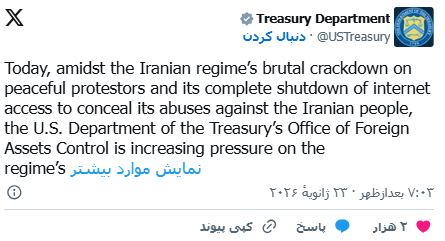
U.S. Treasury Tightens Screws on Iran’s “Shadow Fleet”

The U.S. Treasury’s Office of Foreign Assets Control (OFAC) said Friday, 3 Bahman it is increasing pressure on the Islamic Republic’s “shadow fleet,” linking the move to what it described as a brutal crackdown on peaceful protesters and a complete internet shutdown to conceal abuses. The new sanctions target nine shadow-fleet vessels and their owners or owner-companies that OFAC says moved hundreds of millions of dollars’ worth of Iranian oil and petroleum products to foreign markets; Treasury argued those revenues should belong to Iranians but are instead channeled into regional proxy groups, weapons programs, and security services. Treasury Secretary Scott Bessent said Iran is engaged in “economic self-immolation,” accelerated by President Donald Trump’s maximum-pressure campaign, and claimed Tehran’s choice to back “terrorists” over its own people has driven a collapse in the currency and living conditions, adding that the sanctions strike a key revenue stream used to fund domestic repression and that Treasury will continue tracking funds the regime allegedly moves to banks outside Iran. OFAC said the measures target Iran’s oil and petrochemical sectors.

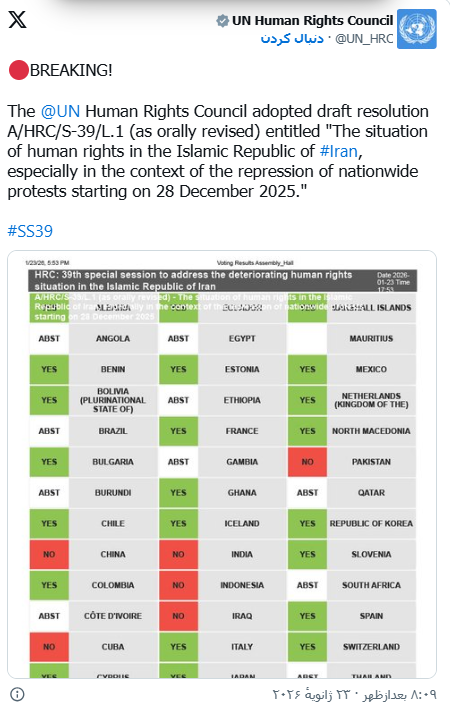
UN Human Rights Council condemns Iran protest crackdown in 25–7 vote

The UN Human Rights Council adopted a resolution on Friday, 23 January 2026 (3 Bahman) condemning the violent suppression of protests in Iran, passing with 25 votes in favor and seven against. Countries reported as voting against included China, Cuba, India, Indonesia, Iraq, Pakistan and Vietnam, while a cross-regional bloc supported the measure as international scrutiny of Iran’s crackdown intensifies.

Trump Backs Putin’s $1B Frozen-Assets Pitch for “Peace Council” Seat

Russia’s Vladimir Putin said Moscow is considering joining President Donald Trump’s “Board of Peace” (also referred to as a “Peace Council”) and proposed using $1 billion from Russian sovereign funds frozen in the United States as the required contribution—framing the money as support for Palestinians and Gaza reconstruction. Trump reacted positively, calling the idea “very interesting,” as the proposal surfaced alongside late-night Kremlin talks with a U.S. delegation that included Steve Witkoff, Jared Kushner, and Board-of-Peace adviser Josh Gruenbaum, ahead of further U.S.-Ukraine-Russia negotiations in Abu Dhabi; there has been no confirmed announcement that Russia has formally joined.

Trump Warns Europe on U.S. Assets, Takes Aim at NATO’s Record

President Donald Trump warned that the U.S. would respond with “big retaliation” if European countries move to sell down trillions of dollars in American assets, saying Washington “has all the cards,” in comments reported from an interview on the sidelines of the World Economic Forum in Davos. In the same media round, Trump also questioned NATO’s value to the U.S., saying America has “never needed” the alliance, and dismissed allied contributions in Afghanistan by claiming NATO troops stayed “a little back” from the front lines—remarks that drew sharp criticism in parts of Europe.

CENTCOM Chief Set for Israel Visit as U.S. Team Meets Netanyahu

U.S. Central Command chief Adm. Brad Cooper is expected to arrive in Israel on Saturday, January 24, 2026, for talks with senior officials amid heightened regional tensions, according to Israel’s Kan public broadcaster. The same reporting says Cooper recently made a low-profile trip to Syria to assess Damascus’s adherence to its ceasefire commitments with the Syrian Democratic Forces, after meeting SDF leaders in Iraq’s Kurdistan region. Separately, Israel’s Channel 12 reported that White House adviser Jared Kushner and U.S. special envoy Steve Witkoff are also due in Israel on Saturday for meetings with Prime Minister Benjamin Netanyahu focused on Hamas and Gaza—especially efforts tied to Ran Gvili, described as the last remaining hostage in Gaza—alongside possible discussions related to Iran.

Reports: Trump–NATO Greenland Understanding Eyes Minerals and Missile Defense

Bloomberg reported that a Trump–NATO understanding on Greenland could grant the U.S. rights to extract minerals on the island, enable deployment of U.S. missiles, and deepen NATO’s presence—while noting the terms are linked to whether President Donald Trump follows through on his pledge to hold off on tariffs on European goods. CNN, meanwhile, reported Trump and NATO Secretary General Mark Rutte have reached an agreement “in principle,” but that the details are not yet formalized in writing; the next step would be U.S.–Denmark–Greenland talks to update the 1951 defense agreement governing the U.S. military presence, alongside measures aimed at blocking Russian and Chinese investment and expanding NATO activity in the region.

Abu Dhabi Talks to Continue as Ukraine Expands Delegation

A member of Ukraine’s delegation in Abu Dhabi, Rustem Umerov, said today’s meeting focused on “the parameters of ending the war and the subsequent logic of the negotiation process” aimed at moving toward a dignified and lasting peace, and confirmed that Kyiv’s talks with the United States and Russia will continue tomorrow. Umerov added that Ukraine will expand its delegation for the next round, with Chief of the General Staff Gen. Andriy Hnatov and Deputy Chief of the Defense Ministry’s Main Intelligence Directorate Lt. Gen. Vadym Skibitsky set to join.

White House: Abu Dhabi U.S.–Ukraine–Russia Meeting “Productive”

The White House said talks in Abu Dhabi between the United States, Ukraine, and Russia were productive, as negotiations on ending the war move forward. Kremlin spokesman Dmitry Peskov said work on resolving the crisis is progressing and emphasized the need to implement the “Anchorage formula.” Media, citing a senior White House official, reported the negotiations will continue tomorrow, and first footage from the delegations’ meeting in the UAE has also surfaced.


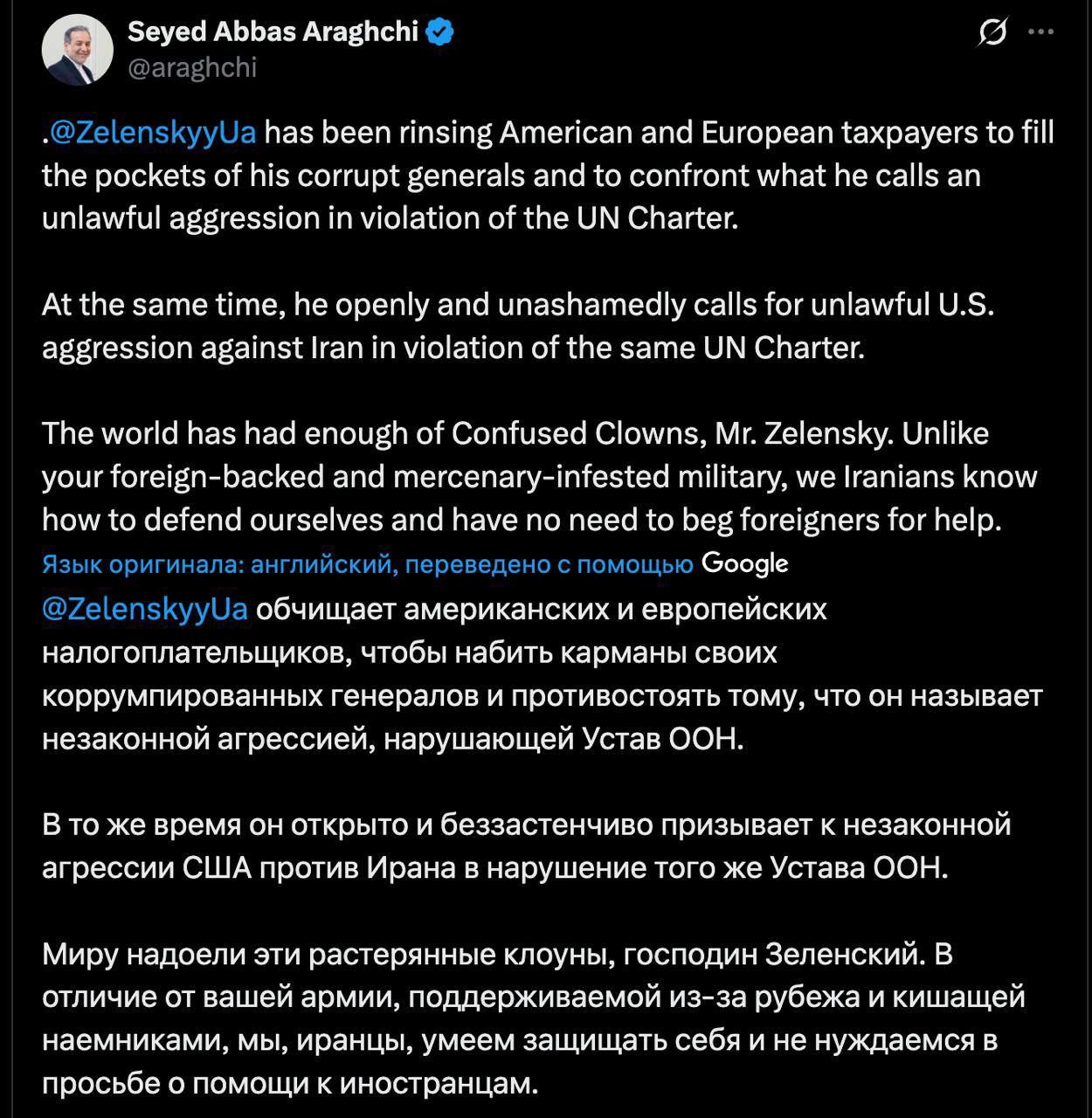
Tehran Slams Zelensky After Davos Protest Remarks

Iranian Foreign Minister Abbas Araghchi lashed out at Ukrainian President Volodymyr Zelensky after Zelensky’s World Economic Forum speech in Davos argued that Iran’s protests were “drowned in blood” and warned that if the clerical leadership survives after killing thousands, it sends a signal to “every bully” that mass violence preserves power. Araghchi responded in an English-language post on X, calling Zelensky a “confused clown,” accusing him of draining U.S. and European taxpayers while also, in Tehran’s framing, urging unlawful U.S. action against Iran—language that underscores how Iran’s crackdown is increasingly spilling into high-profile diplomatic confrontations.

Corriere: Donbas-for-Deal Draft Ties Territory to $800bn Rebuild and U.S. Guarantees

Italy’s Corriere della Sera reported that negotiators are carrying a four-document draft package described as the core of a Trump–Zelensky deal, with one key text envisaging Ukraine yielding the remaining Ukrainian-held part of Donetsk—framed as part of a wider Donbas handover—to Russia. The report says the proposal is paired with a public-private reconstruction plan totaling about $800 billion (linked in the draft to BlackRock’s Larry Fink) and U.S. security guarantees intended to back European troops on the ground—while warning the territorial concession could be politically explosive for Zelensky and noting both the funding and Russia’s acceptance of NATO-linked guarantees remain uncertain.

More Political news

Iran

Khamenei’s Qom representative warns of regional escalation if Iran is attacked

Mohammad Saeedi, Khamenei’s representative in Iran’s Qom province, said that if “the enemy” attacks Iran, Tehran will draw “the entire region” into the conflict—language that underscores a deterrence narrative and signals a broader escalation risk beyond Iran’s borders if military pressure intensifies.

Teachers’ union council: Hamedan educators’ activist Reza Moslemi detained on 19 Dey

Iran’s Coordinating Council of Teachers’ Trade Associations reported that Reza Moslemi, a teachers’ صنفی (labor/union) activist in Hamedan, was detained in the city on 19 Dey. No further official details on the charges or his whereabouts were provided in the report.

Report: 29-year-old Milad Mianehkhah Monfardi killed in Anzali on 19 Dey

Information cited by Iran International says Milad Mianehkhah Monfardi, 29, was killed in Anzali on the night of 19 Dey after being shot with live ammunition by Islamic Republic security forces during the ongoing protests. The report notes he previously played for Malavan’s youth teams. The circumstances described have not been independently verified.

Iran’s prosecutor general rejects Trump’s execution claim: “False… we take orders from no one”

Iran’s Prosecutor General Mohammad Movahedi Azad dismissed Donald Trump’s claim about plans to execute around 800 people, calling it “false” and saying no such figure existed and no decision had been made. He added that Iran’s judiciary is an independent institution and “does not take orders from foreigners.”

Iran MP: Many wounded never reached hospitals and died

Ahmad Fatemi, a member of Iran’s parliament and the Majles Social Commission, said that many people injured during the “Iranian national revolution” protests were not transferred to hospitals and lost their lives—an admission that underscores concerns about access to emergency care and the conditions surrounding the handling of casualties.

IRGC deputy commander: “The Guard’s duty is to protect the Islamic Revolution”

Ahmad Vahidi, the deputy commander of Iran’s Islamic Revolutionary Guard Corps (IRGC), said the IRGC’s mission is “to protect the Islamic Revolution,” reiterating the force’s foundational role as a regime-protection institution amid ongoing unrest.

Former Malavan youth player Milad Mianehkhah Monfardi killed in Anzali, report says

Information cited by Iran International says Milad Mianehkhah Monfardi, 29, a former player for Malavan’s youth teams, was killed in Anzali on the night of 19 Dey 1404 after being shot with live ammunition by Islamic Republic security forces during the ongoing protests. The report adds that he had recently been accepted into a maritime-related field of study and also worked in hemp/rope-making. The circumstances described have not been independently verified.

Kangan witness: Security forces announced “orders to shoot from the waist up” amid crackdown

A citizen account from Kangan (Bushehr province) says that on Friday, 19 Dey, roughly half the city’s population gathered on Moallem Street to protest, and that demonstrators entered a judicial office, removed case files opened against protesters, and set them on fire. The witness says that after about three hours of chanting, security forces were deployed to Kangan from Bushehr and Khormoj and began firing toward the crowd, while using loudspeakers to warn that they had “orders to shoot from the waist up” and demanding people return home. The same account alleges that 15- and 16-year-old girls were detained in front of onlookers and that whenever citizens approached to intervene, forces fired shots into the air; it also claims nearly 100 people were arrested and that live rounds were used to shoot protesters in the legs to disperse the crowd. These claims are extremely serious and have not been independently verified.

Akhavan: Laying groundwork for Iran's “transitional justice” and a potential “Nuremberg moment.”

Payam Akhavan, described as a former UN war-crimes prosecutor and scheduled to speak at the UN Human Rights Council’s special session on Iran, told Reuters that “the scale of these crimes is unprecedented.” He said efforts are underway to prepare the foundations for transitional justice in Iran—positioning the work for a potential “Nuremberg moment” if circumstances allow.

Isfahan: Reports say streets were washed after gunfire to erase signs of crackdown

Messages from witnesses in Isfahan claim that after extensive shooting at protesters, government forces attempted to remove evidence of the crackdown by washing streets and collecting traces of blood and clashes, in an effort to clear visible signs of repression from public areas. These accounts have not been independently verified.

Report: 19-year-old amateur boxer Sepehr Ebrahimi killed in Andisheh, Tehran

Media reports say Sepehr Ebrahimi, a 19-year-old amateur boxer, was killed in Andisheh (Tehran province) during the ongoing protests, with the reports attributing his death to Islamic Republic security forces. Further details on the circumstances and timing have not been independently verified.

Report: 37-year-old Mohammad Mirzaei Noshabadi killed by live fire in Sari on 18 Dey

Information received says Mohammad Mirzaei Noshabadi, 37, a building installations worker, was killed in Sari on the night of 18 Dey after being shot in the abdomen with live ammunition by government forces. The circumstances described have not been independently verified.

Iran MP opposes easing internet curbs, warns it would fuel “violent image” abroad

Abolfazl Aboutorabi, the Majles representative for Najafabad, said restoring access to social networks and lifting internet restrictions would be a “big mistake.” He argued that “counter-revolutionary” groups are poised to exploit any easing to portray the system as violent, which he said could carry international consequences for the country.

Iran’s Intelligence Ministry says it detained a “factory owner” for joining protests

Iran’s Ministry of Intelligence announced the arrest of a “factory owner,” saying the detention was linked to alleged participation in the ongoing protests. No further details about the individual’s identity, charges, or legal process were provided in the announcement.

Rasht witness account: Alleged shootings of people trying to aid the wounded; arson and nightly lockdown claims

A witness message from Rasht alleges security forces encircled injured protesters to block assistance and fired directly at anyone who tried to help, at times forming a ring around the wounded to prevent people from approaching. The account cites an incident on Takhti Street in which a bleeding injured person was allegedly shot alongside a citizen who attempted to provide aid, with the helper reportedly killed by a headshot by officers said to have been hiding in a nearby alley. The same message claims security forces hid in side streets and shot at passersby, while also alleging widespread arson and damage across the city—saying roughly 90% of mosques were set on fire or vandalized, part of Rasht’s Khomeini prayer hall (mosalla) burned on 18 Dey, and banks on main streets were heavily damaged or destroyed. The witness further claimed that a de facto curfew or martial-law conditions in Rasht begin from dusk. These allegations are extremely serious and have not been independently verified.

Report: Poldokhtar boxing chief Ali Alipour dies a day after detention

Information cited by Iran International says Ali Alipour, head of the Poldokhtar boxing board, died one day after being detained during the protests. The report states he was arrested on 19 Dey 1404, released later that night, and then died the following morning from an apparent heart attack. The death is being described as suspicious alongside unverified claims circulated to Iran International alleging torture and injections of unknown substances administered to detainees. These claims have not been independently verified.

Eyewitness: Armored Vehicles and “Bloodied Streets” in Mashhad Crackdown

An Iranian woman in Mashhad told Iran International that security forces used armored personnel carriers and carried out night-time violence that left, in her words, “rivers of blood,” while streets were cleaned in the mornings ahead of further crackdowns. She said many wounded protesters avoided hospitals due to fear of security presence and arrest, leading to improvised home treatment supported by volunteers. She also disputed official fatality figures, claiming roughly 150 people were killed on the first night before a formal shoot-to-kill order, including 40 deaths in the city’s Gorgan neighborhood, and alleged casualties rose sharply after the order—far exceeding the numbers publicly reported.

Rights Groups Urge UN to Launch Independent Probe into Iran Abuses

A coalition of rights and press-freedom organizations—including the Narges Foundation, PEN America, Reporters Without Borders, and Front Line Defenders—sent a letter to the president of the UN Human Rights Council calling for an independent, transparent investigation into serious human-rights violations tied to Iran’s ongoing protests. The groups warned that since 7 Dey, human-rights defenders, journalists, writers, teachers, labor unions, and women’s and minority advocates have been increasingly targeted amid a “brutal crackdown,” while internet disruptions have made documentation—including of alleged mass killings—extremely difficult and placed local documenters at grave risk. They also said detainees face heightened danger, citing the continued detention of figures such as Narges Mohammadi, Sepideh Gholian, and Pouran Nazemi since 22 Azar in Mashhad, alongside broader pressure on anti–death penalty activists, women’s-rights defenders, and lawyers representing protesters. The letter calls for the immediate and unconditional release of all those jailed for peaceful activism or expressing opinions, restoration of full, unrestricted internet access, and strengthened international support for existing UN mechanisms—especially the fact-finding mission and the Iran special rapporteur—while urging governments to facilitate protection pathways, including temporary relocation visas.

Arrest Wave Persists in Islamabad-e Gharb, Rights Group Says

The Kurdistan Human Rights Network reported that after what it described as a severe and bloody crackdown on protests in Islamabad-e Gharb (Kermanshah province), dozens of protesters have been killed and many more injured, while a broad wave of arrests continues. Citing informed sources, the group said security agencies have pressured some families of those killed to blame Kurdish opposition parties for the shootings. It also alleged repeated raids on Islamabad-e Gharb’s hospital—especially on 18–19 Dey—aimed at seizing and detaining injured protesters, prompting families to discreetly remove the wounded and, in some cases, bodies to prevent them from falling into security custody. Another source said families were often denied burial in the city cemetery and were forced to transfer bodies to nearby villages for burial.

Iran Teachers’ Union Condemns “Bloody Crackdown” and Mass Arrests

The Coordinating Council of Iran’s Teachers’ Trade Associations said it “strongly condemns” what it described as the bloody suppression of the popular uprising, the killing of citizens, widespread arrests of teachers, students, and labor activists, and systematic pressure on the families of those killed and detained. In a statement posted on its Telegram channel, the council said the use of organized violence against protesters—especially in educational settings—constitutes a clear violation of human rights, children’s rights, and the fundamental right to education. It held the “direct responsibility” for these crimes with those who ordered and carried out the crackdown, calling for the immediate and unconditional release of all detainees, an end to the securitization of education, and transparent accountability by relevant authorities, adding: “This repression is neither legitimate nor will it be forgotten.”

Teen Protester Killed in Karaj; Mother Held Her Body Until Morning

According to information shared with Iran International, Faizeh Mosta’an (born Mehr 1384) was killed during the 18 Dey protests in Fardis, Karaj, after being shot in the chest. Witnesses said her family began searching the area after losing contact with her, and another protester later delivered her body to the family. Relatives said her mother held Faizeh’s body until around 6 a.m., after which it was transferred for autopsy and reportedly returned to the family about two days later. The report also said Faizeh’s mother fell into a coma during the burial ceremony, which proceeded without her, and alleged the shot was fired from a rooftop using a Kalashnikov-style rifle.


Two Teachers Reported Killed in Iran Protests on 18 Dey

An Iranian teachers’ labor channel, “Chalesh-e Senfi-ye Mo’alleman,” reported that a retired teacher and an active teacher were killed during protests on 18 Dey in Chalous (Mazandaran province) and Kermanshah. It said Reza Karimi-Far, a retired teacher, was shot dead in Chalous by security forces after he tried to help a young female protester who had fallen after being hit by live fire—first struck in the leg and then reportedly shot four more times in the chest. The channel also reported that Kamran Akbari, a teacher in Kermanshah, was killed the same day by direct fire from security forces.

Airlines Quietly Scale Back Middle East Routes on Security Jitters

Several major international airlines are reportedly cancelling or limiting parts of their Middle East schedules gradually and with limited public notice. Reports say Air France has scrapped flights to Dubai and British Airways has halted its evening service on the same route without giving a detailed explanation. KLM explicitly cited “security tensions in the region,” cancelling flights to Tel Aviv’s Ben Gurion airport through Sunday and also suspending services to Dubai and destinations in Saudi Arabia; the carrier typically operates a daily Tel Aviv–Amsterdam rotation. Earlier, the Lufthansa Group (Lufthansa, SWISS, Austrian, Brussels Airlines, and Eurowings) said it would operate Israel flights only during daylight hours due to the regional security situation—moves that collectively point to rising airline risk concerns.

More Iran news

Others

Tense Mood at Davos Signals Unease Over Shifting World Order

Analysts and journalists at Davos observed a tense atmosphere among global leaders and participants, reflecting concerns about rising geopolitical disputes, fragmented alliances, and widening inequalities. Reports describe leaders grappling with challenges to the post‑war international system and struggling to find common ground on cooperation and global governance — even as A Spirit of Dialogue remains the forum’s official theme.

Market impact: Heightened risk sentiment could persist in markets sensitive to geopolitical uncertainty, affecting assets like sovereign bonds and currencies in emerging regions.

WEF Head Says Persian Gulf Shifting from Consumer to AI Power

The head of the World Economic Forum highlighted that the Persian Gulf region is transitioning from a consumer market to a key player in artificial intelligence (AI) during comments in Davos. He said the shift reflects broader trends where emerging markets contribute to technological innovation and global dialogue on AI governance and development.

Market impact: Signals investment potential in AI and tech ecosystems across Middle Eastern economies, with implications for global tech capital flows.

Final Day Focus: Geopolitics, Social Strains, and the Davos Close

On the final day (Day 5) of the World Economic Forum Annual Meeting 2026 in Davos, sessions focused on a range of topics from social movements and mental health to geopolitical risks and the future of science and innovation. Discussions also included the global economic outlook and reflections on the meaning of politics in today’s contested world. Closing remarks were scheduled with WEF President Børge Brende.

Market impact: Signals where global policy and sentiment may be headed in 2026, potentially shaping investor expectations around social, economic, and geopolitical themes.

IMF’s Georgieva Warns AI Could Hit Entry-Level Jobs Hard

IMF Managing Director Kristalina Georgieva warned at Davos that AI could be a “tsunami” for the global labour market, potentially affecting about 60% of jobs in advanced economies and around 40% globally. She cautioned that younger workers may be disproportionately exposed because entry-level tasks are easier to automate. Delegates stressed inclusive approaches so that productivity gains are broadly shared.

Market impact: Keeps focus on labour disruption risk; supportive for automation/AI beneficiaries but increases scrutiny on workforce policy, education, and social-stability trade-offs.

Lagarde and IMF Signal “Cooperate, Don’t Fragment” as Risks Stack Up

In Davos economic discussions, ECB President Christine Lagarde and IMF leadership emphasized cooperation and realism in assessing global risks (inequality, geopolitical tensions, and barriers to trade/technology). Speakers argued against a total breakdown of the international economic order while warning that trust, governance, and distribution effects will be central in the next phase of global growth.

Market impact: Reinforces a cautious macro tone; can support safe havens on weak-confidence headlines while keeping policy-credibility and coordination as key market anchors.

“Davos as a Party” Critique Spreads, Raising Questions on Forum Credibility

Some long-time participants and commentators argued that Davos 2026 is increasingly shaped by private, invitation-only events hosted by large tech and finance firms, turning parts of the week into a social scene and diluting policy focus. The critique gained attention despite the presence of major leaders, highlighting concerns about whether the forum still delivers actionable coordination under the “Spirit of Dialogue” banner.

Market impact: Limited direct market effect, but can influence perceptions of elite coordination venues; reputational debates may shape how investors interpret “Davos signals” going forward.

“Mother of All Deals” Watch: EU–India FTA Gets a Davos Push

Davos talk around trade sharpened as EU leaders signalled the EU–India free trade agreement may be “on the cusp,” with the deal framed as potentially creating a combined market of roughly 2 billion people. The message was echoed across Davos trade discussions as companies were urged to prepare for faster-moving dealmaking in a more fragmented geopolitical environment.

Market impact: If negotiations convert into a concrete timeline, it could boost sentiment for EU/India-linked exporters, supply chains, and cross-border investment—while raising competitive pressure in protected sectors.

Greenland Tariff Threats Quietly Dropped After NATO Meeting

A Davos trade recap noted that U.S. tariff threats tied to European resistance over Greenland-related proposals were dropped after a meeting with NATO Secretary General Mark Rutte—an episode that still rattled markets and reinforced expectations that trade tools will keep being used for non-economic objectives.

Market impact: Reduced near-term tariff tail-risk may offer a brief relief bid for European equities and cyclicals, but the “trade-as-leverage” precedent keeps volatility risk elevated.

Matt Damon’s Water.org Launches “Get Blue” with Major Corporate Partners

Water.org announced a new “Get Blue” initiative at Davos aimed at scaling corporate-backed work on water access, with early partners reported to include Gap, Amazon, Starbucks and Ecolab.

Market impact: Adds momentum to water-access and climate-adaptation funding themes; could support ESG/impact capital flows into water infrastructure and resilience projects.

Trump Pulls Carney’s “Board of Peace” Invite After Davos Speech

The Financial Times reported that Donald Trump rescinded an invitation for Canadian PM Mark Carney to join Trump’s newly launched “Board of Peace,” shortly after Carney’s Davos remarks criticizing the state of the rules-based order and raising governance concerns about the initiative.

Market impact: Highlights uncertainty around ad-hoc geopolitical initiatives; could add risk premium to Middle East-linked assets if perceived as complicating diplomatic pathways.

Social Pulse: WEF Signals the Closing Sequence—Outlook Session, Then Final Remarks

In a public post, the World Economic Forum’s official account flagged the final flow of the day: attention moving to the Global Economic Outlook session ahead of Closing Remarks that formally end Davos 2026.

Market impact: Low direct impact, but it’s a real-time cue for traders/media on when final headline risk from top-stage sessions typically peaks.

Mexico Activity Stalls: IGAE Slips Below Zero in November

Mexico’s economic activity (IGAE) disappointed in November, with -0.2% m/m (vs +0.2% expected, +1.0% prior) and -0.1% y/y (vs +1.2% expected, +1.8% prior). The miss suggests momentum cooled sharply late in the year, raising downside risk to near-term growth expectations.

Market impact: Mildly bearish for MXN at the margin and supportive for Banxico dovish pricing (more room to ease), while weighing on Mexico domestic cyclicals; FX reaction still depends heavily on USD tone and global risk appetite.

More Others news

Europe

Germany–France Outlook Steady: 1.0% Growth Seen for Both in 2026

Economists in a Reuters poll expect Germany—after barely expanding last year—to grow 1.0% in 2026 and 1.5% in 2027, broadly unchanged from October forecasts, partly reflecting optimism around infrastructure spending plans. France is also seen growing 1.0% in 2026 and 1.1% in 2027, versus 0.9% and 1.2% projected three months ago.

Market impact: Modestly supportive for European cyclicals and EUR sentiment at the margin, but the rates/FX impulse should still be driven mainly by inflation, wages, and ECB guidance rather than incremental forecast tweaks.

France Business Mood Jumps: Survey Index Rises to 105

France’s Business Survey strengthened in January, with the headline index rising to 105 (vs 101 expected, 102 prior). The upside suggests improved corporate sentiment and activity expectations at the start of the year, reinforcing a modestly better near-term growth tone.

Market impact: Mildly supportive for French/European cyclicals and EUR sentiment at the margin, though ECB pricing will still hinge more on inflation and wages than on a single confidence print.

France PMI Splits: Manufacturing Expands, Services Slumps—Composite Back Below 50

France’s January HCOB PMI picture deteriorated overall despite a manufacturing uptick. Manufacturing PMI rose to 51.0 (vs 50.4 expected, 50.7 prior), moving deeper into expansion. But Services PMI fell sharply to 47.9 (vs 50.3 expected, 50.1 prior), dragging the Composite PMI down to 48.6 (vs 50.1 expected, 50.0 prior). The divergence suggests services-driven demand is weakening, offsetting gradual factory stabilization.

Market impact: Slightly dovish for ECB pricing at the margin and a mild headwind for EUR if services weakness persists; supports a cautious outlook for French/Eurozone growth-sensitive equities, even as manufacturing pockets improve.

Germany PMI Upturn: Services Solid, Manufacturing Still in Contraction

Germany’s January HCOB PMIs improved broadly. Manufacturing PMI rose to 48.7 (vs 47.8 expected, 47.0 prior), signaling a continued contraction but with a clear easing in the downturn. Services PMI ticked up to 53.3 (vs 52.6 expected, 52.7 prior), staying firmly in expansion. The Composite PMI climbed to 52.5 (vs 51.8 expected, 51.3 prior), pointing to stronger overall activity momentum at the start of the year.

Market impact: Modestly supportive for EUR sentiment and German/Eurozone cyclicals; may reduce near-term recession pricing, but manufacturing below 50 keeps the growth outlook uneven and limits any hawkish repricing of ECB expectations on PMI data alone.

Eurozone PMI Mixed: Manufacturing Improves, Services Cools—Composite Stuck at 51.5

The Eurozone’s January HCOB PMIs were broadly steady but with a clear internal rotation. The Composite PMI held at 51.5 (in line with the prior, just under 51.6 expected), signaling modest expansion. Manufacturing PMI rose to 49.4 (vs 49.1 expected, 48.8 prior), showing gradual improvement though still in contraction. Services PMI slipped to 51.9 (vs 52.6 expected, 52.4 prior), indicating softer momentum in the dominant services sector.

Market impact: Net slightly dovish at the margin (services cooling offsets manufacturing improvement), limiting upside for EUR and keeping ECB pricing biased toward patience/easing; cyclicals may prefer the manufacturing rebound, but growth tone remains only moderate.

More Europe news

USA

Fed Balance Sheet Ticks Up: Reserves Drop to $2.96T

The Federal Reserve’s balance sheet edged higher to $6,585B from $6,582B, while reserve balances fell sharply to $2.957T from $3.062T. The move suggests a notable week-to-week drain in system reserves even as the headline balance sheet was little changed—often reflecting shifts in Treasury cash balances, reverse repos, or other liability-side dynamics.

Market impact: Lower reserves can tighten short-term liquidity at the margin, but this is typically rates-market plumbing unless the trend persists; watch front-end funding conditions and SOFR/OIS spreads for signs of stress.

US Leaves WHO: Withdrawal Now in Effect

The White House said the United States has formally completed its withdrawal from the World Health Organization, following a one-year notice period triggered by President Trump’s withdrawal order. U.S. officials and multiple reports describe the exit as effective as of Jan. 22, 2026, ending decades of U.S. membership and participation in WHO governance and technical coordination.

Market impact: Limited immediate macro impact, but the move can raise tail-risk around global disease surveillance/vaccine coordination and policy uncertainty—relevant to healthcare supply chains, travel/airlines sensitivity in outbreak headlines, and broader risk sentiment if future public-health shocks emerge.

US PMIs Steady: Services Slight Miss, Manufacturing Holds Expansion

U.S. January S&P Global PMIs were largely stable. Services PMI printed 52.5 (vs 52.9 expected, 52.5 prior), a small downside miss but still in expansion. Manufacturing PMI held at 51.9 (in line with expectations, up from 51.8), while the Composite PMI edged up to 52.8 (from 52.7). Overall, the data point to continued moderate growth momentum with little change in the near-term activity picture.

Market impact: Mostly neutral for Fed pricing—supports a “soft-landing/steady growth” narrative; modestly supportive for risk assets, with USD and yields still more sensitive to inflation and labor-market surprises.

Michigan Mood Rebound: Sentiment Jumps, 1-Year Inflation View Eases

The University of Michigan’s January survey showed a sharp improvement in consumer psychology: consumer sentiment rose to 56.4 (vs 54.0 expected, 52.9 prior) and expectations climbed to 57.0 (vs 55.0 expected, 54.6 prior), while current conditions increased to 55.4 (vs 52.4 expected, 50.4 prior). On inflation expectations, 1-year expectations cooled to 4.0% (vs 4.2% expected; prior figure in the data appears truncated), while 5-year expectations ticked up to 3.3% (vs 3.4% expected, 3.2% prior), keeping longer-run inflation sensitivity in focus.

Market effect: Generally, risk-supportive (better sentiment), with a bond-friendly tilt from softer 1-year inflation expectations—though the slight rise in 5-year expectations can limit any dovish repricing of Fed expectations.

US Leading Index Stays Weak: -0.3% in November

The U.S. Leading Economic Index fell -0.3% m/m in November, slightly weaker than expected (-0.2%) and matching the prior decline (-0.3%). The persistent negative prints point to continued soft forward-looking momentum, even as coincident activity data (like PMIs and consumption) have been holding up better.

Market impact: Mildly growth-cautious signal—supports a “late-cycle/slowdown risk” narrative and can be modestly supportive for duration if it reinforces expectations of eventual Fed easing, though markets will still take their main cues from inflation and jobs.

More USA news

Japan

Takaichi Triggers Snap Vote: Japan Heads to Feb 8 Election

Japan’s Prime Minister Sanae Takaichi dissolved the lower house on January 23, 2026, setting a snap election for February 8 and launching what is being described as an exceptionally short 12-day campaign starting Tuesday, January 27. The move appears designed to capitalise on strong approval ratings, but it also interrupts budget work and arrives as markets scrutinise Japan’s fiscal trajectory and rising bond yields.

Market impact: Political uncertainty plus fiscal-stimulus talk is JGB-bearish / yield-supportive at the margin and can add JPY volatility; the BoJ’s reaction function (and any hints on bond-market stability) remains the key cross-asset hinge.

BOJ Holds at 0.75%: Yen Softens as Outlook Turns Slightly More Upbeat

The Japanese yen eased after the Bank of Japan kept its policy rate unchanged at 0.75% in an 8–1 vote, while raising its inflation and growth forecasts for FY2025–FY2026, citing expectations for additional support from government spending. In market trading, USD/JPY rose about 0.2% to ~158.80, reflecting a modestly softer yen as investors weighed the “hold” decision against a marginally more optimistic outlook.

Market impact: Near-term JPY softness/volatility is likely to persist if markets view the BOJ as patient while fiscal support stays expansionary; however, upgraded forecasts keep the risk of earlier hikes in play, which can reprice JGB yields and cap USD/JPY upside on hawkish signals.

Japan Inflation Cools: Core CPI Slips to 2.4%

Japan’s December inflation data showed a clear step-down. National core CPI (y/y) eased to 2.4% (in line with expectations, down from 3.0%), while headline CPI (y/y) fell to 2.1% (from 2.9%). On the month, headline CPI fell -0.1% (from +0.3%) and CPI (NSA) declined -0.2% (from +0.3%). The print supports the view that price pressures are moderating, even as the BoJ weighs the interaction between inflation, wages, and a weaker yen.

Market impact: Marginally dovish for BoJ pricing (supports lower yields) and can be JPY-negative at the margin if it reduces urgency to hike; however, FX reaction still hinges on global yields and BoJ guidance around inflation persistence.

Japan Pitches Cross-Border Tech Cooperation via Digital Policy and Health Tech

Japan’s Minister for Digital Transformation, Minoru Matsumoto, attended Davos and spoke at sessions including “Country Strategy Dialogue on Japan” and “Digital Healthcare Transformation: Re-imagining Health.” He exchanged views with other ministers and global tech executives on digital policy cooperation and health technology innovation.

Market impact: Emphasis on digital health and technology collaboration may attract investor interest in innovative sectors and strengthen signals of cross-border tech policy coordination.

More Japan news

Commodities

Gold Nears $5,000 as Trump Signals U.S. Ships Moving Toward Iran

Gold hit fresh record highs in Asian trade on Friday, January 23, with spot prices touching around $4,967/oz and February futures near $4,970/oz, as safe-haven demand flared after President Donald Trump said the U.S. had deployed a naval “armada”/ships toward Iran. The move extends a broader precious-metals rally that has been supported by heightened geopolitical risk and a softer U.S. dollar backdrop.

Market impact: Bullish bias for gold and broader havens (and potentially oil risk premia) while the Iran headline remains live; watch USD direction and real yields for whether the rally sustains, and expect elevated cross-asset headline volatility (metals, energy, EM FX).

Silver & Platinum Hit Fresh Records as Iran Risk Keeps Havens Bid

Silver and platinum surged to new all-time highs on Friday, with spot silver near $99/oz and spot platinum near $2,690/oz, as haven demand stayed in play. Precious metals had briefly eased after Trump touted a Greenland-related “framework” deal, but a lack of detail and renewed Iran-linked geopolitical headlines kept investors positioned for uncertainty.

Market impact: Supports precious metals and volatility-sensitive hedges; sustained upside typically requires a softer USD and/or lower real yields, while any de-escalation headlines can trigger fast profit-taking.

Oil Extends Weekly Rally as Trump Flags Iran Military Risk

Oil prices rose in Asian trade on Friday after President Donald Trump signaled potential military action involving Iran, lifting concerns about fresh Middle East supply disruption risk. Brent (March) gained about 0.9% to ~$64.62/bbl and WTI rose about 0.9% to ~$59.89/bbl, leaving crude on course for a fifth straight weekly gain as markets added geopolitical risk premium on top of a gradually improving demand narrative.

Market impact: Supportive for near-term crude risk premia (and potentially refined-product cracks) while Iran headlines remain live; expect higher energy volatility and sensitivity in EM FX and shipping/tanker rates if escalation signals intensify.

US Rig Count Edges Up: Oil Rigs at 411, Total at 544

Baker Hughes data showed a small uptick in U.S. drilling activity, with the oil rig count rising to 411 (from 410) and the total rig count increasing to 544 (from 543). The move suggests marginally firmer upstream activity, though changes of one rig are typically noise unless part of a sustained trend.

Market impact: Limited immediate price signal; a gradual, persistent rise would be modestly bearish for crude at the margin via future supply expectations, while near-term oil pricing remains far more sensitive to OPEC+, inventory trends, and geopolitical risk premia.

More Commodities news

Equities

Nikkei Gains Fade After BOJ Hold

Japan’s Nikkei 225 rose 0.3% and the broader TOPIX added 0.4%, but both indexes trimmed earlier gains after the Bank of Japan’s policy decision, suggesting initial risk appetite cooled as traders recalibrated rate and FX expectations.

Market impact: Mildly supportive for Japan equities, but directional follow-through likely hinges on JPY moves and JGB yields after the BOJ messaging.

KOSPI Near Record: Tech and Autos Power a 2.5% Weekly Gain

South Korea’s KOSPI rose 0.6%, trading just below a record high as technology and automaker shares stayed bid. The index capped a strong week, up about 2.5%, making it the top performer in Asia over the period.

Market impact: Reinforces a risk-on tone for Asia ex-Japan and supports KRW sentiment at the margin, though follow-through remains sensitive to global AI/semiconductor pricing, U.S. yields, and any renewed trade/geopolitical headlines.

Netflix vs Paramount: WBD Shareholders Lean Toward Netflix’s $82.7B Studio Bid

Netflix co-CEO Greg Peters told the Financial Times the company is on track to secure Warner Bros. Discovery shareholder backing for Netflix’s $82.7 billion offer for WBD’s film and TV studios, dismissing Paramount’s rival approach as one that “doesn’t pass the sniff test.” Peters said only a “very small” number of WBD shares have been tendered into Paramount’s hostile bid for the full company, and argued Netflix’s proposal carries greater deal certainty, contrasting it with Paramount’s financing structure that includes substantial debt.

Market impact: Supports a higher-probability Netflix–WBD studios outcome (WBD deal-arb premium/volatility), while keeping pressure on the rival bid; NFLX can see M&A risk/valuation debate persist, and credit markets will watch leverage and financing certainty closely.

Intel Shock After the Bell: -13% on Data-Center Chip Shortfall

Asian equities traded higher, but sentiment in tech was dented after Intel warned it struggled to meet surging demand for server CPUs used in AI data centers, helping trigger an about 13% after-hours drop in the stock. The update points to renewed strain in parts of the chip supply chain—where bottlenecks in high-demand data-center components can ripple into delivery schedules, pricing, and capex plans across the AI hardware stack.

Market impact: Near-term negative for INTC and potentially choppy for semis, but it can be supportive for pricing power among constrained suppliers and peers; watch for spillovers into AI-server buildouts, hyperscaler capex narratives, and semiconductor lead-time commentary in upcoming earnings.

More Equities news

UK

UK Consumers Less Downbeat: GfK Improves to -16

The UK’s GfK consumer confidence index edged up in January to -16, beating expectations (-17) and improving from -17 previously. While sentiment remains negative, the incremental uptick suggests households are becoming slightly less pessimistic—consistent with easing inflation pressure and a gradual stabilization in real income conditions.

Market impact: Modestly supportive for UK domestic demand sentiment and consumer-facing equities; limited direct impact on GBP, with BoE pricing still primarily driven by inflation and wage trends.

UK Retail Surprise: December Sales Beat as Core Rebounds

UK retail sales came in stronger than expected in December. Headline sales rose 0.4% m/m (vs 0.0% expected, -0.1% prior) and 2.5% y/y (vs 1.0% expected, 1.8% prior). Core retail sales also firmed, with +0.3% m/m (vs -0.2% expected, -0.4% prior) and 3.1% y/y (vs 1.4% expected, 2.6% prior). The upside suggests consumer demand ended the year on a sturdier footing than markets anticipated.

Market impact: Mildly GBP-supportive and hawkish at the margin for BoE pricing (less urgency to ease) if confirmed by wages/inflation; supportive for UK consumer-facing equities, while gilt yields could edge higher on stronger growth optics.

UK PMI Pops: Services Surge Lifts Composite to 53.9

The UK’s January S&P Global PMIs surprised to the upside, pointing to a clear re-acceleration in activity. The Composite PMI jumped to 53.9 (vs 51.7 expected, 51.4 prior). Services climbed to 54.3 (vs 51.7 expected, 51.4 prior), while Manufacturing improved to 51.6 (vs 50.6 expected, 50.6 prior), moving further into expansion. The breadth of the beat suggests stronger near-term growth momentum than markets had priced.

Market impact: GBP-supportive and hawkish at the margin for BoE pricing (cuts may be pushed back if this persists); gilt yields could firm, while UK cyclicals and domestically exposed equities may benefit from improved activity optics.

UK Claims $2B+ in Fresh Private Investment Deals from Davos

In the forum’s end-of-week takeaways, the UK’s Chancellor Rachel Reeves said she had secured deals worth more than $2 billion in private investment during Davos engagements.

Market impact: Supports a positive narrative for UK inward investment and could marginally help UK asset sentiment—especially if projects map to near-term capex and jobs.


More UK news

China

China Urges Strong Support for Free Trade at Davos

Chinese Vice Premier **He Lifeng emphasized China’s continued commitment to free trade and multilateralism in his address at the World Economic Forum. He called for firm support of global trade systems and equitable economic cooperation as central to sustainable growth, pushing back against protectionist pressures.

Market impact: Encouragement of open trade frameworks could bolster investor confidence in global supply chains and international commerce sectors.

China FDI Worsens: December Inflows Down 9.5%

China’s FDI measure fell -9.5% in December, weakening from -7.5% previously. The deeper contraction points to continued pressure on inbound investment sentiment—consistent with ongoing concerns around growth, regulatory visibility, and geopolitical/trade uncertainty.

Market impact: Mildly negative for CNY sentiment and China/Asia risk appetite at the margin; may reinforce expectations for policy support to stabilize confidence, even if rate cuts remain constrained.

More China news

India

India’s PMIs Accelerate: Composite Hits 59.5 on Strong Services

India’s January PMI readings strengthened across the board. The composite PMI rose to 59.5 (from 57.8), driven by a jump in services PMI to 59.3 (from 58.0), while manufacturing PMI improved to 56.8 (from 55.0). The levels signal solid expansion momentum at the start of the year, with services continuing to lead.

Market impact: Supportive for Indian growth sentiment and equities; can be mildly INR-supportive if it reinforces the “India outperformance” narrative, though FX remains sensitive to global risk appetite and oil prices.

India FX Reserves Rebound: Rise to $701.4B

India’s foreign exchange reserves increased to $701.36B, up from $687.19B previously. The uptick strengthens India’s external buffer and can help smooth INR volatility during periods of capital-flow pressure and global risk swings.

Market impact: Mildly INR-supportive at the margin (stronger reserve cover) and supportive for broader macro stability; near-term INR direction still hinges more on oil, U.S. rates, and portfolio flows.

More India news

Day Trade Signals

Trump Withdraws Mark Carney’s Invitation to the Board of Peace

In a controversial move at Davos, **President Trump rescinded the invitation for former central banker Mark Carney to join the Board of Peace, after Carney delivered a high‑profile speech warning about the erosion of the international rules‑based order. Carney’s withdrawal highlights tensions between Trump’s peace initiative and the concerns of some global leaders about its structure and governance.

Market impact: Illustrates the political risk and fragmentation influencing new global governance efforts, potentially pressuring markets sensitive to diplomacy and institutional credibility.


More Day Trade Signals news

Oceania

New Zealand Inflation Firm: CPI 3.1% y/y in Q4

New Zealand’s Q4 CPI came in slightly hotter than expected, with inflation at 3.1% y/y (vs 3.0% expected, 3.0% prior). On a quarterly basis, CPI rose 0.6% q/q (vs 0.5% expected), while slowing from 1.0% in Q3. The print suggests disinflation is progressing, but more slowly than markets anticipated, keeping inflation still above many comfort zones.

Market impact: NZD-supportive and mildly hawkish for RBNZ pricing at the margin (less urgency to ease); front-end NZ rates may stay firmer, while rate-sensitive equities could face a small headwind.

More Oceania news

Russia

Russia Trade Surplus Narrows: November Balance Falls to $6.8B

Russia’s trade balance surplus narrowed in November to $6.80B, down from $10.80B previously. The smaller surplus suggests reduced net export inflows—potentially reflecting weaker export realizations, firmer imports, or a combination of both amid ongoing sanctions and shifting trade routes.

Market impact: Mildly RUB-negative at the margin (less external surplus support) and a watchpoint for Russia’s fiscal and balance-of-payments dynamics; broader RUB moves still hinge primarily on capital controls, energy prices, and sanction-related headlines.

More Russia news

Canada

Canada Retail Whipsaw: November Surge, December Pullback

Canada’s retail sales rebounded sharply in November, with headline sales up 1.3% m/m (vs 1.2% expected, -0.3% prior) and core sales up 1.7% m/m (vs 1.0% expected, -0.6% prior), signaling a stronger-than-anticipated consumer bounce. But the early read for December points to a reversal, with headline retail sales seen at -0.5% m/m (after +1.3% in November), suggesting spending momentum cooled again into year-end.

Market impact: Mixed for BoC pricing—November strength is mildly hawkish, but the December pullback keeps the trend fragile; near-term CAD reaction is likely limited unless confirmed by broader growth/inflation data.

More Canada news