translate English
 پارسی
English
Englishپارسی
English
Englishپارسی EnglishپارسیEnglishپارسی
Headline US consumer prices rose by 0.2% on a monthly basis in August, matching July's rate, and bringing the annual CPI to 2.5%, in line with market estimates. However, Core CPI, which excludes the volatile energy and food prices, increased by 0.3%, slightly higher than the 0.2% expected.
This slight acceleration in the core figure could reduce the likelihood of the Federal Reserve adopting a more aggressive interest rate cut at its upcoming policy meeting.
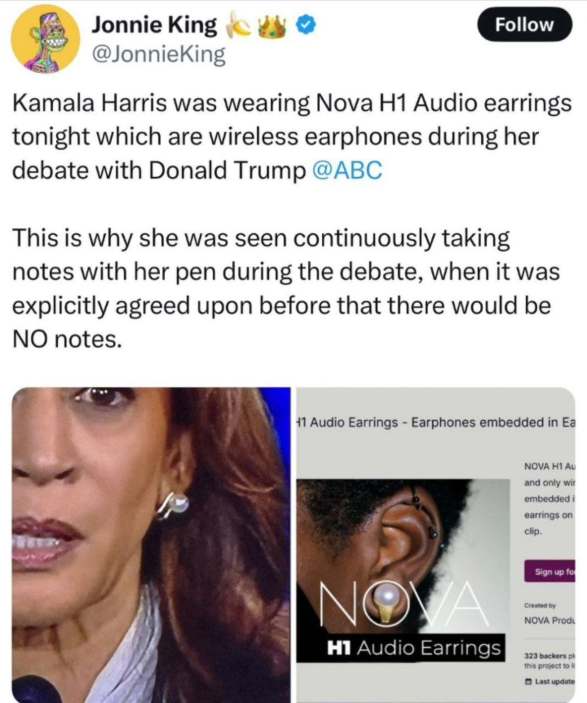
American musician Johnny King accuses Harris of wearing the Nova H1 Audio earrings during today's debate with Trump.
These are wireless headphones, which could explain why she was seen taking many notes with a pen during the debate.
United States wholesale inventories remained at 0.2% in July, below the expected 0.3%. Wholesale trade sales in July increased by 1.1%, following a 0.3% decline in June.
The US economy added 142,000 jobs in August, below the expected 164,000, with July figures revised sharply down to 89,000. The unemployment rate fell to 4.2% from 4.3% in July, in line with estimates. Average hourly earnings rose 0.4% month-on-month and 3.8% year-on-year, exceeding expectations. Overall, the data suggests the US labor market is cooling, though not as badly as feared.
The US Department of Labor reported that new unemployment claims fell to 227,000 in the week ending August 31, below the estimated 231,000 and down from 232,000 the previous week. The seasonally-adjusted insured unemployment rate was 1.2%, with the 4-week moving average easing to 230,000. Continuing claims also dropped by 22,000 to 1.838 million for the week ending August 24.
The US Bureau of Labor Statistics (BLS) reported that job openings fell to 7.67 million in July, down from 7.9 million in June and below expectations of 8.1 million. The report also noted that hires remained steady at 5.5 million, while separations increased to 5.4 million, with quits at 3.3 million and layoffs at 1.8 million.
Meanwhile, US Factory Orders grew by 5% in July, surpassing the forecast of 4.7%.
The United States Goods and Services Trade Balance was recorded at -$78.8 billion, slightly better than the forecast of -$79 billion. For goods alone, the US trade balance declined from -$102.7 billion in June to -$103.1 billion in July.
US exports increased to $266.60 billion in July from $265.30 billion in June. Imports also rose, from $338.00 billion in June to $345.40 billion in July.
The business activity in the US manufacturing sector continued to contract, albeit at a slower pace in August, with the ISM Manufacturing PMI rising to 47.2 from 46.8 in July. However, this increase was below the market estimate of 47.5.
The Employment Index of the PMI recovered to 46 from 43.4 in July.
The New Orders Index declined to 44.6 from 47.4 during the same period.
The ISM Manufacturing Prices Index increased to 54.0, up from 52.9 in July, exceeding the 52.1 estimates.
The ISM Prices Paid Index, which measures inflation, rose to 54 from 52.9, beating the forecast of 52.1.
The ISM Manufacturing Employment Index rose to 46 in August, compared to 43.4 in July.
Additionally, United States construction spending fell by 0.3% in August, matching the decline recorded in July and missing the expected 0.1% growth. Furthermore, the S&P Global US Manufacturing PMI missed the estimate of 48.0, falling to 47.9 from 49.6 in the previous month.
The United States Personal Consumption Expenditures (PCE) Price Index remained at 2.5% in July, matching the June figure but coming in below the forecast of 2.6%.
The United States Core Personal Consumption Expenditures Price Index for July remained unchanged at 2.6% year-over-year (YoY), slightly below the expected 2.7%.
Both the headline and core personal consumption inflation indicators registered a monthly growth of 0.2%, which was in line with forecasts.
United States Personal Spending met the forecast of 0.5% in July, up from 0.3% in June. Personal Income (MoM) was also at 0.3%, significantly above the July forecast of 0.2%.
The United States Personal Consumption Expenditures Price Index (MoM) matched the forecast of 0.2% in July.
According to the US Department of Labor (DoL) on Thursday, the number of US citizens who applied for unemployment insurance benefits increased by 231,000 in the week ending August 24, slightly below the initial estimate of 232,000 and down from the previous week's revised figure of 233,000, which was adjusted up from 232,000.
Additionally, Continuing Claims rose by 13,000 to 1.868 million in the week ending August 17, up from 1.855 million in the prior week but below the estimated 1.870 million.