translate English
 پارسی
English
Englishپارسی
English
Englishپارسی EnglishپارسیEnglishپارسی
The United States has begun nuclear arms control talks in Geneva with a Russian delegation and is set to meet a Chinese delegation next, as Washington pushes for a broader, multilateral framework that would include China alongside Russia after the New START limits expired. Reuters reported that a senior U.S. State Department official said it’s unclear whether the China meeting amounts to formal negotiations, noting Beijing has recently signaled reluctance to enter new trilateral arms-control negotiations at this stage.
The official added the U.S. has already held bilateral talks with the UK and France, framing the move to engage the five permanent UN Security Council members as the “next logical step.”
Source: Reuters, citing a senior U.S. State Department official.
Lebanon’s LBCI reported that the U.S. Embassy in Lebanon has evacuated dozens of employees, describing the move as a preventive measure linked to expectations of a possible regional escalation.
Source: According to LBCI.
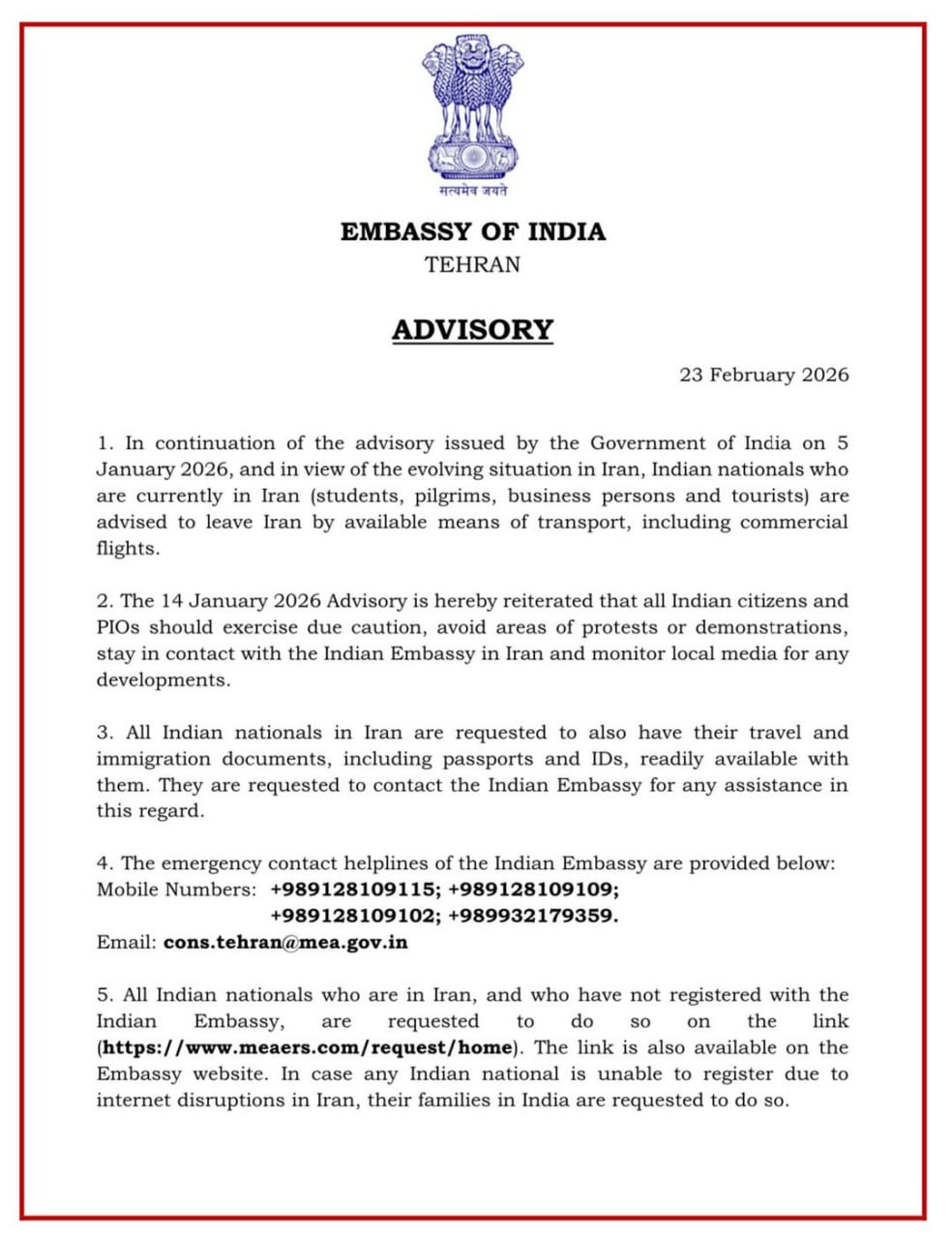
The Embassy of India in Tehran issued a new advisory urging Indian nationals currently in Iran—students, pilgrims, businesspersons, and tourists—to leave Iran by available means of transport, including commercial flights, citing the “evolving situation.”
The embassy reiterated earlier guidance for Indian citizens and PIOs to exercise caution, avoid protest/demonstration areas, stay in contact with the embassy, and monitor local media. It also asked nationals to keep passports/IDs readily available, provided emergency helplines, and urged those not registered to do so via the government’s online portal (families in India can register if internet disruptions prevent it).
Source: Embassy of India, Tehran (official advisory notice).
Hungary’s Prime Minister Viktor Orbán has drawn a hard line over the disruption of Russian oil transit via the Druzhba pipeline, warning Budapest will withhold support for the EU’s 20th Russia sanctions package and a major EU financial package/loan for Ukraine until the flow resumes. Hungary has also threatened countermeasures, including halting diesel exports to Ukraine, as leverage in the dispute.
The outage has been framed by Hungary as an energy-security risk, while Ukraine has argued the disruption is tied to wartime conditions and infrastructure damage, with repairs dependent on worker safety and alternative routing options.
U.S. Senator Ted Cruz said Iran’s Supreme Leader and the ruling clerical leadership have what he described as a “choice” between stepping aside or being “forcibly removed,” framing it as an “opportunity to leave.” Cruz added he hopes the Ayatollah has more sense than Nicolás Maduro, referencing Maduro as a cautionary example.
Source: Fox News (“Hannity”) clip and Cruz’s posted remarks.
Somaliland’s leadership has offered the United States exclusive access to mineral resources and the option to establish U.S. military bases, framing the proposal as part of its push for international recognition, according to an AFP report. Somaliland declared independence from Somalia in 1991, but Somalia still considers it part of its territory; Israel’s recognition in December 2025 remains the only formal recognition reported so far.
Source: AFP (as reported by Al Jazeera), with background confirmed by Reuters/AP.
U.S. special envoy Steve Witkoff said he is “hopeful” the next round of Russia–Ukraine negotiations could happen within the next three weeks, and suggested the process could build toward a potential Zelensky–Putin summit. He also hinted a broader format is possible—potentially involving Donald Trump—but said Trump would only attend if he believes he can bring the deal to a definitive conclusion and achieve “the best result.”
Source: Reported remarks attributed to Steve Witkoff in media coverage (including Fox News-based reporting).
Former CIA officer John Kiriakou said on the “Trendifier” podcast that—based on what he described as information from a former colleague in the White House—the United States could strike Iran as early as Monday or Tuesday (23–24 February / 4–5 Esfand). He cautioned that presidential “deadlines” shouldn’t be taken at face value, arguing an attack could come “a couple of days” into a stated timeline.
Kiriakou also claimed an internal split in Washington, describing an anti-war camp led by Vice President JD Vance and Tulsi Gabbard alongside the Director of National Intelligence, versus a pro-strike camp led by Secretary of State Marco Rubio and Defense Secretary Pete Hegseth. He suggested some high-profile announcements—such as releasing UFO-related documents—might be intended to distract from imminent military decisions. U.S. officials have not publicly responded to his claims, according to the report.
Source: Euronews (reporting on the Trendifier podcast interview).
Israeli media, citing Arab sources, reported that Hezbollah is raising its organizational readiness amid the possibility of a broader confrontation with Israel.
The same sources claimed that officers from Iran’s Islamic Revolutionary Guard Corps (IRGC) have taken on field-level direction of the group. These claims have not been independently verified in the text provided.
Source: Israeli media citing Arab sources.
Roberta Metsola, President of the European Parliament, wrote on X that Iranians have, “as long as I can remember,” lived under an authoritarian theocratic rule.
She added that Iran’s government “does not tolerate opposition, pluralism, or freedom,” concluding: “Iran must be free.”
Source: Roberta Metsola’s post on X.
The Washington Post reports that Donald Trump’s MAGA base—highly vocal last year against opening a new Middle East war ahead of a limited U.S. strike on Iran—is now showing more restraint and less public opposition as the White House weighs a potentially broader military action.
The report recalls that three days before Trump authorized the June strike, conservative influencer Charlie Kirk raised concerns in the Oval Office about the U.S. being pulled into another long conflict, while figures like Steve Bannon and Tucker Carlson warned against regime change and a war of attrition.
Now, as Trump considers a wider operation and even the prospect of toppling Ali Khamenei, leaders and commentators close to the “America First” camp told the paper their quieter stance reflects: greater trust in Trump after limited operations in Iran and Venezuela, fear of breaking with a president who has sidelined conservative critics, uncertainty over the scope of any strike, and acceptance that Trump understands the base’s opposition to long wars—but will ultimately make his own call.
Source: The Washington Post.
Iranian lawmaker Manouchehr Mottaki said Washington’s push for talks with the Islamic Republic is an attempt to “test again” for a win after what he described as multiple failures.
He said the U.S. demand in negotiations is preventing Iran from moving toward a nuclear weapon, while Iran’s stated demands include the right to enrich uranium, a full lifting of sanctions, and the right to self-defense, adding that “defense issues are not negotiable.”
Mottaki also pointed to Iran’s missile strike on Ain al-Asad as a precedent, saying the U.S. had never previously seen its bases attacked in the history of the Pentagon, but Iran targeted Ain al-Asad “for the first time.”
Source: Manouchehr Mottaki’s remarks (Iran Parliament statements).