 English
 پارسی


Watch the Video
Global Economy Weekly Review:
Growth Softened, Inflation Risks Persisted, and Markets Traded Geopolitics First
The global economy ended the week in a more fragile but not yet recessionary position. The dominant macro theme was the Middle East conflict and the still-fragile U.S.-Iran ceasefire, which shaped energy prices, inflation expectations, currencies, and risk appetite across regions. At the same time, the hard data showed a world economy that is still expanding, but with weaker momentum in consumer demand, uneven industrial performance, and persistent inflation pressure in several major and emerging economies.
The broad conclusion from the week is that the global economy is moving deeper into a slower growth, still-inflationary, geopolitically sensitive phase. Growth has not broken down, but it has become more uneven. Services are still holding up in many economies, but housing, construction, confidence, and parts of manufacturing remain weak. Central banks are becoming more cautious, not because inflation is accelerating everywhere, but because energy-related risks are making the outlook harder to manage.
- Geopolitics remained the main macro driver
The most important global development was the temporary ceasefire between the U.S. and Iran. It initially triggered a broad relief rally across equities, pushed volatility lower, and led to a sharp drop in oil prices after crude had surged close to $120 per barrel on fears of a deeper regional war. But the truce quickly showed signs of strain.
Military activity continued in Lebanon, shipping through the Strait of Hormuz remained highly restricted, and repeated statements from Washington and Tehran made clear that a durable settlement was still far away. The result was that markets moved from a clean relief trade to a more cautious reassessment. Oil fell hard, then rebounded again as traders realized that the supply situation had not normalized.
That matters for the global economy because Hormuz remains a critical artery for energy flows. The week showed that even a partial easing in war fears is not enough to fully remove the energy risk premium if actual oil and gas shipments remain constrained.
- Inflation remained the central macro problem
The week’s data showed that inflation is no longer moving in one direction globally. In some places, upstream inflation cooled, but in others, energy-linked price pressure remained firm or reaccelerated.
In the United States, March CPI showed a mixed picture. Headline inflation remained hot, with CPI at 0.9% month on month and 3.3% year on year, while core inflation was softer than expected at 0.2% month on month and 2.6% year on year. PCE data also remained firm, with core PCE at 0.4% month on month and 3.0% year on year. The bigger concern was that inflation expectations rose sharply, with the University of Michigan’s 1-year inflation expectations jumping to 4.8%.
In Europe, producer-price pressure continued to ease at the eurozone level. Eurozone PPI stayed deeply negative year on year and turned more negative month on month, which is consistent with softer upstream inflation. But Germany’s March inflation data moved sharply higher, with both CPI and HICP accelerating strongly from February. That suggests the euro area still cannot declare victory on inflation, especially if energy prices remain volatile.
In Asia, China remained the clear outlier on the soft side, with CPI at -0.7% month on month and 1.0% year on year, showing very weak consumer-side pricing power. But China’s PPI turned positive at 0.5% year on year, which suggests that industrial pricing conditions improved even as household demand remained weak.
Japan, by contrast, continued to show firmer domestic inflation pressure. PPI rose 2.6% year on year, above expectations, while wage growth also remained strong. That combination kept concerns alive that inflation in Japan is becoming more embedded.
Across emerging markets, inflation remained a major issue. Brazil’s CPI accelerated more than expected. Mexico’s headline inflation stayed elevated, even though core inflation eased slightly. Russia’s inflation remained high and sticky. The message across the week was clear: global inflation is no longer broadening in the same way as before, but neither is it fading cleanly enough to make policymakers comfortable.
- Growth slowed, but did not collapse
The global growth story this week was weaker, but not outright recessionary.
In the United States, the third estimate of Q4 GDP was revised down to 0.5%, and personal income fell 0.1% in February, while personal spending rose 0.5%. That combination suggests the consumer is still spending, but with less support from income. Survey data were also poor, with Michigan sentiment dropping sharply to 47.6. The U.S. economy still looks resilient enough to avoid an immediate contraction, but the quality of growth has deteriorated.
In the euro area, the growth picture remained marginally positive. The Eurozone Composite PMI held at 50.7 and the Services PMI at 50.2, which means the economy stayed in expansion, but only barely. Retail sales rose year on year, but fell month on month, while construction remained in clear contraction. Investor confidence deteriorated sharply, with Sentix collapsing to -19.2.
The UK looked similarly weak but not broken. The Composite PMI and Services PMI remained just above 50, meaning activity is still expanding, but both slowed significantly. Housing data weakened, mortgage rates stayed high, and consumer confidence deteriorated again. The UK remains in low-growth territory, not recession, but momentum is clearly fading.
China’s growth signals were mixed. Inflation was soft, but producer prices improved, consumer confidence strengthened, and equities performed well. This suggests China is stabilizing unevenly rather than accelerating strongly. The industrial side is improving faster than the consumer side.
Japan’s growth picture was also mixed. Wage growth, lending, the current account, and machine tool orders were all strong, but household confidence and economic watchers' sentiment fell sharply, while short-cycle activity indicators softened. Japan still has meaningful areas of resilience, but domestic demand remains fragile.
Across emerging economies, the picture was patchy. India remained relatively strong, with a stable policy, rising reserves, stronger money growth, and better confidence. South Korea’s external balance improved sharply, but consumer confidence weakened. Turkey’s industrial output rebounded, but sentiment and fiscal cash conditions remained soft. South Africa’s PMI improved, but manufacturing output weakened. Brazil faced stronger inflation and weaker confidence. Mexico showed mixed activity and inflation. In short, emerging economies remained resilient in parts, but highly uneven.
- Central banks turned more cautious, not more confident
One of the clearest global themes this week was that central banks are not in a position to relax easily.
The Federal Reserve minutes were interpreted as somewhat hawkish because policymakers showed growing concern about higher oil prices and the risk that energy could keep inflation sticky. The Fed is not facing a clean easing environment.
The RBI, RBNZ, and Bank of Korea all kept rates unchanged, and in each case the message was similar: policymakers are trying to preserve stability while watching geopolitical and inflation risks closely.
In Japan, the combination of stronger wages, firmer producer inflation, and higher JGB auction yields kept policy normalization concerns alive. In Europe, the softer growth picture argues for caution, but stronger German inflation and energy uncertainty prevent a straightforward dovish shift.
The global policy takeaway is that central banks are increasingly boxed in by a weaker growth backdrop on one side and energy-related inflation risks on the other.
- Markets recovered, but the rebound was conditional
Global markets had a better week overall, but the rebound was driven more by geopolitics than by a decisive improvement in the macro data.
Wall Street rallied strongly, with the S&P 500, Dow, and Nasdaq all posting solid gains, and the VIX falling sharply. Asian equities also rebounded, led by South Korea and Japan, while European shares recovered as oil moved lower after the initial ceasefire headlines.
The U.S. dollar weakened over the week as safe-haven demand eased, which helped support gold and some non-U.S. currencies. But the dollar did not break decisively lower because the truce remained fragile and inflation risks were still present.
Gold remained elevated and on track for another weekly gain, supported by a softer dollar and persistent geopolitical tension. Oil, meanwhile, became the clearest signal of market uncertainty: it first collapsed on ceasefire optimism, then rebounded as Hormuz disruptions persisted.
That pattern tells us that the global market is not trading a stable peace scenario. It is trading a temporary reduction in worst-case risk, while still keeping a substantial geopolitical premium in energy, shipping, and safe-haven-sensitive assets.
- Bottom line
The global economy had a softer and more fragile week.
The United States showed slower growth, sticky inflation, and rising inflation expectations. Europe remained barely in expansion, but confidence and construction weakened. The UK continued to slow. China stabilized unevenly, with weak consumer inflation but better producer prices and stronger confidence. Japan remained resilient in wages, credit, and external accounts, but weaker in confidence and short-cycle activity. Emerging economies were mixed, with India among the stronger stories and Brazil, Turkey, South Africa, and Russia showing more obvious constraints.
The key macro shift is that the world economy is still growing, but with less momentum and less policy flexibility than before. Growth is weakening, inflation risks are not fully gone, and geopolitics are once again shaping the path of oil, rates, and market sentiment. The result is a global economy that is not yet breaking, but is clearly becoming more vulnerable.
USA
The U.S. economy had a difficult macro week beneath the surface. Growth slowed sharply, household income weakened, sentiment deteriorated, and labor data softened at the margin. Inflation did not spiral higher, but it also did not cool enough to give the Fed a clean opening. Rising inflation expectations made the policy picture even harder.
In practical terms, the U.S. now looks closer to a slower growth + sticky inflation regime than to a clean soft landing. Wall Street recovered because geopolitics briefly improved, and the dollar softened because safe-haven demand eased. But unless inflation falls more convincingly or growth re-accelerates, the domestic macro backdrop still argues for caution rather than complacency.
U.S. Economy Weekly Review
The U.S. economy ended the week in a more difficult macro position than headline market moves initially suggested. Financial markets found support from improving geopolitical headlines and temporary ceasefire hopes in the Middle East, but beneath that relief rally, the domestic economic picture became less favorable. Growth slowed sharply, household income weakened, consumer sentiment deteriorated, and inflation remained too firm to give the Federal Reserve a clear path toward easier policy.
The most important takeaway is that the U.S. now looks closer to a slower-growth, sticky-inflation environment than to a clean soft-landing scenario. The economy is still expanding, and there is no strong sign of an immediate breakdown, but the quality of growth is weakening. That shift matters because it reduces policy flexibility at a time when inflation risks, especially those linked to energy, remain alive.
- Inflation cooled only partially
Inflation data this week offered some relief, but not enough to change the broader story. Core CPI came in softer than expected, suggesting that underlying inflation is not spiraling out of control. However, headline CPI stayed elevated, and PCE data confirmed that price pressure remains sticky enough to keep policymakers cautious. This was not the kind of inflation report that would give the Fed confidence to pivot quickly.
What made the inflation backdrop more concerning was the rise in inflation expectations. Surveys showed households becoming more worried about future price increases, and that is a serious issue for policymakers. Even if actual inflation moderates somewhat, higher inflation expectations can make the Fed more reluctant to ease because they raise the risk that inflation becomes more embedded in consumer and business behavior. That was one of the week’s most important signals.
- Growth clearly lost momentum
If inflation was only partly reassuring, growth data were more clearly disappointing. The third estimate of fourth-quarter GDP was revised down sharply, reinforcing the message that the U.S. economy had less momentum than previously thought. Consumer spending remained positive, but its support base weakened as personal income fell and real earnings deteriorated. In effect, households are still spending, but with less income cushion behind them.
That matters because consumer resilience has been one of the main pillars of U.S. economic strength. When spending holds up, but income weakens, it becomes harder to argue that the economy is on a stable and durable expansion path. Survey evidence pointed in the same direction. Consumer sentiment fell sharply, and broader confidence indicators also deteriorated, suggesting households are becoming more cautious about the outlook.
- Labor is softening at the margin
The labor market is not breaking, but it is no longer clearly strengthening either. Initial jobless claims rose, which points to some softening in layoffs, even though continuing claims remained relatively contained. At the same time, employment-related indicators within services weakened, and broader labor trend measures slipped.
The best way to describe the labor backdrop is that it remains resilient, but less convincing than before. That distinction is important. A collapsing labor market would point toward recession risk. A gradually cooling labor market, by contrast, points more toward slower growth and a more fragile consumer outlook. Right now, the U.S. appears to be in the second category.
- Services held up, but inflation pressure remained strong
Business activity data were also mixed rather than clearly weak. The services sector stayed in expansion, which is still a positive sign for overall growth. New orders remained solid, and parts of the goods economy showed resilience. But the quality of the data was uneven, and one detail stood out in particular: service prices remained very strong.
That is a problem for the Fed because services inflation tends to be more persistent than goods inflation. In other words, even as some parts of the economy cool, the inflation problem is not disappearing cleanly. That combination of softer growth and still-firm price pressure is exactly what makes the current macro setup uncomfortable.
- Fed caution remains justified
The Fed minutes reinforced this message. Policymakers showed concern that higher oil prices and rising inflation expectations could keep inflation sticky for longer. That does not mean another rate hike is imminent, but it does mean the central bank is far from declaring victory. Treasury yields also reflected a market that still sees meaningful rate risk ahead.
- Bottom line
The U.S. economy still looks resilient enough to avoid an immediate contraction, but the week made one thing clear: the macro balance is worsening. Growth is slowing, household income is under pressure, sentiment is fading, and inflation is not cooling fast enough. Wall Street recovered because geopolitics briefly improved, and the dollar softened as safe-haven demand eased, but the domestic fundamentals still argue for caution. Unless inflation falls more convincingly or growth re-accelerates, the U.S. outlook remains fragile rather than comfortable.
U.S. Economic Outlook for the Week Ahead:
Inflation, Growth, and the Fed in Focus
Week 16 is unlikely to deliver a decisive shift in the U.S. macro story, but it could confirm the market’s main concern: inflation remains uncomfortable, growth is slowing, and the Federal Reserve still has little reason to rush toward rate cuts.
The U.S. economic calendar for April 13–19, 2026, may look lighter than usual, but that does not make it less important. In fact, with March retail sales delayed to April 21 and housing starts and building permits postponed to April 29, the data still on deck will carry even more weight for markets. This week is likely to be less about a fresh macro direction and more about whether recent trends are confirmed: sticky inflation, softer but not collapsing growth, and a Federal Reserve that remains firmly in wait-and-see mode.
The most important release of the week is likely to be the March producer price inflation on Tuesday, April 14. After the recent CPI surprise, investors want to know whether inflation pressures are beginning to spread further through the production chain. February PPI was already firm, and another strong reading would reinforce the idea that inflation is not just a consumer-level issue. That matters even more in an environment where higher oil prices and geopolitical tensions are raising the risk that energy costs pass more clearly into transportation, production, and distribution. If that happens, the market may conclude that inflation is becoming broader and harder to contain.
Before that, Monday brings existing-home sales for March, which will offer a useful read on housing demand. The housing sector remains one of the most rate-sensitive parts of the economy, and it is already showing signs of strain. Affordability pressures have stayed high, mortgage applications have been weak, and pending home sales have only improved modestly. Because existing-home sales reflect closings rather than new signings, the March report will mostly capture conditions before the Iran conflict and before mortgage rates moved sharply higher. Even so, the backdrop was already soft, and the risk is that final sales come in weaker than earlier housing indicators suggested. That would reinforce the broader message that domestic demand is cooling gradually.
Wednesday will add more texture to the macro picture. Import and export prices, the Empire State manufacturing survey, the NAHB housing market index, and the Fed’s Beige Book will all help investors judge whether inflation pressure and geopolitical uncertainty are starting to affect business activity more visibly. The Beige Book could be especially important because it offers a broader qualitative read on how firms across the country are experiencing costs, demand, and financial conditions. Markets will be looking closely for any evidence that energy-related pressures are feeding through more widely or that business sentiment is becoming more cautious.
There is also a quieter but meaningful financial-market angle this week: the end of the 2025 tax season. Treasury cash flows can influence liquidity conditions, and while tax receipts have not shown major surprises so far, refunds have come in somewhat lighter than expected. If that pattern continues, it could mean a smaller rise in the Treasury General Account, which in turn may create somewhat easier short-term liquidity conditions. This is not the main macro story, but in a market already sensitive to rates and funding conditions, it is still worth watching.
Thursday will be particularly important for the growth side of the debate. Initial jobless claims, the Philadelphia Fed manufacturing survey, and industrial production should provide a clearer sense of whether the economy is merely slowing or beginning to soften more meaningfully. Recent claims data suggest the labor market is cooling, but only gradually. Industrial production has remained soft rather than outright weak, and manufacturing surveys have been mixed. If Thursday’s data hold up reasonably well, the argument for a still-resilient economy will survive. But if they disappoint together, markets may become more confident that slower growth is beginning to matter more than inflation noise.
Fed communication will also matter, even without a major policy meeting this week. John Williams and Christopher Waller are among the most important scheduled speakers. Williams is unlikely to surprise markets, but any shift in tone on inflation persistence could still be significant. Waller may draw even more attention because he has shown a greater willingness to adapt his public stance to incoming data. His comments could help shape expectations heading into the next FOMC meeting on April 28–29. Right now, the main message remains clear: the Fed is not eager to cut, but it is also not in a comfortable enough position to sound relaxed.
The broader conclusion for the week ahead is straightforward. The U.S. economy is not collapsing, but it is also not delivering the kind of clean disinflation and solid growth mix that would make markets comfortable. If PPI stays hot, import prices firm up, and the Beige Book shows wider cost pass-through, Treasury yields could remain elevated, and the dollar could stay supported. On the other hand, weaker housing, softer surveys, and disappointing production data would strengthen the case that growth is slowing beneath the surface. Either way, this looks like a week that should reinforce caution rather than resolve the macro debate.
USD and Wall Street Weekly Review:
The U.S. dollar lost ground, and Wall Street rallied, but neither move reflected a clean macro reset. The real story was a temporary easing in geopolitical fear, while inflation, fragile ceasefire conditions, and key technical levels kept investors from fully embracing a new trend.
A Softer Dollar, Still Driven by Geopolitics
The week’s market action looked constructive on the surface, but the underlying picture was more complicated. The U.S. dollar weakened, and Wall Street posted strong weekly gains, yet both moves were driven less by a decisive improvement in the economic backdrop and more by shifting geopolitical sentiment. Temporary optimism around a fragile Middle East ceasefire reduced immediate safe-haven demand, encouraged investors back into risk assets, and helped push volatility lower. But the broader message was not that markets had turned decisively bullish. It was that investors briefly stepped back from worst-case positioning while still keeping one eye on inflation, oil, and geopolitical risk.
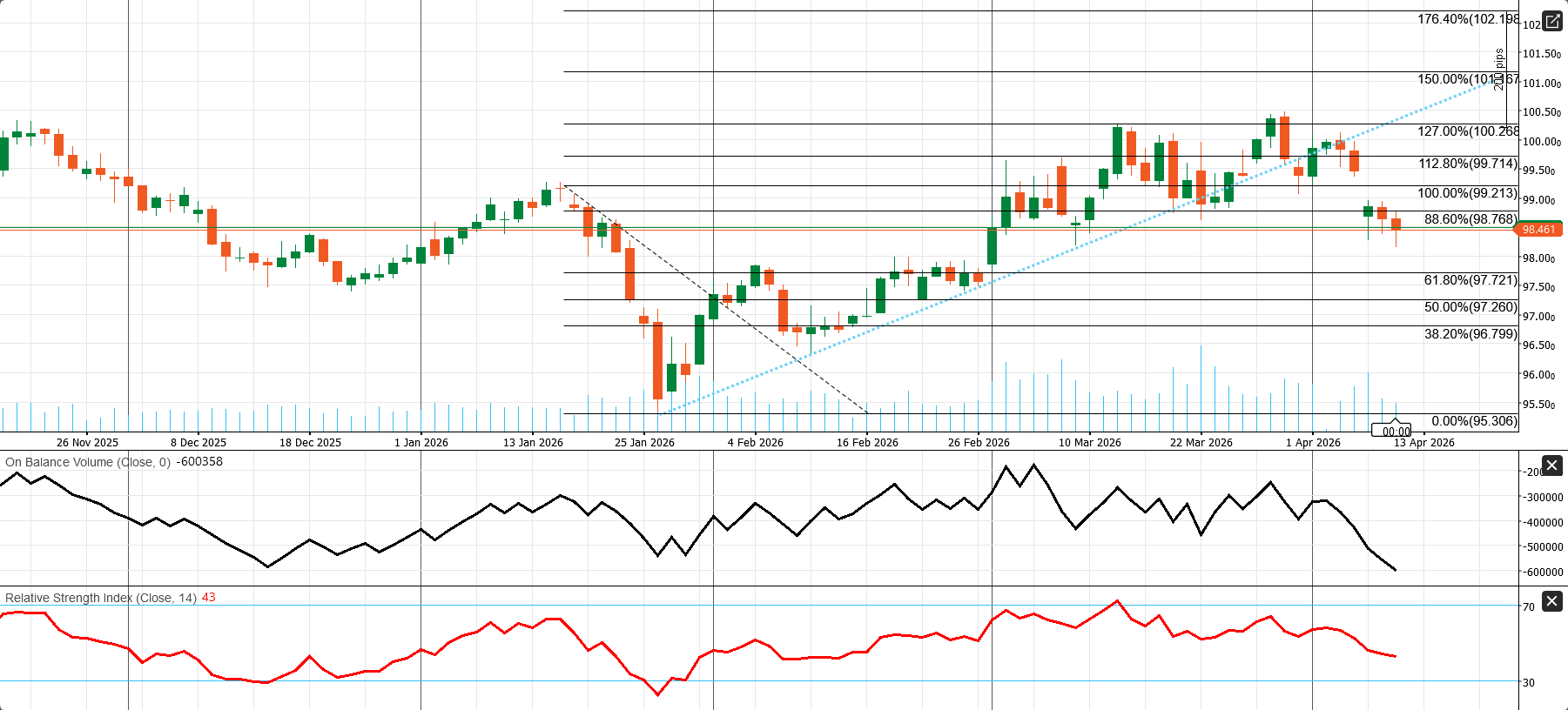
The dollar’s move was an important signal. The U.S. Dollar Index (DXY) ended the week around 98.50, posting its largest weekly drop since January. That decline came as improving risk appetite reduced demand for the dollar’s defensive role. Investors rotated back toward equities and other risk-sensitive assets, especially as hopes grew that diplomacy might prevent a deeper regional escalation. However, the dollar did not break down in a structurally bearish way. As doubts about the ceasefire reappeared and disruptions around the Strait of Hormuz remained in place, the dollar stabilized and even recovered in some sessions. That tells us the market is still not ready to abandon the dollar as a safe haven. This was not a trend reversal. It was more of a pullback in an overstretched defensive bid.
From a technical perspective, the dollar’s chart also became more fragile. The rebound from the late-January low lost momentum after failing near a key Fibonacci resistance zone, and price slipped below the rising trendline that had supported the move from late January into early April. The index also fell below another important Fibonacci level, which now acts as resistance. Momentum indicators added to the softer tone: RSI dropped below the neutral 50 line, and On-Balance Volume trended lower, signaling weaker buying participation. In practical terms, the technical picture now leans cautiously bearish unless the DXY can quickly reclaim nearby resistance. Support levels below remain important because a break there would deepen the downside pressure.
Strong Equity Rebound, and a Market Still Driven by Geopolitics
At the same time, Wall Street had a much stronger week. The S&P 500, Dow Jones, and Nasdaq all posted solid weekly gains, while the VIX fell sharply, showing that near-term fear eased meaningfully. The strongest moves came after ceasefire headlines lowered the immediate threat of a broader regional war and reduced fears of a more severe oil shock. Technology and growth stocks led the recovery, and the Nasdaq outperformed, helped by renewed enthusiasm around semiconductors and the AI-related earnings story. That made sense in context: when geopolitical panic fades, high-beta growth sectors are often among the first to rebound.
Still, the equity rally was not purely about better fundamentals. It was also about relief. Investors were willing to price in a less dangerous geopolitical scenario, but only cautiously. Fighting in Lebanon continued, and the ceasefire narrative remained fragile, which meant markets never fully embraced a stable peace story. Instead, they treated the improvement as provisional. That helps explain why late-week trading became more selective even after strong index gains. The rally was real, but conviction remained conditional.
Fundamentally, U.S. equities also drew support from the earnings backdrop. Investors entered the new earnings season expecting solid profit growth, especially in technology. Reports pointed to improving sentiment around chipmakers, strong first-quarter revenue from key semiconductor names, and expectations for robust earnings growth across major tech-heavy benchmarks. That helped support the Nasdaq and broader growth-sensitive indices. For the coming week, names such as Goldman Sachs, JPMorgan, Bank of America, Morgan Stanley, Netflix, TSMC, ASML, and Johnson & Johnson matter because they offer insight into capital markets activity, credit conditions, consumer resilience, AI demand, semiconductor momentum, and defensive healthcare flows. In other words, earnings now have the potential to either reinforce the rebound or expose its limits.
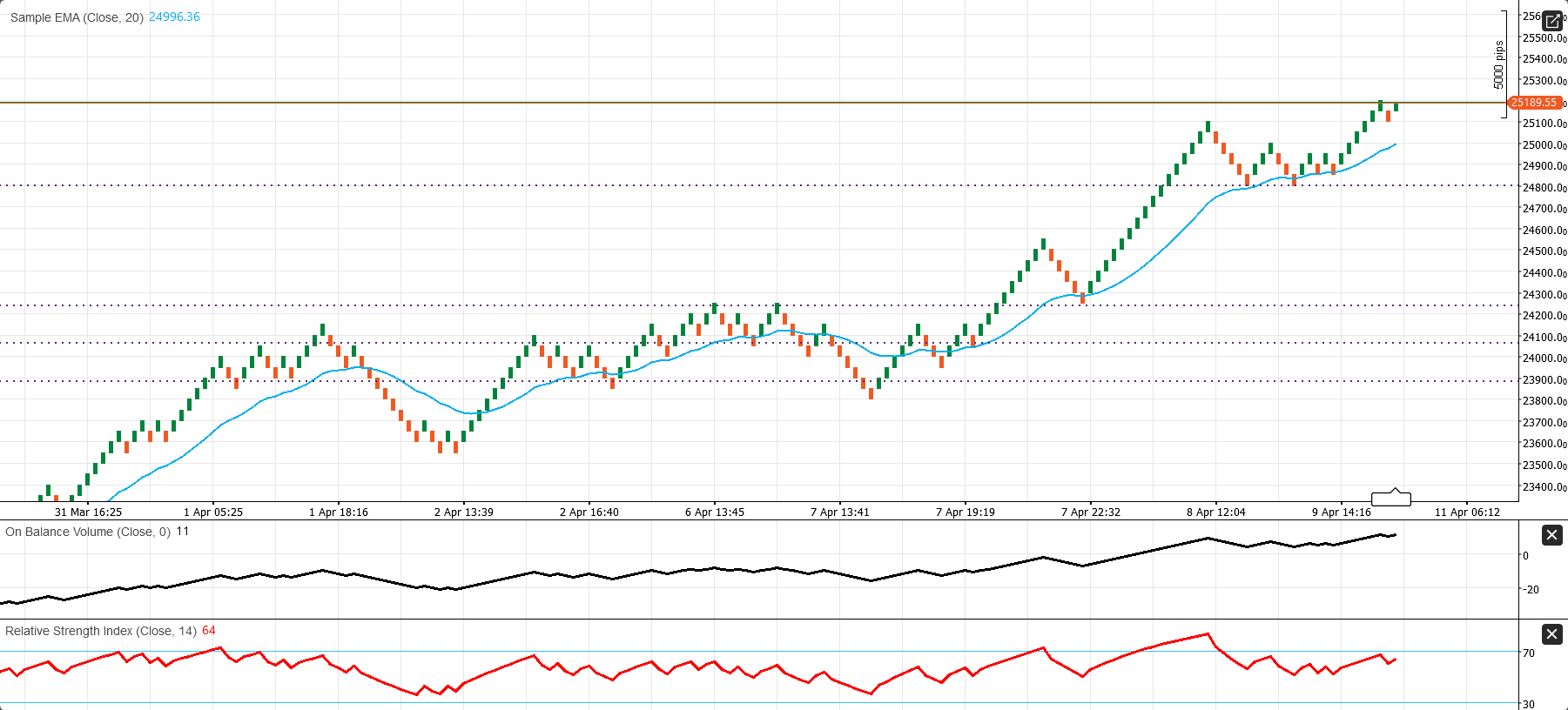
Technically, the US100 Renko 500 daily chart still looks bullish. Price remains clearly above the 20-period EMA, and the recent sequence of Renko bricks shows that buyers have continued to defend pullbacks rather than allowing a deeper retracement. Momentum remains constructive, though the index is now pushing into a key resistance zone around 25,190–25,200. RSI is firm but not yet overbought, which leaves room for further upside if a breakout is confirmed. On-Balance Volume is also supportive, suggesting accumulation improved during the latest rally. As long as the price stays above the EMA and above the breakout base near 24,800, the broader bullish bias remains intact.
The main takeaway from the week is that markets improved, but the improvement came with conditions. A softer dollar helped support risk assets, and equities responded positively to easing geopolitical stress and strong tech sentiment. But inflation remains sticky, the ceasefire remains fragile, and safe-haven demand could return quickly if the diplomatic track deteriorates. For now, Wall Street still has upward momentum, especially in growth sectors, while the dollar has lost some strength. But neither market is trading with full confidence. The week’s real message was not certainty. It was a temporary recovery in sentiment inside a still fragile macro and geopolitical environment.
Earnings in the week ahead
The main earnings reports for the week ahead (April 13–17, 2026) are concentrated in financials first, then health care, semis, and streaming/media. The biggest market focus is likely to be on the large U.S. banks, because Reuters says this week’s bank results are expected to test whether strong trading and investment-banking activity can outweigh macro uncertainty tied to oil prices, inflation, and the Middle East conflict.
- Monday, April 13
Goldman Sachs is the main headline report to watch. Goldman’s investor-relations calendar shows its first-quarter 2026 earnings release on April 13, and Reuters identifies it as the name that kicks off the big-bank reporting wave this week.
- Tuesday, April 14
This is one of the busiest and most important days of the week. The major reports include JPMorgan Chase, Wells Fargo, Citigroup, BlackRock, and Johnson & Johnson.
- Wednesday, April 15
Another heavy financial day. The main names are Bank of America, Morgan Stanley, PNC Financial, and ASML.
- Thursday, April 16
The key names shift toward tech and media: Netflix and TSMC. Netflix says it will post its first-quarter 2026 financial results on April 16, while TSMC says its first-quarter 2026 earnings conference will be held on April 16. TSMC is especially important as a read-through for AI-related chip demand, while Netflix is one of the week’s biggest non-financial consumer/tech reports.
- Friday, April 17
The main reports are again financials, led by State Street, Truist Financial, and Fifth Third Bancorp.
The most market-sensitive names for the week are probably Goldman Sachs, JPMorgan, Bank of America, Morgan Stanley, Netflix, TSMC, ASML, and Johnson & Johnson because they give read-throughs on capital markets activity, loan growth, consumer resilience, AI/semiconductor demand, export-control risk, and large-cap defensive healthcare demand.
UK
The UK week ahead is centered on Thursday’s February activity package and Tuesday’s BoE speakers. My base case is that markets will treat a modest February rebound as backward-looking and keep trading the UK through the lens of energy prices, BoE rhetoric, and whether March’s growth slowdown turns into something more persistent. For trading purposes, GBP and gilts should react most to any surprise in GDP and any hawkish shift from Bailey, Greene, or Mann, while the FTSE remains highly sensitive to oil and the broader ceasefire story.
UK Economy Weekly Review:
Growth Held On, but Momentum Clearly Weakened
The UK economy stayed out of outright contraction this week, but the broader message was one of a fragile, low-growth environment. Services remained in expansion, yet housing softened again, construction stayed weak, and consumer confidence deteriorated, leaving the recovery looking increasingly uneven.
The UK economy ended the week with a picture that was not disastrous, but clearly less comfortable than before. The country is still growing in parts of the private sector, especially services, but the pace has slowed enough to raise fresh questions about how durable that growth really is. The main takeaway is that the UK remains in a low-growth, fragile expansion, rather than slipping into immediate recession. That distinction matters. The economy has not rolled over, but it is also not showing the kind of broad-based strength that would support confidence in a lasting recovery.
The most important signal came from the latest PMI data. Both the S&P Global Composite PMI and the Services PMI stayed above the 50 threshold, which means activity is still technically expanding. However, both indices slowed sharply from the previous month and came in below expectations. That is a meaningful shift. Rather than pointing to a healthy services-led recovery, the numbers suggest the economy is now operating much closer to stagnation. In simple terms, demand has not disappeared, but it has become softer, narrower, and more vulnerable to further pressure. This was one of the week’s clearest warnings.
The weakness was even more visible in construction. The Construction PMI improved slightly and came in better than forecast, but it remained well below 50, which means the sector is still contracting. That is important because construction is often one of the clearest examples of how higher interest rates filter into the real economy. The fact that the sector remains under pressure, even with a small improvement, suggests that borrowing costs are still acting as a real brake on activity. When services are only barely expanding, and construction is still shrinking, the overall growth story becomes much less convincing.
Housing added to that softer picture. The latest Halifax House Price Index showed monthly house prices falling again, while annual price growth also slowed. This does not point to a housing market collapse, but it does show a market that is struggling to build sustained momentum. High borrowing costs remain central to that story. Mortgage rates edged slightly higher, and while the increase was small, the broader message stayed the same: financing conditions in the UK remain tight. Housing is one of the most interest-rate-sensitive sectors in the economy, so continued weakness here matters not just for property activity, but for household confidence, wealth effects, and consumer willingness to spend. The housing market is not breaking, but it is clearly under strain.
Consumer sentiment reinforced that cautious tone. The latest confidence reading fell again, showing that households remain far from confident about the outlook. This fits neatly with the housing data and the softer services momentum. The consumer is not collapsing, but neither is the consumer providing strong upside support. That matters because the UK economy depends heavily on household demand and service activity. If confidence remains weak while financing conditions stay restrictive, it becomes difficult to build a convincing case for a stronger near-term rebound.
There was one brighter area in the data: the car market. New passenger car registrations rose strongly in March, and annual growth remained positive. That suggests some pockets of discretionary demand are still alive. It is a useful reminder that the UK economy is not uniformly weak. Some parts of demand are holding up better than others, and the auto sector offered one of the clearest examples of that resilience. Still, this positive signal was not strong enough to offset the broader softening in PMIs, housing, and confidence. It was a counterbalance, not a game changer.
Taken together, the week’s data point to four broad conclusions. First, growth is still positive, but only narrowly. Second, interest-rate-sensitive sectors remain under pressure. Third, the consumer remains cautious. Fourth, the economy is uneven rather than uniformly weak. That combination is exactly why the UK macro picture now looks fragile rather than firm. The expansion is still alive, but it is thin, and it does not have much room to absorb additional shocks.
For the Bank of England, this week’s numbers support a cautious approach. The data do not suggest the economy is weak enough to force an urgent policy shift, because services are still expanding and some demand pockets remain resilient. But they do reinforce the view that the economy may struggle to tolerate tight financial conditions indefinitely. In that sense, the data slightly strengthen the case for patience and caution rather than confidence.
The bottom line is straightforward: the UK economy is still growing, but only just, and with visibly weaker momentum. Services are still carrying the expansion, but far less comfortably than before. Construction remains in contraction, housing has softened again, mortgage costs are still high, and consumer confidence is weak. The overall picture is not one of immediate recession, but it is also not one of durable recovery. It is the picture of an economy that is still moving forward, though slowly, unevenly, and with very little buffer.
UK Economic Outlook for the Week Ahead:
Growth Data, BoE Signals, and Rising Stagflation Concerns
The UK enters the new week with one central question: is the economy merely slowing, or is it beginning to weaken more broadly just as energy risks and inflation pressures become harder to manage? Thursday’s GDP release and Tuesday’s Bank of England speakers should provide the clearest answer yet.
The week ahead is shaping up as an important test for the UK economy, not because it brings a full set of inflation, labour, and retail data, but because it concentrates attention on one especially important question: Is growth holding up, or was the economy already weakening before the latest geopolitical shock hit confidence and energy markets? That is why Thursday’s February activity package from the Office for National Statistics will be the key domestic release of the week. It will include GDP, services, production, construction, and trade, and in the current market environment, that combination matters more than usual.
The main reason is timing. The UK will not get its next labour-market release until April 21, CPI until April 22, and retail sales until April 24. That means this week’s debate will revolve around growth and central-bank expectations rather than a fresh inflation shock. Markets want to know whether the economy managed at least a modest rebound in February after a flat January, or whether momentum was already fading even before March brought softer survey data and a renewed energy shock tied to Middle East tensions. In that sense, this is not just a data week. It is a credibility test for the UK growth story.
Thursday’s GDP print is therefore the single most important number on the calendar. January GDP was flat on the month, with services unchanged, production down slightly, and construction up modestly. The broader backdrop was hardly impressive either: GDP rose only 0.2% over the three months to January, while fourth-quarter 2025 growth was just 0.1% quarter on quarter. The expectation now is for February GDP to rise by only 0.1% month on month. That would technically mark an improvement, but it would still leave the broader picture subdued. Even a small upside surprise may not be enough to shift the market decisively, especially because the February numbers predate the latest geopolitical escalation and because the April 16 release will also include revisions going back to January 2024.
That revision risk matters. If the data are adjusted lower in a meaningful way, even a positive February headline could lose some of its impact. And even if growth improves slightly, the deeper issue remains that the UK economy has not shown convincing momentum for some time. Retail sales volumes already fell in February, recent survey evidence has turned softer, and sector-level performance continues to look mixed rather than broad-based. Industrial production and services may provide some support, but construction remains a weak spot, and that limits the strength of any rebound narrative.
The second big focus of the week comes on Tuesday, when Andrew Bailey, Catherine Mann, and Megan Greene are all scheduled to speak. Their remarks matter because the Bank of England is facing a more difficult policy environment than it did only a few weeks ago. Growth is subdued, the labour market is softer, wage pressures appear contained, and the policy rate at 3.75% is already near the top of the BoE’s estimated neutral range. Under normal circumstances, that backdrop would strengthen the case for caution and a prolonged hold. But the Middle East energy shock has complicated the outlook by reviving fears that inflation could remain sticky even as activity slows.
That is why the UK is increasingly exposed to a more uncomfortable macro mix. February CPI was already running at 3.0% year on year, unemployment stood at 5.2%, regular pay growth was 3.8%, vacancies were down sharply from a year earlier, and retail sales had weakened. At the same time, more recent business surveys have become less reassuring. The services PMI slowed to 50.5 in March, the composite PMI slipped to 50.3, and service-sector input costs posted their largest monthly rise since 2021. Put together, these numbers suggest an economy that is losing speed while still facing meaningful cost pressure. That is exactly the kind of combination that raises stagflation risk.
Sterling reflects this mixed picture well. On one hand, GBP/USD has been supported by the weaker U.S. dollar after geopolitical stress eased and safe-haven demand for the greenback softened. Sterling rose sharply after the ceasefire headlines and has held onto much of that gain. On the other hand, the pound’s upside is not fully open because the domestic UK backdrop is far from clean. Business optimism has faded, services firms are reporting sharply higher input costs, and the Bank of England is not widely expected to turn more hawkish from here. That leaves sterling supported by external dollar weakness, but constrained by domestic uncertainty.
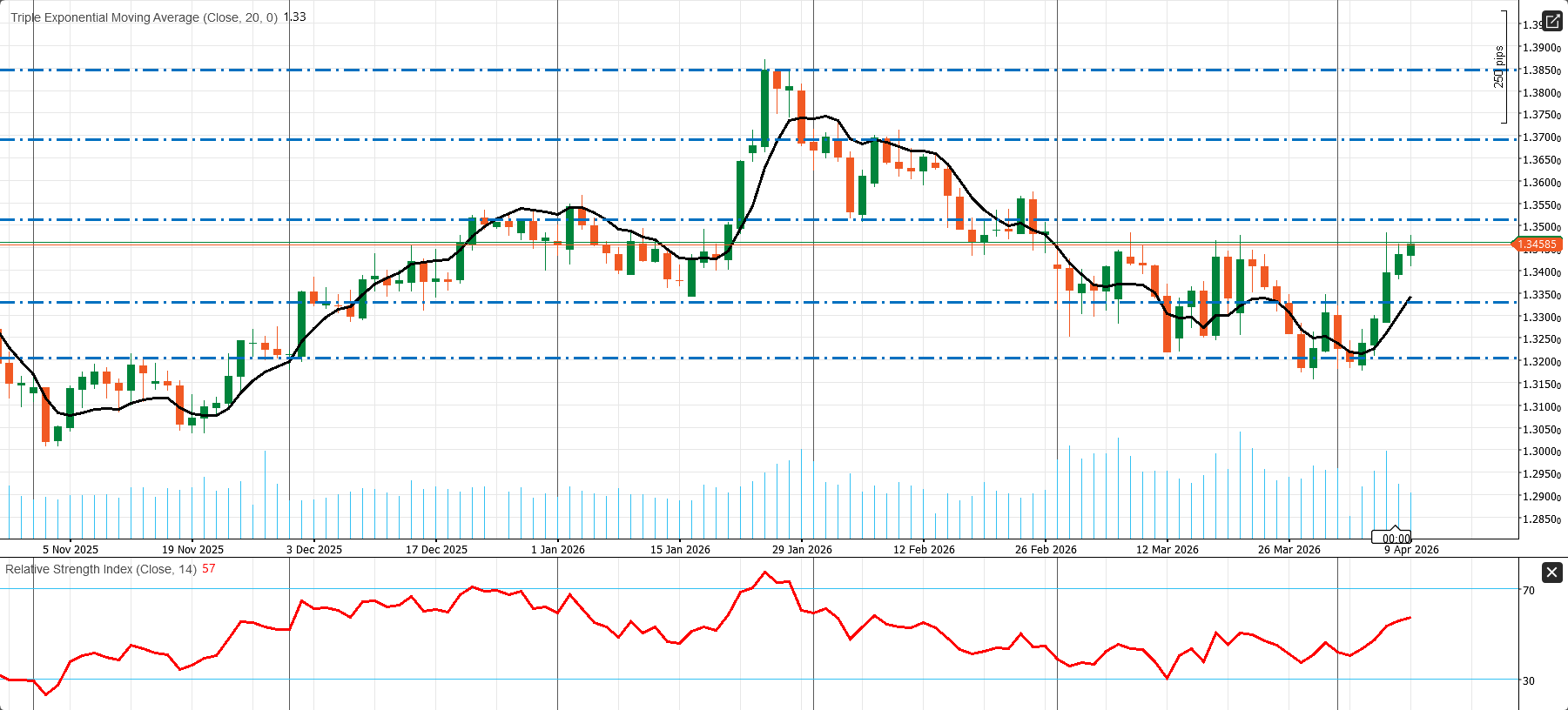
Technically, GBP/USD looks constructive in the near term. The pair has recovered from the 1.3200 area, moved back above short-term support, and is now testing the 1.3450–1.3500 region. Momentum indicators suggest improving upside pressure without yet reaching overstretched conditions, which leaves room for a further recovery if resistance breaks. But that technical resilience will still need support from either stronger UK data or continued dollar softness.
The bottom line for the week ahead is straightforward: the UK is entering a growth-and-central-bank week with very little margin for error. If GDP and production data rebound, markets may dismiss some of the March weakness as temporary noise linked to energy and geopolitics. But if Thursday’s hard data are soft as well, investors will have a much stronger case that UK momentum was already fading before the latest shock. That would leave the Bank of England facing a more difficult mix of weak growth and sticky inflation risk, and it would reinforce the idea that the UK economy is becoming more fragile, not more secure.
Gold Market Weekly Outlook:
Supportive Trend, Fragile Calm, and a Market Watching $5,000
Gold enters the new week with a constructive backdrop, supported by geopolitics, central-bank demand, and a softer U.S. dollar. But the rally is still not fully clean, because sticky U.S. inflation and delayed Federal Reserve easing continue to limit how aggressively bullion can move higher.
Gold’s market condition remains broadly constructive, but it is still being shaped by two competing forces. On one side, the metal continues to benefit from fragile geopolitical conditions, reserve diversification demand, and a weaker dollar. On the other hand, it faces resistance from hot U.S. inflation and the growing belief that Fed rate cuts will come later than previously expected. The result is a market that still leans bullish, especially on pullbacks, but one that remains highly sensitive to headlines and macro signals.
By the end of the week, spot gold was trading near $4,750 per ounce, after touching roughly $4,789.67 on Thursday. That left the metal up close to 2% on the week, which is an important signal after the heavy volatility seen in March. It shows that buyers are returning and that the market is attempting to rebuild confidence after a sharp correction. But this is not yet a clean breakout phase. Instead, gold looks to be in a more gradual recovery process, supported by a favorable macro floor but still lacking the decisive momentum needed to move into a more aggressive rally.
The current backdrop explains why gold remains firm. The most obvious support is geopolitics. Although the recent U.S.-Iran truce reduced some of the worst-case fears in the market, it did not remove broader regional risk. The Middle East situation remains fragile, and restrictions around the Strait of Hormuz continue to keep a level of safe-haven demand alive. In that kind of environment, gold naturally remains attractive as a hedge against instability. Even when panic eases slightly, the market is not behaving as if geopolitical risk has disappeared.
Another major pillar of support is central-bank buying. This is one of the most important structural reasons why gold has stayed resilient even during periods when higher rates and a firmer dollar might otherwise have hurt it more severely. China’s central bank extended its buying streak into March, and broader reserve-management behavior also continues to favor bullion. In a world where many central banks increasingly view geopolitics as a key reserve risk, gold retains a strategic appeal that goes beyond short-term trading. That makes dips harder to sustain and helps explain why the metal has repeatedly found buyers after corrections.
Still, the bullish case is not completely open. The main limiting factor remains the U.S. interest-rate outlook. Inflation in the United States is still running too hot to give the Fed a comfortable opening for near-term easing. As long as inflation stays sticky, the “higher for longer” narrative remains relevant. That matters for gold because the metal does not generate yield. When markets believe interest rates will stay elevated for longer, the opportunity cost of holding gold rises, and that can cap upside momentum even in a supportive geopolitical environment.
That is why the short-term view on gold is best described as cautiously bullish, but uneven. The medium-term trend remains positive, especially as long as geopolitical stress and reserve diversification demand stay in place. But in the near term, price action may remain choppy rather than explosive. Gold can still grind higher, but it may struggle to produce a clean impulsive move unless it gets a stronger external catalyst.
The next major upside battleground is clearly the $5,000 area. That level has become the most important psychological and technical zone in the market. For gold to break decisively above it, the market likely needs one of two developments. The first would be a renewed deterioration in geopolitical conditions that sharply revives safe-haven demand. The second would be a more convincing decline in the dollar and Treasury yields, which would restore stronger monetary-policy support for bullion. Without one of those, gold may remain firm and trend upward, but the pace could stay relatively measured.
The macro calendar for the coming week will therefore matter. The most important events are likely to be the U.S. PPI on April 14, the Beige Book on April 15, and Governor Waller’s Economic Outlook speech on April 17. These releases will help shape the rate outlook. If producer inflation comes in hot and the Beige Book suggests broader pass-through from energy costs, the market could move toward higher yields and a firmer dollar, which would create a headwind for gold. If inflation pressure looks less threatening, or if Fed language sounds less hawkish, bullion could extend its recovery.
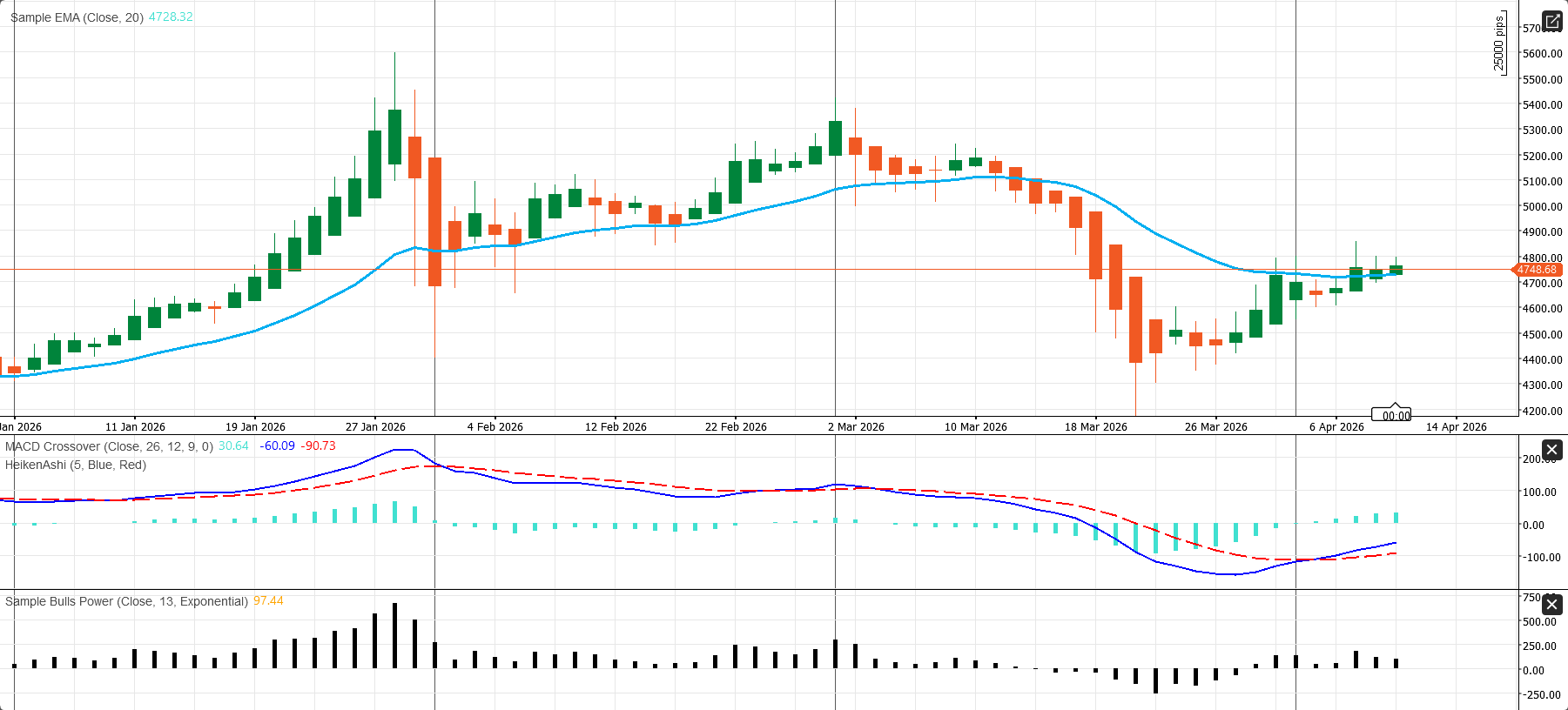
From a technical perspective, the daily chart also supports a cautiously constructive view. Gold is trading slightly above its 20-day EMA, which suggests short-term control is beginning to shift back toward buyers. The recent pattern of higher lows also shows that the rebound is becoming more organized. Momentum indicators have improved as well, with MACD turning more supportive and buying pressure beginning to recover. Even so, the $4,780 to $4,800 region remains the key near-term resistance area. A stronger move above that zone would be needed to confirm a broader upside continuation.
The bottom line is clear: gold remains in a positive trend, but not a fully comfortable one. The metal is supported by geopolitical fragility, central-bank demand, and dollar softness, yet constrained by sticky inflation and delayed Fed cuts. That leaves the short-term bias tilted upward on dips, while the broader outlook stays positive as long as the current macro and geopolitical foundations remain in place.
Energy Market Condition and WTI Weekly Outlook:
Oil Corrected Sharply, but the Supply Shock Has Not Truly Gone Away
Crude oil ended the week with one of its biggest declines in years, but the selloff did not reflect a fully normalized energy market. Futures priced out part of the war premium after ceasefire optimism, while the physical market continued to signal tight supply, restricted shipping, and a still-fragile balance.
The oil market had the most dramatic week among the major asset classes, but the headline price drop tells only part of the story. On paper, crude looked weak: Brent settled near $95.20 and WTI near $96.57, with both benchmarks posting their biggest weekly losses in years. Yet this was not a normal bearish move driven by collapsing demand or a clean improvement in supply. It was, instead, a violent repricing from panic conditions after the U.S.-Iran ceasefire announcement, while the underlying physical market remained far tighter than futures suggested.
That divergence is the most important point for understanding oil right now. Financial markets reacted quickly to the idea that the worst-case war scenario had become less likely. That pushed out a large part of the front-end geopolitical premium and triggered a sharp futures selloff. But in the real-world supply chain, conditions did not normalize. Shipping through the Strait of Hormuz remained heavily restricted, attacks continued to damage Saudi production and pipeline capacity, and Middle East producers were still shutting in significant volumes of crude. In other words, paper crude corrected on diplomacy, while the physical market kept trading a live supply shock. That is why oil repeatedly rebounded on negative headlines even after the steep weekly fall.
The supply backdrop remains difficult enough to prevent a clean bearish conclusion. U.S. official energy assumptions still point to a stressed market, with large shut-in volumes persisting through April under baseline expectations. Even if policymakers assume that the conflict does not extend much longer and that shipping gradually resumes, the near-term disruption is still meaningful. This matters because it means last week’s price decline should not automatically be read as a signal that oil risk has disappeared. Prices fell because fear eased, not because the global oil system returned to normal.
Inventories reinforce that more nuanced view. On the U.S. side, crude stocks rose again, suggesting domestic supply conditions were somewhat looser on a weekly basis. But the pace of stock building slowed compared with the previous report, and refined-product balances remained less comfortable. Distillate inventories, in particular, stayed relatively tight, while refinery runs remained strong. That mix does not describe a market in crisis, but it also does not describe one with an abundant cushion. Crude may have corrected sharply, yet the refined-product side still looks vulnerable enough to keep a firm floor under prices.
Demand expectations are also important. OPEC has not materially downgraded its core demand outlook for 2026 and still sees solid global oil demand growth. That matters because it limits how aggressively the market can price in demand destruction unless incoming macro data deteriorates much more clearly. Right now, the demand side is not strong enough to drive oil into a sustained rally on its own, but it is also not weak enough to justify a collapse in prices. That leaves the market unusually dependent on geopolitics, logistics, and near-term inventory trends.
For the week ahead, the best framework for WTI is volatile, headline-driven, and range-bound with asymmetric upside risk. The market is no longer in full panic mode, but it is also not back to normal. If diplomacy improves and tanker traffic through Hormuz clearly recovers, WTI could extend lower toward the low-$90s. But if talks disappoint, repairs are delayed, or transit remains constrained, crude could recover above $100 very quickly. This is why the current market does not look truly bearish despite the large weekly decline. The downside exists, but the upside reaction to bad news could still be faster and more violent.
Two major market reports will be especially important this week: OPEC’s Monthly Oil Market Report on Monday, April 13, and the IEA’s Oil Market Report on Tuesday, April 14. In normal conditions, these are already key reference points for supply, demand, and balance assumptions. In the current environment, they matter even more because oil has moved from panic spike to uneasy retracement in just a few sessions. If both reports lean heavily on ceasefire optimism and assume quick normalization, the market may feel more comfortable with last week’s selloff. But if they acknowledge that physical tightness remains much more severe than futures imply, oil could quickly find support again.
Beyond that, traders will focus on U.S.-Iran diplomacy, Hormuz shipping flows, U.S. producer inflation, EIA petroleum data, the Beige Book, and industrial production. These factors will shape both sides of the oil equation: supply risk and macro demand confidence. Geopolitics remains dominant, but macro data still matter because higher inflation and firmer yields can complicate the price outlook even when the physical market is tight.
From a technical perspective, WTI still trades in an elevated broader regime, but the near-term structure has clearly turned corrective. Price remains below the main dynamic resistance cluster and the psychological $100 zone, keeping downside pressure alive in the short run. If support near the mid-$90s breaks decisively, the next downside zone opens toward $90. But unless supply conditions improve more visibly, that weakness may prove temporary rather than structural.
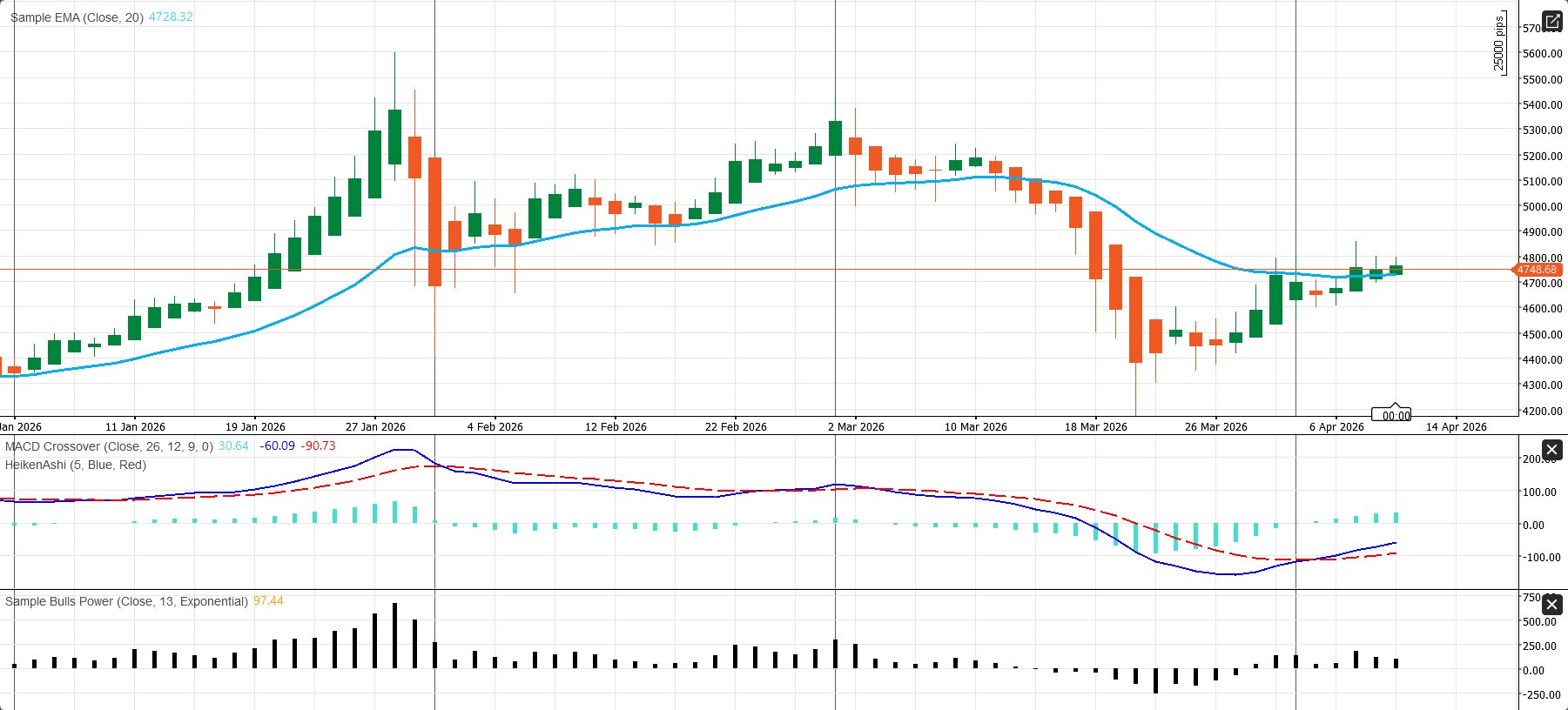
The bottom line is clear: oil corrected hard, but the energy market is not truly calm. Futures have repriced away part of the war premium, yet the physical market still reflects restricted shipping, disrupted Gulf supply, and tight product balances. That leaves WTI and Brent vulnerable to sharp swings in both directions, but with enough underlying stress to keep the overall market more resilient than the weekly price drop alone would suggest.
Crypto Market Weekly Outlook: Bitcoin Rebounds, but the Market Still Needs Confirmation
Crypto ended the week in better shape than it began, but this was not a clean breakout led by internal fundamentals. It was a risk-sensitive recovery, driven mainly by easing geopolitical stress, improving ETF flows, and a softer U.S. dollar, while Bitcoin remained far more resilient than the broader altcoin complex.
The crypto market had a better week overall, but the quality of the rebound matters just as much as the direction. Bitcoin and major altcoins moved sharply higher after President Donald Trump agreed to pause strikes on Iran for two weeks and Tehran tentatively accepted a ceasefire framework tied to safe passage through the Strait of Hormuz. That shift helped trigger a broader relief move across global markets: the dollar weakened, oil prices fell, and risk assets pushed higher. Crypto participated strongly in that move, but the message was clear: digital assets are currently trading more like high-beta risk instruments than like defensive safe havens.
That distinction is important. When the ceasefire headlines first hit, the rally was aggressive and broad enough to suggest that traders were quickly re-pricing lower geopolitical risk. But that first leg higher did not hold cleanly. As doubts about the truce returned and Middle East tensions resurfaced, momentum faded, and several major coins pulled back. By Thursday, Bitcoin had slipped back toward the low-$71,000 area, while Ethereum, XRP, and Solana also lost ground. Then by Friday, the market recovered some of that weakness as attention shifted to U.S.-Iran talks in Pakistan. In other words, crypto did not behave like a market breaking decisively into a new bullish phase. It behaved like a market swinging with every macro headline.
Even so, the underlying tone of the market was healthier than price volatility alone suggested. One of the most encouraging signals came from institutional flows. U.S. spot Bitcoin ETFs reportedly saw a strong one-day inflow early in the week, while broader digital-asset investment products also attracted net inflows. That matters because it shows real-money demand was still willing to buy into weakness, even while macro uncertainty remained elevated. It also helps explain why Bitcoin repeatedly found support on dips. The market may have been fragile, but it was not empty of conviction.
At the same time, the recovery was clearly BTC-led rather than broad-based. Bitcoin held up better than Ethereum, and Ethereum continued to see outflows even as the overall market stabilized. That is an important signal about risk appetite inside crypto. Investors appear willing to own the largest and most liquid crypto asset, but they are still less eager to chase the rest of the complex aggressively. That kind of leadership usually points to a market that is improving, but not yet fully confident. It suggests selective positioning rather than full speculation.
The policy backdrop also improved slightly, though not enough to become a major immediate catalyst. Developments around market structure and institutional adoption were constructive, including renewed support for U.S. crypto legislation and further progress in the banking side of the digital-asset ecosystem. But none of that looks strong enough right now to create an explosive short-term move on its own. The regulatory story is improving at the margin, yet it still feels more supportive for the medium term than for immediate price acceleration.
For the week ahead, the most important catalysts are likely to remain macro rather than crypto-specific. The market will be watching U.S. producer inflation, the Fed’s Beige Book, industrial production, and comments from Fed Governor Christopher Waller. These events matter because Bitcoin is still trading in close connection with the same forces that drive equities and broader risk appetite: the U.S. dollar, Treasury yields, and expectations for Federal Reserve policy. If inflation data come in softer than feared or if Fed language sounds less hawkish, Bitcoin could push higher and test whether the low-$73,000 area can give way more convincingly. But if producer inflation stays hot or the Fed reinforces a higher-for-longer message, crypto could quickly lose momentum again.
From a market-structure perspective, Bitcoin still looks constructive, but not fully confirmed. BTC has managed to recover above both its 20-day and 50-day moving averages, which is an important improvement in short-term technical tone. That suggests buyers have regained some control after the late-January to early-February breakdown. Momentum indicators have improved as well, with RSI moving above neutral levels and participation stabilizing. But the chart is still not sending a fully decisive bullish signal. The 20-day average remains below the 50-day average, which means the broader medium-term structure is still in repair rather than fully reversed. Resistance near $75,000 remains an important test, while the bigger upside zone sits much higher.
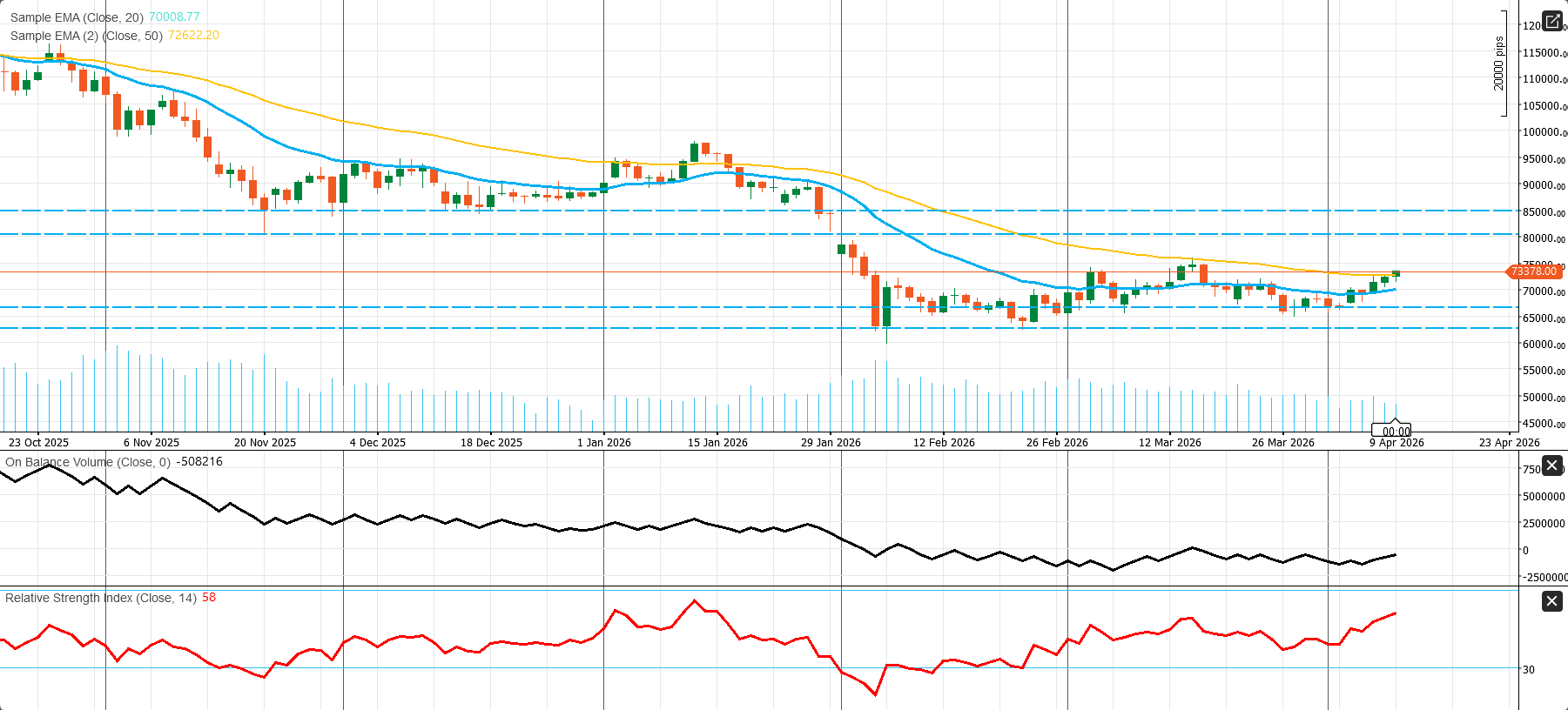
The practical conclusion is that crypto is in a recovery phase, not yet a breakout phase. Bitcoin has done enough to improve the tone of the market, and institutional flows suggest that underlying demand is better than it was during the earlier stress period. But the market is still heavily dependent on macro conditions, geopolitical stability, and the path of U.S. rates. For now, the most accurate description is a range-trading market with an upward bias if macro pressure eases further. The trend has improved, but conviction still needs confirmation.
Comments