 English
 پارسی



The year that refused to be simple
If 2025 taught markets anything, it was that “directional” is not the same as “easy.” The year delivered a strong headline performance in risk assets, but the path was jagged—punctuated by tariff shocks, geopolitical flare-ups, and a policy debate that never fully settled.
The core contradiction defined the tape: a world economy that kept moving forward, while investors repeatedly questioned whether policy credibility, fiscal math, and geopolitical uncertainty would finally bite. That contradiction produced one of the most unusual cross-asset scoreboards in years: global equities up strongly, the U.S. dollar down sharply, oil weaker, and precious metals on a historic tear—all in the same calendar year.
What follows is a full breakdown of how 2025 actually traded: the macro narrative, the regional stories, the asset-class winners and laggards, and the key themes that roll into 2026.
1) The macro regime in 2025: resilience under pressure
The policy cycle shifted—without turning “easy.”
2025 was not a clean pivot year. Yes, the U.S. Federal Reserve cut rates multiple times. But the market learned that rate cuts do not automatically mean dovish clarity. The Fed’s own communications showed meaningful internal disagreement about the right path for 2026—balancing sticky inflation risks against the danger of holding policy restrictive for too long.
That mattered because it shaped everything downstream:
- Equity multiples depended on whether the market could trust a gentle easing trajectory.
- Bond yields depended on whether cuts would be offset by higher term premia and deficit concerns.
- The dollar depended on whether U.S. rate differentials and confidence in the policy framework would narrow.
Fiscal and term premium re-entered the conversation
The long end of the curve became a recurring pressure point in 2025. Even as front-end expectations leaned toward easing, investors demanded compensation for duration risk—especially in a world where fiscal plans, debt issuance, and political uncertainty stayed front and center. This is one reason the year often felt like two markets at once:
- A front end that wanted to price cuts.
- A long end that wanted to price risk.
China stabilized—but the policy stance turned more proactive
China’s year-end messaging was consistent: the economy was expected to meet its “around 5%” growth target for 2025, but policymakers signaled a more proactive 2026 posture, combining consumption support with early approvals for large infrastructure initiatives.
The framing is important. The message wasn’t that China’s growth engine is “fixed.” It was that Beijing is prepared to lean harder on targeted tools—trade-in incentives, investment approvals, and broader support measures—to prevent a fragile domestic demand picture from deteriorating.
2) The 2025 scoreboard: what actually worked
Below is the year’s cross-asset story, written the way the market lived it—theme first, numbers second.
Equities: strong returns, narrower leadership than the headlines suggest
Global equities rose roughly ~21% in 2025, extending a multi-year run of double-digit gains. But the year was not a smooth melt-up. The biggest equity lessons were:
- Volatility was policy-driven, not data-driven. Tariffs and political headlines moved markets as much as inflation prints.
- Leadership stayed concentrated. AI and tech-linked narratives dominated again, even as the market periodically tried to broaden.
- Year-end seasonality disappointed. The “Santa rally” pattern faded into thin liquidity and profit-taking.
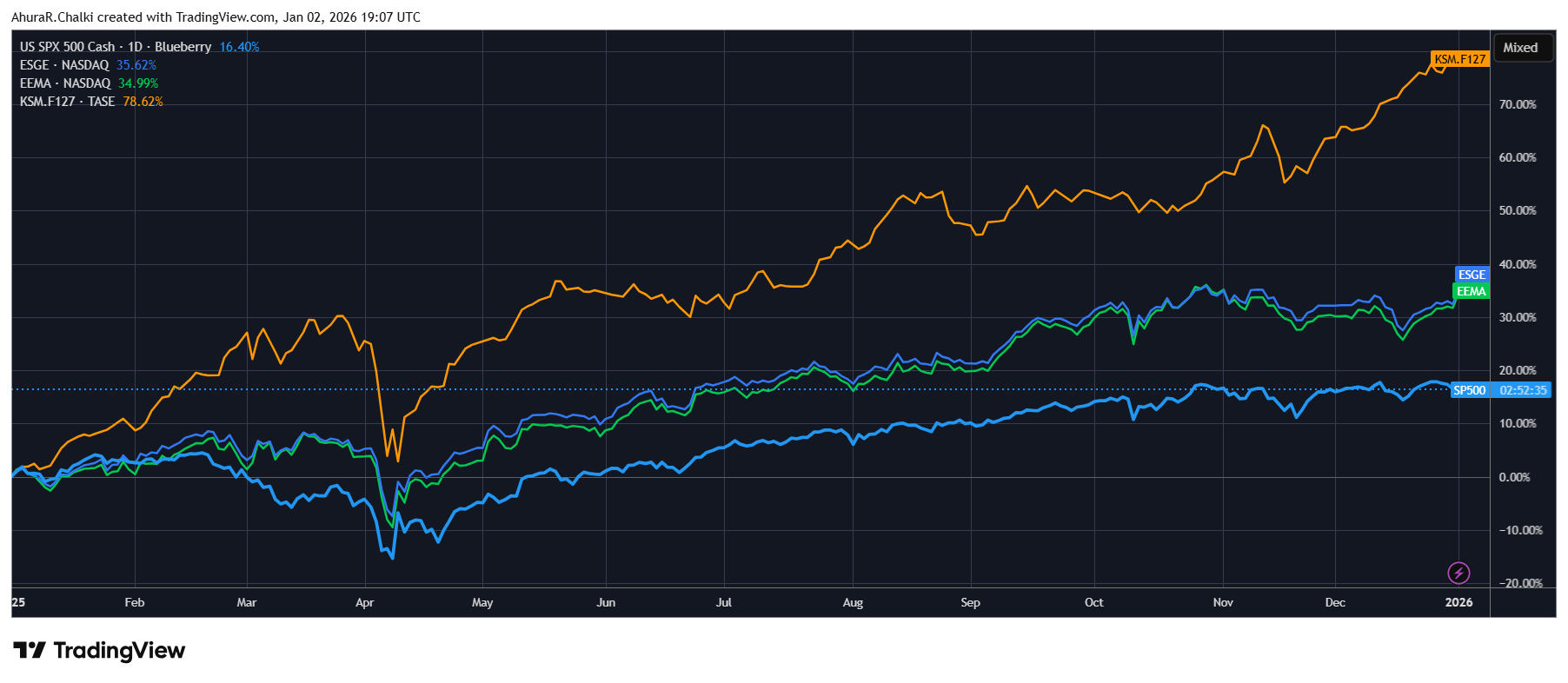
[CHART 1 — Global Equities 2025: MSCI ACWI vs S&P 500 vs STOXX 600 vs MSCI Asia ex-Japan]
Rates: easing at the margin, but duration never got comfortable
The rate story in 2025 was a constant negotiation between “cuts are coming” and “risk still costs something.” Even when bonds rallied, the long end’s sensitivity to fiscal and term-premium dynamics limited the ease of the trade.
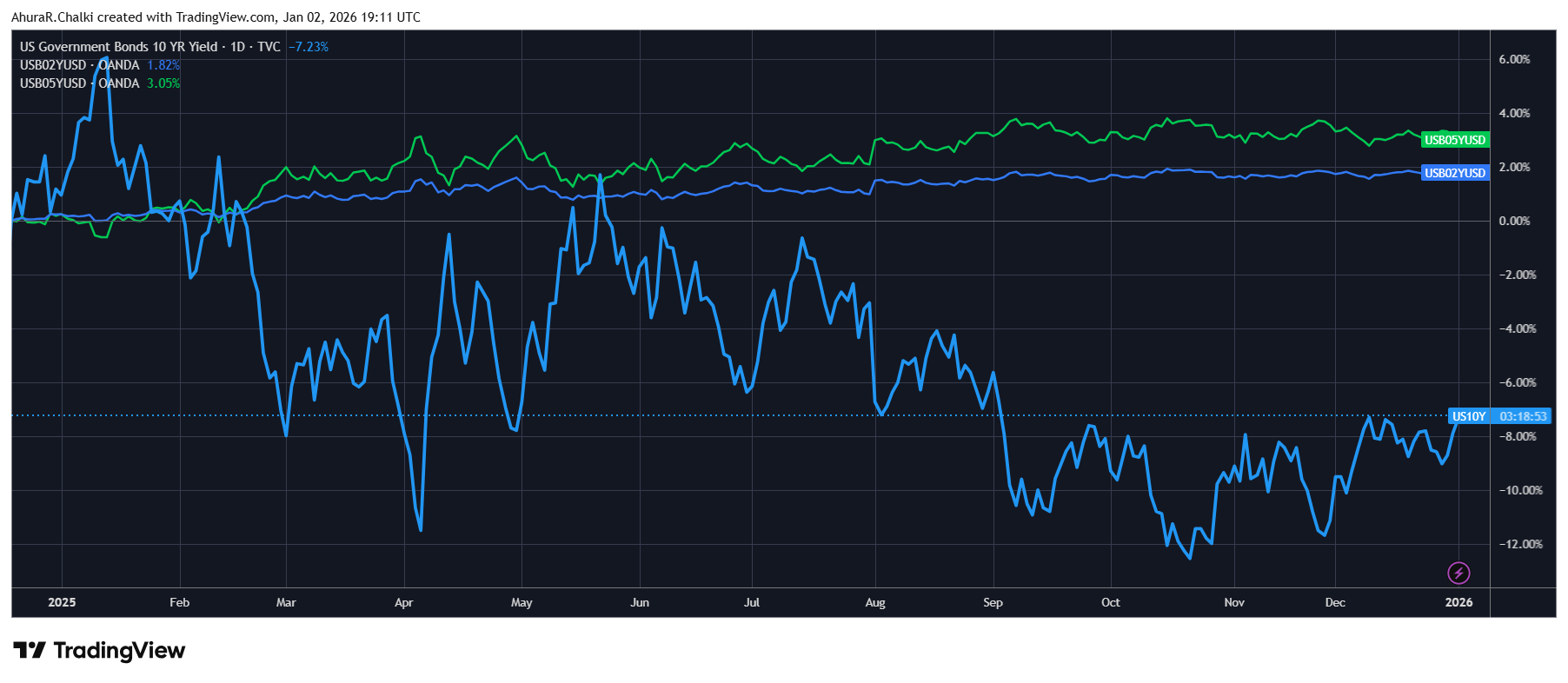
Chart : [CHART 2 — U.S. Treasury curve: start-2025 vs mid-2025 peak vs end-2025]
FX: The defining macro trend was a weaker dollar
The U.S. dollar index fell around ~9.5% in 2025—its biggest annual drop since 2017—while Europe’s major currencies delivered standout gains. The euro rose about ~13.5% and sterling about ~7.6%, both among their strongest years in roughly eight years.
This wasn’t just a “rates” story. It was a confidence story—about the intersection of:
- U.S. rate cuts,
- fiscal concerns,
- and trade-policy uncertainty.
China’s yuan strengthened meaningfully, breaking through key psychological levels and finishing the year with a notable gain. The yen, meanwhile, was the outlier: it struggled to capitalize on dollar weakness and ended the year broadly flat—even with Bank of Japan tightening steps—reflecting how powerful yield differentials and risk sentiment remained.
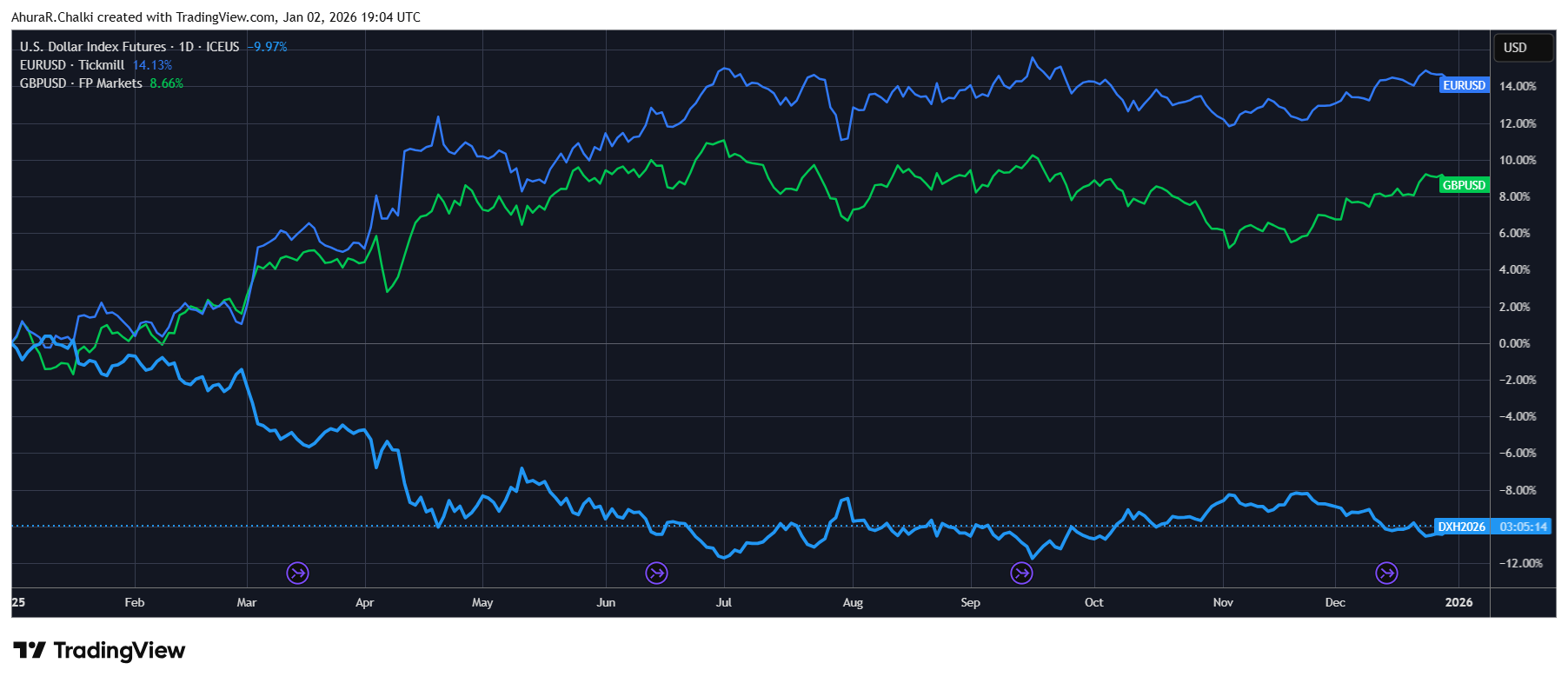
Chart : [CHART 3 — DXY vs EURUSD vs GBPUSD (2025)]
Commodities: precious metals stole the year; oil lagged
2025 will be remembered as a precious metals year.
- Silver surged ~161%, breaking above $80/oz for the first time.
- Gold rose ~66%, repeatedly printing record highs.
The support was multi-factor: investor hedging, central bank demand narratives, and the market’s belief that 2026 would bring lower rates.
Industrial metals also had a powerful year. Copper hit record levels near $12,960/ton and gained roughly ~44%, fueled by demand tied to AI infrastructure and the energy transition, plus supply disruptions.
Oil, by contrast, was the underperformer: Brent and WTI fell roughly ~15–19% on the year, pressured by the view that supply outpaced demand. Geopolitics created spikes—Ukraine-linked disruptions, Middle East risks, sanctions headlines—but the prevailing balance story kept crude heavy.
Chart placeholder:
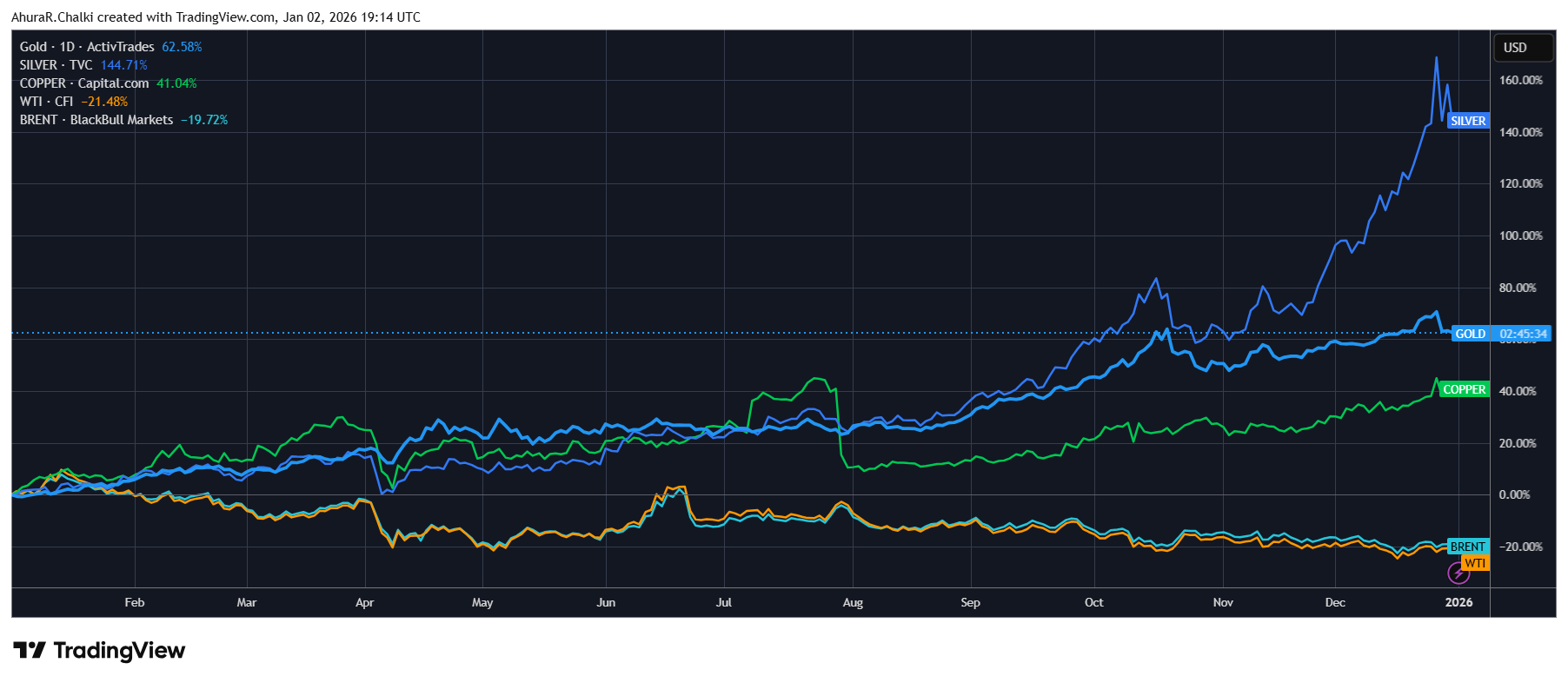
[CHART 4 — 2025 commodity returns: Gold, Silver, Copper, Brent, WTI]
Credit: a reminder that liquidity can outrun fear
Credit markets delivered one of the year’s more uncomfortable truths: even as macro risks piled up, spreads stayed resilient, and risk appetite repeatedly returned, helping lower-quality and distressed corners of the market post surprising gains.
That doesn’t mean credit risk disappeared. It means 2025 was a year where liquidity and carry often mattered more than macro narratives—until they didn’t.
Crypto: a late-year reversal under thin liquidity
Crypto reflected the year’s broader liquidity rhythm. Bitcoin printed a new all-time high above $125,000 in October, then retraced sharply toward the high-$80,000s into year-end—leaving it down modestly for 2025, with a steep drawdown in Q4.
The lesson was familiar: crypto can rally hard on optimism and flows, but it struggles when markets de-risk into thin liquidity—especially as real rates and macro uncertainty return.
Chart : [CHART 5 — Bitcoin: 2025 highs, drawdowns, and year-end level]
3) Regional narratives: the year looked different depending on where you stood
United States: AI optimism vs policy uncertainty
U.S. equities finished the year strong, but the U.S. story was never just “growth.” It was a three-way tug-of-war:
- tariff policy and trade uncertainty,
- the Fed’s uneasy path toward easing,
- and an AI-driven capex cycle that supported earnings expectations.
A key late-year dynamic was simply market microstructure: thin volumes, profit-taking after a strong run, and sensitivity to Fed communications.
Europe and the UK: rearmament themes and currency strength
Europe’s standout feature was sector rotation driven by geopolitics and defense policy. European defense names surged sharply, and European banks posted their strongest year in decades—helped by rates, policy signals, and relative valuation appeal.
The FX story mattered too: euro and sterling strength was not just a “USD down” trade; it was also the market’s view that European central banks might not match the Fed’s easing pace.
China: proactive policy meets fragile confidence
China’s policy posture strengthened into the year-end: more proactive macro support, consumption measures, and early investment approvals. Yet the structural issues remained visible—soft household confidence, deflationary pressures, and a property sector crisis that still defined sentiment.
China’s 2025 takeaway is best expressed as: stabilization is achievable, but momentum requires transmission into households.
Japan: tightening steps, but the yen didn’t get the memo
Japan’s monetary policy continued to normalize in cautious steps, but the yen’s performance highlighted the market’s impatience. Without a sustained fall in U.S. yields or a clear shift in risk sentiment, the yen struggled to reclaim its traditional safe-haven bid.
Asia ex-Japan and EM: AI exports and a currency tailwind
Asia’s equity performance was dominated by technology, semiconductors, and supply-chain beneficiaries of the AI boom. South Korea was a standout, and broader regional indices posted strong annual gains despite periodic tariff-related volatility.
Emerging markets also benefited from two supportive forces:
- the weaker dollar, and
- improved risk appetite toward local-currency assets.
4) The three forces that shaped 2025
1) Trade policy became a macro variable again
The year’s tariff shocks weren’t just headlines—they reintroduced a pricing framework many investors hadn’t needed for years: how tariffs flow through inflation, growth, margins, and central-bank reaction functions.
The market message was blunt: trade policy is back inside the macro toolkit, and it can drive real volatility even when the data calendar is quiet.
2) AI spending turned into a capital cycle
AI wasn’t just a stock story in 2025; it was a capex story. Hyperscalers spent enormous sums on data centers and compute, reshaping expectations for productivity, power demand, and industrial supply chains.
This is why 2025’s best lens is cross-asset:
- Equities rallied on AI optimism,
- Industrial metals gained on infrastructure demand,
- and energy markets faced competing forces (demand from power buildouts vs oversupply in oil).
3) Geopolitics set the floor—and sometimes the ceiling
Geopolitical risk stayed persistent: Ukraine-linked energy risks, Middle East tensions, and shifting global security arrangements. Even when fundamentals argued for lower commodity prices, geopolitics kept a risk premium alive, especially in energy and safe-haven assets.
5) The surprises of 2025 (and why they mattered)
2025’s surprises weren’t random; they were the market repricing assumptions.
Surprise #1: Precious metals outperformed almost everything.
This wasn’t simply fear. It was the combination of hedging demand, policy uncertainty, and a belief that rates eventually drift lower.
Surprise #2: The dollar’s decline was broad and persistent.
A ~10% annual drop in the dollar changes the global landscape: it supports EM conditions, amplifies commodity returns in USD terms, and shifts global asset allocation behavior.
Surprise #3: Oil underperformed despite geopolitical stress.
Oversupply narratives can dominate even in a world full of conflict—until the day they don’t. 2025 reminded investors not to confuse “headline risk” with “tight balance.”
Surprise #4: Risk appetite survived repeated shocks.
From April’s tariff volatility to late-year liquidity thinness, risk repeatedly recovered. That resilience is bullish—until it becomes complacency.
6) The 2026 setup: what to watch (and what could break)
2026 begins with markets priced for a continuation of easing and growth resilience—but the distribution of outcomes is wide. The key watchlist is not long, but it is sharp:
- The Fed’s credibility vs market pricing
Markets have priced more than the Fed has promised. Any conflict between inflation reality and easing expectations can reprice everything quickly.
- Term premium and fiscal sensitivity
If long yields rise for fiscal reasons, it can tighten financial conditions even in an easing cycle.
- The durability of dollar weakness
Short-USD is a popular trade. It can persist—but crowded trades need fresh catalysts to stay smooth.
- China’s policy transmission to households
Announcements matter less than outcomes. The market will watch consumption and private-sector confidence.
- Market breadth beyond AI
If leadership broadens, 2026 can be strong even without multiple expansions. If it stays narrow, volatility risk rises.
- Oil: OPEC+ policy and geopolitical floor
Oil’s bearish balance case is widely accepted. That consensus can be right—until geopolitics forces a repricing.
Comments