 English
 پارسی


Watch the analytical Video
Global Economy Weekly Review
Growth Holds, but the Energy Shock Changes the Risk Map
The global economy ended the week in a stronger position than many investors expected, but the improvement was uneven and increasingly exposed to a renewed energy shock. As a financial market analyst, I see the current backdrop as a mix of resilient demand, fragile confidence, sticky inflation risks, and rising geopolitical pressure. Growth has not broken, but the margin for policy comfort has narrowed sharply.
The biggest macro theme was the return of energy as the main transmission channel from geopolitics to markets. Even after the ceasefire extension, disruptions around Iran and the Strait of Hormuz kept oil and gas flows under pressure. Brent moved toward the high $90s and later above $100, while WTI traded between the high $80s and mid-$90s. U.S. inventory data added complexity: crude stocks rose unexpectedly, but gasoline and distillate inventories fell sharply. That means the risk is no longer just a headline issue. It is now an inflation, transport-cost, consumer-margin, and corporate-profit issue, especially for oil-importing economies.
The United States remained the strongest major developed economy. Retail sales rose 1.7% month-on-month, core retail sales increased 1.9%, and the control group gained 0.7%, confirming that the U.S. consumer is still a key engine of global demand. PMI data also improved, with manufacturing at 54.0, services at 51.3, and the composite index at 52.0. Housing showed some stabilization as mortgage rates eased slightly, while the labor market softened gradually rather than sharply. This is still a resilient economy, but that strength also creates a policy problem: higher oil prices and firm consumption make it harder for the Federal Reserve to move quickly toward easier policy.
The UK also delivered better-than-expected activity data. April PMI readings improved, with manufacturing at 53.6, services at 52.0, and the composite at 52.0. Retail sales rebounded, and the labor market remained mixed but not broken. However, inflation remains the main constraint. Headline CPI accelerated to 3.3% year-on-year, while producer input prices jumped sharply. For the Bank of England, this creates an uncomfortable balance: growth is holding up, but inflation is still sticky enough to limit policy flexibility.
The euro area remained the weakest part of the developed-market story. The composite PMI fell back below the expansion line to 48.6, mainly because services weakened again. Germany stayed under pressure, with softer Ifo and ZEW readings, weaker services activity, and a composite PMI back in contraction. France showed some manufacturing resilience, but services and consumer confidence remained weak. Europe is not collapsing, but its recovery is too narrow. Manufacturing stabilization alone is not enough if services and domestic demand fail to strengthen.
China looked stable, but not convincing enough to call it a broad recovery. The PBoC kept the 1-year LPR at 3.00% and the 5-year LPR at 3.50%, signaling policy stability rather than aggressive easing. The yuan remained broadly steady, but foreign direct investment weakened further, showing that foreign capital is still cautious. China remains a controlled stabilization story, not yet a strong reacceleration story.
Japan produced one of the more constructive macro mixes. Exports accelerated, trade rebounded, and manufacturing PMI jumped to 54.9. National core CPI rose to 1.8%, while corporate services inflation firmed. These numbers suggest Japan is not close to recession. Still, services softened, meaning the recovery is being led more by trade and industry than by synchronized domestic demand. For the Bank of Japan, normalization looks delayed, not canceled.
Emerging markets were highly divided. South Korea stood out, with GDP rising 1.7% quarter-on-quarter and 3.6% year-on-year, supported by semiconductors and the AI cycle. India’s composite PMI remained strong at 58.3, even though infrastructure output weakened. Turkey looked like a stabilization story under high interest rates, while Mexico, Brazil, and South Africa showed more mixed or softer signals. The key point is clear: economies with technology exposure, strong exports, or better reserves are holding up better than domestic-demand laggards.
Financial markets reflected this divergence. U.S. equities reached fresh record highs on earnings resilience and AI enthusiasm, before oil and Iran-related headlines brought caution back into futures. Japan and South Korea benefited from technology and semiconductor strength. Europe underperformed because of weak growth, luxury-sector pressure, and energy sensitivity. Across sectors, AI infrastructure and semiconductors remained the clear winners, while travel, fuel-sensitive industries, and parts of European consumer stocks lagged.
Commodities and crypto showed that markets were not trading in a classic panic. Gold weakened during parts of the week despite geopolitical stress, pressured by a firmer dollar, elevated yields, and inflation concerns. Crypto behaved like a high-beta risk asset rather than a defensive hedge, falling during escalation fears and rebounding when geopolitical risk eased. This matters because the market is trading a growth-versus-inflation shock, not a simple flight-to-safety event.
For central banks, the week delivered no clean signal. The Fed faces strong consumption and higher oil. The BoE faces better growth but sticky inflation. The ECB faces weak activity but still-uncomfortable price risks. The BOJ faces firmer inflation but softer services. The PBoC remains cautious. My conclusion is simple: global growth is still alive, but it is now operating under a tighter risk premium. The key things to watch are oil above $100, refined-product inventories, inflation expectations, PMI momentum, and central-bank language. Growth has not broken, but the energy shock has made the next phase much more fragile.
Global Economic Outlook:
Central Banks, Inflation, and Tech Earnings Define Week 18
The global economy enters Week 18, 2026, with markets facing one of the most important policy and inflation tests of the quarter. From April 27 to May 3, investors will focus on whether the world economy is still moving toward a soft landing or drifting into a harder mix of sticky inflation, slower growth, and energy-driven uncertainty.
The main event is the FOMC meeting on April 28–29. The Federal Reserve is widely expected to keep rates unchanged, but the real market signal will come from its tone on inflation, oil prices, growth risks, and the timing of future easing. The Fed decision will be followed by a major U.S. macro day on Thursday, when Q1 GDP, March PCE inflation, personal spending, and the Employment Cost Index are released. I see Thursday as the key trading day for the U.S. dollar, Treasury yields, gold, Bitcoin, and Wall Street.
Europe will also be under policy pressure. The ECB meets on April 29–30, while the Bank of England meets on April 30. Both face the same problem: higher energy prices have raised inflation risks, but growth remains fragile. The euro area’s April inflation flash estimate will be especially important for EUR/USD, European bonds, and regional equities.
In Asia, the Bank of Japan meets on April 27–28, with investors watching for any stronger signal on inflation confidence, wages, and policy normalization. China’s official PMI data will also matter because markets need confirmation that the manufacturing recovery is still holding.
The Middle East energy shock remains the biggest macro risk. Oil prices are now a central variable because higher energy costs can lift inflation expectations, weaken consumers, pressure margins, and force central banks to stay cautious for longer. That creates a difficult setup for risk assets: equities need lower yields, but oil-driven inflation keeps policymakers defensive.
For Wall Street, earnings may be just as important as macro data. Microsoft, Alphabet, Amazon, Apple, and Meta are expected to report results. Strong AI and cloud guidance could support the Nasdaq, but weaker margins, heavy capex concerns, or cautious guidance may trigger profit-taking.
USA
The U.S. week ahead is a major test for the soft-landing trade. The most market-moving sequences are FOMC on Wednesday, GDP/PCE/ECI on Thursday, ISM Manufacturing on Friday, and mega-cap tech earnings throughout the week. If the Fed holds with balanced language, PCE cools, GDP remains positive, ECI moderates, and mega-cap tech beats expectations, the market can see that as a bullish scenario. On the flip side, equity markets gen get hit if the Fed sounds hawkish, PCE and ECI stay hot, GDP weakens, and tech earnings fail to justify AI valuations. For traders, this is a week to watch rates first, because Treasury yields will likely determine whether strong earnings can keep lifting equities or whether inflation risk caps the rally.
U.S. Economy Weekly Review
Strong Demand Meets a More Complicated Inflation Backdrop
The U.S. economy ended the week with a stronger growth tone, but the details show a more complicated macro picture. As a financial market analyst, I see an economy that is still expanding, supported by resilient consumers, better business activity, and some improvement in housing. However, the return of energy-driven inflation risk, elevated inflation expectations, and only gradual labor-market softening make the outlook harder for the Federal Reserve to read. Growth is not breaking, but the policy environment is becoming less comfortable.
The strongest signal came from consumer spending. March retail sales rose 1.7% month-on-month, beating the 1.4% forecast and improving from the previous 0.7% gain. Core retail sales were even stronger, rising 1.9%, also above expectations. The control group, which feeds directly into GDP calculations, increased 0.7%, far above the 0.2% forecast. Retail sales excluding gas and autos held at 0.6%, while annual retail sales growth reached 3.97%. This confirms that household demand remains the main engine of the U.S. economy. The only softer signal was Redbook sales growth, which slowed to 6.7% from 7.0%, suggesting spending is still solid but no longer accelerating everywhere.
The labor market also remained stable, although it is no longer clearly tightening. Initial jobless claims rose to 214K from 208K, slightly above the 211K forecast. Continuing claims increased to 1.821 million, and the four-week average edged up to 210.75K. These numbers point to a gradual labor-market cooling rather than a sharp deterioration. Weekly ADP employment improved to 54.75K from 39.30K, reinforcing the view that hiring has slowed but not collapsed. For markets, this is important because a softening labor market supports the case for eventual Fed easing, but the data are not weak enough to force an urgent policy shift.
Business activity was one of the most encouraging parts of the week. The preliminary April S&P Global Manufacturing PMI rose to 54.0, beating the 52.5 forecast and improving from 52.3. Services PMI recovered to 51.3 from 49.8, while the Composite PMI increased to 52.0 from 50.3. This suggests the economy entered the second quarter with better momentum across both manufacturing and services. Still, broader indicators were mixed. The Chicago Fed National Activity Index fell to -0.20, and the Atlanta Fed GDPNow estimate for Q1 eased to 1.2% from 1.3%. In other words, activity is improving, but the economy is not moving into a boom phase.
Housing showed signs of stabilization, helped by slightly lower mortgage rates. Pending home sales rose 1.5% month-on-month, beating expectations for no growth, while the Pending Home Sales Index increased to 73.7. The MBA 30-year mortgage rate fell to 6.35% from 6.42%, which supported stronger mortgage activity. Applications rose 7.9%, the purchase index climbed to 175.6, and the refinance index jumped to 1,023.1. Housing remains far from strong by historical standards, but the data show that demand still responds quickly when financing conditions improve.
The inflation picture became more difficult. University of Michigan consumer sentiment improved to 49.8 from 47.6, but inflation expectations remained uncomfortably high. One-year expectations stood at 4.7%, while five-year expectations rose to 3.5% from 3.2%. This is a serious issue for the Fed because stronger sentiment, combined with higher inflation expectations, can make policy easing harder to justify. Energy added another layer of risk. Crude inventories unexpectedly rose by 1.925 million barrels, but gasoline inventories fell by 4.570 million, and distillates dropped by 3.427 million. That means crude supply looked less tight, but refined-product markets remained under pressure.
Financial conditions also reflected this mixed backdrop. The 20-year Treasury auction cleared at 4.883%, higher than the previous 4.817%, pointing to firmer long-end funding costs. The Fed’s balance sheet stayed near $6.707 trillion, while reserve balances declined to $2.915 trillion. Meanwhile, Kevin Warsh’s hearing kept the policy debate alive, with markets hearing support for Fed independence but no clear signal of lower rates soon. That helped keep the dollar and yields relatively supported.
For Wall Street, the message was constructive but not risk-free. Equities reached fresh highs on strong earnings and AI-related momentum, but futures softened as U.S.-Iran tensions and Strait of Hormuz risks brought oil supply concerns back into focus.
U.S. Economic Outlook
Fed, PCE, GDP, and Mega-Cap Tech Put Markets on Alert
The U.S. economy enters the week of April 27–May 1, 2026, with one of the most important macro and market calendars of the quarter. As a financial market analyst, I see this as a week where investors must judge whether the U.S. remains in a soft-landing environment or is moving toward a more difficult mix of slower growth, sticky inflation, and tighter-for-longer monetary policy. The key drivers are the FOMC meeting, the first estimate of Q1 GDP, the March PCE inflation report, the Employment Cost Index, and mega-cap technology earnings from Microsoft, Alphabet, Amazon, Meta, and Apple.
The main market theme is simple: growth vs. inflation vs. Fed patience. U.S. equities have already rallied strongly since late March, helped by AI enthusiasm and resilient earnings expectations. But that rally now faces a serious validation test. Consumer sentiment has weakened sharply, while inflation expectations have moved higher because of energy-price pressure linked to the Iran conflict and Strait of Hormuz disruption. The University of Michigan consumer sentiment index fell to 49.8, while one-year inflation expectations rose to 4.7% and five-year expectations increased to 3.5%. That is an uncomfortable combination for the Federal Reserve and for risk assets.
Tuesday, April 28, starts with the Conference Board Consumer Confidence report at 10:00 a.m. ET. This will be important because markets need to know whether the weakness in Michigan sentiment is becoming broader. A weak reading could pressure consumer discretionary stocks and support bonds, while stronger confidence may help equities but keep yields firmer. The same day, the FOMC meeting begins, which may encourage investors to reduce risk ahead of Wednesday’s policy decision. The ADP Employment Report / NER Pulse is also scheduled for Tuesday. Strong labor signals could support the U.S. dollar and Treasury yields, while weaker data could revive expectations for future Fed cuts.
Wednesday, April 29, brings March Durable Goods Orders at 8:30 a.m. ET. Strong core orders would support industrials, cyclicals, and the growth-resilience narrative. Weak orders would raise concerns that business investment is losing momentum. But the main event is the FOMC decision at 2:00 p.m. ET, followed by the press conference at 2:30 p.m. ET. The Fed is expected to hold rates unchanged, but tone matters more than the decision itself. This is not a Summary of Economic Projections meeting, so markets will focus heavily on Chair Powell’s language.
My base case is a patient Fed. Inflation is still too sticky, energy prices are a near-term risk, and the labor market is cooling but not breaking. The Fed is likely to keep policy optional and emphasize that it needs more data before changing course. Powell may highlight uncertainty from the Iran conflict and its possible impact on both inflation and growth. A hawkish hold would likely lift the 2-year Treasury yield and the U.S. dollar, pressure gold, and create valuation risk for Nasdaq and other long-duration growth stocks. A more dovish hold would support equities, gold, and rate-sensitive sectors.
Thursday, April 30, is the biggest macro shock day of the week. At 8:30 a.m. ET, markets receive Q1 GDP, March PCE inflation, personal income and spending, and the Q1 Employment Cost Index. This gives investors the full macro triangle: growth, inflation, wages, and consumption. The best market setup would be moderate GDP, softer PCE, and contained wage growth. That would support the soft-landing narrative and help equities. The worst setup would be weak GDP, hot PCE, and a strong ECI, because that would raise stagflation risk and likely support the dollar and yields while pressuring stocks.
The PCE report is especially important. Higher energy costs are expected to lift the March PCE deflator, with nominal spending supported by higher prices. Real consumption is expected to be more modest. The key risk is that household spending may be sustained by offsets such as tax refunds and after-tax income rather than stronger underlying fundamentals. I will watch discretionary categories closely because any pullback outside gasoline could show early consumer trade-down behavior.
Friday, May 1, shifts attention to the ISM Manufacturing PMI at 10:00 a.m. ET. The headline matters, but the most important components are new orders, employment, and especially prices paid. In March, ISM Manufacturing stood at 52.7, while the prices index jumped to 78.3, the highest since June 2022. A strong PMI with easing prices would be positive for equities. A weak PMI with high prices would be a classic stagflation warning.
Earnings are the other major market driver. Microsoft, Alphabet, Amazon, Meta, and Apple can decide the direction of the Nasdaq. Investors will focus on AI infrastructure spending, cloud growth, advertising trends, margins, and guidance. Strong AI and cloud numbers could extend the rally in the Nasdaq, S&P 500, semiconductors, and AI-linked names. But if companies show rising AI capex without enough near-term revenue conversion, the market may punish high-valuation technology stocks.
The important note for traders is that the April nonfarm payrolls report is not this week. It is scheduled for Friday, May 8, 2026. That means this week’s labor focus will come mainly through ADP, ECI, and ISM employment signals.
Market Takeaway:
This is a policy-validation week. A balanced Fed, softer PCE, stable oil, moderate GDP, and strong mega-cap tech earnings would support equities, weaken the dollar, and help gold and crypto. A hawkish Fed, hot PCE, strong wage inflation, weak GDP, or disappointing tech guidance would likely lift yields and the dollar while pressuring risk assets. The main things to watch are Fed tone, March PCE, Q1 GDP, ECI, ISM prices paid, oil prices, and mega-cap tech earnings.
USD and Wall Street Outlook:
Fed, PCE, GDP, and Big Tech Decide the Next Move
The week ahead is a major validation test for both the U.S. dollar and Wall Street. After a strong equity rally and a softer dollar close, markets now face four major catalysts at the same time: the FOMC meeting, Q1 GDP, March PCE inflation, and mega-cap technology earnings from Microsoft, Alphabet, Amazon, Meta, and Apple. The S&P 500 ended near 7,165, while the Nasdaq-100 closed around 24,836, confirming that U.S. equities enter the week with strong momentum. The U.S. Dollar Index closed lower at 98.50, showing that the dollar has not yet fully confirmed a hawkish Fed or higher-yield narrative.
The main market question is simple: can the risk rally survive a heavy macro week? Since late March, the S&P 500 has gained around 13%, while the Nasdaq has risen more than 19%. That is a powerful rebound, driven by easing geopolitical stress, AI optimism, and resilient earnings expectations. But this also means the market enters the week with less margin for disappointment. When positioning is already risk-on, even a small negative surprise from the Fed, inflation data, or Big Tech guidance can trigger sharp profit-taking.
For the U.S. dollar, the setup is range-bound to slightly bullish unless inflation softens meaningfully. The dollar started the previous week near 98.15, close to its weakest level since early March, as investors focused on Fed politics and Kevin Warsh’s nomination hearing. But the dollar later firmed toward 98.676 after markets concluded that Warsh was not signaling an easy-money pivot. His support for Fed independence and a smaller balance sheet pushed back against expectations of rapid rate cuts under political pressure.
The macro data also helped the dollar stabilize. March retail sales rose 1.7% month-on-month, beating the 1.4% forecast, while core retail sales jumped 1.9%. The control group rose 0.7%, well above the 0.2% forecast. These numbers showed that the U.S. consumer remains strong enough to reduce the urgency for Fed easing. Business activity also improved, with S&P Global Manufacturing PMI at 54.0, Services PMI at 51.3, and Composite PMI at 52.0. These are not recession signals; they show an economy still expanding at a decent pace.
Inflation expectations remain the problem. The University of Michigan survey showed one-year inflation expectations at 4.7% and five-year expectations at 3.5%. Combined with higher oil prices and renewed Iran-related energy risk, this makes it harder for the Fed to deliver a dovish message. For FX markets, better growth plus sticky inflation expectations usually support the dollar because it keeps front-end yields firmer.
The key transmission channel this week is the 2-year Treasury yield. If the Fed holds with a hawkish tone, PCE inflation stays firm, the Employment Cost Index points to strong wage pressure, and GDP remains resilient, the dollar should regain upside momentum. In that scenario, DXY could move toward the 99.40 resistance area and then the 100.50 zone. But if the Fed sounds balanced or dovish, PCE cools, wage costs soften, and GDP disappoints, the dollar could lose support quickly, especially against gold and lower-beta currencies.
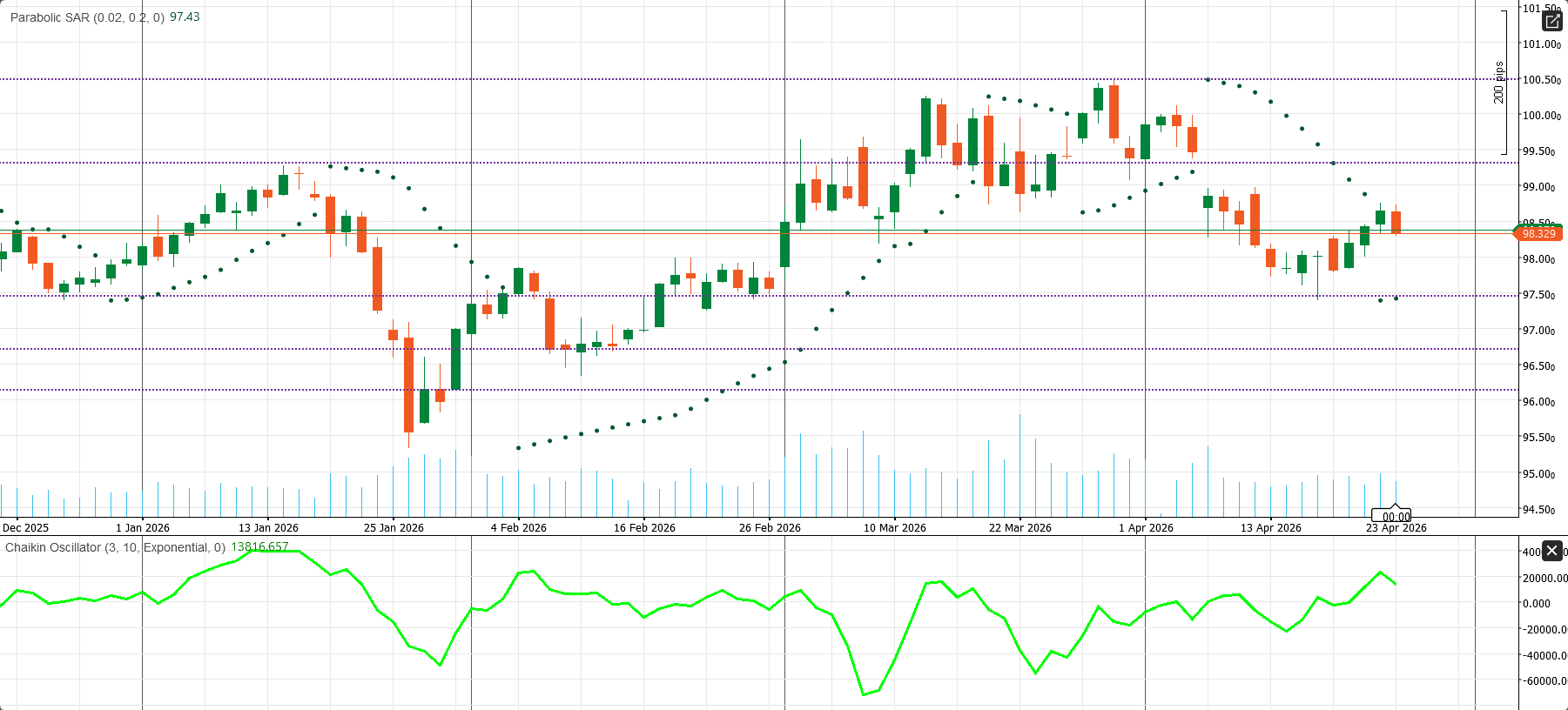
Technically, the U.S. Dollar Index is stabilizing rather than breaking down. Price is near 98.329, while the Parabolic SAR has flipped below price around 97.43, showing that the rebound from the 97.50 support zone is still alive. A move above 98.30–98.40 would keep the recovery intact, but a clean bullish signal needs a break above 99.40. On the downside, a daily break below 97.50 would weaken the recovery and expose 96.70, then 96.10.
Wall Street remains bullish, but event risk is high. The equity market has strong momentum, but the risk-reward balance is less attractive after such a large rally. The best setup for stocks would be a balanced Fed, cooler PCE, positive GDP, and strong Big Tech earnings. That would support the soft-landing narrative, lower yields, and help the Nasdaq, S&P 500, semiconductors, AI infrastructure, communication services, and consumer discretionary stocks.
The biggest risk is a cautious or hawkish Fed combined with hot PCE and strong ECI. That would suggest inflation pressure is not only energy-related, but also wage- and services-driven. In that case, yields could rise, the dollar could strengthen, and high-multiple growth stocks could face pressure. Big Tech earnings are especially important because investors are not only watching EPS beats. The real question is whether AI infrastructure spending is already producing enough revenue and margin support, or whether companies are spending aggressively before the payoff becomes visible.
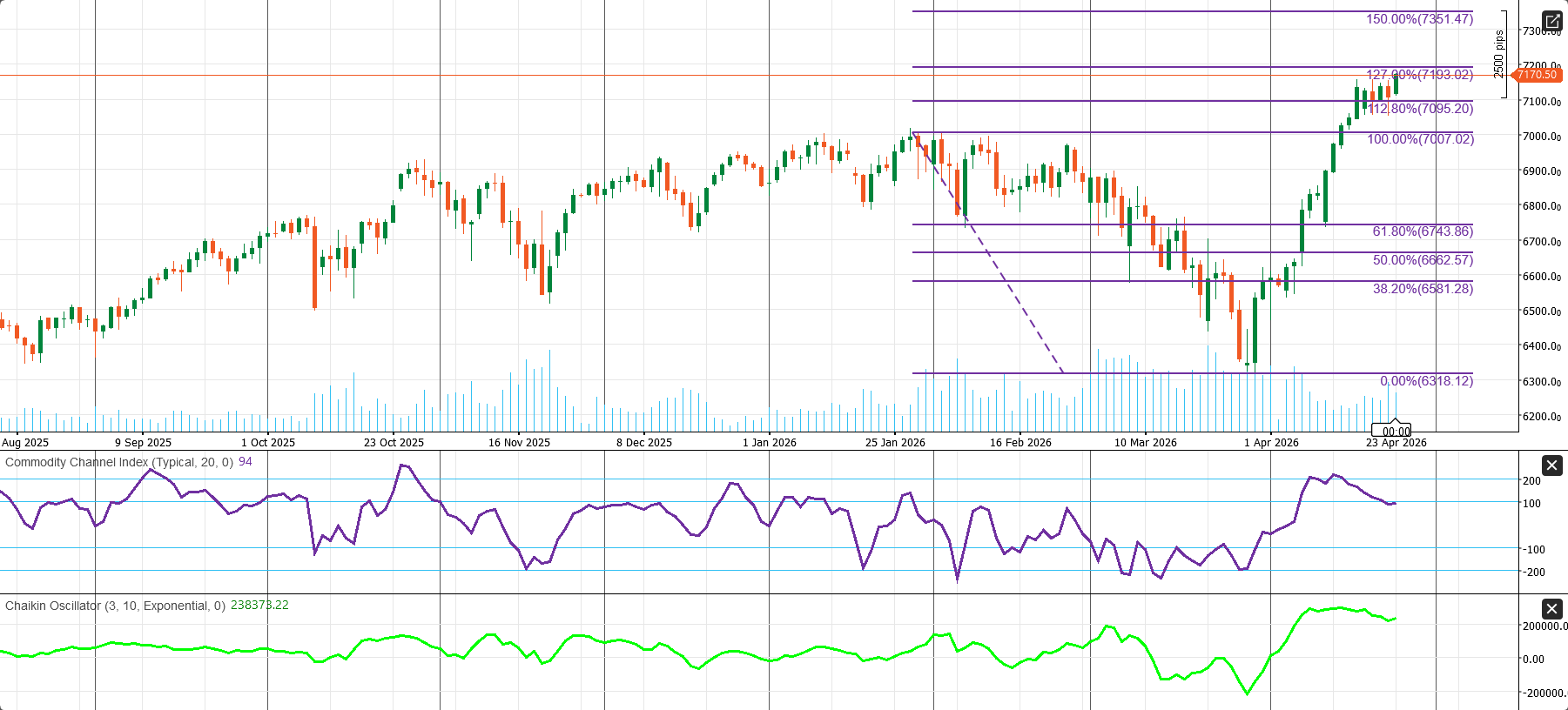
Technically, the S&P 500 remains in a bullish structure. Price is near 7,170.50, after rebounding sharply from the late-March low around 6,318.12. The index has already reclaimed major Fibonacci levels, including 7,007.02, and is now testing the 127% extension near 7,193.02. A daily close above 7,193 would strengthen the bullish continuation case and open room toward 7,351.47. First support stands near 7,095.20, followed by the important breakout base at 7,007.02.
Bottom Line:
This is a make-or-break week for the U.S. dollar and Wall Street. The dollar needs a hawkish Fed, firm PCE, and resilient wage data to extend its recovery. Wall Street needs the opposite: a Fed that avoids tightening the message, inflation that does not reaccelerate, and Big Tech earnings that justify the AI rally. The key things to watch are Fed tone, March PCE, Q1 GDP, Employment Cost Index, 2-year Treasury yields, DXY at 99.40, S&P 500 at 7,193, and mega-cap tech guidance.
Central Banks Outlook: Policy Caution Dominates a High-Risk Week
The week of 27 April–2 May 2026 will be one of the most important central-bank weeks for global markets, as policymakers meet under the pressure of higher energy prices, geopolitical uncertainty, and renewed inflation risks. With oil prices elevated because of Middle East tensions, markets will not only watch rate decisions but also the tone of forward guidance. Bond yields, currencies, equities, gold, and risk assets could all react sharply if central banks sound more hawkish or dovish than expected.
The Federal Reserve remains the central event, but beyond the Fed, five major central banks will also shape global market sentiment: the Bank of Japan, Bank of Canada, Banco Central do Brazil, Bank of England, and European Central Bank.
The Bank of Japan meets on 27–28 April and is expected to keep its policy rate unchanged at 0.75%. Inflation remains close to the 2% target, but higher oil prices have made the policy outlook more complicated. I expect a hawkish pause, where the BOJ may cut growth forecasts but raise inflation projections and keep the door open for a possible June rate hike. A dovish message could weaken the yen and support Japanese equities, while a hawkish surprise would likely strengthen the yen and push bond yields higher.
The Bank of Canada meets on 29 April, with economists expecting the overnight rate to remain at 2.25%. Canada’s inflation is near target and growth is soft, but the country also benefits from higher crude prices as a net oil exporter. A balanced, data-dependent statement would likely keep the Canadian dollar stable. Any hint of future tightening could support the loonie and lift domestic bond yields, while a dovish tone may pressure the currency.
The Banco Central do Brazil meets on 28–29 April. After cutting the Selic rate to 14.75% in March, policymakers are expected to deliver another 25 bps cut. However, Brazil’s central bank must be careful because the energy shock can feed inflation expectations. A measured cut could support local equities and bonds, but may slightly weaken the real. A surprise pause would likely strengthen the currency but hurt risk appetite in Brazilian stocks.
The Bank of England meets on 30 April and is expected to keep Bank Rate unchanged at 3.75%. The UK faces one of the most difficult policy mixes: inflation may move toward 3–4%, while growth remains weak and stagflation risks are rising. The BoE is likely to sound cautious and reduce confidence around future cuts. That could keep gilt yields elevated and support sterling, but any clear signal of future easing would weaken the pound.
The European Central Bank also meets on 30 April, with markets expecting no change after the deposit rate was kept at 2.0% in March. Inflation is projected at 2.6% in 2026, and investors will watch whether the ECB signals that a future hike remains possible. A hawkish message could lift eurozone yields and support the euro, while a dovish tone would pressure both.
Bottom Line:
This is a week of policy caution, not aggressive action. Most central banks are expected to hold rates steady or move carefully, but guidance will matter more than the decisions. The key things to watch are BOJ inflation projections, BoC tone, BCB easing pace, BoE stagflation language, and ECB signals on future hikes.
Commodity and Energy Market Review
Ceasefire Headlines Failed to Calm Physical Energy Stress
The past week in commodities proved that political de-escalation is not the same as market normalization. The ceasefire extension between the United States and Iran reduced immediate war-escalation fears, but it did not restore normal oil and LNG flows through the Strait of Hormuz. That distinction kept energy markets under pressure and forced investors to focus less on diplomacy and more on shipping, insurance, tanker availability, and physical supply chains.
The most important number was shipping activity. Only five ships reportedly passed through the Strait of Hormuz in 24 hours, compared with a pre-war norm of about 140. That showed the market was not dealing with a simple geopolitical headline risk; it was dealing with a real logistics shock. The disruption continued to affect roughly one-fifth of global oil and LNG supplies, while around 14.5 million barrels per day, or 57% of pre-war Persian Gulf output, was estimated to be offline in April.
That is why oil stayed firm despite hopes that the ceasefire would cap the rally. Brent settled at $105.33 per barrel, while WTI closed at $94.40. Brent gained about 16% for the week, and WTI rose nearly 13%. These are not normal weekly moves. They show that the market kept repricing a supply-risk premium every time Hormuz flows looked impaired or peace talks appeared fragile.
The U.S. inventory picture was mixed but still pointed to real energy tightness. Crude inventories unexpectedly rose, which would normally be bearish. However, gasoline and distillate stocks fell sharply, showing that refined-product markets remained tight. This matters because the real economic impact of energy stress usually comes through diesel, gasoline, freight, airline costs, and consumer fuel prices. In other words, the stress moved deeper into usable fuels and logistics rather than disappearing.
Gold had a more complicated week. Normally, unresolved Middle East risk would support bullion. This time, spot gold fell more than 2% during the week before recovering modestly to around $4,721.15 per ounce, while U.S. gold futures settled near $4,740.90. The reason was clear: higher oil lifted inflation fears, inflation fears supported the dollar and yields, and higher yields increased the opportunity cost of holding non-yielding gold.
This same pressure affected silver and platinum, which are more sensitive to the economic cycle. The broader message from metals was that markets were not trading geopolitics as a pure safe-haven event. They were trading it as an inflation-and-rates problem.
The macro signal is important. U.S. consumer sentiment stood at 49.8, while one-year inflation expectations rose to 4.7% and five-year expectations reached 3.5%. That means energy is now feeding directly into inflation psychology and central-bank pricing.
Bottom Line:
Oil remains structurally supported as long as Hormuz flows remain only partially functional. Gold is supported by uncertainty but capped by a firm dollar and elevated yields. The key things to watch are Hormuz shipping volumes, refined-product inventories, oil above $100, inflation expectations, and central-bank reactions.
Gold Weekly Outlook: Fed, PCE, and Real Yields Will Decide the Next Move
Gold enters the new week with a more cautious tone after posting its first weekly loss in five weeks. The market’s main tension is clear: geopolitical risk still supports bullion, but higher oil prices, a firmer dollar, and higher-for-longer rate expectations are limiting the upside. In my view, gold remains fundamentally supported, but the short-term path will be volatile because the next move depends heavily on the Fed, inflation data, and real yields.
The biggest event for gold is the FOMC meeting on April 28–29. Gold usually struggles when real yields rise, so a hawkish Fed message linked to sticky inflation or energy-price risks could lift the dollar and Treasury yields, putting pressure on XAU/USD. However, if the Fed acknowledges weaker growth risks and avoids a strongly hawkish tone, gold could recover quickly.
Thursday will be the key data test. Markets will receive Q1 GDP, March PCE inflation, personal income and spending, and the Q1 Employment Cost Index. A softer PCE print and weaker ECI would be bullish for gold because they would reduce real-yield pressure. Hot PCE and strong wage costs would be bearish in the short term because they would support a more defensive Fed. A weak GDP number combined with hot inflation would be more complicated: the first reaction may support the dollar, but the broader setup could strengthen gold as a stagflation hedge.
Geopolitics remains an important support. The Strait of Hormuz disruption and ongoing U.S.-Iran uncertainty continue to keep oil prices elevated and inflation expectations unstable. This gives gold both safe-haven demand and inflation-hedge demand. The problem is that the same oil shock can also push yields higher, which explains why gold has become more volatile.
Physical demand is still supportive. Indian premiums rose to their highest level in more than 10 weeks, while Chinese premiums also improved to nearly $4,700/oz. Precious-metals funds attracted $841 million in the week ending April 24, marking a fourth straight week of inflows.
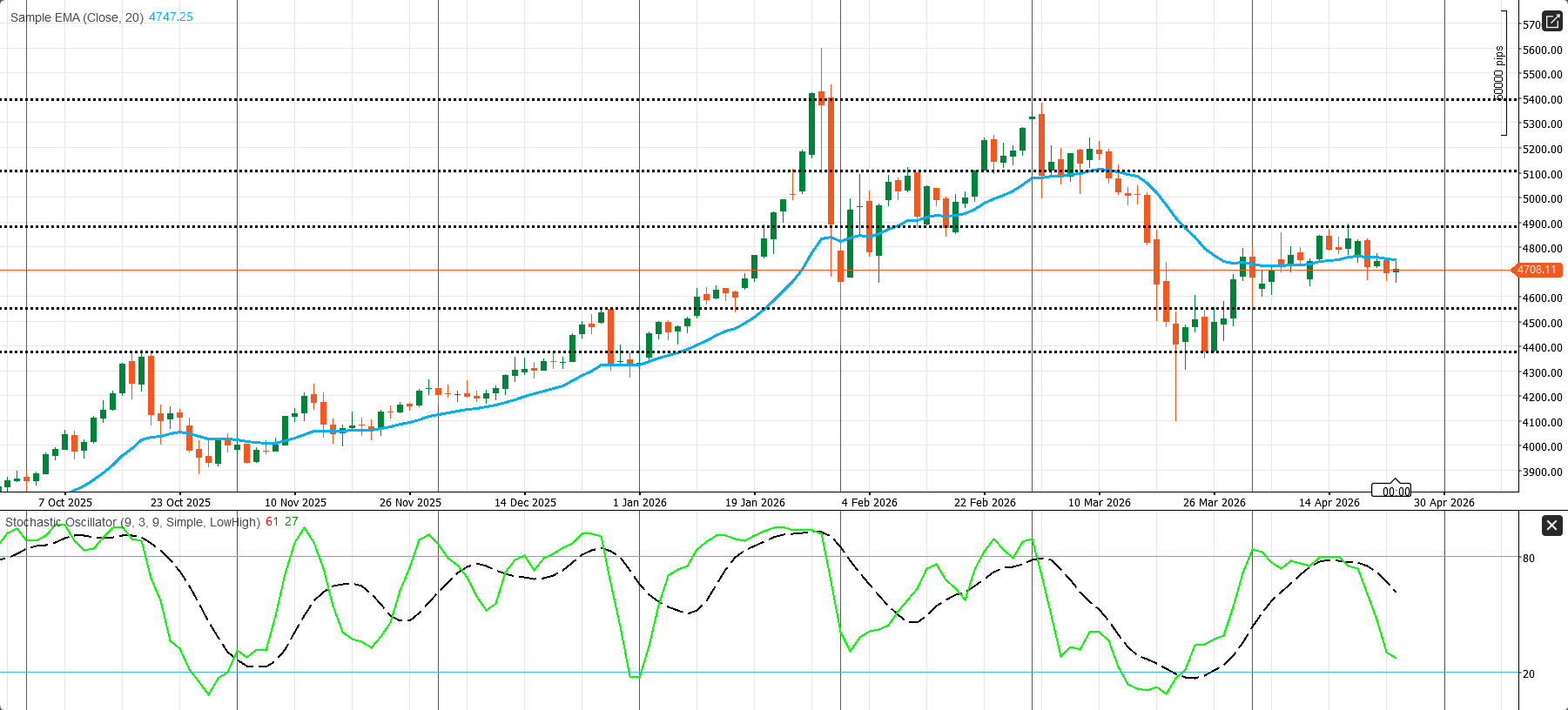
Technically, gold is mixed to mildly bearish in the short term. XAU/USD trades near $4,708, below the 20-day EMA at $4,747. Key support sits at $4,550–$4,400, while resistance is near $4,900. A daily close above $4,900 could reopen $5,100 and $5,400. Below $4,550, the risk shifts toward $4,400.
Bottom Line:
Gold’s bias is neutral to bullish, but the market needs lower real yields or a less hawkish Fed to regain upside momentum.
WTI Weekly Outlook: Supply Risk Keeps Oil Supported, but Demand Destruction Is Building
WTI enters the new week with a neutral-to-bullish bias, but this is not a normal oil rally. The market is being driven mainly by geopolitical supply risk, the unresolved Strait of Hormuz disruption, tight refined-product inventories, and the inflation impact of higher energy prices. WTI settled around $94.40 per barrel, still up nearly 13% for the week, while Brent finished near $105.33, gaining about 16%. That move shows the market is still pricing a large war premium, even though prices eased late Friday on hopes that U.S.-Iran diplomacy could resume.
The main support for oil remains the Persian Gulf supply shock. The Strait of Hormuz is still not functioning normally, with only five ships passing through in the previous 24 hours before the weekend. As one of the world’s most important energy chokepoints, even a partial disruption can keep risk premiums high across crude, diesel, gasoline, and LNG. This means dips in WTI may still attract buyers as long as shipping flows remain impaired.
However, the rally is also vulnerable to fast reversals. Because the move is supply-risk driven rather than demand-led, any credible ceasefire, reopening of shipping lanes, or improvement in U.S.-Iran talks could quickly remove part of the war premium. This makes WTI highly headline-sensitive.
The U.S. inventory picture was mixed but still supportive for the broader energy complex. EIA data showed crude inventories rising by about 1.925 million barrels, which would normally be bearish for WTI. But gasoline inventories fell 4.570 million barrels, and distillates dropped 3.427 million barrels. That is important because refined-product tightness is what transmits oil stress into the real economy through fuel, freight, aviation, and consumer costs.
The medium-term risk is demand destruction. The IEA cut its 2026 outlook sharply, now projecting global oil demand to decline by 80 kb/d, compared with earlier expected growth of 730 kb/d. It also estimated demand contraction of 800 kb/d in March and 2.3 mb/d in April. OPEC remains more optimistic, still forecasting 1.4 mb/d of demand growth in 2026, but the gap between IEA and OPEC shows how uncertain the outlook has become.
Oil is now also a Fed and inflation story. This week’s FOMC meeting, Q1 GDP, and March PCE inflation will matter for WTI. If high oil lifts inflation expectations and strengthens the dollar, risk assets and oil demand sentiment may weaken. If GDP or consumer data show gasoline prices hurting spending, WTI upside could be capped.
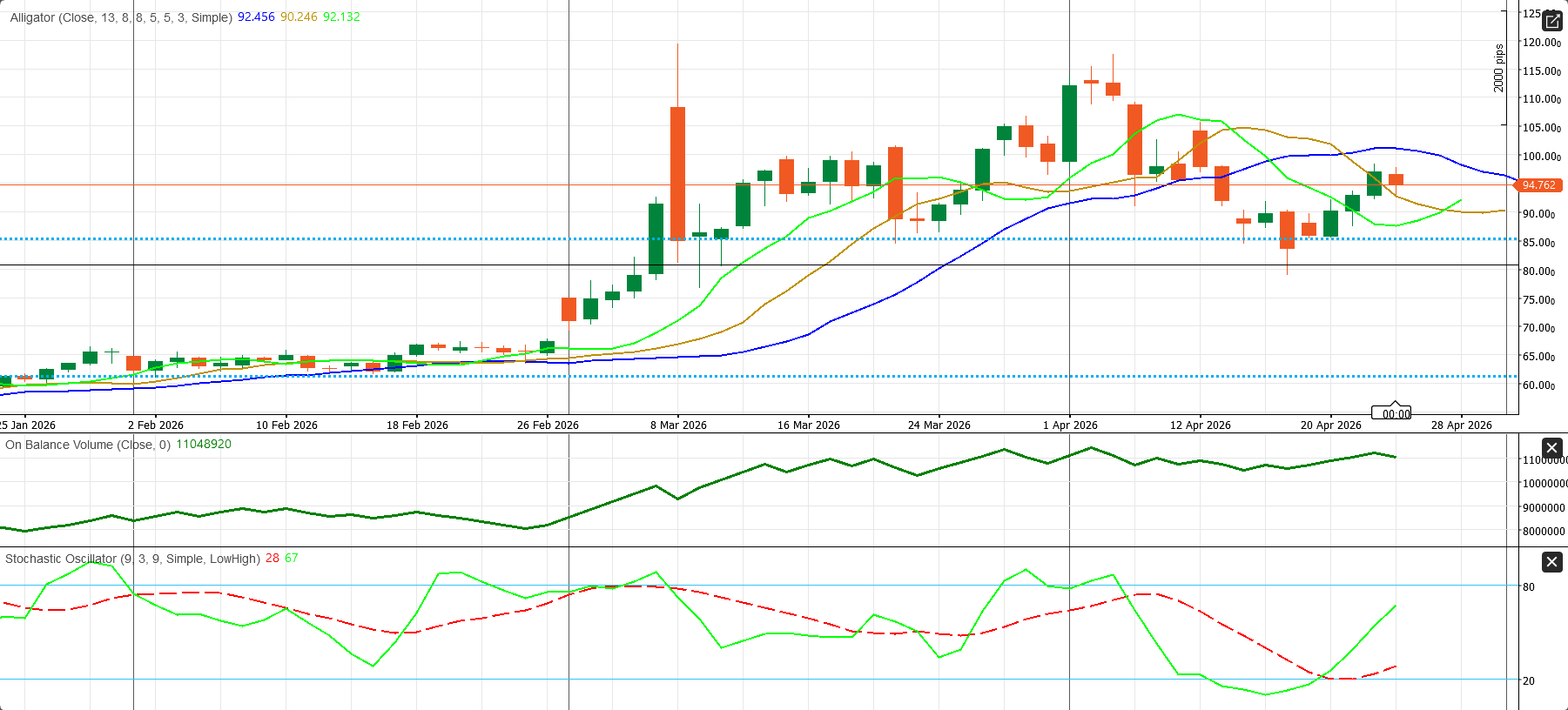
Technically, WTI has improved. Price is near $94.76, above the Alligator lines, with key resistance at $94.75–$95.00. A clean break above $95 could open $100 and then $105. Support sits near $92.10–$92.50, with the major floor around $85.50.
Bottom Line:
WTI remains a buy-on-dips market while Persian Gulf supply disruption continues, but after a 13% weekly rally, the market is carrying a heavy risk premium. The key things to watch are Hormuz flows, EIA inventories, Fed tone, PCE inflation, the dollar, and any U.S.-Iran diplomatic headline.
Crypto Market Review
Bitcoin Rebounds, but Macro Risk Still Controls the Tape
The crypto market ended the week in better condition than it started, but the recovery was not a clean risk-on breakout. As a financial market analyst, I see the current crypto setup as constructive but still highly dependent on macro stability. Bitcoin recovered from its risk-off selloff, major altcoins followed, and ETF inflows stayed strong. However, crypto is still trading less like an independent asset class and more like a high-beta macro asset linked to oil prices, the U.S. dollar, and Fed rate expectations.
The week had two clear phases. First, crypto sold off as Middle East risk and the Strait of Hormuz disruption raised fears of higher energy prices, stronger inflation, and a firmer dollar. In that phase, Bitcoin did not behave like “digital gold.” It behaved like a volatile growth asset. BTC slipped toward the mid-$75,000 area, later traded around $74,220, and briefly touched an intraday low near $73,831. That move confirmed that when geopolitical risk becomes acute, investors still treat Bitcoin as a risk asset rather than a defensive store of value.
The second phase was a recovery. As immediate war fears eased, Bitcoin rebounded toward $76,412 and later near $77,998. From the intraday low around $73,831, that represented a recovery of roughly 5.6%. The important point is that the selloff did not become a structural breakdown. Crypto was fragile, but not broken. Once the most intense macro fear faded, buyers returned quickly enough to protect the broader trend.
Altcoins also recovered, but leadership remained selective. Ethereum dropped to around $2,268.85 before rebounding to $2,385.12, a gain of about 5.1% from its weaker level. XRP recovered from $1.40 to $1.45, Solana from $83.94 to $87.75, Cardano from $0.2450 to $0.2546, and Dogecoin from $0.0937 to $0.0977. These moves were positive, but not euphoric. They looked more like a relief rebound than the start of a broad speculative altcoin cycle.
The strongest constructive signal came from institutional flows. Bitcoin ETFs attracted $663.91 million, pushing total sector net assets above $100 billion. Ether ETFs added $127.49 million, extending inflows to seven straight days. XRP funds drew $13.74 million, while Solana attracted $13.04 million. This is important because professional capital did not abandon crypto during the geopolitical shock. ETF inflows created a medium-term floor under the market and showed that institutional conviction remains intact despite short-term volatility.
Still, the market has structural weaknesses. Regulatory uncertainty around DeFi continues to weigh on sentiment, especially for Ethereum- and Solana-linked narratives. Liquidity is also thinner than in stronger phases of the rally. Stablecoin liquidity across major centralized exchanges has weakened, and thinner order books can make crypto more vulnerable to sharp moves during risk-off events. This means the market does not need a collapse in demand to fall quickly; it only needs a macro shock plus weak liquidity.
The macro environment remains the biggest risk. Higher oil prices can lift inflation expectations, strengthen the dollar, and delay Fed rate cuts. Kevin Warsh’s comments that he did not commit to cutting rates also reinforced the idea that U.S. policy may not turn easier quickly. For crypto, that matters because higher real yields and a stronger dollar increase the opportunity cost of holding speculative, non-yielding assets.
Bottom Line:
The crypto market bent, but it did not break. Bitcoin remains the anchor, ETF inflows are still supportive, and institutional demand is helping protect the medium-term structure. However, the next move depends heavily on oil, the dollar, Fed tone, ETF flows, and liquidity conditions. A softer Fed message and stable oil could help BTC extend toward higher levels. But renewed energy stress, hot inflation data, or a stronger dollar could quickly pressure Bitcoin and altcoins again.
Bitcoin Weekly Outlook
ETF Demand Supports the Recovery, but Macro Risk Still Controls the Breakout
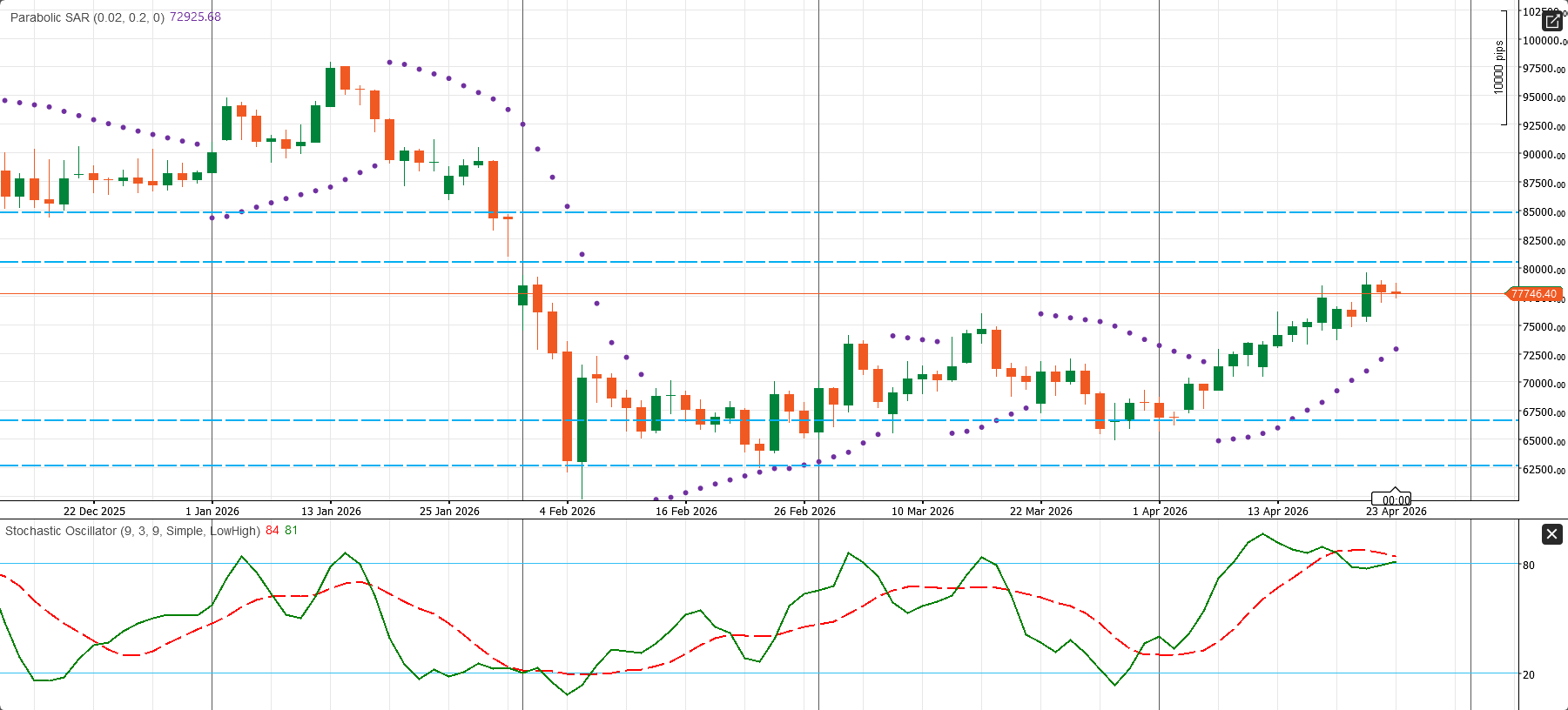
Bitcoin enters the new week in a recovery phase, trading around $77,397, after an intraday range of roughly $77,318–$78,506. Ethereum is also stable but less dominant near $2,314. The crypto market is being supported by stronger ETF demand, improving risk appetite, and easing geopolitical fear, but the next major test will come from the Fed meeting, U.S. PCE inflation, Q1 GDP, and the reaction in Treasury yields.
The main market condition is constructive, but not yet a clean breakout. Bitcoin has recovered from its March weakness and is now trying to hold the $75,000–$80,000 zone. Institutional flows are the strongest bullish factor. CoinShares reported $1.4 billion of inflows into digital-asset investment products, the strongest weekly total since January. Bitcoin attracted $1.116 billion, while Ethereum received $328 million. U.S. spot Bitcoin ETFs also recorded eight straight days of inflows totaling about $2.1 billion through April 23.
This matters because the rally is not only retail-driven. ETF and ETP flows create a structural buyer that can absorb profit-taking, especially near the $80,000 resistance area. A few more days of inflows would strengthen the bullish case, while any sudden reversal into outflows could quickly weaken the recovery.
Bitcoin is still behaving like a high-beta macro asset, not a pure safe haven. It benefits when equities rise, yields stop climbing, liquidity improves, and investors are willing to take risks. That makes the April 28–29 FOMC meeting critical. The biggest data shock comes on April 30, when markets receive Q1 GDP, March PCE inflation, personal income and spending, and the Q1 Employment Cost Index.
The weekly bias is neutral to bullish, but Bitcoin needs confirmation above $80,000–$80,700. A clean daily close above $80,700 could open the path toward $85,000 and improve sentiment across Ethereum, Solana, and broader altcoins. On the downside, first support sits near $72,900, followed by $66,700 and $62,500.
Bottom Line:
Bitcoin can extend higher if ETF inflows continue, the Fed avoids a hawkish tone, PCE stays contained, Treasury yields fall, and Nasdaq remains strong. But a hawkish Fed, hot inflation, stronger dollar, weaker ETF flows, or a post-earnings equity selloff could push BTC back below $75,000 and trigger deeper consolidation.
FAQ
Why is this week important for global markets?
This week combines several major catalysts: the FOMC meeting, U.S. PCE inflation, Q1 GDP, the Employment Cost Index, central-bank meetings in Europe and Asia, oil-market disruption, and mega-cap technology earnings.
What is the most important U.S. data point this week?
The most important data point is March PCE inflation, released alongside Q1 GDP, personal income and spending, and the Employment Cost Index. Together, these reports will show whether growth remains resilient while inflation stays contained.
How could the Fed affect markets?
A balanced Fed could support equities, gold, and Bitcoin by keeping rate-cut hopes alive. A hawkish Fed could lift the U.S. dollar and Treasury yields while pressuring stocks, gold, and crypto.
Why does oil matter so much this week?
Oil is now a major inflation risk. The Strait of Hormuz disruption has kept energy prices elevated, which can raise inflation expectations, pressure consumers, and force central banks to remain cautious.
What should investors watch in gold?
Gold will react mainly to real yields, the U.S. dollar, Fed tone, and PCE inflation. Softer inflation and lower yields would support gold, while a hawkish Fed and stronger dollar could limit upside.
What is the key level for Bitcoin?
Bitcoin needs confirmation above the $80,000–$80,700 resistance zone. A clean breakout could open the way toward $85,000, while a stronger dollar or hot inflation could push BTC back below $75,000.
Why are Big Tech earnings important?
Microsoft, Alphabet, Amazon, Apple, and Meta can decide the next move for the Nasdaq. Markets will focus on AI growth, cloud demand, margins, capex, and guidance.
What is the bottom line for Week 18?
This is a policy-validation week. Markets need confirmation that inflation is not reaccelerating, growth is not breaking, and central banks can stay patient without triggering a new risk-off move.
Comments