 English
 پارسی



Analytical Video
Global Economy Weekly Review:
Slower Growth, Sticky Inflation, and the Oil Shock Reshaping Markets
The global economy ended the week in a more fragile position than it began. Growth has not collapsed, but the margin for error is clearly getting smaller. Across major economies, the underlying pattern was consistent: activity is still expanding, yet momentum is fading; inflation is no longer the dominant market panic, but it remains sticky enough to constrain central banks; and the Iran-linked oil shock has added a fresh layer of uncertainty to an already delicate macro backdrop.
- Event of the Week
The week’s biggest macro event was the sharp move in energy markets. Oil surged early as investors rushed to price in the risk of supply disruption through the Middle East and the Strait of Hormuz. Although crude later pulled back from the highs, the damage to sentiment had already been done. The shock forced markets to reconsider both growth and inflation assumptions. For policymakers, it revived the threat of energy-driven inflation persistence. For energy-importing economies, it raised concerns over weaker activity, higher imported costs, and pressure on domestic currencies. For financial markets, it triggered a broad repricing across equities, bonds, foreign exchange, and commodities before some calm returned.
- USA
In the United States, the data painted the picture of an economy that is cooling but not yet weakening in a disorderly way. Fourth-quarter GDP was revised sharply lower to 0.7% annualized, with softer consumer spending and weaker real final sales confirming that the economy lost momentum late in 2025. Even so, the broader picture remains more resilient than recessionary. Jobless claims stayed relatively low, nominal consumer spending still increased, and the Atlanta Fed’s GDPNow estimate remained near a pace that suggests the first quarter is holding up. Inflation data were somewhat reassuring at the headline level, but core inflation remained sticky enough to prevent the Federal Reserve from relaxing too quickly. That leaves the U.S. economy in a familiar but uncomfortable position: slower growth, still-positive activity, and inflation pressures that are not fully defeated, now complicated by rising oil prices.
- UK
The United Kingdom looked softer and less convincing. January GDP was flat, while industrial production and manufacturing disappointed. Retail conditions also appeared weaker, and consumer confidence slipped again, reinforcing the impression of an economy that is struggling to build momentum. Trade data offered one encouraging sign through a narrower deficit, but the broader growth story remains subdued. The UK is not in collapse, but it continues to look like a low-growth economy with limited internal strength and fragile confidence.
- Europe
The euro area told a similar story, especially in manufacturing and industry. Industrial production across the bloc fell sharply, Germany’s factory orders were particularly weak, and Italy’s industrial output also underwhelmed. Inflation, however, remained more manageable than alarming. Germany, France, and Spain all showed moderate price pressure rather than any major reacceleration. That combination leaves the European Central Bank with some policy room, but not a clean runway, especially if energy prices remain elevated. The broader regional pattern remains unchanged: southern Europe is holding up better, while the core industrial economies continue to struggle under weak demand and poor factory momentum.
- China
China was one of the stronger stories of the week. Inflation surprised to the upside, core prices improved, producer-price deflation eased, trade stayed firm, and credit growth outperformed expectations. Taken together, those numbers suggest China entered 2026 with more momentum than markets had assumed. But this is still not a fully self-sustaining recovery. Export strength remains central, liquidity conditions remain supportive, and temporary boosts such as holiday spending likely played a role in the inflation rebound. China looks better, but it is still exposed to any renewed weakening in global demand and to the negative effects of higher oil prices.
- Japan
Japan also had a constructive week overall. GDP was revised higher, wage growth remained strong, lending conditions stayed supportive, and several leading indicators improved. These are encouraging signals for the Bank of Japan’s gradual normalization path. Still, the picture is not uniformly strong. Household spending remained soft, producer-price momentum cooled, and manufacturing sentiment stayed cautious. Japan is moving toward a more normal growth and rate environment, but the recovery is still uneven and not yet broad enough to be described as a demand-led upswing.
- Emerging Economies
Emerging markets remained divided. India and Brazil continued to show relative resilience, though for different reasons. India still benefits from strong domestic demand and credit expansion, but the rupee came under pressure as oil surged, exposing its vulnerability as a major energy importer. Brazil looked steadier, supported by solid services activity, stronger retail conditions, and cooling inflation on a 12-month basis. Turkey remained one of the more fragile large emerging markets, with strong retail demand offset by industrial weakness, rising inflation expectations, a pause in rate cuts, and pressure on reserves. Mexico softened on both inflation and industrial activity, while South Africa showed some external improvement but remained weak domestically.
Overall, the global economy still looks like it is growing, but with less resilience and greater exposure to shocks. The U.S. is slowing but holding up. Europe remains weak, especially in industry. China is improving, though still reliant on exports and policy support. Japan is stabilizing, but unevenly. Emerging markets are increasingly split between domestic strength and external vulnerability. Above all, the oil shock has reminded investors that inflation risk has not vanished and that global growth remains highly exposed to geopolitics.
USA
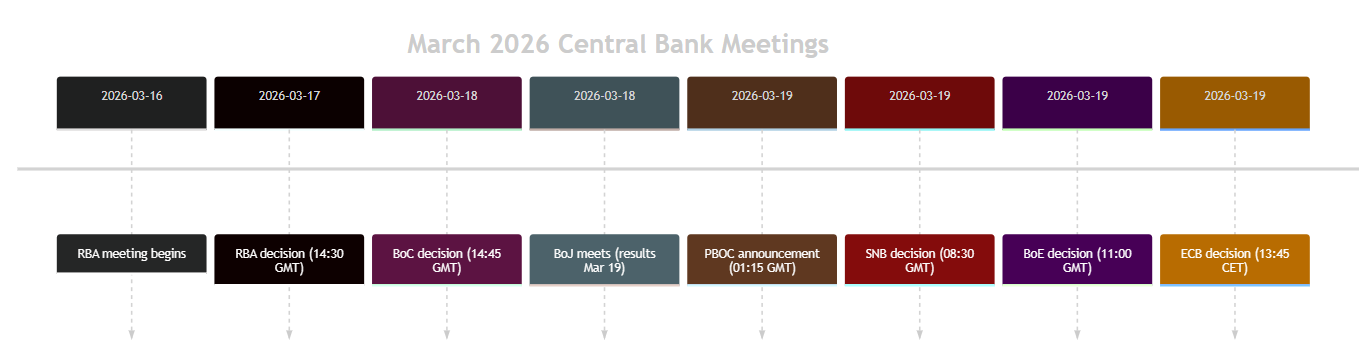
For the week ahead, the U.S. macro narrative is no longer one of a clean, soft landing. It is shifting toward a more uncomfortable mix: slower growth, softer labor momentum, shaky sentiment, and inflation risk that may be re-intensifying through energy. That makes March 18 the key date. A steady-rate decision is widely expected, but the real question is whether the Fed signals patience, caution, or a renewed inflation bias. Right now, the most likely outcome is a cautious, hawkish hold.
U.S. Weekly Economic Review:
Cooling Growth, Sticky Inflation, and a Consumer That Still Holds Up
The U.S. economy sent a mixed but still fundamentally resilient signal over the past week. The broad macro picture is becoming clearer: growth has cooled meaningfully from the stronger pace seen in late 2025, inflation is easing only gradually, and domestic demand remains intact rather than broken. For markets and policymakers, that combination matters. It suggests the economy is slowing into a more constrained environment, not falling into a recessionary spiral.
The biggest macro development came from the latest revision to fourth-quarter GDP. U.S. growth was revised down to an annualized 0.7%, well below the prior 1.4% estimate and sharply lower than the 4.4% pace recorded in the previous quarter. Real final sales slowed to just 0.4%, while real consumer spending eased to 2.0% from 3.5%. That revision was important because it confirmed that the economy lost momentum more quickly than previously believed at the end of 2025. Still, the backward-looking weakness was not the full story. The Atlanta Fed’s GDPNow estimate for the first quarter held near 2.7%, indicating that activity entering 2026 has likely been firmer than the revised Q4 data alone would suggest.
Inflation data reinforced the idea that disinflation is continuing, but only at a slow and uneven pace. February CPI was relatively contained, with headline inflation at 0.3% month-on-month and 2.4% year-on-year, while core CPI came in at 0.2% month-on-month and 2.5% year-on-year. On the surface, that was a decent outcome. But the Federal Reserve is unlikely to be fully satisfied because the PCE data still showed persistence underneath. Headline PCE for January rose 0.3% month-on-month and 2.8% year-on-year, while core PCE remained firmer at 0.4% month-on-month and 3.1% year-on-year. The Dallas Fed trimmed mean PCE at 2.7% added to the same message: inflation is moving in the right direction, but not fast enough to justify easy policy confidence. Treasury markets reflected that reality, with auctions clearing at relatively elevated yields and reinforcing the view that rate cuts are still far from guaranteed.
Consumer behavior remains one of the key reasons the economy is slowing rather than breaking. Personal spending rose 0.4% in January, although real personal consumption increased only 0.1%, showing that inflation is still absorbing part of nominal household spending power. Sentiment data also showed a divide between current resilience and future caution. The University of Michigan survey improved to 55.5 overall, but expectations slipped while current conditions strengthened. That suggests households are still active, but they are becoming more selective and less confident about the road ahead.
The labor market remains the strongest stabilizing force in the U.S. economy. Initial jobless claims fell to 213,000, continuing claims improved, and the four-week average also declined. Those figures do not point to a labor market under serious stress. Private hiring remains modest rather than robust, and small business optimism softened somewhat, but overall employment conditions are still holding up better than broader sentiment measures. As long as labor remains stable, the risk of a sharp demand collapse stays limited.
Housing data were mixed but broadly constructive. Existing home sales beat expectations, housing starts posted a strong upside surprise, and mortgage activity improved despite still-elevated financing costs. The weaker point came from building permits, which fell and suggest a softer construction pipeline ahead. Even so, housing demand has clearly not cracked under higher rates.
Business investment told a similar story. Durable goods orders were flat, but the internal details were better than the headline suggested, with core orders still rising modestly. That fits the broader macro pattern: investment is moderating, not collapsing.
Overall, the U.S. economy looks like it is entering a slower but still functioning phase. Growth has cooled, inflation remains sticky beneath the surface, and oil-related risks continue to complicate the outlook. But labor markets, housing, consumer spending, and trade have not broken down. For now, the most accurate reading is this: the U.S. economy is losing speed, not stability.
U.S. Economic Outlook for the Week Ahead:
Fed Caution, Cooling Growth, and Inflation Risks Back in Focus
The U.S. economy enters the week of March 16–21 in a more delicate position than markets were expecting only a few weeks ago. The main story is no longer one of clear resilience or clear disinflation. Instead, the outlook now reflects a more uncomfortable combination: growth is slowing, inflation is still sticky, and higher oil prices are adding fresh upside pressure to the inflation outlook just as activity data begin to cool. For traders, investors, and policymakers, that creates a tougher macro mix.
The most important theme for the week is the likely outcome of the Federal Reserve meeting. The Fed is still expected to leave interest rates unchanged, but that does not necessarily mean a market-friendly outcome. The real focus will be on the tone of the statement, the updated Summary of Economic Projections (SEP), the dot plot, and Chair Jerome Powell’s press conference. The central question is whether the Fed sounds more concerned about softer growth or more concerned about renewed inflation pressure. At this stage, the balance appears tilted toward caution on inflation, which means the Fed may sound firmer than investors want.
The reason this matters is simple: the U.S. is entering the week with a macro backdrop that is not weak enough to force immediate easing, but not strong enough to dismiss slowdown fears. That is a difficult environment for risk assets. The latest revision to Q4 2025 GDP showed annualized growth of just 0.7%, down sharply from the earlier 1.4% estimate. That revision confirmed that the economy lost momentum more quickly than previously believed near the end of last year. Even though real final sales remained somewhat better than the headline GDP number, the broader signal was still one of decelerating domestic momentum.
At the same time, inflation has not been fully defeated. The most recent CPI data showed headline inflation at 2.4% year over year, still above the Federal Reserve’s target zone in practical terms, while monthly price pressures remained uncomfortable before seasonal adjustment. That alone would already argue for patience from the Fed. But the bigger problem is that the recent oil shock tied to the Iran conflict has reintroduced the kind of inflation risk central banks dislike most: an externally driven price shock that can raise consumer inflation expectations even while growth is slowing. In other words, the U.S. outlook is starting to look more like a growth scare versus inflation scare battle, and that is exactly the kind of setup that complicates monetary policy.
Labor market signals are also adding to the uncertainty. The February payrolls reading weakened noticeably, and that has pushed markets to pay much closer attention to forward-looking labor indicators. It is not yet a collapse story, but it is enough to raise questions about how much hiring momentum is left. Consumer psychology is also becoming more fragile. The University of Michigan sentiment index slipped again, showing households are increasingly uneasy. That matters because a weaker consumer mood can translate into softer discretionary spending, especially if inflation remains elevated and energy prices keep moving higher.
This week’s incoming data will therefore matter not only on its own, but also in terms of how they shape the Fed narrative. On Monday, the spotlight will fall on industrial production and capacity utilization. This is one of the cleanest hard-data readings on real activity during the week. After the softer GDP revision and the weaker labor signal, markets want to know whether the factory side of the economy is still stabilizing or beginning to soften as well. Manufacturing has shown some signs of life this year, helped by high-tech investment and the possibility of delayed capital spending returning. However, the broader backdrop remains uncertain, and the latest geopolitical tensions create fresh downside risks. A solid print would help calm recession concerns. A weak number would reinforce the idea that the U.S. entered 2026 with less momentum than previously thought.
On Wednesday, the key release is the Producer Price Index (PPI), which arrives on the same day as the Fed decision. That makes it especially important. PPI is closely watched because it can influence expectations for future PCE inflation, which is the Fed’s preferred measure. If producer prices come in hot, it would strengthen the case for a hawkish hold, meaning a Fed that leaves rates unchanged but sounds reluctant to cut anytime soon. If PPI is softer, it could help reduce the market damage from a firm Fed message. Either way, inflation data arriving on decision day raises the stakes significantly.
Other data matter too, even if the timing is less certain. Retail sales and housing data would normally be major macro events because they offer direct insight into the health of the consumer and the rate-sensitive parts of the economy. Retail sales will show whether household demand is still holding up after weaker growth data and softening sentiment. Housing will show whether lower mortgage rates since late 2025 are beginning to support activity or whether affordability pressures and uncertainty are still holding the sector back. Because of earlier federal government shutdown disruptions, traders need to watch the calendar carefully. But from a macro perspective, these releases remain highly important.
By Thursday, attention turns to jobless claims, the Philadelphia Fed Manufacturing Survey, and new home sales. Jobless claims remain one of the most timely labor-market indicators, and after the recent payroll disappointment, any upside surprise would attract more attention than usual. The Philadelphia Fed survey will provide an early look at business conditions, orders, hiring, and price pressures in manufacturing. If activity weakens while price components stay firm, markets may interpret the data as increasingly stagflationary. That would not be a comfortable conclusion for either the Fed or investors.
The housing outlook is somewhat better. Lower mortgage rates and builder incentives have supported new home sales, and while winter weather may have distorted some monthly readings, the broader trend still suggests housing demand has not collapsed. That said, elevated inventories and ongoing affordability constraints may limit how much construction can accelerate.
Overall, the base case for the week is clear: the Fed holds, growth concerns remain elevated, and inflation risks stop policymakers from turning dovish. That means markets are likely to react less to the rate decision itself and more to the tone, projections, and Powell’s guidance. The U.S. economy is not breaking, but it is losing momentum at a time when inflation is proving stubborn, and oil is adding new pressure. That is why this week matters: it may define whether markets continue to price a soft landing, or start taking the risk of a more difficult macro path more seriously.
FOMC Meeting Preview, March 17–18: Powell Faces a Stagflation Test
The March 17–18 FOMC meeting is the most important event of the week because it is not just about the rate decision. The market already expects the Federal Reserve to keep rates unchanged at 3.50%–3.75%. What matters far more is the message from Chair Jerome Powell, the updated dot plot, and the new Summary of Economic Projections (SEP). This meeting comes at a difficult moment for the U.S. economy, with growth slowing, labor-market momentum fading, and inflation risks rising again بسبب higher oil prices tied to the Middle East war.
The key issue is that the Fed is now dealing with a more uncomfortable macro mix. Growth has weakened, but inflation has not cooled enough to justify an easy dovish turn. That is why the most likely outcome is a hawkish hold rather than a dovish pause. In practical terms, the Fed is likely to acknowledge softer growth and a less firm labor market, while still signaling that rate cuts are not imminent because inflation remains too sticky and energy prices could push headline inflation higher again.
The oil shock linked to Iran has made the policy path even more complicated. Even if the Fed prefers to look through energy-driven price spikes, it cannot ignore the risk that higher oil and gasoline prices will keep inflation expectations elevated. That raises the chance that the updated projections will look slightly more stagflationary: lower growth forecasts, somewhat higher inflation projections, and a modestly softer labor outlook.
The biggest market focus will be on three things: the dot plot, whether inflation forecasts are revised higher, and Powell’s explanation of whether the oil shock is temporary or a reason to keep policy restrictive for longer. The bottom line is clear: this meeting is less about today’s rate decision and more about whether the Fed reinforces the higher-for-longer narrative. If it does, that would likely support the U.S. dollar and Treasury yields, while keeping pressure on equities and other rate-sensitive assets.
USD and Wall Street Weekly Outlook:
Stronger Dollar, Fragile Stocks, and a Fed-Oil Market Test
The clearest macro trade setup for this week remains relatively straightforward: the U.S. dollar still has fundamental support, while Wall Street remains vulnerable to further pressure unless markets receive either a meaningful geopolitical de-escalation signal or a surprisingly dovish Federal Reserve message. In practical terms, the framework is simple. A hawkish Fed hold combined with elevated oil prices would likely keep the dollar firm and equities under pressure. By contrast, a more balanced Fed tone and calmer energy markets could allow the dollar to give back some gains and help equities stage a short-term relief rebound.
What changed last week was the market’s macro balance. The U.S. dollar strengthened sharply, with the Dollar Index (DXY) rising 1.5% to 100.35, as investors rotated into safer assets and pushed back expectations for Federal Reserve rate cuts. At the same time, Wall Street weakened across the major indices. The Dow Jones fell around 2.0%, the S&P 500 lost 1.6%, and the Nasdaq dropped 1.3% over the week. That combination tells an important story: investors were not simply trading noise. They were repricing a more difficult economic environment.
The reason behind the move was a more uncomfortable macro mix. Oil prices moved higher, inflation risks became firmer, growth expectations softened, and confidence in near-term Fed easing declined. This is a difficult combination for risk assets. Higher oil tends to raise inflation concerns, which in turn can push bond yields higher and reduce the probability of policy easing. At the same time, weaker growth data and softer sentiment make it harder for equity investors to stay confident about earnings and valuation support. That is why the market reaction was so broad-based.
From a macro perspective, the data reinforced this shift. U.S. inflation was not alarming enough to spark panic, but it was also not soft enough to reopen the door to easy rate-cut expectations. February CPI and core CPI remained above levels that would allow the Fed to relax. PCE inflation also stayed sticky, especially in core terms, while Q4 GDP was revised down to just 0.7%, confirming that growth lost momentum late last year. Consumer sentiment weakened as well, reflecting rising unease, especially as higher gasoline prices began to filter into household expectations. The message was clear: the U.S. economy is slowing, but inflation is still sticky enough to limit policy flexibility.
That leaves this week’s main catalyst squarely in focus: the March 17–18 FOMC meeting. This is the defining event because it includes a Summary of Economic Projections, which means markets will assess not just the rate decision, but the Fed’s updated view on growth, inflation, unemployment, and the future path of rates. The decision itself is not the key issue. Markets already expect the Fed to keep rates unchanged. What matters more is whether policymakers sound more worried about slower growth, higher inflation, or geopolitical risk feeding into both.
U.S. dollar
For the U.S. dollar, the setup remains constructive to bullish. The strongest argument for the dollar is that the Fed is unlikely to deliver a dovish surprise in an environment where inflation risk is re-emerging through energy. If Chair Powell and the dot plot suggest that rate cuts may need to stay on hold longer, the dollar should remain supported, especially against currencies that are more vulnerable to oil and imported inflation. In short, the dollar still benefits from policy caution, haven demand, and delayed easing expectations.
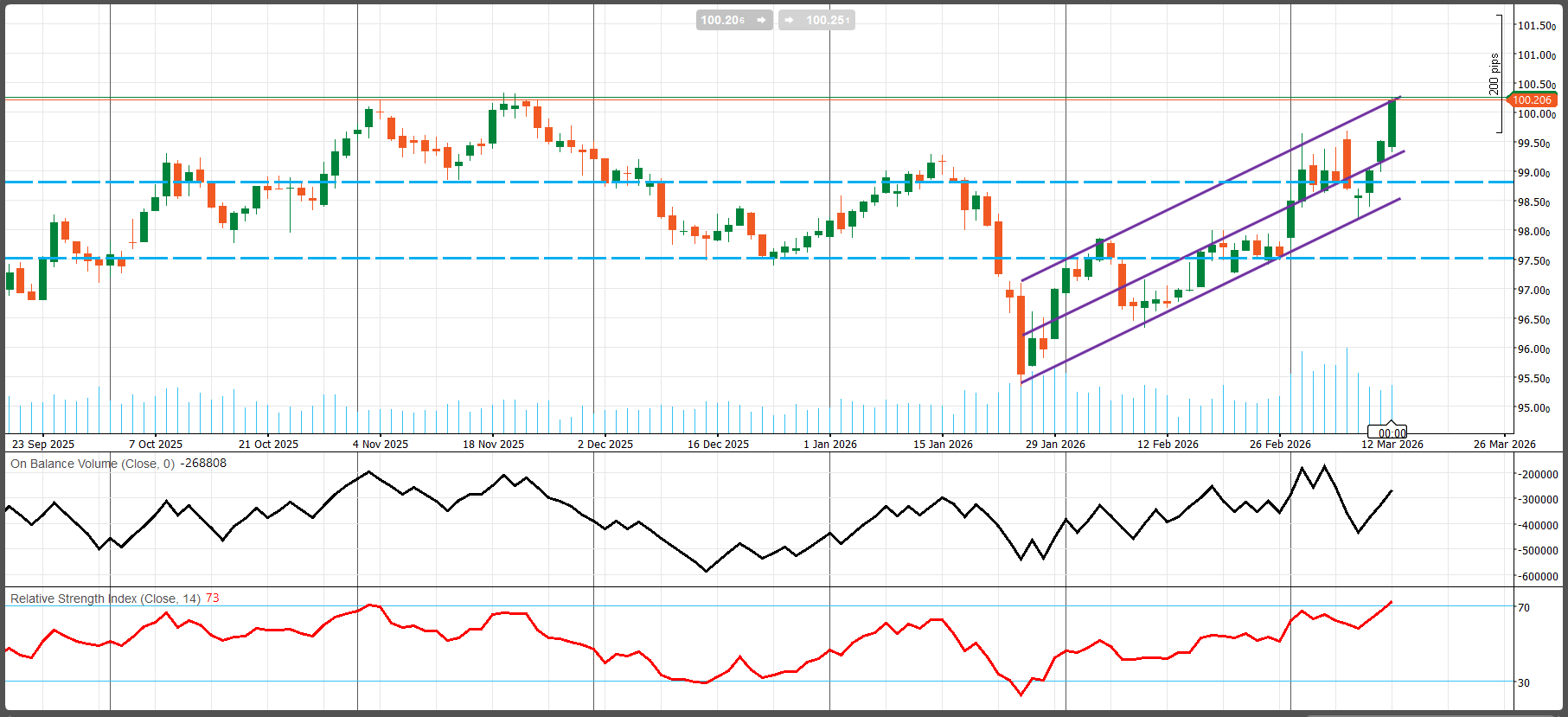
Technically, the daily chart also supports that view. The DXY remains in a strong rising structure, trading inside a clear ascending channel and now testing the 100.25–100.50 resistance zone, which is an important ceiling from previous highs. The broader trend is still bullish, with higher highs and higher lows intact. At the same time, momentum indicators suggest the move is becoming stretched. RSI near 73 signals overbought conditions, which means upside momentum remains strong, but the market is also vulnerable to a short-term pullback or sideways consolidation. On-balance volume has improved, which supports the recent upside attempt and suggests that buying pressure has returned.
The key takeaway is that the dollar remains bullish above 99.00, but the next move depends heavily on whether DXY can break through the current resistance band. A clean move above 100.50 would strengthen the case for further gains toward 101.00 and 101.50. If the index fails at resistance, a retreat toward 99.00 becomes more likely before the broader uptrend is tested again.
Wall Street
For Wall Street, the outlook remains more cautious. This is not necessarily the start of a straight-line collapse, but the macro backdrop is still not friendly for broad equity multiples. Oil-related inflation pressure can keep yields elevated and delay Fed easing, while weaker GDP and softer consumer mood raise doubts about how durable growth really is. That is a difficult backdrop for stocks, especially higher-valuation segments of the market.
Sector behavior last week confirmed this regime shift. Technology was the weakest major area, while more defensive groups, such as utilities, held up better. Financials also underperformed. That pattern makes sense. In an environment of higher oil, firmer yields, and more uncertainty around policy easing, defensive sectors and energy-linked areas tend to perform relatively better, while long-duration growth stocks and cyclical sectors face more pressure.
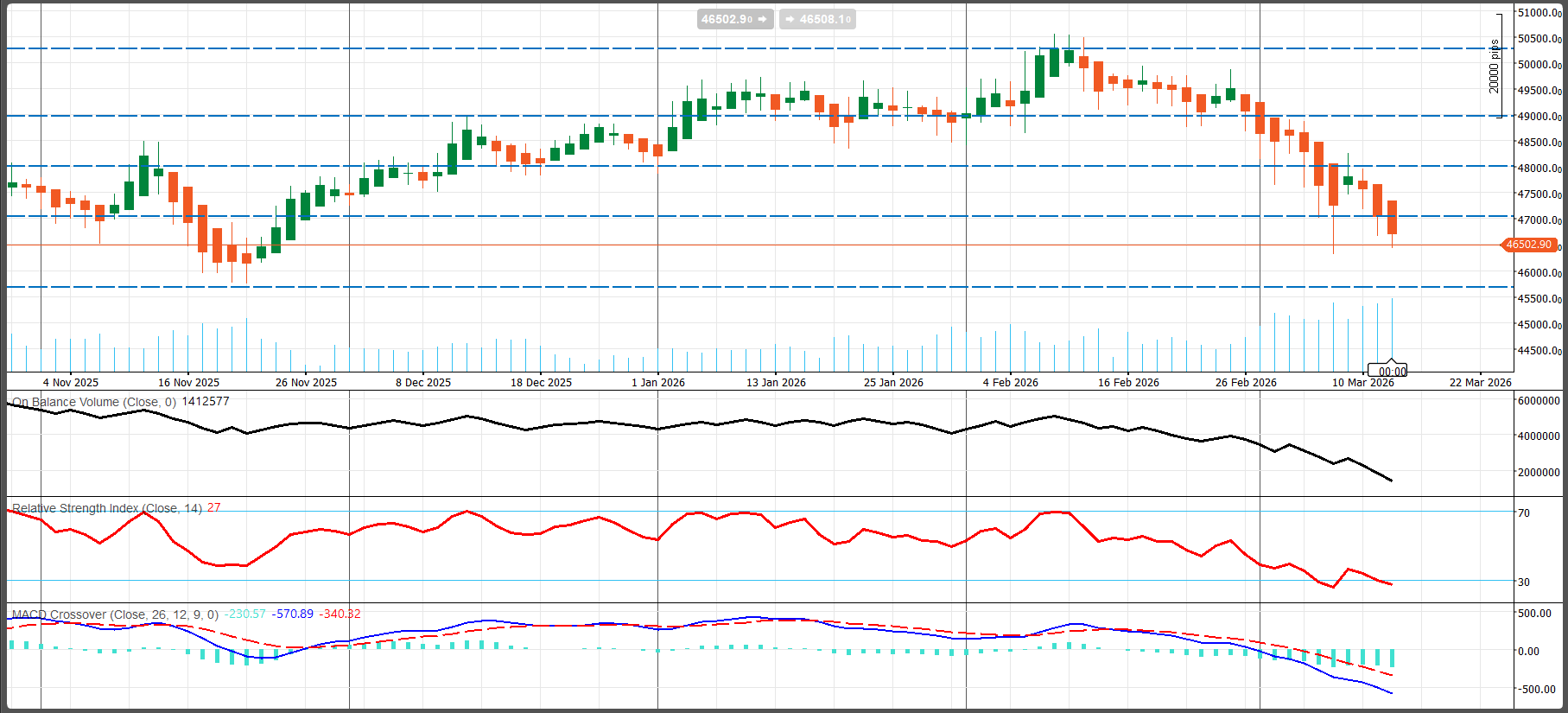
The Dow Jones daily chart also reflects this caution. The short-term trend remains bearish, with a clear pattern of lower highs and lower lows since mid-February. The index is now testing the 46,500 support area. Momentum indicators show that the market is stretched on the downside, with RSI near oversold territory, so a short-term bounce is possible. But the broader structure remains weak unless the index can reclaim higher resistance zones. A break below 46,500 would open the way toward 45,600. On the upside, a move back above 47,000 could trigger a relief bounce, but the trend would remain fragile unless prices recover above 48,000–49,000.
The bottom line for this week is clear: USD strength and Wall Street weakness remain the cleaner fundamental trade, unless something changes the narrative. A sharp geopolitical de-escalation, lower oil, or a softer-than-expected Fed could reduce pressure on equities and limit the dollar’s upside. But without that shift, the dominant setup remains one of firm dollar, fragile equities, and volatile headline-driven trading.
Central Banks in Focus: A Week of Diverging Policy Signals
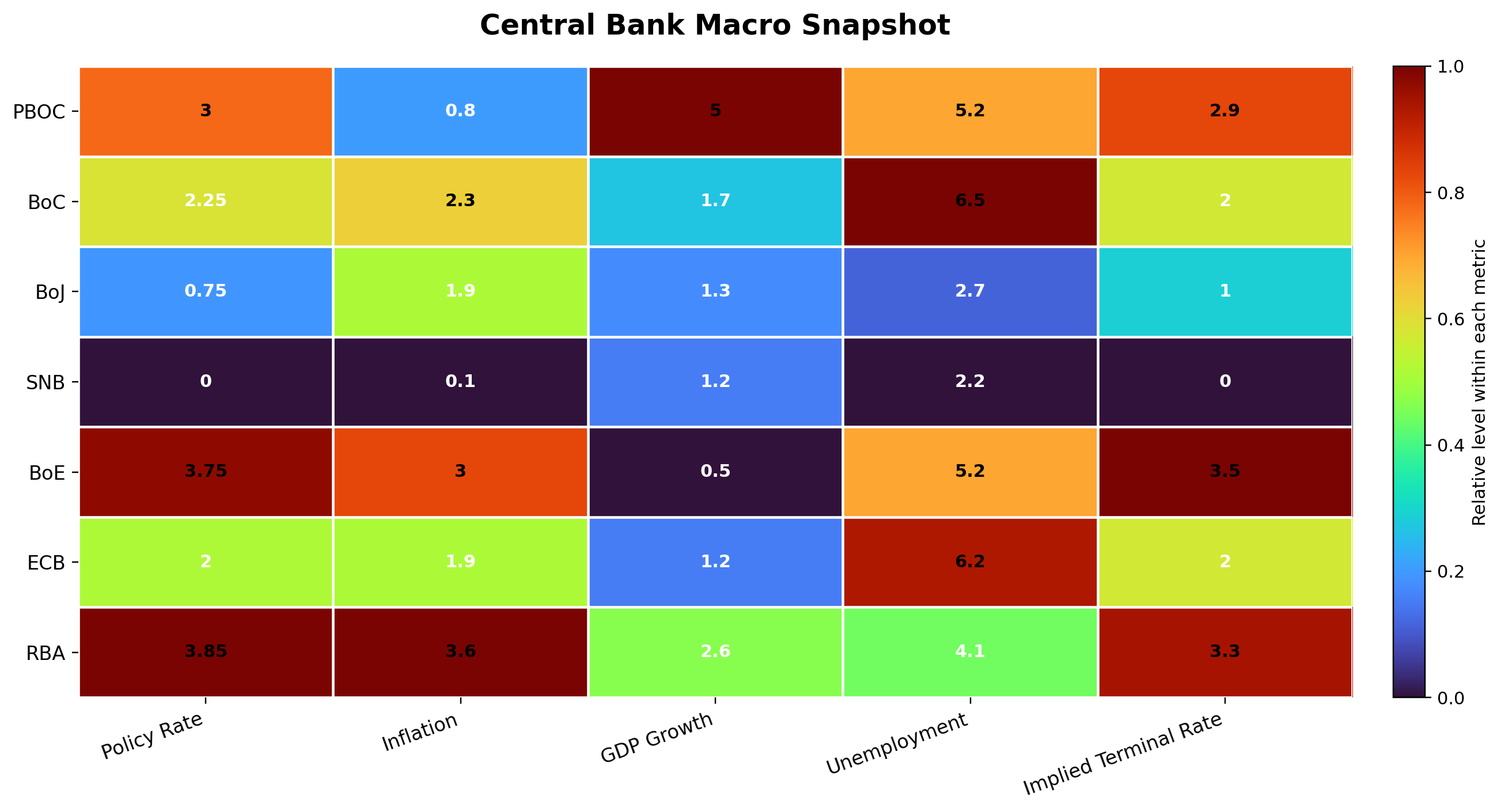
The week ahead is shaping up to be a critical one for global central banks, as policy decisions are likely to underline the growing divergence in economic conditions across major economies. While most central banks are still expected to hold rates steady, the reasons behind those pauses are increasingly different: in some cases, policymakers are responding to slowing growth, in others to sticky inflation, and in several regions to the added uncertainty created by war-driven energy risks and broader geopolitical stress.
In China, the People’s Bank of China (PBOC) is expected to maintain its moderately loose policy stance, keeping key tools such as the 1-year Loan Prime Rate at 3.0% unchanged. The policy bias remains supportive because growth momentum has cooled and inflation is still hovering near zero, leaving Beijing with little reason to tighten.
In Canada, the Bank of Canada, with its policy rate at 2.25%, is also widely expected to stay on hold. The main argument is that the economy has already shown signs of weakness, including a surprising Q4 GDP contraction of 0.6% annualized, while inflation has eased to around 2.3% in January. That combination supports patience rather than further tightening.
The Bank of Japan is likewise likely to pause, even though Japan’s domestic backdrop has improved in some areas. Stronger wage growth and a modest rise in core Tokyo inflation to 1.8% in February support the long-term normalization story, but markets still largely expect the next meaningful policy move only around mid-2026. For now, the yield cap near 0.75% is expected to remain in place.
In Switzerland, the Swiss National Bank is almost certain to leave policy unchanged, with rates near 0%. Inflation remains extremely subdued, at just 0.1% in January, giving the SNB little urgency to act.
The Bank of England may face the most market-sensitive decision of the group. With the Bank Rate at 3.75%, investors are increasingly pricing in the possibility of a March rate cut, particularly after UK CPI slowed to 3.0% and unemployment rose to around 5.2%. That leaves the BoE at the center of the debate over whether weakening domestic conditions now justify easier policy.
The European Central Bank, with its main refinancing rate at 2.00%, is expected to hold steady. Even though euro-area inflation could move back toward 2.0% by the summer, the larger issue for markets is whether higher energy prices and war-related shocks will complicate the inflation path and limit the ECB’s room to turn more supportive.
In Australia, the Reserve Bank of Australia is also likely to pause following its February rate hike, leaving the cash rate at 3.85%. Policymakers still face a difficult balance: inflation remains elevated at 3.6% in Q4, while GDP growth of 0.8% quarter-on-quarter surprised to the upside. That argues for caution and supports a wait-and-see approach.
The broader message is clear: global central banks are no longer moving in sync. Instead, each institution is being shaped by its own mix of inflation trends, growth risks, labor-market conditions, and external shocks. For markets, the key themes to watch this week will be energy prices, geopolitical developments, trade tensions, and any data surprise capable of shifting year-end rate expectations.
Gold Market Outlook: Caught Between Geopolitical Support and Monetary Pressure
Gold enters the new week in a short-term corrective phase, rather than a clean bullish continuation. Spot gold was trading near $5,052 per ounce on Friday afternoon and finished the week down by more than 2%, marking a second straight weekly decline. That price action is important because it shows the market is still receiving support from geopolitical risk and safe-haven demand, but for now, that support is being overpowered by a stronger U.S. dollar and higher real-rate pressure.
Gold’s market condition: supportive backdrop, but no clear upside momentum
The key shift in gold’s current market regime is that it is no longer trading purely as a geopolitical hedge. Instead, bullion is now caught between two competing macro forces.
On one side, the Iran war, supply disruption risks, and broader global uncertainty continue to provide an underlying floor for gold prices. These factors are preventing a deeper collapse in sentiment toward the metal and are helping preserve the medium-term bullish case.
On the other side, the market is facing a much stronger monetary-policy headwind. The U.S. dollar has rallied, Treasury yields remain firm, and expectations for Federal Reserve rate cuts have been pushed further out. That combination is limiting gold’s upside. In simple terms, gold is still benefiting from fear, but it is struggling against the fact that the market now sees higher-for-longer U.S. rates as a more realistic scenario.
This is why the current gold backdrop is best described as short-term pressured, but medium-term still constructive. Even during last week’s decline, the broader structural support for gold remained in place, supported by longer-term asset allocation demand, central-bank buying, and continued ETF inflows.
Gold weekly outlook: all eyes on the Fed
The dominant catalyst this week is the March 17–18 FOMC meeting. This is especially important because it is a projection meeting, meaning markets will receive not just the policy decision, but also updated economic forecasts and the latest dot plot.
The base case remains that the Federal Reserve will leave rates unchanged, but for gold, the real issue is not the decision itself. The real issue is how Chair Jerome Powell frames the outlook. If the Fed leans more heavily toward the risks from sticky inflation and higher energy prices, gold may remain under pressure. If Powell sounds more concerned about slowing growth, that could help gold stabilize and recover.
Right now, the macro backdrop is not ideal for gold in the short run. Recent inflation data showed that headline CPI remained at 2.4% year-on-year, while core CPI held at 2.5%. Meanwhile, the latest PCE report showed headline PCE at 2.8% and core PCE at 3.1% for January. At the same time, Q4 GDP was revised down to 0.7%, highlighting slower growth.
That combination creates an uncomfortable environment for gold. Normally, weaker growth would help bullion by pulling yields lower and increasing expectations for policy easing. But this time, sticky inflation and war-driven oil pressure are preventing the Fed from sounding comfortably dovish. That is why gold is not reacting as positively to weaker growth as it might in a more conventional cycle.
Oil and the dollar remain the main short-term drivers
The oil market is another major variable to watch. Brent crude settled at $103.14 on Friday, rising above $100 for the first time since August 2022, while WTI closed near $98.71. This matters because higher oil prices feed directly into inflation risk.
For gold, the effect is mixed. On the positive side, oil-driven geopolitical stress supports safe-haven demand. On the negative side, oil-driven inflation supports the U.S. dollar and Treasury yields, both of which are traditional headwinds for bullion. Last week, the negative side of that relationship clearly had more influence.
At the same time, the U.S. dollar has become the market’s preferred haven during the conflict. That has been one of the biggest reasons gold has not fully capitalized on geopolitical stress. As long as the dollar stays firm and Fed rate-cut expectations remain delayed, gold may struggle to build strong upside momentum even if geopolitical tensions remain elevated.
Outlook: range-bound to mildly bearish in the short term
For the week ahead, the most practical view is range-bound to mildly bearish in the short term, while still maintaining a constructive broader outlook.
In the near term, gold remains vulnerable to more consolidation or another leg lower if the Fed delivers a hawkish hold, keeps the dot plot relatively firm, and suggests that energy-driven inflation risk limits its ability to ease policy. However, the medium-term structure still does not support a decisively bearish outlook, especially while war risk remains unresolved and structural demand from central banks and ETFs continues to provide support.
The practical takeaway is clear: gold needs either a softer dollar, lower yields, or a more growth-focused Fed message to recover cleanly. Without at least one of those drivers, the metal is likely to remain trapped between geopolitical support below and monetary-policy pressure above.
XAU/USD technical outlook: consolidation after a strong rally
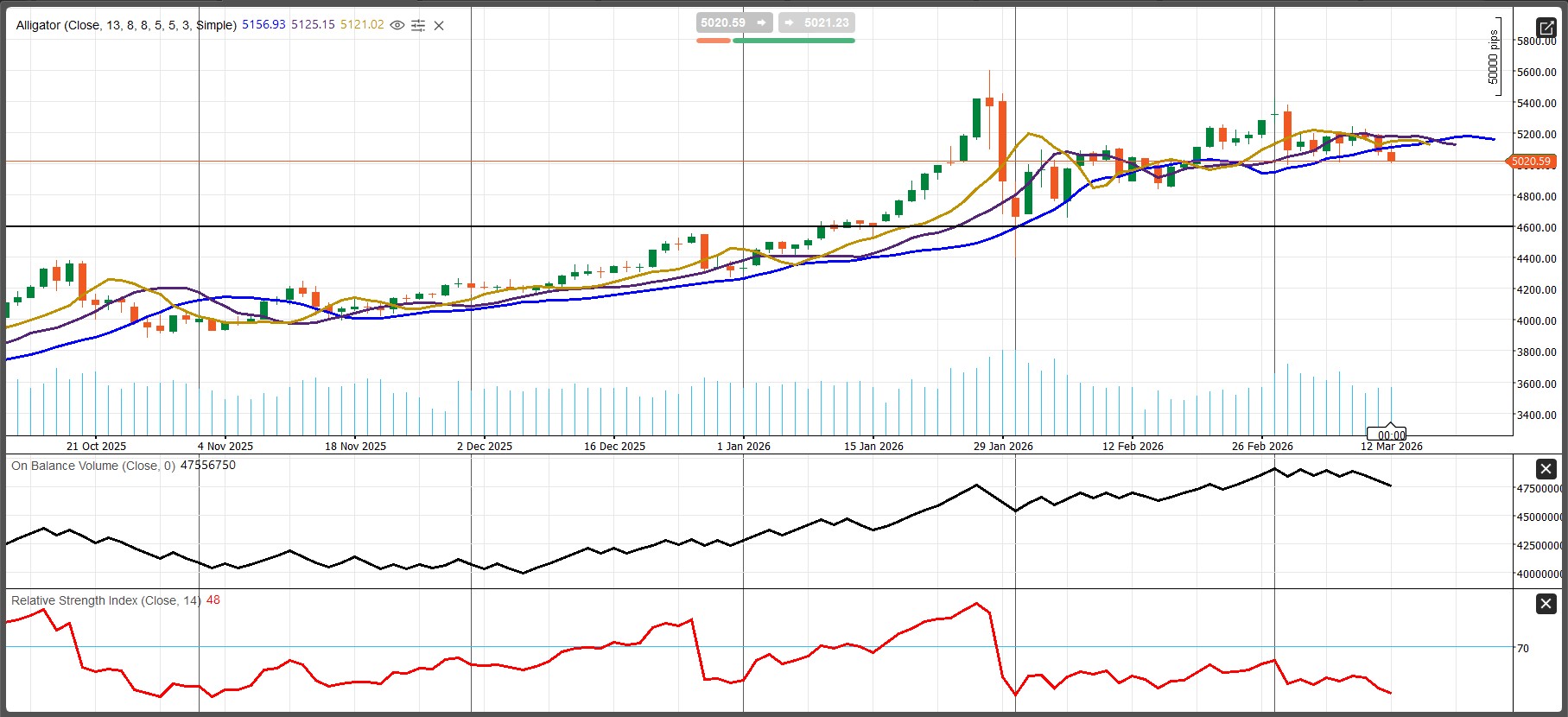
From a technical perspective, gold is moving sideways to lower after its strong rally into late January. The broader structure remains constructive, but short-term momentum has faded, with price now trading around the critical 5,020 zone.
Key technical signals
- Medium-term trend: Still bullish, but short-term price action has turned neutral to slightly bearish.
- RSI near 48: Momentum is neutral, with no strong overbought or oversold condition.
- Alligator lines / moving structure: The lines are flattening and converging, pointing to consolidation and a lack of strong directional trend.
- OBV: Still elevated overall, but beginning to soften, suggesting buying pressure has slowed.
Technically, the chart supports the idea of consolidation after a strong uptrend. As long as gold remains above 5,000, it can stay range-bound and attempt to recover. A clear break below 5,000 would increase the risk of a deeper correction toward 4,900. On the upside, a sustained recovery above 5,150 would improve the bullish setup again.
Crude Oil Market Outlook:
Supply Shock Keeps the Market Supported, but Headline Risk Remains Extreme
Crude oil enters the new week in a structurally bullish but highly unstable market environment. This is not a normal, demand-led oil rally driven by stronger global growth or improving consumption expectations. Instead, the market remains a supply-shock market, with price direction dominated by disruptions tied to the Strait of Hormuz, emergency policy responses, and fast-moving geopolitical headlines. That distinction is critical because it explains why oil can remain fundamentally supported while also experiencing sharp, sudden reversals on any sign of de-escalation, strategic reserve releases, or diplomatic progress.
Oil market condition: structurally tight, but increasingly reactive
The broad energy backdrop remains supportive for crude in the near term. On Friday, Brent settled at $103.14 and WTI at $98.18, after both benchmarks reached their highest levels since 2022 earlier in the week. From the previous Friday close, Brent rose 11.27%, and WTI gained 8%, showing that the market is still pricing in a meaningful geopolitical risk premium.
The primary driver remains the supply disruption linked to the Persian Gulf and the Strait of Hormuz. With shipping flows severely constrained and export routes under pressure, the market continues to price crude as though supply security cannot be taken for granted. That is the main reason dips remain shallow, and buyers continue to re-enter the market on weakness.
At the same time, the oil market is no longer trading on pure panic alone. The focus is now shifting toward a more complex question: how much of the disruption can be absorbed through emergency stock releases, policy intervention, and alternative supply growth? This matters because even in a supply-shock environment, markets eventually begin to assess how much of the lost supply is truly unavailable, how much can be replaced, and how long the disruption is likely to last.
That makes the current oil regime more nuanced than a one-way geopolitical spike. The market still has a bullish core, but it is increasingly sensitive to any evidence that the physical shortfall can be partially buffered. Strategic petroleum reserve releases and coordinated emergency stock measures may not solve the underlying chokepoint problem, but they can still reduce the speed and intensity of price spikes. In other words, they can smooth the market, even if they cannot fully normalize it.
U.S. oil balance: not bearish, but not tight enough to remove the risk premium
On the U.S. side, the latest inventory data presented a mixed picture rather than a clearly bearish one. Commercial crude inventories rose, which on the surface suggests some improvement in domestic crude availability. However, gasoline and distillate inventories fell, while total product supplied moved higher. That combination is important because it shows that even if raw crude stocks are building modestly, refined-product demand and refinery throughput remain strong enough to keep the broader energy complex relatively tight.
This is a key distinction for market interpretation. A crude build alone would usually help calm prices, but when product stocks are drawing and implied demand remains firm, the broader message is not one of easing stress. Instead, it suggests the market is still working through a tight downstream balance, which limits the bearish impact of higher crude inventories.
U.S. drilling activity has also started to respond gradually to higher prices. The Baker Hughes oil rig count edged higher again, marking another weekly increase. That tells us domestic producers are becoming more active as price incentives improve. Still, this is not yet the kind of aggressive supply response that can quickly neutralize a major global disruption. U.S. production can help on the margin, but it is not an immediate solution to a shipping and export bottleneck centered on the Persian Gulf.
Weekly outlook: supported by supply risk, vulnerable to de-escalation headlines
The most practical base case for the week ahead is elevated volatility with a modest upside bias, rather than a clean directional trend. The supply side remains the dominant force, and as long as Hormuz remains materially impaired and Gulf exports stay constrained, oil is likely to remain supported on pullbacks.
That said, this is also a market where headline risk can override trend logic in the short term. If there is no credible signal of reopening Hormuz, reducing attacks on regional energy infrastructure, or restoring normal export flows, traders are likely to continue viewing selloffs as temporary corrections rather than the start of a sustained decline. In that environment, dips are likely to attract buying interest.
However, the opposite is also true. If the market receives a verified and credible de-escalation signal, crude can fall quickly. That is why the near-term outlook should not be described as blindly bullish. It is more accurate to say that oil remains fundamentally supported, but tactically vulnerable to sharp corrections if geopolitical conditions improve even modestly.
This is where emergency reserve releases become especially important. They can help stabilize physical markets and reduce panic pricing, but they should still be viewed as a temporary buffer rather than a permanent solution. Reserve releases can reduce the magnitude of the spike, but they do not eliminate the core structural risk as long as one of the world’s most important energy chokepoints remains under severe stress.
So, from a trading perspective, the weekly bias is best described as range-bound to higher in the absence of de-escalation, but highly vulnerable to downside if the geopolitical premium begins to unwind.
WTI technical outlook: bullish trend, but the market is overstretched
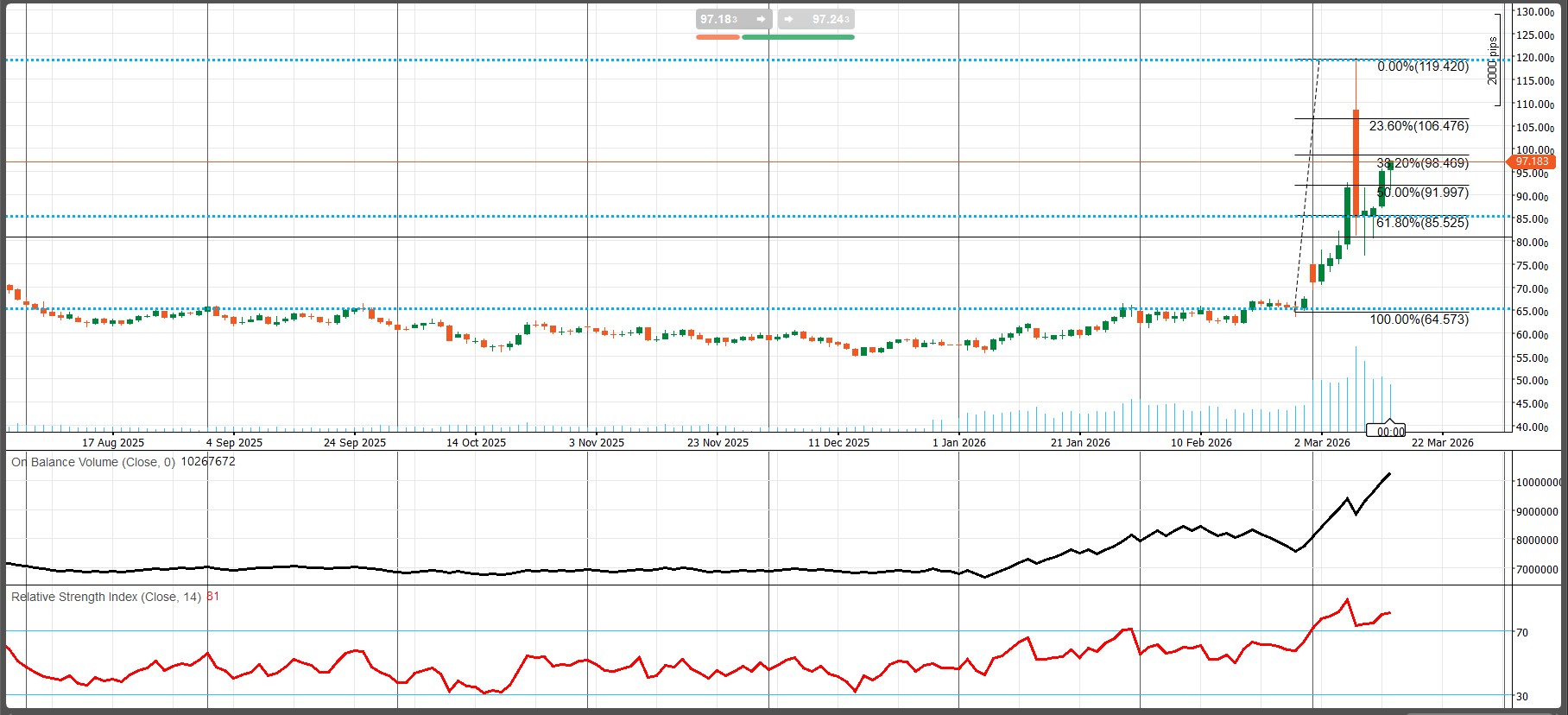
From a technical perspective, WTI remains in a strong bullish trend, but the chart also reflects a market that has become heavily stretched after its sharp breakout earlier in March. Price is trading near 97.18, just below the 38.2% retracement level around 98.47, which makes this area an important short-term pivot zone.
Key technical signals
- Trend: The broader trend remains strongly bullish following the explosive rally from the 64.6 area.
- RSI near 81: This indicates a deeply overbought market. Upside momentum is still strong, but the risk of consolidation or a sharper pullback has increased materially.
- OBV: On-balance volume continues to surge, confirming strong buying pressure and supporting the broader bullish structure.
The bigger technical picture still favors higher prices over time, but after such a vertical move, the market is clearly exposed to profit-taking, sudden reversals, and wide intraday swings.
A move above 98.5 would support bullish continuation toward 106.5. On the downside, a break below 92.0 would suggest that the market is entering a deeper correction, with scope toward 85.5.
Key levels to watch
Resistance:
Immediate resistance is located near 98.5. A break above that area would open the way toward 106.5, followed by the more important spike high near 119.4.
Support:
First support comes in around 92.0, which aligns with the 50% retracement level. Below that, the next major pullback zone sits near 85.5, around the 61.8% retracement level.
Bottom line
Crude oil remains in a supply-driven bullish regime, not a conventional macro rally. That keeps the near-term tone supportive, especially while disruption in the Persian Gulf and Strait of Hormuz remains unresolved. But this is also a market where price action can change abruptly on geopolitics, policy intervention, or reserve-release headlines.
The clearest interpretation for the week is this: oil stays fundamentally supported while the supply shock persists, but the market is too stretched and too headline-sensitive to rule out sharp corrections. In practical terms, the path of least resistance remains higher unless there is a credible de-escalation signal.
Crypto Market Outlook:
Bitcoin Recovery Holds, but Macro Pressure Still Controls the Trend
The crypto market enters the new week in a recovery phase, but not yet a convincing new bull run. Bitcoin remains supported by improving institutional demand and steadier positioning, yet its short-term direction is still being driven far more by the broader macro environment than by crypto-specific momentum. In practical terms, Bitcoin is behaving like a high-beta macro asset, not a fully independent market.
That distinction matters. The clean bullish setup for Bitcoin would require a combination of a softer U.S. dollar, calmer oil prices, more stable bond yields, and a Federal Reserve that holds rates without sounding aggressively hawkish. The bearish setup is the opposite: a firmer dollar, higher yields, elevated inflation fears, and a Fed that reinforces the higher-for-longer narrative. Right now, Bitcoin sits somewhere in between. The market looks more like a fragile recovery inside a macro risk regime than the beginning of a fresh, straight-line rally.
Crypto market condition: recovering, but still macro-sensitive
Bitcoin enters the week near $71,000, while Ether trades around $2,070. That leaves Bitcoin comfortably above its early-February washout lows, but still well below the kind of easy upside environment that defined the earlier bullish phase. The recent behavior of crypto confirms that the market is still trading in line with risk sentiment, technology shares, liquidity expectations, and central-bank pricing. That remains the dominant feature of the current market.
Beneath the surface, however, there are signs of improvement. Institutional demand has clearly stabilized compared with the panic seen during February. Recent fund-flow data showed renewed inflows into digital-asset investment products, with Bitcoin accounting for the majority of those allocations. U.S. spot Bitcoin ETF flows also remained positive through the week, which is an important constructive signal. Even if price action still looks hesitant, steady ETF demand suggests that longer-term buyers are still active and that the market is not being driven solely by short-term speculative trading.
That combination is important. It tells us that while Bitcoin may not yet have the momentum for a breakout, the underlying demand base has become healthier. In other words, the market is no longer in panic mode, but it is also not in a euphoric phase.
Another supportive factor has been the regulatory backdrop in the United States. Optimism around a more coordinated U.S. regulatory approach has helped sentiment at the margin, especially after signs of closer cooperation between the SEC and CFTC. That has given the market a modest confidence boost, because greater regulatory clarity tends to reduce uncertainty for institutions, trading venues, and long-term capital allocators. For Bitcoin, that does not create immediate upside by itself, but it does help improve the medium-term foundation.
Bitcoin weekly outlook: the Fed remains the main catalyst
The dominant event for crypto this week is the March 17–18 FOMC meeting. This is especially important because it is not just a rate decision. It also includes an updated Summary of Economic Projections and a new dot plot, which means markets will get a clearer read on how the Federal Reserve sees growth, inflation, and the future path of rates.
For Bitcoin, this matters because the market is still trading primarily off the same macro variables that move other risk-sensitive assets: the Fed path, the U.S. dollar, real yields, and inflation expectations shaped by oil prices. That is why the current backdrop remains difficult in the short term. Elevated oil prices, firmer Treasury yields, and a stronger dollar all tighten financial conditions. When that happens, crypto usually struggles to sustain upside momentum.
This is also why Bitcoin has not behaved like a traditional safe haven during periods of geopolitical stress. Even with conflict risk elevated, the market has still treated Bitcoin more like a liquidity-sensitive growth asset than a defensive store of value. As long as inflation fears remain high and the Fed is prevented from sounding dovish, crypto is likely to remain sensitive to every move in rates and the dollar.
My base case for this week is choppy, range-bound trading, with only a modest upside bias if the Fed sounds balanced rather than hawkish. If Jerome Powell acknowledges slower growth but avoids materially hardening the higher-for-longer message, Bitcoin may be able to extend its recovery. That would be especially possible because ETF demand has improved, and market positioning is far less euphoric than it was late last year.
However, if the Fed leans more forcefully toward inflation risk, while oil and the dollar remain elevated, then Bitcoin is likely to stay capped. In that scenario, renewed selling pressure would become more likely, particularly if broader risk assets also come under pressure.
BTC technical outlook: stabilizing, but not yet fully bullish
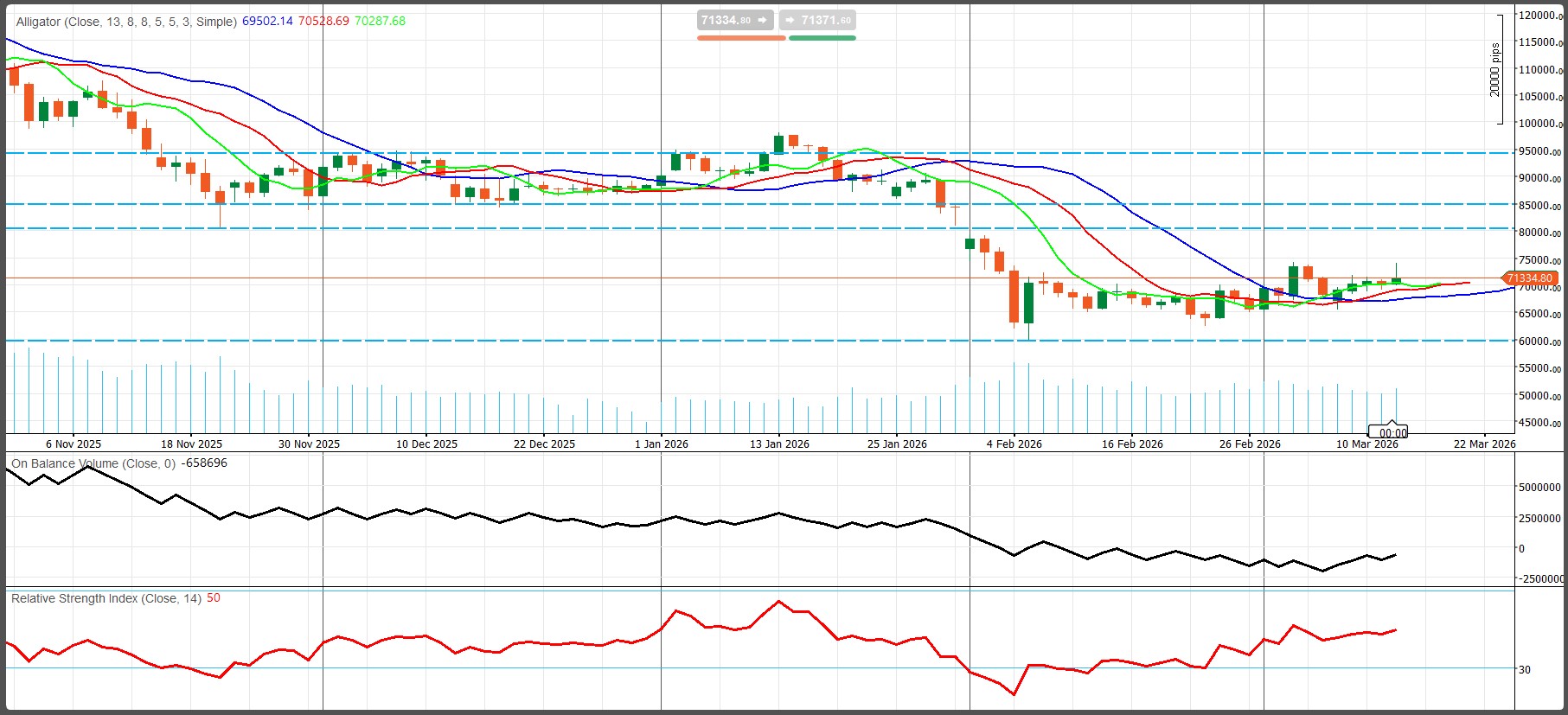
From a technical perspective, Bitcoin is no longer in free fall, but it has also not yet rebuilt a strong bullish structure. The daily chart suggests that the market is in a stabilization phase after the sharp breakdown seen in early February. Price is trading around 71,300, which places it near an important recovery pivot.
The short-term trend has improved from clearly bearish to neutral or mildly constructive, but the broader chart still reflects damage from the earlier selloff. Momentum indicators support that interpretation. RSI is sitting near 50, which signals neutral momentum rather than an overbought or oversold market. That means Bitcoin still has room to move in either direction, depending on the macro trigger.
The moving structure is also flattening, which is usually a sign of consolidation rather than trend acceleration. On-balance volume remains relatively weak overall, although it has started to stabilize. That suggests selling pressure has eased, but strong accumulation is not yet obvious. This is a market trying to build a base, not one that has already completed a breakout.
As long as Bitcoin remains above 70,000, consolidation can continue, and the market still has room to challenge 75,000. A stronger move above that area would improve the recovery profile and open the way toward 80,000. On the downside, if Bitcoin slips back below 70,000, selling pressure could re-emerge and expose the market to a deeper move toward 65,000. Major structural support remains closer to 60,000.
Key levels to watch
The first major resistance zone is around 75,000, followed by 80,000. Beyond that, stronger overhead resistance sits near 85,000 and then 95,000. On the downside, the first key support remains 70,000, followed by 65,000, while the more important long-term support area sits near 60,000.
Bottom line
Bitcoin still has a constructive medium-term backdrop, supported by institutional inflows, healthier ETF demand, and a gradually improving regulatory tone. But in the short term, crypto remains under the control of the macro cycle. The market is recovering, but it is not yet in a clean bullish trend.
The most accurate description for this week is simple: Bitcoin is stabilizing, but still needs macro help to rally convincingly. A softer dollar, calmer oil, steadier yields, and a balanced Fed could support another leg higher. Without those conditions, Bitcoin is likely to remain trapped in a fragile, macro-driven recovery rather than a full bullish breakout.
Comments