IFC Markets Live Quotes

Market news roundup: Tuesday, 10 February 2026

55 short market news items, grouped by 11 sections.

Political

Netanyahu Flies to US to Press Trump on Iran Talks “Principles”

Israeli Prime Minister Benjamin Netanyahu departed for Washington ahead of a high-stakes meeting with U.S. President Donald Trump, saying the Iran negotiations will be the top priority of the visit. Netanyahu said he will present Israel’s “vision/principles” for the negotiations to Trump.

According to Israeli and U.S. reporting, Israel wants any U.S.–Iran deal to go beyond the nuclear file—seeking an end to uranium enrichment, limits on ballistic missiles, and a halt to support for Iran-backed militant groups across the region.

The trip comes as U.S.–Iran talks resumed via indirect discussions in Oman, with Washington weighing whether to broaden already difficult negotiations.

Russia Cheers Gaza Plan Phase Two, Warns Investors Need “Conditions”

Russia’s ambassador to Israel, Anatoly Viktorov, was cited as saying Moscow “appreciates” the shift into phase two of President Trump’s Gaza plan—while arguing that attracting major investors will require “the necessary conditions” on the ground.

Phase two has been framed by U.S. officials and coverage as a pivot from ceasefire mechanics toward demilitarization, technocratic governance, and reconstruction—alongside an international “Board of Peace” structure meant to coordinate portfolios including investment attraction and capital mobilization.

Vance Signs U.S.–Azerbaijan Strategic Partnership in Baku

U.S. Vice President JD Vance met President Ilham Aliyev in Baku and signed a new “Charter on Strategic Partnership” between the two governments, signaling deeper cooperation on security and the economy. Aliyev said the relationship is entering “an entirely new phase,” pointing to collaboration on defense sales and artificial intelligence, alongside continued work on energy security and counterterrorism.

According to Reuters, Vance said the U.S. will provide Azerbaijan an unspecified number of vessels/boats to help protect its territorial waters, and emphasized Washington’s support for the TRIPP corridor (a proposed route across Armenia intended to connect Azerbaijan to its Nakhchivan exclave and onward to Türkiye), framed as part of a wider push to strengthen connectivity and reduce reliance on Russia-linked routes.

In a lighter aside during the appearance, a transcript circulated from the event quotes Vance joking that Aliyev’s ability to maintain good relations with both “the Turks and the Israelis” must mean “the food must be really good… or he must be really charming.”

Macron Signals Europe-Russia “Reset”; Kremlin Says It’s Noted

French President Emmanuel Macron said he has invited several European leaders to resume dialogue with Russia, arguing Europe should prepare its own channel with Moscow and rebuild relations over time.

The Kremlin confirmed it has “noted” Macron’s remarks and has previously framed renewed European talk of dialogue as a potentially positive shift—while emphasizing that any serious settlement would need to address broader European security questions.

Larijani Meets Houthi Spokesman in Muscat as U.S. Talks Roll On

Iran’s National Security Council secretary Ali Larijani met Mohammad Abdulsalam, the Houthis’ spokesperson, during a visit to Muscat, Oman, according to Iran’s Mehr News Agency.

The meeting comes as Oman continues to mediate indirect U.S.–Iran talks aimed at preventing a wider escalation. Iran’s Foreign Ministry has described the latest round as a test of Washington’s “seriousness,” with follow-on diplomacy expected.

Indonesia Readies Gaza Peacekeepers: “Up to 8,000” Troops in Training

Indonesia’s army has begun training engineering and medical units as Jakarta weighs deploying 5,000–8,000 troops to Gaza as part of a proposed international stabilization/peacekeeping force linked to Trump’s Middle East plan, according to reports citing Army Chief of Staff Gen. Maruli Simanjuntak.

Officials stressed that the mandate, timing, and deployment zones are still being negotiated, with the mission framed as humanitarian support and reconstruction rather than frontline combat.

Fidan: Rubio Warned “Anything Can Happen” Hours Before Israel’s Iran Strikes

Turkey’s Foreign Minister Hakan Fidan said that U.S. Secretary of State Marco Rubio called him shortly before the outbreak of the “12-day war” and Israel’s strikes on Iranian officials, urging him to pass on a blunt warning to Tehran: “Tell the Iranians… anything can happen in the next few hours.”

Speaking in a CNN Türk interview on Monday (20 Bahman / Feb 9), Fidan argued that while he does not view a U.S.–Iran war as imminent, talks and negotiations do not eliminate the risk of military escalation—especially in a region where miscalculation can rapidly widen conflict.

Hegseth Urges Tehran to “Take the Deal,” Citing ‘Midnight Hammer’ as Deterrence Proof

U.S. Defense Secretary Pete Hegseth said Iran would be “smart” to pursue an agreement through negotiations, arguing President Donald Trump has made clear he prefers a deal but is prepared to use force if Tehran refuses.

Pointing to Operation “Midnight Hammer”—a U.S. strike on Iran’s nuclear facilities at Fordow, Natanz and Isfahan—Hegseth claimed the operation demonstrated “peace through strength” and that no other country could have conducted it. In the same briefing, Joint Chiefs Chairman Gen. Dan Caine said the strike package exited Iranian airspace undetected and that Iran’s air defenses did not engage on the way out.

Beijing’s Take: “Israel’s Absolute Security” Could Block Any Lasting U.S.–Iran Deal

China’s state-affiliated outlet The Paper (澎湃新闻) argues that the pursuit of “absolute security” for Israel is the single biggest structural obstacle to any long-term détente or agreement between Tehran and Washington.

In the same analysis, The Paper links the external security environment to Iran’s internal pathologies—saying heavy military entrenchment in the economy fuels corruption and inefficiency, driven by continuous resource pumping to maintain loyal networks and a “permanent readiness” posture against outside threats, and concludes that the current Trump–Iran talks look unlikely to succeed.

Separately, CCTV/Xinhua reporting highlights that Washington is pressing for any deal to cover not only the nuclear file but also Iran’s ballistic missile stockpile—a demand that analysts say risks becoming a deal-breaker given Tehran’s repeated insistence that missile/defence capabilities are non-negotiable.

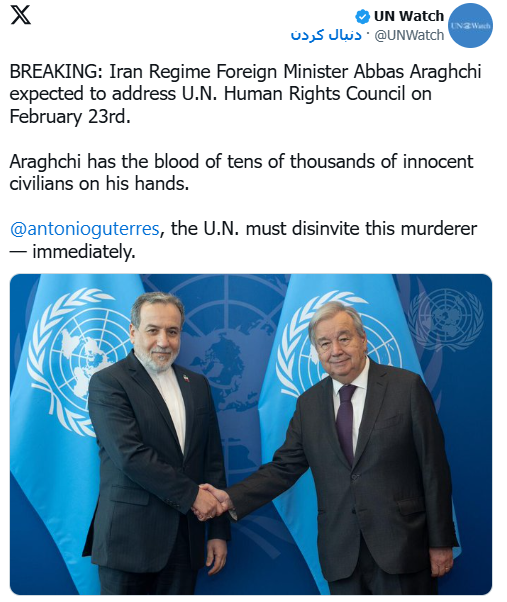
UN Watch Urges Guterres to “Disinvite” Iran FM from UN Rights Council

UN Watch, a Geneva-based NGO that monitors the UN, said Iran’s Foreign Minister Abbas Araghchi is expected to address the UN Human Rights Council (UNHRC) on February 23, and called on UN Secretary-General António Guterres to cancel the invitation.

The group’s statement—posted on X—accused Araghchi of responsibility for mass civilian harm and argued that giving him the floor at the UNHRC would be unacceptable.

The UNHRC’s 61st regular session is scheduled to open on February 23 in Geneva.

Trump Floats “Second Carrier” Option if Iran Talks Collapse

In an interview with Axios’ Barak Ravid, President Donald Trump said that if negotiations with Iran fail, he is considering deploying a second U.S. aircraft carrier strike group—including its accompanying warships—into the region as an added pressure lever.

Reuters separately reported Trump making similar remarks as Oman-mediated diplomacy continues, with Washington warning that failure to reach a deal could trigger a “very tough” response.

Trump’s Iran Pitch: “No Nukes, No Missiles” — Still Wants a Deal

President Donald Trump said he is still pursuing an agreement with Iran despite opposition from some voices in the U.S., arguing Tehran “wants to make a deal” and would be “foolish” not to.

In the interview (Fox Business Network’s “Kudlow”, per Reuters reporting), Trump described his preferred outcome as a “good deal” that includes no nuclear weapon and no missiles, alongside other conditions Washington may demand—while acknowledging skepticism about Iran’s long-term reliability.

More Political news

Others

Lavrov Calls Epstein Files “Pure Satanism,” Blasts “Collective West” on NTV

Russia’s foreign minister Sergey Lavrov said newly released Jeffrey Epstein case files expose “pure satanism” among Western elites, speaking in an interview with Russia’s NTV. Lavrov framed the disclosures as revealing the “true face” of what he called the “collective West” and a “deep alliance” that seeks to run the West—and the world.

The remarks land amid a wider political fight over how the Epstein documents are being interpreted. In recent days, Poland’s PM Donald Tusk said Warsaw would investigate possible links between Epstein and Russian intelligence, while the Kremlin dismissed such claims as a distraction from scandals involving Western figures.

Musk Floats “Amnesty for Testimony” Theory as Epstein Files Redaction Fight Intensifies

Elon Musk posted that “most” of Epstein’s child victims were later turned into traffickers after turning 18, arguing this coercion is why authorities “still won’t name names,” and suggesting they should be offered amnesties to testify. The claim was presented without public evidence in the post and has not been corroborated by official findings.

Trafficking experts and international guidance do recognize a related phenomenon—victims can be compelled to commit crimes (including recruitment or other illegal acts) as part of exploitation, and many jurisdictions apply “non-punishment” principles so victims aren’t prosecuted for acts they were forced into. But that’s different from a blanket amnesty, and any immunity arrangement is typically case-by-case and evidence-driven.

The Musk comments land amid an escalating dispute over the Epstein files release, where lawmakers and media have criticized redactions and the handling of victim information, fueling renewed pressure on DOJ to clarify what can be disclosed and why.

Turkey’s Factory Output Slumps Year-on-Year: Industrial Production Turns Negative in December

Turkey’s industrial sector ended the year on a weaker footing, with industrial production contracting year-on-year in December, a sharp swing from the prior month—despite a modest monthly gain.

  • Industrial Production (YoY, Dec): -2.1% vs +2.2% prior
  • A notable deterioration, suggesting the manufacturing/industrial cycle lost momentum materially at year-end.
  • Industrial Production (MoM, Dec): +1.20% vs +2.50% prior
  • Output rose on the month, but the pace slowed, indicating the rebound was not strong enough to prevent an annual contraction.

TRY angle:

A negative YoY print can weigh on the growth narrative, but the lira’s direction typically hinges more on inflation, policy credibility, and financing conditions than one activity release. Still, persistent weakness in production can raise sensitivity around the broader macro mix—especially if demand, exports, or credit also soften.

Brazil Inflation Firms: IPCA Edges Above Forecast as YoY CPI Climbs to 4.44%

Brazil’s January inflation came in slightly hotter than expected, with monthly prices broadly steady but the annual rate ticking higher keeping the inflation narrative sticky for the real (BRL).

  • IPCA Inflation Index (SA, MoM, Jan): +0.33% vs +0.26% expected
  • A clear upside surprise on the seasonally adjusted measure.
  • CPI (MoM, Jan): +0.33% vs +0.32% expected, +0.33% prior
  • Monthly inflation was essentially unchanged, but still marginally above consensus.
  • CPI (YoY, Jan): 4.44% vs 4.43% expected, 4.26% prior
  • Annual inflation accelerated, nudging further away from comfort and reinforcing “still warm” price dynamics.

BRL angle:

Hotter inflation can be BRL-supportive via rates (it can keep policy more restrictive for longer), but it’s a double-edged sword—persistent inflation also raises macro risk and sensitivity to credibility. Near-term pricing will likely hinge on whether this is a one-off bump or the start of renewed persistence.

Musk Stirs Epstein Debate, Offers to Fund Legal Defense

Elon Musk wrote on X that it’s “mind-blowing” that “500 or 600” January 6 protesters are in prison while “not one person” from a purported “Epstein client list” has been prosecuted, and he pledged to pay legal defense costs for people who “speak the truth” about Epstein and get sued.

The claim lands amid renewed attention on newly released Epstein-related records, but U.S. investigators have said the idea of a formal “client list” is not supported by evidence; an AP review of internal DOJ/FBI records reported the FBI concluded it did not uncover proof Epstein ran a trafficking ring for powerful men and that a widely rumored “client list” does not exist.


Lunch on “Epstein Island”: Lutnick Confirms Visit, Washington Turns Up the Heat

U.S. Commerce Secretary Howard Lutnick has publicly confirmed that he visited Jeffrey Epstein’s private island in 2012, telling lawmakers it was a brief lunch stop during a family trip (he said his wife and children were present) and insisting he did “absolutely nothing wrong.”

The admission—coming years after Epstein’s 2008 sex-crimes conviction—has intensified backlash as newly released DOJ materials suggest more extensive contacts than Lutnick previously described, prompting bipartisan calls for resignation.

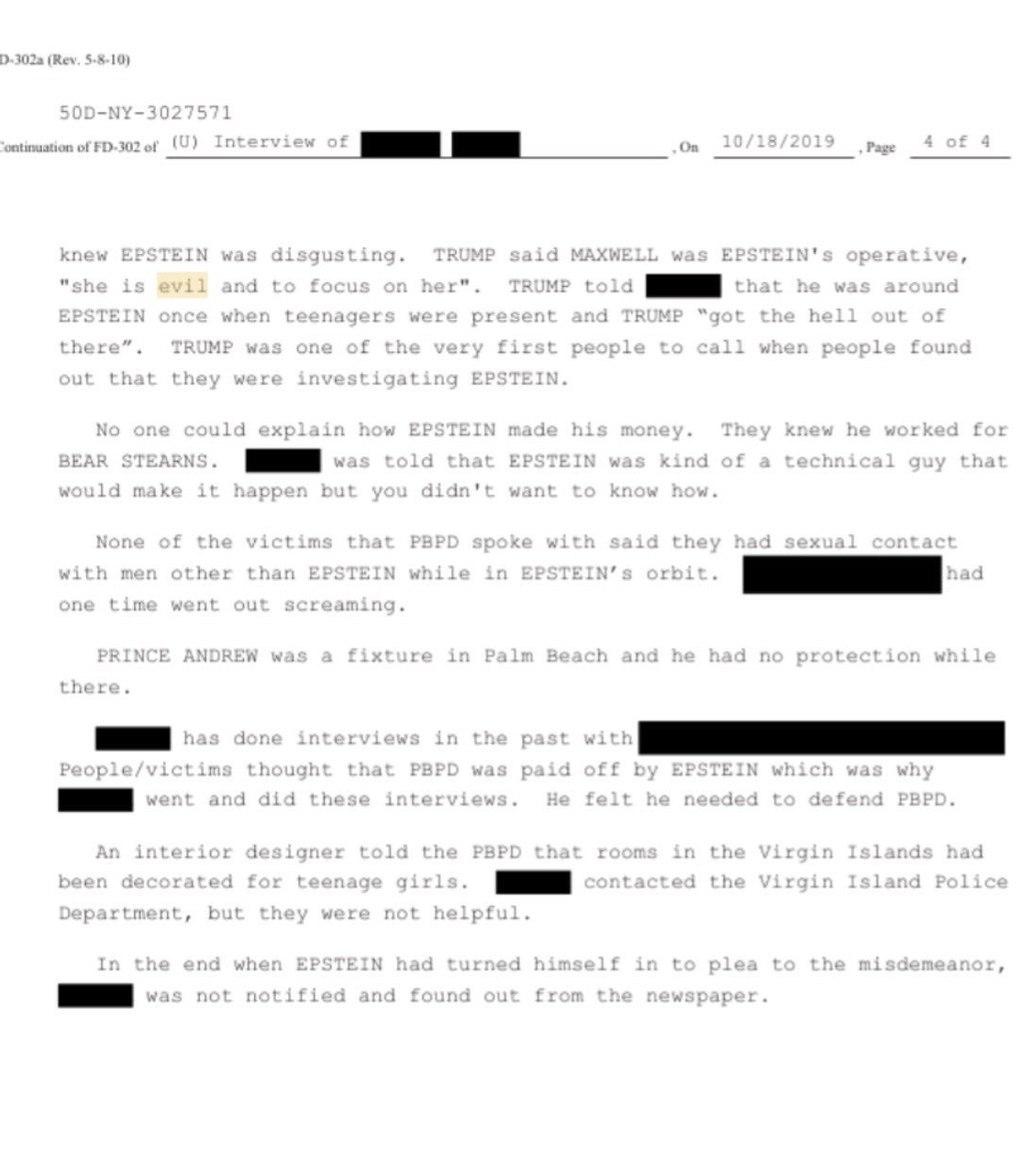
“She Is Evil—Focus on Her”: FBI Memo Recounts Alleged 2006 Trump Call on Epstein

Newly released DOJ material summarizing a 2019 FBI interview with former Palm Beach police chief Michael Reiter says Donald Trump called him in 2006 as Epstein came under local scrutiny—describing Epstein as “disgusting,” calling Ghislaine Maxwell Epstein’s “operative,” and saying “she is evil” and investigators should “focus on her,” according to reporting on the document.

The same FBI memo summary says Trump told the chief he left an encounter after seeing teenagers present (“got the hell out of there”) and that he was among the first to call once people learned investigators were looking at Epstein. The DOJ material has also been described as uncorroborated recollections recorded in interview notes—fuel for a political storm, but not, on its own, a standalone proof trail.

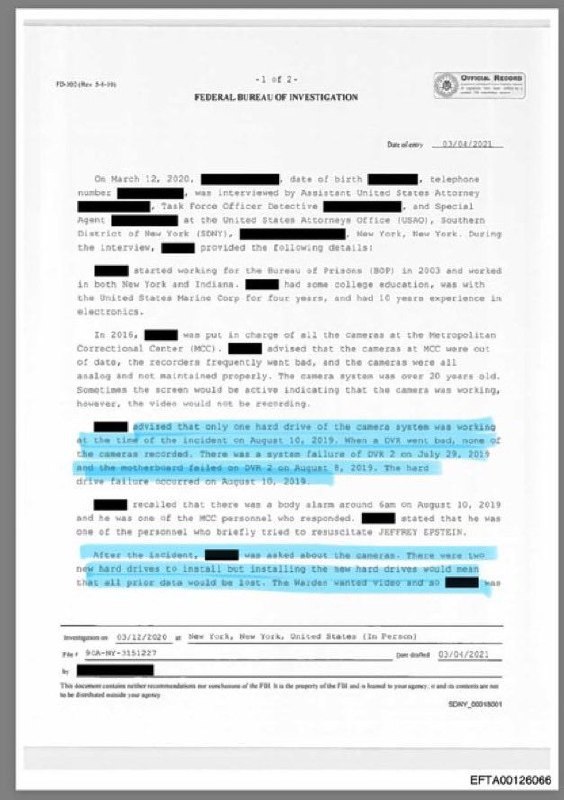
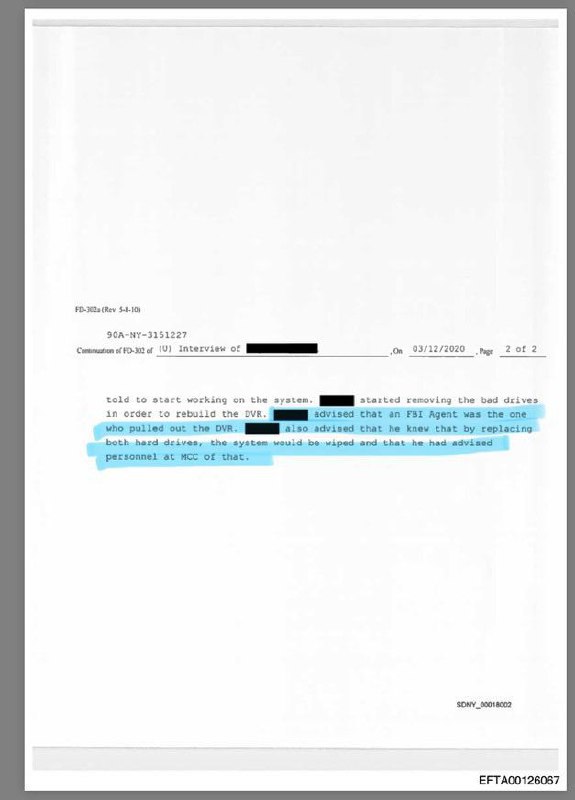
Hard-Drive Claim Reignites the Epstein Death Video Fight

A new wave of posts claims that newly unsealed Epstein documents show an FBI agent removed a jail surveillance hard drive, allegedly wiping video from the period around Epstein’s death. As of now, this specific “agent removed the drive to erase everything” allegation is not clearly corroborated in major, independently reported coverage.

What is well-documented is that Epstein’s jail surveillance environment has long been plagued by camera malfunctions, gaps, and chain-of-custody controversy: Reuters reported in 2019 that cameras outside the area malfunctioned and were sent for FBI examination. The DOJ Inspector General’s 2023 report describes an outdated, poorly maintained system with DVR hard drives that frequently malfunctioned. And later “raw” footage releases have triggered scrutiny after metadata analysis indicated nearly three minutes were cut from a video presented as raw.

Bottom line: the broader video record is messy and disputed—but the hard-drive removal to erase all footage claim still needs primary-document confirmation and independent reporting before it should be treated as established fact.


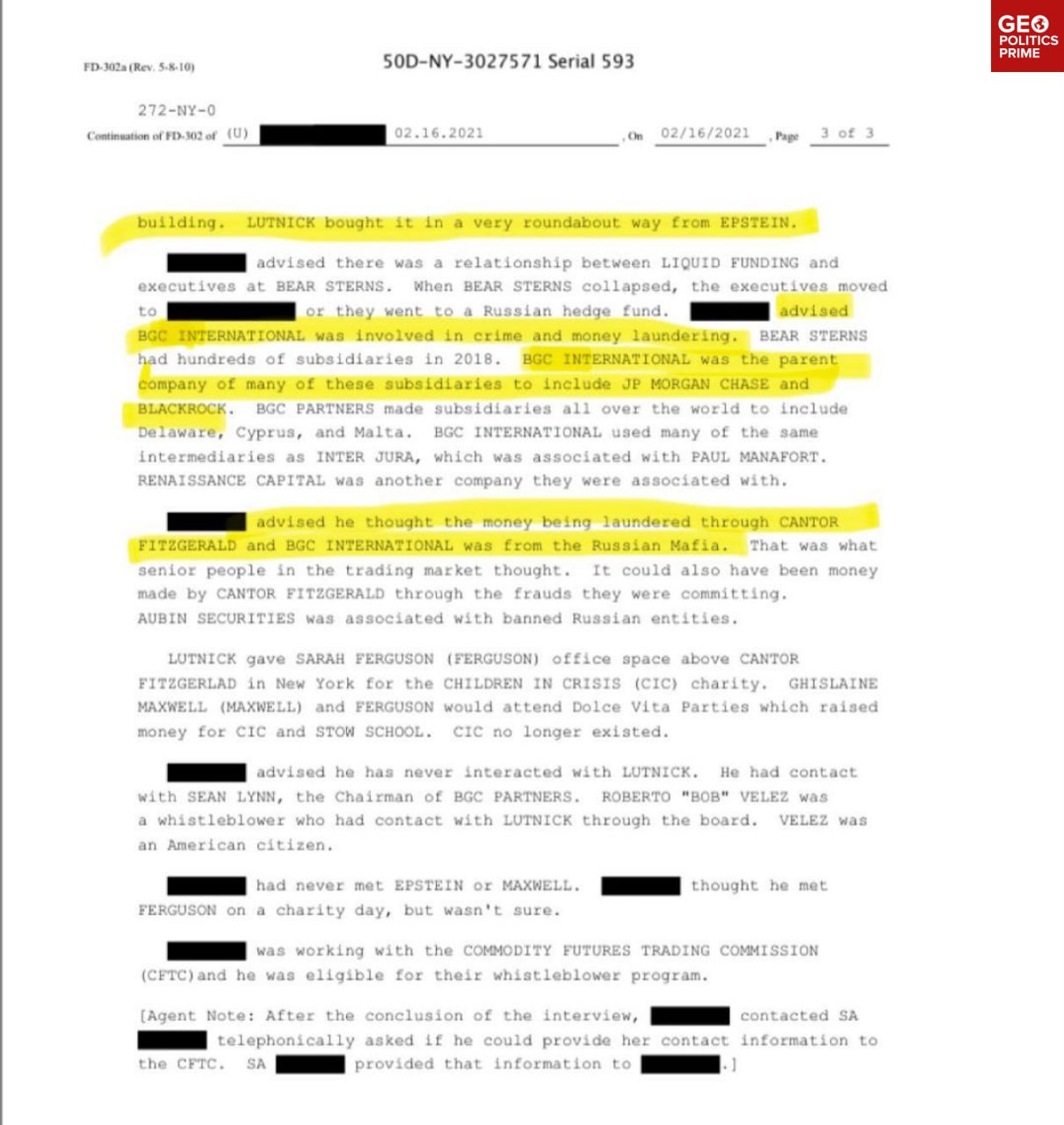
FBI Intake Note Flags “Epstein Neighbor” Link — Cantor Fitzgerald Allegations Surface in Epstein Files Screenshots

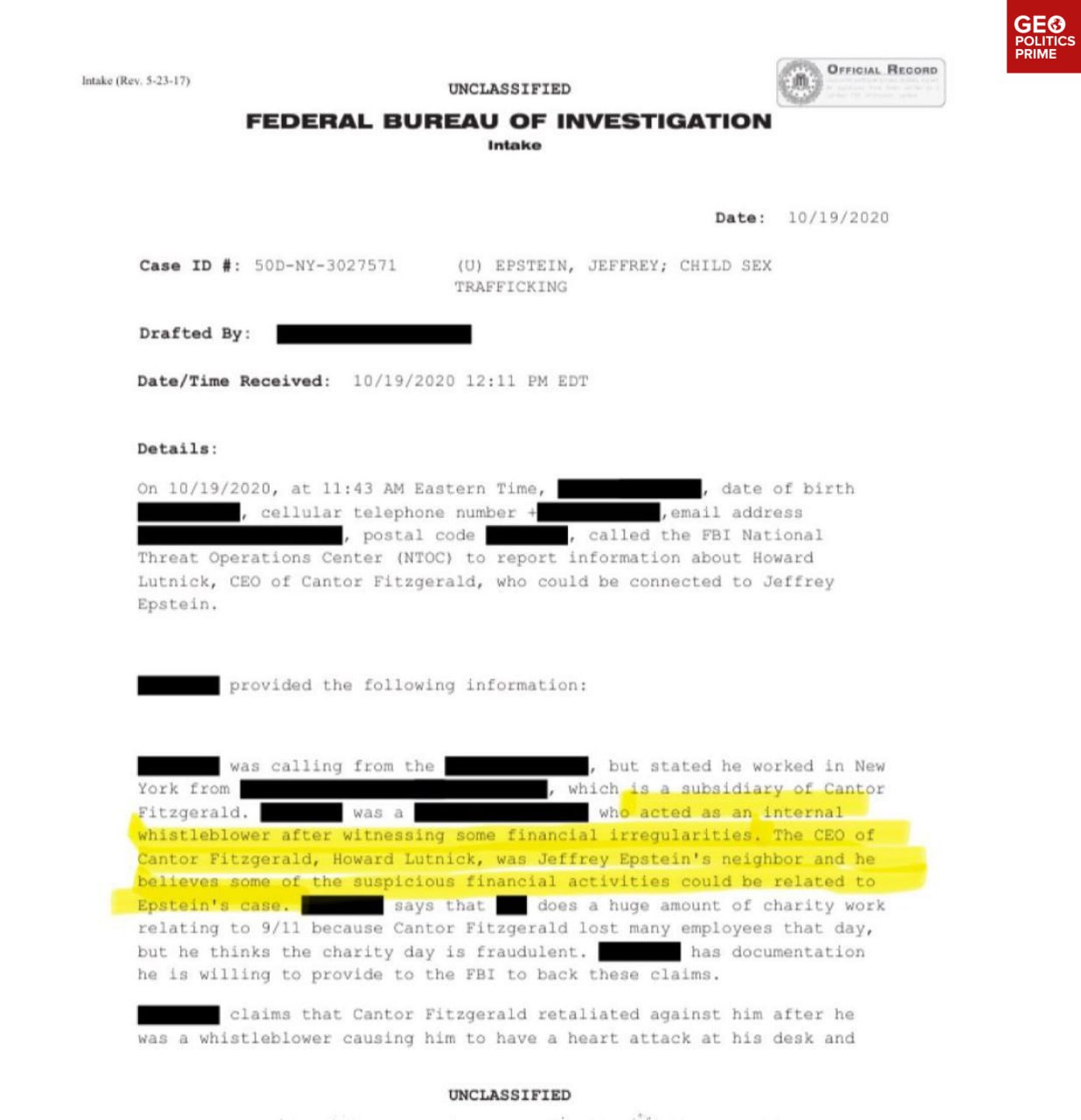
Screenshots circulating as part of the “Epstein files” show an UNCLASSIFIED FBI intake record dated Oct. 19, 2020 (case listed as EPSTEIN, JEFFREY; CHILD SEX TRAFFICKING) documenting a call to the FBI’s National Threat Operations Center (NTOC). The caller—described as a former Cantor Fitzgerald employee and “internal whistleblower”—alleges financial irregularities and claims Cantor Fitzgerald CEO Howard Lutnick was Jeffrey Epstein’s neighbor, suggesting some suspicious activity “could be related” to Epstein’s case. The same note alleges Cantor’s high-profile 9/11-related charity activity was used as a smokescreen, calling the annual “charity day” fraudulent, and claims the caller had documentation to support the accusations.

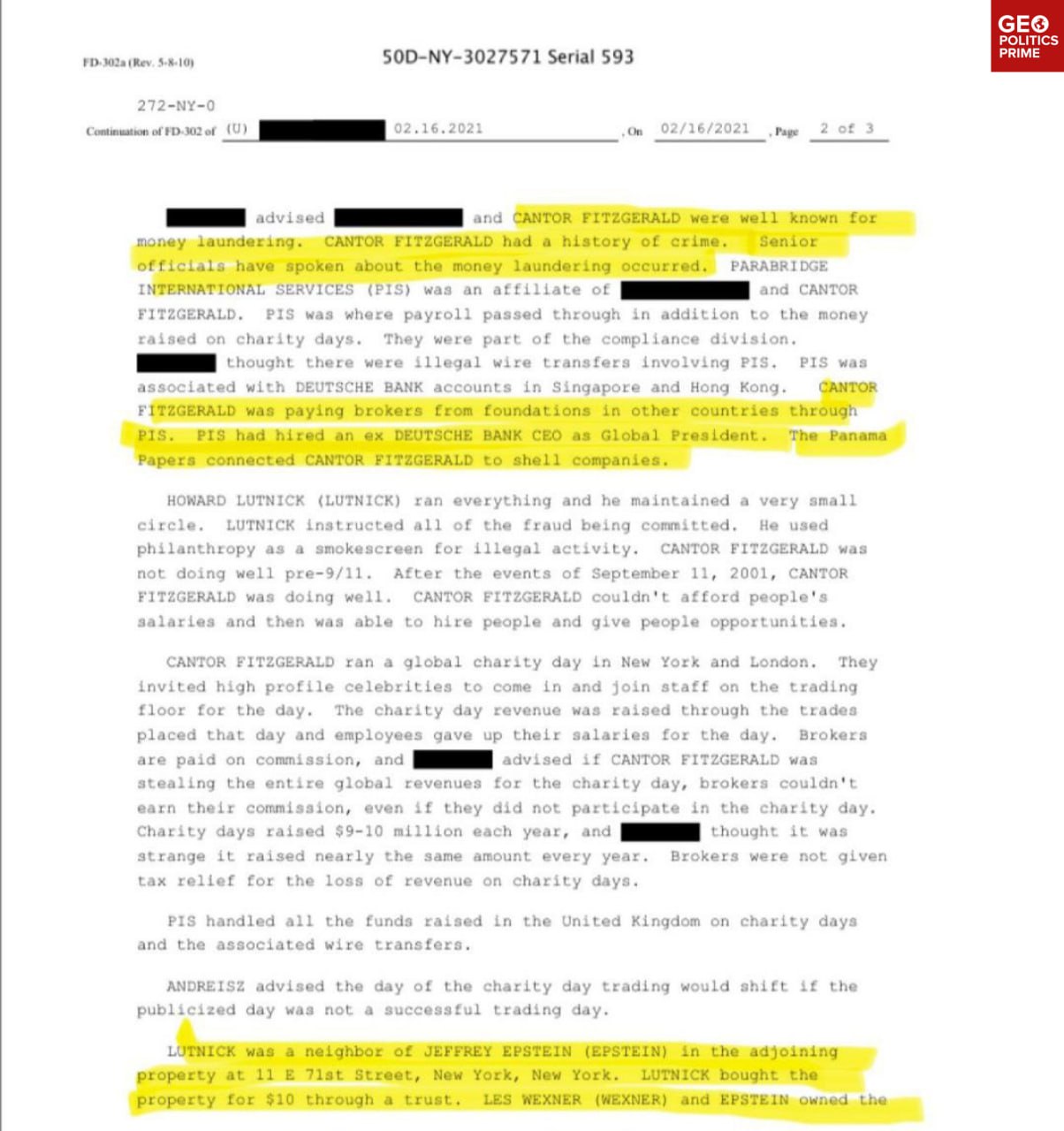
Two additional screenshots labeled FD-302 continuation / Serial 593 (Feb. 16, 2021) expand the allegations: they describe claims that Cantor Fitzgerald and an affiliate (Parabridge International Services, “PIS”) were involved in money laundering / illegal wire transfers, mention funds moving through Deutsche Bank accounts in Singapore and Hong Kong, and assert (as an allegation) that the Panama Papers connect the structure to shell companies. The documents also contain claims about Lutnick’s adjacent property near Epstein’s Manhattan address and a “$10” trust-based purchase, plus broader assertions tying BGC International and other entities to illicit flows.

Important context: these screenshots read like source allegations recorded in FBI paperwork, not court findings. They are heavily redacted, lack full supporting exhibits in the images, and several claims would require independent verification before being treated as established fact.
China’s “Starlink Killer” Microwave Claim Raises Counter-Space Stakes

Chinese media and several international outlets report that researchers at China’s Northwest Institute of Nuclear Technology (NINT) have developed a compact high-power microwave (HPM) device—dubbed TPG1000Cs—that could, in theory, disrupt or damage electronics on low-Earth-orbit (LEO) satellite constellations such as Starlink.

The reports highlight claimed performance figures—up to ~20 gigawatts in a burst lasting as long as 60 seconds—and argue that LEO satellites using commercial-grade components could be vulnerable to non-kinetic “soft-kill” effects.

Still, translating lab or prototype specifications into a real anti-satellite capability depends on hard constraints such as beam control, tracking, range losses, atmospheric effects, and satellite shielding/hardening—and the most dramatic claims remain independently unverified.

UAE Human-Rights Diplomat Pulled Into “Epstein Files” Storm as Email Excerpts Circulate

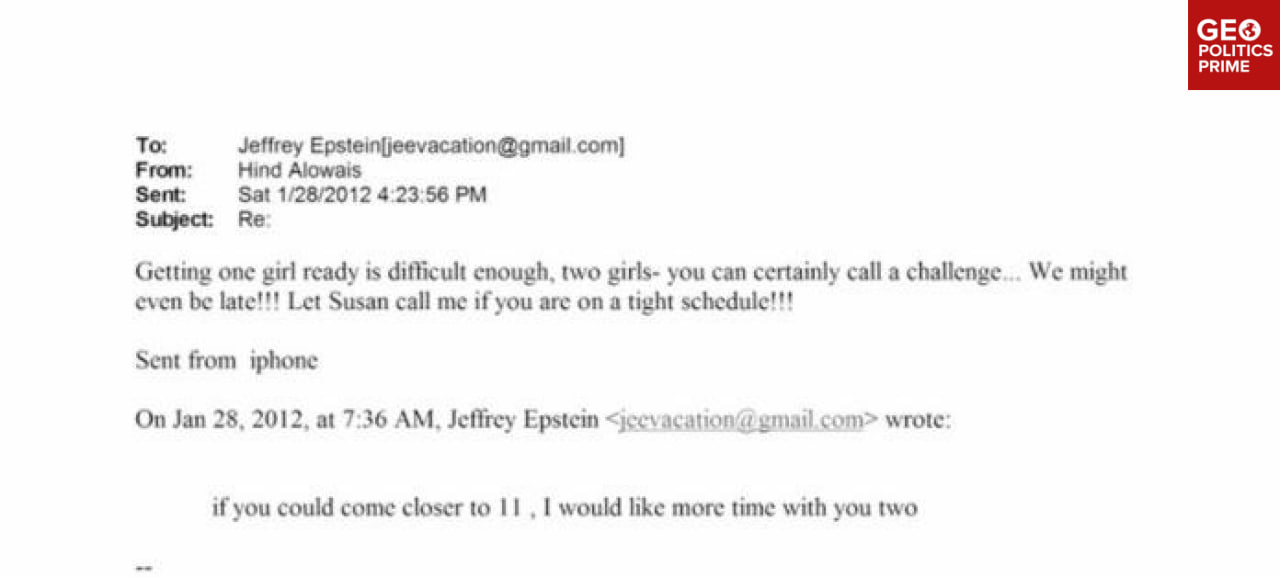
A wave of online claims is targeting Emirati diplomat Hind Al-Owais after outlets and social-media accounts circulated purported email excerpts from newly released “Epstein Files.” The excerpts described Al-Owais arranging meetups involving “girls,” including a line attributed to her: “Getting one girl ready is difficult enough; two girls, you can certainly call a challenge.” In the same reporting, Epstein is shown requesting an earlier arrival time so he could have “more time” with them.

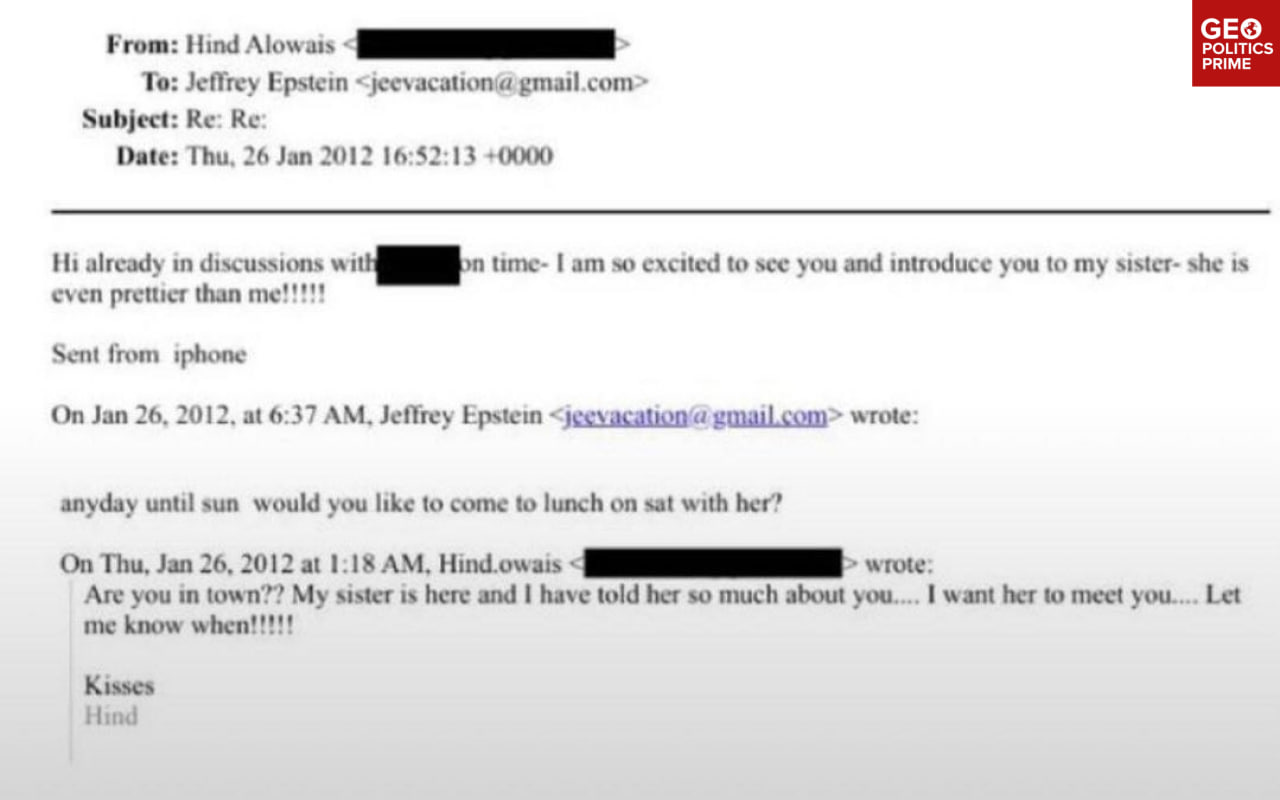
The controversy intensified because the same reporting says Al-Owais repeatedly referenced introducing her “sister” to Epstein (“she is even prettier than me!”). Some posts go further and claim the sister was 13 at the time—but the age detail is not consistently evidenced in the publicly quoted excerpts, and should be treated as unverified unless confirmed by primary documents or credible reporting.

What this does and doesn’t establish: the material being circulated points to communication and scheduling, but does not, by itself, prove trafficking or criminal conduct. As of the reporting cited above, there is no publicly documented criminal charge tied to these claims, and the key assertions remain allegations pending independent verification.


More Others news

Equities

Coca-Cola (KO) — EPS Beat, Revenue Miss

Coca-Cola (KO) reported EPS of $0.58 vs $0.56 expected (+3.57% surprise) but revenue of $11.8B vs $12.04B expected (-1.99% surprise). Shares were down ~1.48% (last $76.82) with +0.15% in extended hours (to $76.93), and market cap is about $335.4B—so the market’s focus likely shifts to volume/pricing mix and forward guidance.

AstraZeneca (AZN) — Massive EPS Beat, Revenue Slight Beat

AstraZeneca (AZN) posted EPS of $2.12 vs $1.06 expected (+100.00% surprise) and revenue of $15.5B vs $15.48B expected (+0.13% surprise). Shares were up ~2.77% (last $193.22) with -0.39% in extended hours (to $192.65), and market cap is about $301.5B—attention now typically turns to guidance and pipeline/launch commentary.

Gilead (GILD) — Narrow EPS Beat, Revenue Beat

Gilead (GILD) reported EPS of $1.86 vs $1.85 expected (+0.54% surprise) and revenue of $7.93B vs $7.68B expected (+3.26% surprise). Shares were down ~2.93% (last $147.23) and -3.00% in extended hours (to $142.81), with market cap around $182.75B—suggesting investors are likely grading guidance and product-level momentum.

Welltower (WELL) — EPS Miss, Revenue Strong Beat

Welltower (WELL) posted EPS of $0.14 vs $0.56 expected (-75.00% surprise) but revenue of $3.18B vs $2.85B expected (+11.58% surprise). Shares were up ~1.82% (last $200.84) and +1.29% in extended hours (to $203.44), with market cap near $137.53B—the market will likely focus on FFO/NOI detail and forward outlook given the EPS shortfall.

S&P Global (SPGI) — Slight EPS Miss, Revenue Beat; Stock Hit

S&P Global (SPGI) reported EPS of $4.30 vs $4.32 expected (-0.46% surprise) and revenue of $3.92B vs $3.90B expected (+0.51% surprise). Shares were down ~9.71% (last $401.08) with +0.26% in extended hours (to $402.11), and market cap is about $121.96B—a move that typically points to guidance, pricing, and growth assumptions being the real driver.

Spotify (SPOT) — Huge EPS Beat, Revenue In Line; Shares Surge

Spotify (SPOT) posted EPS of $4.43 vs $2.85 expected (+55.44% surprise) and revenue of $4.53B vs $4.52B expected (+0.22% surprise). Shares jumped ~14.75% (last $476.01) and were +0.37% in extended hours (to $477.79), with market cap around $99.45B—investors are likely responding to profitability/margins and guidance tone.

Marriott (MAR) — EPS Miss, Revenue Beat; Shares Higher

Marriott (MAR) reported EPS of $2.58 vs $2.61 expected (-1.15% surprise) while revenue was $6.69B vs $6.67B expected (+0.30% surprise). Shares were up ~8.50% (last $359.35) and +0.54% in extended hours (to $361.30), with market cap near $96.88B—implying the market liked guidance and demand commentary despite the slight EPS miss.

Robinhood (HOOD) — EPS Beat, Revenue Miss; After-Hours Drop

Robinhood (HOOD) posted EPS of $0.66 vs $0.60 expected (+10.00% surprise) but revenue of $1.28B vs $1.34B expected (-4.48% surprise). Shares were down ~1.04% (last $85.66) and fell ~6.41% after hours (to $80.11), with market cap around $77.1B—suggesting investors are focused on top-line momentum and outlook.

Ferrari (RACE) — Miss on EPS and Revenue; Stock Still Higher

Ferrari (RACE) reported EPS of $2.14 vs $2.48 expected (-13.71% surprise) and revenue of $1.8B vs $2.07B expected (-13.04% surprise), missing on both lines. Shares were up ~8.06% (last $363.22) with +0.09% in extended hours (to $363.55), and market cap is about $65.18B—a move that often points to guidance, order book, or mix/margins offsetting the headline miss.

Cloudflare (NET) — Beats on Both Lines; Strong After-Hours Pop

Cloudflare (NET) posted EPS of $0.28 vs $0.27 expected (+3.70% surprise) and revenue of $614.5M vs $591.43M expected (+3.90% surprise). Shares were up ~3.55% (last $179.91) and jumped ~7.52% after hours (to $193.52), with market cap around $63.43B—the market is likely rewarding growth durability and guidance.

More Equities news

USA

U.S. Inventory Build Cools: Business Stockpiles Rise Just 0.1% as Retail Inventories Miss

U.S. inventory growth came in softer than expected in November, hinting at a more cautious restocking pace heading into year-end.

  • Business Inventories (MoM, Nov): +0.1% vs +0.2% expected, +0.2% prior
  • Retail Inventories ex-Auto (MoM, Nov): +0.2% vs +0.3% expected

Why it matters:

A cooler inventory build can mean less “inventory contribution” to near-term GDP, but it may also reduce the risk of an inventory overhang—potentially supportive for future production if demand holds up.

USD angle:

On its own, this is typically a low-volatility release, but the downside miss slightly leans toward a softer growth impulse, which can be marginally USD-negative at the margin if reinforced by other cooling data.

U.S. Weekly Spending Gauge Softens Slightly: Redbook Sales Growth Slips to 6.5% YoY

U.S. consumer demand signals eased a touch in the latest weekly read, with the Redbook retail sales index showing slightly slower year-on-year growth.

  • Redbook (YoY): +6.5% vs +6.7% prior

The dip is modest, but it suggests the pace of same-store sales growth cooled at the margin, keeping the market’s focus on whether consumer strength is stabilizing or gradually slowing.

USD angle:

Redbook is a high-frequency indicator and usually not a major FX mover, but a softer print can be marginally USD-negative if it aligns with a broader pattern of cooling consumption.

U.S. Labor Cost Pressures Ease: Employment Cost Index Slows to 0.7% in Q4

U.S. compensation growth cooled in the fourth quarter, with the Employment Cost Index (ECI)—a key Federal Reserve wage-inflation gauge—rising less than expected and marking a step down from the prior quarter.

  • Employment Cost Index (QoQ, Q4): +0.7% vs +0.8% expected, +0.8% prior
  • Employment Benefits (QoQ, Q4): +0.70% vs +0.80% prior
  • Employment Wages (QoQ, Q4): +0.70% vs +0.80% prior

The broad-based easing across wages and benefits suggests labor-cost momentum is gradually cooling, a development that can help reduce services inflation pressure over time.

USD angle:

A softer ECI can be interpreted as dovish at the margin (less wage-driven inflation risk), potentially trimming front-end yield support for the dollar if markets see it as reinforcing a slower-tightening or earlier-easing path.

U.S. Import Inflation Cools Sharply: Import Prices Flat YoY as Export Prices Stay Firm

U.S. trade price data for December showed cooling imported inflation pressures, while export prices remained comparatively stronger, pointing to a mixed inflation signal through the external channel.

  • Import Price Index (MoM, Dec): +0.1% vs +0.1% expected, down from +0.4% prior
  • Imported prices rose modestly, but the pace slowed sharply.
  • Import Price Index (YoY, Dec): 0.0% vs +0.2% expected, +0.1% prior
  • Import inflation dropped to flat, a clear downside surprise.
  • Export Price Index (MoM, Dec): +0.3% vs +0.1% expected, down from +0.5% prior
  • Exports beat expectations on the month, though still slower than November.
  • Export Price Index (YoY, Dec): +3.1% vs +3.3% prior
  • Annual export price inflation eased but remained elevated versus imports.

USD angle:

A sharp cooling in import inflation can be dovish at the margin, reducing external price pressure feeding into CPI. However, firmer export prices can complicate the “cooling” narrative. Net-net, the flat YoY import price is the most market-relevant signal and slightly reduces inflation heat—potentially trimming near-term USD yield support if reinforced by other soft inflation data.

U.S. Consumer Stalls in December: Retail Sales Flat, Control Group Turns Negative

U.S. retail spending lost momentum sharply in December, with headline and core sales flat versus expectations for solid growth, and the key GDP “control group” **slipping into contraction—**a clear downside surprise for the demand narrative.

  • Retail Sales (MoM, Dec): 0.0% vs 0.4% expected, 0.6% prior
  • Core Retail Sales (MoM, Dec): 0.0% vs 0.3% expected, 0.4% prior
  • Retail Control (MoM, Dec): -0.1% vs 0.4% expected, 0.2% prior
  • Retail Sales ex Gas/Autos (MoM, Dec): 0.0% vs 0.3% expected
  • Retail Sales (YoY, Dec): 2.43% vs 3.26% prior

Why it matters:

The control group feeds directly into GDP calculations, so a negative reading raises the risk that consumer spending contributed less to growth heading into year-end. The broad flat prints across categories also suggest the slowdown wasn’t just a one-off distortion.

USD angle:

A demand miss of this magnitude is typically USD-negative at the margin because it can pull down growth expectations and soften front-end rate pricing—especially if it aligns with cooling labor-cost and inflation data.

ADP Jobs Tick Higher: Weekly Hiring Measure Rises to 6.5K, Still Modest

The latest ADP weekly employment change showed a small improvement, with private-sector job gains edging up but remaining low in absolute terms—suggesting hiring is steady, not surging.

  • ADP Employment Change (Weekly): +6.50K vs +5.00K prior

Why it matters:

Even with the uptick, the level implies muted hiring momentum, consistent with a labor market that may be cooling rather than accelerating.

USD angle:

This is usually a low-impact release for FX, but a slightly firmer reading can be marginally supportive for the dollar if it aligns with other labor data. On its own, the message is more “stable” than “strong.”

U.S. Small-Business Mood Softens: NFIB Optimism Slips to 99.3 in January

U.S. small-business sentiment cooled slightly in January, with the NFIB Small Business Optimism Index coming in below expectations and edging down from the prior month.

  • NFIB Small Business Optimism (Jan): 99.3 vs 99.8 expected, 99.5 prior

The dip suggests Main Street confidence lost a bit of momentum at the start of the year, potentially reflecting ongoing caution around demand, costs, and financing conditions.

USD angle:

NFIB is typically not a major immediate FX driver, but a softer print can be mildly USD-negative at the margin if it reinforces a broader narrative of cooling growth and softer domestic demand.

More USA news

Oceania

Aussie Consumers Turn More Cautious: Westpac Sentiment Falls -2.6% in February

Australian household confidence weakened in February, with Westpac Consumer Sentiment down 2.6%, a deeper drop than the prior reading and a sign that cost-of-living and rates may still be weighing on demand psychology.

  • Westpac Consumer Sentiment (Feb): -2.6% vs -1.7% prior

AUD angle:

Softer consumer sentiment can be mildly negative for AUD via the growth channel, especially if it foreshadows weaker spending. However, FX pricing may still be dominated by the RBA’s policy outlook—if the market continues to price a hawkish path, rate support can partially offset softer domestic confidence.

Australia’s Business Pulse Splits: Confidence Up, Conditions Cool in January

Australia’s NAB business readout sent a mixed signal for January, with sentiment improving slightly while the broader activity/conditions measure eased—suggesting businesses are a bit more upbeat, but the operating environment softened at the margin.

  • NAB Business Confidence (Jan): 3 (up from 2)
  • Confidence edged higher, pointing to a small uplift in business sentiment.
  • NAB Business Survey (Jan): 7 (down from 9)
  • The broader survey/conditions gauge slipped, hinting at slower momentum in demand, profitability, or capacity pressures versus the prior month.

AUD angle:

This is not a clean “all-clear” for growth. A confidence uptick can support the narrative that firms remain resilient, but softer conditions may keep markets cautious on the domestic cycle. For the Aussie, the dominant driver still tends to be RBA pricing and global risk sentiment, so follow-through in inflation and jobs will matter more than a one-month wobble.

Australia Housing Permits Crash: Building Approvals Plunge -14.9% MoM as Momentum Cools

Australia’s housing pipeline took a sharp hit in December, with building approvals collapsing after a strong prior month—signaling a sudden loss of momentum in new construction intentions.

  • Building Approvals (MoM, Dec): -14.9% (in line with -14.9% forecast) vs +15.2% prior

A major month-to-month reversal, effectively giving back much of the prior surge.

  • Building Approvals (YoY, Dec): +0.40% (in line with +0.40% forecast) vs +20.20% prior

Annual growth slowed dramatically, suggesting the earlier boom is fading fast.

  • Private House Approvals (Dec): +0.4% (in line with +0.4% forecast) vs +1.3% prior

Detached housing approvals still rose, but only modestly implying the biggest weakness likely came from other categories (often multi-unit).

AUD angle:

A sharp approval drop can be mildly negative for AUD via the domestic growth channel, especially if it persists and feeds into construction activity and employment. Still, near-term FX pricing often hinges more on RBA rate expectations and global risk tone than one housing print.

More Oceania news

Iran

Rally for Relief?” Families of Detainees Told to Film 22 Bahman Loyalty Proof

Multiple reports say families of detained protesters in Iran have been pressured to attend the state’s 22 Bahman (Feb 11, 2026) rally and provide “provable” evidence of participation—including photos and videos sent to security bodies—in exchange for faster case handling and possible leniency.

According to these accounts, families were told that compliance could help secure outcomes such as release, reduced sentences, or avoiding harsher penalties, while some reports add that families were urged to record statements denouncing Western governments and international media as part of the “proof.”

Tehran Metro Alert: Body Searches for “Pellet Marks,” Phones Checked (Including Deleted Folder)

Field reports say that on Monday, Feb 9, 2026 (20 Bahman) at Imam Khomeini and Sadeghieh metro stations in Tehran, some young passengers were subjected to physical inspections reportedly aimed at checking for pellet-shot marks, and their phones were searched—including the “Deleted/Recently Deleted” folder.

The account describes this as one of hundreds of similar incidents reported in recent days, prompting renewed warnings to commuters to stay cautious.

Safety note (general): keep your phone locked with a strong passcode, disable lock-screen previews, back up important data, and avoid carrying unnecessary sensitive material on-device while commuting.


Fireworks Backfire: Anniversary Celebrations Trigger Window Chants

Reports from inside Iran say anti-government chants broke out “everywhere” after authorities launched fireworks for the anniversary of the 1979 revolution. Witnesses say many residents responded by going to windows and balconies and chanting in reaction to the displays.

The accounts are not independently verified, but they fit a broader pattern seen recently: public events or loud nighttime activities becoming a cue for spontaneous, neighborhood-wide chanting.


More Iran news

Japan

Japan Liquidity Stays Soft: M2 Growth Slows to 1.6% While M3 Edges Up

Japan’s latest money data pointed to steady-but-muted liquidity growth, with broad money M2 slowing slightly while M3 rose marginally in level terms.

  • M3 Money Supply (Jan): ¥2,244.9B vs ¥2,244.7B prior

Broad liquidity ticked higher, but only modestly.

  • M2 Money Stock (YoY, Jan): +1.6% vs +1.7% expected, +1.7% prior

The annual growth rate eased below forecast, suggesting credit/money expansion remains subdued.

JPY angle:

Softer money growth is usually not a bullish domestic impulse for JPY because it implies a less forceful demand/credit pulse. That said, the yen’s main drivers often remain rate differentials, risk sentiment, and BoJ signaling, with money supply acting more as a slow-moving macro backdrop.

Japan Capex Signal Surges: Machine Tool Orders Spike 25.3% YoY, More Than Double Prior

Japan’s investment pulse strengthened sharply, with machine tool orders—a key proxy for manufacturing capex—jumping to +25.3% YoY, more than doubling the previous reading.

  • Machine Tool Orders (YoY): +25.3% vs +10.9% prior

The acceleration points to a notable rebound in corporate investment appetite and potentially improving demand conditions across Japan’s industrial supply chain.

JPY angle:

Stronger capex signals can be supportive for JPY through the growth narrative and by reinforcing the idea that Japan’s domestic cycle is firming. That said, the yen’s near-term direction is still heavily driven by rate differentials and BoJ messaging, so markets will look for confirmation in broader production/export data and corporate guidance.

More Japan news

UK

UK Retail Surprise: BRC Sales Growth Jumps to 2.3% YoY, Beating Forecasts

UK retail spending momentum looked stronger in January, with the BRC Retail Sales Monitor accelerating sharply and landing well above expectations—an upside signal for the consumer backdrop at the start of the year.

  • BRC Retail Sales Monitor (YoY, Jan): +2.3% vs +1.3% expected, +1.0% prior

GBP angle:

A stronger retail read can be supportive for GBP via the growth channel and by reinforcing the idea that demand is holding up. The key caveat is whether the gain reflects real volumes or price effects—but as a headline, this is a clear positive surprise.

UK Borrowing Costs Jump: 5-Year Gilt Auction Yield Surges to 4.001%

UK government borrowing costs moved higher at the front-to-belly of the curve, with the latest 5-year gilt auction printing at a notably higher yield.

  • 5-Year Treasury Gilt Auction: 4.001% vs 3.821% prior

The rise suggests investors demanded more yield to absorb supply, pointing to tighter financial conditions and renewed sensitivity to rates and fiscal/issuance dynamics.

GBP angle:

Higher gilt yields can be supportive for GBP via the rates channel (wider yield advantage), but if the move reflects risk premium or fiscal anxiety rather than tighter BoE expectations, it can become a double-edged signal—supportive for carry, but potentially negative for risk sentiment around UK assets.

More UK news

Europe

France Jobless Rate Ticks Up: Unemployment Rises to 7.9%, Missing Expectations

France’s unemployment rate moved higher, adding a small but notable downside signal to the domestic growth picture.

  • French Unemployment Rate: 7.9% vs 7.8% expected, 7.7% prior

The increase suggests the labor market is loosening at the margin, which can feed into a softer outlook for household demand and wage pressure—two inputs markets watch when assessing the broader Eurozone cycle.

EUR angle:

On its own, a 0.1pp miss is typically not a gamechanger for the euro, but it can reinforce a slightly dovish tilt in rate expectations at the margin if accompanied by weaker activity data. The bigger driver remains whether broader Eurozone labor and inflation trends confirm cooling momentum.

Eurozone Front-End Eases: Spain 3M Letras and Germany 5Y Bobl Yields Tick Lower

Two key Eurozone auctions pointed to a slightly softer rates tone, with yields declining in both Spain’s very short end and Germany’s intermediate maturities—suggesting steady demand and marginally easier financing conditions.

  • Spain 3-Month Letras Auction: 1.939% vs 1.954% prior
  • A small dip that signals slightly lower short-term funding costs for Spain.
  • Germany 5-Year Bobl Auction: 2.400% vs 2.470% prior
  • A more noticeable decline, pointing to easing yield pressure in the core belly of the curve.

EUR angle:

Lower yields can be mildly EUR-negative at the margin via the rates channel, especially if the move reflects increasing confidence in ECB easing. However, if it’s primarily a demand-driven auction dynamic, the FX impact is usually limited unless reinforced by broader rate moves.

More Europe news

Commodities

Precious Metals Pull Back: Gold Slides to $5,022 as Silver Drops 2%

Precious metals opened the session under pressure, with gold and silver retreating from recent highs in early trading.

  • Spot gold: -0.7% to $5,022.19/oz
  • April gold futures: -0.7% to $5,044.79/oz (as of 00:34 ET / 05:34 GMT)
  • Spot silver: -2.1% to $80.930/oz
  • Spot platinum: -1.8% to $2,084.85/oz

The price action signals a risk-off tilt within the metals complex, with silver underperforming gold on the downside—often a sign that the market is trimming higher-beta exposure within commodities.

Venezuela’s Oil Reappears on Israel’s Radar After Maduro: First Cargo in Years Signals Trade Rewiring

Venezuela is shipping its first crude oil cargo to Israel in years, according to Bloomberg, in a fresh sign that the country’s oil trade is being rapidly rewired following Nicolás Maduro’s capture and the subsequent reopening of export channels.

The reported Israel-bound shipment lands amid a broader normalization push: Venezuelan exports rebounded sharply in January as U.S. restrictions were eased and trading houses resumed moving barrels, while output has been climbing back toward ~1 million bpd as bottlenecks clear and export flows normalize.

Policy plumbing matters here: Washington has issued broader authorizations for handling Venezuelan-origin oil and also approved U.S. diluent sales—critical for blending and exporting Venezuela’s extra-heavy crude—helping PDVSA and partners keep barrels moving.

More Commodities news

Cryptocurrency

Bithumb’s $44B Bitcoin Blunder Sparks Seoul Crackdown Calls After 620,000 BTC Mistake

South Korean crypto exchange Bithumb said an internal error during a promotional reward event on Friday, February 6, 2026 mistakenly credited users with a combined ~620,000 bitcoins—worth over $44 billion—instead of small cash rewards, triggering an immediate sell-off before the glitch was contained.

Bithumb said it restricted trading and withdrawals for affected accounts within about 35 minutes and recovered 99.7% of the wrongly credited bitcoin; regulators later pointed to the incident as evidence that tougher rules and stronger internal controls are needed as crypto becomes more intertwined with the financial system.

More Cryptocurrency news