IFC Markets Live Quotes

Market news roundup: Thursday, 18 December 2025

30 short market news items, grouped by 11 sections.

Europe

ECB, Nordics Seen Holding Rates

The ECB is widely expected to keep its key rate steady at 2% and show limited appetite for cuts, with markets watching for a possible upward tweak to growth projections. Sweden’s Riksbank is also seen holding at 1.75%, while Norway’s Norges Bank is expected to stay on hold at 4%.

Market impact: Mildly supportive for EUR/SEK/NOK if “higher-for-longer” messaging is reinforced; European front-end yields could stay firm, with the biggest moves likely driven by any shift in guidance and updated projections.
Swiss Trade Surplus Narrows

Switzerland’s trade balance came in at CHF 3.841B in November, below expectations (CHF 5.320B) and down from the prior CHF 4.203B, signaling a narrower surplus for the month.

Market impact: Mildly negative for CHF at the margin; limited follow-through unless confirmed by sustained shifts in exports/imports or broader risk sentiment changes.

France Business Sentiment Improves

France’s December business survey rose to 102 (vs 98 expected; 98 prior), signaling a notable improvement in sentiment versus last month and suggesting a firmer near-term activity tone.

Market impact: Mildly supportive for EUR and French cyclicals; reinforces the idea of stabilization in euro-area growth, though markets will look for confirmation from PMIs and hard output data.

Eurozone Construction Output Rebounds

Eurozone construction output rose 0.88% m/m in October, reversing the prior -0.58% decline, suggesting a modest near-term stabilization in a sector that has been pressured by higher financing costs.

Market impact: Mildly supportive for EUR-area growth sentiment; limited FX impact unless followed by a sustained recovery across activity data.

ECB Holds Rates

The European Central Bank kept policy settings unchanged in December. The deposit facility rate stayed at 2.00% (in line; unchanged) and the main policy rate held at 2.15% (in line; unchanged). The marginal lending facility remains at 2.40%, reinforcing a steady-policy stance as markets look for guidance on the timing of any future easing.

Market impact: Mildly supportive for EUR and front-end euro rates if the ECB maintains a “wait-and-see” tone; biggest sensitivity is to forward guidance and how the ECB frames growth and inflation risks.

More Europe news

USA

Trump Fuels Fed Chair Uncertainty

U.S. President Donald Trump said the next Federal Reserve chair would “believe in lower interest rates by a lot,” adding to uncertainty around the future policy path and perceived Fed independence. Trump has floated Kevin Warsh, Christopher Waller, and Kevin Hassett as potential successors—names markets generally view as more dovish than current leadership—while recent comments from Waller have reinforced the idea that further cuts could be justified if labor-market cooling persists.

Market impact: USD-negative at the margin if “lower-for-longer” expectations build, but near-term FX direction remains dominated by U.S. inflation/jobs data and Treasury yields; heightened headline sensitivity for rates markets.

Jobless Claims Point to Steady Labor Market

U.S. labor-market data stayed broadly stable. Initial jobless claims were 224K (in line with expectations; down from 237K), while the 4-week average edged up to 217.5K (from 217.0K), signaling no clear deterioration. Continuing claims rose to 1.897M (vs 1.930M expected; 1.830M prior), suggesting some increase in benefit rolls, but not a sharp weakening.

Market impact: Mildly supportive for USD and risk sentiment at the margin—claims remain consistent with a still-resilient labor market; rates sensitivity stays tied to whether continuing claims keep trending higher.


U.S. Inflation Cools Sharply

U.S. inflation surprised to the downside in November. Headline CPI eased to 2.7% y/y (vs 3.1% expected; 3.0% prior) and core CPI fell to 2.6% y/y (vs 3.0% expected; 3.0% prior), signaling a meaningful cooling in underlying price pressures. The CPI index (n.s.a.) printed 324.12 (vs 325.13 expected; 324.80 prior) while the core CPI index rose to 331.07 (from 330.54).

Market impact: USD-negative and bond-positive—this kind of downside CPI surprise typically pulls yields lower and boosts rate-cut expectations; supportive for risk assets if markets view it as “soft landing” disinflation rather than demand shock.

Philly Fed Deteriorates Despite Better Orders

The Philadelphia Fed’s December manufacturing index fell to -10.2 (vs 2.5 expected; -1.7 prior), signaling a renewed contraction signal and a clear downside surprise. Under the hood, new orders improved to 5.0 (from -8.6), employment rose to 12.9 (from 6.0), and capex intentions increased to 30.30 (from 26.70), suggesting some forward-looking components were firmer even as the headline weakened. Price pressures cooled notably: prices paid fell to 43.60 (from 56.10). Overall business conditions eased to 41.6 (from 49.6).

Market impact: Mixed—headline weakness is growth-negative, but easing input prices is disinflation-friendly; modestly supportive for bonds, while USD reaction depends on whether markets focus more on activity softness or improving internals.

More USA news

Oceania

New Zealand GDP Rebounds Strongly in Q3, Beating Forecasts and Reversing Prior Contraction

New Zealand’s economy posted a clear upside surprise in Q3. GDP rose 1.1% q/q (vs 0.9% expected; prior -1.0%) while GDP was up 1.3% y/y (in line with 1.3% expected; prior -1.1%), signaling a decisive turn from contraction to expansion. The rebound looked broad-based, with GDP expenditure up 1.3% q/q (prior -0.8%). Even so, the annual average remained -0.5% (prior -1.2%), showing the economy is recovering from a weak base.

Market impact: Supportive for NZD and NZ rates at the margin—reduces urgency for RBNZ easing and challenges the “growth slump” narrative, though follow-through will depend on inflation and subsequent activity prints.

Australia Inflation Expectations Tick Up

Australia’s MI inflation expectations rose to 4.7% from 4.5%, suggesting households are seeing slightly higher inflation ahead after the prior easing.

Market impact: Mildly hawkish at the margin—supports a “higher for longer” bias for the RBA if confirmed by hard inflation data; AUD impact is modest and largely driven by global rates and risk sentiment.

Australia Reserves Rise

Australia’s total reserve assets increased to $113.1B in November from $110.6B, indicating a modest build in official buffers.

Market impact: Limited direct impact on AUD; marginally supportive from a resilience perspective, with FX still driven mainly by rate differentials and global risk sentiment.

More Oceania news

Equities

BP Taps Woodside’s Meg O’Neill as CEO

BP appointed Woodside Energy CEO Meg O’Neill as its next chief executive, signaling a sharper refocus on hydrocarbons after BP’s renewables detour. O’Neill is set to take over on April 1, 2026, with BP executive Carol Howle serving as interim CEO; the move also follows pressure from activist investor Elliott.

Market impact: Potentially supportive for BP on “back-to-basics” expectations and capital discipline; watch near-term execution risk (asset sales, cost cuts) and strategic guidance under the new CEO.

Elliott Builds $1B+ Stake in Lululemon

Activist hedge fund Elliott Management has amassed a more than $1 billion stake in Lululemon and is positioning for leadership influence, including lining up retail executive Jane Nielsen as a potential CEO candidate, according to a Reuters source. The development adds pressure as the company navigates a CEO transition and attempts to regain traction amid tougher competition and execution concerns.

Market impact: Heightened event risk for LULU—activism can catalyze a strategy reset, but also raises governance uncertainty; likely increases volatility in the stock near leadership and board headlines.


Oracle Slides as Blue Owl Drops Out of Data Center Deal

Oracle shares fell 5.4% after the company said its equity deal for a major data center project would not include Blue Owl Capital, a key financing partner. The stock is now down almost 50% from mid-September, when an OpenAI-related deal triggered a ~35% one-day surge, underscoring how quickly sentiment has turned on AI-infrastructure funding risk.

Market impact: Negative for ORCL near term; raises execution/financing risk for AI data-center expansion and can weigh on broader “AI capex” beneficiaries until replacement funding is clarified.

More Equities news

UK

UK Inflation Drop Revives Cut Expectations

Wednesday’s unexpected fall in UK inflation reassured investors that policy easing is coming, even if further rate cuts may still be some distance away given the UK’s still-elevated inflation backdrop at 3.2%. Sterling extended its downside, last nursing losses around $1.3374, as markets leaned into a more dovish BoE trajectory.

Market impact: GBP-negative and gilt-supportive—cooler inflation strengthens easing expectations, but the timing of follow-on cuts remains sensitive to wages and services inflation.

BoE Cut Seen as Thursday’s Only Move

Markets expect the Bank of England to deliver a 25bp cut to 3.75% at Thursday’s packed central-bank lineup, while the ECB (2.0%), Sweden (1.75%), and Norway (4.0%) are largely seen staying on hold. The UK’s softer inflation backdrop has reinforced confidence that easing is next, even as investors watch guidance for how quickly the BoE can follow up.

Market impact: GBP-negative and gilt-supportive at the margin; the biggest reaction risk is a surprise in the vote split or forward guidance versus “one-and-done” market pricing.

BoE Cuts to 3.75%

The Bank of England cut its policy rate to 3.75% in December (in line with expectations; prior 4.00%). The vote split was 5–4 in favor of a cut (with 0 votes for a hike and 4 for unchanged), signaling a relatively close decision even as the BoE starts easing.

Market impact: GBP-negative and gilt-supportive—cut delivered as priced, so the reaction hinges on guidance and how quickly the MPC signals follow-on cuts; the close vote split can keep near-term pricing cautious.

More UK news

Political

EU Weighs Frozen Russian Assets Plan

EU leaders are trying to clinch an agreement at the December 18 summit on how to raise billions of euros for Ukraine by leveraging roughly €210bn in frozen Russian central bank assets, most of which are held in Belgium. The plan is facing legal and financial-risk concerns—especially from Belgium—while some member states remain skeptical, making the decision a key test of EU unity as Kyiv’s funding needs for 2026–27 come into focus.

Market impact: Event-driven for EUR and European risk—an agreement would be supportive for sentiment and Ukraine-linked funding expectations, while delays keep legal/retaliation risks in focus (notably around Euroclear and related litigation).

Belgium Seeks Risk-Sharing Guarantees on Russian Assets

Belgian PM Bart De Wever said he still has not seen guarantees that address Belgium’s concerns over legal and liquidity risks tied to EU plans to leverage frozen Russian central bank assets held largely at Euroclear, adding that the financing plans were “changing as we speak.” The push comes as Russia’s central bank calls the EU approach illegal and has filed a $230bn damages lawsuit against Euroclear in Moscow, with a preliminary court hearing scheduled for January 16, 2026.

Market impact: Event risk for EUR and European rates—progress supports sentiment, but legal/liquidity tail risks (Euroclear exposure, retaliation risk) can keep volatility elevated around summit headlines.

EU Courts Belgium on Russian Assets

EU leaders need to win over Belgium—where €185bn of the €210bn in frozen Russian central-bank assets held in Europe sit—by offering clear risk-sharing guarantees, so Brussels is not left liable if Russia succeeds in international court challenges tied to the Ukraine-financing plan.

Market impact: Event risk for EUR and European rates—credible guarantees support sentiment and reduce Euroclear-tail risks; lack of agreement keeps legal/retaliation uncertainty elevated.

More Political news

Others

South Africa PPI Steady

South Africa’s producer inflation was unchanged in November. PPI was flat at 0.0% m/m (vs -0.1% prior) and held at 2.9% y/y (unchanged), suggesting upstream price pressures remain contained.

Market impact: Neutral-to-mildly supportive for South African bonds; limited impact on ZAR unless CPI and SARB guidance also shift.

Turkey FX Reserves Rise

Turkey’s FX buffers improved, with gross FX reserves up to $78.65B (from $76.76B). Net FX reserves rose to 79.61% (from 77.58%), pointing to a firmer reserve position versus the prior reading.

Market impact: Mildly supportive for TRY and local risk sentiment; stronger reserves can reduce near-term tail risks, but FX direction still hinges on inflation, policy credibility, and capital flows.

Mexico Retail Sales Beat Forecasts

Mexico retail sales strengthened in October, pointing to resilient consumer demand. Retail sales rose 3.4% y/y (vs 3.0% expected; 3.3% prior) and 0.4% m/m (vs 0.3% expected; 0.0% prior), showing both momentum and breadth improved.

Market impact: MXN-supportive at the margin and mildly hawkish for Banxico pricing; reduces near-term urgency for aggressive easing if demand stays firm.

More Others news

Japan

Japan Sees Strong Foreign Inflows Into Stocks

Foreign investors were net buyers of Japanese assets, with equity inflows accelerating. Foreign investment in Japanese stocks rose to ¥528.3B (vs ¥132.8B prior), while foreign bond buying totaled ¥356.4B (vs ¥456.3B prior), showing steady demand for JGBs but a clearer shift toward equities.

Market impact: Supportive for Japanese equities and risk sentiment; mildly supportive for JPY if inflows persist, though FX will still be driven primarily by BoJ expectations and global rates.

BOJ Rate Hike Looms

Japan is back in focus as the Bank of Japan kicked off a two-day policy meeting on Thursday, with markets widely expecting a rate hike on Friday as the BOJ continues to normalize after years of ultra-loose policy. Persistent inflation above the 2% target, firmer wage dynamics, and improving domestic demand underpin the tightening case, even as global growth concerns remain an overhang.

Market impact: JPY-supportive and JGB-yield supportive at the margin; biggest sensitivity is to BOJ guidance on the pace and endpoint of further hikes.

More Japan news

Day Trade Signals

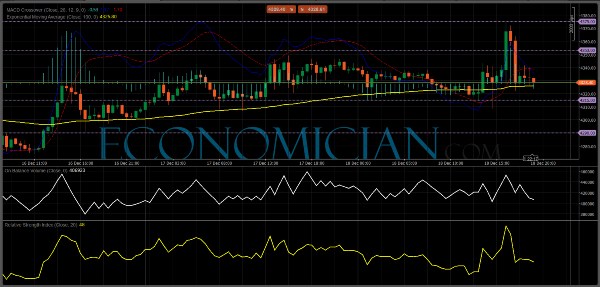
Gold — Buy above 4315, target 4375

Bias: Bullish while above 4315

Pivot: 4315

Primary upside target: 4375

Our preference (Base case):

  • Action: Long above 4315
  • Targets: 4353 (TP1) → 4375 (TP2 / extension)

Alternative scenario (If price breaks below pivot):

  • Trigger: Move below 4315
  • Action: Look for further downside
  • Downside targets: 4290 (TP1) → 4275 (TP2)

Technical note: RSI has reached the neutral zone near 50 and is turning up, supporting the bullish bias as long as 4315 holds.


Start Trading Now


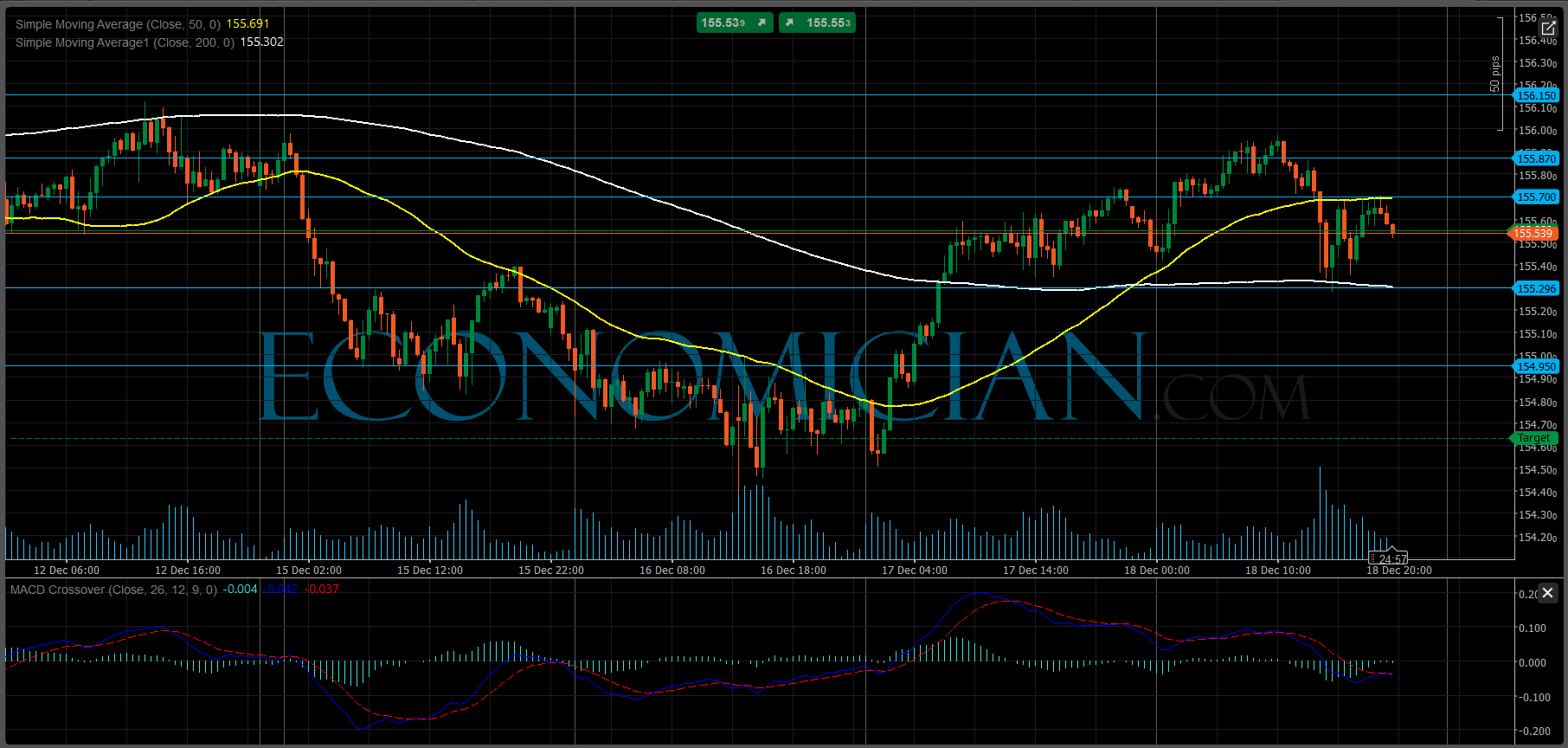
USD/JPY — Sell below 155.70

Target (main): 154.53

Pivot: 155.70

Our preference (Base case):

  • Action: Sell (short) below 155.70
  • Targets: 155.30 (TP1) → 154.95 (TP2 / extension)
  • Main target: 154.53 (final objective if downside extends)
  • Signal filter: MACD is bearish, supporting further downside.

Alternative scenario (If pivot breaks):

  • Trigger: Move above 155.70
  • Action: Look for further upside
  • Upside targets: 155.87 (TP1) → 156.15 (TP2)

Trading implication: As long as price stays below 155.70, the setup favors continuation lower toward 155.30 → 154.95, with scope to extend toward 154.53. A break and hold above 155.70 flips the bias to 155.87/156.15.

Start Trading Now

More Day Trade Signals news

Russia

Russia Reserves Dip Slightly

Russia’s central bank reserves edged down to $741.0B from $741.5B, indicating broadly stable reserve levels with only a marginal weekly decline.

Market impact: Largely neutral for RUB; FX pricing remains more sensitive to energy revenues, sanctions/frictions, and domestic FX controls than a small reserve move.

More Russia news

Canada

Canada Wage Growth Slows

Canada’s average weekly earnings growth eased in October, rising 2.18% y/y versus 2.93% previously, signaling softer wage momentum.

Market impact: Mildly dovish for BoC pricing and supportive for Canadian bonds; modest headwind for CAD if markets lean toward earlier easing expectations.

More Canada news
Market news roundup: Thursday, 18 December 2025