IFC Markets Live Quotes

Market news roundup: Friday, 30 January 2026

100 short market news items, grouped by 13 sections.

Iran

Shamkhani: “A ‘limited strike’ is an illusion”

Ali Shamkhani, a senior adviser to Iran’s Supreme Leader, said the concept of a “limited strike” is a “delusion,” warning that any U.S. military action—“from any origin and at any level”—would be treated as the start of war and met with an immediate, comprehensive, unprecedented response targeting “the heart of Tel Aviv” and “all who support the aggressor,” in a post published on X amid the ongoing U.S.–Iran escalation.
Bloomberg: Khamenei’s Son Tied to Offshore Luxury Property Web

Bloomberg reported—citing a year-long investigation—that Mojtaba Khamenei (56) has overseen a large overseas real-estate and investment network allegedly structured through intermediary firms and layered bank accounts across parts of Europe and the Gulf, with assets not held directly in his name but managed via shell companies in jurisdictions including the UK, Switzerland, and the UAE. The report described holdings including luxury homes in London (including Bishops Avenue, often dubbed “Billionaire’s Row”), high-end villas in Dubai, and premium hotel assets in cities such as Frankfurt and Mallorca, and said the financing was traced to complex cross-border channels; some intermediaries cited in related coverage deny direct links to Mojtaba Khamenei.

Rooftop Gunfire Reported in Karaj

A video received and shared online purports to show gunfire from the rooftop of Police Station No. 15 in Gohardasht, Karaj, during the nationwide unrest. The clip is dated Thursday, 18 Dey (Jan 8, 2026) in the caption. The footage cannot be independently verified here, but it adds to a growing stream of visual reports alleging live-fire use and intimidation tactics by security forces in protest hotspots.


Iran Health Official to Wounded Protesters: Get Treatment—Even Under an Alias

On Jan. 29, 2026 (9 Bahman 1404), Iran’s deputy nursing chief at the Health Ministry, Abbas Abadi, urged people injured in recent unrest not to delay care, warning that postponement can lead to wound infections and turn “simple” cases into complex surgeries. Speaking to ILNA, he said medical services should be provided without discrimination and claimed patients can seek treatment without giving their real name, with identity checks required only if they want to use insurance—comments that come amid reports to Reuters and a UN expert alleging hospital raids and detentions of wounded protesters, which have fueled fear of seeking care.

“Pop” Gets 15 Years in Tehran-Directed Alinejad Hit Plot

The U.S. Department of Justice said Carlisle “Pop” Rivera was sentenced in federal court in New York to 15 years in prison for participating in a murder-for-hire plot directed by the Government of Iran targeting Masih Alinejad, a journalist and civil-rights activist. DOJ said Rivera had pleaded guilty to conspiracy to commit murder-for-hire and conspiracy to commit stalking, and U.S. District Judge Lewis J. Liman (SDNY) imposed the sentence.

HRANA: 6,373 Confirmed Dead on Day 32, Arrests Hit 42,486

HRANA’s latest aggregated update for Day 32 (published Jan. 29, 2026 / 9 Bahman) said 6,373 deaths have been confirmed: 5,993 protesters, 113 children (under 18), 214 government-affiliated forces, and 53 non-protester civilians. It also listed 17,091 deaths under review, 42,486 arrests, 11,018 severely injured, 270 forced-confession broadcasts, and 11,027 summons to security bodies, with 658 protest incidents recorded across 202 cities in 31 provinces—while noting verification is difficult amid internet restrictions and pressure on families. Media and rights investigations have warned the true toll could be far higher than confirmed counts.

EU Sanctions Iran Crackdown Figures as Tehran Clip Alleges Live Fire

EU foreign ministers adopted a new sanctions package targeting 15 individuals and 6 entities over “serious human rights violations” tied to the violent repression of protests, including Interior Minister Eskandar Momeni, Prosecutor General Mohammad Movahedi-Azad, and Judge Iman Afshari, alongside other IRGC and law-enforcement figures. Listed entities include SATRA, the Seraj Cyberspace Organization, the Working Group for Determining Instances of Criminal Content (WGDICC), and several software firms accused of censorship, disinformation, and enabling internet disruption; measures include asset freezes, EU travel bans, and bans on making funds available. Separately, an unverified received video captioned Haft Hoz Square, Narmak (Tehran), Thursday 18 Dey (Jan 8, 2026) appears to show people carrying a body while a voice says, “They’re firing live rounds.”

Narmak Video Claim: “They’re using live rounds.”

A received, unverified video captioned “Haft Hoz Square, Narmak, Tehran — Thursday 18 Dey (Jan 8, 2026)” appears to show people carrying a body amid unrest. In the clip, a voice is heard saying: “They’re firing live rounds!” The footage cannot be independently confirmed here, but it aligns with wider reports alleging lethal force and escalating pressure during the protests.


Yafte Abad Footage Alleges Live Fire, Multiple People Down

Received videos labeled “Yafte Abad, Tehran — Thursday 18 Dey or Friday 19 Dey (Jan 8–9, 2026)” show people in distress amid chaos, with voices heard saying: “It’s young people’s blood— they shot with live rounds!” and “Ten people fell there!” The clips are not independently verified, but the captions and audio reflect growing reports from protest areas alleging use of live ammunition and high casualty incidents during those days.


Kahrizak Forensics Clip Alleges Bodies Moved by Truck

A received, unverified video labeled “Forensic Medicine Center, Kahrizak (Tehran) — Saturday 20 Dey (Jan 10, 2026)” appears to show activity at the facility from an elevated angle. In the audio, a voice claims: “Look at that truck bringing bodies… they take them inside from that side and dump them there…” The footage cannot be independently confirmed here, but it adds to broader accounts alleging large-scale casualties and opaque handling of the dead during the crackdown.


Chitgar Chants After EU Terror Label for IRGC

Footage shared online from Chitgar township in Tehran shows residents chanting on Thursday, Jan. 29, 2026 (9 Bahman), as news broke that the European Union designated the IRGC as a terrorist organization. The videos cannot be independently verified, but they reflect a pattern of localized street and neighborhood reactions following major international pressure steps against Tehran.

Front Line Defenders Sounds Alarm on Mass Arrests Under Iran’s Internet Blackout

Front Line Defenders says it is “deeply alarmed” by what it describes as mass arrests of human rights defenders in Iran, including human-rights lawyers, journalists, doctors and medical staff treating injured protesters, as well as technologists and digital-rights defenders. The group says documenting alleged abuses has been effectively impossible under a three-week digital blackout, and it highlights the cases of Afsoon Alimoradian and Vafa Salehi (reported arrested on Jan. 23, 2026) and Mohammad Hadi Jafarpour (reported arrested on Jan. 18, 2026), arguing the detentions fit an escalating pattern of repression targeting civil society and independent legal support networks.

Iran Prisoner Reports Death Sentence After Weeks Incommunicado

Ashkan Talebi Balakhiabani, a 22-year-old motorcycle delivery rider, has reportedly told his family that a death sentence has been issued against him after being held incommunicado for three weeks following his arrest in Mashhad. A source cited by Iran International said Talebi—arrested on 18 Dey 1404 (Jan. 8, 2026) while returning home from work—called on Thursday 9 Bahman 1404 (Jan. 29, 2026) and said authorities had informed detainees that “a death sentence has been issued,” describing the call as a farewell. The report adds that his family had no information about his condition and could not contact him throughout the three weeks.

Iran Adds 1,000 Strategic Drones to Army Units

Iranian state and semi-official outlets say Iran’s regular army (Iranian Army (Artesh)) has inducted a batch of 1,000 “strategic” drones into the combat structure of its four service branches, following an order by Amir Hatami. Tasnim News Agency reported the drones include strike, reconnaissance, and electronic-warfare types and are intended to strengthen readiness amid heightened regional tension, a development also flagged by Reuters in the context of the ongoing Iran–U.S. standoff.

Trump: “Armada” Near Iran Bigger Than Venezuela Fleet

In remarks to reporters on Friday, Donald Trump said a “large armada” of United States ships is heading toward Iran and is “even larger” than the force previously sent toward Venezuela, adding: “Hopefully we’ll make a deal… If we don’t make a deal, we’ll see what happens.” The warning lands as Tehran continues to push back on Washington’s preconditions—publicly rejecting any negotiation over its missile program and resisting wider U.S. demands tied to the nuclear file—keeping diplomacy uncertain while the military backdrop hardens.

Larijani: EU Armies Now “Terrorist” in Iran’s Eyes

Ali Larijani—described as secretary of Iran’s Supreme National Security Council—said Iran will treat the armed forces of European countries that backed the European Union's move to designate the Islamic Revolutionary Guard Corps as a terrorist organization as “terrorist organizations” as well, framing it as a reciprocal response. The warning adds another escalation layer to the Iran–West standoff amid heightened military signaling in the region.

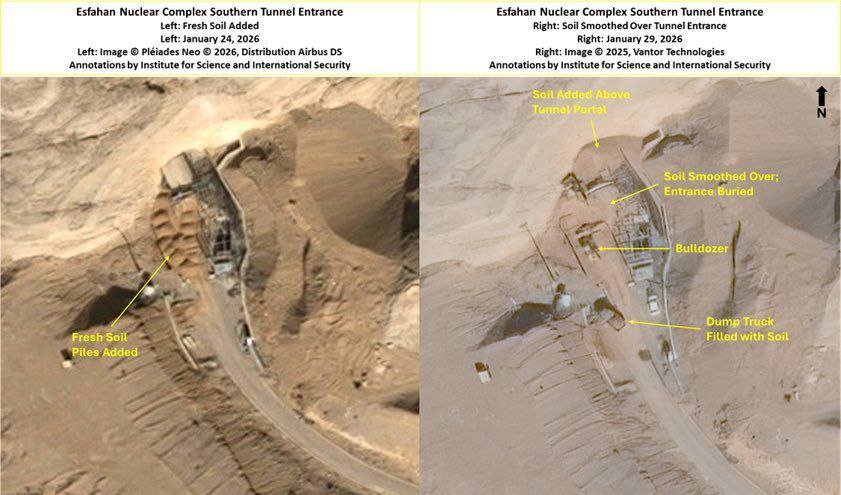
Iran Re-Buries Isfahan Tunnel Entrances

New commercial satellite imagery cited by The Associated Press and reviewed by analysts at the **Institute for Science and International Security indicates Iran has again backfilled/packed soil at multiple tunnel portals linked to the **Isfahan nuclear complex, a step widely interpreted as hardening the site and complicating follow-on strikes as U.S.–Iran tensions rise. The same approach was observed ahead of the June 2025 Israel–U.S. attack: the International Atomic Energy Agency later said the tunnel entrances were hit, while a Reuters explainer citing diplomats said a key underground storage installation at Isfahan appeared not to have been damaged beyond the entrance area—a backdrop that helps explain why Tehran may be re-sealing portals now.

Students Boycott Exams Across Dozens of Iranian Universities

According to Beheshti Independent Guild, students at more than 30 universities and faculties have boycotted exams in protest at the crackdown and the killing of protesters. The boycott reportedly includes Shahid Beheshti University, Isfahan University of Medical Sciences, Kurdistan University of Medical Sciences, Yazd University, Ferdowsi University of Mashhad, Lorestan University, Alborz University of Medical Sciences, University of Qom, Semnan University, University of Kashan, Golestan University, University of Mazandaran, Babol Noshirvani University of Technology, and University of Sistan and Baluchestan among others.

Iran International: “Strike Is Virtually Certain,” Dispute Is Over Timing

A Western source briefed on U.S.–Israeli coordination meetings told Iran International that decision-making circles in Washington, D.C. and Jerusalem now view military action against Iran as “practically inevitable,” with the only real disagreement being when to launch—whether an operational/political window opens in the next few days or only over the coming weeks. The report also notes Donald Trump again claimed a “huge armada” is moving toward Iran—larger than the fleet sent to Venezuela—adding: “If we don’t reach an agreement, we’ll see what happens.”

Golmohammadi’s Instagram Lament After Crackdown Reports

Yahya Golmohammadi, the former head coach of Persepolis F.C. and Foolad F.C., posted an Instagram story reacting to reports of widespread killings and repression following the “Iranian National Revolution.” In the post, he wrote: “I am not sorrowful; I am the sorrow of the world. A homeland is weeping inside my chest.”

Pat Fallon: U.S. “Stands With the Iranian People”

Pat Fallon, a Republican member of the United States House of Representatives, wrote on X that for decades Iran’s “ayatollah regime” has brought “nothing but death and suffering” to Iranians and “innocent people abroad,” calling the regime’s authoritarianism “a cancer for the region.” He added that the United States stands with the people of Iran and against what he described as Ali Khamenei’s religious repression.

Rouhani Calls for “Major Reform” to Answer Public Demands

Hassan Rouhani said that “people must feel we have received their message,” arguing that the core objective should be public satisfaction and that officials must respond with a “major reform.” Speaking at a meeting with former ministers and deputy ministers from his 11th and 12th administrations, he also said unity and cohesion are needed to “stand against foreign power.”

More Iran news

Europe

France Q4 Growth Holds Up, but Domestic Demand Weakens

France’s economy grew 1.1% y/y in Q4 (vs 1.2% expected; 0.9% prior), while Q4 GDP rose 0.2% q/q (in line with 0.2% expected) but cooled sharply from 0.5% previously—signalling momentum slowed even as annual growth improved. Meanwhile, December consumer spending fell -0.6% m/m (vs -0.4% expected; -0.3% prior), reinforcing that household demand remains a drag and keeping the policy focus on whether Europe’s growth resilience is softening into early 2026.

Germany Import Prices Stay Negative, Disinflation Persists

Germany’s import price index fell -2.3% y/y in December (vs -2.6% expected; -1.9% prior), keeping import-price inflation firmly negative even as the annual decline was slightly less severe than forecast. On a monthly basis, import prices slipped -0.1% m/m (vs -0.4% expected) after a +0.5% rise previously—signalling the prior month’s uptick faded and reinforcing a disinflationary pipeline into early 2026.

France Jobs Slip in Q4, Payrolls Turn Negative

France’s non-farm payrolls fell -0.1% q/q in Q4, below expectations of 0.0%, signalling the labor market softened at the margin as 2025 ended. Coming alongside slower sequential GDP growth, the decline reinforces a cooling domestic backdrop and raises the odds that consumption and hiring stay cautious into early 2026.

France Producer Prices Stay in Deflation, Monthly Bounce Fades

France’s producer price index fell -2.00% y/y in December (prior -1.50%), deepening producer-level deflation and reinforcing disinflation pressure in the supply chain. On a monthly basis, PPI rose 0.2% m/m, but that was a sharp cooling from the prior +2.8%, suggesting the earlier surge was temporary and price momentum eased heading into early 2026.

Swiss KOF Indicator Softens, Points to Cooling Momentum

Switzerland’s KOF Leading Indicator fell to 102.5 in January, below expectations of 103.1 and down from 103.6 previously. While the index remains above the 100 long-term average—still consistent with expansion—the decline signals slower forward momentum and a slightly softer near-term growth signal for the Swiss economy.

Spain Growth Pops as Inflation Cools in January

Spain’s Q4 GDP rose 0.8% q/q, beating expectations of 0.6% (prior 0.6%), while GDP growth eased to 2.6% y/y versus 2.7% expected (prior 2.8%). On inflation, CPI cooled to 2.4% y/y (in line with 2.4% expected; prior 2.9%) and HICP slowed to 2.5% y/y (slightly above 2.4% expected; prior 3.0%). Monthly prints were negative—CPI -0.4% m/m (vs -0.3% expected; prior 0.3%) and HICP -0.7% m/m (vs -0.8% expected; prior 0.3%)—while core CPI held at 2.6% y/y (in line). Overall, the data show stronger near-term activity but disinflation continuing, keeping the macro mix broadly supportive for easier policy expectations.

SNB Reserves Edge Higher, FX Footprint Stays Large

Switzerland’s official reserve assets rose to CHF 852.6B in December, up slightly from CHF 852.4B previously. The marginal increase suggests limited month-to-month change, but the overall level remains very large—keeping attention on the SNB’s FX balance-sheet footprint and how it manages franc strength into 2026.

Germany Jobs Market Holds Steady, Unemployment Change Flat

Germany’s January unemployment rate held at 6.3% (in line with 6.3% expected and 6.3% prior), while the unemployment change printed 0K, beating expectations for a +4K rise (prior +3K). The seasonally adjusted unemployed total was essentially unchanged at 2.976M (prior 2.977M), pointing to a stable labor-market backdrop at the start of the year, even as the non-seasonally adjusted count stood higher at 3.085M.

Germany Q4 GDP Beats Expectations, Growth Re-Accelerates

Germany’s economy grew 0.3% q/q in Q4, beating expectations of 0.2% and improving from 0.0% previously—signalling a clearer pickup in sequential momentum into year-end. On an annual basis, GDP rose 0.4% y/y, also above the 0.3% forecast and slightly stronger than the prior 0.3%, reinforcing that growth surprised modestly to the upside and may ease near-term recession fears.

Italy Q4 GDP Beats, Growth Re-Accelerates vs Expectations

Italy’s economy grew 0.3% q/q in Q4, beating expectations of 0.2% and improving from 0.1% previously—signalling better sequential momentum into year-end. On an annual basis, GDP rose 0.8% y/y, well above the 0.5% forecast and stronger than the prior 0.6%, suggesting Italy outperformed consensus and provided a modest positive offset to broader euro-area growth concerns.

Spain Current Account Narrows Sharply, External Surplus Shrinks

Spain’s current account balance slipped to a €0.21B surplus in November, down from €7.18B previously. The sharp narrowing suggests a weaker external contribution for the month—either from softer services/tourism inflows, a wider trade gap, or income/transfer dynamics—keeping attention on whether the surplus normalises further into winter.

Italy Unemployment Beats Expectations, Holds at a Low Level

Italy’s unemployment rate came in at 5.6% in December, beating expectations of 5.8% and matching the prior 5.6%. The steady, lower-than-expected print suggests the labor market remains relatively resilient, helping cushion domestic demand even as broader euro-area growth signals stay mixed.

Eurozone Q4 GDP Beats Expectations, Growth Holds Firm

Eurozone GDP rose 0.3% q/q in Q4, matching the prior 0.3% and beating expectations of 0.2%, signalling steadier momentum than markets anticipated. On an annual basis, GDP grew 1.3% y/y, above the 1.2% forecast but slightly below the prior 1.4%, suggesting growth remains resilient even as the year-on-year pace cooled modestly. The mix supports a “soft-landing” narrative, while keeping attention on whether disinflation and labor-market stability can sustain activity into early 2026.

Eurozone Unemployment Drops, Labor Market Stays Resilient

The euro area unemployment rate fell to 6.2% in December, beating expectations of 6.3% and improving from 6.3% previously. The decline reinforces a resilient labor-market backdrop into year-end, helping support household income and consumption even as growth and inflation dynamics remain mixed across the bloc.

Italy Producer Prices Slide Deeper, Disinflation Re-Intensifies

Italy’s PPI fell -1.4% y/y in December, down from -0.2% previously, signalling a renewed deepening of producer-level deflation. On a monthly basis, PPI dropped -0.7% m/m after a +1.0% rise prior, indicating the earlier rebound reversed quickly. The data reinforce a softer inflation pipeline into early 2026, keeping pressure on pricing power and supporting the broader disinflation narrative in the euro area.

Brazil Fiscal Picture Mixed: Debt Ratio Improves, but Budget Gap Widens

Brazil’s gross debt-to-GDP eased to 78.7% in December (vs 79.5% expected; 79.0% prior), signalling a better-than-expected improvement in the headline debt ratio. However, the budget balance posted a wider -115.502B deficit (vs -95.400B expected; -101.600B prior), indicating a softer monthly fiscal result than markets anticipated. A separate line item showed a budget surplus of 6.251B, reversing from -14.400B previously, while net debt-to-GDP edged up to 65.3% from 65.2%—overall a mixed fiscal snapshot that can keep risk-premium sensitivity elevated for BRL and local rates.

Germany Inflation Re-Accelerates in January, CPI Surprises Higher

Germany’s CPI rose 0.1% m/m in January (vs 0.0% expected; 0.0% prior) and picked up to 2.1% y/y (vs 2.0% expected; 1.8% prior), signalling a firmer inflation pulse than markets anticipated. On the harmonised measure, HICP fell -0.1% m/m (vs -0.2% expected; 0.2% prior), but HICP held at 2.1% y/y (vs 2.0% expected; 2.0% prior), also a touch hotter than forecast. Overall, the data tilt slightly hawkish at the margin for near-term euro inflation pricing, even if the monthly HICP dip suggests some seasonal/technical effects.

More Europe news

Political

Israel Trips Called Off Amid Iran Tensions — Austria Says “Scheduling Clash”

Israeli outlet Ynet reported that Liberian President Joseph Boakai and Austrian Chancellor Christian Stocker have called off planned visits to Israel scheduled for next week, with no official reason given in that report. However, Austrian media citing the Chancellery said Stocker’s trip was postponed due to a calendar conflict: Benjamin Netanyahu is expected to appear in court on Monday, disrupting planned meetings; Vienna says it is working on a new date.

Moscow Readies a Bushehr Evacuation Option

Russia is prepared to evacuate its personnel from Iran’s Bushehr nuclear power plant if necessary, Rosatom chief Alexei Likhachev said, according to TASS, as reported by Reuters. He said Moscow is coordinating with Russia’s Foreign Ministry and Defense Ministry and hopes the facility’s “inviolability” is respected; hundreds of Russian specialists work at Bushehr, and Russia is also building additional units at the site, which Likhachev has previously warned could face catastrophic risk if attacked.

Ankara Pitches a US–Iran–Turkey Summit to Avert Strike

Turkey has proposed a top-level trilateral meeting between the United States, Iran, and Turkey as U.S.–Iran tensions rise, Turkish media reported. According to Hürriyet, President Recep Tayyip Erdoğan raised the idea directly with Donald Trump, arguing the crisis should be resolved through diplomacy, not military action, and suggesting the talks could be held by videoconference to restart dialogue and reduce the risk of a U.S. strike. There has been no official confirmation from Washington or Tehran.

Oman Sea Drills Return as Iran, Russia & China Signal Coordination

Al Jazeera cited Iranian sources saying Iran’s navy will conduct joint “Security Belt” exercises with Russia and China in the Sea of Oman and the northern Indian Ocean “in the coming days,” with Iranian outlet Noor News indicating a start on Sunday, Feb. 1, 2026. The timing also overlaps with IRGC live-fire drills in the Strait of Hormuz on Feb. 1–2, underlining elevated maritime risk around a key global oil chokepoint and potentially adding short-term risk premium to energy and shipping markets.

UK Drafts “Hostile State” Proscription Powers — IRGC on the List

Britain is preparing new legislation to create a bespoke mechanism for proscribing hostile foreign state agencies, with the IRGC explicitly cited in reporting as a likely target. The Home Office has confirmed work is underway on the draft framework, but has avoided naming specific groups publicly while the bill is still being shaped. UK briefings suggest the measure won’t be rushed, given its legal and diplomatic complexity—coming as Europe tightens pressure on Tehran, including the EU’s recent move to designate the IRGC as a terrorist organisation.

Axios: Israelis brief Iran targets as Saudis push diplomacy in Washington

Axios reported on Thursday, Jan. 29, 2026, that the Trump administration hosted senior defense and intelligence officials from Israel and Saudi Arabia in Washington this week to discuss options for dealing with Iran. According to the report, Israeli officials came to share intelligence on potential targets inside Iran, while Saudi officials argued diplomacy still has room and have been passing messages aimed at de-escalation; Axios added that there are currently no serious U.S.–Iran negotiations underway. Reuters separately relayed the Axios reporting and said it could not immediately verify it independently.

Trump to Tehran: “No nukes—stop killing protesters”

A CBS journalist reported that President Donald Trump said he has held talks with Iranian officials in recent days and intends to continue them, adding that “very big, very powerful ships” are moving toward Iran and that he hopes the U.S. won’t have to use them. Trump said he delivered two demands—no nuclear weapons and stop killing protesters—and claimed he “stopped” 837 executions two weeks ago, a figure Iranian officials have previously denied and that remains unverified.


Iran–Turkey Presser Sparks Hardline Optics

In the aftermath of a joint meeting and press conference by the foreign ministers of Iran and Turkey, analyst Ahura Chalki argues that Israel is likely to come away more convinced—once again—that the Islamic Republic’s continued survival and any deepening Iran–Turkey alignment would be read as an “axis” of adversaries acting in the same direction, with the perceived aim of further constraining Israel. From this perspective, the event is framed as another data point that, in Chalki’s view, sharpens the case for the Islamic Republic’s eventual downfall.

U.S. SM-3 Destroyer Docks at Eilat After Donald Trump Confirms Iran Talks

Haaretz reported that the U.S. guided-missile destroyer USS Delbert D. Black docked Friday morning (Jan. 30, 2026) at Israel’s southern port on the Red Sea, just hours after Trump said he had spoken with Iran. The paper said the ship—arriving after roughly three weeks of transit from the U.S.—is equipped with the Standard Missile-3 and forms part of the Aegis missile-defense architecture, meaning it could plug into Israel’s layered air-defense posture against potential ballistic-missile threats. Haaretz also described the deployment as part of a broader U.S. naval presence spanning the Red Sea and the Mediterranean Sea, while separate reporting has highlighted the region’s elevated posture, including the aircraft carrier USS Abraham Lincoln operating in nearby waters with accompanying destroyers.

Deadline Kept Private; Fleet to Stay Nearby

In a reporter’s Q&A on Friday, Donald Trump declined to put a public clock on Tehran, saying any deadline for **Iran is “only they know,” while confirming he has communicated the message directly. Pressed on how long U.S. military assets would remain in the region, he said the timeline will depend on what happens next, adding that the fleet “has to float somewhere,” so it may as well be positioned close to Iran—signaling a posture that keeps pressure on Tehran while leaving the next move ambiguous.

Putin Meets Larijani in Kremlin as Iran–U.S. Tensions Rise

Dmitry Peskov said Vladimir Putin met Ali Larijani—described as secretary of Iran's Supreme National Security Council—at the Kremlin on Friday, Jan. 30, 2026 (10 Bahman 1404), according to Interfax. IRNA cited Kazem Jalali saying the talks focused on expanding bilateral relations—especially economic cooperation—while also consulting on “important regional and international issues,” with no detailed readout released. The visit surfaced after FlightRadar24 posted on X that a government aircraft was en route from Tehran to Moscow, with unofficial reporting linking the flight to Larijani.

Backchannel Talks Stall as Pressure Builds

Reports citing the New York Times say behind-the-scenes Iran–U.S. contacts have reached a dead end, with Tehran rejecting Washington’s terms. In parallel, U.S. and European officials have put three conditions to Tehran—ending uranium enrichment, limiting ballistic missiles, and halting support for regional proxy groups—while Iran’s Abbas Araghchi has publicly ruled out any negotiation on “defensive and missile capabilities” during talks in Istanbul alongside Hakan Fidan. Regional mediation efforts continue, but the military backdrop is hardening: a U.S. missile destroyer docked in Eilat and U.S. naval assets remain positioned nearby. On the human-rights front, Front Line Defenders warned that a prolonged digital blackout has made documentation of alleged abuses extremely difficult while arrests expand to lawyers, journalists, medics, and digital-rights defenders, naming Afsoon Alimoradian, Vafa Salehi, and Mohammad Hadi Jafarpour. Separately, Iran International reported that 22-year-old detainee Ashkan Talebi Balakhiabani told his family he had been informed of a death sentence. Meanwhile, Vladimir Putin received Ali Larijani at the Kremlin amid the broader escalation.

US Carrier Group + 7 Destroyers Tighten the Ring Near Iran

An updated ship list circulating today claims the United States has positioned one aircraft carrier and seven guided-missile destroyers within operational reach of Iran. Public reporting broadly matches that composition: Anadolu Agency says the USS Abraham Lincoln (CVN-72) is now operating in the Arabian Sea with three named escorts (Frank E. Petersen Jr. (DDG-121), Michael Murphy (DDG-112), Spruance (DDG-111)), while other destroyers cited in-theater include McFaul (DDG-74) and Mitscher (DDG-57), with Roosevelt (DDG-80) in the Mediterranean. Separately, Reuters and Haaretz reported Delbert D. Black (DDG-119) arriving into the Red Sea and making a port call at Eilat, reinforcing a visible missile-defense and strike posture around Israel and the broader United States Central Command area as of Jan 29–30, 2026. Exact ship positions and “within X km” claims are not independently verifiable from open reporting, but the strategic logic is clear: Iranian SRBMs such as Zolfaghar are widely assessed at ~700 km range, meaning proximity and routing choices materially affect escalation risk and defensive requirements.

US Airlift and Tankers Keep Moving East via Europe

Open-source flight tracking and reporting say fresh waves of U.S. Air Force logistics and refueling aircraft are continuing to transit from Europe toward the Middle East, adding lift (C-17s) and on-station endurance (KC-135s) to the forward posture. Military-aviation reporting notes that a dozen F-15Es recently departed RAF Lakenheath supported by KC-135 tankers, while C-17 cargo missions also flew Britain-to–Middle East legs to sustain the deployment—an enabling pattern that typically precedes or supports sustained air operations. Reuters has separately reported that the U.S. Central Command area has already received the USS Abraham Lincoln carrier strike group and additional assets, while The Guardian reports multi-day aerial drills intended to demonstrate deploy-and-sustain capability, together reinforcing the picture of a steadily thickening U.S. posture as tensions with Iran remain elevated.

Canada Welcomes EU IRGC Terror Listing

Anita Anand said Canada “welcomes” the European Union decision to designate the Islamic Revolutionary Guard Corps as a terrorist organization, writing on X that allies are “collectively” standing with “the brave people of Iran” and condemning ongoing rights abuses. The EU move was adopted unanimously by member states on January 29, 2026, in response to Tehran’s crackdown and broader human-rights concerns.

More Political news

Equities

Canon Delivers Strong Q4 2025, Beats EPS and Revenue Estimates

Canon (7751) reported EPS of 126.49, beating expectations of 89.5, while revenue came in at 1,321.84B versus 1,286.12B forecast. The beat across both earnings and the top line signals a materially stronger quarter than consensus anticipated, pointing to improved profitability and solid demand across Canon’s portfolio. Canon’s market capitalization stands at 4.11T, with investors likely focused on whether margins can stay elevated and how demand trends evolve into 2026.

Apple Delivers Strong Q4 2025, Beats EPS and Revenue Estimates

Apple (AAPL) reported EPS of $2.84, beating expectations of $2.67, while revenue came in at $143.8B versus $137.47B forecast. The beat across both earnings and the top line signals a stronger quarter than consensus anticipated, pointing to resilient demand and solid execution across Apple’s ecosystem, with profitability also outperforming market assumptions. Apple’s market capitalization stands at $3.8T, reinforcing its mega-cap leadership as investors focus on iPhone/services momentum and margin durability into 2026.

Fuji Electric Posts Solid Q4 2025, Beats EPS and Revenue Estimates

Fuji Electric (6504) reported EPS of 148.53, topping expectations of 143.08, while revenue came in at 307.9B versus 302.52B forecast. The beat across both earnings and the top line points to a firmer quarter than consensus anticipated, suggesting steady demand and operational execution that lifted profitability above market assumptions. Fuji Electric’s market capitalization stands at 1.62T, with investors likely focused on margin durability and order momentum as 2026 unfolds.

Visa Delivers Solid Q4 2025, Beats EPS and Revenue Estimates

Visa (V) reported EPS of $3.17, slightly above expectations of $3.14, while revenue came in at $10.9B versus $10.68B forecast. The modest beat across both earnings and the top line signals steady execution and resilient payments activity, with profitability edging past consensus assumptions. Visa’s market capitalization stands at $634.48B, reinforcing its status as a mega-cap payments bellwether as investors watch volume growth, cross-border trends, and margin durability into 2026.

Mastercard Posts Strong Q4 2025, Beats EPS and Revenue Estimates

Mastercard (MA) reported EPS of $4.76, topping expectations of $4.25, while revenue came in at $8.8B versus $8.78B forecast. The results show a clear earnings outperformance with a modest top-line beat, pointing to resilient payment volumes and strong operating leverage versus consensus assumptions. Mastercard’s market capitalization stands at $485.95B, reinforcing its role as a mega-cap payments bellwether as investors watch cross-border momentum, pricing, and margin durability into 2026.

Caterpillar Delivers Strong Q4 2025, Beats EPS and Revenue Estimates

Caterpillar (CAT) reported EPS of $5.16, beating expectations of $4.70, while revenue came in at $19.1B versus $17.85B forecast. The beat across both earnings and the top line points to a firmer quarter than consensus anticipated, suggesting resilient end-market demand and solid operating leverage that lifted profitability above market assumptions. Caterpillar’s market capitalization stands at $311.32B, with investors likely focused on order momentum, pricing power, and backlog dynamics as 2026 unfolds.

H&M B Posts Mixed Q4 2025 Results, Beats EPS but Misses Revenue

H&M B (0HBP) reported EPS of 2.72, beating expectations of 2.48, while revenue came in at 59.22B, below forecasts of 60.11B. The print suggests profitability outperformed consensus assumptions despite a slightly softer top line, implying margins and cost discipline helped offset modest revenue pressure versus expectations. H&M’s market capitalization stands at 281.05B, with investors likely focused on demand elasticity, inventory management, and margin durability as 2026 unfolds.

Honeywell Posts Solid Q4 2025, Beats EPS and Revenue Estimates

Honeywell (HON) reported EPS of $2.59, slightly above expectations of $2.54, while revenue came in at $10.1B versus $10.02B forecast. The modest beat across both earnings and the top line points to steady execution through the quarter, with profitability edging past consensus assumptions alongside a small revenue outperformance. Honeywell’s market capitalization stands at $144.27B, with investors likely focused on order momentum, margin durability, and 2026 guidance—especially across aerospace and automation-related demand.

Marsh McLennan Delivers Solid Q4 2025, Beats EPS and Revenue Estimates

Marsh McLennan (MRSH) reported EPS of $2.12, beating expectations of $1.98, while revenue came in at $6.6B versus $6.56B forecast. The beat across both earnings and the top line points to a firmer quarter than consensus anticipated, consistent with resilient demand across insurance brokerage and risk/advisory services and solid operating leverage. Marsh McLennan’s market capitalization stands at $91.14B, with investors likely focused on organic growth momentum, pricing conditions, and margin durability into 2026.

SanDisk Posts Blowout Q4 2025, Big EPS and Revenue Beat

SanDisk (SNDK) reported EPS of $6.20, surging past expectations of $3.49, while revenue came in at $3.03B versus $2.67B forecast. The outsized beat across both earnings and the top line points to a sharply stronger quarter than consensus anticipated, suggesting powerful profitability upside and firmer demand/pricing dynamics versus market assumptions. SanDisk’s market capitalization stands at $79.04B, with investors likely focused on cycle sustainability, margin trajectory, and forward demand signals as 2026 unfolds.

Nasdaq Delivers Solid Q4 2025, Beats EPS and Revenue Estimates

Nasdaq Inc. (NDAQ) reported EPS of $0.96, beating expectations of $0.92, while revenue came in at $1.40B versus $1.37B forecast. The modest beat across both earnings and the top line suggests steady execution, with results slightly outperforming consensus assumptions as trading, market services, and recurring data/technology revenues remained supportive. Nasdaq’s market capitalization stands at $56.01B, with investors likely focused on recurring revenue growth, market volatility/trading mix, and margin durability into 2026.

Nokia ADR Misses Q4 2025 Estimates, EPS and Revenue Fall Short

Nokia ADR (NOK) reported EPS of $0.16, slightly below expectations of $0.17, while revenue came in at $6.13B, well under forecasts of $7.10B. The miss on both earnings and the top line signals a softer quarter than consensus anticipated, with the revenue shortfall in particular pointing to weaker-than-expected sales momentum versus market assumptions. Nokia’s market capitalization stands at $34.26B, with investors likely focused on order visibility, 5G/network spending trends, and margin resilience into 2026.

Dow Posts Mixed Q4 2025 Results, EPS Beats but Revenue Slightly Misses

Dow (DOW) reported EPS of -$0.34, above expectations of -$0.51, while revenue came in at $9.46B, just below forecasts of $9.47B. The print shows a meaningful earnings outperformance despite a flat-to-slightly softer top line, implying cost control, mix, and/or margin dynamics improved versus consensus assumptions even as demand remained broadly in line. Dow’s market capitalization stands at $19.48B, with investors likely focused on chemical pricing, volume trends, and margin recovery signals as 2026 unfolds.

Apple’s Biggest iPhone Growth Since 2021 Powers a Q1 Beat

Apple (Nasdaq: AAPL) comfortably beat profit and revenue expectations for fiscal Q1 2026, driven by a sharp rebound in iPhone demand: iPhone revenue rose about 23% y/y to ~$85.27B, the strongest iPhone growth since Q4 2021. Despite the strong print, the stock was weaker in Friday trading (after being down more earlier in the session), while the company’s iPhone 17 cycle—especially higher-end Pro models—helped it capture about 20% of global smartphone market share in 2025 (up from 18% in 2024), according to Counterpoint Research.

More Equities news

Others

Brazil CAGED Shows Sharp Job Loss: -618K vs -478K Expected

Brazil’s CAGED net payroll jobs fell by -618.16K in December, a much larger contraction than the -478.00K expected and a dramatic swing from +85.86K previously. The weak print signals a sharp year-end deterioration in formal hiring, likely reflecting seasonal layoffs and slower momentum. This outcome can weigh on near-term growth sentiment and temper rate-cut expectations if confirmed by broader labor indicators.

South Korea Rebounds: Retail Sales Jump as Output and Production Accelerate

South Korea’s December activity data showed a broad-based rebound. Retail sales rose 0.9% m/m, swinging sharply from -3.3% previously, pointing to a recovery in consumer spending after a weak prior month. On the supply side, service sector output increased 1.1% m/m (up from 0.7%), while industrial production climbed 1.7% m/m (vs 0.5% expected, 0.6% prior), signaling a stronger manufacturing/output pulse. Even so, the y/y industrial production rate remained slightly negative at -0.3%, though it improved meaningfully versus -2.1% previously and -1.4% prior reference—suggesting momentum is improving, but the annual trend is not fully back to growth yet.

South Africa’s Credit Growth Accelerates as Budget Swings to Surplus

South Africa’s private sector credit growth rose to 8.74% y/y in December (prior 7.79%), signalling firmer lending momentum. M3 money supply eased slightly to 8.16% y/y (prior 8.26%), pointing to marginally softer liquidity growth. Meanwhile, the budget balance flipped to a 38.44B surplus in December from a -14.99B deficit previously—an abrupt swing that could influence near-term ZAR rate and bond sentiment.

Turkey’s Trade Deficit Widens as Imports Outpace Export Gains

Turkey’s December trade balance posted a -$9.30B deficit, slightly better than the -$9.40B forecast but wider than the prior -$7.98B, indicating the external gap expanded again. Exports rose to $26.40B (in line with expectations and up from $22.50B previously), showing a strong headline improvement, but the wider deficit implies imports increased even faster, keeping external financing sensitivity and FX attention elevated.

Turkey Tourism Earnings Drop in Q4 Even as Arrivals Accelerate

Turkey’s tourism revenues fell to $15.15B in Q4, down sharply from $24.30B previously, pointing to a weaker quarter for tourism inflows in headline terms. At the same time, foreign arrivals rose 4.99% y/y in December (vs 2.61% prior), showing momentum in visitor numbers improved. The divergence suggests the key question is spend-per-visitor and seasonal mix—whether higher volumes are translating into comparable hard-currency receipts.

Brazil Unemployment Holds Near Lows, Labor Market Stays Tight

Brazil’s unemployment rate printed 5.1% in December, matching expectations (5.1%) and improving slightly from 5.2% previously. The steady, low reading reinforces a tight labor market backdrop, which can support household demand but also keeps attention on wage/price dynamics as markets assess the pace of disinflation and the policy path in 2026.

Mexico GDP Surprises Higher in Q4, Rebounds From Prior Contraction

Mexico’s economy grew 0.8% q/q in Q4, beating expectations of 0.6% and sharply rebounding from -0.3% previously. On an annual basis, GDP rose 1.6% y/y, also above the 1.3% forecast and reversing from -0.1% prior—signalling a clear improvement in growth momentum into year-end. The upside surprise can be MXN-supportive at the margin, especially if it reduces recession risk pricing and supports carry sentiment.

Colombia Central Bank Shocks With 100bp Hike to 10.25%

Colombia’s central bank, Banco de la República, raised its benchmark rate by 100bp to 10.25% on Friday, January 30, 2026, marking its first hike in nearly three years and a larger move than most analysts expected. Policymakers cited rising inflation pressures, a jump in inflation expectations, and mounting fiscal and external risks; the decision was split 4–3—four backed the 100bp hike, two voted for a 50bp cut, and one preferred no change.

More Others news

USA

7-Year Yield Jumps as Fed Reserves Drain

The U.S. Treasury’s 7-year note auction cleared at 4.018%, up from 3.930% previously—signaling a firmer term-premium tone and/or softer demand at the long-intermediate point of the curve. Meanwhile, the Fed’s balance sheet edged up to $6.588T (from $6.585T). Still, reserve balances fell to $2.883T (from $2.957T), pointing to a notable liquidity drain in the banking system even as the headline balance-sheet level was roughly steady.

Two-Week DHS Stopgap Averts Immediate Shutdown as ICE Curbs Negotiated

Democrats and the White House have agreed to split Department of Homeland Security (DHS) funding from the broader government funding package and extend DHS funding for two weeks, buying time to negotiate potential limits and oversight on the Trump administration’s expanded immigration enforcement (including ICE). The compromise is designed to avert a near-term partial shutdown, though lawmakers still warned a brief funding lapse is possible given House timing, with the main fight now shifting to what guardrails (if any) Congress will attach to DHS/ICE operations.

US PPI Re-Heats in December, Core Pipeline Pressures Jump

US producer prices surprised sharply to the upside in December. Headline PPI rose 0.5% m/m (vs 0.2% expected; 0.2% prior), while core PPI jumped 0.7% m/m (vs 0.2% expected; 0.0% prior), signalling a clear re-acceleration in underlying pipeline inflation. On a yearly basis, PPI held at 3.0% y/y (vs 2.7% expected; 3.0% prior), but core PPI climbed to 3.3% y/y (vs 2.9% expected; 3.1% prior). The “supercore” style measure PPI ex food/energy/transport also firmed at 0.4% m/m (prior 0.2%) and stayed 3.5% y/y. Net: this print is hawkish for near-term Fed pricing and can push USD and front-end yields higher if markets read it as sustained input-cost pressure.

Chicago PMI Surges Back Into Expansion, Signals Sharp January Rebound

The Chicago PMI jumped to 54.0 in January, crushing expectations of 43.5 and rising from 42.7 previously. The move back above 50 signals a return to expansion in regional manufacturing/business conditions and points to a materially stronger start to the year than markets were pricing—potentially supportive for near-term USD and risk sentiment if confirmed by broader national ISM/PMI data.

Trump Nominates Kevin Warsh for Fed Chair as Powell-DOJ Clash Rattles Markets

President Donald Trump said on January 30, 2026, he will nominate former Fed governor Kevin Warsh to succeed Jerome Powell as Federal Reserve chair when Powell’s term ends in May, a pick widely read as an attempt to calm investor nerves after weeks of tension over Fed independence. Earlier this month, the Justice Department opened an investigation tied to Powell, and Powell responded with an unusual public pushback—arguing the legal threat was effectively punishment for not setting rates to match the president’s preferences—a backdrop that helped fuel a safe-haven rush into gold before the Warsh headline shifted sentiment.

Donald Trump Picks Kevin Warsh to Lead the Federal Reserve

President Trump announced he has nominated Warsh as the next Fed chair, set to replace Jerome Powell when Powell’s term ends in May 2026, pending Senate confirmation. In a post on Truth Social, Trump praised Warsh as “central casting,” saying he “will never let you down,” and added he expects Warsh to be one of the “GREAT Fed Chairmen.”

Warsh’s Fed Résumé: Crisis Veteran, White House Insider, Wall Street Deal-Maker

Donald Trump’s pick for Fed chair, Kevin Warsh, served on the Federal Reserve’s Board of Governors from 2006–2011 and—at 35—was the youngest Fed governor ever appointed. During the 2008 financial crisis, he became a key liaison between the Fed and Wall Street, and he also represented the central bank at G20 meetings while acting as the Board’s emissary to economies in Asia. Before the Fed, he served in the White House National Economic Council (2002–2006) and earlier worked in M&A at Morgan Stanley & Co.—credentials now under Senate scrutiny as he’s slated to replace Jerome Powell when Powell’s term ends in May 2026.

More USA news

Japan

Tokyo Inflation Cools: Core CPI Misses as Underlying Price Pressure Softens

Tokyo’s January inflation prints came in softer than expected, signaling easing near-term price momentum. Tokyo core CPI (ex fresh food) slowed to 2.0% y/y (vs 2.2% expected, 2.3% prior). The broader Tokyo CPI also cooled to 1.5% y/y (down from 2.0%). More importantly for “underlying” inflation, CPI ex food & energy eased to 1.4% y/y (from 1.5%) and fell -0.3% m/m (vs -0.1% expected), pointing to a clearer moderation in core price pressure. The softer Tokyo data can temper near-term tightening expectations, though markets will still look to wages and nationwide CPI to confirm the disinflation signal.

Japan Jobs Market Steady: Unemployment Holds, Jobs-to-Applicants Improves

Japan’s labor market remained stable in December. The unemployment rate held at 2.6%, matching both expectations (2.6%) and the prior (2.6%). The jobs-to-applicants ratio ticked up to 1.19 from 1.18 (and above the 1.18 expected), signaling slightly tighter labor demand—still consistent with a firm employment backdrop.

Japan Output Stabilizes, But Retail Slumps and Factory Outlook Turns Volatile

Japan’s industrial production in December edged down just -0.1% m/m, beating expectations (-0.4%) and sharply improving from -2.7% previously, suggesting the manufacturing drag eased into year-end. But the forward guidance is choppy: the production forecast shows a +9.3% m/m jump one month ahead (Jan) (vs +1.3% prior reference), followed by a steep -4.3% m/m drop two months ahead (Feb) (vs +8.0% prior reference), highlighting high uncertainty and potential payback effects.

On the demand side, the tone is weaker. Retail sales fell -0.9% y/y in December, missing expectations (+0.7%) and reversing from +1.1% prior, while large retailers’ sales dropped -2.0% m/m (vs +0.7% prior). Even though large-scale retail sales were +2.0% y/y (down from +5.0%), the broader consumer signal is that spending momentum softened materially into year-end.

Japan 2-Year Yield Jumps: JGB Auction Clears at 1.253%

Japan’s 2-year JGB auction cleared at 1.253%, up sharply from 1.129% previously, signaling a notable repricing higher at the front end. The move is consistent with firmer short-term rate expectations and/or reduced demand at auction, as markets continue to adjust to BoJ normalization risks and recent FX volatility.

Japan Housing Shows Tentative Stabilisation: Starts Beat, Orders Surge

Japan’s housing starts fell -1.3% y/y in December, a much smaller decline than the -4.5% expected and a clear improvement from -8.5% previously—suggesting the housing downturn is moderating. Meanwhile, construction orders jumped 20.2% y/y, sharply above the 9.5% prior, pointing to a stronger pipeline of projects and better forward activity for the sector.

More Japan news

Oceania

Australia Producer Inflation Cools: Q4 PPI Misses on the Quarter

Australia’s producer price inflation held at 3.5% y/y in Q4, in line with the prior 3.5%, indicating steady but still-elevated pipeline inflation. However, the quarterly pace softened: PPI rose 0.8% q/q, missing the 1.1% expected and easing from 1.0% previously. The miss suggests upstream price momentum is moderating at the margin—supportive for the disinflation narrative even as pressures remain present.

Australia Credit Growth Accelerates: Private Lending and Housing Beat Prior Pace

Australia’s credit data strengthened in December. Housing credit rose 0.7% m/m (up from 0.6%), while private sector credit grew 0.8% m/m, beating the 0.6% expected and 0.6% prior. The faster credit pulse signals resilient borrowing demand and looser effective financing momentum at the margin—supportive for activity, but also something the RBA will watch given it can complicate the disinflation path if sustained.

New Zealand Liquidity Ticks Up: M3 Money Supply Rises

New Zealand’s M3 money supply increased to NZ$447.9B in December, up from NZ$443.6B previously. The rise points to modestly improving system liquidity and deposit growth at the margin—supportive for credit conditions, though the policy signal depends on whether the pickup persists and how it aligns with inflation and activity trends.

More Oceania news

UK

UK Money Supply Growth Cools, Liquidity Expansion Slows

The UK’s M3 money supply rose to £3,212.7B in December from £3,202.0B, showing a modest increase in broad liquidity. Meanwhile, M4 money supply grew 0.3% m/m, matching expectations (0.3%) but slowing sharply from 0.8% previously—signalling a clear deceleration in monthly liquidity growth heading into early 2026.

UK Credit Data Mixed: Approvals Slip, Lending Holds Up as Consumer Credit Cools

UK mortgage approvals fell to 61.01K in December (vs 65.00K expected; 64.07K prior), signalling softer housing demand/transaction flow into year-end. Mortgage lending was £4.60B (vs £4.50B expected; £4.59B prior), essentially steady and slightly above forecast, suggesting funding volumes held up despite fewer approvals. On the consumer side, BoE consumer credit slowed to £1.524B (vs £1.700B expected; £2.143B prior), while net lending to individuals was £6.10B, matching expectations but down from £6.60B—a sign that overall household borrowing momentum cooled.

More UK news

India

India’s Macro Mix Improves: Fiscal Gap Narrows, Trade Balance Shrinks, FX Reserves Rise

India’s federal fiscal deficit came in at 8,558.42B in December, improving from 9,766.71B previously, while the trade balance moved to 23.18B from 37.92B—a notable narrowing versus the prior month. FX reserves increased to $709.41B from $701.36B, strengthening the external buffer. Taken together, the data lean INR-supportive at the margin, with a firmer reserves position and improved flow metrics helping sentiment.

India Credit Momentum Cools: Loan and Deposit Growth Slow

India’s bank loan growth eased to 13.1% y/y, down from 14.5% previously, signalling a moderation in credit expansion. Deposit growth also slowed to 10.6% y/y from 12.7%, implying funding growth is cooling alongside lending. The combination points to slightly softer banking-system momentum into early 2026, while the loan–deposit growth gap still suggests competition for deposits and funding costs remain a key watch item.

More India news

Canada

Canada GDP Stabilises: November Flat, December Ticks Higher

Canada’s GDP was flat at 0.0% m/m in November, missing expectations of 0.1% but improving from -0.3% previously—signalling the contraction eased into a stall. The preliminary December GDP estimate rose 0.1% m/m, above the 0.0% expectation, hinting at a modest rebound into year-end. Overall, the data point to stabilising growth momentum, which can slightly temper near-term recession concerns while keeping the focus on whether activity can re-accelerate in early 2026.

Canada Budget Deficit Widens in November, Fiscal Backdrop Softens

Canada’s budget balance posted a -$8.02B deficit in November, deteriorating from -$2.28B previously. On a 12-month basis, the budget balance (YoY) also widened to -$26.39B from -$18.37B, signalling a softer fiscal position versus the prior reading. The data can keep attention on Canada’s borrowing needs and debt dynamics, though near-term CAD sensitivity will still be dominated by growth and BoC rate expectations.

More Canada news

Commodities

US Oil Rig Count Flat, Total Rigs Edge Higher

Baker Hughes data show the U.S. oil rig count held steady at 411 (prior 412), signalling little change in near-term drilling activity. The total rig count rose to 546 from 544, indicating a small increase in overall active rigs even as oil-directed rigs stayed broadly stable—suggesting only marginal shifts in upstream momentum.

Precious Metals Rout: Gold Slides 11%, Silver Crashes 31%

In a sharp selloff on Friday, spot gold fell 11.6% to $4,750.12/oz at 13:30 ET (18:30 GMT), while April gold futures dropped 10.7% to $4,782.50/oz. The move was even more violent in silver, with spot silver (XAG/USD) plunging 30.6% to $78.61/oz, underscoring extreme volatility and likely forced deleveraging across the precious-metals complex.

More Commodities news

China

Hong Kong Growth Holds Strong as Liquidity Growth Slows

Hong Kong’s economy expanded 3.8% y/y in Q4, unchanged from the prior 3.8%, while GDP rose 1.0% q/q, accelerating from 0.7% previously—signalling firmer sequential momentum into year-end. Meanwhile, M3 money supply growth eased to 4.2% y/y in December from 4.5%, pointing to slightly slower liquidity expansion even as activity stayed resilient.

More China news