IFC Markets Live Quotes

Market news roundup: Thursday, 29 January 2026

63 short market news items, grouped by 12 sections.

Iran

Iran Navy Chief: “Around 100” Ships at Sea, Full Presence Push

Iranian Navy commander Shahram Irani said there are currently around 100 Iranian ships at sea, adding that Iran’s conditions today are far better than in the 1980s during the Iran–Iraq war. “We are doing everything possible to ensure a full presence at sea,” he said, framing the posture as a sustained effort to expand and maintain continuous naval deployment.

Mousavi Urges Security Forces to Lay Down Arms

Mir-Hossein Mousavi, a leading figure of Iran’s Green Movement, issued a statement on the “Iranian National Revolution” and the violent crackdown on protesters, calling the killings a “dark page” in Iran’s history. Pointing to the role of military and security forces, he argued a repeat of past bloodshed is no longer sustainable and urged them to stop violence and put their weapons down so people can shape the country’s path toward freedom and reconstruction. Mousavi also stressed his opposition to any foreign military intervention, warning that internal repression and shutting down dialogue increase the risk of outside involvement, but said Iran can only be saved by its own people without relying on foreign powers. As a political exit plan, he proposed a constitutional referendum and the formation of a broad national front spanning all tendencies, built on three principles: “no foreign intervention,” “rejection of internal authoritarianism,” and a “peaceful democratic transition.”

17 Activists: Iran Protest Killings Are “State-Organized Crimes Against Humanity”

Seventeen political and civil activists—along with political prisoners—signed a statement describing the widespread killing of Iranian protesters as a “state-organized crime against humanity.” The signatories said the violence against “desperate, rights-seeking and brave” Iranians reflects systematic state action rather than isolated incidents, and framed the crackdown as a decisive moral and legal line that political forces and civil society must confront.

Iran Athlete Detained After Refusing to Hand Over CCTV Footage

Reports say Omid Janami, a 27-year-old bodybuilding athlete in Zarrinshahr, Isfahan, was arrested after refusing to provide security forces with his shop’s CCTV recordings following the large public mobilizations on 18–19 Dey. According to the account, agents demanded the footage in the aftermath of the protests, and Janami was detained for non-cooperation and is now facing serious charges, highlighting continued pressure on civilians and business owners over surveillance material tied to the unrest.

Meta Platforms Posts Strong Q4 2025, Beats EPS and Revenue Estimates

Meta Platforms (META) reported EPS of $8.88, beating expectations of $8.19, while revenue came in at $59.89B versus $58.35B forecast. The beat across both earnings and the top line signals a stronger quarter than consensus anticipated, pointing to resilient ad demand and solid execution that lifted profitability above market assumptions. Meta’s market capitalization stands at $1.69T, reinforcing its mega-cap status as investors focus on the durability of advertising momentum, engagement trends, and the pace of AI-driven investment into 2026.

Noor Pahlavi: No new “cult of personality” for Iran

Noor Pahlavi wrote that repression has not extinguished Iranians’ core belief in a better future, urging the world to back a credible transition. In her New Statesman piece, she points to a proposed transitional framework by Prince Reza Pahlavi built around unity and democratic choice, arguing Iranians want a free, pluralistic, and united country—not one fractured by extremism, ideological monopolies, or territorial division. She cautioned that any future built on coercion, a “cult of personality,” or repression would only replay past tragedies under a different flag.

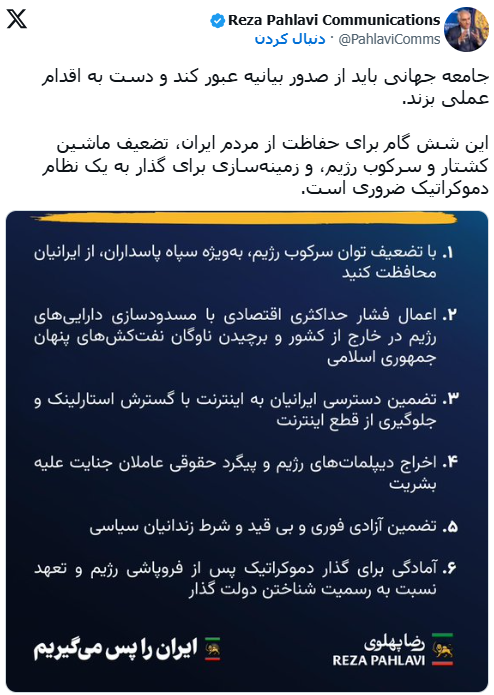
Pahlavi Office: Six Steps, Not Statements

In a post on X following the EU’s designation of the IRGC as a terrorist organisation, the office of Prince Reza Pahlavi urged the international community to move beyond statements and take six practical steps to protect Iranians, weaken the regime’s repression apparatus, and pave the way for a democratic transition: (1) reduce the regime’s coercive capacity—especially the IRGC—to protect citizens; (2) apply maximum economic pressure by freezing regime assets abroad and dismantling the Islamic Republic’s “shadow” oil-tanker network; (3) guarantee Iranians’ internet access by expanding Starlink and preventing shutdowns; (4) expel regime diplomats and pursue legal accountability for crimes against humanity; (5) secure the immediate and unconditional release of political prisoners; and (6) prepare for a democratic transition after regime collapse, including a commitment to recognise a transitional government.

Prince Pahlavi: EU IRGC Listing Is a Start—Back a Legitimate Transition

Prince Reza Pahlavi welcomed the European Union’s decision to designate the Islamic Revolutionary Guard Corps (IRGC) as a terrorist organization, saying the move sends a clear message to a “criminal regime” that it has no global legitimacy. In a post on X, he added that the next phase must be concrete action—both to protect the Iranian people and to support a legitimate transitional government capable of guiding Iran toward democracy.

Hospitals Pressured to Hand Over Names of Wounded Protesters

New messages from inside Iran suggest security bodies are escalating post-protest pressure by forcing hospitals to provide lists of injured demonstrators—raising fears of detention and unknown outcomes for those seeking treatment. A source in Tehran said their spouse, who works at a specialist ophthalmology hospital, saw many patients with pellet-gun eye injuries linked to protests. According to the account, after the demonstrations ended, representatives from the medical sciences university and security agencies visited the hospital and extracted the names of everyone hospitalized between 18–22 Dey from patient files and took the list away. Similar reports have previously surfaced from Tehran, Karaj, Rasht, Khorramabad, Najafabad, and Mashhad, describing armed agents stationed in hospitals, arrests from treatment centers, obstruction of care, pressure on medical staff, and transfers of some wounded people to undisclosed locations.

Reports: Security Agents Sent Into Schools to Push Official Narrative

New accounts from inside Iran say intelligence and security personnel have been dispatched to schools in the wake of protests, pressuring students and attempting to impose the state’s narrative about the “national revolution.” An 18-year-old student in Bandar Abbas said agents have recently visited schools, questioned students, and promoted claims that “Reza Shah II is dead,” protest footage is “fabricated,” and that “no one was killed” because those who died were “all military.” Similar messages from other cities report that when students mention deaths linked to protests, officials deny it and insist “nothing happened.” The student said the atmosphere at school has become highly tense, and despite being in their final year, they are unable to focus on studying.

Glucksmann: Cut Off the IRGC’s Money and Networks

French MEP Raphaël Glucksmann welcomed the EU’s decision to designate Iran’s IRGC as a terrorist organization, saying the mobilization and sustained pressure “worked” and must continue. He argued the next step is operational: dry up the IRGC’s financial resources and dismantle its networks, signaling a push for tougher enforcement and follow-through beyond the designation itself.

Regional Mediation Rush as U.S. Military Options Take Shape

CBS News, citing multiple regional officials, reported that Turkey, Oman, and Qatar are trying to mediate diplomatic talks to avert a potential U.S. strike on Iran as Washington prepares military options in the region—yet sources said prospects for direct U.S.–Iran diplomacy have not met “any welcome or progress.” The Wall Street Journal separately reported that Egyptian Foreign Minister Badr Abdelatty’s outreach to Iran’s Abbas Araghchi and Trump envoy Steve Witkoff also failed to produce results. CBS further confirmed that Israeli military intelligence chief Gen. Shlomi Binder visited Washington earlier this week for meetings at the Pentagon, CIA, and White House, and said Saudi Arabia’s defense minister is expected in Washington by the end of the week.

Two Teachers Detained; Whereabouts Still Unknown

Iran’s Coordination Council of Teachers’ Trade Associations said two teachers were arrested on Bahman 7–8, 1404 (Jan 27–28, 2026) amid an intensified wave of summons and detentions targeting educators. According to the council, Ali Imani Motlagh was detained in Lorestan after security forces raided his home, while Ahmad Alizadeh, a teacher and political activist from Abdanan (Ilam) previously sentenced during the “Woman, Life, Freedom” movement, was arrested by IRGC intelligence. The council said there is still no information on either man’s charges, health status, or place of detention—fueling concerns about their safety.

Bus Union: “Organized Repression” of Teachers Must Stop

The Syndicate of Workers of Tehran and Suburbs Bus Company condemned what it called a renewed wave of arrests, summonses, and security pressure on teachers and labor activists across Iran, describing it as an extension of an organized policy to crush teachers’ right to organize, free expression, and union activity. Citing reports from the teachers’ coordination network, the union named multiple detained or summoned educators and activists (including Reza Moslemi, Abdollah Rezaei, Arman Shapouri, Shervin Hamideh, Jalil Shirdel, Esmail Khodayari, Keyomars Va’ezi, Mohsen Sha’bani, Hossein Ramazanpour, Mehdi Nazari, and Arash Nik-Khou) and said the education community has also seen teachers killed during the unrest (including Kamran Akbari, Karmali A’lai, Reza Karimi-Far, Mostafaei, and Alireza “Yasin” Ansari-Far). The statement called for the immediate, unconditional release of imprisoned teachers, recognition of educators’ civil and union rights, and an end to violent برخوردها با کودکان و نوجوانان, warning the authorities bear direct responsibility for detainees’ safety.

More Iran news

Political

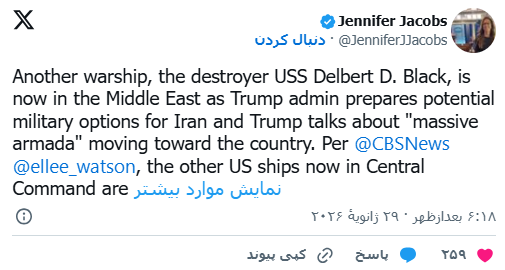
U.S. Sends Another Destroyer Into the Middle East

CBS News reported that the U.S. Navy has moved another guided-missile destroyer—USS Delbert D. Black—into Middle East waters. A U.S. official told Reuters the ship entered the region within the past 48 hours, lifting the U.S. naval posture there to six destroyers, alongside the aircraft carrier USS Abraham Lincoln and three littoral combat ships. CBS listed other U.S. vessels currently operating under U.S. Central Command (CENTCOM), including destroyers Spruance, Michael Murphy, Frank E. Petersen, McFaul, and Mitscher, plus littoral combat ships Canberra, Tulsa, and Santa Barbara, highlighting a broader buildup as regional tensions rise.

Hegseth to Iran: “We’ll deliver what the president expects”

At a January 29, 2026 Cabinet meeting, U.S. Defense Secretary Pete Hegseth warned that if Iran keeps pursuing nuclear weapons capability, the U.S. military “will be prepared to deliver whatever the president expects,” adding that Tehran “has all the options to make a deal” but “should not pursue nuclear capabilities.” Hegseth pointed to the recent U.S. operation that captured Venezuelan President Nicolás Maduro as an example of U.S. reach, as President Donald Trump continues weighing options on Iran amid rising regional tensions.

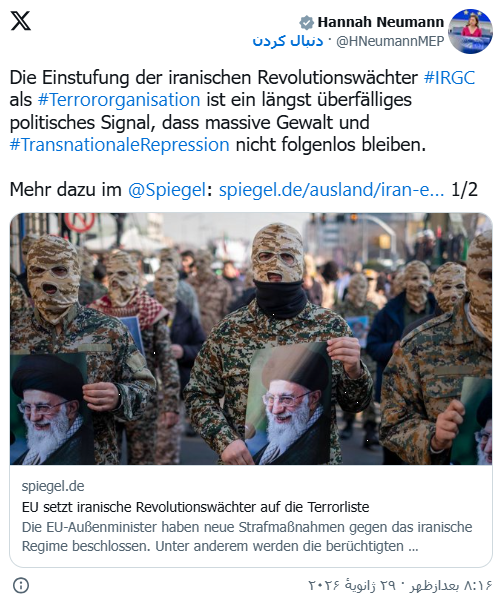
Neumann: EU’s IRGC Terror Listing “Isn’t Symbolic”

German Green MEP Hannah Neumann, who chairs the European Parliament’s delegation for relations with Iran, said the EU’s decision to designate the IRGC a terrorist organisation is a long-overdue political signal that “massive violence and transnational repression” will no longer go unanswered. She stressed the move has clear practical effects—including asset freezes and making financial/material support or cooperation with the IRGC a criminal offence, comparable to how EU rules apply to groups such as ISIS and Hamas.

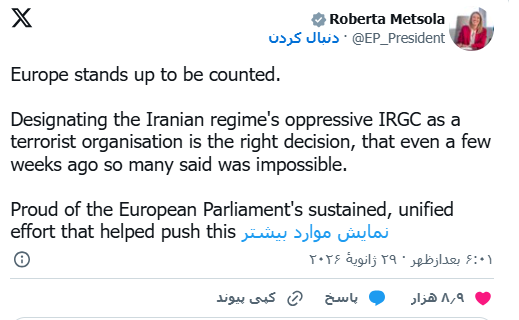
Metsola: “Iran Will Be Free” as EU Backs IRGC Terror Label

European Parliament President Roberta Metsola welcomed the EU’s move to designate Iran’s Islamic Revolutionary Guard Corps (IRGC) as a terrorist organization, calling it “the right decision” and noting that many considered it impossible only weeks ago. She said she is proud of the European Parliament’s sustained, unified push that helped drive the outcome, and argued the moment now demands continued resolve—adding that “now is the time to stand firm” and that “Iran will be free.”


Schoof: EU United Against Iran Crackdown After IRGC Terror Listing

Caretaker Dutch Prime Minister Dick Schoof called the EU’s decision to designate the IRGC a terrorist organisation “good news,” saying the Netherlands has backed the move for years and that Europe is united in responding to the bloody repression of peaceful protesters in Iran. The comments come as EU foreign ministers formally agreed on 29 January 2026 to add the IRGC to the EU terror list and roll out additional Iran-related sanctions.

Sweden’s PM: EU Takes a “Strong and Clear” Line on Iran’s Repression

Swedish Prime Minister Ulf Kristersson said the EU has reached a political agreement to place Iran’s Islamic Revolutionary Guard Corps (IRGC) on the bloc’s list of sanctioned terrorist organisations—an outcome he noted Sweden has long pushed for. He added the decision signals a “strong and clear stance” against the Iranian regime’s brutal repression and against actions that threaten security, as EU foreign ministers moved to tighten pressure on Tehran.

Germany’s FM: “Blood on Their Hands” — EU Must Turn IRGC Terror Label Into Law

Germany’s foreign minister Johann Wadephul said the EU’s political agreement in Brussels to designate Iran’s Islamic Revolutionary Guard Corps (IRGC) as a terrorist organisation is a strong but overdue signal, stressing the next step must be rapid implementation into a legally binding listing. In an official statement dated 29 January 2026, Wadephul described the IRGC and its auxiliary forces as the regime’s “henchmen,” accusing them of brutal repression, executions of protesters, and a destabilising regional role, and said they were behind attempted attacks in Germany and Europe—“in short, they have blood on their hands.” He also welcomed that other EU member states have now backed Germany’s long-running push, after recent reporting that some capitals—including France, Italy and Spain—had been among the late holdouts before shifting position.

EU AML Blacklist Adds Russia — Transfers to Russian Banks Get Slower, Costlier

EU foreign policy chief Kaja Kallas said the EU has added Russia to its money-laundering “blacklist” (the EU list of high-risk third countries), a step that will slow processing and raise compliance costs for transactions involving Russian banks as EU institutions apply tighter checks. The change is anchored in Commission Delegated Regulation (EU) 2026/46, which entered into force on 29 January 2026.

Israel’s Top Intel Chiefs Brief Washington on Iran Options

The Mossad director David Barnea and Israel’s military intelligence chief Maj.-Gen. Shlomi Binder traveled to Washington for high-level consultations on how to handle Iran, according to The Jerusalem Post and Axios. The Jerusalem Post said Barnea arrived Jan. 16 and met Trump envoy Steve Witkoff, shortly after a Jan. 14 Netanyahu–Trump call in which Netanyahu reportedly urged delaying any strike until more U.S. forces were in place; Axios said Binder met senior officials at the Pentagon, CIA and the White House to share intelligence on potential targets, as Saudi Defense Minister Prince Khalid bin Salman also visited to push a diplomatic off-ramp.

Trump Claims Putin Agreed to a One-Week Pause on Kyiv Strikes

U.S. President Donald Trump said on January 29, 2026, during a Cabinet meeting, that he personally asked Russian President Vladimir Putin to not strike Kyiv and other cities for a week because of record-cold weather, and that Putin agreed. Trump portrayed the pause as an unexpectedly successful, humanitarian-driven step, though there was no immediate confirmation from the Kremlin in early reporting.

More Political news

Europe

Switzerland Trade Surplus Shrinks Sharply in December

Switzerland’s trade balance posted a surplus of CHF 1.036B in December, far below the CHF 4.850B expected and down from CHF 3.841B previously. The sharp undershoot suggests a weaker net-trade contribution into year-end—likely reflecting softer exports and/or stronger imports—an important watchpoint for growth momentum given Switzerland’s high export sensitivity.

Spain Retail Sales Cool Sharply, Signaling Softer Year-End Demand

Spain’s retail sales rose 2.9% y/y in December, slowing markedly from 6.0% previously. The deceleration points to a softer consumer-demand pulse into year-end—potentially reflecting easing inflation support, tighter financing conditions, or base effects after a strong prior month.

Eurozone Credit Growth Stays Firm, While Money Growth Cools

Eurozone loan growth remained steady in December, with loans to non-financial corporations at 3.0% y/y (slightly softer than 3.1% prior) and private sector loans at 3.0% y/y (up from 2.9%). In contrast, M3 money supply growth eased to 2.8% y/y (vs 3.0% expected/prior), even as the level of M3 rose to €17,230.7B from €17,189.3B. The mix suggests credit creation is holding up, but broad liquidity growth is cooling—consistent with a still-tight monetary backdrop even as lending momentum remains resilient.

Italy Non-EU Trade Surplus Widens, Supporting External Balance

Italy’s non-EU trade balance posted a surplus of €8.39B in December, up from €7.04B previously. The wider surplus points to a stronger external position versus non-EU partners into year-end—potentially reflecting firmer export performance and/or easing import costs, and providing a modest tailwind to growth through net trade.

Eurozone Sentiment Firms: Consumers Steady, Industry Improves, Services Strengthen

Eurozone survey data for January painted a broader improvement in confidence. Consumer confidence held at -12.4, matching expectations and improving from -13.1 previously, while consumer inflation expectations fell to 24.1 from 26.7, hinting at easing price fears. The business side was notably better: industrial sentiment rose to -6.8 (vs -8.1 expected, -8.5 prior) and services sentiment increased to 7.2 (vs 6.0 expected, 5.8 prior). The overall picture also brightened with business climate improving to -0.41 (from -0.56) and the Business and Consumer Survey rising to 99.4 (vs 97.0 expected, 97.2 prior). Pricing intentions cooled somewhat, with selling price expectations at 10.0 (vs 10.8 prior), consistent with softer inflation momentum.

Italy Industrial Sales Stall YoY, Slight MoM Dip Signals Soft Patch

Italy’s industrial sales were flat y/y (0.0%) in November, slowing sharply from +1.7% previously, pointing to a loss of momentum in the sector’s annual trend. On the month, sales edged -0.1% m/m, a smaller decline than the prior -0.6%, suggesting the contraction moderated but conditions remain soft heading into year-end.

Italy BTP Auctions Steady: 5Y at 2.74%, 10Y at 3.44%

Italy’s latest auctions showed stable sovereign funding costs, with the 5-year BTP clearing at 2.74% and the 10-year BTP at 3.44%, both unchanged versus the prior auctions. The flat outcomes suggest steady demand and little immediate repricing of Italy’s risk premium at these maturities.

France Jobseekers Fall, Pointing to a Slightly Firmer Labour Market

France’s total number of jobseekers fell to 3,117.4K in December from 3,129.3K previously, indicating a modest improvement in labour-market conditions into year-end. The decline suggests slightly reduced unemployment pressure at the margin, though markets will watch whether the downtrend persists alongside broader activity data.

Spain Business Confidence Improves Slightly, Still Negative

Spain’s business confidence ticked up to -3.0 in January from -3.4 previously, indicating a modest improvement in corporate sentiment. However, the index remains in negative territory, suggesting firms are still cautious on activity and the outlook despite the small uptick.

More Europe news

Others

Brazil Holds Selic at 15% as Policy Stays Restrictive

Brazil’s central bank kept its policy rate (Selic) unchanged at 15.00%, matching expectations (15.00%) and the prior level (15.00%). The steady decision signals policymakers remain focused on anchoring inflation expectations, keeping financial conditions tight while they assess whether disinflation is durable.

Turkey Unemployment Drops to 7.7%, Marking a Clear Improvement

Turkey’s unemployment rate fell to 7.7% in December, down from 8.5% previously, signaling a notable improvement in labor-market conditions into year-end. The decline suggests hiring held up despite tight financial conditions and inflation pressures—supportive for household demand, though markets will watch whether the drop is sustained and how participation trends evolve.

Turkey Economic Confidence Dips Slightly, Still Near Neutral

Turkey’s Economic Confidence Index edged down to 99.40 in January from 99.50 previously, a marginal softening that keeps sentiment essentially flat. With the index still just below the 100 thresholds (often viewed as “neutral”), the reading suggests confidence remains steady but not decisively upbeat.

South Africa PPI Steady YoY, With a Small Monthly Uptick

South Africa’s producer price inflation held at 2.9% y/y in December, unchanged from the prior 2.9%, while the m/m rate ticked up to 0.2% from 0.0%. The data suggest factory-gate inflation remains contained overall, with only a mild month-end increase—supportive for a stable inflation backdrop unless cost pressures re-accelerate.

Brazil IGP-M Rebounds to +0.41% in January, Matching Forecast

Brazil’s IGP-M inflation index rose 0.41% m/m in January, exactly in line with expectations (0.41%) and a clear rebound from -0.01% previously. The swing back into positive territory signals renewed upstream price pressure at the margin—worth watching given IGP-M’s role in rent and contract indexation in Brazil.

Brazil Credit Growth Accelerates as Bank Lending Jumps

Brazil’s bank lending rose 1.8% m/m in December, up from 0.9% previously, signaling a clear acceleration in credit expansion into year-end. The stronger lending pace can support domestic demand, but it also bears watching for its implications on inflation persistence and the central bank’s “higher-for-longer” stance.

Turkey FX Reserves Rise, Signaling Improved Buffer

Turkey’s gross FX reserves increased to $86.20B from $84.15B, indicating a modest improvement in the central bank’s external liquidity buffer. Net FX reserves also strengthened to 97.37 from 91.01, pointing to a clearer rebuilding trend. The reserve uptick is generally supportive for TRY sentiment as it reduces near-term external financing stress—though markets will still watch sustainability, swap-adjusted measures, and the policy mix.

South Africa Holds Rates at 6.75%, Keeping Policy Steady

South Africa’s central bank kept its policy rate unchanged at 6.75% in January, matching expectations (6.75%) and the prior level (6.75%). The prime rate also remained steady at 10.25%, signaling no change in near-term borrowing conditions as policymakers balance inflation risks against growth and currency sensitivity.

More Others news

USA

US Jobless Claims Hold Near Cycle Lows as Continuing Claims Fall

Weekly initial jobless claims came in at 209K, slightly above 206K expected but essentially in line with the 210K prior, keeping layoffs contained. Continuing claims dropped to 1.827M (vs 1.860M expected, 1.865M prior), suggesting fewer people are staying on benefits and pointing to ongoing labor-market resilience. The 4-week average edged up to 206.25K from 204.00K, indicating only a mild, gradual firming—still consistent with a tight labor backdrop.

US Productivity Surges as Labor Cost Pressure Reverses

U.S. nonfarm productivity rose 4.9% q/q in Q3, matching expectations (4.9%) and accelerating from 3.3% previously signaling a strong efficiency boost. At the same time, unit labor costs fell -1.9% q/q, in line with forecasts (-1.9%) and a sharp reversal from +1.0% prior. The combination is disinflation-friendly: higher productivity with falling labor costs reduces wage-driven price pressure and supports a “soft-landing” narrative if it persists.

US Trade Gap Blows Out as Imports Surge and Exports Slip

The U.S. trade balance widened sharply to a -$56.8B deficit in November, far worse than the -$43.4B expected and a big deterioration from -$29.2B previously. The gap expanded because exports fell to $292.1B (from $303.0B), while imports jumped to $348.9B (from $332.1B). The mix implies a heavier drag from net exports on near-term GDP tracking and reinforces the view that domestic demand (and import absorption) remained strong into month-end.

US Factory Orders Surge, Pointing to a Stronger Goods Pulse

U.S. factory orders rose 2.7% m/m in November, beating 1.7% expected and rebounding sharply from -1.2% previously signaling a clear pickup in goods demand/order flow. Stripping out transportation, orders still increased 0.2% m/m, improving from -0.1% prior, suggesting the strength wasn’t solely driven by big-ticket aircraft/auto swings. The combination supports a firmer near-term manufacturing backdrop.

US Durable-Goods Strength Holds: Broad Gains Beyond Transport

U.S. durables excluding defense rose 6.5% m/m in November, essentially matching the prior 6.6% surge and signaling that momentum in big-ticket demand stayed strong. Durables excluding transportation increased 0.4% m/m, only slightly softer than the 0.5% prior, indicating underlying capital-goods and equipment demand remains constructive even after stripping out the most volatile categories.

US Wholesale Sales Jump as Inventories Grow More Slowly

U.S. wholesale trade sales rose 1.3% m/m in November, a sharp rebound from -0.4% previously, pointing to stronger distribution demand into month-end. Meanwhile, wholesale inventories increased 0.2% m/m, matching expectations (0.2%) but slowing from 0.5% prior. The combination is constructive: sales accelerating while inventories build more modestly implies a healthier inventory-to-sales balance and reduces near-term overhang risk.

GDPNow Slides: Atlanta Fed Lowers Q4 Growth Estimate to 4.2%

The Atlanta Fed’s GDPNow model cut its Q4 growth estimate to 4.2%, down from 5.4% previously (and below the 5.4% reference). The downgrade signals softer real-time tracking for late-year activity—often driven by weaker net exports, inventories, or consumption inputs—as incoming data reshapes the model’s components.

T-Bill Yields Steady: 4-Week Holds, 8-Week Ticks Up Slightly

The U.S. Treasury’s short-end auctions were essentially stable: the 4-week bill cleared at 3.630%, unchanged from 3.630% previously, while the 8-week bill edged up to 3.635% from 3.630%. The small move suggests steady front-end funding conditions and little change in near-term rate expectations.

More USA news

Equities

Microsoft Delivers Strong Q4 2025, Beats EPS and Revenue Estimates

Microsoft (MSFT) reported EPS of $4.14, topping expectations of $3.93, while revenue came in at $81.27B versus $80.23B forecast. The beat across both earnings and the top line points to a firmer quarter than consensus anticipated, reflecting strong execution across Microsoft’s platform—typically driven by resilient cloud demand and steady enterprise spending. Microsoft’s market capitalization stands at $3.58T, reinforcing its position as a mega-cap bellwether as investors focus on cloud growth, AI monetisation, and margin trajectory into 2026.

Tesla Beats Q4 2025 Estimates, Slightly Tops EPS and Revenue

Tesla (TSLA) reported EPS of $0.50, edging above expectations of $0.45, while revenue came in at $24.9B versus $24.78B forecast. The modest beat across both earnings and the top line suggests a slightly stronger quarter than consensus anticipated, with profitability and sales narrowly outperforming market assumptions. Tesla’s market capitalization stands at $1.43T, and investors will likely focus on margin trajectory, delivery momentum, and 2026 guidance signals—especially around pricing, mix, and cost efficiency.

IBM Delivers Strong Q4 2025, Beats EPS and Revenue Estimates

IBM (IBM) reported EPS of $4.52, beating expectations of $4.29, while revenue came in at $19.7B versus $19.22B forecast. The beat on both earnings and the top line points to a firmer quarter than consensus anticipated, suggesting steady execution and resilient demand across IBM’s core software, services, and infrastructure portfolio. IBM’s market capitalization stands at $274.96B, with investors likely focused on the pace of software growth, services backlog conversion, and margin durability into 2026.

Southwest Airlines Posts Mixed Q4 2025, Beats EPS but Misses Revenue

Southwest Airlines (LUV) reported EPS of $0.58, slightly above expectations of $0.57, while revenue came in at $7.4B, below forecasts of $7.5B. The print suggests profitability held up a touch better than expected despite a softer top line, implying margins and cost execution helped offset modest revenue pressure versus consensus. Southwest’s market capitalization stands at $21.13B, with investors likely focused on unit revenue trends, capacity discipline, and margin durability as 2026 unfolds.

More Equities news

Oceania

NZ Trade Swings Back to Surplus as Exports Jump

New Zealand posted a NZ$52M trade surplus in December (vs NZ$30M expected, after -NZ$335M previously), driven by a sharp rise in shipments: exports climbed to NZ$7.65B (from NZ$6.81B), while imports rose to NZ$7.60B (from NZ$7.15B). The turn back into surplus is NZD-supportive at the margin, though the annual trade balance is still in deficit at -NZ$2.20B (slightly improved from -NZ$2.22B).

New Zealand Business Sentiment Cools, But Remains Very Strong

New Zealand’s ANZ Business Confidence slipped to 64.1 in January from 73.6, while NBNZ Own Activity eased to 51.6% from 60.9%. The pullback signals some cooling in optimism and near-term activity intentions, but both readings remain at elevated levels—consistent with a still-supportive domestic backdrop even as momentum moderates.

Australia’s Trade Prices Swing Higher as Import Costs Surprise

Australia’s import price index rose 0.9% q/q in Q4, a clear upside surprise versus -0.2% expected and reversing from -0.4% previously signaling a renewed lift in imported inflation pressures. Meanwhile, the export price index jumped 3.2% q/q, snapping back from -0.9%, pointing to stronger pricing for Australia’s outbound commodities and a potential lift to nominal income/terms of trade if sustained.

More Oceania news

Japan

Japan Foreign Flows Flip to Bonds as Equity Inflows Cool

Foreign investors turned net buyers of Japanese bonds (+¥177.6bn) after last week’s -¥361.1bn outflow, signaling renewed demand for JGB exposure as rates/FX volatility stays elevated. At the same time, foreigners still bought Japanese equities (+¥328.1bn), but inflows slowed sharply from +¥878.9bn previously suggesting risk appetite toward Japan remains positive, just less aggressive than the prior week.

Japan Household Confidence Improves, Signaling a Modest Sentiment Lift

Japan’s household confidence index rose to 37.9 in January, beating the 37.1 expected and improving from 37.2 previously. The uptick suggests a modest improvement in consumer sentiment, though the level remains low—implying households are still broadly cautious on spending amid inflation and real-income concerns.

More Japan news

Canada

Canada Trade Deficit Widens as Exports Drop

Canada’s trade balance deteriorated to a -C$2.20B deficit in November, much weaker than the -C$0.70B expected and down from -C$0.40B previously. The miss was driven mainly by softer exports: exports fell to C$63.94B from C$65.78B, while imports were broadly steady at C$66.14B (vs C$66.18B prior). The mix points to a weaker net-trade contribution to near-term growth and can be a mild headwind for CAD if the export softness persists.

Canada Wage Growth Picks Up, Signaling Firmer Pay Momentum

Canada’s average weekly earnings rose 2.45% y/y in November, accelerating from 2.00% previously. The pickup points to firmer wage momentum into year-end—supportive for household income and consumption, but also a variable the Bank of Canada will watch for persistence in services inflation.

More Canada news

Cryptocurrency

Bitcoin Slips Under $85K as Tech Rout Spills Into Crypto

Bitcoin broke below $85,000 in Thursday’s North American session, briefly printing around $84,400 (its lowest since Dec. 1, per Binance) after a broader risk-off move in U.S. equities. The slide erased over 5% of BTC’s market cap in the past 24 hours, with a sharp ~3% one-hour drop as traders linked the move to the stock selloff—led by a reported ~12% plunge in Microsoft. Technically, the $84,000 area is now the key near-term support; a clean break could open a path toward $80,000.

More Cryptocurrency news

Russia

Russia FX Reserves Rise, Strengthening the External Buffer

Russia’s central bank reserves increased to $786.9B, up from $769.1B previously, indicating a firmer external liquidity buffer. The rise can help support macro stability at the margin—though markets will still focus on reserve composition, accessibility under sanctions, and the broader balance-of-payments backdrop.

More Russia news

Commodities

US Gas Storage Draw Deepens: -242 Bcf vs -237 Expected

U.S. natural gas storage fell by 242 Bcf in the latest weekly report, a larger draw than the -237 Bcf expected and sharply bigger than the -120 Bcf prior week. The overshoot signals stronger-than-anticipated winter demand and a tighter near-term supply cushion—typically supportive for prompt gas prices if cold-driven withdrawals persist.

More Commodities news