IFC Markets Live Quotes

Market news roundup: Wednesday, 28 January 2026

104 short market news items, grouped by 13 sections.

Iran

IranWire: Ilam Student Reportedly Detained by IRGC Intelligence

IranWire reports that an Islamic Azad University student in Ilam, Mohammadmehdi Makan Nemati (English Literature), has been detained since 18 Dey 1404 and transferred to an undisclosed location. Informed sources cited by IranWire say the detaining authority is the IRGC Intelligence Organization in Ilam, raising renewed concern over student arrests and lack of transparency around detention locations and legal access.

Tehran Disappearance Reported After Dey Crackdown Arrest Wave

Following the heavy crackdown on the nights of 18–19 Dey 1404, reports say a new wave of extrajudicial detentions has spread across multiple Iranian cities. One informed source now says a 30-year-old accountant, Mahya Goleh-Dari, has disappeared since 25 Dey 1404 after going missing in Tehran’s Piroozi neighborhood, where she lives. The report raises renewed concern over “enforced disappearance” risks in the post-crackdown period, as families and activists warn that the lack of official information can obscure custody status and legal access.

Evin Letter: “Not Just Repression—A Scorched-Earth Message”

Reza Khandan, civil activist and the husband of human-rights lawyer Nasrin Sotoudeh, wrote in a letter from Tehran’s Evin Prison that the recent mass killing of protesters was not merely a crackdown. He described it as an attempt to “break the nation’s back” and leave a “scorched earth,” framing the violence as a deliberate strategy to intimidate society and deter further resistance.

Mourners Disrupt Official Speech at Tehran Medical University Gathering

Students mourning Aida Heydari reportedly left the venue after the deputy for student affairs at Tehran University of Medical Sciences arrived, preventing him from delivering a speech. Heydari, a University of Tehran student, was killed in Tehran on 18 Dey 1404 after being shot by Islamic Republic forces, according to the report—an incident that has become a focal point for campus anger and grief.

Guardian Probe Flags Possible Mass Burials to Conceal Iran Protest Death Toll

A Guardian investigation published on Tuesday, January 27, 2026 (7 Bahman 1404) says testimonies and evidence gathered from doctors, forensic-medicine staff, and eyewitnesses in Iran suggest authorities may have carried out mass burials and removed bodies from official channels to mask the true scale of deaths during the protests crackdown. The report describes claims of disappeared bodies, pressure on morgue/graveyard staff, and alleged manipulation of records—while noting verification remains difficult under severe restrictions and fear of reprisals.

Araqchi: “No Recent Contact” With Witkoff, No Request for Talks

Iran’s Foreign Minister Abbas Araqchi said on Wednesday there has been no contact in recent days between Tehran and Steve Witkoff, the U.S. special envoy, and that Iran has not requested negotiations. He added that several countries are acting as intermediaries and consultations with them continue, while stressing that talks “don’t go along with threats” and can only proceed once coercive pressure and excessive demands are set aside.

IRGC Deputy: Iran’s Defense Has Grown, Any Attack Now “Riskier”

Ahmad Vahidi, deputy commander of Iran’s Islamic Revolutionary Guard Corps, said the Islamic Republic’s defensive capabilities have strengthened in recent years, making any military action against Iran “riskier” for adversaries. Using a deterrent tone, he added that the “enemy” does not understand it would be fighting something it “cannot overcome,” and said statements by U.S. officials “do not frighten” Iran—signaling Tehran’s effort to project readiness and raise the perceived cost of escalation.

Iran Army Chief: If Conflict Erupts, U.S. Warships Will Take “Heavy Damage”

Habibollah Sayyari, chief of staff and deputy coordinator of Iran’s army, downplayed reports of an expanded U.S. naval presence in the region and issued a deterrent warning that if “something happens,” U.S. aircraft carriers and warships would also be hit—and that the damage would be “significant.” The remarks are part of Tehran’s broader effort to raise the perceived cost of escalation and signal that any U.S. maritime buildup would not be risk-free.

Iran MP Mocks Trump, Threatens U.S. Carriers—But Claims No Attack Will Happen

Iranian MP Mohammad Seraj used insulting language toward U.S. President Donald Trump, calling him a “blond Yankee buffalo with animal understanding,” while issuing sharp military threats. Seraj claimed a U.S. aircraft carrier in the region is “easy prey” for Iran and said Iranian missiles could penetrate its defenses, warning Tehran could send U.S. warships “to the bottom of the open seas” if needed—yet he also asserted the U.S. “certainly” will not attack Iran. Separately, cleric Abbas Kaabi, a member of the Assembly of Experts’ presidium, said any potential strike on Ali Khamenei would be an “act against the Islamic world,” warning it would bring “unimaginable” consequences for the U.S. and Trump—signaling Iran’s continued effort to combine deterrent threats with political messaging aimed at raising the perceived cost of escalation.

Houthis Hint at Red Sea Escalation as USS Abraham Lincoln Enters the Region

Yemen’s Houthi movement has signaled it could ramp up actions tied to the Iran standoff, as the USS Abraham Lincoln Carrier Strike Group arrives in U.S. Central Command’s area of responsibility and Washington boosts its regional posture. The combination of (1) proxy “readiness” messaging and (2) a larger U.S. naval footprint raises the odds of renewed disruption risk across key shipping lanes, keeping geopolitical risk premium elevated—especially for freight, insurance, and energy-sensitive assets.

IndiGo Extends Regional Flight Suspensions as Iran Airspace Risks Persist

India’s IndiGo extended the suspension of flights to Tbilisi, Almaty, Tashkent, and Baku for another two weeks, citing the prevailing security situation around Iranian airspace; reports say the cancellations now run through February 11, 2026, as airlines continue to adjust routings and schedules amid heightened regional volatility.

Mizan: Political Prisoner Executed on “Israel Espionage” Charge

Iran’s judiciary-linked outlet Mizan reported that Hamidreza Sabet Esmailpour was hanged at dawn on Wednesday, Jan. 28, 2026 (8 Bahman 1404) after being convicted of “espionage” and “intelligence cooperation” for Israel (Mossad). Mizan said he was arrested on 29 April 2025 (9 Ordibehesht 1404); separate reporting notes the case was confirmed through Iran’s legal process, while rights groups continue to argue that Iran’s national-security trials routinely fall short of fair-trial standards—especially in politically charged cases.

Angelina Jolie: “Accountability” for Iran Crimes, After Posting Child at Mother’s Grave

Angelina Jolie, the former UNHCR Special Envoy, called for accountability for crimes committed in Iran in an Instagram post showing a seven-year-old girl at her mother’s grave. Jolie wrote that Parisa Lashgari, 30, was killed during protests in Nurabad, Fars province, on January 10, 2026, adding that no child should carry such grief and urging protection of civilians, truth-telling, and accountability for those responsible.

NYT’s Bret Stephens: Should Iran’s Executioners Walk Free?

In a New York Times opinion column published Tuesday Jan. 27, 2026 (7 Bahman 1404), Bret Stephens argues that the Islamic Republic’s crackdown—especially the killings reported during Dey 18–19—raises an urgent question: should those responsible for mass killings of Iranians be allowed to escape punishment. To convey the scale, he compares the reported death toll to major historical atrocities, and cites a U.S.-based Iranian human-rights group saying 5,500+ protesters have been verified killed while 17,000 additional cases are under review. Stephens also points to reports of mass arrests and severe injuries, noting Iranian judiciary chief Gholam-Hossein Mohseni-Ejei has promised punishment “without the slightest leniency,” and asks whether the world will let that stand.

Araghchi: “Finger on the trigger,” but open to a nuclear deal

Iran’s Foreign Minister Seyed Abbas Araghchi said Iran’s armed forces are prepared “with their fingers on the trigger” to respond “immediately and powerfully” to any aggression against the country across land, air, and sea, adding that lessons from the “12-Day War” have strengthened Iran’s ability to respond faster and more forcefully. In the same message, he said Iran would welcome a “mutually beneficial, fair and equitable” nuclear deal—free from coercion and threats—that preserves Iran’s rights to peaceful nuclear technology while guaranteeing “no nuclear weapons,” reiterating Tehran’s longstanding claim that it has never sought to acquire a bomb.

France Condemns Iran Crackdown, Backs New Targeted Sanctions

France’s foreign minister Jean-Noël Barrot said images and reporting from Iran point to an “intolerable, unacceptable and inhumane” crackdown that has left thousands killed and wounded and led to the arbitrary detention of tens of thousands. He said Paris “strongly condemns” what he called “blind state violence” targeting the Iranian people, praised the “courage of Iran’s women and men,” and voiced full support for citizens pressing what he described as legitimate demands for a dignified life, prosperity, and greater freedoms. Barrot added that fighting impunity for perpetrators is essential and said France would support new targeted sanctions against those chiefly responsible. In a separate post on X, he also backed designating the IRGC as a terrorist organization and urged Iranian authorities to free prisoners, halt executions, lift the “digital siege,” and allow the UN Human Rights Council fact-finding mission to investigate alleged crimes in Iran.

US State Dept Accuses Iran of Ransom-Style Extortion of Victims’ Families

The Persian-language X account of the U.S. State Department accused the Islamic Republic of destroying Iran’s economy and carrying out a bloody crackdown on protesters, saying government policies have left many people unable to meet basic needs—one of the main drivers of the recent wave of unrest. The post alleged that after protests erupted, authorities killed large numbers of innocent citizens solely for protesting and expressing their views, and claimed bereaved families—already hit by the economic crisis—are being forced to pay or borrow money to retrieve bodies and hold funerals. It also said families are pressured to sign false “confessions” stating the deceased were government supporters, with officials allegedly threatening to withhold bodies or even cremate them if families refuse. The State Department described the alleged conduct as “disgusting and inhumane,” arguing it reflects the regime’s “limitless violence” and exploitation of Iranians’ grief.

US: Iran Regime “Sacrifices” People Through Economic Ruin and Bloody Repression

The U.S. State Department said the Islamic Republic is responsible for destroying Iran’s economy and deepening widespread poverty, arguing that people’s inability to meet basic needs was a key driver of the recent nationwide protests. It said Tehran responded not by addressing citizens’ economic and social demands but by violently cracking down, killing “many innocent people” solely for protesting and expressing their views. The statement also alleged that bereaved families—already hit by the economic crisis—are being forced to pay or borrow money to retrieve bodies and are subjected to inhumane pressure. It further claimed some families are coerced into signing “false confessions” asserting the deceased were regime supporters, with officials threatening to withhold bodies or even burn them if they refuse. The State Department described these actions as “disgusting and inhumane,” saying the exploitation of grief reflects extreme cruelty and “leaves no limit to brutality.”

Journalist: “Khamenei Ordered the Killings” — Call for a Clean Break From the Regime

Morteza Kazemian, speaking to Iran International, described the recent crackdown during protests in Iran as an unambiguous case of crime, massacre, and crimes against humanity, arguing its scale and methods go far beyond a standard “security response” and should be termed a “killing of the Iranian people.” He said the order for the bloody repression was issued by Ali Khamenei and that the primary responsibility lies with the Islamic Republic’s supreme leader. Pointing to the deep rupture between the state and society, Kazemian argued Khamenei knows most Iranians do not want him, and that this awareness has driven him to use violence “at any cost” to preserve power. He urged political currents and activists to fully distance themselves from the government, stand explicitly with the public, condemn the alleged crimes against humanity, and publicly draw a clear line separating themselves from the current ruling system.

Rubio: No Simple Script for Iran After a Regime Collapse

U.S. Secretary of State Marco Rubio said there is no “simple answer” to what happens if Iran’s supreme leader and the Islamic Republic were to fall, arguing the country’s power structure is complex and any transition scenario would be hard to predict. He said the best hope may be that a pathway to an orderly transition could emerge “from within the existing structure,” while cautioning that such an outcome would require careful thinking given the regime’s long entrenchment.

Tehran Dollar Pops Above 160,000 Toman

The U.S. dollar in Tehran’s free (unofficial) market reportedly jumped by about 10,000 tomans day-on-day and moved above 160,000 tomans per dollar (≈ 1.60 million rials), according to currency price-tracking outlets and local market reports. The move underscores intensifying demand for hard currency and a higher risk premium, typically feeding through into import costs and inflation expectations as the market reprices political and macro uncertainty.

Israel’s UN Envoy: Iran’s Wealth “Funds Terror,” Not People

Danny Danon, Israel’s ambassador to the United Nations, wrote on X that the “ayatollah regime” makes no investment in the Iranian people and instead channels the country’s resources into financing terrorism, pointing to Hamas, Hezbollah, and the Houthis as what he called direct products of that policy. He framed it as “the same regime, the same method,” accusing Tehran of exporting hatred and violence rather than prioritizing domestic welfare.

Pezeshkian’s Office Says It Will Publish Names of the Dead Amid Disputed Toll

Masoud Pezeshkian’s office said it will publicly release the names and identifying details of all those killed in recent incidents, adding that a mechanism has been set up to review and verify conflicting claims, in what it described as a response to “forgeries and manufactured statistics.” The Islamic Republic’s officially announced figure puts the death toll at 3,117, with officials saying 2,427 of those were “martyrs and security defenders.” Iran International’s editorial board, citing what it says are confidential datasets provided from within government bodies, has reported the real number of those killed is more than 36,500—a claim that sharply contradicts the official tally.

Families Say Cemeteries Charged Fees to Search Victims’ Names

A family of a “Javidnam” protest victim told Iran International that for days after their loved one was killed, they received no answers from officials wherever they went to follow up—until a visit to a cemetery where, they say, they were told they must pay a fee simply to search the deceased registry. The account adds to broader reports that bereaved families have faced pressure after the protests, including demands for money—sometimes described as “haghe tir” (a so-called “bullet fee”)—to retrieve bodies, alongside threats, delays, and charges during the handover process, while also being restricted from speaking freely. The family said many mourners have additionally been prevented from holding funeral and burial ceremonies in the way they want.

Tehran Signals Enrichment Flex, Warns US Bases “In Range”

Iran’s envoy in Egypt, Mojtaba Ferdousi Pour, told Sky News Arabia that Tehran has “not closed the doors of diplomacy,” but said any negotiations must be “fair” and based on mutual respect. He added that Iran could offer concessions by lowering its uranium-enrichment level, while warning that if Iran is attacked, U.S. military bases, fleets, and warships would be within Iran’s reach. The report also notes Iranian state media quotes Foreign Minister Abbas Araghchi denying any recent contact with U.S. envoy Steve Witkoff and arguing talks cannot proceed “under threats.”

Nujaba Commander Warns of Region-Wide Escalation if Iran Is Hit

Akram al-Kaabi, the leader of Iraq’s armed group Harakat al-Nujaba, warned that any U.S. or Israeli military strike on Iran would “ignite” the wider region, framing it as a trigger for an open-ended conflict with cascading retaliation beyond Iran’s borders. He argued that once fighting begins it would not remain contained and could expand over time to reach the attackers’ own cities and communities—language that underscores how Iran-aligned factions are messaging deterrence through the threat of broader regional escalation.

Leaked Tasnim Memo Targets Prince Reza Pahlavi as “Enemy Tool”

Iran International reports it obtained a confidential document attributed to Tasnim News Agency’s Strategic Center that outlines a media line—linked to an outlet associated with the IRGC—aimed at undermining Prince Reza Pahlavi and discouraging public support for his calls. According to the reported memo, the messaging goal is to persuade audiences that Prince Reza Pahlavi is inconsistent in his positions, evades responsibility, and is not a genuine political or social actor, but rather an “enemy” media instrument—framing designed to erode credibility and weaken mobilization around his name.

U.S.: Iran Escalates Religious Minority Crackdown After Protests

The U.S. State Department said the Islamic Republic has intensified a new wave of systematic repression against religious minorities in the wake of recent protests, with a particular focus on Bahá’ís, who it described as facing some of the harshest forms of religious persecution in Iran. Washington said Bahá’ís are increasingly being detained on what it called baseless accusations—including “espionage” and alleged “links to Zionism”—and argued this fits a longstanding pattern in which Tehran, after broad domestic crackdowns, uses the climate to scapegoat religious communities. The statement added that other groups—including Christians, Jews, Zoroastrians, and Sunnis—are also being targeted with unfounded charges, calling the campaign a clear, systematic human-rights violation aimed at silencing anyone or any group not aligned with the state, and insisting the international community will not be misled by such narratives.

Shamkhani: Any U.S. Strike Means War—“Tel Aviv’s Heart” on Target

Ali Shamkhani, Supreme Leader Ali Khamenei’s representative on Iran’s defense council, warned on X that the idea of a “limited” strike is an illusion, saying any U.S. military action against Iran— “from any origin and at any level”—would be treated as the start of a war and met with an “immediate, comprehensive, and unprecedented” response. He added that if Iran is attacked, Tehran’s retaliation would target the “aggressor,” “the heart of Tel Aviv,” and all those he described as supporters of the aggressor, underscoring escalating deterrence messaging amid heightened regional tension.

US Forces “Ready” Briefing to Israel as Iraq Warns of Possible Iran Clash

Israel’s Channel 14 reported that Washington has briefed Israeli officials on the readiness posture of U.S. forces for a potential operation against Iran, according to Iran International’s coverage. In parallel, Iraq’s foreign minister warned that the risk of a strike on the Islamic Republic and a wider military confrontation exists—highlighting Baghdad’s concern that escalation could spill across borders. The reporting comes amid broader signs of heightened U.S.–Iran tension, including precautionary moves around U.S. regional basing and personnel as Washington weighs options.

NetBlocks: 20 Days In, Iran’s Internet Still “Whitelist” and Unstable

NetBlocks says that 20 full days after Iran imposed a nationwide internet shutdown, most ordinary users are still facing severe filtering and unstable access under a “whitelist” system. While the number of networks and data centers visible internationally has notably increased—a sign of partial re-emergence of connectivity—the watchdog says this has not translated into normal public access, with many services still unreliable or heavily restricted.

UWW Medic Chief Calls for Wrestler’s Release

Babak Shadgan, the Iranian head of the United World Wrestling (UWW) Medical Commission, urged UWW members to act for the release of Iranian Greco-Roman Olympian Alireza Nejati after reports he was violently detained by Qom’s intelligence apparatus over social-media posts backing the “Iranian National Revolution.” Shadgan wrote that authorities should immediately provide information on Nejati’s physical and legal status and that his swift release should be demanded, amid claims the 27-year-old athlete was severely beaten and arrested on 19 Dey 1404.

Prince Reza Pahlavi: A “Free Iran” Would Be Europe’s Stability Dividend

Prince Reza Pahlavi said he met with the European Parliament’s Defense and Security Committee chair to discuss developments in Iran and the “Iranian National Revolution,” calling the official’s support for the Iranian people—and recognition of the Islamic Republic’s destructive role— “highly valuable.” He argued that a fundamentally changed, free Iran would strengthen regional stability and reduce the large migration waves driven by proxy wars, potentially enabling refugees to return home. He added that a free Iran could become a genuine commercial partner for Europe instead of engaging in hostage-taking of European citizens or plotting terrorist acts on European soil and could shift from supplying drones and weapons for conflicts to promoting peace, stability, and legitimate economic and technological cooperation. Prince Reza Pahlavi said that if Europe moves beyond statements and urgently implements the six announced policies supporting Iranians in practice, a transition away from the Islamic Republic and the emergence of a democratic Iran would be within reach.

Prince Pahlavi to Jerusalem Post: Global Action Against IRGC “Can Help End the Regime”

In an interview with the Jerusalem Post, Prince Reza Pahlavi said Iran’s future will be decided only by Iranians, but urged the international community to stand with them, arguing the latest protests show the Islamic Republic is at its most fragile while Iranians are at their most united. Citing the 18–19 Dey calls, he said millions took to the streets nationwide and framed the movement as more than a domestic uprising—one with direct consequences for global security and strategic interests—claiming Iranians are fighting not only for their own freedom but to free the world from a “criminal regime.” Referring to figures he attributed to human-rights groups, he said the crackdown has left at least 43,000 killed, over 330,000 injured, and more than 30,000 detained, adding that protesters’ core demand is civilian protection and the weakening of the regime’s repressive capacity; he argued targeted measures against the IRGC’s leadership, command, and infrastructure could bring the system to an end. He said this movement differs from past protests because it advances a clear national demand to end the Islamic Republic and transition to democracy with a defined alternative, and said he is ready to return to Iran—even before a collapse—not to seek power, but to help ensure an orderly transition, protect Iran’s territorial integrity, and deliver free elections.

Rubio: Iran Death Toll “Definitely in the Thousands”

U.S. Secretary of State Marco Rubio told a Senate hearing that the number of people killed in Iran’s recent protests is “definitely in the thousands,” describing the Islamic Republic’s response as a horrific, targeted crackdown—arguing some regimes have “learned” that firing directly at civilians can be “effective.” He said the government is weaker than at any other time and, unlike past unrest, now faces a fundamental crisis it cannot solve: an economy collapsing under its own policies, including diverting national resources into weapons programs and support for armed groups he labeled “terrorist,” which he said helped drive sweeping international sanctions and deepen Iran’s isolation. Rubio added that Iranians’ core demand is for the state to abandon this path, address citizens’ needs, and create conditions where sanctions could be lifted—but he argued the regime shows no willingness to change or relinquish power, warning that even if protests temporarily subside, unresolved root problems make renewed flare-ups likely.

Spain Signals Support for EU IRGC Terror Listing Ahead of Brussels Talks

Diplomatic sources cited in Spanish reporting say Madrid is ready to back a new EU package of measures against Iran after weeks of violent protest repression, including support for adding the Islamic Revolutionary Guard Corps (IRGC) to the EU’s terrorist list—an issue due to be discussed by EU foreign ministers in Brussels on Thursday, January 29, 2026. The same process is expected to advance additional targeted sanctions—typically travel bans and asset freezes—against officials and entities linked to the crackdown, even as the final outcome on a formal terror designation remains politically and legally sensitive inside the bloc.

UN Rapporteur: Death Penalty Is a Tool of Fear—Execution “Imminent” in Ozdemir Case

Mai Sato, the UN Special Rapporteur on human rights in Iran, said the death sentence of Hatam Ozdemir, a Kurdish Turkish citizen, is now close to being carried out after a third request for retrial was rejected. She said Ozdemir has been on death row since 2022 on a baghi charge (armed rebellion against the Islamic Republic), and noted that although Iran’s Supreme Court had previously overturned the sentence due to insufficient evidence—including no proof of participation or intent to participate in armed activity—a lower court, on review, reissued the death penalty based on what she described as new but contradictory testimony. Sato added that her mandate is closely monitoring reports of potential use of the death penalty against protesters, stressing that executions are among the state’s tools to instill fear.

Hormuz Warning: IRGC Navy Hints at Strait Closure if War Erupts

Iranian media cited remarks from a deputy commander of the IRGC Navy suggesting Tehran could move to close the Strait of Hormuz in the event of war, claiming Iran has “complete control” over the surface, underwater domain, and airspace in the area. In that context, Fars News argued Iran could “very easily” block the passage and trigger a shock to the global economy. The threat is market-sensitive because the Strait of Hormuz is a critical energy chokepoint: U.S. EIA data put 2024 flows at roughly ~20 million barrels per day (about ~20% of global petroleum liquids consumption) and note it accounts for more than one-quarter of global seaborne traded oil, with major Gulf exporters dependent on the route.

More Iran news

Political

Sybiha: Two Signatures, Two Deals

Ukraine’s Foreign Minister Andrii Sybiha says the peace track currently being discussed would produce two separate documents: a 20-point framework signed between Kyiv and Washington, and a separate U.S.–Russia document, with no EU signature—though Sybiha stresses Europe is “present” in the process and that key provisions cannot move without coordination with European partners. He said talks showed “progress” at a trilateral meeting in Abu Dhabi, and that a parallel military track (including military intelligence and the General Staff) discussed ceasefire/truce parameters, monitoring/verification, deadlines, and how each side interprets key terms; he added negotiations remain ongoing and the final configuration could still change.

Shelling Near Rmelan Tests Syria’s Fragile Truce

Reports circulating on social media claim the Syrian Arab Army carried out artillery strikes on Syrian Democratic Forces (SDF) positions near Rmelan in Al-Hasakah governorate. The specific incident has not been independently confirmed by major wire services, but it comes as the U.S.-backed ceasefire between Damascus and the Kurdish-led SDF remains tense, with both sides repeatedly accusing each other of violations and reinforcing around key northeastern hubs. Reuters reported the truce has been extended through February 8 and that new U.S.-supported integration talks were expected inside Syria, underscoring that the situation remains a live military-political standoff despite negotiations.

Trump Says “Another Magnificent Armada” Is Heading Toward Iran, Urges a Deal

Speaking to residents in Iowa, President Donald Trump said “another magnificent armada” of U.S. ships is moving toward Iran and added, “I hope they make a deal,” as Washington ramps up military signaling alongside diplomatic pressure. Iran’s foreign minister Abbas Araqchi pushed back, saying Tehran did not request negotiations with the U.S. and that talks cannot proceed under threats and coercive demands, though he acknowledged contacts via intermediaries.

Fidan: “Don’t Attack Iran—Start With the Nuclear File, One Issue at a Time”

Turkish Foreign Minister Hakan Fidan said it would be “wrong” to attack Iran and “wrong” to start another war, arguing there’s still room for diplomacy because Iran is ready to return to nuclear negotiations. In an interview with Al Jazeera, Fidan urged Washington to avoid a “package deal” approach and instead resolve disputes step by step—starting with the nuclear issue—warning that bundling everything together can look humiliating to Tehran and become politically hard to sell to Iran’s leadership.

Sharaa Heads to Moscow for Putin Talks

Syrian President Ahmed al-Sharaa is expected in Moscow for talks with Russian President Vladimir Putin, with the Kremlin saying the leaders will discuss the outlook for bilateral relations and the broader Middle East situation. The trip—reported as Sharaa’s second Moscow visit in his current role—comes as Russia recalibrates aspects of its Syria posture while maintaining key military footholds, and underscores Damascus’ push to reset ties with a pivotal wartime power amid mounting regional uncertainty.

Cairo Steps In: Egypt Calls Both Witkoff and Araqchi

Egypt’s Foreign Ministry says Foreign Minister Badr Abdelatty held separate phone calls with Steve Witkoff, the U.S. special envoy, and Abbas Araqchi, Iran’s foreign minister—signaling Cairo’s effort to keep a diplomatic channel open as regional tensions rise. The twin calls point to an active intermediary role by Egypt, aimed at de-escalation and keeping talks from collapsing into a single, high-stakes “all-or-nothing” package.

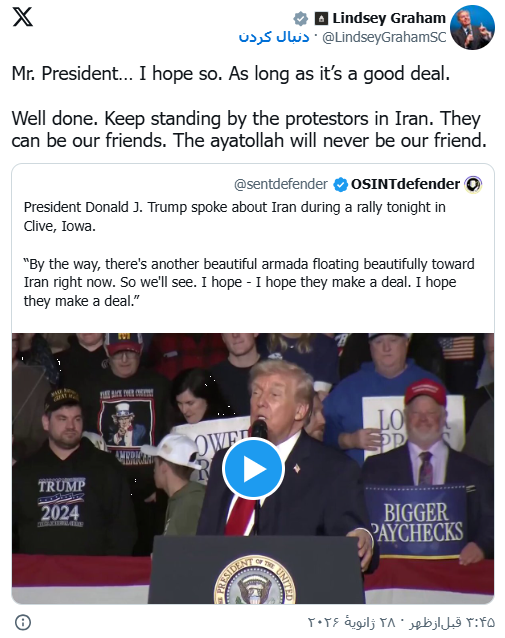
Graham Backs Trump’s “Armada” Message: “Iranians Can Be Our Friends”

U.S. Senator Lindsey Graham reposted President Donald Trump’s remarks about “another” U.S. naval armada moving toward Iran and urged Trump to keep backing Iran’s protesters, writing on X: “They can be our friends. The ayatollah will never be our friend.” Trump, speaking in Iowa on Tuesday Jan. 27, 2026 (7 Bahman 1404), also said he hoped Iran would “make a deal,” as Washington continues to pair military signaling with pressure for negotiations.

Macron Draws a Line in the Arctic: France to Open Nuuk Consulate

President Emmanuel Macron said France will “stand by” Greenland, backing Denmark and Greenland’s sovereignty and territorial integrity, and confirmed France will open a consulate general in Nuuk as a political signal of solidarity amid rising Arctic tensions.


MAGA Base War-Skepticism Erodes as Iran Tops Strike Support — Politico Poll

A new Politico poll suggests Donald Trump’s voter base within the MAGA movement—long identified with opposition to U.S. entanglement in foreign wars—is increasingly backing military action against a wider set of countries, led by Iran. According to the survey, 65% of Trump voters support U.S. military action against at least one of several potential targets, including Iran, Greenland, Cuba, Colombia, China, and Mexico. Iran stands out as the most prominent scenario: it recorded the highest support among all listed foreign targets, with 61% of MAGA supporters backing potential military action against Iran.

Wallström Pushes EU to Blacklist IRGC as France Shifts Stance

Former Swedish foreign minister Margot Wallström said she hopes the European Union will move to designate Iran’s Islamic Revolutionary Guard Corps (IRGC) as a terrorist organisation, welcoming what she described as a shift in France’s position toward backing an EU listing. Ahead of an EU foreign ministers’ meeting expected to take place tomorrow, Wallström said she hopes the gathering results in a final decision to blacklist the IRGC. She also argued there is a direct link between the Islamic Republic and the continuation of the war in Ukraine, saying weapons sent from Iran to Russia are helping prolong the conflict. Her comments come as political pressure inside the EU has been rising in recent days to tighten measures on Tehran and expand sanctions, including through a potential IRGC terrorist designation.

Ex-US Envoy: Trump Pressure Track on Iran Likely Ends in Strikes

Dan Shapiro, the former U.S. ambassador to Israel, said the odds of a diplomatic deal between Washington and Tehran are “very low,” arguing that even if the Islamic Republic were to hypothetically accept terms such as zero enrichment, strict limits on its missile program, and ending support for regional proxies, the concessions it would seek after a bloody crackdown on protesters would be politically and morally untenable. Shapiro added that after threatening force and deploying substantial military capabilities to the region, President Donald Trump now faces narrowing options—on a path that, in his words, is “more likely to end in military attacks.” He also said that scenarios involving targeting top Iranian leadership alongside other key regime assets remain part of Washington’s plausible calculations and warned that a turn toward diplomacy framed around “threat of force” is unlikely to produce a durable agreement given the sharply higher cost of any compromise with Tehran.

Metsola: Europe Has a “Historic” Duty to List the IRGC

European Parliament President Roberta Metsola urged the EU to finally designate Iran’s Islamic Revolutionary Guard Corps (IRGC) as a terrorist organisation, arguing Europe has a “historic opportunity” and a “moral duty” to act. Writing on X, she said the move would not be merely symbolic, and called for moral clarity and leadership in response to repression in Iran—adding that Iranians living under crackdown are watching Europe, that those killed deserve justice, and that “oppressors” should have no safe haven.

Israel Urges EU to Terror-List IRGC, Citing Iran Crackdown

Israel’s foreign minister, Gideon Sa’ar, called on the European Union to designate Iran’s Islamic Revolutionary Guard Corps (IRGC) as a terrorist organisation, welcoming France’s reported support for such a move and arguing the IRGC is playing a central role in violent repression inside Iran. Sa’ar urged EU governments to translate political momentum into a formal listing, framing it as both a security step and a signal of solidarity with Iranians facing intensified crackdowns.

IRGC Spokesman: “Military Option Has Failed”

IRGC spokesperson Ali Mohammad Naeini said the “military option” against Iran has failed, claiming the Guard has plans for “all U.S. scenarios” and is “in control of the battlefield.” He also argued White House officials are operating in a state of “confusion and helplessness,” framing Tehran’s posture as prepared for escalation while projecting deterrence.

Israeli Think Tank: If Trump Holds Back, Israel May “Eliminate” Khamenei

The Jerusalem Center for Security and Foreign Affairs (JCFA) wrote that senior Israeli security officials fear a “historic opportunity” to replace Iran’s ayatollah-led system could be lost if U.S. President Donald Trump refrains from striking Iran, arguing Israel previously missed a chance during the June 2025 “12-day war” to take out Iran’s top leadership. The piece cites a “senior political source” claiming that if Washington does not replace the current leadership in Tehran, Israel could be forced to “eliminate” Ali Khamenei itself, while also portraying Prince Reza Pahlavi as a symbolic option for transitional leadership and warning that without leadership change Israel may face repeated confrontations to contain Iran’s nuclear and missile rebuild.

Rubio: Post-Supreme Leader Iran “Complex”; U.S. Keeps Pre-emptive Defense Option

U.S. Secretary of State Marco Rubio said Iran’s power structure is split between the Supreme Leader, the IRGC, and nominally elected institutions—but that key decisions ultimately run through the Supreme Leader—arguing there is “no simple answer” for what comes next if the Supreme Leader and the regime were to fall, beyond the hope that someone within the system could help steer a transition. He warned any major change after decades of entrenched rule would require careful, cautious planning, while stressing the U.S. must maintain a credible regional posture: Rubio told a Senate hearing that 30,000–40,000 U.S. troops are spread across eight or nine facilities in the Middle East and are within range of Iran’s drones and short-range ballistic missiles, adding the President “always reserves” a pre-emptive defensive option if there are indications of an imminent attack. Rubio also pointed to U.S. security commitments—including to Israel—and said that despite Iran’s economic deterioration, Tehran has still amassed “thousands and thousands” of ballistic missiles, which he framed as a direct threat to U.S. forces and partners.

Merz: Iran Regime’s “Days Are Numbered”

German Chancellor Friedrich Merz said on Wednesday (Jan. 28) that the Islamic Republic—“a regime that can only hold onto power through sheer violence and terror against its own population”—has its “days numbered,” adding it “could be a matter of weeks” and arguing the government has “no legitimacy” to rule Iran. The remarks were made at a press conference in Berlin, reflecting a sharper European tone as debate grows inside the EU over new Iran-related measures.

Pompeo: Don’t Count on a Deal—Only Pressure Moves Tehran

Former U.S. Secretary of State Mike Pompeo said Washington should not expect a workable agreement with the Islamic Republic, arguing Iran’s leadership only backs down when confronted with force and sustained pressure. In remarks aired by Fox News and amplified in a post on X, Pompeo wrote that Tehran may claim it wants a deal, but any arrangement that keeps the regime in power is “inherently incompatible” with regional security—adding that it is “not a regime you can negotiate with.” He also welcomed the deployment of U.S. naval assets toward Iran and called for maintaining strong external pressure to help Iranians inside the country determine their own future.

Prague Push: U.S. Rallies 40 Nations to Enforce Re-imposed UN Iran Sanctions

The U.S. State Department said the United States and 40 partner countries met last week in Prague, Czech Republic, for a symposium aimed at advancing implementation of re-imposed UN Security Council resolutions on Iran. Participants discussed the full range of issues tied to how UN member states carry out these renewed obligations, and the meeting was used to secure commitments from several countries seeking country- and sector-specific technical security assistance from the U.S. to maximize sanctions effectiveness. The symposium also addressed threats linked to Iran’s nuclear activities, ballistic missiles, and conventional arms, with Washington arguing that Iran’s continued threat posture and violent suppression of protests make broad, urgent enforcement of UN measures and related restrictions necessary.

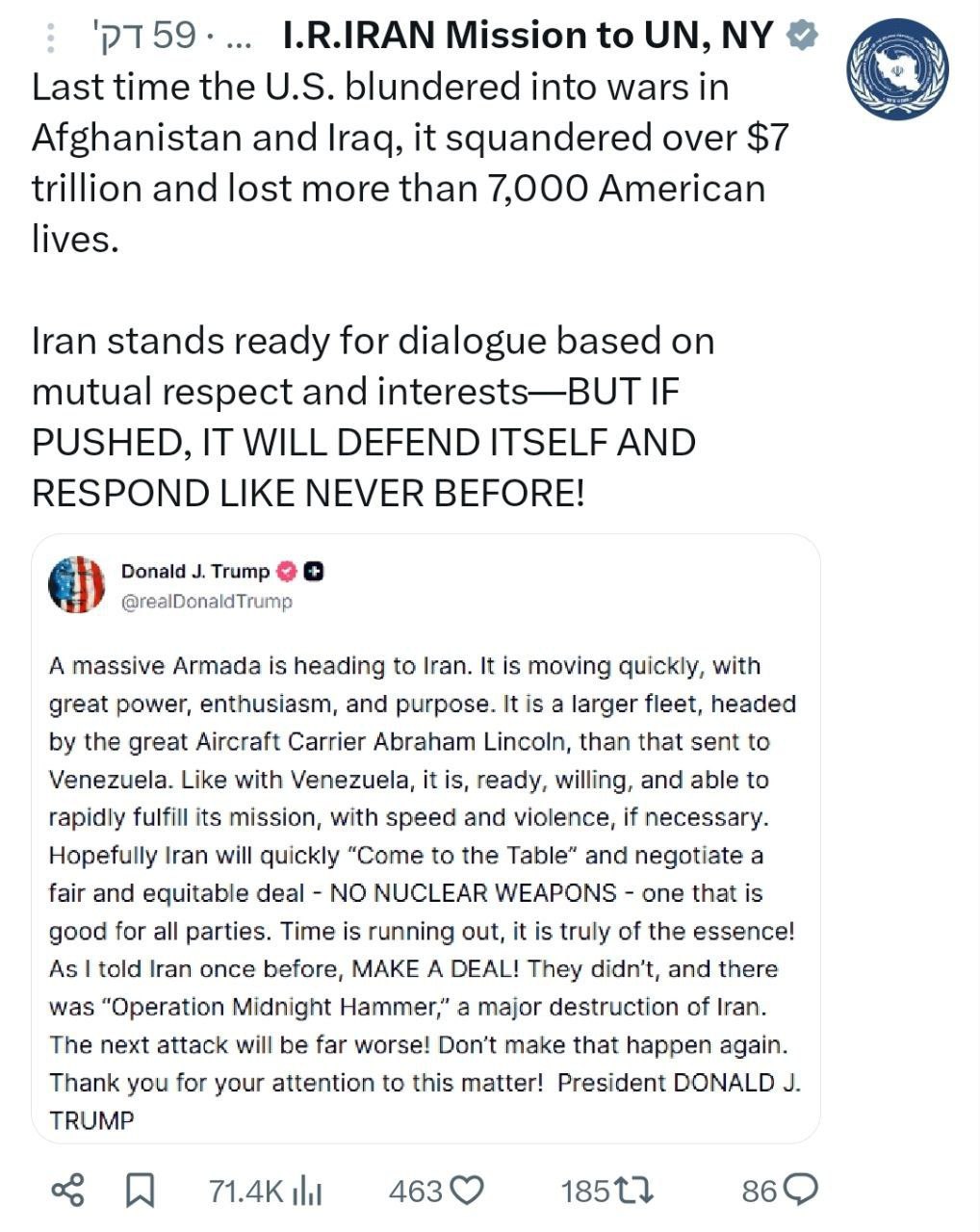
Iran’s UN Mission to Trump: “Talks, But If Pushed—Unprecedented Response”

Iran’s mission to the United Nations reacted to President Donald Trump’s latest threat—where he claimed a “massive armada” is heading toward Iran and urged Tehran to “make a deal”—by warning against another U.S. war in the region. The mission said the last time the U.S. “blundered” into wars in Afghanistan and Iraq it spent over $7 trillion and lost more than 7,000 American lives, adding that Iran is ready for dialogue based on mutual respect and interests, but if provoked it will defend itself and respond “like never before.”


Rubio: 30–40k U.S. Troops at 8–9 Middle East Sites; “Preemptive” Option on the Table

U.S. Secretary of State Marco Rubio said 30,000–40,000 U.S. military personnel are stationed across eight to nine bases/facilities in the Middle East, warning they are within range of Iran’s drones and short-range ballistic missiles. He added that the U.S. would maintain sufficient capability to defend those forces and that the President keeps a “preemptive” defensive option—meaning if Washington receives credible intelligence of an imminent Iranian attack, it could move first to protect U.S. troops and assets.

Signals Buildup: Rivet Joint Lands at Al Udeid as European Airlift Moves East

Flight-tracking data and defense reporting show a U.S. Air Force RC-135V Rivet Joint intelligence aircraft has arrived at Al Udeid Air Base in Qatar, adding airborne signals-intelligence capacity as U.S. forces reposition in the region. Separately, flight-tracking observers also reported British, Spanish, Italian, and German military transport aircraft heading toward the Middle East—moves typically associated with logistics flow, personnel/equipment lift, and coalition readiness—though those specific airlift claims rely on open-source tracking accounts rather than official announcements.

Putin Congratulates Syria’s Interim Leader on “Euphrates Reunification”

Russian President Vladimir Putin congratulated Syrian interim President Ahmad al-Sharaa on what Moscow described as progress in restoring Syria’s territorial integrity, including the reintegration of areas in the Euphrates region/east of the Euphrates back under Damascus’s control. The remarks came during talks in Moscow that also focused on Syria’s reconstruction and the future of Russia’s military footprint in the country, with the Kremlin framing the territorial consolidation as a significant step in stabilizing Syria after years of fragmentation.

More Political news

Equities

Louis Vuitton ADR Posts Mixed Q4 2025, Misses EPS but Beats Revenue

Louis Vuitton ADR (LVMUY) reported EPS of $2.49, falling short of expectations of $3.29, while revenue came in at $27.15B, above forecasts of $25.91B. The combination points to stronger-than-expected top-line delivery but weaker profitability versus consensus, suggesting margin pressure and/or an unfavorable mix offset solid sales performance. LVMUY’s market capitalization stands at $351.3B, with investors likely focused on margin recovery signals and demand resilience across key luxury categories into 2026.

Louis Vuitton Posts Solid Q4 2025, Beats EPS as Revenue Meets Expectations

Louis Vuitton (0HAU) reported EPS of 10.42, topping expectations of 9.95, while revenue came in at 41.05B, exactly matching forecasts of 41.05B. The result points to a profitability outperformance despite a top line that was precisely in line with consensus, suggesting stronger margins and operating discipline helped lift earnings above expectations. The company’s market capitalization stands at 292.9B, with investors likely focused on margin sustainability and demand trends across key luxury categories as 2026 unfolds.

UnitedHealth Posts Mixed Q4 2025, EPS In Line but Revenue Misses

UnitedHealth (UNH) reported EPS of $2.11, exactly matching expectations of $2.11, while revenue came in at $113.2B, below forecasts of $113.73B. The print signals a quarter that met the earnings bar but came in slightly light on the top line, suggesting revenue momentum was a touch softer than consensus assumed, even as profitability held steady. UnitedHealth’s market capitalization stands at $256.08B, with investors likely watching medical cost trends, membership dynamics, and any guidance signals for 2026.

Boeing Stuns in Q4 2025, Massive EPS Swing and Strong Revenue Beat

Boeing (BA) reported EPS of $9.92, crushing expectations of -$0.45, while revenue jumped to $23.9B versus $22.4B forecast. The result marks a dramatic profitability upside versus consensus alongside a clear top-line beat, pointing to a far stronger quarter than the market had priced—likely reflecting improved commercial delivery/production dynamics and operating leverage through the period. Boeing’s market capitalization stands at $191.91B, with investors now focused on whether this earnings inflection is sustainable and what it implies for 2026 execution.

NextEra Energy Misses Q4 2025 Estimates, EPS and Revenue Fall Short

NextEra Energy (NEE) reported EPS of $0.54, below expectations of $0.56, while revenue came in at $6.5B, under forecasts of $6.78B. The double miss signals a softer quarter than consensus anticipated, with both profitability and the top line landing below market assumptions. NextEra’s market capitalization stands at $181.5B, and investor focus is likely to shift to management’s 2026 outlook, project execution, and any signals on rate/regulatory dynamics and renewable build-out pacing.

General Motors Posts Mixed Q4 2025 Results, Beats EPS but Misses Revenue

General Motors (GM) reported EPS of $2.51, beating expectations of $2.24, while revenue came in at $45.29B, below forecasts of $45.88B. The print suggests profitability outperformed consensus assumptions despite a slightly softer top line, implying margins and cost discipline helped offset a modest revenue shortfall versus expectations. GM’s market capitalization stands at $78.09B, with investors likely focused on pricing/volume trends, EV profitability progress, and 2026 guidance signals.

American Airlines Misses Q4 2025 Estimates, EPS and Revenue Come Up Short

American Airlines (AAL) reported EPS of $0.16, well below expectations of $0.38, while revenue came in at $14.0B, slightly under forecasts of $14.04B. The miss across both earnings and the top line signals a softer quarter than consensus anticipated, with profitability notably weaker versus market assumptions, even as revenue was only marginally light. America’s market capitalization stands at $8.95B, and investors will likely focus on cost trends, unit revenues, and 2026 outlook commentary.

SpaceX IPO Talk Turns “Celestial”: June 2026 Window Floated

Elon Musk has floated timing SpaceX’s initial public offering for mid-June 2026—reportedly to coincide with a planetary alignment and his birthday—as the company’s CFO Bret Johnsen has held calls with existing private investors since mid-December to gauge appetite and discuss timing, the Financial Times reported. The same report (as relayed by Reuters) says SpaceX has discussed an IPO that could seek up to ~$50bn and imply a valuation around ~$1.5tn, though SpaceX has not confirmed the plans publicly.

Volvo A Stumbles in Q4 2025, Misses EPS and Revenue by a Wide Margin

Volvo A (VOLVAs) reported EPS of 4.73, well below expectations of 8.29, while revenue came in at 123.8B versus 237.91B forecast. The scale of the miss on both earnings and the top line signals a materially weaker quarter than the market had priced in, pointing to significant pressure on demand, pricing, and/or profitability versus consensus assumptions. Volvo’s market capitalization stands at 626.51B, with investors likely focused on whether the weakness is cyclical, company-specific, or tied to a sharper-than-expected slowdown in end markets heading into 2026.

AT&T Delivers Strong Q4 2025, Beats EPS and Revenue Estimates

AT&T (T) reported EPS of $0.52, topping expectations of $0.46, while revenue came in at $33.5B versus $32.87B forecast. The beat on both earnings and the top line points to a firmer quarter than consensus anticipated, suggesting solid operational execution and steadier demand across the core telecom business. AT&T’s market capitalization stands at $170.29B, with investors likely focused on subscriber trends, ARPU dynamics, and cash-flow durability as 2026 unfolds.

Progressive Posts Mixed Q4 2025 Results, Beats EPS but Misses Revenue

Progressive (PGR) reported EPS of $5.02, beating expectations of $4.43, while revenue came in at $19.51B, below forecasts of $20.31B. The combination suggests profitability outperformed consensus assumptions despite a softer top line, implying underwriting margin strength, favorable loss trends, and/or expense discipline helped offset revenue coming in light versus expectations. Progressive’s market capitalization stands at $123.15B, with investors likely focused on pricing momentum, loss-cost trends, and margin sustainability into 2026.

Starbucks Posts Mixed Q4 2025 Results, Misses EPS but Beats Revenue

Starbucks (SBUX) reported EPS of $0.56, below expectations of $0.59, while revenue came in at $9.9B, above forecasts of $9.62B. The combination points to better-than-expected top-line delivery but weaker profitability versus consensus, suggesting margin pressure—potentially from costs, mix, or promotional intensity—offset stronger sales. Starbucks’ market capitalization stands at $112.78B, with investors likely focused on margin recovery signals, traffic trends, and management’s 2026 outlook.

New Oriental Education Beats Q4 2025 Estimates, Tops EPS and Revenue

New Oriental Education (9901) reported EPS of 0.351, beating expectations of 0.2662, while revenue came in at 9.29B versus 9.01B forecast. The beat across both earnings and the top line points to a stronger quarter than consensus anticipated, suggesting solid demand and operating execution through the period. The company’s market capitalization stands at 72.96B, with investors likely focused on growth durability and margin trajectory into 2026.

MSCI Posts Solid Q4 2025, Beats EPS and Revenue Estimates

MSCI (MSCI) reported EPS of $4.66, topping expectations of $4.58, while revenue came in at $822.5M versus $820.45M forecast. The modest beat across both earnings and the top line suggests steady execution, with results slightly outperforming consensus assumptions as demand for index, analytics, and related data services remained resilient. MSCI’s market capitalization stands at $44.93B, with investors likely focused on subscription growth, retention, and margin durability into 2026.

Teva ADR Delivers Strong Q4 2025, Beats EPS and Revenue Estimates

Teva ADR (TEVA) reported EPS of $0.96, beating expectations of $0.65, while revenue came in at $4.71B versus $4.33B forecast. The upside across both earnings and the top line signals a materially stronger quarter than consensus anticipated, pointing to improved profitability and firmer sales execution versus market assumptions. Teva’s market capitalization stands at $36.47B, with investors likely focused on the sustainability of the earnings rebound and the outlook for key products into 2026.

VF Corp Beats Q4 2025 Estimates, Tops EPS and Revenue

VF Corp (VFC) reported EPS of $0.58, beating expectations of $0.45, while revenue came in at $2.88B versus $2.75B forecast. The beat across both earnings and the top line points to a stronger quarter than consensus anticipated, suggesting improved execution and profitability versus market assumptions. VF’s market capitalization stands at $7.29B, with investors likely focused on whether the momentum is sustainable and how the company navigates demand and inventory dynamics into 2026.

More Equities news

Commodities

API Signals Surprise Crude Draw Ahead of EIA

The API’s weekly report for the week ended Jan. 24 showed U.S. crude inventories fell by 0.247 million barrels, versus expectations for a +1.450 million build and after the prior week’s +3.040 million build. The unexpected draw is a near-term bullish signal for oil, hinting at tighter balances versus forecasts—though traders will look to the official EIA data for confirmation.

Oil Extends Gains as Storm Disruptions and Mideast Risk Premium Linger

Oil prices pushed higher on Wednesday as supply concerns persisted after a winter storm disrupted U.S. crude output and exports, while Middle East tensions added support. Brent rose 28 cents (+0.4%) to $67.85/bbl by 04:10 GMT, and WTI gained 35 cents (+0.6%) to $62.74/bbl; both benchmarks had surged about 3% on Tuesday. Reuters cited storm-related losses of as much as ~2 million bpd (around 15% of U.S. output) and interruptions to Gulf Coast export flows as key near-term drivers.

Storm Shock Keeps Oil Bid as Gulf Exports Hit “Zero” and Tengiz Stumbles

Oil’s rally is being underpinned by fresh supply fears after the U.S. winter storm knocked up to ~2 million bpd (about 15%) of national output offline over the weekend, while crude and LNG exports from U.S. Gulf Coast ports fell to zero on Sunday, according to Vortexa. Additional support is coming from Kazakhstan, where the Tengiz oilfield is expected to restore less than half of normal output by Feb. 7 after a fire and power outage—tightening balances at the margin even as analysts warn selling pressure could return once disruption risks fade.

OPEC+ Set to Extend Supply Freeze Into March

OPEC+ is expected to keep its pause on planned oil output increases for March at a Feb. 1 meeting, according to multiple delegates, reinforcing a “wait-and-see” stance despite January’s price rebound. The decision would keep near-term supply growth capped as the group weighs weak demand forecasts alongside fresh disruption risk—most notably reduced output in Kazakhstan—while markets watch whether tightening headlines outweigh lingering concerns about a potential surplus later in 2026.

Silver and Platinum Hold Near Records as Precious-Metals Rally Broadens

Spot silver rose 1.3% to $114.67/oz, while spot platinum added 0.6% to $2,669.61/oz, keeping both metals close to record highs. The gains suggest the broader precious-metals complex remains well-bid, with investors still leaning into hard assets amid elevated macro and geopolitical risk—despite the market’s recent bouts of sharp, intraday volatility.

Gold Targets $5,300 as Trump’s Iran “Armada” Talk Fuels Haven Rush

Spot gold pushed through $5,200 and set a fresh record around $5,266/oz, with traders increasingly eyeing the $5,300 level as geopolitical risk stays elevated. Safe-haven demand has been reinforced by President Donald Trump’s comments about U.S. naval assets heading toward Iran—followed by remarks about another “armada”—alongside broader U.S. policy uncertainty that has repeatedly injected geopolitical risk premium this year, from the Greenland tariff dispute to the Venezuela episode.

EIA Confirms Crude Draw as Refinery Runs Slide

The EIA’s weekly report for the week ended Jan. 24 showed a clear tightening in crude balances, with crude oil inventories falling -2.295M barrels versus expectations for a -0.200M draw, reversing from a +3.602M build previously. Cushing stocks also declined (-0.278M), while crude imports fell -1.706M, helping explain the headline draw. On products, gasoline inventories rose +0.223M (well below the +1.300M expected after a +5.977M prior surge), while distillate stocks increased +0.329M versus an expected -0.550M draw. Refining activity softened: utilization fell -2.4pp w/w (vs -2.0pp expected) and crude runs dropped -0.395M bpd, indicating reduced processing throughput—consistent with winter impacts and maintenance dynamics.

More Commodities news

Forex

Dollar Rout Deepens After Trump Shrugs It Off

A fresh wave of dollar selling gathered pace after Donald Trump brushed off the greenback’s slide, telling reporters the dollar was “doing great,” a comment traders read as tolerance for a weaker exchange rate. The move pushed the euro above $1.20 for the first time in more than 4.5 years and drove the Swiss franc to a 10-year high; while a modest rebound is underway, investors say the Trump-era risk around USD exposure is becoming clearer. Geopolitics, policy uncertainty, hints that Washington prefers a lower dollar, and renewed worries about Federal Reserve independence helped pull the dollar index down more than 9% in 2025.

Sterling Pauses After 2021-High Breakout

Sterling eased 0.33% to $1.3796, giving back a small part of the prior session’s surge after it jumped 1.2% and hit its highest level since 2021. The pullback looks like a typical post-breakout consolidation rather than a full reversal, with traders watching whether the move can hold above nearby support levels.

Trump Shrugs, Dollar Sinks: DXY Near a 4-Year Low

Donald Trump said the dollar was “great” when asked if it had fallen too much, and traders took the nonchalance as a green light to press short-USD positions. The dollar index (DXY) slid toward the 95.9–96.1 area after briefly plumbing a four-year low around 95.566, leaving the greenback down more than 9% in 2025 and already about 2.3% lower in January as investors weigh trade-policy volatility, geopolitical uncertainty, worries over Fed independence, and the implications of expanding U.S. fiscal deficits.

Yen Pops on Intervention Chatter, Then Cools as Dollar Volatility Lingers

The yen surged more than 1% to a three-month high of 152.10 per dollar on Tuesday as broad dollar weakness intensified, before easing 0.4% to 152.79 on Wednesday in a modest consolidation. The move has been amplified by renewed talk of U.S.–Japan “rate checks”—often seen as a precursor to official FX intervention—after a New York Fed check last week and rising coordination rhetoric from Tokyo, keeping USD/JPY traders on high alert even as spot pulls back from the highs.

Aussie, Kiwi Pull Back as Dollar Stabilises Ahead of Fed

The Australian dollar eased 0.34% to $0.6987, and the New Zealand dollar fell 0.5% to $0.6015, giving back some gains as the U.S. dollar found a footing after a Trump-triggered selloff. The Aussie had earlier touched $0.70225—its highest since February 2023—after hotter inflation data lifted expectations of an RBA hike, but broader FX trading remained dominated by the Fed event risk and the dollar’s sharp slide and partial rebound.

More Forex news

Europe

Germany Consumer Mood Improves, But Stays Deeply Negative

Germany’s GfK Consumer Climate index rose to -24.1 for February, beating expectations (-25.5) and improving from -26.9 previously. The uptick signals a modest lift in household sentiment, but the level remains deeply negative—suggesting consumers are still cautious on spending and the outlook despite the incremental improvement.

Swiss ZEW Expectations Flip Negative, Signaling a Deteriorating Outlook

Switzerland’s ZEW Expectations index dropped to -4.7 in January from +6.2 previously, swinging into negative territory and pointing to a clear weakening in sentiment among surveyed financial-market experts. The shift suggests the near-term economic outlook has turned more cautious—often consistent with rising uncertainty and softer growth expectations.

Italy Business Confidence Improves, While Consumers Stay Cautious

Italy’s business confidence edged up to 89.2 in January (vs 89.0 expected, 88.5 prior), signaling a modest improvement in the corporate mood. Consumer confidence also ticked higher to 96.8 (vs 97.0 expected, 96.6 prior), but still came in slightly below forecasts—suggesting households are stabilizing, yet remain relatively cautious.

Italy Bills Steady; Germany’s 10Y Bund Clears Slightly Higher

Italy’s latest 6-month BOT auction was essentially unchanged, with the yield at 2.040% versus 2.036% previously—signaling stable short-end funding conditions. Germany’s 10-year Bund auction cleared at 2.850%, up from 2.830%, pointing to a modest uptick in long-end yields and a slightly firmer term-premium tone.

More Europe news

USA

Hedge the Dollar, Keep the Stocks: Big Money Reprices FX Risk

As TD Securities’ Prashant Newnaha put it, the problem for overseas investors is simple: you can earn ~4% in Treasuries and still lose ~10% on the currency if the dollar slides. That logic is starting to show up in real allocation behavior—Reuters reported that Australia’s second-largest pension fund, Australian Retirement Trust (ART), is reducing U.S. dollar exposure via heavier FX hedging while maintaining its U.S. investments, a playbook that helps explain how equities can keep grinding to record highs even as FX swings get more violent.

US Mortgage Rates Rise, Applications Slide as Refi Boom Cools

The MBA’s 30-year mortgage rate ticked up to 6.24% from 6.16%, triggering a sharp pullback in demand. Mortgage applications fell -8.5% w/w after a +14.1% surge previously, while the purchase index dipped to 193.3 (from 194.1). The rate move hit refinancing hardest: the refinance index dropped to 1,332.2 (from 1,580.8), and the broader mortgage market index slid to 363.3 (from 397.2). The data suggest that housing finance conditions remain highly rate-sensitive, with activity cooling quickly when yields rise.

Fed Holds at 3.75%—But Two Officials Wanted Another Cut

The Federal Reserve kept the fed funds target range unchanged at 3.50%–3.75% (upper bound: 3.75%), matching expectations and the prior setting, as it pointed to “solid” economic growth, low job gains with signs of stabilization in unemployment, and inflation still “somewhat elevated.” The vote was 10–2, with Stephen Miran and Christopher Waller dissenting in favor of a 25 bp cut—a notable split that keeps markets focused on the timing of the next move and the balance between sticky inflation and cooling labor momentum.

More USA news

Others

Super Heavy Roars: Musk Posts Raptor “Mega-Fire” Footage

Elon Musk shared new footage of SpaceX testing its Super Heavy booster, showing dozens of methane-fueled Raptor engines firing at once—essentially a near-full cluster for the 33-engine first stage of Starship. At full throttle, Super Heavy is designed to deliver more than ~16 million pounds of thrust (≈7,300 tons-force), making it the most powerful booster stage by thrust and a key step toward SpaceX’s rapid-reuse launch cadence.


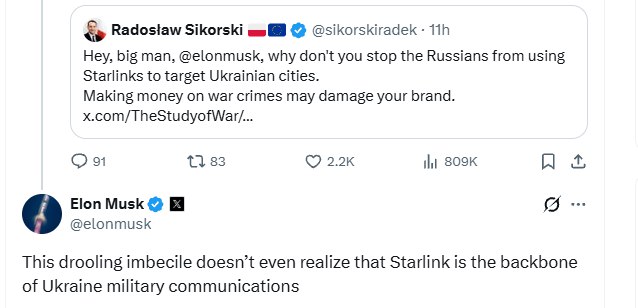
Musk Calls Poland’s FM a “Drooling Imbecile” in Starlink Row

Elon Musk lashed out at Poland’s Foreign Minister Radosław Sikorski after Sikorski urged him to stop Russians from using Starlink to target Ukrainian cities and warned that “making money on war crimes” could damage Musk’s brand. Musk replied that Sikorski “doesn’t even realize” Starlink is “the backbone of Ukraine military communications,” escalating the public dispute over how Starlink is used in the war and sharpening the political and reputational pressure around the service.

Brazil FX Flows Improve, But Stay Negative

Brazil’s foreign exchange flows came in at -$0.638B, still in net outflow territory but less negative than the prior -$1.696B. The improvement suggests reduced near-term capital pressure on the real, though persistent negative prints would still signal an ongoing drain of foreign currency liquidity.

More Others news

Oceania

Australia Inflation Reheats as CPI and Core Beat Forecasts

Australia’s inflation read came in hotter than expected, with headline CPI rising 3.6% y/y in December (vs 3.4% forecast, 3.5% prior) and the monthly CPI indicator accelerating to 3.8% y/y (vs 3.5% expected, 3.4% prior). Under the hood, trimmed mean CPI—the RBA’s preferred core gauge—printed 0.9% q/q in Q4 (vs 0.8% expected, 1.0% prior) and 3.4% y/y (vs 3.0% expected), reinforcing “sticky” underlying pressures even as the weighted mean CPI showed a mixed profile (3.2% y/y vs 3.4% prior, but 0.9% m/m vs 0.3% expected). Overall, the package leans hawkish on the margin and keeps “higher for longer” risks in play.

More Oceania news

Cryptocurrency

X “Crypto Data” Push Sparks $7,000/Day Moon Hash Claims—But Verification Is Thin

A press-release style report circulating online says X’s added spotlight on crypto market data is driving interest in “Moon Hash” and even claims some users are earning up to $7,000 per day via Proof-of-Work “computing power” contracts—language that reads more like marketing than independently verified reporting. Public signals are mixed: Trustpilot flags the site as potentially tied to high-risk investments, while multiple third-party reviewers label it a scam risk; taken together, it’s a reminder that headline-grabbing yield claims in cloud-mining/“assetized hashrate” products warrant extra due diligence.

More Cryptocurrency news

India

India Factory Output Beats as IIP Surges, Keeping Growth Pulse Firm

India’s industrial production (IIP) rose 7.8% y/y in December, well above 5.5% expected and faster than the 7.2% prior pace, signaling a strong year-end push in activity. The cumulative industrial production measure also strengthened to 3.9% (from 3.3%), reinforcing the broader uptrend. Manufacturing output was reported up 8.1% m/m (vs 8.5% prior), still elevated despite a slight step-down. Overall, the mix is growth-positive and may keep markets cautious on how quickly policy can turn more supportive if momentum stays this firm.

More India news

Canada

BoC Holds at 2.25%, Keeping Policy Steady

The Bank of Canada left its policy rate unchanged at 2.25%, matching expectations (2.25%) and the prior decision (2.25%). The hold signals a continued wait-and-see stance as policymakers balance progress in cooling inflation against growth risks and financial-condition sensitivity.

More Canada news

Russia

Russia PPI Deflation Deepens, Signaling Weak Factory-Gate Pricing

Russia’s producer price index (PPI) fell -1.6% m/m in December, a steeper decline than the -0.9% prior reading, indicating accelerating factory-gate disinflation. On an annual basis, PPI was -3.3% y/y, well below the -1.1% expected, reinforcing the message that upstream pricing power remains weak—often a sign of softer demand and/or commodity-price effects feeding through to producers.

More Russia news