IFC Markets Live Quotes

Market news roundup: Saturday, 17 January 2026

105 short market news items, grouped by 3 sections.

Iran

Prince Reza Pahlavi Calls for Nightly 8 p.m. Chants in Iran, Jan. 17–19

Prince Reza Pahlavi urged Iranians to raise their voices each night from Saturday to Monday (27–29 Dey / Jan. 17–19, 2026), calling on people to chant national slogans at exactly 8:00 p.m. Iran time as a coordinated expression of anger and protest over the ongoing crackdown.

Iranians Rally in Darwin, Australia, to Support Iran’s National Revolution

Iranians living in Darwin, the capital of Australia’s Northern Territory, held a rally on Saturday in support of Iran’s national revolution. The gathering adds to a growing wave of diaspora demonstrations aimed at keeping international attention on the protests and honoring those affected by the crackdown.

Iranians in Barrie, North of Toronto, Rally With Canadian Officials, Raise Lion-and-Sun Flag in Solidarity With Iran

Iranian residents in Barrie, north of Toronto, held a solidarity event for Iran’s national revolution with the participation of provincial and federal Canadian lawmakers and ministers. Organizers said the gathering included raising the lion-and-sun flag in front of Barrie’s city hall as a public show of support for protesters in Iran.

Iran International: Quds Force and Allied Militias Played Key Role in Killings on 18–19 Dey

Iran International said it has obtained new details indicating the IRGC Quds Force and its regional allied proxies played a central role in the killing of Iranian protesters on 18–19 Dey. According to the report, Afghanistan’s Fatemiyoun Brigade, Pakistan’s Zeynabiyoun Brigade, and Iraq’s Hashd al-Shaabi were responsible for a significant share of the violence. Hassan Hashemian, an analyst of Arab affairs, told the outlet that Iranian authorities turned to foreign forces due to manpower shortages and because the scale of nationwide protests exceeded the capacity of domestic security units; he argued that claims of 12,000 to 20,000 killed over two days suggest these groups were deployed specifically to kill and drew on prior experience in Iraq and Syria.

Ynet: Iran Unrest Rattles the “Axis of Resistance” as Proxies Fear Losing the “Mother Ship”

Israeli outlet Ynet argues that the scale of Iran’s protests has put Tehran’s allies and regional proxy network into heightened anxiety, fearing that a collapse in Iran could weaken the entire “Axis of Resistance” and reshape regional balances. The analysis says Middle East reactions have been cautious, not out of indifference but out of calculation and concern—felt both by Iran-aligned groups and by regional rivals wary of spillover. Ynet describes the deepest alarm inside the Shiite core of the axis, including Hezbollah, built to project deterrence through a “ring of fire” around Israel and a “Shiite crescent,” but notes recent regional confrontations exposed major setbacks—citing heavy blows to Hezbollah and Hamas and the effective collapse of Bashar al-Assad’s government in Syria. The piece adds that unrest now touches the system’s “central core” in Tehran, and quotes analyst Danny Citrinowicz warning that a potential regime collapse could produce an “earthquake” comparable to 1979—likely leaving proxies weakened even if they do not disappear, while states harmed by Iran’s interventions could gain strength.

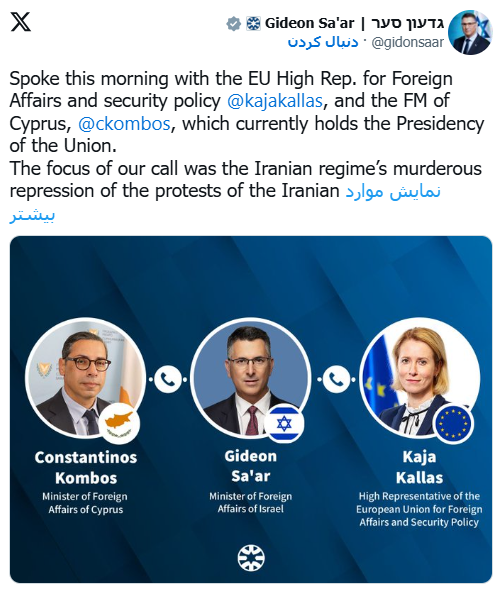
Sa’ar Says He Raised IRGC Terror Listing With EU’s Kallas and Cyprus FM Kombos

Israeli Foreign Minister Gideon Sa’ar said on Friday, 26 Dey, that he spoke by phone with EU foreign policy chief Kaja Kallas and Cyprus Foreign Minister Constantinos Kombos—whose country currently holds the EU Council presidency—about adding Iran’s Islamic Revolutionary Guard Corps (IRGC) to the EU’s terrorist list. The outreach comes as pressure grows inside Europe to harden measures against Tehran, and debate continues over whether the bloc should formally designate the IRGC as a terrorist organization.

Kurdistan Human Rights Network: No Word for Over a Week on Detained Teachers’ Activist Abdullah Rezaei

The Kurdistan Human Rights Network said it has been more than a week since the arrest of Abdullah Rezaei—a teachers’ union activist and board member of the Hersin Teachers’ Guild Association and Iran’s Coordinating Council of Teachers’ Trade Associations—without any information about his condition or whereabouts. Rezaei was detained on 18 Dey and transferred to an undisclosed location, in what the report links to the Coordinating Council’s support for Iran’s national revolution. The outlet noted Rezaei has previously been arrested multiple times over labor activism and faced judicial پرونده‌سازی. Separately, the “Professional Challenge of Iran’s Teachers” channel said security bodies and detaining institutions bear full responsibility for his safety and that any threats, torture, or harm would be directly attributable to those agencies. The same channel also reported that Abolfazl Rahimi-Shad, another teachers’ labor activist arrested in Tehran on 17 Dey, was released on 24 Dey.

Foreign Policy: Prince Reza Pahlavi Emerges as an “Unavoidable” Figure

Foreign Policy, in a report titled “Iran’s Crown Prince Has Become an Unavoidable Figure,” argues that Prince Reza Pahlavi has moved from a teenage exile to a prominent symbol of Iran’s political future as the Islamic Republic faces an unprecedented survival threat from a broad, nationwide protest movement. The piece notes that while some dismiss his rising popularity as nostalgia, it can also be read as youthful defiance from a globally connected, digitally fluent generation angered by the country’s imposed tragedies—alongside a deeper sense of regret among older Iranians.

Ottawa Rally: Iranian Demonstrators Meet U.S. Ambassador After Protest Outside Embassy

Iranians in Ottawa held a rally outside the U.S. Embassy in support of Iran’s national revolution. During the demonstration, the U.S. ambassador reportedly joined the crowd and then invited three representatives of the protesters into the embassy for a meeting. Participants described the discussion as warm, respectful, and constructive.

ABC: Pentagon Eyes Middle East Buildup, USS Abraham Lincoln Under Consideration

ABC News reports the Pentagon is expected to send additional military assets to the Middle East in the coming days—potentially including the USS Abraham Lincoln carrier strike group—framing it as a standard precaution given roughly 30,000 U.S. troops across the region. ABC says there is currently no U.S. aircraft carrier in the Middle East, though six Navy ships (including three missile destroyers) are in regional waters; officials said the added force would deter attacks on U.S. bases but also give President Donald Trump more options to strike Iran if he chooses, with any Lincoln deployment taking more than a week to arrive. Fox News separately reported that at least one U.S. aircraft carrier is already moving toward the region amid the deliberations.

London: Protester Raises Lion-and-Sun Flag at Iran’s Embassy During Ongoing Rallies

Iranian demonstrators gathered again on Friday outside the Islamic Republic’s embassy in London in support of Iran’s national revolution. Social-media images circulating from the scene show one protester climbing part of the embassy building and raising the lion-and-sun flag, a symbolic act increasingly used by diaspora rallies to signal opposition to the current regime.

Belgium’s Defense Minister: Prince Reza Pahlavi Could Help Unify Iranians During a Transition

Belgian Defense Minister Theo Francken said in a TV interview that Prince Reza Pahlavi could play a constructive role during a transition period by helping bridge Iran’s different political currents and supporting a path toward a democratic, secular Iran. Francken added that Iran’s future must be decided by Iranians themselves and that Europe’s role should be to support—not to dictate—while noting that, from a Western interest perspective, the emergence of a cooperative government and potential economic ties, especially in energy, would be significant.

Prince Reza Pahlavi: “Replace Silence With Action”—Says Iran Is Under “Foreign Occupation” Amid Proxy Role

Prince Reza Pahlavi said the Islamic Republic’s use of allied proxy forces in the crackdown amounts to Iran being under a form of “foreign occupation.” He urged the international community to “replace silence with action,” so Iranians have a real chance to prevail.

Iran Human Rights: “Martial-Law” Atmosphere Persists, Heavy Armed Presence After Dark

Iran Human Rights said Friday, 26 Dey, that reports it received indicate Islamic Republic security and military forces maintain a broad presence across cities and that a de facto “martial-law” environment takes hold after sunset. Citing an eyewitness who recently managed to leave Iran, the organization described Tehran and Karaj as unusually empty—“like ghost cities”—with residents angry and hoping for outside assistance, while armed forces stand on streets and alleys with live-fire weapons. The witness also reported night raids targeting Starlink satellite-internet receivers, describing surprise home searches—reported especially in parts of Tehran such as Punak, Narmak, and Haft-Hoz—where officers allegedly ransack homes while looking for terminals. Iran Human Rights added that in Kurdish regions, alongside the continued internet disruption, cities remain under a heavily militarized security posture with ongoing patrols and tight restrictions on SMS and phone calls.

Kurdpa: Iran-Backed Proxy Forces, Including Iraq’s Hashd al-Shaabi, Enter Kurdish Cities

Kurdpa reported that a heavy security and militarized atmosphere continues across Kurdish-populated areas, with widespread patrols by uniformed forces and plainclothes agents, and said Iran-aligned proxy elements—including Iraq’s Hashd al-Shaabi—have entered multiple cities. The report echoes earlier Iran International reporting that Tehran-linked Iraqi armed groups began recruiting fighters starting 13 Dey to support the Islamic Republic’s crackdown on protesters.

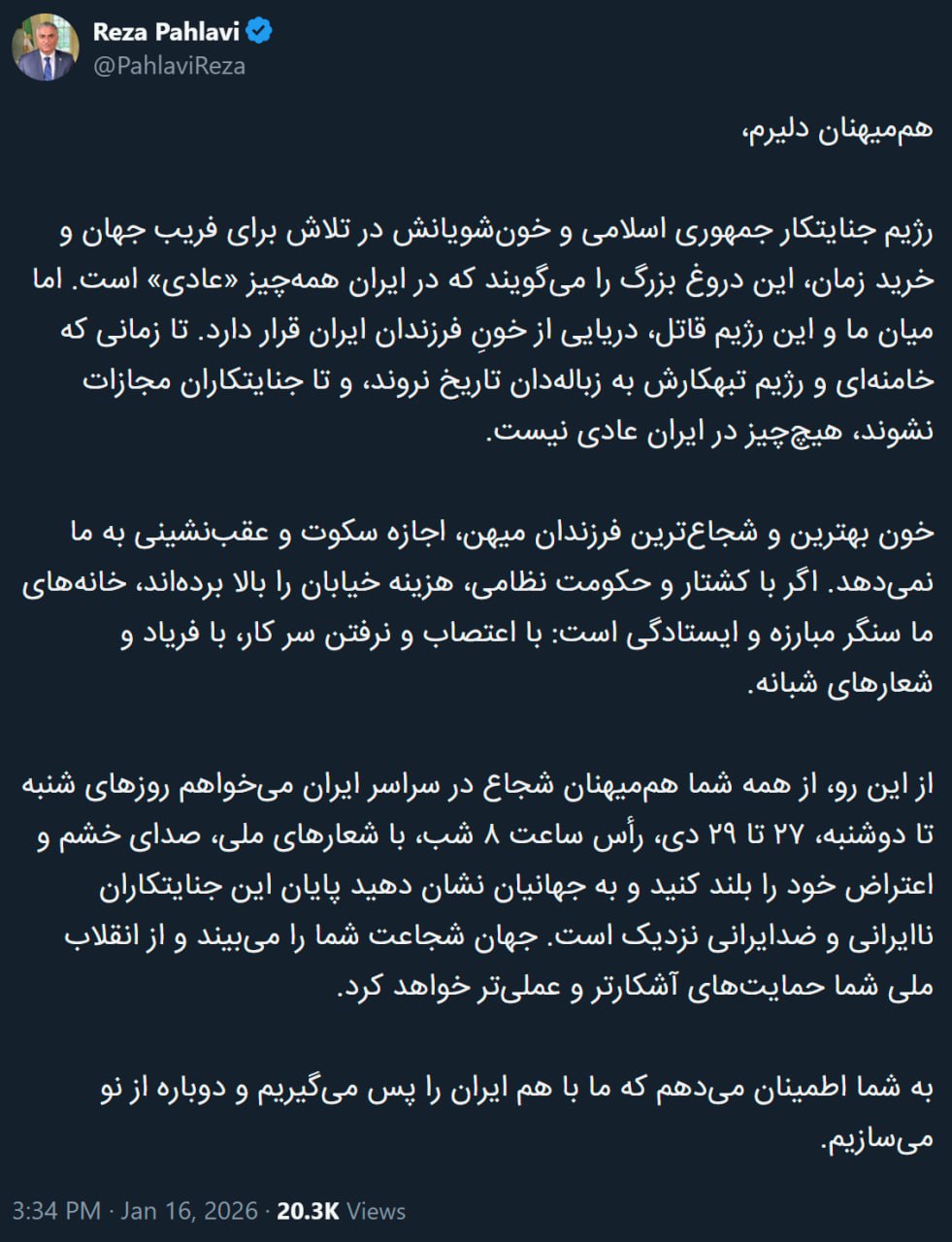
Prince Reza Pahlavi Calls for Nationwide 8 p.m. Chants, Jan. 17–19, to Amplify Protest “to the World”

Prince Reza Pahlavi urged Iranians to chant “national slogans” every night at 8:00 p.m. Iran time from Saturday through Monday (27–29 Dey / Jan. 17–19, 2026), saying the goal is to carry the public’s anger to the international community and signal that the “end” of what he called “anti-Iranian criminals” is near. Addressing “brave compatriots,” he argued that global audiences are watching and will move toward clearer, more practical support for Iran’s national revolution. He described the Islamic Republic as a “criminal regime” and said its officials are trying to deceive the world and buy time by portraying the situation as “normal,” insisting that “nothing will be normal” until Ali Khamenei and the ruling structure step aside and perpetrators are held accountable.

Tehran Protest Death Reported

Reports say Reza Eskandarpour, a 37-year-old citizen, was killed during the January 8 protests in Tehran’s Aryashahr district after being hit by six live rounds in what is described as direct fire from a rooftop sniper. The incident is being cited as part of the continued lethal crackdown on demonstrators.

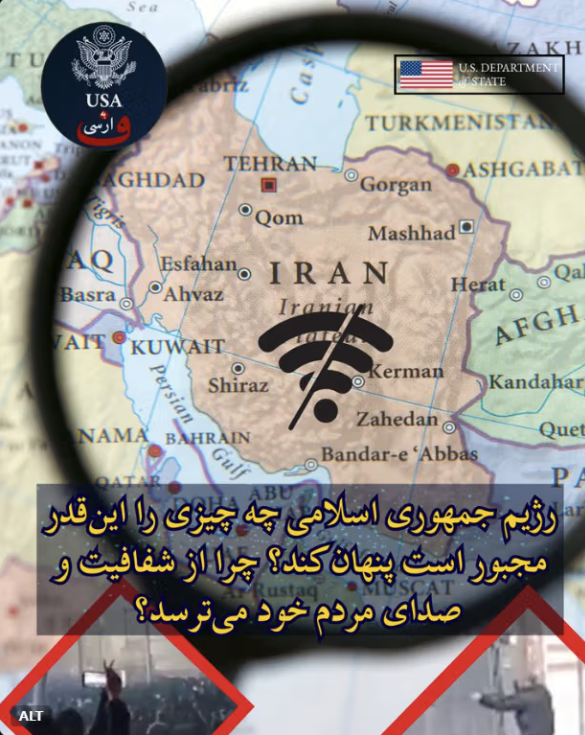
U.S. State Dept: Tehran Fears Transparency

The U.S. State Department’s Persian-language account on X said Iran’s continued internet shutdown reflects the Islamic Republic’s fear of transparency and public voices, citing a claim by a regime spokesperson that restrictions will last until Nowruz—extending an isolation period that Iranians have already endured for more than 216 hours. The post argued the move is deliberate, pushing millions further into information darkness, cutting them off from the world and from each other, and signalling a government focused on silence and isolation rather than addressing the country’s real challenges.

Curfews Tighten, Death Toll Claims Rise Across Iran

As forced shop closures and movement restrictions continue after the protests, messages from multiple cities describe an intensifying de facto martial-law posture—alongside reports of live fire and mounting fatalities that cannot be independently verified. In Qom, residents say curfews are being enforced with shops shut after 8 p.m.; in Rafsanjan, sources claim 45 protesters were killed and similar restrictions imposed. In Tehran’s Sattar Khan and Selsebil areas, residents report heavy use of tear gas in recent days. Reports also cite arson attacks in Karaj targeting a municipal building and a mosque, while in Kish, sources allege reinforcements were sent from Bandar Abbas after large crowds on the first day of Prince Reza Pahlavi’s call and that at least 30 people were killed with live rounds. In Pardis, a young man reportedly died on January 9 (19 Dey), and his family was allegedly asked for 700 million tomans to retrieve the body. In Dezful, messages claim 188 deaths, continued curfew conditions, and a ban on business activity, while additional reports from Khorasan Razavi and Shahsavar refer to transfers of bodies and pressure on families.

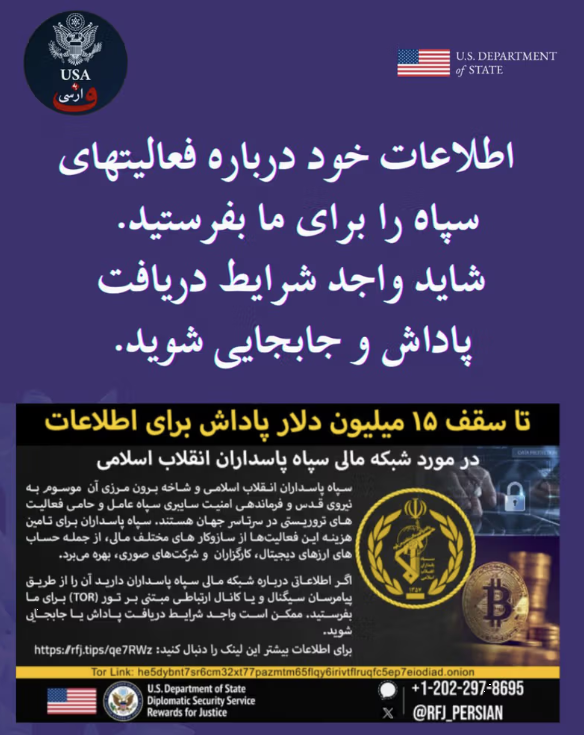
U.S. Call Targets IRGC Funding Networks

The U.S. State Department’s Persian-language account on X said the Islamic Republic spends billions of dollars of Iran’s wealth on the Islamic Revolutionary Guard Corps (IRGC), alleging the funds are used to suppress Iranians. The post urged people to help “cut off” the IRGC’s financial lifelines by sharing information about its activities, adding that individuals may be eligible for a reward and relocation.

Montreal Iranians Hold Candlelight Vigil for Protest Victims

A video shared with Iran International shows Iranians in Montreal, Canada, gathering alongside similar rallies worldwide to support fellow citizens and commemorate those killed in Iran’s national uprising. Participants reportedly lit candles and sang patriotic songs in a public show of solidarity.

Marvdasht Videos Show Alleged Live Fire at Protesters

Videos sent to Iran International—reported to be from January 8–10 (18–20 Dey)—appear to show protest gatherings in Marvdasht and security forces firing directly toward the crowd. The footage is being cited as further evidence of an intensifying crackdown during the latest wave of demonstrations.

Adelaide Rally Backs Iran’s Anti-Regime Uprising

Iranians in Adelaide, Australia, held a gathering in support of Iran’s national uprising against the Islamic Republic, with participants reportedly chanting and singing patriotic anthems as a public show of solidarity.

Aachen March Shows Diaspora Support for Iran Protests

Iranians living in Germany marched in Aachen on Saturday, January 17 (27 Dey), in support of Iran’s national uprising against the Islamic Republic, chanting slogans and staging a public demonstration of solidarity.

Copenhagen Rally Chants “Pahlavi Will Return”

Iranians in Copenhagen held a demonstration on Saturday, January 17 (27 Dey), in support of Iran’s national uprising against the Islamic Republic, chanting slogans backing Prince Reza Pahlavi and repeating the refrain, “Pahlavi will return.”

Former Political Prisoner Reported Killed in Mashhad Protests

Information shared with Iran International says Abbasali Ramazani, a veteran Mashhad civil activist and former political prisoner, was killed during Iran’s national uprising after being shot by security forces while attending large protests on Vakilabad Boulevard—reportedly while wearing an electronic ankle monitor. Ramazani was imprisoned in the 1980s and faced repeated arrests afterward; reports say he was detained in 2011 while trying to organize a Ferdowsi commemoration and held for more than seven months in solitary confinement. He was also arrested last summer to serve a three-year and seven-month sentence issued by Mashhad’s Revolutionary Court, reportedly linked to financial support for families of political prisoners and charges such as “propaganda” and “acting against the system.”

18-Year-Old Protester Reported Killed in Isfahan

Information shared with Iran International says Arshia Ahmadpour, an 18-year-old protester living in Baharestan, Isfahan, was killed on January 9 (19 Dey) after being shot by Islamic Republic security forces during demonstrations in the city. A relative said Ahmadpour was originally from Izeh, worked as a barber in Isfahan, and was also an athlete who trained in boxing.

Karaj Protest Death Reported; Victim Buried in Tehran

Information shared with Iran International says Mohammadreza Zamini, 41, was killed on January 9 (19 Dey) during protests in Golshahr, Karaj, after being hit by direct gunfire from government forces. Reports add that he was buried on January 13 (23 Dey) at Behesht Zahra cemetery in Tehran. Zamini was the father of a 17-year-old daughter and had previously worked in various jobs, including mobile phone sales.

Report: 45-Year-Old Mountaineer Killed in Rasht

IranWire reported that Sara Behboodi, a 45-year-old mountaineer, was killed during Iran’s national uprising after being hit by live ammunition fired by Islamic Republic security forces in Rasht on the evening of Friday, January 9 (19 Dey). The report adds she died from the gunfire during the ongoing crackdown on protests.

Yazd Businesses Reportedly Half-Shut Under “Martial-Law” Atmosphere

Messages sent to Iran International say daily life and bazaar activity in Yazd has slowed to a near standstill amid what residents describe as a “martial-law” environment, echoing similar reports from Tehran and other cities. Locals say many people are avoiding the streets due to repression and threats, while government forces are reportedly present in hospitals and medical centers. One account claims dozens have been forced to undergo eye removals after shootings, and that officials are preventing mourning ceremonies for those killed and demanding money from families to release bodies.

Witness Alleges “Unlimited Massacre” in Iran Protests

Meraj Tehrani, described by Iran International as an eyewitness to Iran’s national uprising, said in an interview that large crowds filled the streets and alleged an “unlimited massacre” by the Islamic Republic during the protests. Tehrani reportedly left the country after the January 8–9 demonstrations (18–19 Dey).

IRGC-Linked Media Defend Iran Internet Shutdown as “International Norm”

Tasnim, a news agency affiliated with the Islamic Revolutionary Guard Corps (IRGC), claimed Iran’s nationwide internet shutdown is “aligned with common international practices,” without specifying which international standards would justify a broad cutoff. Separately, Fars—another IRGC-linked outlet—reported that private chats and group activity on social platforms will be enabled only on domestic messaging apps.

Hezbollah Chief Blames Iran Protests on U.S., Israel

Naim Qassem, Hezbollah’s secretary-general, echoed Iranian officials by attributing Iran’s protests to the United States and Israel, arguing Washington does not want a “free system.” He said he views the Islamic Republic’s leadership as “strong and steadfast,” adding that Iran would remain a frontline of the so-called “resistance.” The term “Axis of Resistance” is used by Iranian officials and aligned media to refer to Tehran-backed armed groups in the region, including Hamas, Palestinian Islamic Jihad, Hezbollah, Iraq’s Popular Mobilization Forces, and Yemen’s Houthis.

Expert Warns Iran Moving Toward “Tiered Internet” and Cyber Psy-Ops

Sahar Tahvili, a researcher in IT and AI, told Iran International that Iran’s recent “managed” internet on-and-off disruptions appear to be part of a deliberate repression strategy aimed at controlling narratives, rather than restoring full nationwide access. She said the evidence points to a push for a “tiered internet” model coupled with cyber psychological operations, including organized pro-government cyber groups—especially active on X—using coordinated posts, images, and messaging to portray the country as “normal” and suggest protests have ended. Tahvili argued the effort is designed to weaken protesters’ on-the-ground accounts and sever the public’s connection to street-level realities.

Doctor: Wounded Protester Mocked as Security Forces Tighten Hospital Control

A Tehran doctor said security personnel stationed in a hospital mocked an injured patient by telling him, “Tell the Prince to come remove the pellets from your body,” as reports continue of intensified security control over medical centers following the crackdown. The account underscores growing claims that hospitals and treatment facilities are being used to monitor, intimidate, and manage protest-related injuries.

Reports: Rising Death Toll as Crackdown Spreads City to City

With repression intensifying across Iran, messages received by Iran International claim the number of people killed is rising and that in some towns “nearly every family” has lost someone or has at least one relative detained or injured. In Izeh, one account said at least five people—including a 15-year-old girl—were killed on the night of January 8 (18 Dey), amid reports of de facto curfew conditions after 5 p.m., rooftop snipers, and armed forces present even inside side streets. In Khorramabad, residents report heavy security deployments in the Karim Khan area and alleged large-scale transfers of bodies to medical facilities, while in Borujerd messages describe severe curfew-like measures, raids on homes, and reports of deaths and arrests. In Bam, one source claimed more than 100 arrests and about 10 deaths during January 8–9 (18–19 Dey), with families saying they have no information on detainees’ whereabouts and that at least one family was told authorities would handle the burial. Reports from Arak allege morgue capacity at “Behesht Zahra” was overwhelmed, and in Qazvin eyewitnesses said protesters were fired on from rooftops.

Journalist Warns State Narrative Puts Detainees at Greater Risk

Mehdi Nakhl Ahmadi, a journalist and political activist, told Iran International that at least 30 independent human rights organizations have warned about the situation of those detained during the latest protests, saying the detainees include peaceful protesters as well as journalists and political, civil, and human-rights activists. He argued the Islamic Republic is again pushing a familiar narrative that frames protesters as “violent” or tied to foreign governments—an approach he said has intensified after Ali Khamenei’s remarks again blaming the U.S. for the unrest, potentially laying the groundwork for a broader crackdown and harsher treatment of detainees.

Aryashahr Killing Reported as Tehran Crackdown Deepens

Reports say Reza, a 37-year-old Tehran resident born in October 1988 and living in Marzdaran, was killed by direct fire during the January 8 protests (18 Dey) in Aryashahr, as accounts of unusually severe repression continue to circulate. According to information received, he attended the protests with five friends; after one of them was shot, Reza reportedly returned to help and was then targeted by a security-linked rooftop sniper. The reports claim he was hit by six live rounds and died at the scene, and that two other people in the group were also killed during the same assault. Reza reportedly ran a cabinet-making workshop in Aryashahr and was said to be preparing for marriage; his mother said he handed her his phone, passcode, and car keys before leaving home and asked forgiveness. Witness messages further allege security forces were given authorization to use “direct fire” and “finishing shots” against protesters.

Foreign Coaches Quit Iranian Clubs After Exit Warnings

Following European travel warnings urging nationals to leave Iran amid escalating unrest, Iranian media reported that Dragan Skočić’s foreign assistants at Tractor have terminated their contracts and left the club. ANA said the departing staff include three Croatian coaches and one Slovenian. Earlier, Fars reported Tractor’s failure to travel to Qazvin for a Hazfi Cup match was linked to Skočić and Croatian staff refusing to leave their Tabriz accommodation after an alert from the Croatian embassy. Separately, Tasnim reported on Saturday, January 17 (27 Dey) that Nuno Morais—Esteghlal’s coach and Ricardo Sá Pinto’s first assistant—also ended his contract with the Tehran club.

Iran Wrestling Faces Croatia Ranking No-Show After Internet Blackout

Iranian outlet ANA reported that Iran’s wrestling team is likely to miss Croatia’s ranking tournament after the Islamic Republic’s nationwide internet blackout disrupted visa processing. The report said Croatia visa procedures have been halted, raising the risk that Iran cannot attend the first ranking event of 2026. Iran’s authorities have kept internet access fully cut since Thursday, January 8, 2026 (18 Dey 1404), coinciding with Prince Reza Pahlavi’s first call to mobilize.

Lawyer: Detentions May Be in the Tens of Thousands Amid Blackout

Marzieh Mohabbi, a lawyer, told Iran International that scattered but alarming reports from inside Iran suggest mass detentions during the latest protests could range from roughly 20,000 to 50,000 people, though she stressed the internet shutdown and severe communications disruption make any precise figure impossible to verify. She said the current situation has “blurred the line between life and death,” accusing the Islamic Republic of widespread street killings despite international legal and human-rights obligations. Mohabbi also cited reports of bodies accumulating in multiple cities and burials being obstructed, alleging that in Mashhad some information indicates authorities have transported bodies by truck to sites for mass graves. She argued the arrests serve multiple aims—from torture and extracting intelligence to identifying protest networks, hostage-taking, instilling fear, and, in some cases, the physical elimination of individuals without any judicial process.

Clashes Outside Iran’s London Embassy Leave Officers Hurt

London’s Metropolitan Police said a protest outside the Islamic Republic’s embassy in Kensington turned violent, with four officers injured and 14 people arrested on Friday night/Saturday, January 17, 2026. Iranian International’s correspondent Tajeddin Soroush, who was on the scene, reported details of the confrontation between police and demonstrators.

Report: 23-Year-Old Psychiatry Student Killed in Borujerd

A message from a local source says Ariana, a 23-year-old psychiatry student, was killed in Borujerd on January 8 (18 Dey) during Iran’s national uprising. Further details about the circumstances of her death have not been independently verified.

Khamenei Acknowledges “Several Thousand” Dead, Blames U.S. and Israel

Iran’s Supreme Leader Ayatollah Ali Khamenei said on Saturday, January 17 (27 Dey) that “several thousand” people were killed during the latest wave of nationwide protests—one of the first official acknowledgments of the scale of fatalities—while blaming actors linked to the U.S. and Israel and accusing President Donald Trump of inciting the unrest. In the same remarks, he said the state does not intend to push Iran toward war but will not “let domestic or international criminals go,” and signaled tougher follow-through beyond what he called putting down the “sedition.”

Reports: Officials Blocking Hospital Injury Figures as Security Pressure Rises

Messages received by Iran International say authorities are preventing the release of hospital patient and injury figures amid continued security pressure on medical centers to identify and detain the wounded. One account from Isfahan on Saturday, January 17 (27 Dey) claimed officials stopped any leakage of injury statistics from Al-Zahra Hospital, while surgeons treated large numbers of patients for bullet and pellet removal, including children. The same source alleged many injured citizens underwent eye-removal surgeries, though it also said doctors in multiple facilities have been treating patients without charge. The message further claimed security forces have transferred some wounded people out of hospitals, including to IRGC-controlled medical centers, and that staff shifts and hospital operations are now under tight oversight in a de facto martial-law atmosphere.

Stockholm Vigil Honors Protest Victims, Chants for Regime Change

Iranians in Stockholm, Sweden, held a gathering on Saturday, January 17 (27 Dey) to commemorate those killed in Iran’s national uprising, lighting candles and holding a vigil in their memory. Participants also chanted slogans including “Death to the Islamic Republic” and “Regime change for Iran,” reflecting continued diaspora mobilization alongside protests inside the country.

Analyst: Regime Escalates Violence Out of Fear, Amid Signs of Defections

Political analyst Jaber Rajabi said the Islamic Republic has intensified its use of violence out of fear, arguing that growing signs of erosion and defections within repression forces are also shaping the state’s harsher behavior. He suggested the combination of insecurity and internal slippage is pushing authorities toward a more aggressive crackdown.

Madrid Rally Chants “Reza Pahlavi” in Anti-Regime Protest

A group of Iranians in Madrid, Spain, held an anti–Islamic Republic demonstration, chanting slogans including “This is the national slogan: Reza, Reza Pahlavi,” in a show of diaspora support for Iran’s national uprising.

U.S. Lawmaker: Iranian Protesters Want a Better Future

Rep. Josh Gottheimer said the men and women protesting across Iran are not “enemies of the world,” describing them as students, workers, and families seeking a better future. His remarks add to growing international political messaging framing the unrest as a popular demand for change rather than a security threat.

Israel Backs Argentina’s Quds Force Terror Listing

Israel’s foreign minister welcomed Argentina’s decision to designate the IRGC’s Quds Force as a terrorist organization, arguing the unit continues to “export terror” across the Middle East and worldwide while also suppressing Iranians at home through intimidation and violence.

Graham Warns on “Imminent Execution,” Calls for Iran Regime to Fall

U.S. Senator Lindsey Graham said he was “deeply saddened” after reading reports of the possible imminent execution of Erfan Soltani, a 26-year-old he described as facing death for peaceful protest in pursuit of a better life. Graham wrote that Soltani’s family has appealed to the world to help save him, adding he hopes and prays the execution does not go ahead. He argued that allowing such an execution while the current system remains in power would normalize intimidation and “barbarism” in the 21st century, and concluded: “This regime must fall and the Iranian people must achieve a better life,” claiming the region and the world would benefit from an end to what he called “killer ayatollah” rule.

Report: 24-Year-Old Protester Killed in Yazdanshahr

Information received by Iran International says Soheil Zilabi, a 24-year-old resident of Yazdanshahr, was killed on Friday, January 9, 2026 (19 Dey 1404) after being shot directly by security forces during protests in the city. A relative said he was struck in the head on Motahhari Boulevard, transferred the same night to Fatemeh Zahra Hospital in Yazdanshahr, and died there. The family was reportedly given only his bloodstained clothes and told to go to Bagh-e Rezvan cemetery in Isfahan to receive the body; relatives said they visited for three days, and the body was ultimately handed over five days later. The source described Soheil as kind and hardworking, recently returned from military service and employed as an auto paint-color diagnosis assistant, working long hours from early morning to late afternoon.

Aryashahr Shooting Reportedly Kills 37-Year-Old Protester

Reports say Reza Eskandarpour, a 37-year-old citizen, was killed during the January 8 protests (18 Dey) in Tehran’s Aryashahr district after being hit by six live rounds in what is described as direct fire from a rooftop sniper. The account is being cited as part of the ongoing lethal crackdown on demonstrators.

Tom Cotton: Trump Won’t Forget “Ayatollahs’ Bloodstained Hands”.

U.S. Senator Tom Cotton told Fox News that Donald Trump has not forgotten what he described as the ayatollahs’ responsibility for the deaths of hundreds of Americans, warning Tehran should take the president’s threats seriously. Cotton said Trump has multiple options, but argued any course of action should maintain “maximum pressure” on Iran’s rulers while aiming to minimize casualties.

Padua Rally Highlights “12,000 Killed” Claim, Shows Photos of Victims

A group of Iranians in Padua, Italy, held a solidarity gathering to support compatriots inside Iran, carrying placards referencing claims that at least 12,000 Iranians have been killed. Participants also displayed photos of some of those reported killed during the national uprising.

Cologne Gathering Backs Iran Protesters and Prince Reza Pahlavi

Iranians in Cologne, Germany, held a rally on Saturday, January 17 (27 Dey) in support of Iran’s national uprising, voicing solidarity with protesters inside the country and expressing support for Prince Reza Pahlavi.

Prince Reza Pahlavi: “Nothing Is Normal” Until Khamenei Steps Aside

Prince Reza Pahlavi wrote on X that “nothing in Iran is normal” as long as Ali Khamenei and the ruling structure remain in place and those responsible for the crackdown are not held accountable. He urged people to amplify their protest with “national slogans,” adding that the international community is watching the demonstrations.

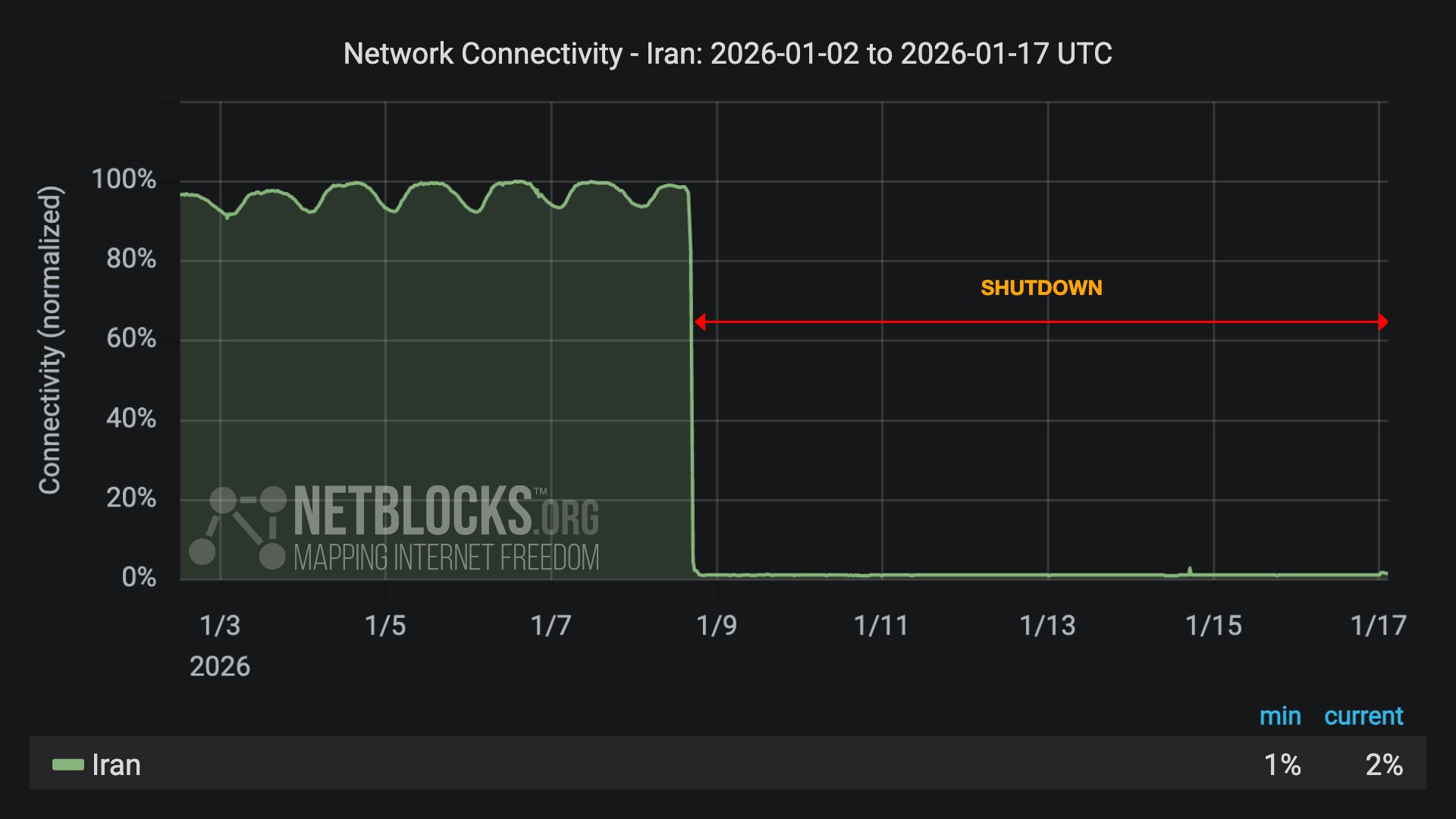
NetBlocks: Iran Internet Ticks Up—Still ~2% Online

NetBlocks monitoring data show a very slight increase in internet connectivity in Iran in the early hours of Saturday, January 17, 2026 (27 Dey)—more than 200 hours after the start of a broad nationwide blackout. Despite the marginal uptick, overall access remains around 2% of normal levels, with no sign of a meaningful restoration; analysts say the limited improvement appears confined to select state-linked infrastructure and specific networks rather than broad public access.

Khamenei Breaks Silence on the Death Toll

Iran’s Supreme Leader Ayatollah Ali Khamenei said “several thousand” people were killed during the recent nationwide protests, while blaming the violence on actors “linked to the U.S. and Israel” and accusing President Donald Trump of inciting unrest. The comments come after Trump warned of “very strong action” if detainees were executed, then publicly thanked Tehran for calling off mass hangings—an assertion Iranian officials disputed, saying there was “no plan to hang people”; Trump separately claimed Iran had canceled the execution of “over 800” people. The admission of a “several thousand” death toll marks a notable escalation in official rhetoric after earlier messaging that blamed “terrorists” and offered lower or less specific casualty figures.

Tehran Prosecutor Slams Trump’s Execution Claim

Tehran Prosecutor Ali Salehi rejected Donald Trump’s claim that Iran had halted executions of detained protesters, saying Trump “often talks nonsense” and that the judiciary’s response will be “firm, deterrent, and swift.” Salehi added that a large number of cases have already resulted in indictments and have been referred to court.


“Take a Deep Breath!” Video Shows Protester Shot in Mashhad

A video circulating with the caption “Mashhad, 18 Dey (January 8)” appears to show a protester being shot during Iran’s national uprising, while people nearby repeatedly shout, “Take a deep breath! Take a deep breath!” The footage is being shared as another snapshot of the violence reported during the crackdown, though the exact circumstances and identity of the injured person have not been independently verified.


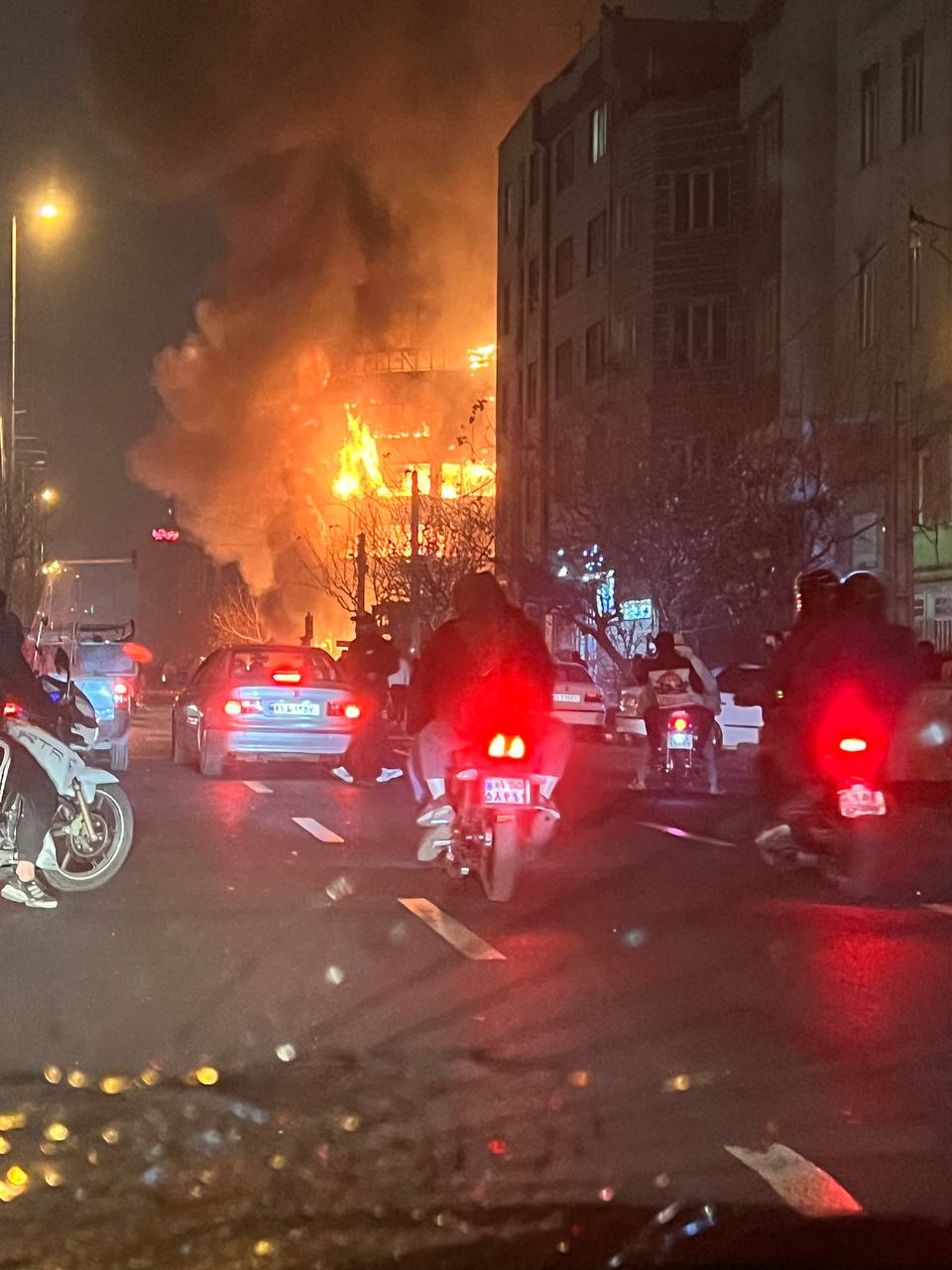
Tehran Fire Reported at Bank Building Near Khosh Intersection

A user-shared video reports a fire at the Ayandeh Bank building on Khomeini St., Tehran (Khosh intersection), geotagged near 35.6873, 51.3736. The footage description indicates an active blaze at the site; the cause, damage, and any casualties are not confirmed from the clip alone.


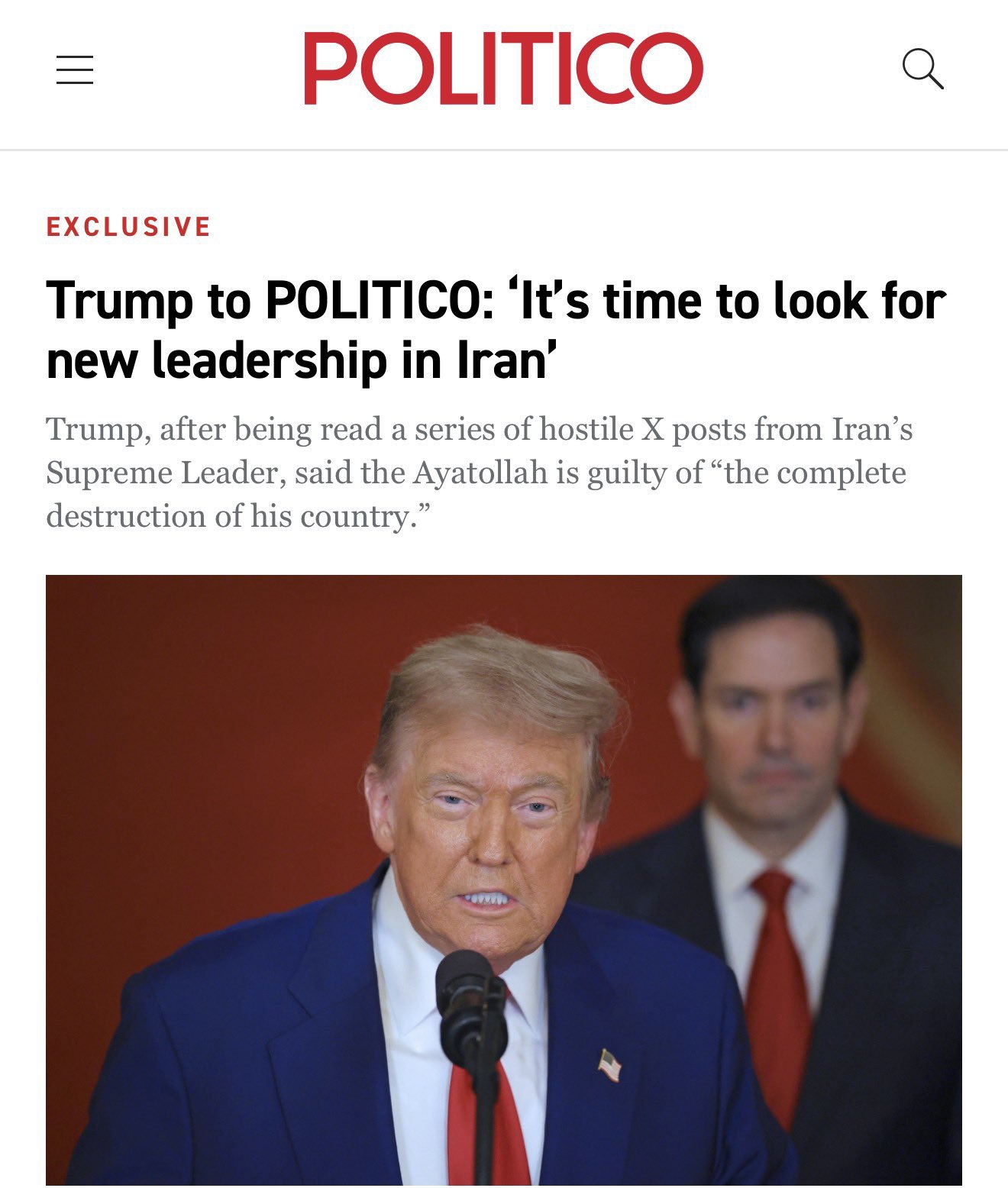
Trump to POLITICO: “Time for New Leadership” in Iran.

U.S. President Donald Trump told POLITICO it is “time to look for new leadership in Iran,” blaming Supreme Leader Ali Khamenei for what he called the country’s “complete destruction” and unprecedented levels of violence. Trump argued that leadership should focus on running the country rather than “killing thousands” to maintain control, and described Khamenei as a “sick man” who should stop the bloodshed.

Video Shows Mashhad Protests on Jan. 8–9

A received video described as “various scenes from the Thursday, 18 Dey and Friday, 19 Dey protests in Mashhad” shows different moments from demonstrations in the city during Iran’s national uprising. The clip is being circulated as part of the growing volume of visual evidence from the crackdown period, though the exact locations, identities, and specific timing within those dates cannot be independently verified from the footage alone.


CCTV Clip Shows Armed Raid on Building Where People Sought Shelter in Tehran

Received footage described as CCTV imagery from Tehran shows what appears to be security-linked plainclothes forces attacking people who had taken refuge inside a building, using batons and weapons, while one citizen is seen attempting to block their entry. The video description says the on-screen monitor timestamp reads Wednesday, January 7 at 1:40 a.m., and alleges the attackers used knives and machetes during the assault; the identities of those involved and the full context cannot be independently verified from the clip alone.


Backchannel Text: Tehran Signals Execution Halt, WaPo Reports

The Washington Post reported that on Wednesday, January 14, 2026, as expectations of imminent U.S. strikes rose, Iran’s Foreign Minister Abbas Araghchi sent a text message to White House envoy Steve Witkoff—relayed to President Donald Trump—saying Tehran was prepared to stop the killing and cancel the planned executions of about 800 detained protesters, according to officials familiar with the exchange.

Graphic Video From Kahrizak Sparks New Outcry

Journalist Farzad Seifikaran shared a graphic video he said was received from the Kahrizak forensic medicine facility, showing a mother searching among bodies for her missing child and shouting anti-Khamenei slogans. Seifikaran wrote that the footage was recorded on 20 Dey (January 12, 2026), framing it as evidence of large-scale killings during the crackdown; independent verification of the video’s full context remains limited.


Two Gorgan Citizens Reportedly Killed by Direct Gunfire

Reports say two citizens from Gorgan—Matin Montazerzohour (32) and Sina Haghshenas (27)—were killed after being hit by direct fire from repression forces. The two were related, and the account describes them as young men who joined street protests seeking freedom but were met with live bullets. The report adds that Gonbad-e Kavus and Gorgan saw large crowds in the streets on 18–19 Dey (January 8–9), with multiple fatalities reported, though an exact death toll remains unclear.

“Freedom” Name, Fatal Shot: Shayan Azadi Killed in Gohardasht

Reports say Shayan Azadi, a 25-year-old single man, was killed in Gohardasht on 18 or 19 Dey (January 8–9) after being struck from behind by a live round fired by Islamic Republic forces. The account describes his death as part of a wider pattern of direct, targeted shooting against protesters seeking freedom and dignity, highlighting the grim symbolism of his surname—“Azadi” (Freedom)—as he reportedly died “for freedom.”

A Last Post, Then a Bullet: Reza Eskandarpour Reportedly Killed in Tehran

Reports say Reza Eskandarpour, a 37-year-old single man from Tehran, was killed on Thursday night, January 8, 2026 (18 Dey 1404) during protests after being hit by direct gunfire in Tehran’s Aryashahr area. A person close to him said he was struck by six live rounds to the chest and heart, describing the shooting as targeted and intended to kill. His final Instagram post—shared widely afterward—read: “When life reached us, it was cut off, banned, censored, canceled, made expensive, turned into war, turned into killing… and what a sad ending.” Reports say his funeral was held on Sunday.

New Eyewitness Account From Rasht Alleges Mass Killings and Machine-Gun Fire

A person who recently left Iran and says they were in Rasht during the bloody 18–19 Dey (January 8–9) protests described widespread public participation—men and women, young and old, rich and poor, workers and merchants—standing together in the streets, with parents present to support their children. The witness claimed the authorities fired on crowds with heavy weapons, including machine guns, and said residents opened doors and garages to shelter people. In one allegation, the witness said security forces entered a parking garage and killed around 60 people in a single burst of gunfire. The same account dismissed broader death estimates as understated, claiming fatalities in Rasht alone exceeded 3,500, and alleged that repression forces set the Rasht bazaar on fire and fired on people there as well. The witness added that families searching for loved ones were forced to scan large numbers of bodies, describing it as an additional form of trauma. The source note says the full testimony runs over 20 minutes and only a short summary was shared publicly.

New Shiraz Protest Footage Surfaces From Jan. 8–9

Newly received videos from Shiraz—compiled into a single clip—show crowds in the streets during the 18–19 Dey (January 8–9) protest period, though it is unclear which scenes correspond to each day. The footage and accompanying accounts describe demonstrators moving “side by side” and taking over major streets, while sources claim security forces carried out a broad crackdown and fired on people in Shiraz, as in other cities. No verified casualty figure is available from these reports.


Bill Cassidy: Khamenei Cut Internet to Kill “Without Witnesses”

U.S. Senator Bill Cassidy said Iran’s Supreme Leader cut internet access so he could “kill his own people without any witnesses,” calling the Iranian regime “pure evil.” The statement was issued amid reports of a prolonged nationwide communications blackout during the crackdown on protests, highlighting growing U.S. political pressure over Tehran’s use of internet shutdowns to limit documentation and accountability.

State TV Admits Kahrizak Forensics “Overwhelmed” by Bodies

Iran’s state broadcaster reported that the Kahrizak forensic center was “caught off guard” by the volume of bodies, saying it lacked preparedness for such a large number of victims. In the report, IRIB journalist Mohammad Negini-Pour said Tehran’s forensic capacity—one large warehouse and three smaller ones—was completely filled, with many bodies linked to the bloody events of Thursday, and families forced to identify victims by lifting body covers themselves, often repeatedly, as some remained unidentified by Tuesday. He added that contrary to expectations, many bodies were not kept in organized cold-storage conditions, and a significant number were placed on the ground in the center’s outer area, shocking families and visitors. The report said the scale was so large that even emergency overflow facilities proved insufficient, pointing to an unusually high death toll.


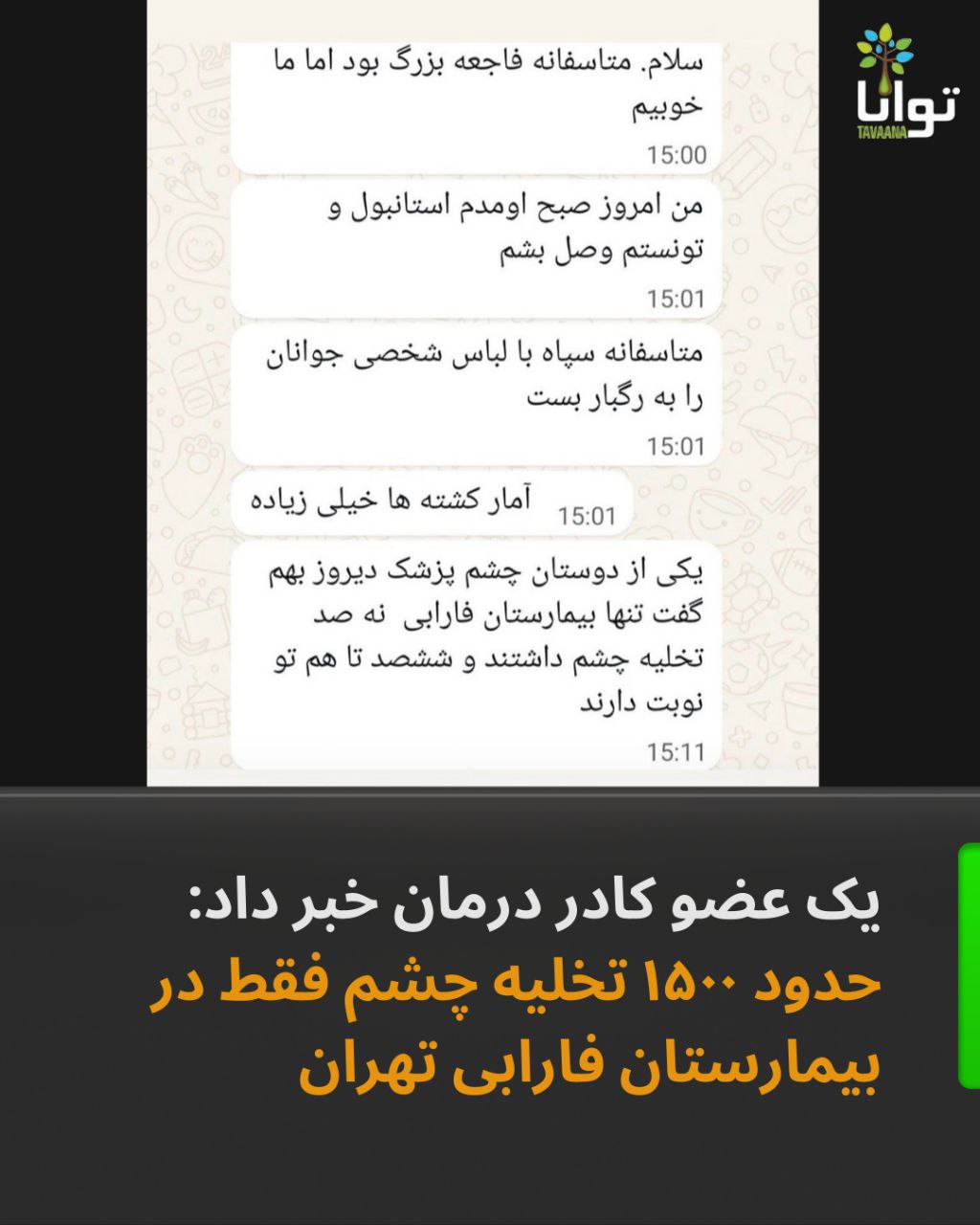
Report: “1,500 Eye Removals” at One Tehran Hospital

A member of Iran’s medical staff said that Farabi Hospital in Tehran alone has carried out roughly 1,500 eye-removal surgeries—a procedure typically performed when there is no hope of saving the eye—implying that the total number of people injured in the eye is significantly higher. The source stressed this figure would cover just one hospital and only Tehran, underscoring claims of widespread severe injuries during the crackdown; the number has not been independently verified.

New Mashhad Footage Shows Protest Clashes on Jan. 9

New videos shared by Ilya Hashemi and dated to 19 Dey (January 9) show street demonstrations in Mashhad and apparent confrontations with repression forces. The clips are being circulated as additional visual evidence of the unrest and crackdown, though the precise locations, identities, and full context cannot be independently verified from the footage alone.


Isfahan Crowd Storms State TV Building, Sets It Ablaze

Newly received footage described as Isfahan on 18 Dey 1404 (January 8, 2026) appears to show a large crowd moving toward the Isfahan IRIB (state broadcaster) building, with the building later seen on fire. The description frames IRIB as a regime propaganda outlet rather than a public voice, and presents the attack as part of the wider unrest. The exact sequence of events, responsibility for the fire, and any casualties or damage figures cannot be independently verified from the video alone.


Tehran Streets Packed With Protesters on Jan. 8, Reports Say

Newly received images described as Tehran on 18 Dey 1404 (January 8, 2026) show large crowds of protesters in the streets. The accompanying account says demonstrators were met with heavy gunfire and a violent crackdown, though the exact scale of force used and casualties cannot be independently verified from the images alone.


Mashhad Chant: “Ball, Tank, Fireworks—Khamenei…” in New Jan. 8 Video

Newly shared videos described as Mashhad, 18 Dey 1404 (January 8, 2026) show protesters chanting a slogan that includes “Ball, tank, fireworks, Khamenei…,” circulating as fresh footage from the city during the unrest. The clip adds to the growing stream of visual material from those days, though the exact location and context within Mashhad cannot be independently verified from the video alone.


New Karaj Protest Footage Emerges From Jan. 8–9

Newly received images and videos described as Karaj protests on 18–19 Dey 1404 (January 8–9, 2026) show crowds in the streets during the peak protest period. The material is being circulated as additional visual documentation of the unrest and crackdown in Karaj, though the exact locations, timing by day, and identities of those shown cannot be independently verified from the footage alone.


Report: Lahijan Protester Mehran Rafiei Killed on Jan. 8

Local accounts say Mehran Rafiei, a barber from Lahijan, was killed on Thursday, January 8, 2026 (18 Dey 1404) during street protests near Enghelab Square. Rafiei, originally from the village of Zamidan, is described as an ordinary citizen who was participating in demonstrations when he died, in what sources portray as part of the violent crackdown on protesters.

Civil Activist Parastoo Jamalzai Reportedly Re-Arrested at Arak Checkpoint

Reports say Parastoo Jamalzai, a 32-year-old civil activist from Arak, was arrested on Wednesday by IRGC intelligence at the entrance to Arak while traveling from Tehran, in what sources describe as a detention linked directly to the latest protests. The account says authorities have set up checkpoints at city entrances and are detaining people they deem suspicious. Jamalzai has previously faced repeated security pressure: she was detained during the “12-day war” and later released on 500 million tomans' bail, after which new cases were opened against her. A criminal court reportedly issued fines totaling 70 million tomans on charges including “spreading falsehoods” and “publishing obscene images,” later suspended for two years; a separate Revolutionary Court case for “propaganda against the Islamic Republic” has reportedly been heard but not yet ruled. Sources also say her Instagram page—previously with around 21,000 followers—is now under security control.

Message: At Least Three Medical Staff Reportedly Killed in Kermanshah

A message from someone who says they work in Kermanshah province emergency services claims that several hospital medical workers were targeted and that they are aware of the deaths of three healthcare colleagues in Kermanshah. The source says emergency staff and doctors have suffered serious psychological trauma while treating large numbers of wounded and registering deaths. The same account adds that, based on incoming reports, some doctors and nurses have been detained and that authorities have restricted or blocked Instagram pages of physicians who said they were treating injured protesters for free. These claims have not been independently verified.

Iranian Lawyer Pleads: “Help Us Before We’re Cut Off Again”

Attorney Samin Cheraghi wrote an urgent appeal warning that conditions inside Iran are “more terrifying and catastrophic” than what is visible in published footage, repeating: “Help us, help us… before we’re cut off again.” The message reflects a broader wave of accounts saying the images seen so far cannot convey the scale of what people claim they witnessed, alongside allegations that authorities are suppressing information and pushing counter-narratives to obscure the reality on the ground.

“A Carpet of Bodies”: Survivor Account From Islamshahr’s Bagh-e Feyz

A new narrative shared by Farangis Bayat describes what she says was relayed by a survivor from Islamshahr’s Bagh-e Feyz street: the witness claims a machine gun emplacement was set up, initially perceived as intimidation, before the crowd grew and, as the person tried to return home, the street had become “a carpet of bodies,” making passage impossible. The accompanying message urges Iranians to document and amplify eyewitness testimonies—through writing, film, and storytelling—arguing that authorities are attempting to distort reality and bury the scale of what people say occurred, and characterizing the events as among the largest massacres since World War II. The claims in this account have not been independently verified.

Urmia Eyewitness: “The City Feels Like an Undeclared Martial Law Zone”

A citizen from Urmia, speaking to the Tavaana organization, described an unprecedented escalation of repression in recent days—mass arrests, killings, and enforced disappearances—after large crowds joined street protests from Thursday through Sunday. The witness said the turnout was “beyond imagination” despite attempts to sow division, but that from Saturday onward, “many were detained and many were killed,” adding that one of their own friends was arrested and has since disappeared with no information from police stations, prisons, or courts. The account also alleged security forces, in some cases, took people directly from their homes and returned bodies the next day, while the city has been saturated with armed personnel—security forces, Basij, and plainclothes units—moving in groups. The witness said nighttime vehicle stops and searches intensify after 10 p.m., describing Urmia as effectively under an undeclared martial law, and noted many families are reportedly searching for missing relatives while officials repeatedly deny holding them. These claims have not been independently verified.

Kermanshah Doctor: Hospitals Overrun, Morgues Overflowed After First Night

A doctor from Kermanshah, speaking to the Tavaana organization, described a “horrific” scale of deaths and injuries on the first night of the public call to protest, saying the number of casualties was so high that hospital morgue capacity could not cope. The physician said that, unlike typical mass-casualty incidents—where most trauma cases concentrate in specialized centers—every hospital in the city, public and private, was inundated as ambulances and residents took the wounded wherever they could. The doctor alleged a three-year-old child was killed by a government-affiliated plainclothes force, and claimed authorities initially recorded the death as protest-related before attempting a new narrative later. The account also said many victims were shot in the back while fleeing, and described wounds consistent with high-destruction live ammunition, including severe vascular damage where even a thigh wound could be fatal. The doctor cited one case—a head nurse at Kermanshah’s cardiac specialty hospital—who reportedly died despite multiple surgeries due to catastrophic vascular injury, and added that three healthcare workers in Kermanshah were also killed by gunfire. These claims have not been independently verified.

Fardis, Karaj: Hope in the Streets—Then a Brutal Crackdown

A narrative from Fardis, Karaj, dated Thursday, 18 Dey 1404 (January 8, 2026) describes a day when many Iranian cities saw unusually large crowds in the streets, with people celebrating, flashing victory signs, and believing the scale of turnout signaled a turning point. The account says protesters did not anticipate how ruthlessly security forces would respond, alleging people were met with indiscriminate live fire and an “unprecedented” level of killing. The message frames the crackdown as a major crime that will carry severe consequences for the leadership and its supporters.


Report: 17-Year-Old Student Killed in Karaj Protest

Reports say Barna Dehghani, a 17-year-old student from Karaj, was killed on Friday, 19 Dey 1404, during protests in the city after being shot by government forces. The account identifies him as a Baha’i teenager and quotes him responding to his parents’ pleas not to leave home: “If I don’t go, nothing will change.” (Note: your text lists “9 January 2025,” but 19 Dey 1404 corresponds to January 9, 2026.)

Report: Violin Teacher Sanam Pourbabaei Killed in Lahijan Protests

Reports say Sanam Pourbabaei, a violin instructor, died on Thursday, 18 Dey 1404 (January 8, 2026), during protests in Lahijan, near the governorate building. She was originally from Siahkal, and her body was reportedly buried at the Barfjan shrine in that شهرستان. The account describes Pourbabaei as a music educator and cultural figure and argues her death underscores that the crackdown has extended beyond street protesters to ordinary citizens, artists, and cultural workers. The circumstances and attribution in this report have not been independently verified.

Rasht Witness: “A Historic Massacre—The City Was Ours for a Full Night”

“Saman,” a Rasht resident who says he recently left Iran, posted a video on Instagram describing what he called a “historic massacre” during the bloody protest days in Rasht, arguing that what has appeared in the media so far is only a small fraction of what happened. He claimed Rasht was the only city where, from Thursday night into Friday night, the authorities effectively disappeared from the streets and “the city was in people’s hands,” with families, women, children, and elderly residents out in public. Saman alleged security forces set the Rasht bazaar on fire, trapped people in the area, and then opened fire, and said that on Thursday night, “there were no arrests—only killing.” He added that by late Friday afternoon, the city was “re-encircled,” power was cut, shops were forced shut, and Rasht turned into a “ghost city” amid smoke and fires. He described a heavy armed presence—IRGC, Basij, police, and even the army, including tanks—moving with rifles, machine guns, and grenades, and said it is a “delusion” to expect security forces to side with protesters. He also alleged that bodies were transported to Baghe Rezvan cemetery in dump trucks, stacked and unidentified, and that some families faced extreme demands—up to 800 million tomans—and pressure to sign statements blaming “foreign agents” for deaths. These claims have not been independently verified.

Report: Mother of Two Shot in the Head in Isfahan, Died in Her Son’s Arms

Reports say Arezoo Abedi, a 50-year-old mother of two from Isfahan, was killed on Friday, 19 Dey (Jan. 9) on Bagh-e Daryacheh Street after being shot in the head, allegedly while in her son’s arms. She is described as an athlete, mountaineer, and fitness coach, and the account says her children—a 19-year-old son and a 25-year-old daughter—are now grieving her death. The report characterizes the shooting as a targeted strike and presents her killing as a stark example of lethal violence against ordinary citizens, including women and mothers, during the crackdown. These details have not been independently verified.

Four Days, 22 Executions: HRANA Flags Surge Under Internet Blackout

HRANA reported that at least 22 prisoners (including one woman) were executed across multiple Iranian prisons between Monday, January 12, and Thursday, January 15, 2026 (22–25 Dey), as protests continued and nationwide internet access remained severely restricted. The rights outlet warned that communication blackouts reduce transparency, hinder independent documentation, and can delay families’ access to basic information about detainees’ fate. HRANA’s annual reporting for Jan 1, 2025–Jan 1, 2026 cites at least 2,063 executions, while other summaries for calendar-year 2025 cite at least 1,922, underscoring the likelihood of undercounting amid secrecy.

Night Chants Heard in Tehran’s Sa’adat Abad Around 8:15 p.m.

A clip shared via Ilya Hashemi’s Telegram is described as showing nighttime chants in Sa’adat Abad, Tehran, at around 20:15 on Saturday, 27 Dey (Jan. 17). The post indicates continued street-level protest signaling after dark, though the exact location and timing cannot be independently verified from the clip alone.

Report: Mashhad Footballer Re-Arrested After Intelligence Raid

Reports say Mohammadhossein Hosseini, a 26-year-old footballer from Mashhad and a protest detainee from 2021 (1401), was arrested again after intelligence agents raided his home at around 16:00 on Tuesday, 23 Dey 1404 (Jan. 14). The account says he has been detained six times since 1401, including a brief arrest following the seventh-day memorial for the late Khosrow Alikordi, and that friends are increasingly worried given prior cases and rulings against him. No details have been provided on the stated reason for arrest, the specific charges, or his current place of detention.

“A Dandelion That Walks After Death”: Babak Sadeghi Mohseni Killed in Tehranpars

Reports say Babak Sadeghi Mohseni (born 1373), originally from Karaj and living in Hamedan, was killed during the 19 Dey 1404 protests in Tehranpars after being hit in the head by a live round. His body was reportedly buried on 24 Dey under heavy security with limited family attendance. His mother, Hajar Maleki, was quoted ahead of the funeral saying: “Don’t cry. Babak is a hero. Hold your heads high and say he chose this path.” Friends describe him as a long-time pro-freedom protester—injured in past uprisings—an outdoorsman and mountaineer who loved music and life. A line attributed to him on one photo reads: “I stare at the dandelion that sets off after death,” a phrase his circle now uses to frame him as a symbol whose “seeds” spread after loss. These details have not been independently verified.

More Iran news

Political

Slovakia Shuts Tehran Embassy; New Zealand Moves Operations to Ankara Amid Worsening Security

Slovakia said it has temporarily closed its embassy in Tehran and withdrawn diplomatic staff, citing a “significant” deterioration in the security situation and a “real threat” of further military escalation, according to statements attributed to Foreign Minister Juraj Blanár. New Zealand also said it has temporarily closed its Tehran embassy, with diplomatic staff leaving on commercial flights and consular operations shifted to Ankara, while urging its citizens to avoid travel to Iran and leave if already there, warning its ability to provide consular assistance is “extremely limited.”

Bern Protest Outside Iran Embassy Signals Support for Prince Reza Pahlavi

Iranians in Bern, Switzerland, gathered on Saturday, January 17 (27 Dey) outside the Islamic Republic’s embassy to show solidarity with people inside Iran and support for Prince Reza Pahlavi. Protesters carried the Lion and Sun flag and chanted slogans against the Islamic Republic, reflecting continued diaspora mobilization alongside unrest at home.

Argentina Adds IRGC Quds Force to Terror List

Argentina’s presidential office said on January 17, 2026 it has designated the IRGC Quds Force and 13 associated individuals as a terrorist organization and added them to the country’s RePET registry, triggering financial sanctions and operational restrictions. The statement cited Argentina’s history as a victim of Quds Force-linked operations in the 1990s, including the 1992 Israeli Embassy attack in Buenos Aires and the 1994 AMIA bombing, and highlighted that Ahmad Vahidi (a former Quds Force commander) remains under an INTERPOL red notice while Iran has not cooperated with prosecution.

Trump to POLITICO: “Time for New Leadership” in Iran

In an interview with POLITICO, U.S. President Donald Trump said “it’s time to look for new leadership in Iran,” blaming Supreme Leader Ayatollah Ali Khamenei for Iran’s deterioration and for relying on repression and violence to stay in power. The remarks came after Khamenei accused Trump and the U.S. of backing the unrest and bearing responsibility for deaths during the crackdown, escalating the war of words as protests and heavy security measures continue across Iran.

Tom Cotton: Trump Won’t Forget “Ayatollahs’ Bloodstained Hands”

U.S. Senator Tom Cotton told Fox News that Donald Trump has not forgotten what he described as the ayatollahs’ responsibility for the deaths of hundreds of Americans, warning Tehran should take the president’s threats seriously. Cotton said Trump has multiple options, but argued any course of action should maintain “maximum pressure” on Iran’s rulers while aiming to minimize casualties.

U.S. State Dept: Tehran Fears Transparency.

The U.S. State Department’s Persian-language account on X said Iran’s continued internet shutdown reflects the Islamic Republic’s fear of transparency and public voices, citing a claim by a regime spokesperson that restrictions will last until Nowruz—extending an isolation period that Iranians have already endured for more than 216 hours. The post argued the move is deliberate, pushing millions further into information darkness, cutting them off from the world and from each other, and signalling a government focused on silence and isolation rather than addressing the country’s real challenges.

U.S. “Sets the Force” as Iran Strike Options Expand

Retired Gen. Jack Keane said in a Fox News interview that the United States is visibly repositioning military assets to widen its options as tensions with Iran rise. Fox News and ABC report the Pentagon is moving at least one aircraft carrier toward the Middle East and weighing a broader surge of air, sea, and missile-defense assets to strengthen deterrence and preserve strike flexibility. In parallel, Reuters reports the U.S. has begun withdrawing some personnel from key regional bases after Iranian officials warned neighboring states hosting U.S. forces that American bases could be targeted if Washington conducts strikes.

U.S. Warns Tehran: “Don’t Play Games With Trump”

The U.S. State Department’s Persian-language account said it has received reports indicating the Islamic Republic is preparing options to target U.S. bases, reiterating that “all options remain on the table.” The message warned that any attack on U.S. assets would be met with “very, very powerful force,” adding: “We’ve said it before and we’ll say it again—don’t play games with President Trump.”

More Political news

Japan

Japan Pulls Some Embassy Staff From Iran, Issues Exit Warning

Japan decided on January 17 (27 Dey) to withdraw some staff from its embassy in Tehran, after issuing a nationwide “evacuate” advisory for Iran a day earlier that also covers Tehran. Citing the worsening security environment and disruptions to international air links, Tokyo urged Japanese nationals to leave Iran as soon as safe travel is available, while keeping essential personnel in place for consular support; Japan also issued Level 1 “exercise caution” advisories for the UAE, Oman, and Qatar.

More Japan news