IFC Markets Live Quotes

Market news roundup: Wednesday, 14 January 2026

119 short market news items, grouped by 14 sections.

Iran

Hassan Khomeini: “After the Islamic Republic, You Will Have No Security, No Freedom, No Prosperity”

Hassan Khomeini, the grandson of the founder of the Islamic Republic, told Iran’s state broadcaster that the “Pahlavi current” is anti-religious, arguing that in a post–Islamic Republic scenario, people would have “no security, no freedom, and no prosperity.” The remarks reflect the regime’s narrative framing the protests as an existential threat and warning against alternatives linked to the Pahlavi era.

Iran International: Former Tractor Player Mojtaba Tarshiz and His Wife Reportedly Killed in Crackdown

Iran International reported that information it received indicates Mojtaba Tarshiz—a former footballer who played for clubs including Nassaji Mazandaran, Tractor, Fajr Sepasi, and Mes Kerman—and his wife were killed during the recent protests by Islamic Republic security forces. The couple, parents of two daughters, were reportedly buried in Karaj on Monday, 22 Dey 1404 (January 12, 2026), in “complete silence.”

Qom Judiciary: Assets and Bank Accounts of Café Owner Saeedi-Nia Seized After Backing Protests

Qom’s chief justice said authorities have frozen all assets and bank accounts belonging to Mohammad Saeedi-Nia, a café owner in Qom accused of supporting strikes and protests. Saeedi-Nia was arrested on 23 Dey 1404 (January 13, 2026). The move follows earlier remarks by Iran’s prosecutor general calling for protesters’ assets to be identified and seized—signaling an intensifying financial pressure campaign alongside arrests.

Iranian Doctors Abroad: Attacks on Hospitals and Killings of Protesters Amount to “Crimes Against Humanity”

A group of Iranian doctors living abroad issued a statement alleging “organized crimes” by what they called the Islamic Republic’s “criminal” authorities against Iran’s protest movement, describing the violence as carried out by the IRGC, Basij, and “non-Iranian mercenary militia forces.” They said abuses include firing tear gas into medical and emergency facilities, shooting and beating medical staff and the wounded, blocking the transfer of injured people, alleged “finishing shots,” and the abduction of some patients from hospitals. The signatories also cited widespread use of live ammunition and pellet rounds against unarmed protesters—leading to массов injuries, blindness and amputations—and referenced claims of a “mass killing” of more than 12,000 people in the first two weeks of unrest, including children and teenagers. They added that internet and phone blackouts, reported power cuts, threats against families, and alleged demands for payments such as “bullet costs” are part of the same repression, urging international organizations and world leaders to take immediate practical steps to stop it.

Iran Says It Will Seize Protesters’ Assets as Prosecutor General Calls for “Deterrent” Punishment

Iran’s prosecutor general Mohammad Movahedi-Azad said authorities should identify and confiscate protesters’ assets to deliver what he called an “exemplary” deterrent response, instructing enforcement bodies to locate such property and report it to prosecutors’ offices. At the same time, the Islamic Republic has aired videos presented as confessions by some detainees—footage that opponents and rights advocates have frequently described as coerced.

Prince Reza Pahlavi to Fox News: Helping Iranians Win Freedom Is Not “Invasion”

In an interview with Fox News, Prince Reza Pahlavi argued that, amid reports of Iranians being shot “in the most brutal way,” providing support to help a nation secure its freedom should not be viewed as an “invasion.” He framed outside assistance as legitimate when aimed at stopping the killing of unarmed civilians and helping the Iranian people pursue liberation.

Iran Justice Minister Signals Martial-Law Clampdown From Prince Reza Pahlavi Call Date

Iran’s Justice Minister Amirhossein Rahimi confirmed the imposition of martial-law-like conditions starting from 18 Dey 1404 (January 8, 2026)—the date of Prince Reza Pahlavi’s call—labeling peaceful protests as a “civil war” and saying anyone detained for being on the streets from that day onward should be treated as a “criminal.” Separate reports cited by Iran International describe a sweeping crackdown in which communications and movement, bazaar activity, medical services, schools and universities, and all media publishing and content distribution have been placed under near-total state control, alongside an escalation in arrests and violent برخوردها against protesters and those around them.

Iran Justice Minister: Martial-Law Measures in Effect From 18 Dey, Prince Reza Pahlavi Call Date

Iran’s Justice Minister Amirhossein Rahimi said martial-law-style measures have been enforced since 18 Dey 1404 (January 8, 2026)—the date of Prince Reza Pahlavi’s protest call—labeling the largely peaceful demonstrations as “civil war” and declaring that anyone detained for being in the streets from that date onward should be treated as a “criminal.”

Telegraph: “Rivers of Blood” as Iran’s Hospitals Are Overrun in Crackdown

In a report published on January 13, 2026, The Telegraph cited medical accounts describing Iranian hospitals and morgues being overwhelmed as security forces intensify their crackdown on nationwide protests, with doctors reporting large volumes of gunshot and pellet injuries and an unrelenting flow of casualties arriving by ambulance and private vehicles. Separate eyewitness accounts carried by CNN also described chaotic hospital conditions in Tehran, including bodies “piled up” after nights of violence, as Iran’s communications shutdown limits independent verification and complicates emergency response.

Kataib Hezbollah Warns U.S.: War With Iran “Won’t Be a Game”

Abu Hussein al-Hamidawi, secretary-general of Iraq’s Iran-aligned Kataib Hezbollah, issued a warning to the United States in remarks carried by IRGC-linked media on Tuesday, 23 Dey 1404 (January 13, 2026), saying any war with Iran would not be “entertainment” but a fire that, once ignited, would be hard to extinguish—adding that Washington would face severe consequences.

Iran Forensic Chief Claims Many Protest Deaths Were From Knives and Hunting Shotguns

Iran’s Forensic Medicine Organization chief Abbas Masjedi-Arani said on Tuesday, 23 Dey 1404, that a “significant number” of those killed during the Dey 1404 protests died from knife wounds and blasts from hunting shotguns—an official narrative that shifts blame away from state gunfire as reports from medics and rights groups continue to document extensive use of live ammunition and pellet rounds against demonstrators.

IranWire Video: Saderat and Mellat Bank Buildings Seen Burning During Protests

IranWire said it received a video dated Sunday, 21 Dey 1404 (January 11, 2026), showing buildings associated with Bank Saderat and Bank Mellat affected by fires amid the protests. The footage adds to a growing stream of visuals emerging from Iran despite severe restrictions on reporting and communications.


Iran U23 Coach Omidreza Ravan Khah Backs Nationwide Protests: “My Social Duty Is to Stand With My People”

Omidreza Ravan Khah, head coach of Iran’s U23 national football team, voiced explicit support for Iran’s nationwide protests against the Islamic Republic after his team’s match against Lebanon in the Asian Championship. He said it is his “social duty” to stand with his people in these circumstances—adding that regardless of any consequences for him, he hopes the protesters’ voices will be heard.

Canada Tells Citizens to Leave Iran “Now” as Travel Risk Level Tightens

Canada’s government said in an updated travel advisory on Tuesday, 23 Dey 1404 (January 13, 2026), that Canadians in Iran “should leave Iran now if you can do so safely,” while maintaining an “Avoid all travel” warning. Ottawa cited ongoing nationwide demonstrations, regional tensions, and a high risk of arbitrary detention, noting that many airlines have suspended flights but overland exits via Armenia and Türkiye remain available, and that Canada’s consular capacity inside Iran is “extremely limited.”

Ex-Iran Keeper Amir Abedzadeh Posts About “Massacre,” Fans Note Silence From Team Captain Jahanbakhsh

Amir Abedzadeh, a former Iran national-team goalkeeper and son of legendary keeper Ahmadreza Abedzadeh, wrote in an Instagram story about the “killing in Iran,” saying he prayed for God to save the Iranian people. In contrast, some observers and supporters have criticized Iran’s current team captain Alireza Jahanbakhsh, for not publicly reacting to reports of the crackdown despite being abroad in recent days.

IranWire: Teachers’ Union Activist Shokrollah Ahmadi Arrested in Fars During Protests

IranWire reported that Shokrollah Ahmadi, a board member of the Fars Teachers’ Trade Association and an inspector with Iran’s Coordination Council of Teachers’ Trade Associations, was arrested after security forces raided his home in Nurabad Mamasani on Saturday, 20 Dey 1404 (January 10, 2026), amid ongoing protests. As of the report’s publication, his detention location and the charges against him had not been disclosed.

Elnaz Rekabi Reposts Post Asking: “What War Kills 12,000 People in Two Days?”

Iranian climber Elnaz Rekabi reshared a post questioning how “12,000 people” could be killed “in just two days,” a pointed reference to widely circulated claims about the scale of fatalities during Iran’s Dey 1404 nationwide protests. Her repost adds to a growing wave of high-profile athletes and public figures using social media to amplify outrage over reported protest deaths amid tight information controls.

IranWire: Three Yarsan Family Members Arrested After Security Raid in Kerend

IranWire reported that Iranian security forces detained three members of a Kurdish Yarsan family in Kerend in the early hours of Friday, 19 Dey 1404, identifying them as Farshad Shafiei (45), his daughter Ghazal Shafiei (23)—a tanbur musician and instructor—and Elham Mehrabi, the mother. Yarsan sources cited in the report said the arrests were linked to the family’s participation in protests on 18–19 Dey, and described post-protest raids carried out without judicial warrants amid a broader sweep of detentions.

Prince Reza Pahlavi to Iran’s Army: “You Are the National Military—Join the People”

In a message issued Tuesday night, 23 Dey 1404 (Jan. 13, 2026), Prince Reza Pahlavi urged Iran’s Artesh to break with the Islamic Republic, telling personnel: “You are the national military of Iran, not the military of the Islamic Republic,” and warning they “do not have much time” to fulfill their duty to protect fellow citizens—calling on them to join the people as soon as possible amid the escalating crackdown.

Israel’s UN Envoy Calls for Emergency Security Council Debate on Iran Crackdown

Israel’s Ambassador to the UN, Danny Danon, wrote on X that—after what he described as “long days” of killings and violent repression in Iran—the UN is preparing to convene an emergency Security Council debate. Danon criticized what he portrayed as slow international action while Iranian authorities “shoot at protesters” and “hang opponents,” and he addressed Iranians directly, saying: “You are not alone.”

Father of 17-Year-Old Footballer Rebin Moradi Breaks Down in Tears After Report on His Death

Iran’s state broadcaster aired a segment from the Kahrizak forensic medicine office featuring two men identified as Rebin Moradi’s father and coach. Separate information reported by Iran International says Moradi—a 17-year-old student and a youth player for Saipa—was shot from behind and killed by Islamic Republic security forces during the ongoing popular uprising.

Videos Show Hezbollah Members, Assad Loyalists Signal Readiness to Back Khamenei Against Iran Protests

Media-circulated videos show a number of Bashar al-Assad supporters and individuals described as Hezbollah members declaring they are ready to support Ali Khamenei and confront Iran’s popular protests. The footage suggests a willingness to assist the Islamic Republic in suppressing unrest, though the identities and affiliations shown in the videos have not been independently verified.

Iran International Cites CNN: 300+ Pakistanis Leave Iran Amid Security Clampdown

Iran International reported—citing CNN—that more than 300 Pakistani citizens have left Iran over the past several days as the security atmosphere has tightened alongside an intensified crackdown.

France Weighs Sending Eutelsat Satellite Terminals to Iran Amid Internet Blackout

French Foreign Minister Jean-Noël Barrot said Paris is reviewing the option of transferring Eutelsat satellite terminals to Iran, as authorities impose widespread internet disruptions during the current unrest—signaling that France is “exploring all options,” including satellite connectivity support.

Resident Describes “Flash-Mob” Neighborhood Rallies After Prince Reza Pahlavi Call

A resident inside Iran told Iran International that following Prince Reza Pahlavi’s call for gatherings at 6 p.m., streets would remain quiet until the final minute—then large crowds would suddenly pour out of homes and assemble in local neighborhoods. The resident said protests in Tehran had recently eased under intensified crackdowns and killings, but on the evening of 21 Dey, western districts such as Punak and Marzdaran became key protest hubs, prompting a rapid security deployment that included tear gas and reconnaissance drones. The resident also reported satellite jamming in parts of Tehran.

Former U.S. Official Claims Decisive Strikes Would Split Iran’s Military From Khamenei

Mark Levin, a conservative American commentator and former member of a U.S. Department of Homeland Security advisory body, posted on X arguing that the Islamic Republic is increasingly weakened and that decisive military action against it would prompt Iran’s armed forces to abandon Ali Khamenei and the Islamist ruling system. His remarks reflect escalating rhetoric in U.S. political commentary as regional tensions intensify.

Pence Thanks Trump, Says U.S. Stands With “Brave” Iranians—Contrasts With Obama’s 2009 Response

Former U.S. Vice President Mike Pence wrote on X that he appreciates Donald Trump’s statements about helping the Iranian people, adding that it is “more than Obama would say” during Iran’s 2009 Green Movement protests. Pence said Washington is standing with the “brave people of Iran,” as international scrutiny over Tehran’s crackdown continues to intensify.

Estonia Says It Stands With Iranians—and Pushes EU to List the IRGC as Terror Group

Estonia’s Foreign Minister Margus Tsahkna said Tallinn stands with the Iranian people “in their fight for freedom and dignity,” adding that Estonia is working to help ensure the European Union designates the Islamic Revolutionary Guard Corps (IRGC) as a terrorist organization.

Araghchi to Trump: “You Should Know Where to Turn to Stop the Bloodshed”

Iran’s Foreign Minister Abbas Araghchi said in a social media post that U.S. President Donald Trump should “know where to turn to stop the bloodshed,” framing the violence in Iran as part of a broader regional escalation and accusing Israel of trying to pull Washington into conflict. The remark comes as tensions and military signaling across the Gulf continue to intensify.

Dimona Mayor Reopens Public Shelters Amid Rising Regional Tensions

Dimona Mayor Benny Biton said the city has opened its public bomb shelters as a precautionary step, stressing that the move is meant to boost residents’ sense of security rather than respond to a specific warning, and that there is no change in Home Front Command instructions.

Germany: Iran Crackdown “Must Not Go Unpunished,” Calls for Fast EU Sanctions

Germany’s Foreign Office human rights directorate said the Iranian regime’s widespread violence in response to nationwide protests “must not go without consequences,” urging the European Union to swiftly move forward with sanctions against individuals responsible for the crackdown, according to Iran International reporter Ahmad Samadi.

Field Reports Suggest Martial-Law-Like Conditions Emerging in Iran Amid Ongoing Crackdown

As the Iranian authorities intensify their suppression of the national uprising, field reports and citizen messages indicate conditions resembling martial law in parts of the country. Martial law refers to an emergency situation in which civilian administration is effectively handed over to military forces, typically accompanied by expanded security controls and restrictions on public movement.

Saeed Azari: “History’s Tyrants Pale” Next to Iran’s Crackdown

Saeed Azari, former CEO of Zob Ahan FC, wrote that the genocides of historical dictators “pale” in comparison to those who “massacred Iran’s children,” reacting to what he described as the killing of 12,000 Iranian protesters by the Islamic Republic’s security forces during the national uprising. Azari also accused authorities of branding protesters as “rioters,” then labeling “rioters” as “terrorists” to manufacture a pretext for lethal repression, and warned those who issued the orders that “severe punishment” awaits them.

Iran International: Plainclothes, IRGC Raid Homes of Slain Protesters’ Families; Dawn-Only Burials Imposed

Iran International cited informed sources saying plainclothes forces and IRGC-linked units raided the homes of families of those killed in Iran’s national uprising—along with neighboring homes—in parts of eastern Tehran on Wednesday, 24 Dey (January 14, 2026). Sources alleged the raiders fired at walls, insulted and humiliated family members, and looted property, including emptying refrigerators. The same sources said authorities told families bodies would only be handed over in the first hours before dawn, insisting burials be conducted individually and completed by 4 a.m., while threatening mass burials if families refused. Separately, sources claimed security officials demanded families pay 250 million tomans per bullet allegedly fired at the deceased protesters.

Citizen Account: Families Pressured to Label Protesters as Basij, Pay Up to 2 Billion Tomans for Bodies

In response to Iran International’s call for evidence on the killing of protesters, a citizen message said security forces have pressured families to register the dead as “Basij” members and demanded payments of up to 2 billion tomans in exchange for releasing the bodies. Iran International said the account was reread anonymously to protect the source’s safety.

Paolo Maldini: “All Eyes on Iran” After Mass Turnout Following Prince Reza Pahlavi’s Call

Paolo Maldini, the Italian football icon and former captain of Italy and AC Milan, reacted to Iran’s national uprising by resharing an Instagram post highlighting the large crowds in the streets after Prince Reza Pahlavi’s call for rallies, adding: “All eyes on Iran.”

450 Iranian Feminists Demand Urgent Global Action Amid Internet Blackouts and Crackdown

In a statement dated 24 Dey 1404 (January 14, 2026), around 450 Iranian feminists warned of the “killing of protesters” and urged immediate international action, saying Iran’s internet, mobile, and communications shutdowns are not “technical disruptions” but a deliberate tool to block public oversight and independent reporting while violent repression escalates. The signatories said the current protests—sparked by severe economic conditions and broader opposition to the system’s “totalitarianism”—continue the same demands voiced in the “Woman, Life, Freedom” uprising and the 2017 and 2019 protest waves, explicitly calling for fundamental political change. They also cautioned against the erasure of protesters’ diverse voices and rejected any organized effort—especially violent—to impose a single, uniform narrative for Iran’s future.

Field Reports Point to Martial-Law-Like Conditions in Iran as Crackdown Intensifies

As the authorities step up repression during Iran’s national uprising, field reports and citizen messages describe conditions resembling martial law in parts of the country—an emergency state in which civilian governance is effectively handed over to military forces, typically accompanied by expanded security controls and tighter restrictions on movement and public assembly.

Googoosh Urges Trump to Act “Decisively” on Iran, Calls for Cooperation With Prince Reza Pahlavi

Googoosh, the iconic Iranian pop singer, wrote a letter to U.S. President Donald Trump urging him to follow through on his promises and take “immediate and decisive” action in response to what she described as the Islamic Republic’s killing of Iranians. She also asked Trump to work with Prince Reza Pahlavi, writing that she is an Iranian artist who once “lost her voice” under the Islamic Republic and now seeks action. In the letter, she pointed to Iran’s domestic crises—drying rivers and economic collapse—while alleging billions were spent on missiles, Hezbollah, and foreign proxies, leaving Iranians facing poverty, power outages, water shortages, censorship, prison, and mass emigration. She concluded by appealing for help for “defenseless” people inside Iran amid “ongoing crimes against humanity,” expressing hope Trump would be the first U.S. leader in five decades to stand firmly with Iranians and help revive historic ties between the two nations.

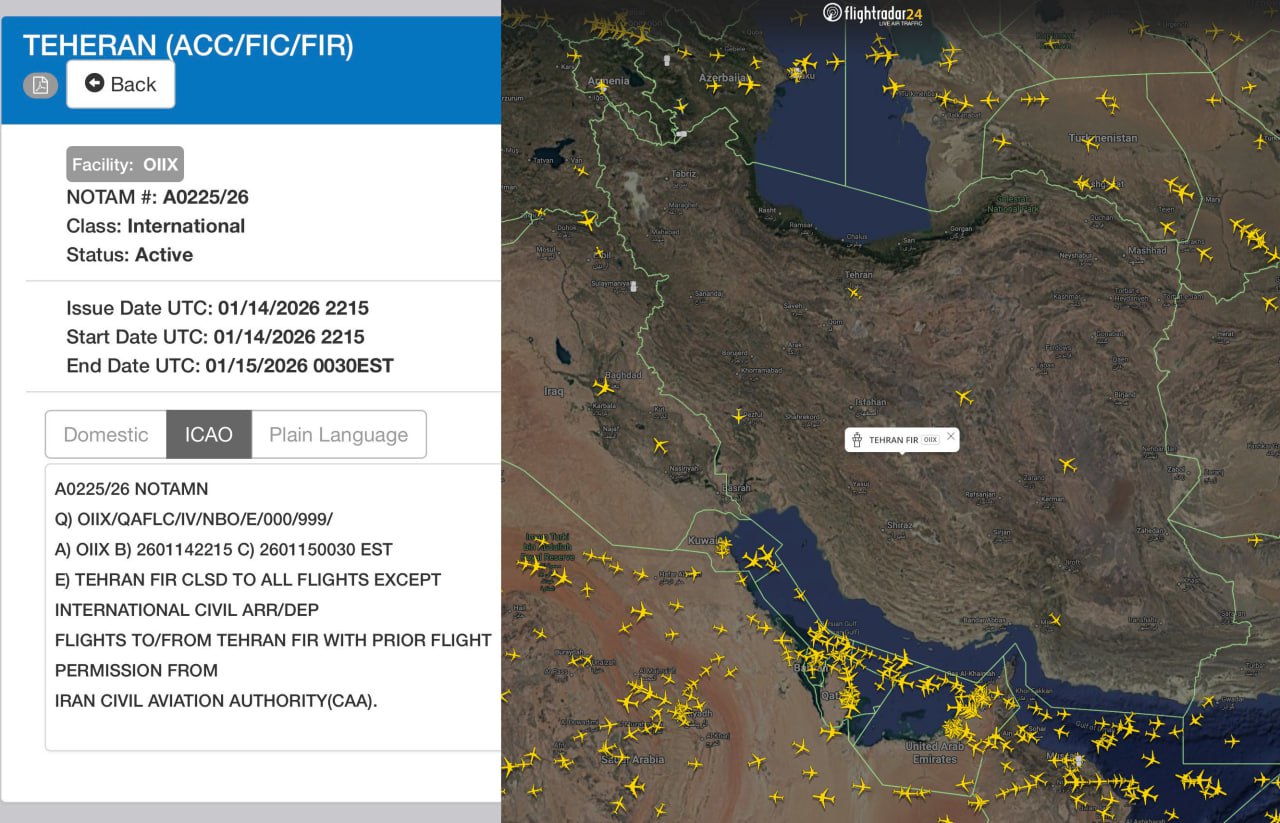
Iran Temporarily Closes Airspace to Most Commercial Flights, Flight Trackers Say

Flight-tracking service Flightradar24 reported that Iran issued a notice late Wednesday closing the country’s airspace to all commercial flights except international arrivals and departures that have prior authorization from Iran’s Civil Aviation Organization. Reuters, citing an aviation notice posted on the U.S. FAA website, said the restriction was set to last a little over two hours (with the possibility of extension), prompting carriers to avoid Iranian airspace amid heightened regional tensions.

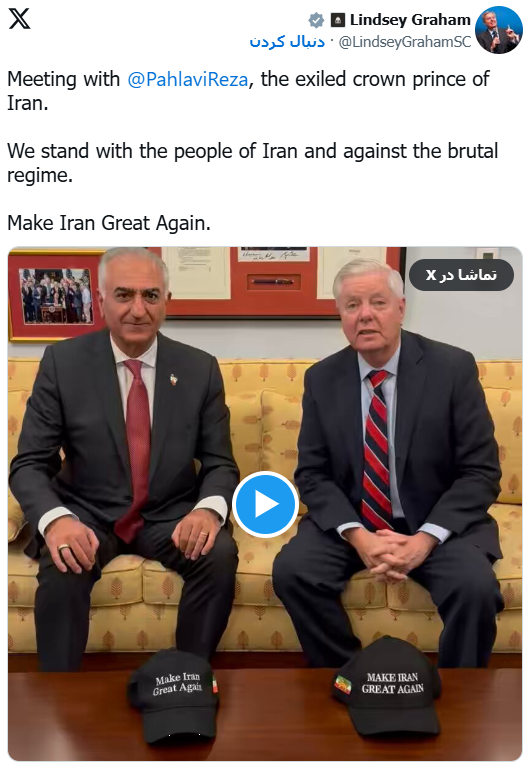
Graham Meets Prince Reza Pahlavi: “The Only Way Is to Stand With the Iranian People”

U.S. Republican Senator Lindsey Graham posted a video of his meeting with Prince Reza Pahlavi, saying he stands with Iranians against what he called a “brutal regime” and arguing that the only viable path for protesters to prevail is sustained support for the Iranian people. Graham also framed the issue as a U.S. national-security priority, calling Iran the world’s leading state sponsor of terrorism and saying protesters could become future American allies. In the same video, Prince Reza Pahlavi thanked Graham and said this may be the closest moment yet to victory, pledging his commitment to ensuring Iranians can decide their future freely and by choice.

Channel 14: $1.5B Reportedly Moved Out of Iran via Crypto to Dubai in 48 Hours

Israel’s Channel 14 cited an informed source as saying roughly $1.5 billion left Iran over the past 48 hours, not through the banking system but via cryptocurrency, with Dubai reported as the destination. The claim has not been independently verified.

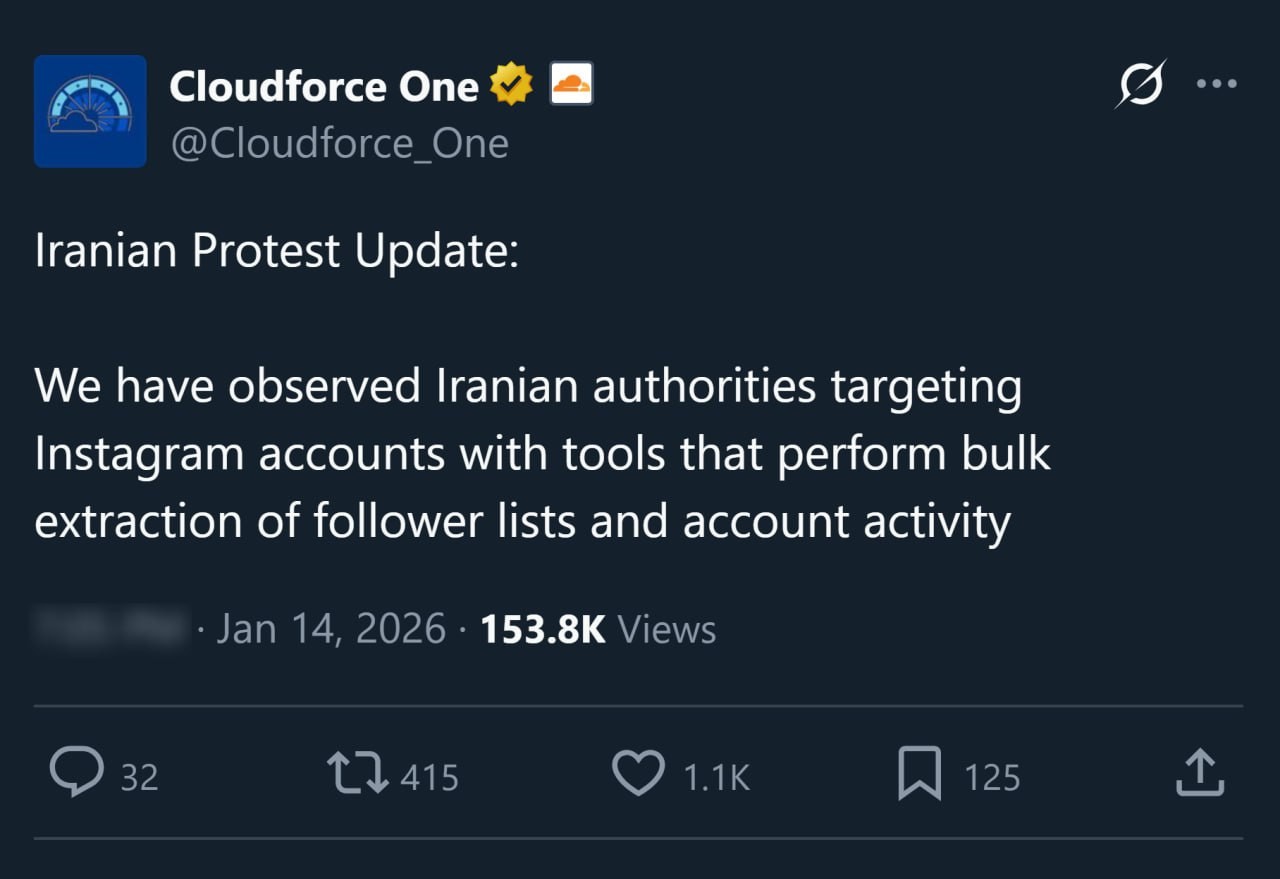
Cloudflare Warns Iranian Authorities Are Targeting Instagram Accounts to Harvest Followers and Activity Data

Cloudflare’s threat-intelligence unit Cloudforce One said it has observed Iranian authorities using tools that enable bulk extraction of Instagram follower lists and account activity, a tactic that could help map who follows which pages and how they engage. The alert comes as Iran has faced a near-total internet shutdown since January 8, with Cloudflare Radar data showing traffic dropping to effectively zero during the blackout.

Iran Issues Overnight Tehran Airspace Restrictions, Limits Flights to Pre-Approved International Traffic

International aviation sources circulated a NOTAM issued by Tehran Air Traffic Control indicating temporary restrictions over parts of Iran’s airspace: the Tehran flight region is declared closed except for inbound and outbound international flights that have obtained prior authorization. The restriction is set to take effect from Wednesday night, 24 Dey (January 14, 2026) through early Thursday morning.

Graphic footage reported from Kahrizak Forensic Center as Iran Crackdown Continues

Videos received and dated Saturday, 20 Dey 1404 (January 10, 2026) purport to show the bodies of people killed in recent violence at the Kahrizak Forensic Medicine Center. The footage has not been independently verified, but it is circulating alongside mounting reports of fatalities during the ongoing crackdown.


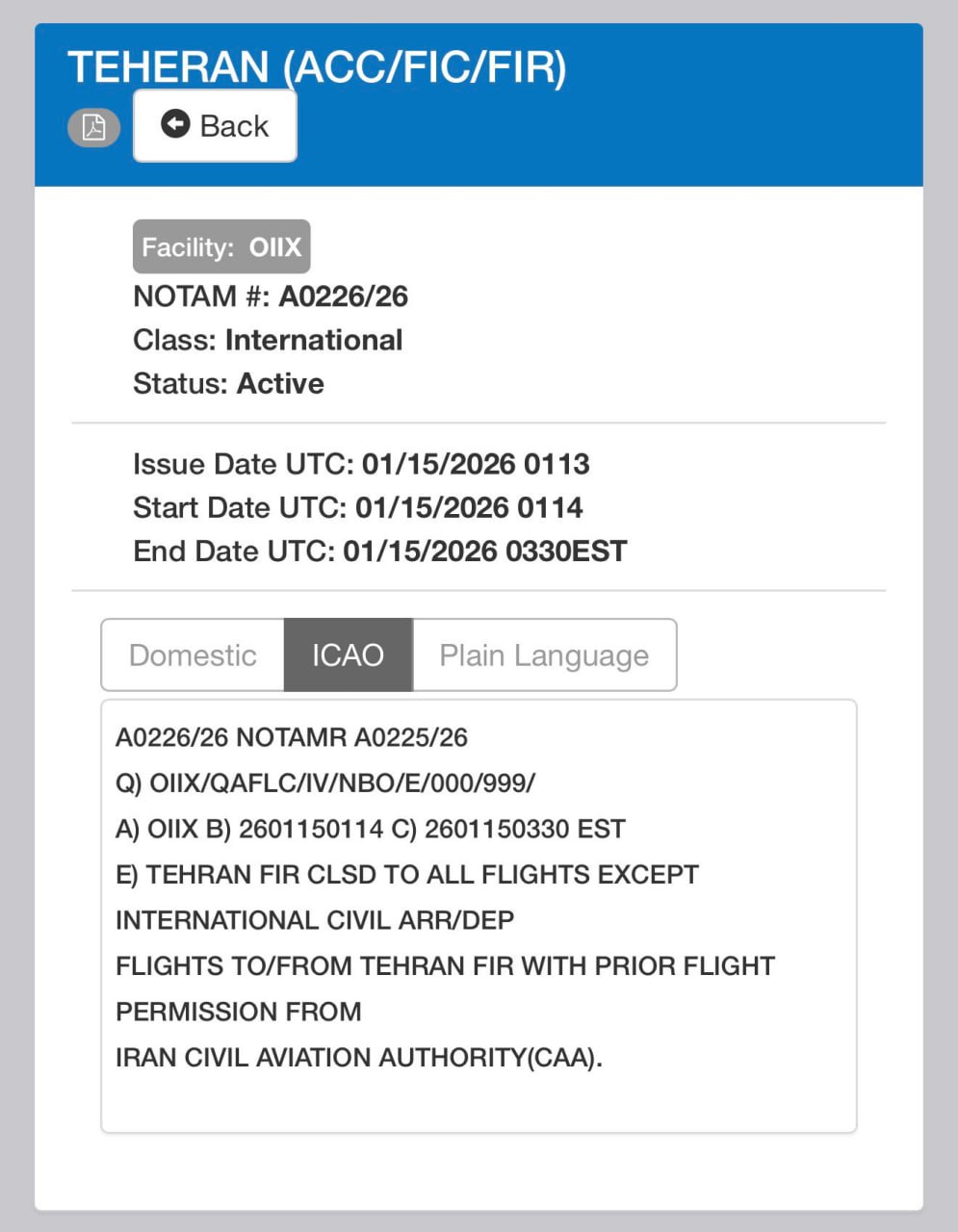
Iran Extends Airspace Restriction NOTAM to 7:00 a.m. Tehran Time

Iran has extended its aviation NOTAM, keeping parts of the Tehran FIR closed to most traffic until 07:00 Tehran time (about 03:30 UTC) as regional tensions remain elevated. The restriction reportedly continues to allow only international civil arrivals/departures with prior authorization, reinforcing airlines’ widespread avoidance of Iranian airspace and underscoring the risk of sudden, short-notice operational changes.

More Iran news

Political

Iran FM Araghchi: Trump’s Remarks Are “Interference,” Holds Calls With UAE and Turkey

Iran’s Foreign Minister Abbas Araghchi spoke with the UAE’s Foreign Minister Sheikh Abdullah bin Zayed Al Nahyan about Iran’s national uprising, and said President Donald Trump’s statements amount to interference in Iran’s internal affairs. In a separate phone call with Turkey’s Foreign Minister Hakan Fidan, Araghchi also confirmed that Iranian protesters have been killed and discussed developments from recent days.

U.S. State Department: Real Power Lies With Iran’s Unarmed Protesters—Not a Repressive Regime

The Persian-language account of the U.S. State Department posted a video on X showing security forces firing toward protesters in Iran, writing: “When a regime needs weapons to confront unarmed people, that’s not strength—it’s fear and cowardice.” The State Department added that “real power” belongs to unarmed protesters who stand up to what it called brutality.

Washington Post: U.S. Asked Europe to Share Intel on Potential Targets Inside Iran

The Washington Post, citing two European officials, reported that the Trump administration on Monday, 22 Dey 1404 (January 12, 2026), asked European countries to share intelligence on possible targets inside Iran. One of the officials said there were no indications the U.S. was preparing to strike nuclear facilities, and that a more likely focus would be leadership and forces linked to the security apparatus involved in killing protesters—part of a broader internal review of response options.

Turkey’s Fidan Tells Iran’s Araghchi Talks Are Needed to Defuse Regional Tensions

A Turkish Foreign Ministry source said Foreign Minister Hakan Fidan told his Iranian counterpart Abbas Araghchi in a phone call that negotiations are necessary to resolve current regional tensions. The message aligns with Ankara’s broader line, warning that escalation or outside intervention could deepen instability and urging dialogue to reduce pressure across the region.

German MP Röttgen: Europe Must Stand Openly With Iran’s Protesters

Norbert Röttgen, a member of Germany’s Bundestag, wrote on X that many Iranians felt Europe “left them alone” during the 2022 “Woman, Life, Freedom” protests—arguing that Europe should not repeat that mistake and must now act openly and clearly in support of the Iranian people as the current unrest escalates.

Former U.S. Official McGurk: Any Trump Strike Order Would Likely Hit IRGC, Basij “Repression” Nodes, Not Be a One-Off

Brett McGurk, a former U.S. National Security Council coordinator for the Middle East and North Africa, said President Donald Trump’s warnings over Iran’s crackdown effectively point toward regime change, arguing it is hard to imagine any military move as a single, isolated strike. McGurk said planners would likely seek to degrade Iran’s retaliatory missiles and systems, and that target sets could include what he called the regime’s internal repression apparatus—such as the Basij and IRGC headquarters—cautioning that leadership targets could open a “Pandora’s box.”

Reuters: Some Personnel at U.S. Al Udeid Air Base in Qatar Advised to Leave by Wednesday Evening

Reuters, citing three diplomatic sources, reported that some personnel at the U.S. military’s Al Udeid Air Base in Qatar were advised to leave the base by Wednesday evening, while the U.S. embassy in Doha had no immediate comment. Al Udeid—described as the largest U.S. base in the Middle East, hosting around 10,000 troops—has previously seen limited personnel moves ahead of periods of elevated tensions, and the advisory may signal a heightened security posture amid regional uncertainty.

EU Parliament President Metsola: 2026 Is When Dictatorships End—A “Golden Moment” to Back Iranians

European Parliament President Roberta Metsola said 2026 should be the year “dictatorships are over,” calling the moment “golden” for the EU and member states to state openly that Iran’s ruling system is “on its last legs.” She added that Iranians want change and that Europe should support them, while emphasizing that the outcome must ultimately be decided by the people of Iran.

Sweden’s Ex-FM Wallström: World Should Declare Iran’s Regime Lacks Popular Legitimacy

Former Swedish Foreign Minister Margot Wallström wrote on X that Germany and Australia have already stated clearly that Iran’s ruling system lacks legitimacy in the eyes of the Iranian people, and argued that other countries should now adopt the same position, saying she expects Sweden and the EU to do so quickly. She also urged the EU to immediately designate the IRGC as a terrorist organization, recall EU ambassadors from Iran, and explore ways to help Iranians regain internet access.

Von der Leyen: EU to Swiftly Propose New Iran Sanctions as Crackdown Deepens

European Commission President Ursula von der Leyen said the rising number of casualties in Iran is “horrifying,” condemning the “excessive use of force” and continued restrictions on freedoms. In a post on X on Tuesday, 23 Dey 1404 (January 13, 2026), she said the EU has already listed the Islamic Revolutionary Guard Corps (IRGC) in its entirety under the bloc’s human-rights sanctions regime, and that—working closely with EU foreign-policy chief Kaja Kallas—additional sanctions targeting those responsible for the repression will be proposed “swiftly,” adding that the EU stands with Iranians “bravely marching for their liberty.”

US House Foreign Affairs GOP: “Make Regime Change Inevitable”

The Republican-led majority of the U.S. House Foreign Affairs Committee said in an X post on 23 Dey 1404 (January 13, 2026) that Supreme Leader Ali Khamenei is responsible for the killing of Iranian citizens, for driving the rial to what it called “the weakest currency in the world,” and for squandering national resources—urging Iranians to “make regime change inevitable.” The message came alongside intensifying U.S. political pressure over Iran’s crackdown, as Iranian state media continues to air “confession” videos that activists and rights groups describe as coerced.

Israel Raises Security Alert as U.S. Strike on Iran Looks More Likely

Israel has heightened its security readiness amid growing speculation that the United States could launch an attack on Iran. A security official in Prime Minister Benjamin Netanyahu’s government told Channel 12 that Israeli intelligence and security agencies are reviewing developments inside Iran and assessing all possible scenarios.

Former Irish Minister Urges Dublin to Designate IRGC as a Terror Group

Alan Shatter, a former Irish minister and ex-member of parliament, wrote on X that the Irish government should formally designate Iran’s Islamic Revolutionary Guard Corps (IRGC) as a terrorist organization—adding fresh pressure on Dublin as scrutiny of Tehran’s security apparatus intensifies.

U.S. Drawdown at Al Udeid as Iraqi Sources Point to Base Clear-outs in Iraq

Reuters reported on January 14, 2026 that some personnel were advised to leave the U.S.-run Al Udeid Air Base in Qatar as a precaution amid rising regional tensions. Separately, Iraqi security sources said the U.S. has begun clearing out parts of its footprint at several sites—including Ain al-Asad in Anbar—moving weapons and equipment, as Iraq has also said the coalition is set to hand over Ain al-Asad to Iraqi forces.

European Diplomats “Strongly” Push Back on Tehran’s Protest Narrative in Closed-Door Meeting

POLITICO reported that European representatives in Tehran forcefully challenged Iran’s official account of the anti-government protests during an unusual closed-door session with Foreign Minister Abbas Araghchi, amid EU efforts to escalate pressure over the crackdown. According to a diplomat cited by the outlet, ambassadors from European countries still operating in Tehran—along with the UK—were summoned to the meeting, where Araghchi reportedly opened by portraying protesters as “rioters” backed from abroad, prompting a blunt rebuttal from European diplomats.

Reuters: U.S. Pulls Some Troops From Key Middle East Bases as Tensions Rise

A U.S. official told Reuters that Washington is withdrawing some military personnel from key U.S. bases in the Middle East as a precautionary step amid heightened regional tensions. The move follows comments attributed to a senior Iranian official that Tehran has warned neighboring states hosting U.S. forces that American bases could be targeted in retaliation if the United States strikes Iran.

Channel 12: Saudi Arabia Urges “Limited, Precise” U.S. Action Aimed at Iran’s Repression Apparatus

Israel’s Channel 12 (N12) reported that Saudi Arabia has advised the United States to consider a focused, narrowly tailored response targeting the Islamic Republic’s domestic suppression mechanisms—rather than a broader or ineffective operation that could ultimately help Tehran consolidate control. The report cites a Saudi royal family source warning that an unmeasured move could backfire by strengthening the regime’s hand against protesters.

i24: Trump Team Received a List of 50 Potential Targets in Iran

Israeli outlet i24NEWS reported that the Trump administration has been presented with a list of 50 potential targets in Iran, including 23 sites tied to the IRGC and Basij. The details have not been independently confirmed by U.S. officials, but the report comes as Washington weighs a range of Iran-related options amid heightened regional tensions.

Qatar Says It Is Taking “All Necessary Measures” to Protect Residents as Al Udeid Drawdown Begins

Qatar said it continues to implement “all necessary measures” to safeguard the security and safety of its citizens and residents, after confirming that some forces and staff are departing the Al Udeid Air Base. Doha said the decision was taken in response to “current developments and tensions in the region,” framing the move as a precautionary step amid heightened regional risks.

Ynet: U.S. Attack on Iran Seen as Likely, But Immediate Missile Response on Israel Not Guaranteed

Israeli sources cited by Ynet assessed that a U.S. strike on Iran is ultimately likely, but said this does not automatically imply an immediate Iranian missile response against Israel; the timing and form of any retaliation would depend on the scope and nature of U.S. action. Israel remains on heightened alert amid the prospect of U.S. intervention.

Hezbollah Source: Diplomats Sought Assurance It Would Not Respond if Iran Is Attacked

A source close to Hezbollah said diplomats have sought guarantees that the group would refrain from action if Iran were struck. The source said Hezbollah offered no such assurance, but currently has no plan to intervene unless an attack on Iran is deemed “existential” in nature.

U.S. Embassy in Saudi Arabia Urges Staff to Limit Non-Essential Visits to Military Facilities

The U.S. Mission to Saudi Arabia has advised its personnel to exercise increased caution and limit non-essential travel to any military installations in the region, citing ongoing regional tensions. The mission also recommended that U.S. citizens in the Kingdom follow the same precautions.

i Paper: UK Begins Withdrawing Some Personnel From an Air Base in Qatar

Britain is pulling some military personnel from a Qatari air base, The i Paper reported, a move described as mirroring U.S. precautionary drawdowns across the Middle East amid heightened regional tensions. The UK Ministry of Defence declined to comment on basing and deployment details for security reasons, while separate reporting indicates the adjustments are linked to the current risk environment around potential escalation with Iran.

CENTCOM Opens New Middle East Air-Defense Operations Cell at Qatar’s Al Udeid

U.S. Central Command (CENTCOM) said it has launched the Middle Eastern Air Defense – Combined Defense Operations Cell (MEAD-CDOC) inside the Combined Air Operations Center (CAOC) at Al Udeid Air Base in Qatar, staffed by U.S. and regional partner personnel. CENTCOM said the new cell is intended to tighten air-and-missile defense coordination, accelerate information and threat-warning sharing, and support multinational drills and contingency response, building on earlier bilateral command posts created with Qatar and Bahrain.

Iran’s Envoy in Cairo Says Tehran Is “Without Doubt” in a State of War

Mojtaba Ferdowsi Bor, Iran’s representative in Cairo, told Al Hadath that Iran is “without doubt” in a “state of war,” describing the current moment as an active wartime posture rather than a diplomatic standoff, as regional tensions and military signaling continue to escalate.

Lufthansa Prepares Israel Contingency Plans as Flights Face Disruption From Thursday

Israeli Channel 12 reported that Lufthansa has told staff to be ready to leave Israel and to brace for flight cancellations starting Thursday, January 15, 2026, amid rising regional tensions. Separately, Lufthansa said it will avoid Iranian and Iraqi airspace and operate daytime-only flights to Tel Aviv and Amman through January 19, warning that some flights may still be canceled as a result of the adjusted operations.

Republican Sen. Kevin Cramer: “I Hope Trump Acts Soon” Against Iran, Pledges Support for Internet Access

U.S. Senator Kevin Cramer told Iran International that he is fully prepared to take necessary steps to support Iranians’ access to the internet amid reported nationwide restrictions, adding: “I hope Trump acts as soon as possible against the Islamic Republic.”

CNN: Targeting Iran’s Leadership Footprint Seen as a Symbolic Option for Washington

CNN reported that analysts see a wide range of potential U.S. targeting options if Washington chooses to escalate, with visiting Griffith Asia Institute fellow Peter Layton saying one early option could involve senior Iranian leaders—likely indirectly—because Iran has learned to disperse and conceal key figures after last year’s Israeli strikes that killed senior commanders and nuclear scientists. Retired U.S. Navy captain and Hawaii-based analyst Carl Schuster echoed that assessment, arguing Iran now hides what it values, but the U.S. has demonstrated it can strike what it can locate. Layton added that hitting leaders’ homes or offices could still send a clear message, even if the military value is limited and largely symbolic as a signal of support for protesters.

CNN: U.S. Could Favor Standoff Missiles and Drones Over Another B-2-Led Strike Package

CNN reported that while U.S. B-2 bombers played a leading role in last summer’s strikes, a broader set of potential targets this time could make other options more suitable—particularly long-range standoff weapons that reduce risk to U.S. forces. Retired U.S. Navy captain and analyst Carl Schuster said IRGC command nodes and regional bases could be hit with Tomahawk cruise missiles launched from ships or submarines at distance, while the air-launched JASSM family—fired from aircraft including fighters and bombers—was also cited as a possible option; analysts added drones could be used as well. Visiting Griffith Asia Institute fellow Peter Layton told CNN it is unlikely the U.S. would rely on manned aircraft dropping short-range munitions or unguided gravity bombs, which he said would be assessed as too risky.

Iran International: Diplomatic Source Says Germany Convened a Security Meeting on Iran

A diplomatic source told Iran International that the German government has held a security meeting to review the situation in Iran. No further details on the agenda or outcomes were disclosed in the report.

New York Times: U.S. Sends Additional Naval Firepower to the Region as Iran Tensions Rise

The New York Times reported—citing U.S. officials—that the U.S. Navy now has three missile-capable destroyers in the Middle East region, including the USS Roosevelt, which recently entered the Red Sea, and that at least one missile-firing submarine is also positioned in the area. The deployments underscore a posture of heightened readiness as Washington weighs next steps amid escalating pressure on Tehran.

Graham: “Standing With Protesters Isn’t Enough—Stop the Killings Fast”

U.S. Republican Senator Lindsey Graham wrote on X that the “next step” in response to Iran’s crackdown is to stand with protesters seeking an end to repression—but argued that support alone is insufficient. He said those responsible for killing civilians should be stopped “as soon as possible” and “with every necessary tool,” framing the goal as making Iranians “safe again.”

EU Parliament President Urges Tougher Sanctions, Calls to List IRGC as Terror Group

Roberta Metsola, President of the European Parliament, wrote on X that Europe must act “decisively,” arguing “If not now, then when?” She called for stricter sanctions on those who, in her words, keep Iran’s rulers in power through violence, killings, and repression, and said it is time for the Islamic Revolutionary Guard Corps (IRGC) to be formally recognized as a terrorist organization—adding that “it’s time for freedom in Iran.”

G7 Condemns Iran Crackdown, Signals More Sanctions if Repression Continues

G7 foreign ministers (Canada, France, Germany, Italy, Japan, the UK, and the US) together with the EU’s High Representative said they are “gravely concerned” by the ongoing protests in Iran and strongly opposed the authorities’ intensified repression since late December 2025. The statement condemned the deliberate use of violence—including killings, arbitrary detentions, and intimidation—urged full restraint and respect for fundamental rights (including freedom of expression, access to information, and peaceful assembly), and warned the G7 is prepared to impose additional restrictive measures and sanctions if the crackdown and rights violations persist.

Channel 12: Israel Signals “Regime-Fall” Response if Iran Strikes

Israel’s Channel 12, citing a senior security source, reported that Israeli decision-makers see a “window of opportunity” and have adopted a clear line: if Iran attacks, Israel would treat it as more than another round of escalation and move to bring about the regime’s collapse. The report comes amid heightened regional alert levels and intensifying talk of wider military escalation.

Former Persepolis Striker Shahab Zahedi: “They Silenced the Streets With Blood—Iran Will Rise From It”

Shahab Zahedi, a former Persepolis forward, wrote in an Instagram story that the authorities “choked the protests,” cut the internet, and “silenced the streets with people’s blood,” reacting to what he described as the killing of 12,000 Iranian protesters during the national uprising. He added that “from this very blood, Iran will stand tall again.” Zahedi had earlier condemned the internet shutdowns from 18 Dey 1404, saying it was not merely an internet cut but “a cut to people’s lives,” citing disrupted calls, canceled flights, and Iran’s isolation from the world while urging the international community to amplify Iranians’ voices.

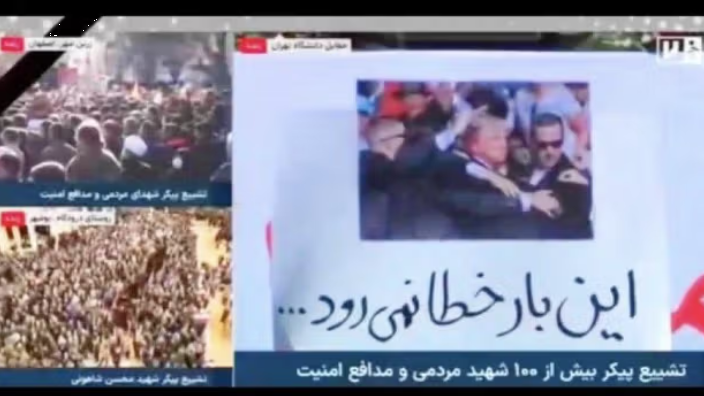
Iran State TV Graphic Sparks Cruz Warning of Assassination Threat Against Trump

U.S. Senator Ted Cruz said Iran’s state broadcaster aired—and he reposted—a zoomed-in image referencing the July 2024 shooting attempt on Donald Trump, accompanied by the Persian caption “This time there will be no mistake.” Cruz argued the broadcast amounts to an explicit threat to assassinate the U.S. president, saying it contradicts claims circulated elsewhere that Tehran has not threatened Trump.

Spain Urges Citizens to Leave Iran Immediately as Security Situation Deteriorates

Spain’s Foreign Ministry said travel to Iran is strongly discouraged due to the “highly unstable” situation in Iran and the wider region, and advised Spanish nationals currently in Iran to leave the country using available means.

POLITICO: UK Temporarily Closes Embassy in Tehran, Moves Operations Remote

POLITICO reported that the UK has temporarily closed its embassy in Tehran. A UK government spokesperson said the mission will “now operate remotely,” and the Foreign Office has updated its travel advice to reflect the change in consular operations.

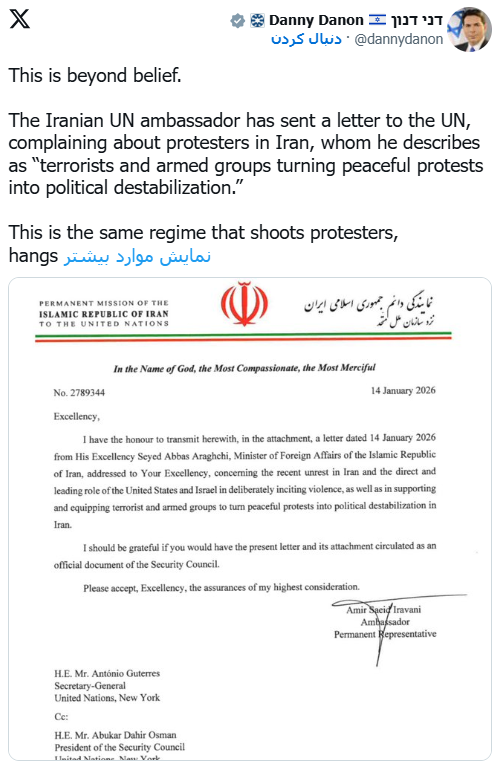
Danon Dismisses Iran UN Envoy’s Protest Letter as “Crocodile Tears”

Israel’s Ambassador to the UN Danny Danon wrote on X that the Iranian ambassador’s letter to the United Nations about the protests amounts to “crocodile tears,” arguing it comes from a regime that “shoots protesters,” “hangs opponents,” and suppresses the population. In the Iranian envoy’s letter, protesters are described as “terrorists” who allegedly turned peaceful demonstrations into violence.

AlJeebal: Residents Report Fighter Jets Heard Over Basra Near Iran Border

Iraqi news platform AlJeebal reported that residents in Basra (southern Iraq), only a short distance from the Iranian border, heard—and in some cases saw—fighter jets overhead earlier this evening. There has been no official confirmation of the aircraft’s identity or mission, and the report should be treated as unverified amid heightened regional military activity.


More Political news

USA

US 30-Year Auction Tails Higher: 4.825% Signals Softer Long-End Demand

The U.S. 30-year Treasury auction cleared at 4.825%, above the prior 4.773%, indicating a higher stop-out yield and a modestly weaker tone at the long end. A move higher like this typically reflects investors demanding more compensation for duration risk amid heavy supply, fiscal uncertainty, and sensitivity to inflation expectations—especially when the curve’s long end is already volatile.

Market impact: Mildly bearish for long-duration bonds (higher long-end yields) and can be supportive for USD at the margin via higher rate differentials, while potentially weighing on rate-sensitive equities. Watch whether the market keeps pushing the term premium higher into the upcoming supply and macro catalysts.

US Budget Deficit Narrows Slightly: -$145B vs -$173B Prior

The U.S. federal budget balance posted a -$145.0B deficit in December, roughly in line with expectations (-$144.5B) and improved from -$173.0B previously. The modest narrowing points to slightly better month-to-month fiscal arithmetic, but the deficit remains large—keeping Treasury supply dynamics and term-premium sensitivity in focus for rates markets.

Market impact: Typically, limited immediate USD impact. A marginally smaller deficit can be modestly supportive for Treasuries at the margin, but broader drivers remain the fiscal outlook, auction demand (especially at the long end), and Fed policy expectations.

US Mortgage Demand Surges as 30-Year Rate Dips to 6.18%

U.S. MBA data showed a sharp rebound in mortgage activity as the 30-year mortgage rate eased to 6.18% (from 6.25%). Mortgage applications jumped 28.5% WoW (vs **0.3% prior), led by a powerful refi wave: the refinance index surged to 1,313.1 (from 937.0). Purchase demand also improved, with the purchase index rising to 184.6 (from 159.3), while the broader mortgage market index climbed to 348.0 (from 270.8). The combination suggests rate sensitivity remains high—small declines in yields can quickly unlock sidelined borrowers, especially on refinancing.

Market impact: Mildly growth-supportive for housing-related activity and consumer cash-flow via refinancing, though the move is volatile week-to-week. Limited direct USD impact, but it can be supportive for rate-sensitive equities if lower mortgage rates persist.

US PPI: Core Stalls in November, but Yearly Pipeline Inflation Edges Higher

U.S. producer prices signaled cooler monthly pressure in November, but firmer year-on-year momentum. Headline PPI rose 0.2% MoM in November (in line, vs 0.6% prior), while core PPI was flat (0.0% MoM) (below 0.2% expected, vs 0.4% prior)—a notable moderation in underlying monthly pipeline inflation. However, the annual rates ticked up: headline PPI accelerated to 3.0% YoY (above 2.7% expected, vs 2.8% prior) and core PPI to 3.0% YoY (above 2.7% expected, vs 2.9% prior). Taken together, the data read as “near-term easing, but not yet a clean downtrend” on producer-side inflation.

Market impact: The flat core MoM is bond-supportive and USD-negative at the margin (less immediate inflation heat), while the higher YoY rates can temper dovish enthusiasm by keeping attention on stickier underlying trends. Equity reaction is typically modest unless markets are hyper-focused on inflation repricing.

US Consumer Stays Firm: Retail Sales Beat, Current Account Deficit Narrows

U.S. November retail sales surprised to the upside, signaling resilient consumer demand. Headline retail sales rose 0.6% m/m (0.5% expected, -0.1% prior), while core retail sales increased 0.5% (0.4% expected, 0.2% prior). The closely watched retail control metric—most relevant for GDP tracking—printed 0.4% (in line, vs 0.6% prior), and sales ex gas/autos also came in at 0.4% m/m, indicating steady underlying momentum even as some components normalized. On the external side, the Q3 current account deficit narrowed to -$226.4B (vs -$235.0B expected, -$249.2B prior), a modest improvement that suggests a slightly reduced drag from net external financing needs.

Market impact: The retail beat is modestly USD-supportive and can be rates-bearish at the margin (stronger demand can keep the Fed cautious), while the in-line control print tempers the “re-acceleration” narrative. Equities may take it as supportive for a soft-landing backdrop, especially for consumer-facing sectors.

US Existing Home Sales Jump: 4.35M, Biggest Beat Signals Housing Thaw

U.S. existing home sales rose to 4.35M in December (4.21M expected, 4.14M prior), with sales up 5.1% MoM (vs 0.7% expected). The strong upside surprise points to a late-year pickup in housing activity, likely helped by improved affordability at the margin (lower mortgage rates) and some easing in the “lock-in” effect as sellers and buyers adjust to the new rate regime. Even so, supply constraints remain a key limiting factor for sustained upside.

Market impact: Mildly USD- and risk-supportive on a growth signal, and can be modestly rates-bearish at the margin if markets read it as demand staying firm. For equities, it’s supportive for homebuilders, real estate services, and housing-linked cyclicals—though follow-through depends on mortgage rates and inventory.

US Consumer Sentiment Firms: Ipsos PCSI Rises to 53.81

The U.S. Thomson Reuters/Ipsos PCSI increased to 53.81 in January, up from 51.86 previously, indicating a clearer improvement in household sentiment at the start of the year. The move suggests consumers are feeling somewhat less pressured—potentially reflecting easing inflation perceptions, steadier labor conditions, and improving real-income expectations—though confidence remains sensitive to rates and political uncertainty.

Market impact: Mildly risk-supportive and constructive for consumer-facing equities if it translates into spending, while the direct USD impact is usually limited. The signal becomes more market-relevant if corroborated by retail sales and services activity.

Atlanta Fed GDPNow Jumps to 5.3% for Q4, Signaling Firmer Growth Tracking

The Atlanta Fed’s GDPNow estimate for Q4 rose to 5.3% (5.1% expected, 5.1% prior), implying stronger real-time growth tracking versus the previous update. Moves of this size usually reflect incremental data inputs—often from consumption, inventories, or trade—rather than a wholesale regime shift, but it does reinforce a “resilient growth” narrative into year-end.

Market impact: Mildly USD-supportive and Treasury-bearish at the margin (firmer growth can keep upward pressure on yields), while equities may read it as supportive if it aligns with a soft-landing backdrop and cooling inflation.

More USA news

Others

Korea’s Trade Inflation Cools: Export Prices +5.5% YoY, Import Prices Nearly Flat

South Korea’s Export Price Index rose 5.5% YoY in December (vs 6.8% prior), while the Import Price Index increased just 0.3% YoY (vs 1.9% prior). The step-down in both measures points to easing price pressures in Korea’s trade channel—consistent with a cooler global goods inflation impulse and less imported-cost pressure. A wider gap between export and import price inflation can also be read as mildly supportive for terms-of-trade dynamics, depending on volumes and currency effects.

Market impact: Mildly supportive for Korean disinflation and could be bond-friendly at the margin, potentially giving the BoK more flexibility if domestic growth softens. For KRW, the direct effect is usually limited; FX remains driven by global risk tone, USD moves, and semiconductor-cycle expectations.

Korea Jobless Rate Jumps to 4.0%, Signaling Labor-Market Softening

South Korea’s unemployment rate rose to 4.0% in December, up sharply from 2.7% previously, pointing to a notable deterioration in labor-market conditions at year-end. While seasonal factors can amplify December moves, the magnitude of the increase suggests genuine softness in hiring and employment momentum, adding to concerns about domestic demand and growth resilience amid a slowing global cycle.

Market impact: Mildly KRW-negative at the margin and supportive for Korean bonds, as a weaker labor market can give the Bank of Korea more room to lean dovish if growth risks intensify. Equity impact is mixed, with domestic-facing sectors more exposed than exporters.

Korea Liquidity Growth Eases: M2 Slows to 6.8%

South Korea’s monetary aggregates point to a gradual cooling in liquidity growth. M3 stood at KRW 5,999.3T in November (vs KRW 6,006.1T prior), while M2 money supply growth eased to 6.8% (vs 7.1% prior). The deceleration suggests financial conditions are becoming less expansionary at the margin—consistent with slower credit impulse and a more measured domestic demand backdrop.

Market impact: Typically KRW-neutral in the near term. Softer money growth can be modestly bond-supportive and gives the Bank of Korea more flexibility if activity weakens, but FX direction remains dominated by USD moves, risk sentiment, and the semiconductor cycle.

Brazil Consumer Sentiment Improves: PCSI Rises to 55.14

Brazil’s Thomson Reuters/Ipsos PCSI (consumer sentiment) rose to 55.14 in January, up from 53.15 previously, pointing to a clearer improvement in household confidence at the start of the year. A move like this typically reflects easing inflation stress, better real income expectations, and/or improving labor-market perceptions—factors that can support near-term consumption momentum.

Market impact: Mildly BRL-supportive at the margin and constructive for domestically oriented Brazilian equities (retail, banks) if the trend persists. Policy impact is usually limited unless sentiment strength feeds into faster spending and renewed inflation pressure.

Brazil FX Outflows Persist, but Ease: -$1.70B vs -$4.13B Prior

Brazil reported foreign exchange flows of -$1.696B, still negative but a clear improvement from the prior -$4.127B outflow. The smaller drain suggests reduced capital leakage in the latest period—potentially reflecting better risk sentiment, improved carry appeal, or less corporate/seasonal demand for dollars—though flows remain a key watchpoint for BRL stability.

Market impact: Mildly BRL-supportive at the margin versus last week, given the smaller outflow, but still a caution flag. If outflows persist, BRL upside can be capped despite strong carry; a turn to inflows would be a more durable bullish signal.

More Others news

Japan

Japan Business Mood Softens: Reuters Tankan Falls to 7

Japan’s Reuters Tankan index eased to 7 in January (vs **10 prior), indicating a modest deterioration in business sentiment at the start of the year. While still positive—implying optimists continue to outnumber pessimists—the decline suggests firms are a bit less confident on near-term conditions, potentially reflecting demand uncertainty, input-cost dynamics, and currency-related volatility.

Market impact: Mildly JPY-negative at the margin and modestly supportive for a cautious BoJ read-through, but the yen remains primarily driven by global yields and risk sentiment. The signal matters more if confirmed by capex intentions, hiring plans, and hard output data.

Japan Money Growth Steadies: M2 Holds 1.7% as Liquidity Remains Moderate

Japan’s M3 money supply rose to ¥2,244.5T in December (vs ¥2,241.3T prior), while M2 money stock growth held at 1.7% YoY (vs **1.9% expected, 1.7% prior). The flat YoY pace signals stable, moderate liquidity growth—not a re-acceleration—suggesting money dynamics are consistent with a steady domestic cycle rather than an overheating impulse, even as markets watch for gradual policy normalization.

Market impact: Typically limited for JPY. A steady M2 trend is broadly neutral for BoJ expectations; yen direction remains driven primarily by rate differentials, risk sentiment, and policy communication.

Japan 5-Year Auction Reprices Higher: 1.639% Signals Firmer Front-End Yields

Japan’s 5-year JGB auction cleared at 1.639%, up sharply from 1.435% previously, underscoring continued repricing higher in mid-curve yields. The move is consistent with markets demanding more compensation for duration risk as expectations build around gradual policy normalization and as fiscal/election headlines keep pressure on the term premium.

Market impact: Mildly JPY-supportive via higher domestic yields, but the yen’s direction still depends primarily on U.S.–Japan rate differentials and risk sentiment. For local assets, higher 5-year yields can pressure rate-sensitive equities while supporting the banking/financials tone.

Japan Capex Signal Cools: Machine Tool Orders Slow to +10.6% YoY

Japan’s machine tool orders rose 10.6% YoY in December, but fell short of expectations (14.2%) and eased from 16.8% previously. The print still signals expansion in capital-goods demand, yet the deceleration suggests the investment cycle is losing some momentum at the margin—potentially reflecting softer external demand, normalization after a strong run, or greater corporate caution heading into early 2026.

Market impact: Mildly JPY-negative / growth-negative at the margin, with limited standalone FX impact. For Japanese equities, it can be a modest headwind for capital goods and industrial exporters unless global tech/AI capex remains strong enough to offset broader slowing.

More Japan news

Oceania

New Zealand Housing Signal Turns Up: Building Consents +2.8% MoM

New Zealand’s building consents rose 2.8% MoM in November, reversing the prior -0.7% decline and pointing to a tentative pickup in residential pipeline activity. While consents can be volatile month to month, the rebound suggests housing-related activity may be stabilizing after a weaker stretch—an important swing factor for domestic growth and construction employment.

Market impact: Mildly NZD-supportive at the margin and can be interpreted as a modest upside risk to the growth outlook. Typically not a major mover on its own, but it matters more alongside credit conditions, house prices, and inflation data guiding RBNZ expectations.

NZ Commodity Prices Slide: ANZ Index Falls 2.1% MoM

New Zealand’s ANZ Commodity Price Index dropped 2.1% MoM, a larger decline than the prior -1.6%, indicating renewed downside pressure in key export commodity prices. For a commodity-linked economy, a steeper fall in the index can translate into weaker terms of trade and softer farm/export income, which may ultimately weigh on growth and inflation dynamics.

Market impact: Mildly NZD-negative at the margin, as weaker export price momentum can reduce the external support for the currency and reinforce a more cautious RBNZ path if disinflation persists. The signal is more meaningful if corroborated by dairy auction results and trade balance trends.

Australia Housing Pipeline Rebounds: Approvals Surge 15.2% in November

Australia’s building approvals jumped 15.2% MoM in November (in line), a sharp rebound from -6.1% previously, while approvals rose 20.2% YoY (also in line) versus -1.8% prior. The strong headline suggests the residential construction pipeline is re-accelerating after a weak patch. Within the detail, private house approvals rose 1.3% (in line) after -1.3%, implying the bulk of the surge likely came from multi-unit approvals—a segment that can be volatile but is crucial for meeting housing supply targets.

Market impact: Mildly AUD-supportive and a modest upside risk to domestic growth, though the market will focus on whether approvals translate into starts amid capacity constraints and still-high financing costs. For the RBA, stronger housing momentum can complicate the disinflation narrative at the margin, but policy remains primarily driven by inflation and labor data.

More Oceania news

Equities

Bank of America Posts Solid Q4 2025, Beats EPS and Revenue Estimates

Bank of America (BAC) reported EPS of $0.98 per share, topping expectations of ~$0.96, while revenue rose to $28.4B versus $27.55B forecast. The beat suggests a firmer quarter across BAC’s core banking engine, with revenue outperformance indicating healthy fee activity and/or steadier net interest dynamics relative to consensus. The bank’s market capitalization stands at $403.02B, reinforcing its status as a major U.S. financial bellwether heading into 2026.

Wells Fargo Delivers Mixed Q4 2025, Beats EPS but Misses Revenue

Wells Fargo & Co (WFC) reported EPS of $1.76 per share, beating expectations of $1.66, while revenue came in at $21.29B, below forecasts of $21.64B. The combination suggests profitability held up better than the top line, with margins and expense discipline likely cushioning slightly weaker-than-expected revenue. Wells Fargo’s market capitalization stands at $280.85B, with investors focusing on revenue momentum and core banking trends as 2026 begins.

Citigroup Posts Mixed Q4 2025, Beats EPS but Misses Revenue

Citigroup (C) reported EPS of $1.81 per share, beating expectations of $1.70, while revenue came in at $19.9B, below forecasts of $20.55B. The print suggests better-than-expected profitability despite a softer top line, indicating cost control and/or mix benefits helped offset revenue coming in light versus consensus. Citigroup’s market capitalization stands at $201.11B, with attention likely turning to revenue momentum and business-line execution as 2026 unfolds.

More Equities news

Commodities

API Shows Surprise Crude Build: +5.27M Barrels

The API weekly report for the week ended Jan. 10 showed U.S. crude oil inventories rose by 5.27 million barrels, sharply against expectations for a 2.0 million-barrel draw and reversing the prior 2.8 million-barrel decline. The unexpected build suggests softer refinery demand or higher imports in the period, tempering the recent geopolitical risk premium in oil markets and putting focus on confirmation from the official EIA data.

Market impact: Near-term bearish for crude prices if confirmed by the EIA, potentially weighing on energy equities. Any downside may be cushioned by geopolitical risks and OPEC+ supply discipline.

EIA: Crude Build Confirms API, Gasoline Stockpiles Surge Nearly 9M

The EIA weekly report for the week ended Jan. 10 showed U.S. crude inventories rose 3.391M (vs -1.700M expected, -3.832M prior), confirming a supply-side surprise after last week’s draw. Cushing stocks increased 0.745M (from 0.728M), while crude imports rose 0.710M (from 0.563M), helping explain the crude build. The biggest shock was in products: gasoline inventories surged 8.977M (vs 4.000M expected, 7.702M prior) even as gasoline production was only slightly higher (+0.029M vs -0.472M prior). Refinery activity was modestly firmer—crude runs +0.049M (vs +0.062M prior) and utilization +0.6pp (vs 0.0pp prior)—but not enough to prevent the inventory swell. On distillates, the picture was comparatively tighter: heating oil stockpiles fell -0.745M (vs +0.672M prior), and distillate stocks were near-flat at -0.029M (vs -0.200M expected, +5.594M prior) with distillate production down -0.019M (vs +0.081M prior).

Market impact: Near-term bearish for crude and especially gasoline cracks given the outsized product build; supportive for a softer oil tape unless offset by geopolitics. Distillates being tighter can cushion broader refining margins, but the headline combination of crude build + massive gasoline build typically weighs on energy sentiment.

More Commodities news

Canada

Canada Leading Index Rises 0.26% in December, Signaling Modest Momentum

Canada’s Leading Index increased 0.26% MoM in December (in line with the prior 0.26%), pointing to steady—if unspectacular—forward momentum heading into early 2026. A repeat gain suggests the outlook is stabilizing rather than accelerating, consistent with a mixed macro picture where soft spots (housing permits) coexist with pockets of resilience in activity.

Market impact: Typically CAD-neutral. A steady leading index can modestly support the “soft landing” narrative for Canada, but FX and rates will remain driven more by the BoC path, oil, and the U.S. growth/inflation mix.

Canada Consumer Sentiment Rebounds: Ipsos PCSI Jumps to 49.28

Canada’s Thomson Reuters/Ipsos PCSI rose to 49.28 in January, up from 46.43 previously, signaling a meaningful month-to-month improvement in consumer sentiment. Even with the rebound, the level remains close to the 50 line, implying households are still cautious, but less downbeat than late 2025—potentially reflecting easing inflation anxiety, better real-income perceptions, or improved rate expectations.

Market impact: Mildly CAD-supportive at the margin and constructive for domestic cyclicals if confidence translates into spending. On its own, it’s rarely a major market mover, but it can reinforce a “stabilizing Canada” narrative when aligned with retail and labor data.

More Canada news

China

China Trade Beats: Exports +6.6%, Imports +5.7% as Surplus Stays Huge

China’s December trade data surprised to the upside, showing firmer external momentum and a healthier import pulse. Exports rose 6.6% YoY (3.0% expected, 5.9% prior) and imports grew 5.7% YoY (0.9% expected, 1.9% prior), while the trade surplus (USD) came in at $114.10B (vs $114.30B expected, $111.68B prior). In yuan terms, the trade balance widened to CNY 808.80B (CNY 805.00B expected, CNY 792.57B prior). The key signal is the combination of stronger exports and a meaningful import rebound—suggesting not just export resilience but also improved demand for inputs/commodities and intermediate goods, even as the overall surplus remains structurally large.

Market impact: Modestly CNY-supportive on the growth impulse (imports beating is particularly constructive), and supportive for regional risk sentiment and commodity-linked assets. However, FX follow-through will still hinge on policy expectations, capital flows, and the global risk backdrop—especially if trade strength is partly front-loading ahead of potential tariff escalation.

More China news

India

India Wholesale Inflation Jumps: WPI Back to +0.83% as Manufacturing Firms Up

India’s WPI inflation accelerated to +0.83% YoY in December (0.30% expected, -0.32% prior), snapping back into positive territory and signaling firmer pipeline price pressure than markets anticipated. The detail shows manufacturing WPI rose to +1.82% YoY (vs +1.33% prior), while food WPI improved to 0.00% YoY (from -4.16%) and fuel WPI stayed negative at -2.31% YoY (vs **-2.27% prior). The mix suggests the rebound is being driven more by manufactured goods and a normalization in food pricing, even as energy remains a disinflationary force.

Market impact: Mildly INR-supportive at the margin and a small check on aggressive RBI cut expectations—though CPI remains the primary policy anchor. If WPI strength persists, it can feed into corporate cost curves and keep a floor under inflation expectations even with softer consumer inflation.

More India news

Short News

Reuters: U.S. Military Intervention in Iran Could Come Within 24 Hours

Reuters cited two European officials saying a U.S. military intervention in Iran appears likely, with one warning it could occur within the next 24 hours, while an Israeli official said it looks like President Donald Trump has decided to intervene—though the timing and scope remain unclear. Qatar said the drawdown of some personnel at Al Udeid, the region’s largest U.S. base, is a response to “current regional tensions,” and three diplomats said some personnel were told to leave, without signs of the kind of large-scale pre-strike movement seen last year.

More Short News news

UK

UK 10-Year Gilt Yield Drops to 4.456% at Auction, Easing From 4.613%

The UK’s 10-year Treasury gilt auction cleared at 4.456%, down from 4.613% previously, signaling a lower stop-out yield and a firmer tone for duration demand at the long end. The move suggests investors were willing to accept less compensation for holding UK rates risk—consistent with either improved risk appetite for gilts, a softer growth/inflation outlook, or positioning ahead of key UK macro and Bank of England signals.

Market impact: Generally gilt-supportive and mildly GBP-negative at the margin if markets interpret it as easing rate pressure and a more dovish path. UK equities can take it as neutral-to-positive via lower discount rates, especially for rate-sensitive sectors. بخش‌های حساس به نرخ بهره.

More UK news

Europe

Germany 30-Year Bund Auction Jumps to 3.450%, Signaling Rising Term Premium

Germany’s 30-year Bund auction cleared at 3.450%, up sharply from 3.260% previously, pointing to a meaningful repricing higher in long-end euro rates. A move of this magnitude typically reflects higher term premium—investors demanding more compensation for duration risk—amid heavier supply expectations, sticky long-run inflation uncertainty, and global yield spillovers.

Market impact: Modestly bearish for long-duration EUR rates (higher long-end yields) and can be mildly EUR-supportive via wider rate differentials. For equities, higher long-end yields can be a headwind for rate-sensitive sectors, while benefiting banks through steeper curve dynamics.

More Europe news